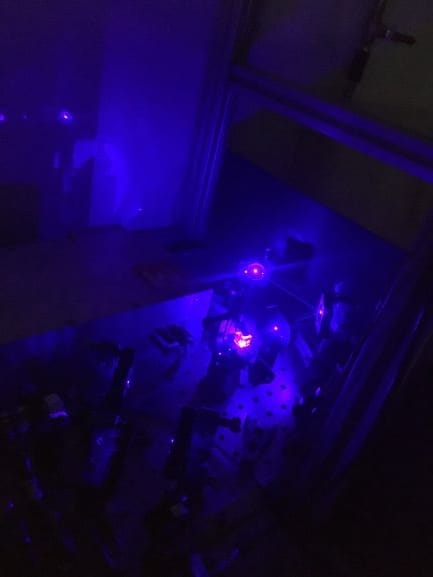
Making lasers behave As in most atomic physics experiments, the equipment in Hannah Williams’ lab requires regular attention and cannot be operated remotely. (Courtesy: Hannah Williams)
I moved to France with my partner just over five months ago, and we now live in a small flat in the centre of Paris. As an experimentalist, I usually spend most of my day in the lab, often coaxing the lasers into behaving. In my experiment, we trap individual atoms in an arbitrarily arrangeable array of optical tweezer traps. We can then excite these atoms into a Rydberg state and use the set-up to simulate quantum systems. There is no such thing as a normal day for me, as my tasks are dictated by the current state of the experiment. Over the course of a week I could be working on a laser, taking data, analysing and writing up results, or fixing machinery or other pieces of equipment. This hands-on variety is my favourite part of being a researcher.
Empty shops, empty lab
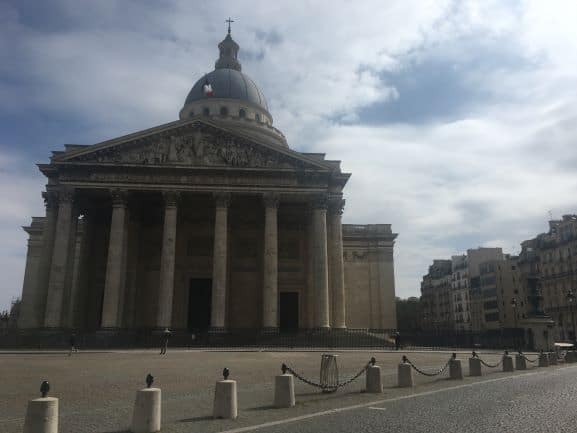
As with most people, the pandemic has had a huge impact on my daily life. The French government closed universities and research labs on 13 March, and since then it has introduced strict lockdown rules. My partner and I are expected to stay in our apartment, only leaving for food, medicine or exercise. We must remain within 1 km of our home, return within an hour and carry a note indicating the time we went out and the reason why. From my brief excursions it seems like people are adhering to these rules; the streets are empty and the shops and hotels have been boarded up, although the boulangeries remain open to provide the city with baguettes and croissants. This lockdown was initially set to last for 14 days, but it is likely to be extended.
The vast majority of my job is not amenable to working from home. Sadly, the experiment consists of many physical buttons and switches that need pressing in order to run, and it cannot be controlled remotely. Therefore, I have had to find new tasks that can be completed from the (relative) comfort of my dining table. I am currently focusing on building and running simulations of the experiment. This is a good task for me as I have wanted to do this for a while, but I find it too easy to get distracted by the goings-on in the lab.
Three mornings a week the lab has a group Skype where we discuss our work, catch up and check in on one another. Last week I also took part in a workshop that had been moved online. I had not registered for the “real-life” version, and had it not been for the global lockdown I would not have known about it. I also might never have got to experience being totally confused by a theory talk while sitting on my sofa, in my joggers.
Deserted The Pantheon in Paris is normally a major tourist destination, both in its own right and because it has an uninterrupted view of the Eiffel tower. (Courtesy: Hannah Williams)
Blue skies above, anxiety below
Staying inside my flat has not been easy, as I like being outside and walking. I usually walk for over an hour each day just to get to my lab, but my Fitbit informs me that last week I walked 50 km less than normal. To make matters worse, the weather in Paris is suddenly beautiful, with blue skies every day and temperatures warm enough to eat ice-cream in the street. However, I understand the importance of staying inside and I know that I am in a position of privilege; I am healthy, I’m still getting paid, I live with my partner and French supermarkets are being kept very well stocked. I am enjoying the extra time I have because I’m no longer commuting; I am cooking more, doing yoga (almost) every day and running three or four times a week. I am also talking more to friends and families via group Skypes and virtual pub meet-ups in which we try to avoid talking about the virus, but inevitably circle back round to it.
I miss the lab, and I miss the work I was doing. After five months in my role, I finally really understood the experiment and was very excited about the data we were taking. Some days are harder than others and remaining productive can be a challenge. I feel anxious about the health of family and friends and down about the state of the world. It is difficult to escape from the barrage of statistics and endless lists of “How to be productive at home”, “Best workouts to do in your living room” and “Top TV shows to binge watch” – none of which make for interesting or uplifting reading. This is a time of uncertainty and disruption which many of us have never faced before, with no clear end in sight. So when I feel anxiety or stress, I take a break. I don’t try to make myself work. I do something else – and above all, I get off the Internet.
Many male butterflies have exceptionally black wings with optical properties that have long-puzzled scientists. Now researchers in the US found that the wings of at least 10 species have nanoscale structures that increase light absorption and scattering that create the “ultra-black” appearance. These structures may have evolved to enhance the contrast of colour patches used in courtship displays, according to the researchers. Understanding why the wings are so dark could lead to the development of ultra-black synthetic materials.
Butterfly wings are made of scales that usually consist of two chitin layers. One layer is a smooth, flat plate. The other layer has ridges that are connected by cross ribs to form a honeycomb-like structure. The two layers are connected by pillars known as trabeculae.
It has been suggested that the size of the nanoscale holes in the honeycomb-like structure on the upper scales could be responsible for the extreme light-absorbing properties of some butterflies. But when Alex Davis at Duke University and colleagues examined the scales of 10 butterfly species that are exceptionally black, they found that that was not the case.
Extremely low directional reflectance
When the researchers shone light on specimens from museum and university collections, they found that the black scales had an extremely low directional reflectance. With the light source perpendicular to a wing’s surface, the ultra-black butterflies only reflected between 0.06 and 0.4% of light, they report in Nature Communications. In contrast, “control” butterflies that are brown or less black, had reflectance values of 1–3%.
Scanning electron microscopy on both the ultra-black and control butterflies found, however, that there was considerable variation in the shape and size of the holes in the upper wing scales – with them ranging from honeycombs and rectangles to a V-shaped pattern. The ultra-black specimens covered four different subfamilies of butterflies and there was little similarity between the hole structures. This led the researchers to conclude that hole shape or size is not linked to ultra-blackness.
Instead, Davis and colleagues found that other structures were very similar across the ultra-black specimens. The parallel ridges and trabeculae on their wing scales were much deeper and thicker than in the control butterflies, which had larger gaps between the ridges and either no or significantly reduced trabeculae.
Computer models
Next the team created computer models of different wing scales. Simulations of scales without either the ridged surface or interior pillars reflected up to 16 times more light, while those lacking both were up to 28 times more reflective.
Davis told Physics World that expanded trabeculae and ridges, the ultra-black butterflies have more surface area for absorbing and scattering light. This combined with the light absorbing pigment melanin, which is embedded in the structure, produces the low reflectance. Light enters the scales and bounces around, but very little bounces back.
This structure is so good at absorbing light that the ultra-black scales still appear black when coated with gold for scanning electron microscopy, the researchers report.
Brightly coloured areas
Ultra-black wing patches in butterflies often border brightly coloured areas. The researchers believe that the black patches have evolved to make those colours appear brighter during courtship. “Given that the males are much blacker than the females in most of these species, we suspect ultra-black scales have evolved to increase the contrast of signals used in mating,” Davies explains. “These butterflies tend to court one another in sunny areas where a typical black scale may look washed out.” Davies thinks there are probably many other ultra-black butterflies using the same structures.
Silvia Vignolini at the University of Cambridge, UK, who was not involved in the work, thinks there could be a more functional benefit to the enhanced light absorption. “They need to warm up the wings in order to fly,” she explains.
Vignolini adds that the study is interesting because it compares different butterfly species and families and shows how scale morphology can decrease reflection. She cautions, however, that while she sees no reason to doubt the results, the paper lacks detail on how the authors measured reflectance, and what they measured.
It is also not safe to assume that a single, ultrathin (2.5 μm) scale from one of these butterflies would show the same levels of reflectance, Vignolini says, as the researchers studied whole wings. “The wing is composed of more than one scale, and the scales are superimposed on top of each other,” she says. Adding that this means that “you have more scattering, because you have space between each scale”.
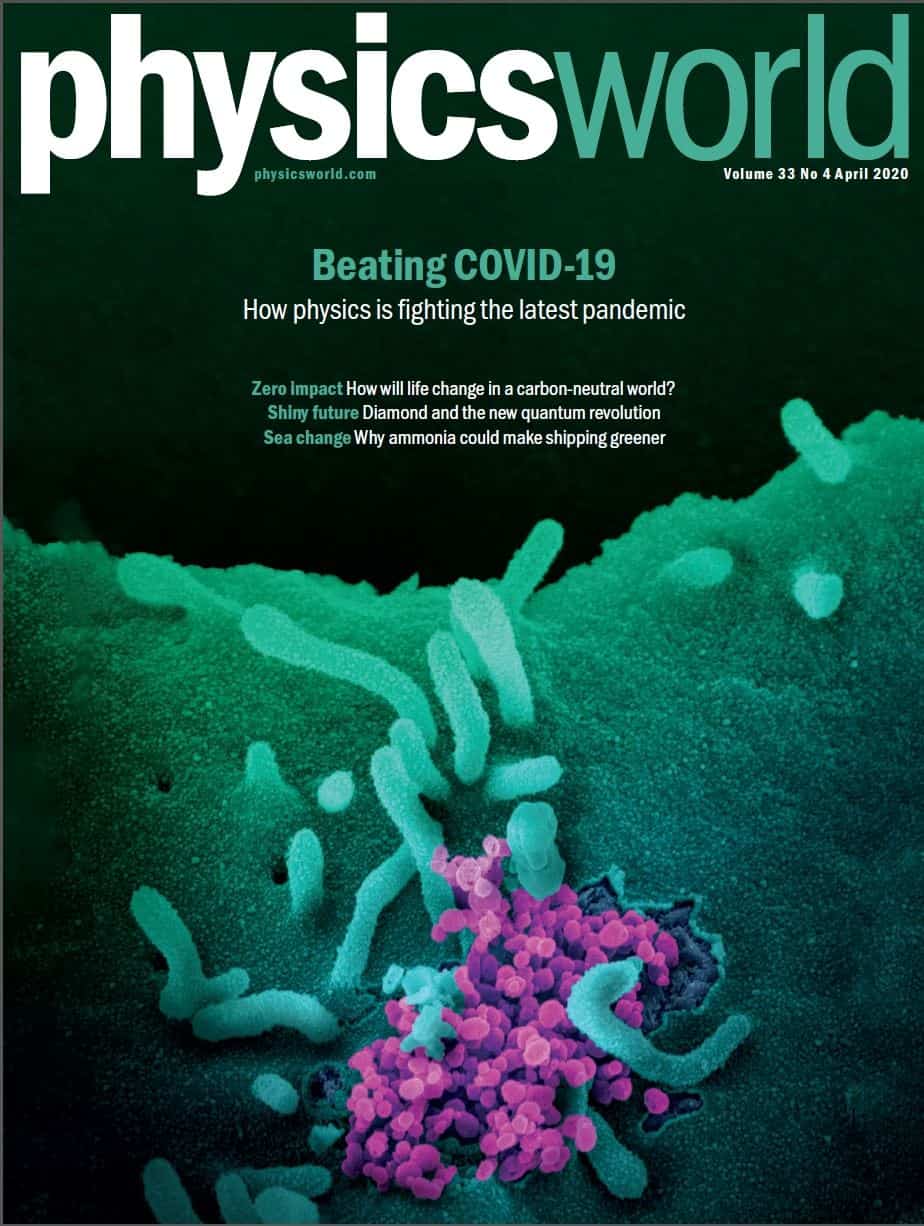
Life in the pandemic: how physics is helping us understand the virus behind COVID-19.
Like everyone else around the world, physicists have been caught up in the COVID-19 outbreak, which was declared a pandemic by the World Health Organization last month. Naturally, all of us will be concerned first and foremost for our own friends and family.
The disease is usually mild, but it can turn nasty – and with lots of people falling ill at once, there will be big pressures on medical systems around the world. It goes without saying that we should all look out for each other, especially older neighbours, colleagues and family members.
And with so many of us under lock-down, what better time to sit back with the latest issue of your favourite physics magazine, now out in print and via the Physics World digital apps for iOS, Android and Web browsers.
The cover feature is by science writer Jon Cartwright, who looks at how physics-based techniques are helping us to understand the virus behind COVID-19 – also available online here.
We’ve created a short video that summarizes the key points: bottom line, we can thank X-ray crystallography, cryo-electron microscopy and network theory for understanding the disease and how it spreads.
For the record, here’s a rundown of what else is in the issue.
• Coronavirus puts physics in turmoil – COVID-19 has hit the international physics community hard, with meetings and conferences cancelled, including the showpiece events of the American Physical Society. Matin Durrani surveys the fall-out from the global pandemic.
• Moving forward together – In the run-up to a pivotal announcement on the future of particle physics in Europe, Tessa Charles urges backers of rival colliders to unite around whichever project gets the go-ahead.
• What would you do? – Robert P Crease examines his responsibility for not exploring one physicist’s treatment of women.
• Shipping carbon-free – Air travel is bad for the environment – but shipping is not that great either. James McKenzie wonders how best to decarbonize sea travel.
• Fighting a pandemic – The latest novel coronavirus, SARS-CoV-2, has reached pandemic status. While health workers and governments do their part, scientists are trying to understand the virus and develop vaccines and treatments. Jon Cartwright looks at how physics plays an important role in the fight.
• Life in a carbon-neutral world –Increasing numbers of cities and countries around the globe are pledging to become net carbon neutral within the next few decades. But what will day-to-day life look like in a “net-zero” world? Kate Ravilious looks at the changes that society will need to make.
• The diamond quantum revolution – Diamond is more than just a pretty gem – it has many attractive properties that stretch far beyond its aesthetic appeal. Matthew Markham and Daniel Twitchen from UK firm Element Six explain how this special form of carbon now has many practical quantum applications too.
• Can a machine think? – Susan Curtis reviews The Road to Conscious Machines: the Story of AI by Michael Wooldridge.
• Duck, duck, goose? – Ian Randall reviews At the Edge of Time: Exploring the Mysteries of Our Universe’s First Seconds by Dan Hooper.
• Half a life – Jess Wade reviews the film Radioactive, a biopic about Marie Curie directed by Marjane Satrapi, screenplay by Jack Thorne.
• Going with the flow – Early-career industry physicist Aidan White tells Joe McEntee about his work as a project engineer at TÜV SÜD National Engineering Laboratory, the UK’s designated institute for flow and density measurement.
• Ask me anything – In the latest in our new series of careers-advice articles, we feature Chad Orzel, who is an associate professor in the Department of Physics and Astronomy at Union, and author of four popular-science books.
• Physics on ice – Rhett Allain uses simple Newtonian mechanics to estimate how far an ice-hockey puck could travel on a low-friction icy surface.
I suspect my experience with the outbreak of COVID-19 here in British Columbia differs little from that of millions of others. My wife and I both work at the University of Victoria, and it was relatively easy for us to shift our teaching, research and collegial interactions online. The simulated and historical data that comprise the grist of my climate research are still accessible, so that work goes on unhindered. We are both lucky in that respect, and also to have shielded our family from the tragedy thus far.
In the days before being sent home from the office, I combed the Internet for reliable sources of data on the spread and growth rate of the infection: a nightly hobby only another scientist could appreciate. One conclusion was immediate: each country’s cumulative cases closely followed an exponential curve, with only China exhibiting a flattening and subsequent decline. I downloaded the daily case totals and performed log-linear fits to the data, revealing differing growth rates across the world. And in my province, checked daily for signs of flattening. While undeniably tragic, it’s also fascinating to see a phenomenon of such staggering scope unfold in real time, dictated by simple mathematics. When my 14-year-old son’s home schooling starts next week, you can guess what applied math topic we’ll tackle first.
Once the government imposed physical distancing guidelines, a neighbour asked my opinion (“as a scientist”), and shared his own. The government measures were certainly overkill, he felt: his clients were shuttering their businesses, this was killing the economy, why are they even talking about months? I agreed it was sudden, and uncharted territory. But the exponential curve danced in my head: these were not bacteria multiplying in a dish, but sick human beings, in every corner of the world. If there is anything that would kill the economy, I opined, it’s something that forces people out of it. We agreed to disagree.
And lessons learned so far? Here on Vancouver Island, at the end of the Trans-Canada Highway and near the end of supply lines to western Canada, we are occasionally reminded that we live in an earthquake zone. There’s a better-than-even chance a megathrust quake will occur in the region during my kids’ lifetime, we’re told. The COVID-19 experience has already taught us that, even in a global crisis, people keep their heads, large populations adapt, and there is considerable resilience in the consumer supply chain. We can trust the advice proffered by government and scientists, provided it is evidence-based. And when we encounter those who may be more sceptical, as scientists we can share our perspectives on the natural laws that no amount of wishful thinking can supersede.
When Physics World learned that an Australian astrophysicist had tried to invent a device to keep people from touching their faces during the coronavirus pandemic, only to wind up in hospital with four neodymium magnets stuck up his nose, our first thought was, “Is it April Fool’s Day in Australia already?”
Our second thought, though, was, “Yeah, that sounds like something a physicist would do.”
We write a lot about physicists. We’re regularly amazed and humbled by the creativity and cleverness they show in the face of daunting scientific challenges. But we also know that physicists have a rare talent for making absolute arses of themselves – and we have a giant red folder full of stories to prove it.
So this year, in lieu of an April Fool (and to reassure the above-mentioned Aussie, Daniel Reardon, that getting magnets stuck up your nose during a pandemic is not, in fact, the dumbest thing a physicist has ever done – although it’s close), we present five additional astonishing displays of idiocy by otherwise highly intelligent people. All are drawn from the Physics World archives and compiled by our emergency otolaryngology correspondent Ken Heartley-Wright, who is currently self-isolating at his country home in Borsetshire. Enjoy!
That’s not (n)ice
Like Reardon, Muhammad “Moe” Qureshi made a fool of himself while attempting to aid the battle against a terrible illness. In the “ice bucket challenge” of 2014, celebrities, politicians and ordinary folk lined up to pour buckets of ice over their heads to raise money for research on motor neurone disease. The late physicist Stephen Hawking, who lived with the condition for more than 50 years, was among the participants.
But Qureshi, who was then a nanotechnologist at the University of Toronto in Canada, decided to go one better than Hawking et al. “Instead of using ice water, we’re going to be using liquid nitrogen,” he announced to the camera as a collaborator filmed his don’t-try-this-at-home stunt. “This is extremely dangerous and not safe, but we’re going to do it anyway.” A few seconds later, the video shows Qureshi pouring a substantial quantity of steaming liquid nitrogen over his head.
Unlike Reardon, Qureshi did not require hospital treatment. However, the footage of him dancing around yelling “Oh my gosh, that’s cold!” while frantically trying to remove the 77 K liquid from his hair, T-shirt and shorts should nevertheless give would-be imitators pause.
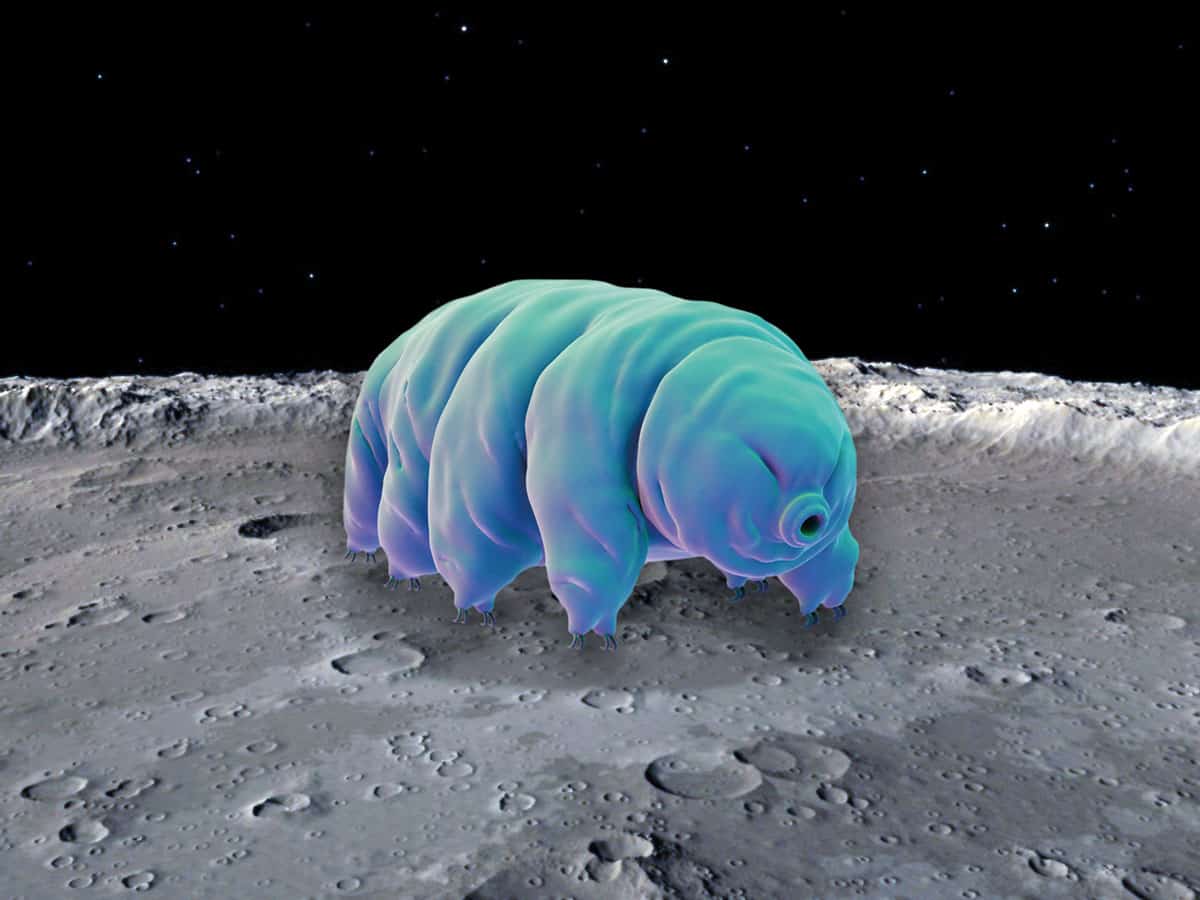
Scientists have long wondered whether life exists outside the Earth. In April 2019, an Israeli space mission may have answered that question by accidentally populating the Moon with tardigrades. These creatures, also known as water bears, can survive in some of Earth’s most extreme environments, and they were flown to the Moon aboard the Beresheet spacecraft. During the landing process, however, a malfunction caused the craft’s engines to shut down, and it crashed to the lunar surface.
Beresheet’s crew of 10,000 tardigrades were shipped to the Moon in a dehydrated state, with a dramatically reduced metabolism. Tardigrades are, however, known to endure incredibly harsh conditions – including the vacuum of space. If they survived the crash, a little water might be enough to resurrect them. It’s a long shot, of course: tardigrades have poor tolerance to solar UV radiation, and the Moon (like some supermarkets during the current pandemic) has a distinct shortage of liquid water or food. But now we’ll always be wondering.
Legal troubles, part 1
In medieval and ancient times, alchemists sought to turn base metal into gold. In the late 2000s, Iain Fielden, a physicist at Sheffield Hallam University in the UK, managed to do the opposite by turning a £60 speeding ticket into court costs exceeding £20,000.
The affair began in mid-2006, when a speed camera clocked Fielden’s wife Vikki driving around a curved street in Huddersfield at 36 mph in a 30 mph zone. Fielden, who was sitting in the passenger seat at the time, insisted she was driving at 31±3 mph. He chose to fight the ticket because, he claimed, the speed camera was situated on a curve and would only work correctly for vehicles travelling in a straight line.
So far, so reasonable. But Fielden’s efforts quickly took on the character of a crusade. After a magistrate’s court handed down the £60 fine in 2007, he, his wife and two witnesses set out in the dead of night to measure the curvature of the road using a tape measure, rope and a laser. The results showed that the radius of the road was about 600 m – half the minimum value permitted in the camera manufacturer’s guidelines.
Fielden duly challenged the magistrate court’s ruling on the basis that the police were not using the radar in line with the guidelines. But despite spending 1000 hours researching the case (and, at one point, impersonating a lawyer for the Crown Prosecution Service during a phone conversation with a witness) he lost his appeal at Bradford Crown Court – one reason being that the limit of 1200 m for the curvature was, it seems, arbitrary.
By this time, Fielden’s legal costs had reached £15,000 – an amount he said would lead to “bankruptcy, probably”. But he didn’t stop there. Instead, he pursued the matter to the High Court, where, in mid-2009, one of the judges described the suit as “doomed to fail”, dismissed it and denied Fielden a further chance to appeal. This result cost him a further £5000 in legal fees. At that point, Fielden vowed to take his case to the European Court of Human Rights. While Physics World can find no record of his having done so, the protracted battle doesn’t seem to have diminished his interest in the law: he is now part of an expert witness programme at Sheffield Hallam’s Materials and Engineering Research Institute.
Legal troubles, part 2
Fielden’s problems with the law pale in comparison with those of Paul Frampton. A British-born theorist, Frampton made a name for himself within the field of particle physics. By 2012 he was a respected but decidedly un-famous professor at the University of North Carolina in the US.
All that changed when, at the age of 71, Frampton travelled to Bolivia in hopes of meeting the Czech-born lingerie model Denise Milani, with whom he had supposedly been corresponding over the Internet. When he arrived, Milani was nowhere to be seen, but someone did turn up with a request that he carry “her” suitcase to Buenos Aires, Argentina. This he duly did – only for airport officials to find 2 kg of cocaine tucked into its lining.
Exactly how much Frampton knew about this is a vexed question. While he has always maintained his innocence, text messages sent from him to “Milani” (in reality, a fraudster whose identity remains unknown) suggest that he may have been less naïve than he claims. According to a 2013 New York Times article, the texts included comments such as “This stuff is worth nothing in Bolivia, but millions in Europe” and “Monday arrival changed. You must not tell the coca-goons.”
At his trial, Frampton claimed the messages were “jokes”; later, he hired a forensic linguist to try to prove he hadn’t written them. Neither strategy did him much good. He was sentenced to 56 months in a Buenos Aires jail, and his former employer refused to reinstate him. Still, his experiences may yet have a silver lining of sorts. In 2013, Fox Searchlight asked officials from the US film-production company Film Rites to make a film based on his life. We can only assume that the pandemic must have held up production.
Acid attack
And finally, in our roll-call of dumbest things ever in physics, Physics World is delighted to bring you this cautionary tale of Irish physicist Kevin McGuigan during his time as a PhD student.
Seeking to dope some silicon ingots with copper, McGuigan decided to melt a glass tube containing his ingredients by heating them in a furnace at 1000 °C using an “oxygen-hydrogen welding station” in the corner of his lab. Upon opening the main valves to the gas cylinders, McGuigan noticed an ominous hissing noise that he wanted to “sort out” with a “small twist” of his spanner.
Cack-handed: a warning to all would-be Kevin McGuigans
Aware that hydrogen is dangerously flammable, McGuigan “panicked” and began turning the fittings on the cylinder “the wrong way”. The regulator refused to budge, prompting McGuigan to increase his “purchase” on the bottle, by wrapping his legs around the base “in an attempt to stop it spinning”.
Then, just as McGuigan was having visions of a Hindenburg-style disaster, his supervisor walked in. Upon seeing him wrapped around the hydrogen cylinder “wrestling with the regulator like a demented, pole-dancing plumber”, his boss calmly closed the cylinder’s main valve.
A nightmare was averted, but McGuigan’s day was about to take a turn for the worse.
After doping his samples, McGuigan placed them in a beaker of concentrated hydrochloric acid. While attempting to dissolve “the final traces of copper from the ingots”, he held the beaker up to the light “as you would with a fine wine”. Finally, he tried to inspect the samples’ surfaces by giving the beaker, as you do, “a good slosh”.
As luck would have it, the acid sloshed right out of the beaker and onto his groin. McGuigan jumped up, unbuckled his belt and trousers, and thrust them down by his ankles. Noticing the acid making its way onto his boxer shorts, he yanked them down too before “speed-shuffling over to a metal sink” and vigorously dousing his nether regions in water.
It was then that McGuigan’s supervisor, the head of department and a visiting female professor walked in – on an impromptu tour of the lab.
Although McGuigan was unscathed “apart from what looked like a pubic perm gone wrong”, his supervisor and the department head agreed that henceforth, McGuigan’s “theoretical and modelling skills should be enthusiastically encouraged”.
Most of the time science appears in the media – including in this podcast – the focus is on the scientific results. Rightly so, as scientific research consistently delivers inspiring breakthroughs. But this type of coverage can present an idealized version of science. Researchers are presented as dispassionate beings working together seamlessly to uncover the common truths of their discipline.
In reality, scientists are people with a range of personalities and backgrounds, displaying all the usual human traits – the good and the bad. In this episode of the Physics World Stories podcast, Andrew Glester meets a selection of successful researchers to discover what it is really like to carve out a career in physics. What motivates them? What are the big challenges lying ahead for early-career researchers? What are the rules they play by?
For more information and advice on this topic, see the 2020 edition of Physics World Careers. In the March issue of Physics World magazine, we also launched our new “Ask me anything” interview series, providing careers advice for physics graduates. Physics World’s Tushna Commissariat asks 10 of today’s top physicists three questions to find out about their roles and what they wish they knew when they started their careers.
Some of the ice on Mercury is created by chemical reactions triggered by the planet’s extreme daytime heat according to Brant Jones and Thomas Orlando at the Georgia Institute of Technology and NASA’s Menelaos Sarantos. The trio discovered the process by modelling the chemistry that unfolds as the solar wind impacts the planet’s surface. Their discovery could explain the presence of up to 10% of Mercury’s total water ice, and also provide new insights into how water could be created on the Moon.
Despite its daytime temperatures reaching as high as 400 °C, Mercury is known to host vast quantities of frozen water in the deep, permanently shadowed craters close to its poles. First discovered by Earth-based radar systems, this ice has now been precisely mapped by NASA’s MESSENGER spacecraft, which has been in orbit around Mercury since 2011. Astronomers believe that most of this water was delivered by impacting asteroids and comets. They also think the ice has remained trapped for millions of years in shady areas where temperatures remain permanently below -200 °C.
In this latest study, Jones, Orlando and Sarantos describe how protons in the solar wind may also be creating water on the planet. The trio developed a model that suggests that the protons can penetrate to depths of up to 15 nm into Mercury’s surface soil. There, the protons react with metal oxides to form hydroxyl (OH) groups. In Mercury’s extreme daytime heat, these groups can react with each other to form gaseous water, along with molecular hydrogen.
Exospheric journey
The trio then simulated how water behaves in Mercury’s exosphere – the planet retains no atmosphere but is surrounded by an exosphere of atoms and molecules kicked up from the surface. Water in the exosphere is transported across the planet through a variety of mechanisms. Some of these molecules rise far above the surface, while others are split into fragments.
However, the simulation revealed that some water does become trapped in the chilly polar craters, which occupy around 1% of Mercury’s total surface area. The trio predict that this process could account for around 10% of Mercury’s frozen water.
The result could shed new light on the differences between the ice-forming mechanisms found on Mercury, and those of other airless bodies like the Moon. The Moon has far cooler temperatures than Mercury, so the solar wind is far less likely to produce hydroxyl groups. This would explain why water ice does not appear to be nearly as abundant in the Moon’s craters as in Mercury’s. Instead, the trio hopes that their findings could lead to the development of new techniques for fabricating water on the Moon – which could be crucial for future space missions.
A new type of quantum memory that could extend the range of quantum encryption systems has been unveiled by physicists at Harvard University in the US. It offers a secure way of allowing an intermediate to assist in the transmission of quantum information and could lead to the more widespread use of quantum key distribution (QKD) cryptography.
Using QKD, two people (Alice and Bob) rely on quantum mechanics to exchange information secretly. Alice sends Bob a series of quantum bits (qubits) encoded into the polarization states of single photons (or weak coherent light pulses). By carrying out a series of measurements and communications over an insecure link, Alice and Bob generate an encryption key that they can use to send secret messages over an insecure link. Crucially, if an eavesdropper (Eve) intercepts and measures the quantum bits, Alice and Bob are alerted thanks to the laws of quantum mechanics.
Although some commercial QKD systems are in use, sending single-photon qubits over long distances in optical fibres is a significant technical challenge. The current record for QKD over a commercial telecom link (rather than a dedicated link) is 50 km.
“Photons get lost”
“At its core, the reason we don’t have a quantum internet right now is that photons get lost,” explains team member Bart Machielse: “Photons are scattered out of fibres, photons are absorbed, and as the links get longer the communication rate goes down.” Incorporating multiple photons into each pulse would remove the absolute security, as Eve could measure one photon without disturbing the others.
One possibility is to incorporate a third party (Charlie) between Alice and Bob to measure the states of the photons they exchange. However, if the security is to remain absolute, Charlie cannot simply measure the state of a photon from one party and compare it to the next photon he receives from the other, as he may not be trustworthy himself.
Here, too, quantum mechanics offers a solution: Charlie compares the polarizations without knowing their individual values. “Charlie does measurements on both photons and says ‘These are the same’ or ‘These are different’,” explains Machielse, “Alice and Bob say ‘I know what photon I sent’ and ‘Charlie tells me our photons are the same or different’.” This preserves the security of the communication even over an insecure link.
Simultaneous measurements
One problem with current technologies is that to make a secure comparison, Charlie must receive the photons simultaneously from Alice and Bob – which happens rarely. Researchers have therefore tried to develop a quantum memory that allows Charlie to store the quantum state of a photon he receives without measuring it. “People have used memories ranging from trapped atoms and ions, quantum dots, different defects in diamonds, you name it,” says Machielse. None of these, however, have actually improved over what can be achieved by direct photon exchange.
In the new research, Machielse and colleagues created a memory using a silicon vacancy centre (Si-V) in a diamond. A Si-V is a defect formed when two carbon atoms in the diamond lattice are replaced by one silicon atom. This creates a quantum spin that is isolated from the environment and can be measured using laser light and microwave pulses.
The team placed their Si-V inside a nanophotonic cavity held at ultracold temperatures. The spin of the Si-V can be flipped by absorbing a 737 nm wavelength photon. If the spin state of the Si-V does not change after absorbing two photons, Charlie knows that the two photons had the same polarization as each other. If the state has been flipped, the polarizations must have been opposite. Crucially, however, Charlie does not know the polarization of either photon.
Another key feature of this implementation is that the photons from Alice and Bob do not have to arrive simultaneously at the Si-V. Instead, the Si-V stores the polarization of the first photon until the arrival of the second.
The Si-V-based quantum memory achieves both very strong and very reliable spin-photon interaction. “With a lot of the other memories, either not every photon that arrives is stored, or an error happens in the storage process and the information is essentially useless,” explains team member Ralf Riedinger, “We achieved low enough error rates that, even after correcting for the errors, we still achieved faster communication than anything possible with a direct communication link.”
The researchers describe their work in Nature. Sophia Economou of Virginia Tech in the US says “This is a very significant paper: I would call it a milestone in the field of quantum networks”. She believes the work opens up “several future directions” such as transferring information from the electronic spins of the Si-V centres to the more stable nuclear spins of the surrounding carbon-13 isotopes in the diamond: “Achieving this would allow storage of information for longer periods of time, boosting performance of the protocol and opening more opportunities for quantum networks,” she says.
When one bad apple rots the bunch, it’s ethylene’s fault. Not only does this “universal plant hormone” trigger germination, flowering, ripening and rotting in seeds, flowers, fruit and vegetables, it’s also released during these processes, ensuring that a small problem quickly escalates. Ethylene is social media for plants, allowing them to communicate and synchronize – and it’s something the food and flowers industries would love to detect early, so they can forecast which products to sell first, and how to spot rot before it spreads.
The problem? “There really isn’t a good industrial sensor out there,” says Timothy Swager, a materials chemist at the Massachusetts Institute of Technology (MIT) in the US. Now, however, Swager, Darryl Fong and colleagues at MIT and the Nanotechnology National Laboratory for Agriculture in Brazil have combined the sensitivity of carbon nanotubes (CNTs) with a highly selective catalyst to produce a sensor that can detect ethylene at concentrations of as little as 15 parts per billion.
CNT sensing
Previous approaches to ethylene sensing have typically either been based on photoacoustic spectroscopy (which detects sounds produced in response to light) or on gas chromatography (which separates chemicals based on their different retention times in solvents). Neither technique is easy or simple enough for a grocer or florist to incorporate it into their work. Instead, Swager and colleagues looked at the reactions ethylene readily undergoes and focused on finding ways of detecting when such a reaction had taken place.
This is where the CNTs come in. Single-walled CNTs have several attributes that make them well-suited for sensing processes that involve the transfer of electrons – the basis of any chemical reaction. The CNTs Fong and Swager and their colleagues worked with are p-type semiconductors, so n-type dopants – anything that donates electrons to the CNT – will diminish their conductivity. The CNTs’ curved graphene surface also makes their electronic properties incredibly sensitive to dopants in their environment.
This may sound ideal for a sensor, but you can have too much of a good thing. “There’s a graveyard of CNT sensors with low specificity,” Swager tells Physics World. Because the CNTs are so sensitive to everything in the environment, he explains, all you detect is white noise. “You need a way of boosting the signal above the noise,” he adds.
Wacker reaction chemistry
Building on their expertise in analytic and synthetic chemistry as well as CNT technology, Swager and colleagues identified the so-called Wacker reaction as having both the specificity and sensitivity they needed. In this reaction, which was developed as a synthetic process in the 1950s, ethylene – a hydrocarbon containing two double-bonded carbon atoms – oxidizes into acetaldehyde. This chemical is perhaps best known as the primary cause of hangover-related headaches, although the researchers note that the test they developed does not produce it in high concentrations.
The Wacker reaction is not the only reaction ethylene undergoes, and it was not the first port of call for Swager and his group. First, they tried to mimic the plants themselves, which use copper ions to promote ethylene activity. However, trying to make a sensor out of copper proved almost as headache-inducing as acetaldehyde. Plants have a natural ability to keep copper in its Cu(I) oxidation state, which has one fewer electron than the material would have as a neutral atom. Ethylene readily binds to copper in this oxidation state, triggering a cascade of plant activity and ultimately the up-regulation of certain genes. However, in a synthetic device, copper tends to exist in the Cu(II) oxidation state, and preventing Cu(I) from oxidizing to Cu(II) proved too difficult for this approach to have commercial potential.
In the Wacker reaction, in contrast, ethylene oxidation is catalysed by palladium in the Pd(II) state. This is far more stable than Cu(I). Although palladium can catalyse other reactions as well, the palladium in the Wacker reaction is in an organic complex optimized to catalyse ethylene oxidation. The reaction also relies on a nitrite source, which contributes to the organic complex. The resulting ethylene reaction surrenders electrons that reduce Pd(II) to the n-dopant Pd(0), which the highly sensitive CNTs should announce with a dip in conductivity from the excess electrons.
Budding commercial potential
The researchers tested their proposed mechanism by replacing the CNTs with ZnO nanofibers, which are n-type semiconductors. This test showed that, as expected, the material’s conductivity increased in response to the Pd(0) produced in the presence of ethylene and the Wacker reaction Pd(II) catalyst. Next, they optimized their CNT-based sensor and used it to detect ethylene production from carnations (which, in their experiment, all burst into bloom on the same day) and purple lisianthus (which bloomed over the course of a week). They found that the ethylene they detected reflected these different blooming times.
The process is now licensed by a company that Swager co-founded, but some hurdles remain before the sensor is available commercially. “We could industrialize these sensors in a matter of months, but how long before it is commercialized is something the business world will control,” Swager says.
The shutting down of my department was a surprisingly difficult day. The Imperial College chemistry department made the decision to shut on 16 March, when the first social distancing measures in the UK were announced, and I was not prepared for the emotional toll it would take on me. I’m in the last year of my PhD and was preparing to focus on a difficult year of work. Instead, I found myself putting away all my experiments and taping shut our freezers.
We’d all talking about it; we even had an informal bet on when the college would finally shut. Everyone had been on edge for a couple of weeks, and no-one could talk of anything else. I’m grateful that we shut down in the end though. Social distancing in London is very difficult and, as anyone who has been on the tube will know, sometimes it’s just impossible.
So now I’m at home writing my thesis. I have my desk set up by my window and a routine established. At least that’s what I’m supposed to be doing. My brain hasn’t quite worked out a way to stop worrying enough to work properly. I’m trying to be kind to myself; scientists don’t live in a vacuum and the state of the world will affect our work. Trying to adjust to the massive changes we’ve all experienced in the past month is no small task.
As an experimental scientist, all my work is lab based. Like many around the world, I’m faced with the uncertainty of not knowing when I’ll be able to get my next results. I have an ever-expanding list of experiments that I want to do when I can return to the lab. In the meantime, like many other scientists, I’m going to try to learn all these computational and programming techniques that have been passing me by for years. Prepare for some very mediocre modelling!
Whilst I was trying to settle into the new rhythm, one of my flatmates developed symptoms. Which means that now we’re self-isolating as well. This has added an extra layer of worry, as I’m constantly concerned about her health and waiting to see if I get it. Hearing her coughing from my room, I’m continuously reminded how serious this crisis is.
One of the positives I’ve managed to find though, is that my research group has banded together. Everyone has been checking in on each other and putting online coffee sessions and Friday drinks in the calendar. We had our first virtual group meeting and I was struck by how much it started to make me feel normal again. Through all of this I’ve been overwhelmed by the amount that people are reaching out and making connections. It’s these interactions that are becoming my inspiration, lifting my spirits enough to be able to put pen to paper.