How does brain motion impact microbeam radiation therapy?

Microbeam radiation therapy (MRT) is an emerging preclinical modality that could one day become a preferred treatment for inoperable brain tumours, due to the reduced impact of microbeams on healthy surrounding tissues. However, the effectiveness of the treatment could be compromised by the effect of brain motion on the precise delivery of radiation dose.

Researchers from Australia and France have conducted a study to assess this possibility using a dosimeter based on a novel single silicon strip detector (SSSD). They determined that the radiobiological effectiveness of MRT dose distribution could indeed be impacted by brain motion (Med. Phys. 10.1002/mp.13899).

The brain is known to exhibit cardio-synchronous pulsating motion, due to expansion and contraction triggered when an arterial pulse travels into the cerebrovascular system. This motion has an amplitude of 100–200 μm, comparable to the microbeam width and spacing, potentially resulting in dose blurring due to microbeam displacement and overlap.

The underlying radiobiological advantage of MRT relies on high peak doses and low valley doses – or a high peak-to-valley dose ratio (PVDR). If microbeams overlap, this can reduce the PVDR and affect the efficacy of the MRT. Building upon prior research, which found that PVDR decreases and full-width at half-maximum (FWHM) of the peaks increases as a function of brain motion amplitude, the researchers conducted the first experimental measurement of microbeam profiles under simulated brain motion.

A team at the Centre for Medical Radiation Physics (CMRP) at the University of Wollongong utilized a real-time dosimetry system that they developed for MRT, based on a SSSD with a spatial resolution of approximately 10 μm. This was placed in a water-equivalent phantom and scanned through the microbeam distribution. The sample positioning stage reproduced brain motion at vertical scan speeds of 5, 10 and 20 mm/s.

The researchers carried out measurements at the ID17 Biomedical Beamline at the European Synchrotron Radiation Facility (ESRF) in France. They employed microbeams with a width of 50 μm and centre-to-centre peak distance of 400 μm, using a tungsten carbide multislit collimator to spatially fractionate the incoming beam.

Mitchell Duncan, a PhD student at CMRP and his principal supervisor Marco Petasecca chose three positions within the dose distribution that corresponded to regions largely, moderately or minimally affected by motion. They reconstructed dose profiles from the SSSD for each scan speed and at each line. They determined that brain motion introduced large disturbances in the dose profile, particularly at low scan speed. At scan speeds of 5 and 10 mm/s, they saw a decrease in total dose delivered, with distorted and broadened distribution.
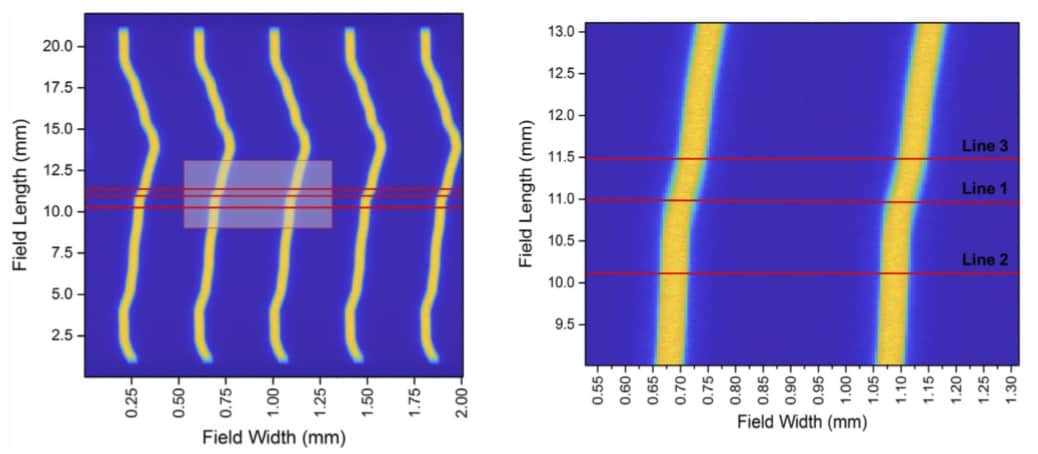
Lines of motion

“When brain motion is applied, the SSSD shows a 150–200% increase in FWHM of profiles and a 50% reduction in PVDR,” the researchers write. “Motion-induced misalignment and distortion of microbeams at treatment delivery will result in a reduced PVDR and increased irradiation of additional healthy tissue, potentially compromising the radiobiological effectiveness of MRT.” They note that at a higher scan speed of 20 mm/s, this effect was drastically reduced, with minimal impact on PVDR and FWHM of the microbeams.
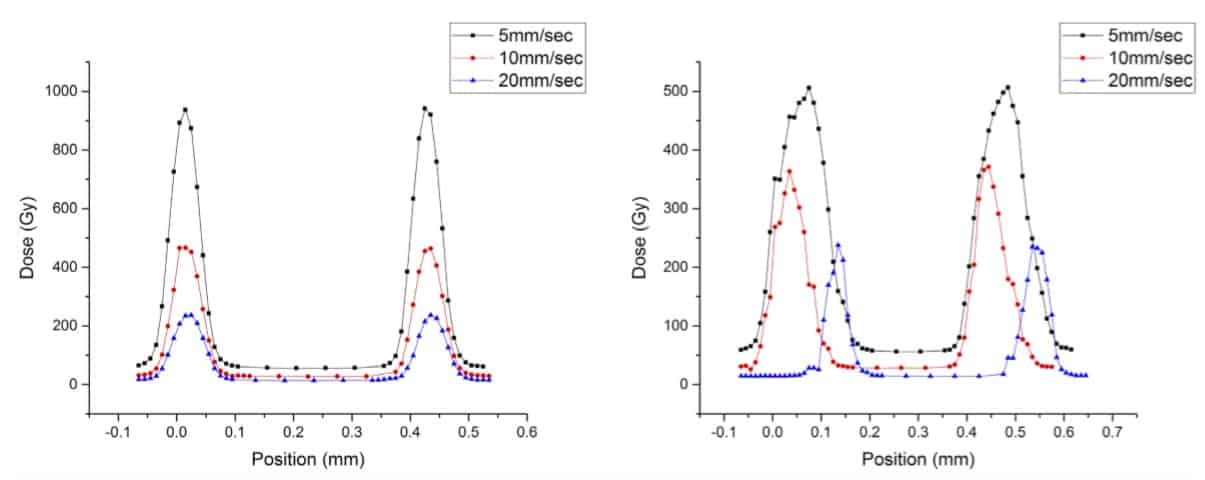
Dose profiles

“At the Centre for Medical Radiation Physics, we are mainly dedicated to developing innovative radiation dosimetry sensors and instrumentation for radiotherapy,” says Petasecca. “Microbeam radiation therapy is a particularly challenging radiotherapy modality because it requires dedicated detectors to perform accurate dosimetry of the thin (50 μm width) blades of light spaced by only 400 μm.”

Petasecca explains that his group is studying a new organic semiconducting material for dosimetry. “We are conducting this research because although the SSSD is a very effective and accurate device for MRT dosimetry, its substrate is silicon,” he says. “This is a limitation because the energy deposited in silicon is different from tissue-equivalent materials such as water, particularly in the energy spectrum adopted in MRT.”

“The new organic semiconducting material has the same density as water and has no perturbation of the beam with respect to human soft tissues. We are working to optimize the composition and geometrical structure of this new sensor, to maximize its performance as a dosimeter and bring this game changing technology to the service of the radiotherapy medical industry,” Petasecca tells Physics World.

Towards a sustainable future

“The country that harnesses the power of clean, renewable energy will lead the 21st century.” So said former US President Barack Obama in 2009. At the time, renewables such as wind and solar power were just getting off the ground with around 160 GW of wind capacity and just 21 GW of solar photo-voltaics (PV solar) in place worldwide.

Since then, the costs of renewables have fallen dramatically – by 76% in the case of PV solar. The boom has been aided by concerns about the impact of climate change as well as by rampant air pollution, particularly in some Asian cities. And the costs continue to fall. Indeed, they are now the cheapest power option in most places.

Global renewable energy capacity hit 2351 GW by the end of 2018, accounting for a third of the world’s total power capacity and supplying over 26% of global power. In the UK, the overall share of renewables in power generation has increased to over 33% – a figure that is set to rise as new offshore wind projects come online. The share of renewables in Portugal is over 54% while in Denmark it is near 60% and Sweden has reached 66%. Interestingly, renewable energy accounted for 70% of electricity production in Scotland in 2017.

The Norwegian energy firm DNG-GL forecasts an 80% share of power generation by 2050 for renewables, while the International Renewable Energy Agency (IRENA) says it could be more like 86%. That may be too much for some countries, however, as the ongoing energy transition means a host of political and economic issues.

As ever, there are doubters who say the whole renewable agenda is ill-conceived and that renewables cannot deliver on the scale and pace necessary to cut emissions. Part of the problem is that, in some locations, energy demand is rising and so is -fossil energy use. This leads to a lowering of the renewable share percentage, followed by a rise in emissions, which is likely to get worse unless urgent action is taken. Despite the potential, the short-term prognosis does not look too good. Renewable investment levels have recently reduced and annual capacity expansion has stalled.

This is partly because costs are decreasing and the profit margins on new projects are falling. It is possible to get more output and better returns from less money. Competition has also led to a “race to the bottom”, also known as the “market-cannibalization” effect whereby only the cheapest projects are funded.

Globally – in capacity and investment terms – China is the clear leader in renewables with over 720 GW. But faced with delays in matching its power-grid expansion to its renewables expansion, China has reduced its rate of investment in renewables. Yet the global slowdown seems unlikely to affect the overall cumulative global expansion process. Indeed, the International Energy Agency (IEA) forecasts that the share of renewables in global power generation will rise from 26% today to 30% by 2024. Global renewable power capacity could grow by 50% between 2019 and 2024 – an increase of 1200 GW – but even this might not be fast enough to meet climate change goals.

The IEA says we therefore need to go faster both with renewable and, crucially, with energy saving and demand reduction. Demand for electricity has actually fallen in recent years in 18 out of 30 IEA member countries. However, demand for other types of energy is rising, especially for transportation. But if this is decarbonized by switching to electric vehicles, for example, electric power demand may start rising again.

Some are still optimistic for the future of renewables. IRENA states that renewables could be able to supply 50% of all global energy – not just electricity – by 2050. Studies in the US, Germany and elsewhere even claim that renewables could supply 100% of all global energy by 2050. That may be technically possible and even economically attractive, but it would certainly require new investment in hardware and back-up systems, and in new technology for both.

The IEA notes that R&D on renewables has expanded significantly in recent years and is now roughly similar to nuclear. Overall, global investment in clean-energy technology has been running at $300bn or more per year in recent years while that for nuclear fell to a new low of $17bn last year. Nuclear is not zero carbon and it seems to have stalled or declined in many places.

However, we need more carbon-free energy investment – and fast. One way to raise more money for accelerating renewables is by carbon taxes and the creation of a global carbon market. But this might not be enough and we may need a more radical energy and economic transition – one that includes implementing new economic models and patterns of energy use.

The longer-term benefits of renewables are substantial, not least helping to avoid the ever-increasing social, environmental and economic costs of fossil fuel. Given the political will and continued technological development, including energy storage, grid balancing and demand-management systems, I believe that renewables can help us all move to a sustainable energy future.

Climate change contributing to increase in extreme weather events, says expert report

Extreme weather events such as heatwaves, droughts and heavy rainfall are becoming increasingly likely to occur because of human-caused climate change. That is a conclusion of a report by climate experts that was released recently at the annual meeting of the American Geophysical Union in San Francisco.

Explaining extreme events from a climate perspective” is the eighth report in an annual series published by the Bulletin of the American Meteorological Society (BAMS). Comprising 21 peer-reviewed studies of extreme weather around the world in 2018, the report is based on the research of 121 scientists in 13 countries.

Since the first report in 2011, BAMS editor-in-chief Jeff Rosenfeld says, “it feels like a century, in terms of how the science has changed.” The papers are now are much more adventurous and look to the future as much as to the past. We study extremes, he said, “because they are the way we experience climate.” This year’s paper covers not only temperature extremes, but floods, hailstorms, wildfires, rainfall, drought, and other phenomena.

Stephanie Herring of the US National Oceanic and Atmospheric Administration (NOAA), the lead editor of the series, notes that the report did not attempt to be comprehensive and that some areas of the world, including South America,  Africa, and the oceans are undersampled. That said, over the eight years of reports, 168 extreme events have been studied, representing 29 event types. Of those, around 73% involved a role for climate change, while around 27% did not. Over just the past two years, however, around 95% of the events studied involved human-caused climate change.

Statistical approach

The most common events studied over the eight years, Herring says, were temperature (50 studies) and precipitation or its lack (37 studies).  Only in 2016 were scientists able to conclude for the first time that several events were not possible without human influence on climate.  No events quite made that list for 2018.  The way attributions are made, said Herring, draws on the statistical approach of epidemiologists who compare, for example, lung cancer levels in a group of smokers with that in a similar group of nonsmokers, to determine the increased risk attributable to smoking.

With regard to climate, we have the observable record of, for example, rainfall in a certain region over a certain period of time. But, Herring says, we have no “planet B” to use as a control study. Therefore, a modelled planet B is created, with atmospheric data based on 1850, prior to the start of the industrial revolution. By comparing observed inputs for our real planet with simulated inputs for planet B, scientists come up with a fraction of attributable risk, the likelihood that the event was contributed to by anthropogenic climate change.

The reason that more and more papers in the annual reports are finding a role for climate change could be that scientists now have improved observational tools and models, allowing them to better detect the signal in the noise, Herring says. But, also, it may be that the role of climate change has become a more significant driver of events in recent years.

The tempestuous genius of Fritz Zwicky

Fritz Zwicky

“I have read every paper you ever wrote, I have listened to every presentation you have ever given, and I can tell you quite categorically that I have never found a single original idea that you could honestly call your own.” That’s what Swiss physicist Fritz Zwicky once said when he was just 32, to Nobel laureate Robert Millikan. Despite the fact that Zwicky was yet to establish his scientific reputation at the time, Millikan – who was the head of Zwicky’s laboratory at the California Institute of Technology (Caltech) – simply responded: “All right, how about you?”

“I have an original idea every two years,” replied Zwicky. “I’ll go further: you name the subject, I’ll come up with the new idea.” “All right young man,” said Millikan. “Astrophysics.”

Three years later, at a dramatic meeting in Stanford University in 1933, Zwicky, along with the astronomer Walter Baade from the Mount Wilson Observatory, proposed the supernova – a phenomenon first observed by Chinese astronomers in 185 AD – as a new category of astronomical object. When a supernova flares up, they suggested, it “represents the transition of an ordinary star into a neutron star, consisting mainly of neutrons” (a particle that had been identified just one year earlier). It also becomes the source of the then-mysterious cosmic radiation detected on earth.

For decades, this theory was controversial, until neutron stars were detected in the form of pulsars in 1967 by Antony Hewish and Jocelyn Bell. In his 1994 book Black Holes and Time Warps: Einstein’s Outrageous Legacy, Caltech’s Kip Thorne described the Baade/Zwicky Stanford presentation and their subsequent five-page research paper, “Cosmic rays from super-novae” (PNAS 20 259) as “one of the most prescient documents in the history of physics and astronomy”. It was essentially the birth of high-energy astrophysics.

Zwicky used to recount this story about Millikan often, writes John Johnson Jr, a prize-winning science journalist formerly with the Los Angeles Times, in his new book Zwicky: the Outcast Genius Who Unmasked the Universe, a detailed and insightful biography. The story certainly captures both the way in which Zwicky liked to see himself and the way in which some leading physicists responded to him. Others, however, took offence and did their best to ignore the astronomer, both during his lifetime and afterwards – one of the reasons why he is largely forgotten today. Indeed, Johnson’s book is the first biography to be written in English since the astronomer’s death aged 75 in 1974.

Zwicky had a preternatural ability to welcome opposition as proof that he was on the right track

Zwicky had a “preternatural ability to welcome opposition as proof that he was on the right track”, writes Johnson in an excellent introductory chapter. “It was a characteristic that would underpin all the accomplishments of his working life, one that would bring him both honour and calumny,” the author writes. “It lay behind his prediction of dark matter [also in 1933]…And it was critical to his research into jet propulsion and rocket fuels during and after the Second World War, which helped transform the humble rocket, a toy of backyard dabblers, into ballistic missiles capable of ending life on Earth and carrying astronauts to the Moon.”

It also contributed to Zwicky’s reputation as a difficult, enigmatic man. “Feuding with many of the important scientists of his day, he inspired so much resentment that after his death his critics did all they could to forget or disparage what he had done. Like the great forces he chronicled, Fritz Zwicky distorted the orbits of everyone who came in contact with him, attracting many, driving just as many away.”

Among his supporters appears to have been Albert Einstein, who is said to have taught Zwicky in Switzerland during the First World War. In the US – to which Zwicky emigrated in 1925 to join Caltech – journalists called him Einstein’s “most promising” pupil, perhaps borrowing the phrase from Zwicky. According to him, Einstein once told him with reference to his own search for a unified field theory, that the theory’s aim was “to obtain a formula that will account in one breath for Newton’s falling apple, the transmission of light and radio waves, the stars, and the composition of matter”. It sounds like Einstein – though maybe with a soupçon of Zwicky.

Like Einstein after 1933, Zwicky settled in the US. But unlike Einstein he revisited Europe, even educating his children in Switzerland while living in California. However, he refused to take American citizenship, which caused him difficulties during the “Red Scare” of the 1950s, despite his very public opposition to Communism.

He also visited Germany in the immediate aftermath of the war, and conducted extensive interviews with German rocket scientists, including General Walter Dornberger, the man in charge of the Peenemünde Army Research Centre – where the V-2 rocket was developed – and Wernher von Braun, who became a key figure in the American space programme of the 1950s. Indeed, Zwicky and two associates (one from General Electric, the other from Caltech – Millikan’s son) were the first to question von Braun, in May 1945. The following year, Zwicky used this knowledge to launch a V-2 rocket from the White Sands Proving Ground in New Mexico in his first (failed) attempt to penetrate space.

Regrettably, Johnson gives us little idea of how Zwicky and von Braun, the former Nazi, interacted at a non-technical level. Given Zwicky’s abrasive comments on so many of his scientific colleagues – “horses’ asses”, “spherical bastards”, by way of (mild) example – one suspects a degree of empathy between him and von Braun, based on their joint fascination with science and technology regardless of its ethical implications. “Once the rockets go up, who cares where they come down?/ That’s not my department, says Wernher von Braun” wrote Tom Lehrer in his classic song of 1965 (not quoted by Johnson). Zwicky was never a man willing to compromise with others in order to fulfil his own promise. If he had been, concludes Johnson, “he wouldn’t have been Fritz Zwicky”.

  • 2019 Harvard University Press 352pp £28.95hb
  • See “A relative journey” for our review of Andrew Robinson’s latest book

Top 10 physics breakthroughs of the decade

Physics World has been selecting its breakthrough of the year since 2009. Without doubt, the past decade has included some truly quantum leaps in physics – quite literally in one case. Winners of the award all met the following criteria:

  • Significant advance in knowledge or understanding
  • Importance of work for scientific progress and/or development of real-world applications
  • Of general interest to Physics World readers

This short video takes you on a flyby tour of all the 10 winners since 2009.

Organic electrochemical transistor monitors bone cell differentiation

A new way of detecting chemicals secreted by stem cells as they differentiate into bone cells could make it possible to electrically monitor the differentiation process in real time. The technique relies on an organic electrochemical transistor (OECT) with a gate electrode that is sensitive to one of the molecules involved in differentiation, and the researchers who developed it say it offers a simple and practical route to understanding how stem cells transform into other types of tissue.

Mesenchymal stem cells are “multipotent”, meaning they can differentiate into other types of cells such as fat, bone, cartilage, tendon or muscle cells. The differentiation process that produces bone is highly complex, involving a range of molecules that includes collagen type I, osteopontin, osteonectin, osteocalcin and a cytokine known as Bone Morphogenic Protein 2 (BMP-2). All of these molecules can be used as biomarkers to monitor stem cell differentiation, but current techniques do not allow their concentrations to be monitored as they are secreted.

Anchored antibodies

The new OECT was made by a team of researchers led by Róisín Owens and Donata Iandolo from the University of Cambridge in the UK and Mines Saint-Etienne in France, as well as Beatrice Fraboni of the University of Bologna in Italy. The device is a three-terminal transistor composed of a source and a drain, connected by a channel made of the conducting polymer PEDOT-PSS and a gate on which are anchored antibodies against BMP-2. When BMP-2 binds to the antibodies, the current through the OECT changes by an amount that the researchers can measure.

The researcher say that their device detects BMP-2 at levels approaching those employed in in vitro experiments to induce stem cell differentiation. This means it might be used in future experiments of this type, such as those that use applied electrical fields to kick-start the differentiation process.

The transistor might also be able to detect other cytokines or analytes (such as osteocalcin, osteopontin and osteonectin) produced during stem cell osteogenic differentiation by simply changing the selected capture element on the PEDOT-PSS-coated gate.

Applications beyond differentiation monitoring

Stem cell differentiation monitoring might not be the only application, either. Iandolo says that the team’s device could also be used to detect early-stage diseases in small-volume samples of body fluids. Another option might be to integrate the transistor into structures such as bandages, where it could be used to detect clinically-relevant markers of disease.

The researchers say they are now working on a European Space Agency-funded project called BONUS, which aims to develop in vitro and in vivo pre-screening models and services to detect (and potentially prevent) the bone and muscle fragility that can develop in astronauts during long-term space missions. The team are particularly interested in investigating the effect of space missions on bone cell differentiation. “We are looking into integrating highly specific sensors within a platform containing cell cultures in a controlled fluidic environment to establish in vitro models of bone tissue in this context,” Iandolo tells Physics World. These models might also come in useful for when it comes to developing stem-cell-based therapies for osteoporosis, or brittle bone disease, which affects one in three women and one in five men over the age of 50.

The present work is detailed in Flexible and Printed Electronics, which (like Physics World) is published by IOP Publishing.


Screening platform traps, images and then retrieves single bacteria

Bacterial cultures are highly diversified, with each bacterium very different to another. And just as it is not fair to tar everyone with the same brush, researchers are looking for tools with which to investigate the properties of individual cells. Indeed, studying cells one by one is extremely helpful for understanding the dynamics and behaviour of cellular populations.

Locating and studying many individual bacteria over time, however, is not an easy task. Most single-cell techniques come with an undesirable trade-off: they can measure many single cells for a very short time frame each; or track fewer cells over longer times. Selectively picking and retrieving the “odd ones out” for further analysis is even more difficult.

A recent study by Scott Luro and colleagues from Harvard University reports on a new tool that overcomes this trade-off (Nature Methods 10.1038/s41592-019-0620-7).

The research team used a microfluidic device, known as the mother machine, to localize thousands of individual bacteria in microscopic channels. Once a single bacterium, referred to as the mother cell, enters one of the channels, its growth is constrained to a single direction so that daughter cells can be characterized with time-lapse microscopy over many generations. Such lengthy observations capture dynamic cell-to-cell differences while providing enough data to reliably quantify bacterial traits (the so-called phenotype, such as shape, growth rate or behaviour).

After the long-term screening process, an external optical trap can pick up any bacterium of choice using a focused low-power laser beam to attract the bacterium in the laser focal spot. This allows the safe transport of cells to a second parallel collection channel. From here, single bacteria are flushed out of the chip and collected for further analysis, such as genome sequencing or plating. This process enabled the researchers to link specific observed phenotypes on chip to their genomic origins.

“The mother machine has enabled quantitative measurements and analyses of many subtle but important biological phenomena,” says Luro, lead author and graduate student in the Johan Paulsson Lab at Harvard. “The tool we created transforms this powerful imaging platform into a screening device, with the ability to cleanly collect live individual cells of interest.”

Large-scale screening of microbes

In a set of proof-of-principle experiments, the researchers created a mock microbial culture containing three labelled sub-populations mixed into a larger population of unlabelled bacteria to simulate a screening run. The three minority populations showed different phenotypes to the rest: they were fluorescent bacteria emitting red, yellow or cyan light. After growing the culture for 24 hours, the team separately picked three individual different-coloured bacteria, flushed them out of the chip and plated them to prove successful isolation of a bacterium from each sub-population.

In a second series of experiments, the team studied synthetic gene oscillators, namely systems that periodically produce certain proteins induced by deliberate and specific modifications of bacterial plasmids. An important requirement for the study was long-term imaging to accurately measure the amplitude and phase of the oscillations, for which the newly developed chip provided a perfect tool. In addition, the large size of the screened population enabled exploration of oscillatory properties from many different genetic variants. These features allowed the researchers to reliably measure and design some of the most regular periodic gene oscillators known to date.

A new tool for efficient genetic screening

The method developed by Luro and colleagues offers potential for many applications. The ability to screen such a huge number of phenotypes, pinpoint those of interest, and strongly link them to their genotype, could be the cornerstone of new genetic screening procedures. Furthermore, the device enables such screening to be performed at the single-cell level.

“We believe this screening platform could be particularly useful for generating ‘designer’ cells engineered to carry out complex functions, since live top-performing variants are physically collected. This circumvents the need for strain reconstruction, as would be required for similar methods reliant on in situ barcoding,” explains Luro. “We are also looking beyond microbes and have begun adapting our chips for mammalian cell cultivation and isolation, which looks promising.”

In turn, the method allows users to trap and track thousands of bacterial lineages and then retrieve down to a single bacterium off the chip, be it a phenotypic outlier, a specific mutant or your favourite-looking bacterium.

Festive gift ideas for your physics-loving friends and family

A few weeks ago I was chatting to CERN physicist Kate Kahle about CERN Courier, which IOP Publishing (publisher of Physics World) publishes on behalf of the Geneva-based lab.

I happened to notice Kate was wearing a fantastic shirt covered in mathematical equations, which she told me came from the specialist Paris-based online store Coton Doux. Envious, I looked online and was pleased to find it’s also available for men offering “elegance and unusualness in a perfect equation”.

Now I’m not saying I’d buy the shirt myself, but it got me thinking: what physics-themed presents would be perfect for the physicists among your family and friends? Well, who better to ask than the Physics World editorial team themselves!

So Kate Gardner has spotted some great LEGO space R&D sets, these cool science-themed XKCD T-shirts, plus Andrea Beaty’s book Ada Twist, Scientist. Aimed at children aged 4–8, the book won the 2017 Little Rebels Award in its attempts to upend science stereotypes.

Tushna Commissariat, our resident science-fiction nut, sent me a huge wish-list, which includes this funky Apollo 11 lunar lander, a 20-cm diameter particle accelerator clock (er, right), some wooden Higgs boson coasters, and this Schrödinger’s cat in a box, which apparently is a “very unique present for the special geek, nerd or cat person in your life”. The box contains a 1-inch-square cat enamel pin that’s either dead or alive until you choose to open the box (or not if you’d rather stay in limbo). Tushna also suggests this “Map of the Universe” sculpture, which is “officially the smallest-scale commercially available map ever made”. (I think I’ll stick with the Coton Doux shirt.)

Michael Banks has his eyes on this Playmobil Space 9487 Mars space station, ideal for children ages 6+. I’m only worried that it contains a “187-piece play figure set” and a further 183 accessories, which are bound to be lost down the back of the settee before you know where you are.

Margaret Harris says her older niece is getting the book Rosie Revere Engineer, also by Andrea Beaty, in which quiet-by-day Rosie turns at night into “a brilliant inventor of gizmos and gadgets who dreams of becoming a great engineer”. Margaret’s younger niece, aged not quite two, also “wants” a good science-based alphabet book if Margaret can find one that is.

Sarah Tesh, meanwhile, fancies some science-themed jewellery from Boutique Academia, including a π-to-35 decimals necklace, earrings featuring the iconic image of a black-hole taken by the Event Horizon Telescope earlier this year, and an atomic-physics necklace boasting a “dark grey Swarovski pearl on a hand-wrapped silver wire” that apparently “matches everything, from T-shirts to prom dresses”.

Over in the US, the Institute for Systems Biology has drawn up its own gift list, which includes this cool solar-system crystal ball, a DIY kit that lets you insert a jellyfish gene into bacteria, creating bacteria that glows green when you shine a light on them, as well as these interesting “science pants” – not underwear, but trousers featuring “prints of real microscopic cellular images digitally printed on organic, recycled fabric”.

Our friends at the American Physical Society, meanwhile, have got plenty of gifts on offer, including this red T-shirt featuring the slogan “If this shirt is blue, you’re going too fast”. Now that made me smile, so APS, if you’re listening, I’ll have one please!

Event Horizon Telescope’s Shep Doeleman explains how to image a black hole

This episode of the Physics World Weekly podcast features an exclusive interview with Shep Doeleman of the Harvard–Smithsonian Center for Astrophysics, who is founding director of the Event Horizon Telescope (EHT). Doeleman and colleagues bagged the 2019 Physics World Breakthrough of the Year for capturing that iconic image of the shadow of a supermassive black hole at the centre of the Messier 87 galaxy.

Doeleman explains to me how the EHT uses eight radio dishes distributed across the western hemisphere to collect vast amounts of data, which are then combined to create images with remarkable angular resolution. He also says that the team would like to put dishes in space to improve the resolution even further. We also chat about how EHT astronomers are trying to image the supermassive black hole at the heart of the Milky Way – and how this could eventually lead to movies of black-hole dynamics.

I also chat with my colleagues Sarah Tesh and Matin Durrani about whether the 2010s has been the decade of black holes and ponder what field of physics could define the 2020s.

This is the final episode of the weekly podcast for 2019. Tune in on 9 January 2020 for the next installment.


Gas-pressure standard gets down to fundamentals

A new standard for pressure measurement that does not rely on artefacts such as mechanical pistons or columns of mercury has been developed by researchers in Germany. The method, which draws instead on first-principles calculations and sensitive measurements of the electrical properties of helium gas, is accurate to within 5 parts per million at pressures of up to 7 MPa and could eventually replace pressure standards based on physical objects.

In the mid-1600s, scientists such as Evangelista Torricelli and Christiaan Huygens began using open-ended columns and tubes of mercury to measure the pressure exerted by a gas relative to atmospheric pressure. Systems of this type are still used as pressure standards, but in recent decades metrologists have worked to develop alternatives that eliminate the need for toxic mercury. The new pressure standard grew out of one such effort, led by Christof Gaiser and colleagues at the Physikalisch-Technische Budesanstalt Institut (PTB) in Berlin.

The PTB team’s first step was to replace mercury columns with precision-engineered pistons. The pressure below a piston can be calculated in a straightforward way, by multiplying the surface area of the piston by the mass of the load. The difficulty, Gaiser explains, is that both the surface area of the piston and the gap between the piston and the surrounding cylinder must be measured to a very high degree of accuracy. Moreover, since the pistons are physical objects, each one is slightly different. “The piston gauges we have at PTB with an uncertainty of one part per million are artefacts,” Gaiser says. “They are all unique, and they must be characterized very accurately.”

A piston balance standing on a table

An independent method

To eliminate this disadvantage, and to check the accuracy of their mechanical piston gauges, Gaiser and colleagues developed an alternative gas-pressure standard based on a technique known as dielectric constant gas thermometry (DCGT). This method, which was invented in the early 1980s and refined at PTB as part of an international effort to fix the value of the Boltzmann constant (and thereby redefine the kelvin unit of temperature), involves measuring how electrical capacitance changes when the space between a capacitor’s electrodes is filled with a pressurized gas. The change in capacitance is related to the gas’ dielectric constant, which depends in turn on its density. Once you know the density, Gaiser says, it is straightforward to calculate temperature using a modified version of the ideal gas law.

The PTB team’s latest result offers a new twist on DCGT. Instead of using the change in capacitance to calculate temperature, they used it to derive pressure, taking advantage of the now-fixed definition of temperature and theoretical calculations of two quantities: the electrical polarizability of the gas and the strength of interactions between gaseous atoms.

In helium, such calculations can be performed from first principles. Gaiser notes that they have a long history, with the first values for helium’s electrical polarizability being derived in the 1920s and 1930s. More recently, the kelvin-redefinition project spurred major advances in the accuracy of these calculations, with several research groups independently developing better methods of performing them. These improvements, together with the PTB group’s own work in the laboratory, made it possible to develop the new capacitance-based standard.

‘Probably the world’s best pressure measurements’

“[The PTB researchers] had to do (probably) the world’s best pressure measurements when determining the Boltzmann constant by DCGT, so I am not surprised you can do the reverse and use a similar approach to measure pressure accurately,” says Graham Machin, a fellow at the National Physical Laboratory in Teddington, UK.

Machin, who led the UK’s contribution to redefining the kelvin but was not involved in the present work, says that the PTB team’s method could form the basis of a future non-mechanical pressure standard. Although he cautions that mechanical standards will not be replaced overnight, “in the longer term, when older standards reach the end of their life, this would be a serious alternative.”

James Schmidt, a physicist and pressure expert at the US National Institute of Standards and Technology (NIST), concurs. “In the same way that the kelvin has been replaced by a definition of the Boltzmann constant, the pressure scale could be replaced by the density of a well-characterized gas and electronic measurements of either the dielectric permittivity or refractive index of that gas,” he says. “While the re-definitions and new techniques may not immediately replace operations on the factory floor, they are important for a few of the highest-level national standards institutions, such as PTB and NIST.”

Gaiser agrees that the PTB method will need further work before it is widely adopted. “It’s a quite huge experiment and you have to take into account that you need a very pure gas and good temperature stability,” he says. Pushing the method beyond its current 7 MPa limit will also require further advances in the theory of helium gas at very high pressures, he adds.

The team report their work in Nature Physics.

Copyright © 2026 by IOP Publishing Ltd and individual contributors