“I’ve been thinking about fusion since I was about eight years old,” says David Homfray, Head of Engineering Realisation at the UK Atomic Energy Authority (UKAEA). “It has always fascinated me what we could do if we could harness the power of the Sun and the stars.”
Homfray was recruited by UKAEA in 2002. He originally applied for a position as a mechanical engineer, a role he admits he was “entirely unsuited for”, and didn’t get the job. But his interviewers were so impressed by his energy and enthusiasm that they offered him a role as a physicist instead.
Today, some 17 years later, Homfray is at the bleeding edge of fusion research, a technology that promises to deliver sustainable electricity without harmful emissions. He is now an Engineer in Charge of the Joint European Torus (JET), currently the world’s most powerful fusion machine, and he also leads a team that is maturing the technologies needed to build a working fusion power plant.
“This is without doubt the most exciting time in the 20 years I’ve been here,” says Homfray. “If you’d have asked me even three years ago whether we could deliver fusion power in my lifetime, I would have given you some nice diplomatic answer. Now, in my opinion, I think we will see it in my career.”
Doughnut or apple?
Homfray’s optimism is well founded. An international consortium is currently building the most ambitious fusion experiment to date in rural southern France. ITER will ultimately produce 10 times more energy than is needed to heat its fusion fuel – generating 500 MW of power for 20 minutes using only 50 MW of input power – and one of its core objectives is to prepare the ground for the first large-scale fusion power plants.
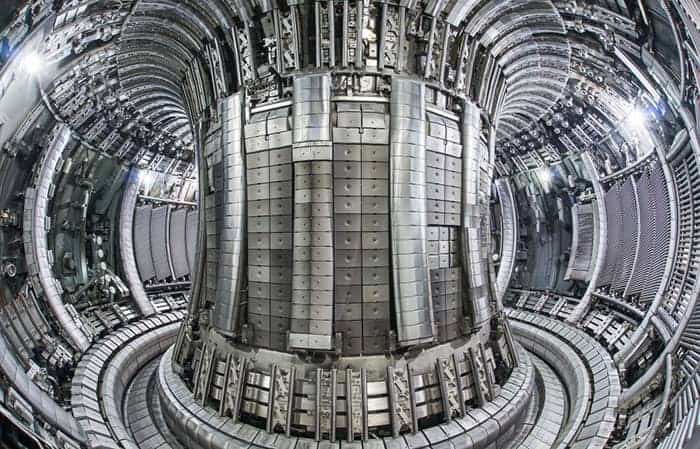
Inside the Joint European Torus (Courtesy: European Consortium for the Development of Fusion Energy)
Since ITER is essentially a scaled-up version of JET’s toroidal tokamak design, the experience that UKAEA has gained with JET has made it a critical partner in the ITER project. JET is providing both a testbed for new ITER technologies and a training ground for the next generation of fusion professionals.
Alongside its central role in the development of ITER, Homfray is enthused that UKAEA is also rapidly expanding its world-class capabilities across a broad range disciplines that will be crucial to realizing fusion power as fast as possible. This includes several major new facilities, such as Remote Applications in Challenging Environments (RACE), which is developing robotic maintenance techniques for reactors; the Materials Research Facility for processing and analysing radioactive samples; the Fusion Technology Facilities for testing components in the extreme conditions inside a fusion machine; and the Hydrogen-3 Advanced Technology (H3AT) centre for tritium science – a key fuel for fusion reactions.
A particularly exciting new development is a major upgrade to the Mega Amp Spherical Tokamak (MAST), a UK facility that represents a different approach to fusion power. MAST exploits a spherical design – like a cored apple, rather than the ring doughnut shape of JET and ITER – that was pioneered by the UKAEA in the late 1990s. The compact geometry of the spherical tokamak requires a lower magnetic field, which is less expensive to produce and maintain.
The upgrade to MAST-U, enabled by funding from the UK’s Engineering and Physical Sciences Research Council, will allow scientists to study long pulse-length plasmas that are closer to the steady-state conditions that will be needed for commercial fusion power plants. “It’s an incredible opportunity for the country to really drive forward the development of a technology the world is crying out for, and in which we are already a global leader,” Homfray adds.
Expanding workforce
With so many new facilities coming online, UKAEA is well equipped to explore a wide variety of promising fusion research avenues. But to make the most of these capabilities, the organization must expand its workforce too. UKAEA needs new recruits, and not just nuclear and plasma physicists. “We’re bringing in people with all types of skills,” says Heather Lewtas, UKAEA’s Head of Manufacturing Realisation. “We’re recruiting chemists, mechanical engineers, physicists, material scientists, biologists, as well as data scientists, AI researchers, roboticists, project managers, business development, HR … you name it, we need them.”
Those joining UKAEA will be contributing to a diverse workforce, which ranges from seasoned nuclear professionals to those just beginning their careers. For the latter, there are certified apprenticeship and graduate schemes in a host of different areas. And all new recruits can take advantage of many exciting continuous professional development schemes, including MSc and PhD fellowships.
Moreover, the collaborative atmosphere at UKAEA allows ideas and results to be shared with colleagues and with the international fusion community. This not only makes UKAEA “an incredibly friendly place to be”, but also accelerates learning and development.
This is without doubt the most exciting time in the 20 years I’ve been here
David Homfray
Lewtas joined UKAEA in December 2016. She is a prime example of how new recruits can develop their skills rapidly and find themselves working on important projects. Though she had a PhD in experimental physics from the University of Oxford, as well as postgrad and industrial experience, like many UKAEA staff she had “no background in fusion, no background in nuclear”. Luckily for her, UKAEA’s excellent formal and informal training, including a mentoring scheme and management development programme, enabled her to rapidly get up to speed.
As a result, just a year into her role at UKAEA she was tasked with leading a project called Joining and Advanced Manufacturing (JAM), which aims to find innovative manufacturing and testing solutions for a fusion power plant by forging collaborations with universities, the UK’s High Value Manufacturing Catapult centres, as well as SMEs and industry. “I enjoy making links between different areas of science and engineering, or between different sectors,” she says. “I absolutely love the fact that I’ve got the opportunity to do that and to make a real difference in progressing fusion in the process.”
Lewtas could not have achieved so much success without a dynamic, energized team behind her. JAM team members have backgrounds from a range of sectors and spanning all levels of experience. Who knows? Her next team member could even be you. “People shouldn’t write themselves off because they think they won’t fit into an organization like UKAEA,” Lewtas says. “Many, many different skillsets can contribute to trying to realize fusion.”
The travel – 90% by plane – is equivalent to three trans-Atlantic trips from Montreal to Paris and back per person each year. The amount of travel varies greatly between professors, however, with some scarcely leaving the university walls while others clock up some 175,000 km, the study found.
“Flying around the world comes at a high environmental price,” says Julien Arsenault of the University of Montreal. “It is very easy to be hyper-mobile, but we should really think hard about how much of this travelling is actually necessary or even beneficial to science.”
Together with co-authors at the University of Montreal and McGill University, both in Canada, Arsenault decided to assess the travel habits of his colleagues as he was involved in a cross-institutional project to reduce the environmental footprint of universities. Although the University of Montreal could supply him and his co-authors with figures for its own environmental footprint – drawn, for example, from its energy usage and food sold – there was no information available on long-distance academic travel.
To generate this information themselves, Arsenault and his co-authors sent a survey to faculty members, research staff and graduate students. The survey set out to establish not just the carbon footprint of academics and students, but also their nitrogen footprint – a metric, gaining in usage, that reflects how much nitrogen a person is responsible for releasing into the environment from crop fertilization, fossil-fuel combustion and other processes. Nitrogen has a range of harmful effects on the environment, including smog, river pollution, and the creation of nitrous oxide, a greenhouse gas that is some 300 times more potent than carbon dioxide.
Professors leave nearly 11 tonnes of carbon dioxide and 2 kg of nitrogen in annual per-person footprints, the researchers found, while international students leave nearly 4 tonnes of carbon dioxide and 0.5 kg of nitrogen. “We were surprised by those numbers,” says Arsenault.
A 2015 study by a team at the Lanzhou Library of the Chinese Academy of Sciences found that in 2007 the average Canadian emitted about 13 tonnes of carbon dioxide from their household a year. Assuming academics generate similar household emissions, says Arsenault, their professional travel nearly doubles their overall carbon footprint, from 13 to 24 tonnes.
Arsenault expects the academic footprint to be lower in Europe, where academic institutions are grouped closer together, and larger in Australia, where students and professors seeking to network and attend conferences must travel farther. He also believes the footprint is likely to be much lower in developing countries, where there is less funding available for travel.
“We believe travelling is necessary in many cases: for field research, for young researchers who need to secure employment through networking, or for researchers from developing countries who may benefit from presenting their work in international conferences,” Arsenault explains. “However, established academics from developed countries have, in our opinion, a responsibility to reduce their travel or to minimize its environmental impact.”
Arsenault recommends that the “internationalization” of someone’s research activities should not be rated so highly when recruiting new staff. He also suggests that universities could require their researchers to buy carbon offsets for air travel, and for shorter distances only provide expenses for travel by rail or bus. But, he adds, “the decision to travel is also an individual one. Researchers need to rethink their travel habits.”
It’s been an exciting few months for particle physicists. In May more than 600 researchers gathered in Granada, Spain, to discuss the European Particle Physics Strategy, while in June CERN held a meeting in Brussels, Belgium, to debate plans for the Future Circular Collider (FCC). This giant machine – 100 km in circumference and earmarked for the Geneva lab – is just one of several different projects (including those in astroparticle physics and machine learning) that particle physicists are working on to explore the frontiers of high-energy physics.
CERN’s Large Hadron Collider (LHC) has been collecting data from vast numbers of proton–proton collisions since 2010 – first at an energy of 8 TeV and then 13 TeV during its second run. These have enabled scientists on the ATLAS and CMS experiments at the LHC to discover the Higgs boson in 2012, while light has also been shed on other vital aspects of the Standard Model of particle physics.
But, like anything else, colliders have a lifespan and it is already time to plan the next generation. With the information that could be obtained from the LHC Run 3 expected to peak in 2023, a major upgrade has already begun during its current shutdown period. The High-Luminosity LHC (HL-LHC), which will run from the mid-2020s to the mid-2030s, will allow high-precision collisions with a centre-of-mass energy of 14 TeV and gather datasets that are 10 times larger than those of the current LHC.
Particle physicists hope the upgraded machine will increase our understanding of key fundamental phenomena – from strong interactions to electroweak processes, and from flavour physics to top-quark physics. But even the HL-LHC will only take us so far, which is why particle physicists have been feverishly hatching plans for a new generation of colliders to take us to the end of the 21st century.
Japan has plans for the International Linear Collider (ILC), which would begin by smashing electrons and positrons at 250 GeV, but could ultimately achieve collisions at energies of up to 1 TeV. China has a blueprint for a Circular Electron Positron Collider that will reach energies of up to 250 GeV – with the possibility of converting the machine at some later point into a second-generation proton–proton collider. At CERN, two options are currently on the table: the Compact Linear Collider (CLIC) and the aforementioned FCC (see box).
CERN’s Future Circular Collider
(Courtesy: CERN)
Along with the Compact Linear Collider (CLIC), CERN has another option for the next big machine in particle physics. The Future Circular Collider (FCC) would require a massive, 100 km new tunnel to be excavated below France and Switzerland – almost four times longer than the current LHC. The FCC would run in two phases. The first would be dedicated to electron–positron collisions (FCC-ee) in the newly built 100 km tunnel, starting in around 2040. The second phase, running from around 2055 to 2080, would involve dismantling FCC-ee and reusing the same tunnel to carry out proton–proton collisions (FCC-hh) at energies of up to 100 TeV. The European Particle Physics update is due to conclude and publish priorities for the field that will eventually inform the CERN council on whether to move forward with the technical design report.
Setting targets
Now, if you’re not a particle physicist, you might be wondering why we want to upgrade the LHC, let alone build even more powerful colliders. What exactly do we hope to achieve from a scientific point of view? And, more importantly, how can we most effectively achieve those intended goals? Having attended the Brussels FCC conference in June, I was struck by one thing. While recent news stories about next-generation colliders have concentrated on finding dark matter, the real reason for these machines lies much closer to home. Quite simply, there is lots we still don’t know about the Standard Model.
A key task for any new collider will be to improve our understanding of Higgs physics (see box below for just one example), allow very precise measurements of a number of electroweak observables, improve sensitivity to rare phenomena, and expand the discovery reach for heavier particles. Electron–positron colliders could, for example, more precisely measure the relevant interactions of the Higgs boson (including interactions not yet tested). Future proton–proton colliders, meanwhile, could serve as a “Higgs factory” – with the Higgs boson becoming an “exploration tool” – to study, among other things, how the Higgs interacts with itself and perform high-precision measurements of rare decays.
Understanding the Higgs mass
(Courtesy: iStock/malerapaso)
The Higgs boson was discovered at CERN in 2012, but we’re still not sure why it has such a low measured mass of just 125 GeV. Known as the “naturalness problem”, it’s linked to the fact that the Higgs boson is the manifestation of the Higgs field, with which virtual particles in the quantum vacuum interact. As a result of all these interactions, the Higgs boson squared mass receives additional contributions of energy. But for the Higgs mass to be as low as 125 GeV, the contributions from different virtual particles at different scales have to cancel out precisely. As CERN theoretical physicist Gian Giudice once put it, this “purely fortuitous cancellation at the level of 1032, although not logically excluded, appears to us disturbingly contrived” (arXiv:0801.2562v2). He likens the situation to balancing a pencil on its tip – perfectly possible in principle, but in practice highly unlikely as you have to finetune its centre of mass so that it falls precisely within the surface of its tip. Indeed, Giudice says that the precise cancellations required for the measured mass of the Higgs boson to be 125 GeV is like balancing a pencil as long as the solar system on a tip a millimetre wide.
A further task would be to shed light on neutrinos. Physicists are keen to understand the mechanism generating the masses of the three species of neutrino (electron, muon and tau) that are linked to the physics of the early universe. And then, of course, there’s the physics of the dark sector, which includes the search for a variety of possible dark-matter candidates. Any eventual finding for these in new colliders would have to be combined and cross-checked with data coming from direct dark-matter detection searches and a variety of cosmological data.
More generally, there’s the physics that goes Beyond the Standard Model (BSM). BSM physics includes (but is not limited to) familiar supersymmetric (SUSY) models, in which every boson (a particle with integer spin) has a fermion “superpartner” (with half-integer spin), while each fermion has a boson superpartner. The BSM landscape extends well beyond SUSY, and features a number of possible exotic options, ranging from possible new resonances at high energy to extremely weakly coupled states at low masses.
An interesting methodological approach
But one thing is certain in this bewildering array of unanswered questions: how we approach these challenges matters as much as what kind of machine we should build. And that’s why it’s crucial for particle physicists – and for philosophers of science such as myself – to discuss scientific methodology. Theorists have tried to find a successor to the Standard Model, but it’s still the best game in town. New methodological approaches are therefore vital if we want to make progress.
How we should methodologically approach these unanswered questions matters as much as how we should build the new machines themselves
I can understand why most current research is still firmly grounded in the Standard Model, despite the many theoretical options currently explored for BSM physics. Why jump ship if the vessel’s still going strong, even though we don’t fully understand how it functions? The trick will be to learn how to navigate the vessel in the uncharted, higher-energy waters, where no-one knows if – or where – new physics might be. And this trick has a name: “model independence”.
Model independence, which nowadays is routinely used in particle physics and cosmology, has been prompted by two main changes. The first is the immense wealth of data emerging from particle colliders like the LHC or cosmology projects such as the Dark Energy Survey, as just one example. This new era of “big data” is forcing scientists to do fundamental research in a way that is no longer railroaded along pre-defined paths but is more open-ended, more exploratory and more sensitive to data-driven methods and phenomenological approaches.
The other main factor behind the growth of model-independent approaches has been the proliferation of theoretical models designed to capture possible new BSM physics. Similarly, its increasing popularity in cosmology has been driven by the many different modified-gravity models proposed to tackle open questions about the standard ΛCDM model, which postulates the existence of cold dark matter (CDM) and dark energy (Λ).
But what exactly is model independence? Surely scientific inquiry depends on models all the way down – so how can scientific inquiry ever be independent of a model? Well, first let’s be clear what we mean by models. To understand how, say, a pendulum swings, you model it using the principles of Newtonian physics. But you also have to devise what philosophers of science call “representational models” associated with the theory. In the case of a pendulum, these representational models are built using Newtonian physics to represent specific phenomena, such as the displacement of the pendulum from equilibrium.
The reason why we build such models is to see if a real system matches the representational model. In the case of a pendulum, we do this by collecting data about how it swings (model of the data) and checking for any systematic error in the way it functions (model of the experiment). But if models are so ubiquitous even for something as simple as a pendulum, how can there be any “independence from models” when it comes to particle physics or cosmology? And why does this question even matter?
Model independence matters in fields where research is more open-ended and exploratory in nature. It is designed to “bracket off” – basically ignore – certain well-entrenched theoretical assumptions of the Standard Model of particle physics or the ΛCDM model in cosmology. Model independence makes it easier to navigate your way through uncharted territories – higher energies in particle physics, or modified gravity in the case of cosmology.
To see what this “bracketing-off” means in practice, let’s look at how it’s been used to search for a particular example of BSM physics at the LHC through the phenomenological version of the Minimal SuperSymmetric Model (pMSSM). Like any SUSY model, this model assumes that each quark has a “squark” superpartner and each lepton has a “slepton” superpartner – particles that are entirely hypothetical as of today. Involving only a handful of theoretical parameters – 11 or 19 depending on which version you use – the pMSSM gives us a series of “model points” that are effectively snapshots of physically conceivable SUSY particles, with an indication of their hypothetical energies and decay modes. These model points bracket off many details of fully fledged SUSY theoretical models. Model independence manifests itself in the form of fewer parameters (masses, decay modes, branching ratios) that are selectively chosen to make it easier for experimentalists to look for relevant signatures at the LHC and exclude, with a high confidence level, a large class of these hypothetical scenarios.
In 2015, for example, members of the ATLAS collaboration at CERN summarized their experiment’s sensitivity to supersymmetry after Run 1 at the LHC in the Journal of High Energy Physics (10 134). Within the boundaries of a series of broad theoretical constraints for the pMSSM-19, infinitely many model points are physically conceivable. Out of this vast pool of candidates, as many as 500 million of them were originally randomly selected by the ATLAS collaboration. Trying to find experimental evidence at ATLAS for any of these hypothetical particles under any of these physically conceivable model points is like looking for a needle in a haystack. So how do particle physicists tackle the challenge?
What members of the ATLAS collaboration did was to gradually trim down the sample, step by step reducing the 500 million model points to just over 310,000 that satisfied a set of broad theoretical and experimental constraints. By sampling enough model points, the researchers hoped that some of the main features of the full pMSSM might be captured. The final outcome of this sampling takes the form of conceivable SUSY sparticle spectra that are then checked against ATLAS Run 1 searches. And as more data were brought in at LHC Run 2, more and more of these conceivable candidate sparticles were excluded, leaving only live contenders (which nonetheless remain purely hypothetical as of today).
In other words, instead of testing a multitude of fully fledged SUSY theoretical models one by one to see if any data emerging from LHC might support one of them, model independence recommends looking at fewer, indicative parameters in simplified models (such as pMSSM-19). These are models that have been reduced to the bare bones, so to speak, in terms of theoretical assumptions, and are therefore more amenable to being cross-checked with empirical data.
The main advantage of model independence is that if no data are found for these simplified models, an entire class of fully fledged and more complete SUSY theoretical models can be discarded at a stroke. It is like searching for a needle in a haystack without having to turn and twist every single straw, but instead being able to discard big chunks of hay at a time. This is, of course, only one example. Model independence manifests itself more profoundly and pervasively in many other aspects of contemporary research in particle physics: from the widespread use of effective field theories to the increasing reliance on data-driven machine-learning techniques, just to mention two other examples.
Cosmological concerns
Model independence has led to a controversy surrounding cosmological measurements of the Hubble constant, which tracks the expansion rate of the universe. The story began in 2013 when researchers released the first data from the European Space Agency’s Planck mission, which had been measuring anisotropies in the cosmic microwave background since 2009. When these data were combined with the ΛCDM model of the early universe, cosmologists found a relatively low value for the Hubble constant, which was confirmed by further Planck data released in 2018 to be just 67.4 ± 0.5 km/s/Mpc.
Problems arose when estimates for the Hubble constant were made using data from pulsating Cepheid variable stars and supernovae Ia exploding stars, which offer more model-independent probes for the Hubble constant. These model-independent measurements led to a revised value of the Hubble constant of 73.24 ± 1.74 km/s/Mpc (arXiv:1607.05617). Additional research has only further increased the “tension” between the value of the Hubble constant from Planck’s model-dependent early-universe measurements, and more model-independent late-universe probes. In particular, members of the H0liCOW (H0 Lenses in COSMOGRAIL’s Wellspring) collaboration – using a further set of model-independent measurements of quasars gravitationally bending light from distant stars – have recently measured the Hubble constant at 73.3 ± 1.7 km/s/Mpc.
And to complicate matters still further, in July Wendy Freedman from the University of Chicago and collaborators used measurements of luminous red giant stars to give another new value of the Hubble constant at 69.8 ± 1.9 km/s/Mpc, which is roughly halfway between Planck and the H0LiCOW values (arXiv:1907.05922). More data on these stars from the upcoming James Webb Space Telescope, which is due to launch in 2021, should shed light on this controversy over the Hubble constant, as will additional gravitational lensing data.
Let’s get philosophical
Model independence is an example of what philosophers like myself call “perspectival modelling”, which – metaphorically speaking – involves modelling hypothetical entities from different perspectives. It means looking at the range of allowed values for key parameters and devising exploratory methods, for example, in the form of simplified models (such as pMSSM-19) that scan the space of possibilities for what these hypothetical entities could be. It is an exercise in conceiving the very many ways in which something might exist with an eye to discovering whether any of these conceivable scenarios is in fact objectively possible. Ultimately, the answer lies with experimental data. If no data are found, large swathes of this space of possibilities can be ruled out in one go following a more data-driven, model-independent approach.
As a philosopher of science, I find model independence fascinating. First, it makes clear that philosophers of science must respond to – and be informed by – the specific challenges that scientists face. Second, model independence reminds us that scientific methodology is an integral part of how to tackle the challenges and unknowns lying ahead, and advance scientific knowledge.
Model independence is becoming an important tool for both experimentalists and theoreticians as they plan future colliders. The Conceptual Design Report for the FCC, for example, mentions how model independence can help “to complete the picture of the Higgs boson properties”, including high-precision measurements of rare Higgs decays. Such model-independent searches are a promising (albeit obviously not exclusive or privileged) methodological tool for the future of particle physics and cosmology. Wisely done, the scientific exercise of physically conceiving particular scenarios becomes an effective strategy to find out what there might be in nature.
The observations appear to undermine climate adaptation strategies, which rely on there being a time lag between changes in the climate and the resulting changes in the environment.
“We are seeing fast shifts in ecosystem responses,” says Jasmine Saros at the University of Maine, US. “This makes it an even greater challenge to know how to anticipate and avoid [them].”
The Arctic is the most rapidly warming region of the planet and has a big influence on many climatic and environmental processes elsewhere. Over the past 150 years, the Arctic has warmed between two and three times faster than the global average.
In Greenland between 2007 and 2012, mean annual air temperatures were 3 °C higher than in the two decades up to 2000. Meanwhile, the area of Kangerlussuaq, West Greenland, exhibited no warming for most of the 20th century then suddenly started warming after the mid-1990s.
Saros and colleagues took Kangerlussuaq as an ideal place to quantify the ecological effects of very rapid warming. They analysed monitoring data and environmental “archives” such as lake sediment cores and shrub rings for the past 40 years. In the latter half of this period there were two jumps in the data: from 1994, mean June air temperatures rose 2.2 °C while mean winter rainfall doubled; then from 2006, mean July air temperatures rose 1.1 °C.
Both these climate jumps saw concurrent or only slightly delayed environmental responses. For instance, in the 1990s the seasonal loss of lake ice shifted six days earlier, and the date by which half of all plant species had come into growth moved 10 days earlier. In the early 2000s, this initiation of plant growth shifted another 13 days earlier, while discharge from the Greenland Ice Sheet rose 50%.
A little later, lakes became clearer and warmer, which the researchers believe will have driven a rise in bottom-dwelling algae. “That shift is important because it can change the nutrient and carbon cycle in lakes, and ultimately across the landscape,” says Saros.
“We were surprised because previous research typically revealed that ecosystem responses to rapid climate change are often delayed or dampened by dynamics and interactions within ecosystems,” says Saros. “In this case, however, we found that Arctic systems responded simultaneously with, or shortly after, these climate shifts.”
Saros believes that shorter growing seasons, simpler ecosystems and lower biodiversity could all contribute to the sensitivity of Arctic ecosystems to rapid climate change.
“Our results have implications for sea level rise, ocean salinity, and carbon cycling – all environmental changes with far reaching consequences,” she says.
The Intergovernmental Panel on Climate Change published a report last year that starkly laid out what was needed to limit global warming to 1.5 °C. It pointed to the overwhelming evidence that irreversible climate change was already occurring and that many of the changes were happening faster than previously thought. At the report’s heart, however, was a message of hope and optimism – we can regain some control and avert disaster if we act quickly.
While we all need to act individually, we also feel that physics as a discipline needs to come together to avoid the impending climate disaster. We therefore call on the community – students, scientists, industrialists, publishers and funders – to declare a climate emergency and commit to placing emissions reductions at the heart of our work. This means placing emissions reductions at the heart of everything we do. For inspiration we should look to the Pugwash movement, which sought a world free from weapons of mass destruction, and to the founding ideals of organizations like CERN, which harnessed the collaborative, evidence-based approach of physics to deliver peace and prosperity.
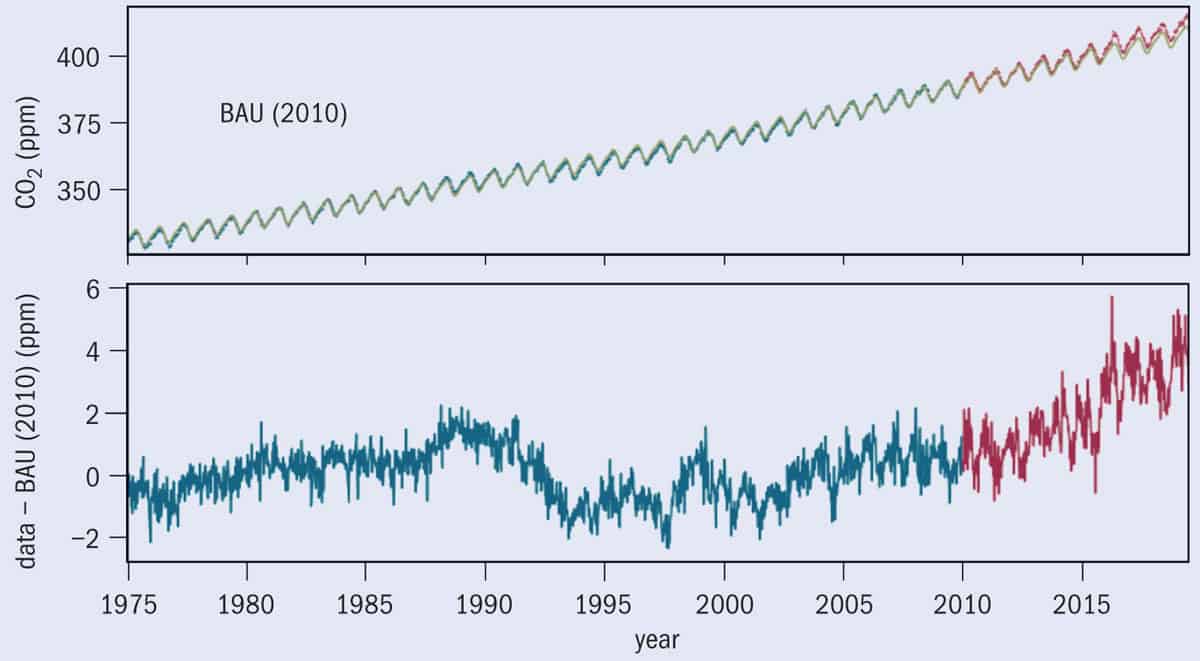
Accelerating away Top: carbon-dioxide (CO2) emissions in parts-per-million (ppm) recorded by the US National Oceanic and Atmospheric Administration (NOAA) up to 2010 (blue) and beyond (red), alongside emissions calculated in 2010 by a model (green) that assumes the world continues in a “business-as-usual” (BAU) way. Bottom: the difference between the NOAA data and the BAU model reveals that emissions are not only rising – but doing so even faster than the 2010 BAU model predicted.
Many physicists are already working on the science and technology of emissions reduction – and this effort will continue to grow. We are instead concerned with community-wide action that changes the way we work and demonstrates to the wider public that global, collaborative activities like science may be sustainably carried out. It is essential that physics plays its part in a wider and growing call to action from across the scientific community.
In late August, the climate activist Greta Thunberg crossed the Atlantic via a zero-emissions sailboat to speak at the UN Climate Action Summit on 23 September. She travelled that way to draw attention to the environmental cost of air travel, which many of us ignore. We’re all familiar with the senior scientist who jets in to give a conference talk before leaving for another event that evening or the next day. Given the carbon cost, it is hard to argue that this model of nomadic superstars who spend their summer in airports is justified, especially in an era where live-streamed TED talks can be watched by millions. In fact, a recent study by the University of British Columbia in Canada suggests that, beyond a low minimum level, more travel does nothing to improve scientific productivity. To put things into perspective, a recent investigation by the leading research Swiss institution ETH Zurich found that flights accounted for a staggering 50% of its emissions. Clearly urgent action is needed.
Physicists – who led the world developing better ways to collaborate, from the telegram to the World Wide Web – should show leadership when it comes to cutting their travel. Making more use of online technology at physics conferences would also have wider benefits, such as allowing people who have to care for family members – or who find it hard to travel – to take part remotely. It would also help physicists from countries with less funding for science. A grassroots campaign to cut the amount of academic travel has been running since 2015.
We have already begun to ask organizers about giving our talks remotely, stimulating high-level discussions with the American Physical Society and at leading US universities. As a result, one of us will trial a “virtual visit” to Harvard University and the Massachusetts Institute of Technology this winter, which will include remote presentations and discussions. Indeed, at a recent meeting we hosted at Durham University in the UK, the stand-out talk was delivered remotely from a national laboratory in the US, demonstrating the potential for high-quality scientific collaboration that does not compromise the quality of the meeting.
As well as action at an individual level, we must also seek policy changes from funding bodies, learned societies and hiring committees. For example, rules set by UK Research and Innovation – the umbrella organization of the seven UK research councils – currently favour the cheapest (rather than the most carbon efficient) means of travel and expressly forbid the use of funds to pay for emissions offsetting. In 2004 Kevin Anderson a climate scientist from the University of Manchester, UK, proposed the idea of a “carbon credit card” to properly account for carbon emissions. Such ideas could enable funding agencies to cut the number of international conferences we attend, reducing our dependency on air travel.
We also recommend that sustainability should become an explicit criterion when funding bodies assess grant applications, on a similar level to ethical considerations and impact. So any attempts to assess the academic and societal impact of our research and teaching – such as the UK’s Research Excellence Framework – should include an assessment of its climate impact too.
Some might argue that any change we make is a drop in the ocean. The same, of course, is true of most of our individual contributions to scientific progress. Yet physics shapes all our futures. Let us use this incredible privilege to act on climate change and hand our children a world where they can still follow their physics dream.
A new technique for reliably inserting single-ion impurities into a crystal and with a precision of just tens of nanometres could help in the development of quantum devices such as quantum computers or quantum simulators. The approach involves using a source of laser-cooled praseodymium ions to fabricate arrays of praseodymium colour centres in synthetic crystals of yttrium aluminium garnet (YAG). 50% of the impurities fluoresce – a success rate that is comparable to techniques that require ion energies three orders of magnitude higher.
Solid-state materials containing impurities such as nitrogen-vacancy colour centres or single rare-earth ions are a promising way to make scalable quantum information processors. The quantum states of these impurities can be tailored by laser and microwave pulses to perform quantum logic operations and the states read out by measuring their fluorescence. Precisely introducing ordered arrays of such impurities into crystals for scaling up quantum processors has proved difficult, however.
Deterministic single ion implantation with high placement precision
“Our technique allows for deterministic single ion implantation in a solid-state material with high placement precision,” explains Karin Groot-Berning of the Johannes Gutenberg University Mainz, who led this research effort. “The added advantage is that it can be applied to a large range of materials, doping ions and implantation energies. We believe it paves the way to the scalable fabrication of qubit arrays, such as those made of phosphorus qubits in ultra-pure silicon, for example. Being able to precisely place these arrays of single atoms in solids is an important step towards making quantum devices in which the arrays are the quantum register.”
Paul trap
Groot-Berning and colleagues began by loading and trapping a single praseodymium (Pr) ion and a single calcium (Ca) ion in a Paul trap. The Ca ion is laser-cooled so that the wave packet of the sympathetically cooled Pr ion also becomes very small (well below 100 nm in size), she explains.
The researchers extract both ions by applying an electric field. They “blank” away the Ca ion, but steer the Pr ion into a lens and focus it down to a spot size of about 30 nm.
“The Pr ion then hits the surface of a YAG crystal, which is a synthetic crystal commonly employed as a lasing medium, with a speed of 73 km/s and it enters the material to a depth of about 6 nm,” says Groot-Berning. “We repeat this procedure to inject a succession of Pr ions into the crystal.”
Forming a colour centre
“The crystal can be moved with a piezo-translation state and we can implant any pattern,” she tells Physics World. “We perform the measurements in an ultrahigh vacuum apparatus in Mainz, where we can trap, cool and extract the ions. Finally, we take the YAG out of the apparatus and send the sample to our colleagues at the Physical Institute of the University of Stuttgart. Here, they flash-heat the crystal to 1200°C such that the Pr ions replace the yttrium ions in the crystal lattice, thus forming a colour centre.”
The researchers then use a set of lasers to excite the array so that it emits photons, which they can detect with a confocal microscope. They found that they could control the position of the Pr ions to a precision of 34 nm and that up to 50% of the colour centres fluoresced.
Precision could be improved further
This precision could be improved further, because it is currently limited by imperfect cooling and mechanical vibrations, says Groot-Berning. “Indeed, we have already started to work on this problem and improve the mechanical stability of our set up in a second-generation implanter.”
The team, reporting its work in Physical Review Letters, says that it now plans to use its technique to implant phosphorus ions into silicon to form arrays of quantum bits. “We also plan to investigate implanting bismuth ions, for coupling their nuclear spins to superconducting quantum bit devices, and cerium ions into the YAG crystal, because this rare earth ion allows for super-resolution microscopy (STED),” reveals Groot-Berning. “This will allow us to fabricate qubit devices using these ions and detect them with even better resolution – down to a few nm.
“Our current placement accuracy is already sufficient for fabricating quantum devices, however,” she stresses.
Scientists have criticized the US government for politicizing weather forecasts from the National Weather Service (NWS) following a dispute over the potential path of Hurricane Dorian. The acting chief scientist of the National Oceanic and Atmospheric Administration (NOAA), of which the NWS is part, is investigating whether the agency violated its policies and ethics over the issue. Meanwhile, the Democratic-led House of Representative’s committee on science, space and technology has announced its own investigation into the matter.
Dorian became a category five hurricane on 1 September just before making landfall on the Bahamas. Late in August, some of the charts created by the NWS indicated a small chance that a part of Alabama would experience high winds from the hurricane. On 1 September, President Trump tweeted that the state “would most likely be hit (much) harder than anticipated”. By the time of Trump’s tweet, however, the hurricane had swung north with NWS charts showing no impact on Alabama.
[The NWS] should be celebrated for communicating accurate information so important to the public
Alan Leshner
Responding to panicked calls from state residents, the branch of the NWS in Birmingham, Alabama, quickly tweeted that the state “will NOT see any impacts” from the hurricane. But the president refused to admit that he had been wrong. As proof, he revealed an NWS projection of Dorian’s cone of uncertainty together with an extra semicircle that was apparently drawn by a Sharpie pen. The added area covered the southeastern segment of Alabama, with Trump admitting that he did not know who added the semicircle.
According to the Washington Post, NOAA staff were instructed to “stick with official National Hurricane Center forecasts” in response to questions about the issue and not to “provide any opinion” on the President’s tweets. But an unsigned press release from NOAA, dated 6 September, stated that the agency had informed Trump “that tropical-storm-force winds from Hurricane Dorian could impact Alabama”. The release also excoriated the Birmingham NWS because, it stated, its tweet denying Trump’s information “spoke in absolute terms that were inconsistent with probabilities from the best forecast products available at the time”.
Scientists have come out in support of the NWS. Alan Leshner, interim chief executive of the American Association for the Advancement of Science, says that the NWS “should be celebrated for communicating accurate information so important to the public [and] not asked to change a weather forecast in reaction to any political pressure”. The American Meteorological Society notes in a statement that it “fully supports” the NOAA “who consistently put the safety of the American public first and foremost”.
Meanwhile, NOAA’s acting chief scientist, Craig McLean, is investigating whether the agency’s unsigned statement violated the agency’s policies and ethics. In an e-mail message to staff, he called the NOAA’s response to the issue a “danger to public health and safety”.
Sub-nanometre resolution in 3D position measurements of light-emitting molecules has been achieved by physicists in Germany. Jörg Enderlein and colleagues at the University of Göttingen achieved the result by replacing metal films used in previous super-resolution techniques with single layers of graphene. Their innovation could allow researchers in a wide variety of fields to measure molecular positions to unprecedented degrees of accuracy.
Recently, the technique of single-molecule localization super-resolution microscopy (SMLM) has become an incredibly useful tool for researchers in fields ranging from fundamental physics to medical research. By analysing images of single light-emitting molecules, researchers can pinpoint the positions of their centres to within single atomic widths. However, SMLM faces one significant shortcoming: it can only locate molecules in 2D, giving no information about their positions along the out-of-plane axis.
This problem can be partially overcome through the technique of metal-induced energy transfer (MIET), which introduces a thin metal film to the setup. The idea is that the apparatus picks up changes in the molecule’s fluorescence that are caused by the molecule coupling to collective excitations of surface plasmons in the film. Since this light emission varies with distance from the film, researchers can use MIET to calculate the molecule’s distance relative to the film surface, allowing them to locate it along the third axis. Yet with current versions of the technique, the accuracy of axial localization (along the vertical axis) measurements is of the order of 2-3 nm.
Atomic-scale resolution
Enderlein’s team aimed to improve this accuracy by replacing the metal film with graphene, which is a film of carbon just one atom thick. This setup also results in distance-dependent fluorescence through coupling between the graphene and the emitter. This time, however, the spatial resolution in the out-of-plane direction is nearly 10 times better than in previous studies that used the metal film. For the first time, this setup, called graphene-MIET (gMIET), allowed for measurements of molecular positions to resolutions of one angstrom – 10–10 m or 0.1 nm, which is roughly the “size” of an atom in a solid or molecule.
The researchers demonstrated this super-resolution by measuring the thicknesses of single lipid bilayers – the two, opposite facing, 2D films of tadpole-shaped molecules which form cell membranes. By localizing fluorescent dyes attached to the heads of the molecules in each bilayer, relative to a graphene film, Enderlein and colleagues estimated a membrane thickness of around 5 nm. This result is remarkably consistent with the known value. With further improvements, the team believes that gMIET could be used to resolve distances between individual molecules; more complex groups of molecules; and small cellular structures, with sub-nanometre accuracy.
The European Society of Radiology (ESR) has issued a detailed set of recommendations designed to promote the understanding and use of validated imaging biomarkers as decision-making tools in clinical trials and routine practice.
The 16-page document produced by the European Imaging Biomarkers Alliance (EIBALL), and endorsed by the ESR’s Executive Council, was published on 29 August in Insights into Imaging. EIBALL is a subcommittee of the ESR’s Research Committee, and its mission is to facilitate imaging biomarker development and standardization as well as promote their use in clinical trials and in clinical practice by collaboration with specialist societies, international standards agencies and trials organizations (Insights into Imaging 10.1186/s13244-019-0764-0).
“Both radiologists and clinicians are wary about using biomarkers,” lead author Nandita deSouza told AuntMinnieEurope.com. “They are often acquired with very different imaging protocols, which make the quantitation across sites and equipment variable. Understanding this variability and the evidence for appropriate biomarker use would greatly help those who wish to incorporate these quantitative techniques into research or clinical use to make decisions when faced with individual patients.”
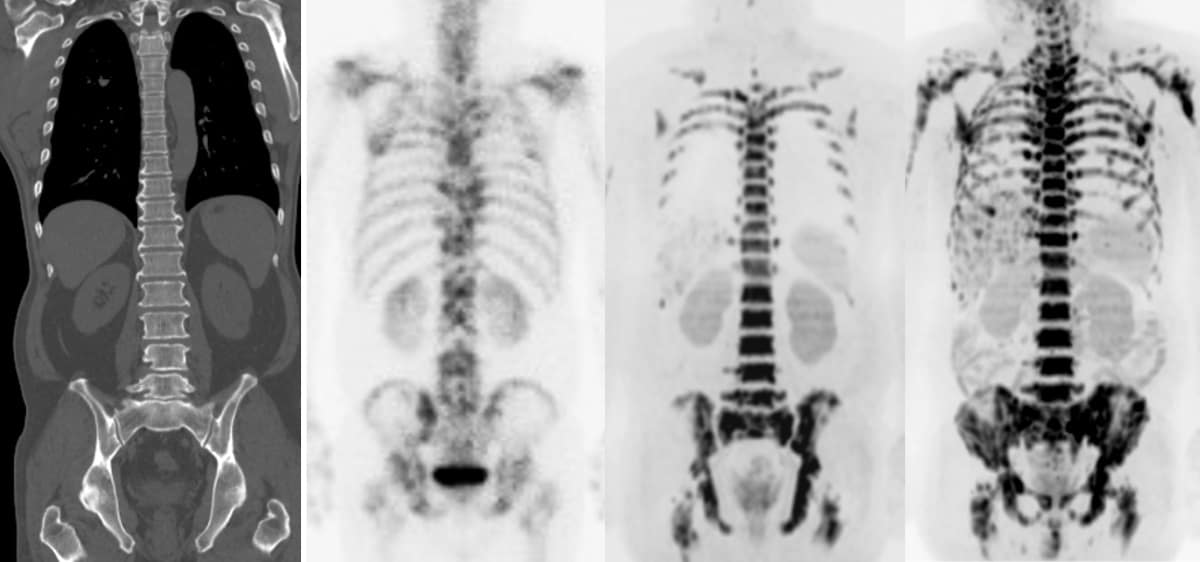
Multimodality imaging of the skeleton shows secondary deposits in bone. Diffusion-weighted MRI (far right image) is a quantitative technique from which a biomarker called the apparent diffusion coefficient can be derived either from specifically segmented regions or from the whole skeleton. (Courtesy: Nandita deSouza)
Quantitation is going to increase as artificial intelligence (AI) comes on line, and making sure it is robust and meaningful is going to be hugely important, added deSouza, who is a professor in translational imaging and co-director of the Cancer Research UK Clinical Magnetic Resonance Research Group at the Institute of Cancer Research.
EIBALL is developing a web-based biomarkers inventory that will be available to anyone on the ESR website. EIBALL works with and seeks endorsement by specialist societies such as the European Society of Gastrointestinal and Abdominal Radiology (ESGAR), the European Society of Gynaecological Oncology (ESGO) and the European Society for Breast Imaging (EUSOBI) for creating this inventory.
Also, EIBALL is working closely with its North American counterpart, the Quantitative Imaging Biomarkers Alliance (QIBA). The two groups both work towards setting benchmarks for imaging biomarker quantitation. They meet regularly to contribute to each other’s work and ensure their goals are aligned.
“The ESR strongly supports this process, and gives EIBALL a platform for presenting developments at ECR every year,” she pointed out.
Need for harmonization
In an era of machine learning and AI, it is vital to extract quantitative biomarkers from medical images that inform on disease detection, characterization, monitoring and assessment of response to treatment. Quantitation can provide objective decision-support tools in patient management, but the quantitative potential of imaging remains underexploited because of variability of the measurement, lack of harmonized systems for data acquisition and analysis, and crucially, a paucity of evidence on how such quantitation potentially affects clinical decision-making and patient outcome, according to the authors of the EIBALL report.
Having looked at the use of semiquantitative and quantitative biomarkers in clinical settings at various stages of the disease pathway – including diagnosis, staging and prognosis, as well as predicting and detecting treatment response – they feel strongly that measurement variability needs to be understood and systems for data acquisition and analysis harmonized before using quantitative imaging measurements to drive clinical decisions.
Semiquantitative readouts of scores based on an observer-recognition process are useful here. For example, MRI scoring systems for grading hypoxic-ischemic injury in neonates using a combination of T1-weighted imaging, T2-weighted imaging and diffusion-weighted imaging have shown that higher postnatal grades were associated with poorer neurodevelopmental outcome, the authors noted.
In cervical spondylosis, grading of high T2-weighted signal within the spinal cord has been related variably to disease severity and outcome. In common diseases such as osteoarthritis, where follow-up scans to assess progression are vital in treatment decision-making, such scoring approaches also are useful; web-based knowledge transfer tools using the developed scoring systems indicate good agreement between readers with both radiological and clinical background specialisms in interpreting the T2-weighted MRI data.
“MRI is more versatile than ultrasound and CT,” they wrote. “It can be manipulated to derive a number of parameters based on multiple intrinsic properties of tissue (including T1- and T2-relaxation times, proton density, diffusion and water-fat fraction) and how these are altered in the presence of other macromolecules (e.g., proteins giving rising to magnetization transfer and chemical exchange transfer effects) and externally administered contrast agents (gadolinium chelates).”
Perfusion metrics have been derived with arterial spin labelling, which does not require externally administered agents. The apparent diffusion coefficient is the most widely used metric in oncology for disease detection, prognosis and response evaluation. Postprocessing methods to derive absolute quantitation are extensively debated, but the technique is robust with good reproducibility in multicentre, multivendor trials across tumour types, according to deSouza and colleagues.
Hybrid imaging
Quantitation of F-18 FDG PET/CT studies is mainly performed by standardized uptake values (SUVs), although other metrics such as metabolic active tumour volume and total lesion glycolysis are being introduced in research and the clinic.
“The most frequently used metric to assess the intensity of FDG accumulation in cancer lesions is, however, still the maximum SUV,” they continued. “SUV represents the tumour tracer uptake normalized for injected activity per kilogram body weight. SUV and any of the other PET quantitative metrics are affected by technical (calibration of systems, synchronization of clocks and accurate assessment of injected F-18 FDG activity), physical (procedure, methods, and settings used for image acquisition, image reconstruction and quantitative image analysis) and physiological factors (FDG kinetics and patient biology/physiology).”
To mitigate these factors, guidelines have standardized imaging procedures and harmonized PET/CT system performance at a European level. Newer targeted PET agents are only assessed qualitatively on their distribution.
Future challenges
To become clinically useful, biomarkers must be rigorously evaluated for their technical performance, reproducibility, biological and clinical validity and cost-effectiveness, the authors wrote.
Technical validation establishes whether a biomarker can be derived reliably in different institutions and on widely available platforms. Provisions must be made if specialist hardware or software is required, or if a key tracer or contrast agent is not licensed for clinical use, they stated. Reproducibility is very rarely demonstrated in practice because inclusion of a repeat baseline study is resource and time intensive. Multicentre technical validation using standardized protocols needs to be addressed after initial biological validation. Quantitative biomarkers can then be clinically validated, showing that the same relationships are observed in patients.
Increasingly, the role of imaging in the context of other non-imaging biomarkers needs to be considered as part of a multiparametric healthcare assessment. The integration of imaging biomarkers with tissue and liquid biomarkers is likely to replace many traditional and more simplistic approaches to decision-support systems.
“In an era of artificial intelligence, where radiologists are faced with an ever-increasing volume of digital data, it makes sense to increase our efforts at utilizing validated, quantified imaging biomarkers as key elements in supporting management decisions for patients,” they concluded.
Intensity-modulated radiotherapy (IMRT) and variants such as volumetric-modulated arc therapy (VMAT) have proven to be game-changers in cancer treatment over the past decade, delivering precise and highly conformal “dose painting” of complex tumour sites while minimizing collateral damage to healthy tissue and nearby organs at risk. While the benefits are clear, the complexities of IMRT/VMAT treatment planning and delivery are such that a redoubled focus on all aspects of quality assurance (QA) is essential – not least in terms of patient-related QA to ensure that dose delivery remains within tolerance versus the original simulation and treatment plan.
Standard Imaging, a US-based provider of QA solutions for radiation oncology, believes that its Adaptivo patient dosimetry software ticks a lot of those patient QA boxes by providing a granular view into the daily and cumulative dose delivered as patient geometry, set-up and tumours change during the course of treatment. What’s more, the software automatically imports and analyses patients, presents data in a summary dashboard, and sends alerts for dose deviations that require attention from the oncologist.
Problem-solving
“The problem Adaptivo addresses is the gaping hole in treatment delivery in most radiation oncology clinics,” explains Shannon Holmes, staff medical physicist at Standard Imaging. “What’s missing is that day-to-day information to understand the impact of various geometric changes in the patient’s anatomy [e.g. weight loss, tumour shrinkage] or patient positioning on the overall quality of the treatment,” she adds. “Put simply, are we hitting the target and are we doing it in the way we intended in the treatment plan?”
Shannon Holmes: “Having the data to assess patient changes gives confidence that you are delivering high-quality treatments.” (Courtesy: Standard Imaging)
To align with existing clinical workflows, Adaptivo’s functionality is organized into three core building blocks. The Pre-treatment module verifies IMRT and VMAT delivery using the treatment system’s portal imager, streamlining pre-treatment QA without the need for phantoms or additional detectors. The software communicates directly with the record and verify (R&V) system and automatically compares measured results to the predicted image (with email notification of either each pre-treatment delivery or only those that fail acceptance criteria).
The In Vivo module, meanwhile, provides daily exit-dose monitoring to identify unforeseen deviations from the treatment plan, performing portal-to-calculated and portal-to-portal comparisons of per-beam metrics, per-fraction metrics and gamma metrics. The software’s third module, Adaptive, provides daily and cumulative 3D dose analysis, automatically mapping the original planned contours to daily cone-beam CT images (or the most recent cone-beam image set). This deformable registration ensures that changes in tumour size and patient weight loss, for example, are factored into both daily and cumulative dose and dose volume histogram (DVH) tracking.
Clinical upside
So what are the main operational benefits of Adaptivo for medical physicists and the wider radiation oncology team? “I would say insight first and foremost,” notes Holmes, citing the access the software provides to daily information about patient set-up and anatomy variations and the impact on dose distributions. “Having the data to assess those patient changes gives confidence that you are delivering high-quality treatments,” she explains. “I guess there’s also the issue of having the hard data to support decision-making if you need to replan a patient – or whether, despite patient weight loss for example, your treatment plans are still robust.”
Workflow efficiencies also figure prominently, with Holmes noting that Adaptivo’s automated data input and analysis allows medical physicists to focus their time on tasks that align with their abilities and training. “With Adaptivo, a physicist would be analysing results rather than just transferring files and hitting ‘calculate’,” she explains. “The software also makes chart-checks more meaningful because you’re no longer just looking at whether the number of MU [monitor units] delivered matches the number of MU that were planned. You can actually understand the impact on your patient: was the dose distribution as expected, was the patient set-up in alignment, was the daily treatment in line with what was expected.”
Radiation oncologists can quickly judge whether a replan is needed, focusing on those plans that truly require altering and expediting the approval process
Shannon Holmes
It’s the insights that Adaptivo provides – highlighting daily and cumulative dose deviations or trends – that’s the big differentiator in terms of patient QA and enhanced treatment outcomes. Consider head-and-neck cancer, a clinical indication that commonly requires treatment replanning during a course of radiation therapy. “For head-and-neck patients,” explains Holmes, “it often hurts to eat during treatment, so the patient loses weight and there’s often significant anatomical change in a location that affects the attenuation of the treatment beam.”
Within Adaptivo, those anatomical changes manifest as higher exit doses in the In Vivo module, an indicator that attenuation is decreasing. In this scenario, the 3D dose calculations in the Adaptive module will display how the daily doses on the cone-beam CT are changing as the patient loses weight, mapping that daily data back onto the planning CT to give a cumulative delivered dose distribution.
In turn, says Holmes, “the Adaptive module will actually generate a predictive, cumulative dose flag that tells you, based on how you’ve been treating so far, whether you’re going to be outside the tolerance you’ve set yourself by the end of the treatment – and if so, how far out you’re going to be.”
Holmes concludes: “It’s this complete view of delivered dose that gives the data and confidence needed to validate any replanning. Radiation oncologists can quickly judge whether a replan is needed, focusing on those plans that truly require altering and expediting the approval process.”
Standard Imaging released Version 1.3 of Adaptivo earlier this summer and will be showcasing the latest features of the software at the ASTRO Annual Meeting this week. Version 1.3 enhancements include compatibility with ARIA version 15 (Varian’s R&V system) and pretreatment QA functionality for 10 MV beams. Disease-specific gamma criteria can now be applied for both the Pre-treatment and In Vivo analysis modules, while there’s also a representative beam data option for In Vivo commissioning.
Standard Imaging will be exhibiting at booth 1435 during the ASTRO Annual Meeting in Chicago, IL, from 15-17 September.