Innovation: patent applications review

MRI system incorporates motion detection

Philips has developed an MRI system that contains an additional RF sensor to monitor signals from breathing and cardiac motion (WO/2019/096707). The system comprises an RF coil arrangement with a coil that transmits and/or receives an RF signal for generating an MR image and an additional RF sensor that transmits an RF transmit signal adapted to interact with the patient’s tissue. This allows sensing of signals due to patient motion simultaneously with transmitting and/or receiving the RF signal for generating the MR image. In this way, movements of a patient under examination in an MRI system may be detected in an efficient and reliable way.

Machine learning methods ease lesion analysis

Patients with known or suspected pathologies of the lungs and liver are commonly assessed using CT or MRI. Identifying and quantifying possible malignant regions in the resulting images is essential for accurate and timely diagnosis. However, careful quantitative assessment of lung and liver lesions can be tedious and time consuming. Computer aided detection software can improve accuracy and efficiency for both lesion detection and quantitative assessment. With this goal, Arterys has described an automated end-to-end pipeline for accurate lesion detection, segmentation and longitudinal identification (WO/2019/103912).

PET detector designed for combined PET/MRI scanner

Researchers at RWTH Aachen University have created a PET detector for use in a combined PET/MRI scanner (WO/2019/101909). The detector incorporates shielding against electromagnetic fields, such that fields generated by the MRI scanner are kept away from the PET detector, and fields from the PET detector’s processing electronics are kept away from the MRI scanner’s receiver coil. The PET detector is suitable for use within the MRI scanner, with the scanning unit of the PET detector is not oriented in parallel with the main axis of the MRI scanner and where the shielding of the detector has at least one slot perpendicular to the main axis of the scanner in at least one projection, to prevent induced currents.

Digital X-ray system offers automatic exposure control

IRay has described a digital X-ray system with automatic exposure control (WO/2019/105490). The system generates a pre-exposure parameter and sends it to a high-voltage generator, which performs pre-exposure imaging according to this parameter. This image is collected by a flat-panel detector and used to obtain a pre-exposure image greyscale value. According to this greyscale value, the pre-exposure X-ray dose and a set main exposure greyscale value, the system calculates a main exposure X-ray dose and generates a main exposure parameter. The high-voltage generator then performs the main exposure according to this parameter and the resulting image is collected and sent by the flat-panel detector. IRay says that this method removes the need to install an ionization chamber, has accurate exposure and low complexity, reduces system costs, decreases scrap rates in clinical applications, and reduces generation of extra radiation.

Cascaded dual-polarity waves deliver ultrafast ultrasound

Versitech Limited, the commercial arm of the University of Hong Kong, has invented a system and method for ultrafast ultrasound imaging (WO/2019/114585). The approach involves directing an array to transmit sets of cascaded titled ultrasound waves towards a tissue sample, and decoding the reflected signals through summing, subtracting and delay operations. The reflected signals can then be reconstructed to provide a final decoded output. The technique, known as “cascaded dual-polarity waves imaging” increases the signal-to-noise ratio and sensitivity in ultrafast imaging without compromising the frame rate.

3D printing creates physical models from medical images

The University of Pennsylvania has presented methods, systems and computer readable media for 3D printing from volumetric medical images, for example, MR or CT images of anatomical structures (WO/2019/113254). An example method involves receiving, from an imaging device, a multi-dimensional image of an anatomical structure. For each 2D slice of the original or resampled/processed image, voxels of the 2D slice are converted, row-by-row, into 3D printing instructions for that slice. By controlling a 3D printing extruder, a physical model based on the anatomical structure is created by printing, slice-by-slice, each 2D slice using the printing instructions.
Superconductivity signatures seen in trilayer graphene

A trilayer graphene (TLG) and hexagonal boron nitride (hBN) moiré superlattice could be the ideal platform in which to study strong correlated physics and so find signatures of high-temperature superconductivity. So say researchers at the Lawrence Berkeley National Laboratory and the University of California at Berkeley who have observed metal-to-Mott insulator and Mott insulator-to-superconductor phase transitions as a function of electron-electron correlation strength in the 2D heterostructure material.

In recent years, researchers have been able to exfoliate and stack atomically thin 2D materials to make synthetic quantum materials, such as new classes of van der Waals heterostructures. They can conveniently control the quantum mechanical interactions between large numbers of electrons in these materials, and thus their electronic properties, by changing both the composition and the direction in which the different layered materials are stacked and by applying an external electric field via electrostatic gate contacts.

Such techniques have led to the recent discovery of correlated insulating states and superconductivity in so-called magic-angle twisted bilayer graphene (TBG) and gate-tuneable Mott insulating states in ABC-TLG-hBN heterostructures.

Hubbard model

Understanding high-transition-temperature (high-Tc) superconductivity, which occurs when electrons overcome their mutual electrical repulsion and form correlated “Cooper pairs” that then travel unheeded through the material as a supercurrent, is an important goal in condensed matter physics. One system in which this superconductivity is predicted to appear is a doped Mott insulator as described by the Hubbard model, which defines electrons as Fermi-Dirac particles (fermions) that hop between fixed sites on a lattice. These electrons only interact with each other when they occupy the same lattice site. The researchers, led by Feng Wang, thus decided to investigate ABC-TLG-hBN heterostructures since they are thought to be the ideal platform in which to study this model.

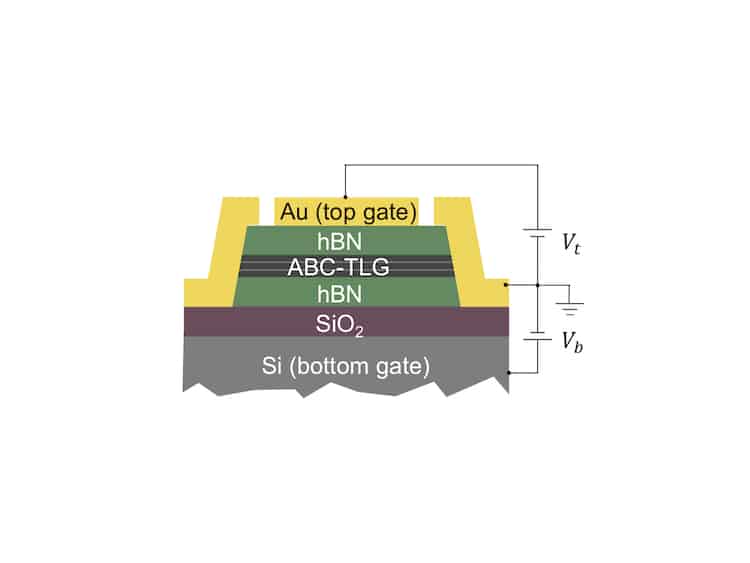
The researchers made their heterostructures by stacking exfoliated ABC-TLG and hBN in a hBN/ABC-TLG/hBN sandwich using a dry transfer technique. They assembled the stacks by carefully aligning them at a certain angle and then fabricated electronic devices from them in a Hall bar geometry. They contacted the TLG through 1D edge contacts with non-superconducting Cr/Au metals and then deposited a metal top electrode to form dual-gated devices. This arrangement means that the structures can be gated via both the top metal electrode and a bottom silicon substrate.

Device structure

“This dual-gate configuration allows us to control the electron concentration and mini-bandwidth of the ABC-TLG/hBN heterostructure independently by applying a vertical electric field, D,” explains study lead author Guorui Chen. “This means we can control the electron-electron interactions in a single device and so see the phase transition from metal-to-Mott insulator and Mott insulator-to-superconductor as a function of the electron-electron correlation strength.”

“Domes” in the phase diagram

The researchers performed their experiments at “relatively” high temperatures of 5 K and observed one-quarter and one-half Mott insulating phases in the phase diagram of the material. These correspond to one and two holes per unit cell respectively. They then cooled the sample down to 40 mK and observed signatures of superconductivity (“domes” in the phase diagram) when a very large vertical electric field of -0.54 V/nm was applied to the one-quarter filling Mott state doped with electrons.

“Since we have two parameters (carrier doping, n, and vertical electric field, D), we spent a lot of time searching for the parameter space in which superconductivity should appear because we didn’t know where this was,” Chen tells Physics World.

This heterostructure is very different to “magic angle” TBG (an experimental platform engineered on two misaligned graphene layers – at “magic angles” near 1.1° so that they form a moiré pattern),” says Chen. “When we started our project in February 2017, we hadn’t heard of magic angle TBG yet.”

schematic of moiré TLG

Several advantages

“Compared to this material our TLG has several advantages. First, we can tune the correlation strength in the material, or its bandwidth, by tuning the vertical electrical field applied to it. Second, the moiré pattern of TLG is more uniform than that of TBG’s. Third, the TLG/hBN is not so twisted-angle sensitive compared to TBG, which only works at one magic angle. For TLGs, any small angle close to zero is fine. And finally, TLG/hBN offers a more general route to obtain 2D correlated systems.”

The researchers say that the electronic behaviour in the ABC-TLG/hBN superlattice should depend sensitively on the interplay between the electron-electron interactions and the mini-bandwidth. “The electron-electron interaction strength is described by U/t, where U is the Coulomb energy of these interactions and t is the carrier hopping term – which is proportional to the bandwidth for a solid,” explains Chen. “We thus know that we need to reduce the bandwidth to enhance the electron-electron interactions.”

Follow-up studies

The team is now busy with follow-up studies to understand the mechanism behind superconductivity in ABC-TLG/hBN. “For example, scanning tunnelling microscopy studies could provide us with more information on the correlated phases present,” says Chen. “We are also making higher quality samples to increase the superconducting Tof the material. Its magnetic properties are also very important and magnetotransport or direct magnetic susceptibility measurements could be helpful to us here.”

Chen says that he and his colleagues are also particularly interested in the topological properties of ABC-TLG/hBN. “So far we have observed ferromagnetism with a quantized anomalous Hall effect in the material as a Chern insulator phase with a Chern number of two. This is, as far as we know, the first such system with a Chern number of greater than one. We have published these results on arXiv and are very excited to find superconductivity and topological phenomena in a single material.”

The research is detailed in Nature 10.1038/s41586-019-1393-y.

Aerogel insulation could provide habitable regions on Mars

silica aerogel

Regions of Mars could be made habitable within decades using current technology. So say researchers at Harvard University, the California Institute of Technology (Caltech) and the University of Edinburgh who suggest warming just certain areas of the planet – using greenhouse-like shields made from silica aerogels – rather than terraforming it entirely.

The surface of Mars is hostile to life as we know it – it is too cold for liquid water to exist and there is no ozone layer to protect it from ultraviolet radiation. Although researchers have put forward many proposals over the years to make Mars more hospitable, all these would require massive environmental modifications. “Such global terraforming will not be possible for centuries, if ever,” says Robin Wordsworth of the Harvard Paulson School of Engineering and Applied Sciences, who led this new study.

Solid-state greenhouse effect

Wordsworth and colleagues have now put forward a new idea: exploiting a solid-state analogue to the atmospheric greenhouse effect here on Earth. This effect occurs when sunlight is absorbed inside translucent snow or ice layers. It is most pronounced in materials that are partially transparent to visible light but have low thermal conductivity and block infrared light. Unlike Earth’s polar ice caps, the polar ice caps on Mars (which contain a combination of both water ice and frozen carbon dioxide) are much too volatile to make robust solid-state greenhouse shields, say the researchers.

They explain that silica aerogels, which contain nanoscale networks of interconnecting silica clusters, contain over 97% air by volume and have some of the lowest measured thermal conductivities of any known material (of 0.02 W/m/K at 1 bar pressure or 0.01 W/m/K at Martian atmospheric pressure). Thanks to these properties, the materials are already routinely employed in many engineering applications, including in NASA’s Mars Exploration Rovers where thin aerogel layers provided night-time thermal insulation.

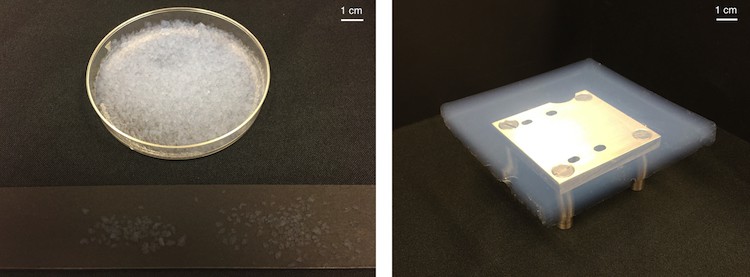
In their experiments, Wordsworth and co-workers replicated the surface conditions of Mars in the laboratory. They then placed a layer of silica aerogel particles or tiles on a base that reflects little light surrounded by a thermally insulating material. Next, they exposed the apparatus to visible light from a solar simulator. They measured the broadband light flux incident on the aerogel layer using a pyranometer and the temperature with calibrated glass-bead thermistors.

2-3 cm thick silica aerogel layer is enough

Both the aerogel particles and tile layers received visible flux in the 100-200 W/mrange. To compare, Earth receives on average 342 W/mand Mars 147 W/m2.

The team found that a 3 cm layer of silica aerogel can increase the temperature of the underlying surface by 45 K when it receives a flux of 150 W/m2. Aerogel tiles, which transmit more visible light, increase temperatures by a further 10 K, reaching over 50 K at just 2 cm thicknesses.

The researchers say they can obtain warming to 0°C or higher under Mars-like insulation levels using a 2-3 cm thick silica aerogel layer. The maximum amount of warming possible is likely even higher since heat is lost in the experimental set up.

They also measured how much UV light the aerogel and tiles absorbed and found that it strongly blocked UVA and UVB radiation (280-400 nm wavelengths) and nearly totally blocked the most hazardous UVC (220-275 nm) radiation.

“The aerogel is effective at transmitting visible light but blocks infrared radiation and is an extremely effective insulator,” says Wordsworth. This makes it very efficient at warming via the solid-state greenhouse effect, while also blocking harmful UV radiation,” he tells Physics World.

Habitation domes and self-sustaining biospheres

The material could be used as a shield to warm up small, sufficiently ice-rich, relatively dust-free regions of Mars’ surface – to build habitation domes, for example, or even self-sustaining biospheres, he adds.

“There are many mid-latitude locations rich in ground ice and low dust accumulation rates within the latitude band where solar flux is high throughout the year (45°S–45°N). We calculated how the Martian subsurface would evolve using our aerogel for one location (Deuteronilus Mensae).

“Assuming the presence of a 2.5-cm-thick aerogel layer, subsurface temperatures down to depths of several metres are high enough to allow liquid water throughout the Martian year after a few years at this location.”

“Small islands of habitability”

“Mars is the most habitable planet in our Solar System besides Earth,” explains Laura Kerber of the Jet Propulsion Laboratory at Caltech. “But it remains a hostile world for many kinds of life. A system for creating small islands of habitability would allow us to transform Mars in a controlled and scalable way.”

The team, reporting its work in Nature Astronomy 10.1038/s41550-019-0813-0, now plans to investigate the response of the aerogel shield to the pressure changes expected to occur on heating the Martian surface. “We also plan to perform field tests in analogue, extreme, environmental sites on Earth, such as in the dry valleys of Antarctica or Chile, to increase the realism of our setup,” says Wordsworth.

There are also the all-important philosophical and ethical questions concerning astrobiological planetary protection that will need to be answered before any such technology can realistically be employed. “If you’re going to enable life on the Martian surface, are you sure that there’s not life there already? If there is, how do we navigate that,” he asks. “The moment we decide to commit to having humans on Mars, these questions are inevitable.”

The Earth without the Moon, the science of the Apollo missions and the challenges of nuclear forensics

In this episode of the Physics World Weekly podcast we ponder what it would be like on Earth if we did not have the Moon and chat about the amazing science that has been done by the Apollo missions.

We also learn about the challenges facing those in the exciting field of nuclear forensics.

Solar panel generates fresh water and electricity

A new system for removing salt from seawater using the waste heat from solar panels has been created by Peng Wang and colleagues at King Abdullah University of Science and Technology in Saudi Arabia. The team installed a multistage membrane distillation (MSMD) device directly underneath the solar panels so that the system occupies the same footprint as the solar panels.

Energy and water are two crucial resources that are often connected. Creating freshwater from seawater consumes about 15% of electricity generated in Arab countries, for example, and finding carbon-free sources of energy for desalination is a huge challenge facing countries in the driest regions of the world.

Wang’s team have answered this challenge by creating a desalination system that uses waste heat produced by solar power plants. While solar cells can convert about 20% of sunlight into electricity, the remaining 80% simply heats up the solar panels. The team’s MSMD device comprises three stacked layers of water distillation channels that run parallel to solar panels. Each layer is separated by porous hydrophobic membranes and heat conduction layers.

Evaporation and condensation

Within each layer, seawater in the uppermost channel is evaporated by waste heat from the solar panel, and then condenses to freshwater inside a second channel on the other side of the membrane. This desalinated water then flows into a storage container, while the remaining seawater, along with the rest of the waste heat, pass down to the layer below, where the process repeats.

Wang and colleagues show that the MSMD device can be installed directly underneath existing solar panels; requiring no specialized mounting equipment, and no extra requirements for land use. While previous attempts at this technique came at the cost of overall solar panel performance, the researchers observed virtually no decrease in power generation efficiency in their system. At the same time, the MSMD device was able to desalinate up to 1.64 l of fresh water per square metre per hour. According to team member Wenbin Wang, this is more than double the water output of traditional solar stills, which use a one-stage design.

The team points that new technology could encourage energy and water companies to work together in dry regions. Furthermore, they point out that creating fresh water offers a way of mitigating the inherent low efficiency of solar panels and could make their deployment more attractive.

As a next step, the team wants to study how the system could be used in an agricultural setting – with the water used for irrigation.

The desalination system is described in Nature Communications.

New €500m German battery institute hit by ‘scandal’ over site decision

A decision by the German government to pick the University of Münster as the site of a new €500m battery-cell-production research centre has provoked anger from those behind competing bids. The prime ministers of three German states — Baden-Württemberg, Bavaria and Lower Saxony — have penned an open letter to German Chancellor Angela Merkel claiming that the decision is based on political issues rather than being purely on scientific merit.

Dubbed the Forschungsfertigung Batteriezelle, the new centre has been set up by Germany’s Fraunhofer Society — Europe’s largest applied research organization. The selection process for the site of the new centre began in February, when several German organizations experienced in designing and producing battery cells were asked to submit proposals. Six cities submitted bids that were then reviewed by a founding commission that included representatives from Fraunhofer, the German Education and Research Ministry (BMBF) and the federal economics ministry.

Our aim is to create a top-class research centre for battery cell production

Reimund Neugebauer

Three proposed locations were deemed suitable — Münster in the state of North Rhine-Westphalia, Ulm in Baden-Württemberg and the Lower Saxony city of Salzgitter. On 28 June — less then five months after research organizations were asked to submit proposals — Münster was announced as the winning bid at a press conference at the BMBF in Berlin.

Fast moving

The new centre will be located at the MEET battery-research facility at the University of Münster, with a key participant being RWTH Aachen University. Construction of a building to house the research centre is set to begin by the end of this year and completed by 2022. In addition to the €500m from the German government to establish the centre, the state of North Rhine-Westphalia has pledged an additional €200m.

“MEET’s expertise in developing materials and cells for batteries and RWTH Aachen’s expertise in the production of cells and batteries are an ideal complement to Fraunhofer’s expertise in production technology and the transfer of knowledge to industry,” says Fraunhofer president, the mechanical engineer Reimund Neugebauer. “Our aim is to create a top-class research centre for battery cell production that will organically accelerate innovation in the manufacture of new battery cell designs and their advance to the mass-production stage.”

Yet some have questioned the bidding process and in the speed with which a decision was made. In an interview with Die Welt, Baden-Württemberg prime minister Winfried Kretschmann described the decision as a “grave mistake for the entire republic”. He and many others had expected Ulm to be selected to host the new centre. The city is home to the Helmholtz Institute Ulm (HIU), which focuses on electrochemical energy storage and is affiliated with the University of Ulm and the Karlsruhe Institute of Technology. HIU also cooperates with the DLR German Aerospace Center and the Center for Solar Energy and Hydrogen Research, both located in Stuttgart, the capital of Baden-Württemberg.

The BMBF says that a quick decision was needed to let German research to move fast in the globally competitive field of battery-cell production, adding that the BMBF picked the site after consulting with the founding commission. It has also been widely noted in the German press that BMBF Minister Anja Karliczek was born and raised near Münster and that her constituency remains there. The BMBF insists, however, that while Karliczek started the selection procedure, she then stood down and exerted no influence during the process.

Maximilian Fichtner, HIU deputy director and head of its solid-state chemistry group, told the regional broadcaster Südwestrundfunk that there were ambiguities in the selection process that have not yet been explained. He adds that while “Berlin” asserts that the founding commission did not take a vote to choose the best city some say there was indeed a vote. Asked whether the decision was “a scandal” as politicians in the Baden-Württemberg parliament have claimed, Fichtner says it would be if the expertise presented during the selection process by researchers and representatives of the battery industry had been overridden. “Then, in our view, that would be questionable,” he adds.

Prosthetic hand controls finger motion with high accuracy and minimal training

A prototype 3D-printed myoelectric prosthetic hand developed in Japan successfully passed a test by an upper-arm amputee, performing a series of intricate finger motions with more than 90% accuracy. The success of this test is an important step forward in the development of more user-friendly, easier to train and less expensive hand prosthetics (Sci. Robot. 10.1126/scirobotics.aaw6339).

Myoelectric hands are externally powered prostheses designed to take advantage of the natural signals generated by muscle contractions. They incorporate electrodes that measure and amplify these muscle signals. The myoelectric signals are then used to activate various functions of the prosthesis that are trained to respond to them.

Hundreds of thousands of upper-arm amputees worldwide could benefit from prosthetic hands with independently operating fingers that can perform a range of motions. Commercially available prosthetic hands with this advanced functionality are expensive to purchase and maintain, and require large training datasets with their user to classify hand and finger movement.

The researchers – from the Graduate School of Engineering of Hiroshima University, the Robot Rehabilitation Center in the Hyogo Institute of Assistive Technology and Kinki Gishi Corporation – have developed a 3D-printed hand with independently operating fingers. The prosthetic hand uses a control system powered by muscle synergy, in which the combined activation of one muscle group – “muscle synergy” – drives one single finger motion, while combined motions are driven by combinations of different muscle synergies.

A microcomputer in the prosthetic hand converts electromyogram (EMG) signals to extract features,  classify motion and control movement. Operator motion is predicted from the history of the muscle synergies, and the motion-generation model for the hand’s five fingers is based on an event-driven model. Motion motors operate on information given by forces on the prosthetic, with operational motion estimated by EMG signal processing and biometric control.

Performance testing

One upper-arm amputee who had used a myoelectric prosthesis for 17 years and six able-bodied 23-year old male volunteers participated in performance tests of the new device. The six volunteers were divided into two groups, one that could see how the prosthetic hand responded to their commands and the other blocked from this feedback.

Sitting with their right arms positioned on a table and flexed at a 90° angle, the volunteers performed single motions that included flexing each finger and grasping an object. They also performed five complex motions, which included pinching objects with two and three fingers, making a peace sign, holding up an index finger and giving a thumbs-up sign. All motions were repeated five times for a duration of 10 s each.

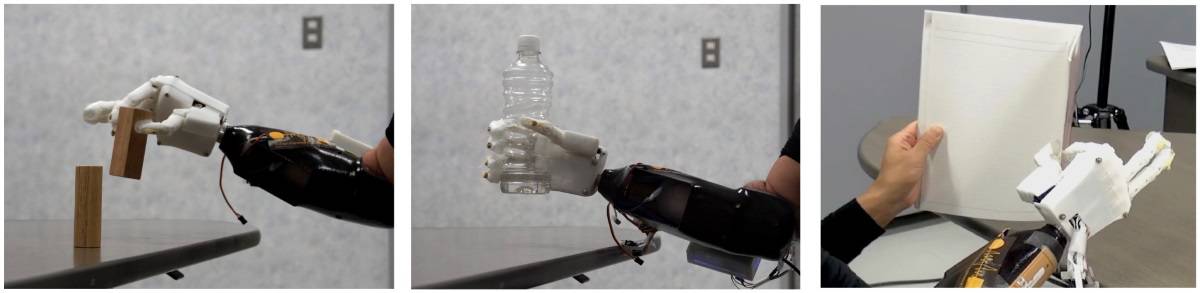
The researchers developed a custom-configured forearm socket with embedded EMG electrodes for the amputee participant. Sitting in the same position at a table, he performed four single motions and one combined motion, with each motion task performed twice for 10 s. This participant also used the prosthetic hand to pick up a notebook, a plastic bottle and blocks, for 60 s each.

Control tasks

Lead author Akira Furui and colleagues reported that every able-bodied participant performed all finger motions with greater than 90% accuracy. Those who could see the hand motion achieved an average accuracy of 97.3%, compared with 91.7% for the blinded group. The amputee participant achieved a classification accuracy of greater than 89% for both single and combined motions, with an average accuracy of about 92%. “These results indicate that the proposed system can be applied to situations in which actual use of prosthetic hands is likely to occur,” wrote the authors.

The researchers need to refine this prototype so that it can be operated easily over long durations without muscle fatigue, with posture changes and to ensure that classification accuracy of EMG patterns will not decrease. A research priority is to improve the robustness of the EMG pattern classification.

Next, the researchers hope to test the prosthetic hand on multiple amputee participants and develop a formal training programme. They also aim to introduce sensory feedback mechanisms to provide better movement execution and force regulation, ultimately resulting in a practical and intuitively controllable prosthetic hand.

Intergalactic explorers’ handbook

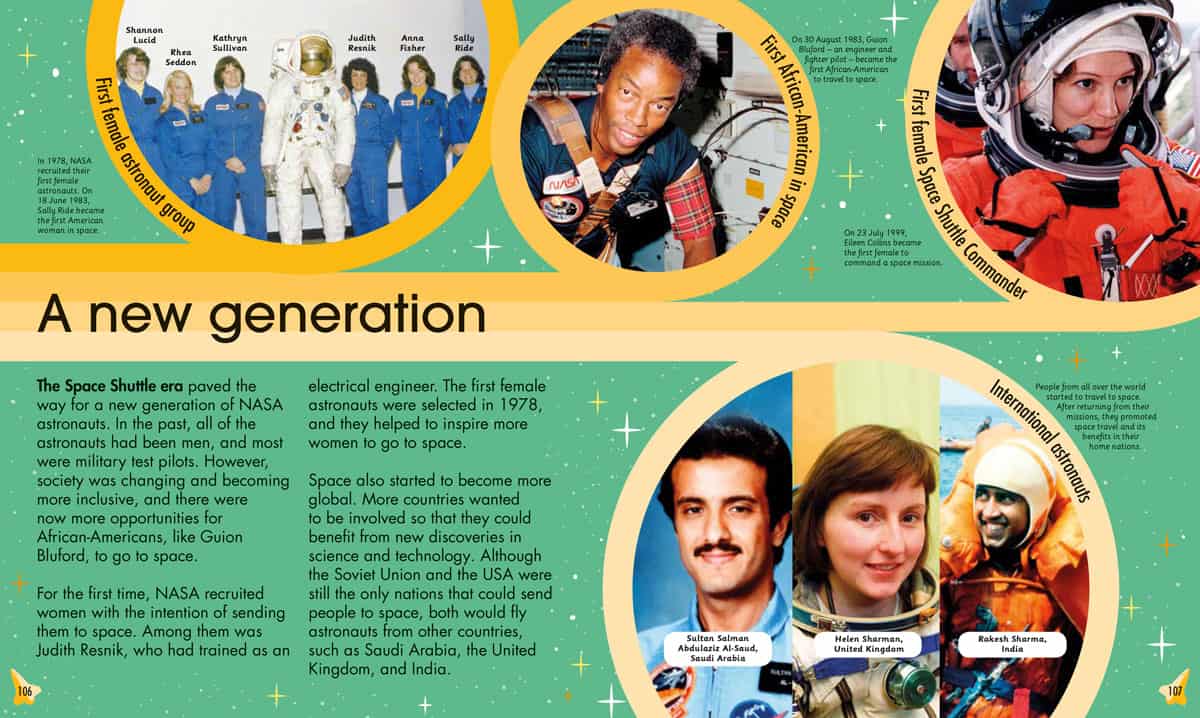
“Being in space is awesome. It’s the most amazing human experience,” writes NASA astronaut Eileen Collins in the foreword to The Space Race by Sarah Cruddas, the latest book about the Moon and space travel to hit the shelves this year. Collins, the first ever female Space Shuttle commander, sets the right tone to kick off this children’s book that will take young readers from Earth to the Moon, across the solar system and much further beyond.

The book is divided into three main sections – “To the Moon”, “After Apollo 11” and “The New Space Race” – each of which include nearly 30 double-page spreads. In the first section, Cruddas quickly but clearly covers nearly 100 years of aeronautic research (actually she goes as far back as the first gunpowder-powered rockets built by the Chinese in 1200 CE, but then jumps forward to the start of the 20th century, when scientists really began thinking of sending rockets into space). Zipping from Wernher von Braun and Sergei Korolev to Yuri Gagarin and Alan Shepard, this section swiftly brings us to the Moon. Along the way, children will learn about everything from the first animals in space to how astronauts learned and trained to walk in space.

With a shiny silver cover, large square format and brightly coloured illustrations, this book is sure to catch and hold any child’s attention. Indeed, the artwork, created by popular children’s book illustrator Mark Ruffle, really brings this book together. With their vivid colours and slightly vintage style, the graphics keep you turning the pages.

Rocket women

One of my favourite spreads in the book is “Rocket women”, which highlights the Mercury 13 – a group of talented and ambitious female pilots all of whom passed NASA’s rigorous astronaut testing in the early 1960s, but sadly never made it into space. A photo of them standing with Collins prior to her first launch in 1995 is particularly touching – but including these stories in books aimed at children is of importance even today.

Another excellent spread is that depicting the Lunar Module. While simple and not too detailed, it outlines all the key parts of this amazing achievement in engineering. And a similar two-page spread does a great job at labelling all the parts of the astronauts’ spacesuits.

The “After Apollo 11” section of the book has a few fun pages showing Neil Armstrong, Buzz Aldrin and Michael Collins “on tour” around the world, post their historic first mission to the Moon. Most of that section then follows the other Apollo missions, their various triumphs and failures, the legacy of the Apollo missions, and what it meant for humans to have reached space at that time in our history.

Space Shuttle

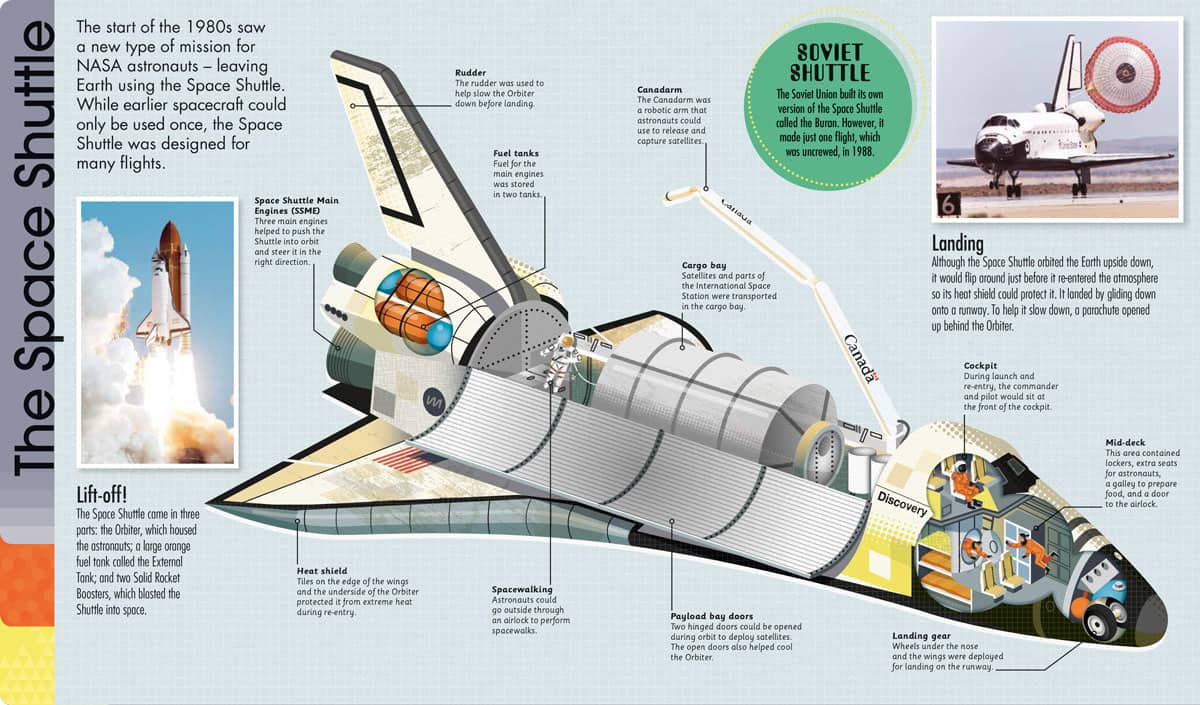
Cruddas spends a good few pages, as she should, detailing the Space Shuttle and the “new generation” of NASA astronauts that it paved the way for. It is at this point where the much more international nature of modern space travel becomes visible, as astronauts from different countries are featured, including Helen Sharman, the first British astronaut to go into space. The book touches on other space-based ventures such as the Mir space station and the Hubble Space Telescope, and of course the International Space Station (ISS). There are many detailed and informative pages that cover the vast amount of research that has been carried out on the ISS over the years, and the many astronauts who have visited it.

The final third of the book, “The New Space Race”, is what sets this book apart in many ways. While there are numerous books about space travel for children available, I can’t think of many (or indeed any) that actually tell the story of what is happening today in the space sector. Cruddas – a trained astrophysicist and BBC broadcaster who specializes in the commercial space sector – is particularly well placed to tell this part of the story. She deftly covers everything from asteroid mining to getting humans to Mars, from SpaceX and its landing rockets, to the problems of space junk and space tourism.

New generation astronauts

This section includes a spread on “space creations” that touches up how 3D-printing technology is already being used on board the ISS to build small tools and devices. To further inspire young readers, Cruddas has also included a spread on “space jobs” of the future, where she highlights roles such as spacecraft designer and space farmer, as well as an interview with Virgin Galactic test pilot Kelly Latimer.

The penultimate spread, depicting “future spaceships” that could carry small nations across interstellar space (or through a wormhole even) is truly exciting and sure to fire the imaginations of all readers, young and old alike.

  • 2019 DK Children 192pp £16.99hb

Planet and profit forge alliances in the materials industry

“We need to get better at doing more with less,” Ed Lester, a professor at Nottingham University and technical director of the spin-out company Promethean Particles told attendees at the Advanced Material Show at Telford International Centre in the UK last week. Promethean Particles opened up the world’s largest nanoparticle plant in 2016, its vast production capacity enabled by continuous online liquid product formulation, which has efficiency advantages over the synthesis of dry nanoparticles mostly for later dispersion in a liquid. As the self-styled “McDonald’s of manufacture” for fast nanoparticle synthesis Promethean Particles may not be the first place you would look for an advocate of an abstemious approach in the materials industry, but Lester was far from alone in voicing concerns over sustainability.

Waste less

Less waste often means lower costs so that environmental interests aside, efficiency savings have an inherent attraction. In terms of less waste in production of materials, and nanomaterials in particular, real-time monitoring can make a real difference. In the past manufacturers have sent samples from batches away for product-control sizing measurements, but finding out at the end of a batch that the sizing is off can write off large quantities of product already made.

Sam Barton, a service engineer from Xoptix described how laser-diffraction particle sizing can help.  “Laser measuring is simple,” he told Physics World, adding that although these sizing measurements have traditionally used a whole benchful of optics, the set-up can be much more compact.  The Xoptix equipment can fit in a large brief case, and installed alongside the production system it can steer samples of the product away for testing and back into the production apparatus to take measurements in real-time and flag up any problems. Other companies at the show including as Malvern Panalytical are also now promoting inline and in situ measurements.

Thin advantages

Nanomaterials may also contribute to minimizing the toll on the planet’s material resources on account of their enhanced properties, which often allow product designers to make layers thinner while still matching or improving on the performance offered by incumbent materials. While thin layers with electronic and optoelectronic functionality are making waves in potential flexible devices and roll to roll printing for low-cost manufacture, applications exploiting mechanical properties can benefit too.

The Graphene Engineering and Innovation Centre (GEIC) in Manchester plans to pilot a graphene-enhanced road near the centre. “The road isn’t ours to lay,” GEIC Chief Executive James Baker told Physics World, emphasising that the project is in its infancy at present. However conversations with the council are promising and the project also now benefits from six months of data for analysis from a graphene-enhanced road laid side by side a conventional road in Rome. The hope is that incorporating graphene could help towards thinner more durable layers of materials. “The big benefit comes if you can de-ice it,” added Baker, highlighting the challenge of rapid fluctuations between warm and freezing temperatures from day to day in the UK that leads to water freezing and expanding in cracks to form potholes.

This is not carbon

While environmental benefits may feel good for the manufacturer, it’s the attraction they hold for the consumer that makes or breaks the business case. “People won’t pay for green,” Christian Fischer CEO and co-founder of Bcomp told attendees. Bcomp produces automobile materials based on flax, a plant commonly grown anyway as a rotation crop in agriculture. The flax-based material now has a strong offering in the world of motor-racing, where traditionally 50% of the car volume is plastic. However convincing people that there was a place for these alternative more sustainable materials in the sector was far from simple. “Guys my customers just aren’t ready for this brown chalet chic Swiss kind of look – they want carbon,” was the initial response. However, by focusing on light-weighting, a goal shared by any other high-performance automobile manufacturer, Bcomp were able to present a product that could sufficiently outperform incumbent materials to grab notice, with the added bonus of great green credentials.

Re-use, recycle

Bcomp offers alternative to plastics for some applications, but the permanence and prevalence of plastic pollution is an issue all industries need to tackle. As Sally Beken from the Knowledge Transfer Network, who heads the recently established UK Circular Plastics Network told attendees, “It’s not a bad material, the problem is our poor husbandry of it.” Part of the challenge in retrieving and recycling plastic has been the lack of standardization and a proliferation of different plastics each requiring different treatments. For certain plastics established recycling schemes and infrastructure are helping to reposition the material among the more environmentally benign. Government incentives encouraging the use of recycled plastics mean that recycled PET, for example, commands a higher purchase price than the originally produced material. In contrast “biodegradable” plastics can still cause problems if they end up in the ocean, as degradation takes significantly longer at the colder temperatures there.

Design for manufacturing; design for recyclability - Fernando Castro, National Physical Laboratory

Ambitions for recycling have even risen to the lofty heights of space projects, the most braggadocious being the reusable rocket aspirations of SpaceX. A lot can go wrong when sending a rocket into space so again monitoring and real-time measurements are key. Nanmac supplies SpaceX and various other clients with thermocouples for temperature monitoring. The key materials challenge for thermocouples monitoring the extremely high temperatures of rocket launch is the sheath, which needs to protect the instrument from degradation while still letting the temperature through. As a company that span out from Nasa 65 years ago, Nanmac has ample experience in handling the extremes of space missions, but for SpaceX they have now mastered the additional requirement allowing the thermocouples to be re-used.

“Design for manufacture; design for recyclability,” urged Fernando Castro, Head of Materials Science and Engineering at the UK’s National Physical Laboratory, during a session on nanoelectronic materials – design and development. “Because further down the road it becomes much more costly.” The advice highlights a theme that pervaded the conference, that sustainability practicalities merit equal consideration with a material’s production, and that ultimately the long-term interests of materials companies and the long-term interests of the planet are unequivocally entangled.


Green power curtailment in China

There have been problems with curtailment of renewable energy outputs in China.  Many of the country’s wind projects are in remote areas in the north-west, poorly served by grid links. They have sometimes been unable to dispatch their full potential output to users, most of whom are in the major urban areas on the south-east coast. Similar problems have faced some solar projects. Basically, the rush to deploy wind and photovoltaics (PV) overwhelmed the grid system.

One response has been to slow down the deployment rate of wind and PV while grid improvements were made. As I noted in an earlier post, new projects were halted in some areas and capacity caps and quotas imposed, that also being a response to a cost/subsidy overshoot problem caused by the very rapid deployment. The government was forced to suspend all new subsidized solar capacity approvals for a while, after a record 53 GW capacity increase in 2017 left it with a backlog of at least 120 billion yuan ($18 billion) in subsidy payments. So there was a big slowdown.

Necessary action

Clearly something had to be done about the cost overshoot and about curtailment, with a slowdown being an obvious first step. The PV curtailment rate across China had risen 50% in 2015 and 2016, with over 30% of available power in the north-west provinces Gansu and Xinjiang failing to reach the grid. Curtailment of surplus wind output had reached 20% in 2016 nationally and was much more in some remote locations with poor grid links – 43% in worst-case Gansu province. However, there has been progress. Curtailment fell to 33% in Gansu and 15% nationally in 2017. With the slowdown no doubt helping, efforts are now under way to get curtailment down to 30% in the worst locations, Gansu and Xinjiang, and to 20% in Jilin, Heilongjiang and Inner Mongolia. The expectation is that it could be completely eliminated in Heilongjiang, Jilin and Ningxia, while Inner Mongolia is expected to reduce it to below 5%.

In the meantime, the slowdown has helped with the subsidy overspend, as has the fall in cost of PV and wind. In January 2019, China’s National Reform and Development Commission (NRDC) reportedly said that solar construction costs in China had fallen 45% from 2012 to 2017, while wind project costs had dropped 20%. As a result, the subsidy system was being revamped, with some wind and PV projects able to go ahead subsidy-free. Some projects will still get subsidies but the NRDC said “the economic efficiency of projects has steadily increased, creating favourable conditions for state subsidies to retreat and pressures on subsidy funds to ease”.

It seems China’s renewable power capacity will continue to rise. Indeed, by the end of 2018, it had reached 728 GW, up 12% on the year before, according to the National Energy Administration (NEA), and representing 38.3% of China’s total installed power capacity. It included an extra 20 GW of wind and 44 GW of PV. Reuters said “China has tried to change the ‘rhythm’ of renewable power construction to give grid operators time to raise transmission capacity and ensure clean electricity generation is not wasted”. The NEA noted that overall rates of waste in the wind power sector had fallen to 7% in 2018, down five percentage points on the year before, although the major wind generation regions of Xinjiang and Gansu in the far northwest had still failed to get around a fifth of potential wind power onto the grid over the period. There is still a way to go.

More change please

Further improvements are clearly needed. However, looking at it optimistically, a recent report from the US Brookings Institution says “if renewable energy curtailments were to be resolved, then its share in meeting new electricity needs will raise from 37.8% to 63.4%. Similarly, it will increase its share of total electricity generation by 1.6% (from 26.4% to 28.0%)”.

In some ways it’s a little surprising that China has had these problems. With ostensibly high levels of central control China ought, you might think, to have more coherent energy system planning and regional grid co-ordination. However, the reality seems to be that what exists is what has been described as “fragmented authoritarianism”, with rival bureaucratic cliques having conflicting or at least confused jurisdictions. Not too dissimilar from elsewhere perhaps! Though as we have seen, it has had some unwelcome impacts on China’s renewable developments with, for example, edicts coming from central government about building more generation capacity but local regional agencies having responsibility for grids but not always being given the resources to meet them. Clearly, much more needs to be done in terms of national and local grid-strengthening, better project siting and systems design, as well as more integrated planning and institutional policy processes.

Meanwhile, in terms of grid upgrades, one central government priority has been to improve links to the giant 22.4 GW Three Gorges hydro project, which is in the middle of the eastern part of the country, some way from urban centres of power demand on the eastern and southern coast. A series of High Voltage Direct Current (HVDC) links has been built to East and South China, over distances of around 1,000 km, to transfer electricity from the hydro project, and presumably that will also help wind and solar projects in the area. In all, the total capacity of the HVDC links is 7200 MW, with line losses put at about 3%.

Supergrid spread

HVDC links are also being made further afield, from Liaoning, Tianjin and Shandong to Russia and Mongolia. That can help with balancing for China and maybe for other countries in Asia. Given its huge wind, solar and hydro resources, China may at times have some energy to spare for sale, as long as it improves its internal grids, yet at other times the nation may need some balancing inputs. For that, there is abundant wind potential available in Mongolia, where there are also plans for developing large-scale concentrating solar power (CSP) projects in the Gobi Desert. For example, excess power (1 GW’s worth) from the proposed Gobitec CSP project would be exported to urban centres in China, Japan and South Korea via a new network of nearly 4000 km of high-voltage direct current (HVDC) transmission lines.

That could see the creation of an Asian supergrid network, something that Japan in particular, being a series of islands with limited land area for renewable energy projects, may find very helpful. It could also provide useful balancing by linking up renewable inputs across a very wide area at, it is claimed, reasonable cost. As I noted in an earlier post, a variant of this idea, promoted by the Japanese Softbank Group and Japan’s Renewable Energy Institute (REI), is the so-called Golden Ring. Wind energy generated in Mongolia would be transmitted via China and South Korea to Japan, using HVDC links and undersea grid cables, and hydropower from Russia would also be delivered to Japan and other nations. Companies in each region have expressed interest.

That may be some way off but taking it one – big – step on, China has reportedly been looking seriously at the idea of a $50 trillion global grid. But first it must get its internal grids sorted. It is certainly trying with, as I noted earlier, vast cross-county HVDC supergrid links, of which 30,000 km has already been completed. The main aim of supergrid systems is to enhance trade but they would also aid balancing and could reduce the need for local curtailment. Though at a cost. In my next post I look at the somewhat heretical idea that we should accept curtailment since dealing with it will be too expensive.

The above is based in part on material in the new updated and expanded edition of my IOP book Renewables, out later this year.

Copyright © 2026 by IOP Publishing Ltd and individual contributors