“Adding biochar improves soil quality, helps the soil store both nutrients and water and makes the soil a better media for plant roots,” says David Laird of Iowa State University, US.
Farmers often burn or plough the stalks and plant debris left after harvesting. If instead these remnants cook slowly in low-oxygen conditions, the resulting biochar can be reused as a soil conditioner.
Hamze Dokoohaki, then at Iowa State University, US, investigated where farmers in the US are likely to see benefits from biochar. Together with Laird and other colleagues, Dokoohaki collated data from previous studies to analyse the relationship between biochar application and crop yields.
“While there is no or little incentive for farmers to adopt most climate change mitigation practices, the potential yield increase following biochar application has made it a promising new climate mitigation strategy,” write the scientists in Environmental Research Letters (ERL). “Farmers will have to weigh the cost of applying biochar—which usually happens in the first year—with the increase in revenue triggered by higher yields in subsequent years. Thus, the ability to accurately predict crop yield response to biochar applications is critical to the development of a viable biochar industry and to the design of incentive programs to enhance biochar adoption and carbon sequestration.”
“Under current economic and regulatory conditions, biochar is not going to be profitable for most grain farmers,” says Laird.
But farmers working on poor quality soils and those growing high-value crops could still benefit. Applying biochar to maize tended to boost revenue more than using the technique on soybeans or wheat.
“The US southeast has highly weathered soils that are acidic and have low nutrient holding capacity,” says Laird. “These soils are anticipated to be very responsive to biochar, because biochar treatments can be engineered to help solve these problems.”
To be economically worthwhile for take-up by farmers across a quarter of US cropland, biochar would need to produce yield increases of over 6%, the team found. Covering one tenth of US cropland would need yield increases of 8.8% upwards.
If carbon taxes were introduced in the US, biochar would become far more economically viable.
With yield increases of around 5.5%, biochar application in the US would sequester enough carbon in soil to offset just over 0.5% of US greenhouse gas emissions, the results showed.
Worldwide, tropical and subtropical regions tend to have some of the poorest soil quality. Countries like China and India have a long history of burning crop residues, which forms a major source of air pollution. Switching to producing biochar could both reduce air pollution and significantly increase crop yields.
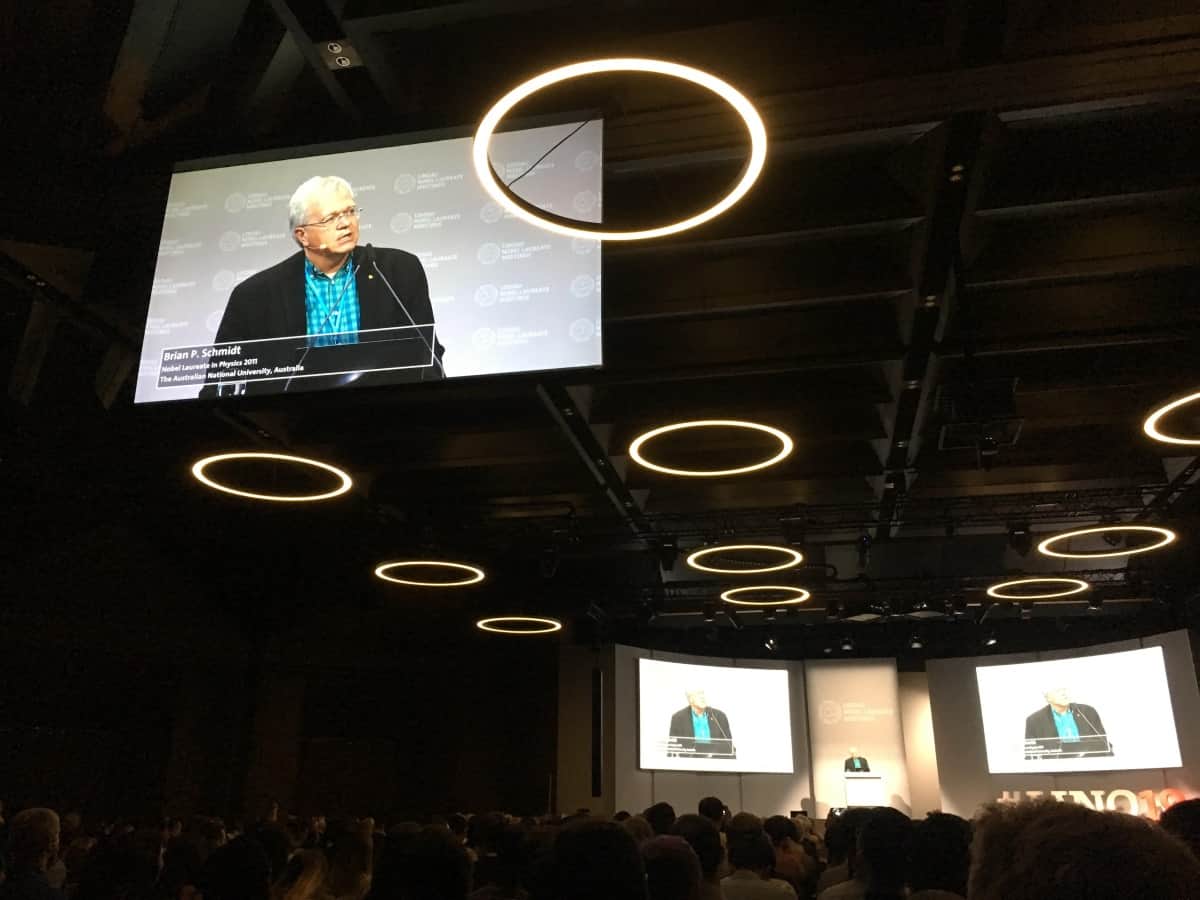
Herzliche Grüße from Lindau! With a packed program, it already seems a while since Sunday afternoon, when young scientists and laureates escaped the 35 °C temperatures for the air-conditioned Inselhalle and the official opening. There, the opening keynote by Brian Schmidt, 2011 Nobel laureate and now Vice Chancellor of the Australian National University in Canberra, was a big hit.
Cosmologist Brian Schmidt implores young scientists to “think big” to address the climate crisis (Courtesy: Jude Dineley)
Schmidt has a knack for clear, engaging communication, making his rallying call to young scientists all the more persuasive. “We live in a time where use of Earth’s resources is not sustainable over the current human lifetime,” he said, highlighting the challenges presented by the climate crisis. “But there is hope, and hope is here is this room.”
The cosmologist implored early career scientists to reach out to politicians and wider society. Within academia, he called on them to think big, develop the technological solutions to society’s problems, support an open scientific community and tackle their own subconscious biases.
I briefly chatted to Schmidt in a coffee break yesterday morning. It’s no mean feat – in Lindau, when laureates stop moving, a halo of excited young scientists quickly forms around them. He told me, quite sincerely, “these issues are close to my heart”.
Earlier that morning, I joined young scientists at a Science Breakfast event, Reaching for the Stars, where Schmidt was a guest panellist. It was organized by a South African delegation; this year’s nominated host country at Lindau. The title is a nod to the blossoming astronomy community there, largely a consequence of the country’s co-hosting of the Square Kilometre Array (SKA) radio telescope.
The discussion focused on the country’s ambitions for physics, in which young scientists will play an important role. As moderator Beverley Damonse from South Africa’s National Research Foundation explained, there is strong political will to invest in and grow research, technology and innovation within the country – and the government recently released a policy document detailing planned initiatives. According to Damonse, these initiatives are seen as a way to tackle problems faced by South Africa, which include a struggling economy, high unemployment and widespread poverty.
Part of the puzzle for emerging research nations is attracting young talent. Responding to a question from a young scientist from Thailand, panellists emphatically extolled the benefits of outreach to achieve this. One was Buyisiwe Sondezi, senior lecturer at the University of Johannesburg and the first woman in Africa to gain a PhD in the experimental study of highly correlated matter. One approach she uses is to go into high schools – where she speaks to students about her work and maintains contact up to school-leaving age. “I found that strategy working, although it takes a bit longer,” she commented. “You have to be patient for a result.”
Country-wide, it would seem such efforts are working. There has already been a marked increase in postgraduate students, women included, reported Damonse. In the audience, Master’s student Tanita Ramburuth-Hurt from the University of Witwatersrand in Johannesburg is one of them. During the session Ramburuth-Hurt asked: “Where does the panel expect to see South Africa on the global scientific stage in the next five to ten years?”
Sondezi replied that that are good reasons for optimism, citing multiple initiatives in universities to grow research and government support. “The future’s very bright for the country,” she told the audience.
Relative to the size of the Earth, our Moon is more massive than any other planet-moon combination in the solar system. For that reason, it has a big influence on life on Earth. So what would happen if the Moon were to vanish; or perhaps if we had multiple moons? That is the subject of a feature by Ethan Siegel, written for July’s PhysicsWorld, a special issue celebrating the 50th anniversary of the Apollo 11 Moon landing.
Spectral-domain optical coherence tomography (OCT) is the gold standard for diagnosing retinal diseases such as macular degeneration and diabetic retinopathy, as well as glaucoma. OCT is particularly useful as a screening tool for early detection of disease. But widespread screening is hindered by the large size and expense of OCT systems, which can cost more than $100,000.
Biomedical engineers at Duke University have now developed a portable OCT scanner that’s 15 times lighter than current commercial systems and is expected to be sold for less than $15,000. The team hopes that the new scanner, which delivers comparable image quality to current systems, could increase access to retinal imaging and help bring this vision-saving technology to underserved regions throughout the world (Trans. Vis. Sci. Tech. 10.1167/tvst.8.3.61).
“Once you have lost vision, it’s very difficult to get it back, so the key to preventing blindness is early detection,” says lead author Adam Wax. “Our goal is to make OCT drastically less expensive so more clinics can afford the devices, especially in global health settings.”
System redesign
OCT is an interferometric technique that works by sending near-infrared light into tissue and detecting the backscattered signal. A spectrometer compares the phase of this returning light with that of a reference beam that has travelled the same distance but not interacted with tissue, and uses the time delay information to create a depth profile of the tissue structure.
To build a smaller, less expensive OCT device, Wax and his former graduate student Sanghoon Kim redesigned the spectrometer. While traditional spectrometers direct light through a W-shaped series of lenses, mirrors and diffraction slits, in Wax’s spectrometer, the light travels on a circular path within a housing made mostly from 3D-printed plastic. This means that any mechanical shifts arising from temperature changes occur symmetrically, balancing out to keep the optical elements aligned. The device also uses a large detector at the end of the light path to minimize misalignments.
The handheld scanner, which contains the light source, reference arm and sample arm, weighs less than 500 g. The system body, which houses the custom-designed spectrometer and an integrated mini-PC, weighs 1.8 kg. The team also incorporated a touchscreen into the system body to enable data acquisition control and display of the retinal images.
“Right now, OCT devices sit in their own room and require a PhD scientist to tweak them to get everything working just right,” says Wax. “Ours can just sit on a shelf in the office and be taken down, used and put back without problems. We’ve scanned people in a Starbucks with it.”
Clinical comparisons
In the first clinical trial of the new OCT scanner, retina surgeon J Niklas Ulrich from the University of North Carolina tested it’s performance against a commercial Heidelberg Spectralis OCT system. Ulrich imaged 60 eyes in healthy volunteers and 60 eyes with known retinal disease. Although the low-cost scanner is designed as a handheld device, for this comparison, it was mounted on a chin rest.
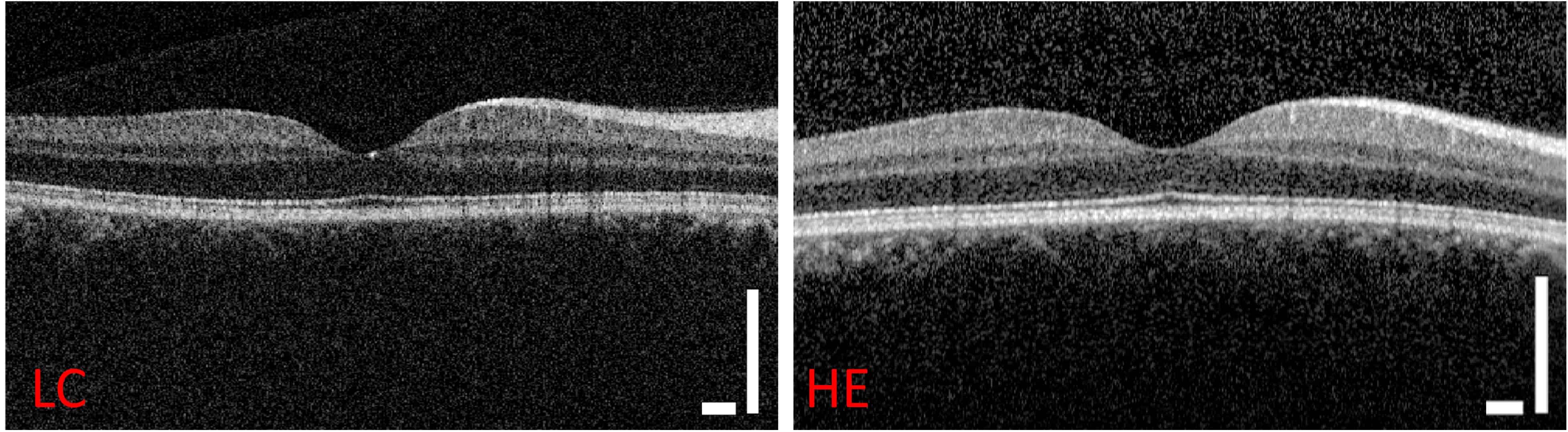
Retinal images taken by the low-cost OCT system (left) and a commercial device (right). The new system produced images that were 95% as sharp as those taken by the commercial system. (Courtesy: Adam Wax, Duke University)
The low-cost OCT demonstrated an axial resolution of 8.0 µm, a lateral resolution of 19.6 µm and an imaging depth of 2.7 mm for a 6.6 mm field-of-view. The images could clearly resolve relevant layers of the retina, comparable to those from the Heidelberg Spectralis system. The mean contrast-to-noise ratio (CNR) of images from the portable scanner was only 5.6% lower than that of the commercial machine, which is good enough for clinical diagnostics.
“I have been very impressed by the quality of images from the low-cost device, it is absolutely comparable to our standard commercial machines,” says Ulrich. “It allows for accurate diagnosis of structural retinal disease as well as monitoring of treatment success. The setup is quick and easy with a small footprint, allowing the device to perform well in smaller satellite offices.”
The researchers also imaged five patients using the scanner in handheld mode. They were able to obtain high-quality retinal images with an operator holding the scanner without a chin rest. There was no significant difference in mean CNR between images acquired in handheld mode and those acquired using a chin rest.
Wax is commercializing the device through the start-up company Lumedica, which is already producing and selling first-generation instruments for research applications. “There’s a lot of interest from people who want to take OCT to new parts of the globe as well as to underserved populations right here in the US,” he explains.
“With the growing number of cases of diabetic retinopathy in places like the United States, India and China, we hope we can save a lot of people’s sight by drastically increasing access to this technology,” says Wax.
It is a truism to say that the race to the Moon was never primarily about science. It was a political battle between superpowers, with ideology and economics at stake. Regardless of the motives, the US Apollo missions and the Soviet Union’s Luna programme did also result in plenty of new science and unprecedented technology breakthroughs. In addition, the era left many tantalizing questions about the Moon, which have grown more intriguing in recent years with data from unmanned missions.
Fast forward to 2019 and the race is back on. This time, there are more nations competing and the rise of commercial space players has diversified the field. But national pride, along with some big personal egos, are very much on the line once again. Fortunately, science and technology could stand to win as a result of this competition, with some of the key developments having been discussed at this year’s recent general assembly of the European Geosciences Union in Vienna.
Could we create a base on the Moon that could accommodate long stays and the possibility of a permanent human presence?
During a session on lunar science and upcoming lunar missions, delegates pondered questions such as how exactly the Moon formed, assuming it aggregated from the debris left by a collision between early Earth and a Mars-sized body. With its lack of atmosphere and plate tectonics, could we find clues to the origin of life on Earth preserved within the lunar geology? And could we even create a base on the Moon that could accommodate long stays and the possibility of a permanent human presence?
Targeting a lunar gateway
Moon missions are coming thick and fast. In March US vice-president Mike Pence declared that the US wants to return astronauts to the lunar surface by 2024 (which would be the final year of Donald Trump’s presidency, should he win a second term). The landing would be part of NASA’s Artemis programme, named after Apollo’s twin sister in Greek mythology. The concept is for lunar landers to depart from the planned Lunar Gateway – a small lunar-orbiting space station being developed by NASA and its partners.
Pence’s announcement came less than three months after China made history by landing the Chang’e-4 spacecraft on the far side of the Moon on 3 January. In relaying images and data back to Earth, Chang’e-4 became the first mission to operate on the far side of the Moon – the hemisphere that always faces away from Earth. Studying this rugged and varied landscape could provide important information about how the Moon and the rest of the solar system formed (see ‘Exploring the far side’).
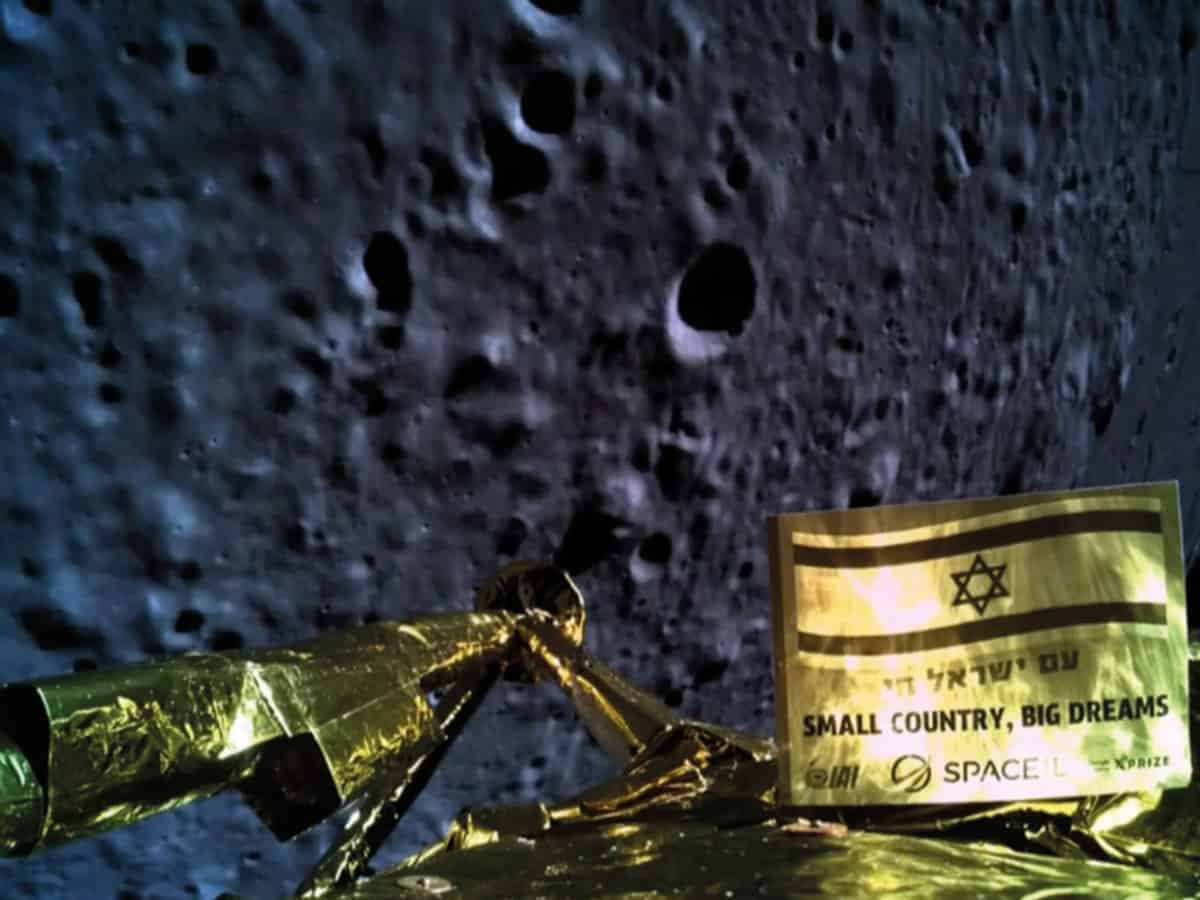
China’s success means that it is joined by Japan, India and the European Space Agency (ESA) in having successfully sent craft that have orbited, landed on or flown by the Moon. But private organizations have also entered the game, notably the European contractor LuxSpace, which in 2014 became the first private probe to fly by the Moon, piggy-backing on a Chinese mission. This April, meanwhile, the Israeli not-for-profit organization SpaceIL attempted to become the first private outfit to land a craft on the Moon, although its engine dramatically failed during the final moments of landing.
So near yet so far: SpaceIL was among several private players seeking to win the Google Lunar XPRIZE. This image shows its Beresheet lander 22 km above the lunar surface shortly before it crash-landed following an engine malfunction. (Courtesy: SpaceIL)
Private players
SpaceIL had originally been among several private players seeking to win the Google Lunar XPRIZE – to build, launch and land an unmanned spacecraft on the Moon. Although Google’s competition ended on 31 March 2018 with no winners, SpaceIL pushed on with its mission with private investment. Chris Russell, a member of the SpaceIL science team, told Physics World that the gamechanger for lunar travel is the arrival of private companies that can assist with launching rockets and planning missions. Indeed, SpaceIL’s Beresheet spacecraft (meaning “Genesis” in Hebrew) hitched a ride to space on one of SpaceX’s Falcon 9 rockets. “In the end, SpaceIL fell victim to the fact it’s very hard to go and land on the Moon,” Russell told EGU delegates the morning after the crash.
Another speaker in Vienna was Igor Mitrofanov of Russia’s Institute for Space Research in Moscow, who discussed Russia’s revived Luna programme. Scheduled for 2021, Luna-25 will be Russia’s first mission to the Moon since Luna-24 in 1976 and it will be swiftly followed by the Luna-26 orbiter in 2023, then the Luna-27 lander in 2024. These three missions will investigate the chemistry of the lunar permafrost in the Moon’s cold southern polar region. Although the origin of life is still a highly contested question, some believe that it could have been seeded by complex molecules contained in asteroids that bombarded the Earth. The mechanism through which life then emerged is not clear, but any “pre-organic” molecules preserved in the lunar ice may provide clues. The absence of an atmosphere and plate tectonics means the Moon can provide a frozen record of the Earth’s advanced history.
In addition to the science goals, Russia’s upcoming missions will also test a new “soft-lander” technology, which Mitrofanov compared to a reverse-parking system you find in cars. If successful, this technology could assist future astronauts to guide themselves to a safe landing, clear of hazards including rocks and steep slopes. Indeed, the Luna programme will pave the way for a lunar base that can be visited by a future series of manned missions.
The last of the space cowboys
Matthias Maurer, who in 2018 became an ESA-certified astronaut allowed to travel into space, believes that Moon exploration should prioritize the creation of permanent bases akin to Antarctic research stations. Giving the keynote talk at the EGU session, Maurer explained how the “lunar village” will enable longer stays and more detailed scientific investigations. Maurer – a materials scientist by training – also spoke about the qualities required in the modern astronaut. Apollo-era astronauts needed “fast reactions like cowboys”, while the astronauts returning to the Moon will have to have a much deeper understanding of science and technology, especially the geology, he said.
Maurer discussed some of the research into lunar bases taking place at the new Luna facility at ESA’s Astronaut Centre in Cologne, Germany. By recreating the lunar surface on Earth, the centre is investigating how astronauts can live and work for longer periods in reduced gravity. It is seeking to develop sustainable sources of oxygen and energy, along with improved communications between astronauts and research scientists on Earth. Maurer was particularly animated when speaking about the flexible skin suits that could make physical tasks “10 times” faster than possible with current rigid pressurized space suits.
As a stepping stone to a permanent lunar base, ESA is also working with the Japanese and Canadian space agencies on HERACLES, a robotic mission planned for the mid-to-late-2020s. The aim is to land an 1800 kg rover on the lunar surface, controlled by astronauts located in the orbiting Lunar Gateway. An ascent module will take off from the surface and return to the gateway with samples taken by the rover.
Discussing the HERACLES project at the EGU meeting was planetary scientist Harald Hiesinger of the University of Münster, Germany. “To make it clear, HERACLES is not the perfect science mission. But it is a pretty good compromise between science and technology,” he said. “We were thinking of placing the Lunar Gateway in a near rectilinear halo orbit, which we can optimize for lunar surface missions. With this type of orbit, we can cover or reach the entire lunar surface.”
Ever wondered what Beethoven and bone have in common? According to researchers at Massachusetts Institute of Technology (MIT) in the US they both gain from being composed of structures over a range of scales be that notes, chords and melodies or amino acids, proteins and collagen matrices. Taking the analogy further Markus Buehler and colleagues have translated the vibrations of amino acids and the longer-range structures of the proteins they form into a musical framework. Machine learning algorithms trained on this musically transcribed protein data could devise fresh amino acid music based on musical principals learnt from the training data set, which the researchers then translate back into protein structures.
“What we’ve been trying to do in a lot of different ways is to find ways of predicting a protein’s functionality from its sequence and that’s a really difficult thing to do,” Buehler tells Physics World. For several years Markus Buehler and his group at MIT have studied materials including spiders’ webs and nacre to identify the hierarchical structures behind their impressive mechanical properties. He explains that current approaches to relating protein structure and function generally rely on long computational-resource-hungry molecular dynamics simulations to solve equations approximating the quantum mechanical interactions at the molecular scale in order to determine how the protein folds, and how it functions. “One of the directions we have pursued is to think how we look at materials, and we realized that when we look at materials at the molecular scale, the atoms and molecules continuously vibrate. So we thought that maybe there’s a way of capturing the spectrum of vibrations at the nanoscale and building a model from that.”
Based on the vibrational frequencies of amino acids the researchers developed an amino acid musical scale. They then encoded secondary structures that govern the way the proteins fold into other musical components such as rhythm and volume. Just as pictorial representations of data can make it easier to recognize patterns and trends, presenting the algorithm with a musical representation of the data may help identify relationships that have so far remained elusive, and already the results are promising.
“Based on a training [data] set, we can now come up with proteins that nature has not invented before,” says Buehler. “We’ve also found that some of the proteins that our AI method can generate are proteins that nature has invented, but they were not part of the training sets – it’s really fascinating that the method can sort of discover things that evolution has already discovered on its own. And this leads to the application of this work, that we’re now able to optimize protein sequences using this method because we can ask the AI to generate a large number of candidates, which we can then further categorize.”
Musical inspiration
Training a machine learning algorithm on an amino acid orchestra to discover new useful materials may seem a neat if unorthodox idea, but successfully putting it into practice has built on over a decade of work exploring the function and properties of hierarchical structures and the translation of theoretical models into different frameworks. As well as this unique catalogue of expertise in Buehler’s group, developments in AI have been crucial to making use of the approach.
Unlike classical western music, where each scale is made up of 12 notes separated by semitones, the amino acid scale has 20 tones, and sounds very different. Using the musical representation of proteins to reveal insights into the relationships between protein structures at different levels and their functions, requires not just a familiarization with this strange sounding music but the ability to ignore the principals of classical music.
“AI was a way of overcoming that limitation, to have a neutral model that has never heard any music but basically learned only from the data that was provided,” says Buehler. “Because one of the problems you have with a human brain, is that if you want to compose a new protein you tend to want to make it sound like the music you’ve heard before – this is sort of how composition works we’re trying to create or explore ideas, themes, chord progressions and so on that you have maybe heard before. Of course, in this case it doesn’t work, because these core progressions and melodies and successions of notes, might not at all relate to anything that’s important for protein.” While the system has already identified real and potentially realisable proteins, future work will require improved data sets to train the algorithms with the aim of identifying protein structures with specific folding and functional properties.
Unifying trends
Buehler is also optimistic about other sectors that could benefit from a musical representation of data. “Generally, I think there’s a very interesting fundamental insight that one can possibly get from this kind of work. An extension of this work would be the idea that many of these hierarchical systems actually show striking similarities in the way they’re built.” He describes the way materials like spider silk, bone, and nacre, or language or music share similarities in the way they are constructed to give rise to various functions from simple building blocks. “One of the general things I think that we could explore is whether we have discovered certain features or ways systems can be designed better in other representations.”
You can hear compositions from these musical representations on soundcloud or download an app to play with them yourself. Full details of the work applied to protein research are reported in ACS Nano.
This article was edited Thursday 4th July to include the audio clip
Stereotactic radiosurgery (SRS) is a precision-targeted radiotherapy technique that has registered significant success in treating single and metastatic tumours in the brain. By employing multiple narrow beams from different directions, radiation oncology teams are able to deliver conformal, high-dose radiation in one or a few fractions while minimizing collateral damage to surrounding healthy tissue and organs at risk. When used to treat tumours elsewhere in the body – for example, the lungs, liver and spine – these high-precision, high-dose techniques are known collectively as stereotactic body radiotherapy (SBRT).
Taken together, the growing clinical adoption of SRS/SBRT represents a significant dosimetric and quality assurance (QA) challenge for medical physicists and radiation therapy departments – not least in terms of the small treatment volumes (down to 0.75 cm3) versus standard conformal radiotherapy. The precision targeting inherent to SRS/SBRT means that all manner of different checks – machine, patient and end-to-end QA – are necessary to manage, verify and validate the treatment procedure to ensure that radiation is being delivered to the patient as intended (i.e. overall treatment accuracy needs to match the treatment planning margins of 0–1 mm).
Innovation in quality assurance
To support the ongoing clinical uptake of SRS/SBRT applications, Sun Nuclear Corporation, a US-based provider of QA solutions for radiation oncology, has prioritized development and innovation across a broad portfolio of products specifically for clinical teams delivering stereotactic procedures. “We take very seriously our role as an independent QA provider for SRS/SBRT,” says Jennifer Hamilton, a staff medical physicist at Sun Nuclear. “We’ve always believed that QA workflow has to be simple and user-friendly, or it won’t be done effectively.”
With that in mind, Hamilton says the focus at Sun Nuclear is “on getting the science right and standing behind the customer and the products”. Of Sun’s 300+ staff worldwide, the company employs more than 40 physicists, with around a third of the total workforce in R&D roles and 15% in customer support.
This gives us high-quality patient QA in minutes rather than hours and significantly enhanced patient throughput
Brett Miller, University of Tennessee Medical Center
At the heart of the vendor’s SRS/SBRT offering is the StereoPHAN phantom, designed for end-to-end commissioning and QA testing on all parts of the treatment process, including QA of image-fusion algorithms for CT and MRI as well as diode array, film and single-point ion-chamber dose measurements.
“StereoPHAN is incredibly easy to use,” says Hamilton. “It requires no tools, it indexes to the treatment table, and it does all the tests that the medical physicist needs to do for SRS end-to-end testing. A big plus is that it’s easy to quickly reconfigure for different needs, unlike a lot of other phantoms.”
The QA benefits are workflow efficiency and measurement accuracy. “After all,” adds Hamilton, “if I’m doing an end-to-end QA test and I have to use a screwdriver to take apart a phantom and then put it back together, how do I know I haven’t introduced positional error?”
Optimizing the workflow
Another core building block in Sun Nuclear’s SRS/SBRT portfolio is the SRS MapCHECK, a high-density diode array for patient-specific QA and end-to-end testing that’s billed as an “efficient digital alternative to film for small-field dosimetry”.
Designed to insert into the StereoPHAN, the SRS MapCHECK comprises 1013 silicon diodes, each with an active area of only 0.5 mm2, in a 77x77 mm effective measurement area – an arrangement that enables absolute dose measurement of field sizes as small as 5 mm with the tight spatial resolution (2.47 mm centre-to-centre) needed for SRS/SBRT.
“Prior to SRS MapCHECK, there really wasn’t an appropriate QA tool for SRS patient QA outside of film,” notes Hamilton. “However, the problem with film is that it’s temperamental and extremely time-consuming. To get consistently accurate absolute dose out of film the user needs to have really tight controls on their process. You can do it – it’s just painful.”
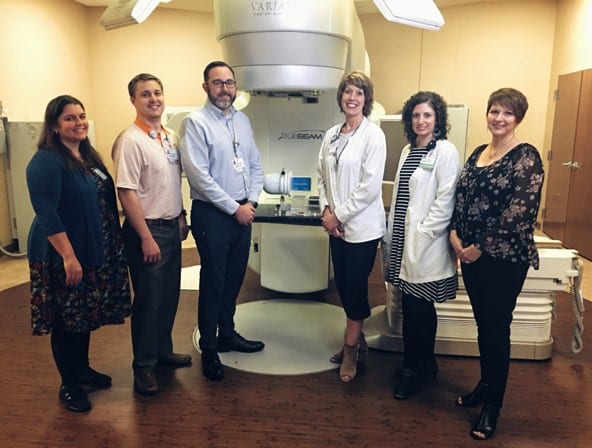
It’s all about outcomes: Brett Miller (third from left) and his team at University of Tennessee Medical Center see the use of SRS MapCHECK as “a win-win” for their QA practices and departmental efficiency. (Courtesy: University of Tennessee Medical Center)
Among the early-adopters of SRS MapCHECK was Brett Miller, chief physicist (radiation oncology) at the University of Tennessee Medical Center. Miller heads up a team of eight medical physicists and dosimetrists, and he is responsible for all aspects of radiotherapy QA and treatment planning at the Knoxville clinic. “The use of SRS [for brain] and SBRT [for lung, spine, and liver] has ramped up over the past couple of years and remains on an upward trajectory,” he explains.
Miller and his team were among the initial beta sites to evaluate SRS MapCHECK, starting in early 2018. Deployment into the daily clinical workflow followed about nine months ago, says Miller, yielding significant time savings and efficiencies along the way.
“Patient QA with SRS MapCHECK has become a routine part of our SRS/SBRT workflow, whereas before [with film dosimetry] it was a bit of a bottleneck,” he notes. “Ultimately, this gives us high-quality patient QA in minutes rather than hours and significantly enhanced patient throughput. It’s a win-win.”
What’s more, the whole point of SRS/SBRT is to focus high-dose radiation very precisely and have it fall off as quickly as possible to spare healthy tissue and nearby organs at risk. “SRS MapCHECK has very high spatial resolution, and a very small detector active area, so you can get a lot more detectors with precise measurement capability in a small field and actually see some of those high dose gradients,” explains Miller. “It allows you to confirm your targeting accuracy and your dose distribution accuracy.”
Hitting the spot
The Tennessee experience suggests that SRS MapCHECK has hit the sweet-spot in terms of SRS/SBRT QA, a view reinforced by the fact that more than 200 SRS MapCHECK units have been ordered since commercial release.
“We spent a lot of time ensuring that the small-field factors were accurate for SRS MapCHECK and I think the R&D team has done a fantastic job,” explains Hamilton. “We’ve also applied automatic angular dose corrections. Ours is the only 2D diode array with this capability and it means you can shoot at SRS MapCHECK from any angle – essential for SRS/SBRT where you’re rotating everything.”
In terms of next steps, R&D testing is now complete on a version of SRS MapCHECK that provides compatibility with Accuray’s CyberKnife robotic SRS/SBRT system and Varian’s HyperArc system. Commercial release will follow soon. “CyberKnife users are eagerly awaiting this next release,” Hamilton adds. “They’re ready for a patient QA tool that’s easier to use than film.”
Another Sun Nuclear QA product that’s generating plenty of clinical interest is the MultiMet-WL Cube, an insert for the StereoPHAN phantom that enables medical physics teams to verify the accuracy of single-isocentre, multiple-metastasis SRS treatments.
The problem this product is addressing is radial propagation of error, explains Hamilton. “In other words, if you have a very small offset in the very centre of your field, and then have large rotations in your plan, by the time you get out to the edge of your field that error could be really large – much larger than you can tolerate.”
This translates into a significant issue now that so many clinics are adopting multiple-metastasis, single-isocentre treatments over the whole brain. Hamilton continues: “The MultiMet-WL Cube is a simple way for medical physicists to measure within 0.1 mm accuracy the precision of their off-axis targets out to a range of 7 cm off-axis. It’s letting you know what your error is so that you can plan for it – ultimately yielding better targeting and better clinical outcomes.”
Sun Nuclear physicists, in collaboration with the radiation oncology team at Baptist Hospital in Miami, US, will present a clinical evaluation of the MultiMet-WL Cube at the upcoming AAPM Annual Meeting. They conclude that the MultiMet-WL Cube is a “readily usable off-the-shelf solution and a clinically useful tool for machine daily QA…and an effective supplementary tool for end-to-end testing for SRS”.
When NASA’s Apollo 11 craft landed on the Moon 50 years ago on Sunday 20 July 1969 at 20:18 (UTC), it was not just a significant moment in the history of science and technology. Those famous footsteps – first by Neil Armstrong and then Buzz Aldrin – were also witnessed by millions of “ordinary” people around the Earth.
It can be hard to comprehend how people set foot on the Moon with technology far inferior to today’s, especially as it's only now, five decades later, that we're thinking of sending astronauts back to the Moon again. But when that does happen, the insights from the Apollo programme will be crucial – after all, the 12 Apollo astronauts who walked on the Moon between 1969 and 1972 did more than just nose around.
One moment in time: it's 50 years since Neil Armstrong and Buzz Aldrin first walked on the Moon.
As writer and broadcaster Sue Nelson explains in the July 2019 special issue of Physics World, science was at the forefront of the Apollo missions, with their astronauts performing more than 50 experiments on the lunar surface and collecting around 382 kg of Moon-rock samples. Indeed, one experiment, the lunar ranging retroreflectors, is still running today, as Robert P Crease explains.
Elsewhere in the issue, Beijing-based science writer Ling Xin reveals the inside story of China’s Chang’e 4 craft, which is the first lander to explore the far side of the Moon (an image of which is depicted on the new issue's cover).
Finally, in a wonderful feature for which we've created a short, fun video (see above), astrophysicist Ethan Siegel reminds us just why our Moon is so important to us, by imagining a world in which our Earth had no Moon at all. It's all pure speculation of course, but as well as darker skies and much smaller tides, would we have even stepped foot on another planet? You can read the feature online here too.
You can enjoy the entire July 2019 issue of Physics World magazine via our digital apps for iOS, Android and Web browsers (membership of the Institute of Physics required). Let us know what you think about the issue on Twitter, Facebook or by e-mailing us at pwld@ioppublishing.org.
• A string of upcoming lunar missions will yield many scientific breakthroughs, as James Dacey discovers.
• Money from the Moon – James McKenzie reflects on the possible business opportunities from future missions to the Moon and beyond
• Defending the lunar landscape – John Budden calls for certain areas on the Moon to be protected from human interference so that they can be dedicated to radio astronomy
• Giant leaps for knowledge – NASA’s Apollo 11 mission will forever be remembered as the first to land humans on the Moon. But the mission and the rest of the Apollo programme should also be remembered for the science it achieved and enabled. Sue Nelson explores Apollo’s scientific legacy
• What's in a Moon? –What would life on our planet be like if the Moon were to vanish; or perhaps if we had multiple moons? Earth wouldn’t be the same without its constant lunar companion, as Ethan Siegel explains
• How high the Moon – Half a century after the historic Apollo 11 landing on 20 July 1969, Robert P Crease explains why the mission’s lunar laser ranging experiment is alive and well – and still encountering new frontiers
• Exploring the far side – The far side of the Moon remained an untouched territory until a Chinese lander, called Chang’e-4, touched down in the region earlier this year. Ling Xin examines the consequences for our understanding of Earth’s nearest neighbour
• Intergalactic explorers' handbook – Tushna Commissariat reviews The Space Race: the Journey to the Moon and Beyond by Sarah Cruddas
• Race to lunar space – Andrew Glester reviews Apollo 11: the Inside Story by David Whitehouse
• A new look at our old Moon – Sarah Cruddas reviews The Moon: a History for our Future by Oliver Morton
• Diamonds are a physicist's best friend – Julianna Photopoulos talks to Pascal Gallo, co-founder and chief executive of Swiss start-up company LakeDiamond, about his career in quantum physics and crystal growth
• Once a physicist – meet Louise Adams, an IT transformation expert at PA Consulting
• Microbes and the Moon – Michael Hill-King on why we quarantined the Apollo 11 astronauts.
The warming effect of aeroplane contrails on Earth’s climate could increase threefold by 2050, according to new research done by Lisa Bock and Ulrike Burkhardt at the German Aerospace Centre in Oberpfaffenhofen. Their study highlights the importance of looking beyond carbon dioxide emissions when considering the environmental impacts of the aviation industry.
Contrails are the familiar line-shaped clouds of ice crystals that appear behind aircraft and are usually created by the freezing of water vapour in engine exhaust. Ice formation is aided by soot particles – also emitted by jet engines – which provide nucleation sites. Contrails can also be created from ambient humidity when the wings of an aircraft cause a rapid drop in the local air pressure and temperature.
Contrails have the potential to linger and become artificial cirrus clouds. These clouds reflect infrared radiation coming up from the Earth’s surface far more than they reflect incoming solar radiation back into space. As a result, such clouds tend to trap heat in the Earth’s atmosphere and have an overall warming effect on climate.
Important, but overlooked
Indeed, contrail cirrus clouds are the single largest source of the aviation industry’s contribution to climate change, far outpacing the impact of aircraft carbon dioxide emissions. Despite this, however, their role is often overlooked and is not included in the United Nation’s upcoming Carbon Offsetting Scheme for International Aviation (Corsia).
“It is important to recognize the significant impact of non-carbon dioxide emissions, such as contrail cirrus, on climate and to take those effects into consideration when setting up emission trading systems or schemes like the Corsia agreement,” says Bock.
To this end, Bock and Burkhardt used a special atmospheric climate model to calculate the climate impart of contrail cirrus formation to explore the clouds’ projected climate impact by the mid-21st century.
The researchers incorporated the predicted increase in global air traffic – with four times more traffic expected in 2050 than in 2006 – which is the baseline year of the study. Also considered were improvements in fuel and engine efficiency and the slight upwards shift in cruising altitudes expected to result from ongoing changes in aircraft design . Such higher flying, the researchers report, is likely to increase the rate of contrail formation over the tropics.
Faster rise
From their modelling, the researchers estimate that the radiative forcing from contrail cirrus will be three times larger in 2050 than 2006. Furthermore, the climate impact of contrails will rise faster than that coming from the aviation industry’s carbon dioxide emissions, thanks to anticipated increases in fuel efficiency.
“Contrail cirrus’ main impact is that of warming the higher atmosphere at air traffic levels and changing natural cloudiness,” says Burkhardt. However, she added, “how large their impact is on surface temperature and possibly on precipitation due to the cloud modifications is unclear".
Bock adds, “There are still some uncertainties regarding the overall climate impact of contrail cirrus, and in particular their impact on surface temperatures,” noting that the effects of the clouds are an active area of research. Nevertheless, she concludes, “it’s clear they warm the atmosphere".
The team found that the climate impacts of contrail cirrus will be highest in busy air traffic areas above North America and Europe. They also predict a significant increase in the busier sectors of Asian airspace.
An often-proposed method for mitigating the overall impact of contrail cirrus is to reroute flights around those regions of the atmosphere that are particularly susceptible to the effects of the clouds. The researchers caution, however, that this approach risks increasing the emission of long-lived carbon dioxide, potentially making such a cure worse than the original disease.
Cleaner emissions
Instead, a better course of action may be to reduce soot emissions from aircraft engines to make ice nucleation less likely. “This would enable international aviation to effectively support measures to achieve the Paris climate goals,” Burkhardt says.
“Larger reductions than the projected 50% decrease in soot number emissions are needed”, Burkhardt says, however, adding that even a 90% reduction might not be enough to keep the climate impact of the clouds at the same level as was seen in 2006.
University of Leeds climate researcher Piers Forster highlights the importance of Bock and Burkhardt’s demonstration that the warming effect scales with increasing flights. “There was the possibility of the warming effect saturating, as contrails don’t have much effect if the sky is already full of them,” he says, adding however that “this study shows that any saturation effect is small".
“Overall, their results indicate that more radical solutions will be needed,” Forster concludes. “Flying lower and slower could reduce both carbon dioxide and contrailing,” he adds, “but in the end we might need to take the train more or simply stay home".
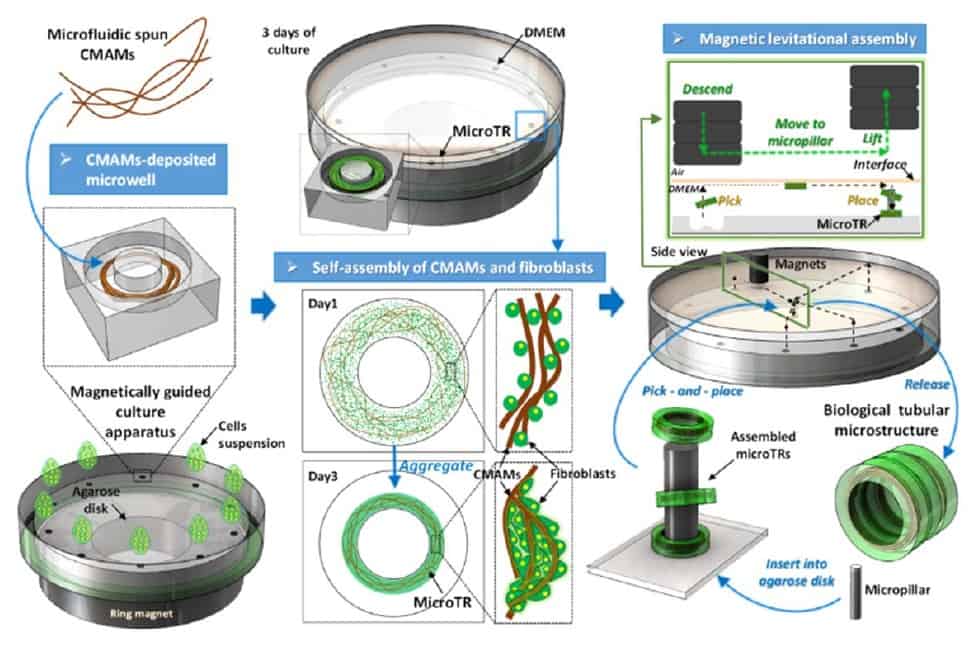
Schematic representation of the production of tissue micro-rings. (Courtesy: T Sun et al Biofabrication 10.1088/1758-5090/ab1ee5)
Tao Sun and colleagues from Beijing Institute of Technology have described a novel method to incorporate synthetic microfibres containing magnetic beads into self-assembled tissue micro-rings. Magnetic force, coupled with a smart usage of surface tension, enabled the adhesion and proliferation of fibroblasts on the micro-rings, as well as subsequent stacking of the rings into tubular structures (Biofabrication 10.1088/1758-5090/ab1ee5).
Finding tissue donors can be a limiting factor in the treatment of several diseases. For this reason, tissue engineering has become a booming field in the last decade, with scientists striving in their quest to replicate functional tissues in vitro. Many fundamental structures in the human body display a tubular shape (the trachea, oesophagus and blood vessels, for example) that researchers try to replicate.
Current trends in tissue engineering include the use of hydrogels, which have many advantages but come with a price: inhomogeneous cell distribution, as well as poor mechanical properties and limited nutrient diffusion. Alternative approaches to the direct delivery of cell-supplemented hydrogels to the injury site are already established. Among these is bottom-up structural assembly of biological tubes using tissue rings with incorporated microscaffolds. However, few microscaffolds are currently available as platforms. Therefore, Sun and colleagues examined whether tissue rings with incorporated microscaffolds could be created from microfluidic spun hydrogel microfibres.
In this study, the researchers incorporated magnetic particles in crosslinked calcium-alginate hydrogel fibres, with diameters optimized to provide the best support for cell growth and diffusion. To better hook cells, they coated the microspun fibres with poly-L-lysine residues bound to a fibronectin network.
To align the fibres in a parallel direction, the researchers exploited the surface tension of the fibronectin solution while transferring the rings in a culture dish placed onto a magnet before seeding fibroblasts on them. Thanks to the incorporated magnetic beads, they were then able to avoid floating of the rings, allowing for fibroblast seeding. Cell seeding was successful, with fibroblasts eventually spreading uniformly on the fibres, forming multiple layers and displaying good morphology and viability.
After three days of incubation, the rings self-assembled: the fibres guided the growth of fibroblasts, creating connections between themselves and the microgel, which resulted in the progressive shrinkage of the annular structures. The researchers then used magnetic force to serially assemble the micro-rings on top of each other around an inner pillar. This formed a cylinder that was cultured for five more days to let the cells seal the rings together. The result closely resembled the structure of a blood vessel.
Having provided this important proof-of-concept for bottom-up tissue engineering, the authors plan some important modifications to this platform in their forthcoming studies. These include addressing the observed formation of cell aggregates (possibly due to limited fibronectin coating), as well as the limited guidance of cell orientation. They envision that the substitution of alginate hydrogel microfibres with methacrylamide-modified gelatin (GelMA) microfibres will do the job.