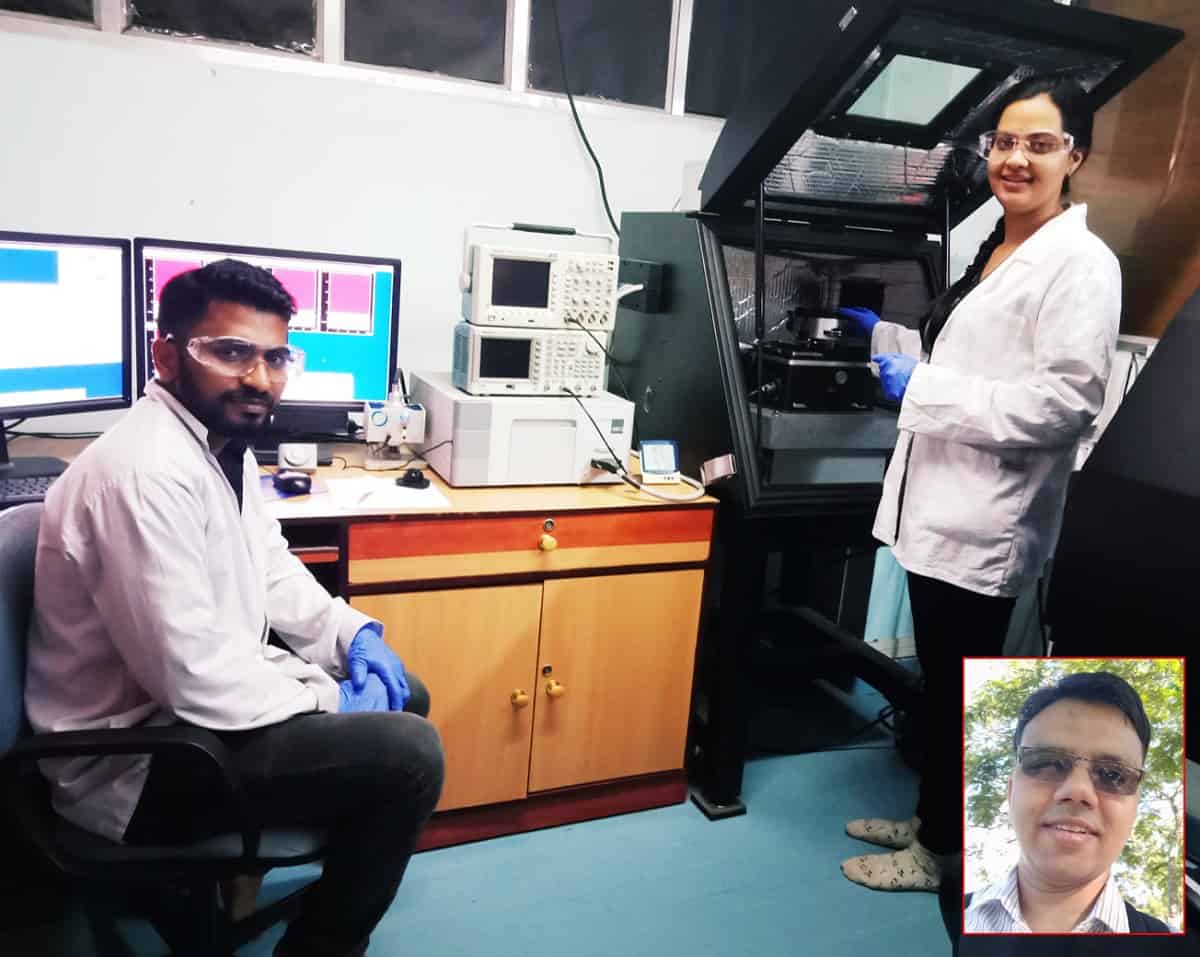
Richa Pandey (right) and SB Gangadhar (left), who developed the FASnI3 PENGs. Inset: Dinesh Kabra, who supervised the research. Credit: Pandey
Despite the potential of piezoelectric nanogenerators (PENGs) as energy harvesting devices, their integration into the human body has been stalled by dependence on highly toxic ceramics such as lead zirconate titanate (PZT). But now that scientists at IIT Bombay have unveiled the origin of ferroelectricity in lead-free hybrid perovskites, there may be a safer alternative. Indeed, PENGs made with their new technology could be perfect for powering self-sustainable devices such as pacemakers, health monitors and microsensors.
Piezoelectricity and ferroelectricity are inextricably linked – when a net polarization exists across the domains of a crystal (ferroelectricity), they are likely to respond to the application of an electric field by expanding or contracting (piezoelectricity). Scientists covet this curious behavior on account of the many associated applications in memory, power generation and sensing.
Within this context little attention has been given to hybrid perovskites such as FASnI3 (where FA is formamidinium) on account of its centro-symmetric unit cell, which should lead to no spontaneous polarization.
It therefore caused quite a stir when Dinesh Kabra and his student Richa Pandey demonstrated a remarkable piezoelectric response of 38 pm/V in this material, far out-performing the leading non-toxic piezoelectric BaTiO3 (28 pm/V) and the lead-based hybrid perovskite CH3NH3PbI3 (5 pm/V).
Pandey explains that there is more to the FASnI3 crystal than first meets the eye. “While on paper the FASnI3 crystal should be cubic, the bulky FA+ ion imposes a strain on the unit cell that breaks the centro-symmetry and induces a net polarization.” But the associated spontaneous polarization is still relatively small (6.1µC/cm2) compared with typical inorganic ferroelectric perovskites e.g. BaTiO3 (27µC/cm2). So why does FASnI3 exhibit a much stronger ferroelectric effect?
Soft optical phonons
In order to answer this question, the researchers had to look deeper into the fundamental vibrational structure of the crystal. In particular, they were keen to investigate the behavior of soft optical phonons i.e. the out-of-phase movements of ions in the lattice. “We found that these lattice vibrations are particularly active in FASnI3, and therefore the crystal is naturally disposed towards expanding or contracting along an axis that separates ions,” explains Pandey.
After unravelling the ferroelectric mechanism in FASnI3, the researchers set about enhancing the effect by incorporating the perovskite into a ferroelectric polymer and by carefully combining these two active components, they were able to further enhance the piezoelectric response to 73 pm/V.
This unprecedented performance led the researchers to consider possible applications. “PENGs create electrical power by squeezing piezoelectric materials. As FASnI3 produces one volt each time the lattice contracts by 73 pm, it is an ideal candidate for such an application,” explains Pandey. The researchers’ hypothesis was confirmed by developing a device with the novel material and measuring the 23 V generated, an unprecedented high amongst existing lead-free PENGs.
Pandey is quick to mention that device stability remains a significant barrier to future commercialization. “Now that we have presented the potential of FASnI3 PENGs, we must now focus on improving their lifetime. Work is underway to do this either by manipulating the intrinsic stability of the perovskite, or by protecting the device from oxidation through encapsulation.”
Expanding horizons of PENGs
While this performance has yet to reach that of commercial lead-based PENGs, the lower toxicity opens up a new set of applications. For example, the healthcare industry requires a sustainable way to power biomedical devices. Currently, life-saving machines such as pacemakers rely on batteries that have a finite operational lifetime. But FASnI3 nanogenerators could pave the way for completely self-sustained biomedical devices powered by the very beating of our hearts.
Chris Stark, chief executive of the UK government’s advisory Committee on Climate Change (CCC), recently outlined the CCC story so far. “In 2008, the first action of the newly independent Committee on Climate Change was to advise on the appropriate 2050 target for emissions,” he says. “At the time, there was no globally agreed temperature goal. So we judged, based on the available climate science, that an appropriate global climate objective would be 2 °C, and to avoid an extreme danger threshold of 4 °C. An 80% reduction in greenhouse gases by 2050, from their 1990 level, was our best estimate of the appropriate UK contribution to that goal. We said it was ‘challenging but feasible’ and that it carried a cost — of 1–2% of GDP — which was affordable to avoid a much greater economic cost in the future.”
Progress since then has been quite good. Indeed, Stark notes, it was often said that the UK is a global leader on climate change, with a 42% fall in production emissions from 1990 levels, while growing the economy by 70%. However, there was much more to do, he says, and to some extent so far we had only focused on the easy stuff — decarbonization of electricity supply: “we will shortly run out of coal-fired power plants to close”. What’s more, that phased, sector by sector approach was no longer viable. “If there was ever an idea that we could approach this as a ‘sequential’ transition — moving from power, to transport, to heat, to industry and agriculture — then that thought needs to be re-examined,” he says. “Tougher targets imply a different kind of sectoral strategy. Bluntly, we will need to move quickly to decarbonize every sector in unison.”
We can increasingly consider policy’s role as enabling investment rather than subsidizing – and that makes me more optimistic about achieving deep emissions reductions than I have been before
Chris Stark
Technology to the rescue
Fortunately, green energy technology has come to the rescue, bringing lower costs. “The key technologies – wind, solar, batteries – globally have fallen in price, to become cost competitive in some cases with fossil-fuelled systems,” says Stark. “That means that innovation has been the key – driven by policy – in ways that we did not fully expect ten years ago. Globally, a clear goal to decarbonize, with co-benefits of improved air quality in cities, has stimulated commercial innovation. And here in the UK, we have successfully specialized in those areas where it is possible for the UK to move at a different pace — where UK policy can drive innovation at a different pace. Learning by doing. That is the offshore wind story — and I believe the conditions are there for the UK to drive innovative, rapid transitions and cost falls in other sectors too. But it is equally true that ten years ago, the CCC was overly optimistic about cost falls in some other technologies – nuclear for example”. That is quite an admission and suggests that a new approach may now emerge.
Remarkably, if we put the right steps in place, we can look forward to the transition in some sectors carrying negative GDP impact – that is, it will be cheaper to decarbonize them than not
Chris Stark
Stark certainly admits to a change of view. “In our retrospective on the last ten years, it’s now clear that the costs of some of the key transition technologies are much lower than we thought they would be in 2008,” he says. “Remarkably, if we put the right steps in place, we can look forward to the transition in some sectors carrying negative GDP impact – that is, it will be cheaper to decarbonize them than not.”
By contrast, Stark seemed to admit that the carbon market has not been as effective as hoped. “Twenty years ago, we might have had the luxury of allowing prices and carbon pricing to do the heavy lifting required, but we have been too slow globally to respond to climate change — and we are now up against hard, scientific deadlines,” he says. “So, it is vital to consider how regulation can be deployed to drive more rapid change — often by providing a firm backstop date for a transition for example, to encourage a swifter market response.”
What next?
The CCC’s new climate policy report is due out in May. It has to come to terms with the government’s admission that the UK is likely to miss its next two emission reduction targets (for 2013–27 and 2028–32). But in this preliminary overview Stark seems confident that “a transition to a near zero carbon economy is now technically achievable – credible scenarios now exist to achieve near-full decarbonization in most sectors. This is genuine progress. Electrification with zero carbon supply takes us much of the way – and there are now credible alternatives, like hydrogen, for those applications where that strategy won’t work. And even in those sectors where emissions look set to continue, we can match emissions with greenhouse gas removals. So it is possible. But that does not mean it is feasible. The scale of the change is enormous, and this transition must take place at remarkable (although not unprecedented) speed.”
In terms of a socially equitable “just transition”, Stark says “while the economic costs of decarbonization overall may be smaller than we thought – potentially allowing the UK to go further for the same cost envelope, I doubt we will make further progress without a thorough review of how these costs are distributed – and the appropriate strategic policy levers”. It follows, he explains, that we must consider the appropriate balance of cost for the Exchequer, costs on the consumer, and economy-wide costs. “And we must make use of the right tools – carbon pricing, tax, financial incentives, information or regulation. But I think we can also say that for many of the key technologies we can increasingly consider policy’s role as enabling investment rather than subsidizing – and that makes me more optimistic about achieving deep emissions reductions than I have been before.”
Although the transport and heat side have to be addressed much more effectively, overall a quite positive review, with the CCC evidently trying hard to keep costs down while ramping up carbon reduction, aided by the falling cost of renewable energy technology. It is certainly a lot more optimistic than the recent report from the World Economic Forum. Gloomily, this says that, although some progress has been made in some countries, including the UK, the world’s energy systems overall have become less affordable and are no more environmentally sustainable than they were five years ago with, in some cases, emissions still rising. The CCC’s line is much more in tune with the “Clean Planet for All” Net Zero Carbon 2050 vision outlined by the European Commission, and even with some aspects of IRENA’s latest optimistic projection, which sees renewables taking an 80%+ global energy share by 2050. Inevitably, some will query whether that can happen, or even whether it would be enough. Certainly, there is no shortage of pessimism about the future, but the CCC does seem to be trying hard to keep things moving in the UK. In my next post I will look at the situation in the US, where the Green New Deal idea has been pushed hard.
Clinicians are finally getting their hands on a new generation of image-guided radiotherapy systems that make it possible to visualize the target area during treatment and adapt the radiation dose in real time. Christopher Schultz, who is Professor and Chair of the Radiation Oncology Department at the Medical College of Wisconsin at Froedtert Memorial Lutheran Memorial Hospital (F&MCW), Milwaukee – one of the leading academic centres for cancer care in the US – believes that the technology will “fundamentally transform how radiation therapy regimens are developed, implemented and adapted to achieve optimal outcomes for our patients”.
Schultz and his team are one of the early adopters of Elekta’s Unity system, which combines high-field, 1.5 T magnetic resonance (MR) imaging with a state-of-the-art linear accelerator. Unity was certified for clinical use in Europe in June 2018 and gained US clearance at the end of last year, and the MCW team has been treating patients with the MR-enabled system since January.
According to Schultz, integrating diagnostic quality imaging into the treatment system offers a route to personalized therapy that is tailored to each patient’s tumour and anatomy, and also enables clinicians to adapt treatment in real time as the tumour changes shape and position. “Having image guidance closest to the delivery of the treatment, and compressing the workflow that used to occur over a week or longer into hours, is really powerful,” he comments. “There’s a real opportunity to improve the precision of radiation therapy, and we believe it could offer substantial improvements for certain tumour sites.”
MR images of liver metastases show their position relative to other organs and the spinal column (Courtesy: C Schultz/F&MCW)
After just a few short months it’s too early for Schultz and his team to properly assess the impact on patient outcomes, but the initial indications are promising. “It’s certainly allowed us to see tumours in the liver, for example, that we wouldn’t have been able to verify otherwise. We’ve also treated an upper abdominal case where we where we were really impressed to see just how much things could move around during treatment.”
Schultz is particularly keen to explore how MR-guided radiotherapy could help to manage the movement of tumours between and during treatments, plus he also sees potential in using adaptive radiotherapy to treat tumours that respond rapidly to treatment, as well as those that prove unresponsive to standard doses of radiation treatment. In this case the ability to define the tumour and its environment make it possible to increase the dose without damaging the adjacent organs and structures. “If you could identify which tumours are responding and which ones aren’t, you may be able to pivot to different treatments on the fly, rather than waiting to complete a whole treatment course,” he says.
Imaging reaches the treatment room
It’s no coincidence that Schultz has been quick to deploy MR-guided radiotherapy in his cancer care clinic. Back in 2007, the F&MCW team started to introduce high-field MR imaging into the treatment planning workflow, and MR physicists were recruited to perfect the technology set-up, MR sequence selection, and planning process – which has been used in around 3000 cases so far. The team has also implemented a computer tomography (CT) imaging and linear accelerator platform for daily repositioning and to capture any changes in the target or surrounding normal structures, which makes it possible to make any daily “online” updates to the treatment plan that may be needed.
“We were very interested in the idea of integrating MR imaging with a linear accelerator, and we had the right skillset with experience of both MR imaging and the CT-based in-room adaptive therapy workflow,” comments Schultz. As a result, the team has been actively involved in bringing the MR linac technology to the clinic, and F&MCW is a founding member of a unique consortium established in 2012 by Elekta and its MR technology partner Philips to ease clinical adoption and share best practice.
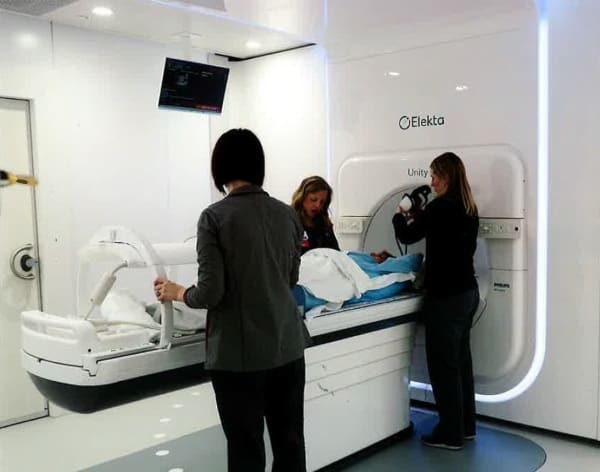
A patient being treated with the Unity system (Courtesy: C Schultz/F&MCW)
The MR-linac Consortium, which initially included six founding members alongside F&MCW, prioritized nine disease sites that would benefit most from the technology. Each of these institutions have since then taken the lead on developing treatments for these different disease sites, with the aim of developing and documenting a common clinical approach that can be adopted by other oncology centres.
The team at F&MCW has a particular interest in pancreatic cancer, in which case the duodenum is often immediately adjacent to the target. “If we can verify that the duodenum is positioned away from the target area in the pancreas, we can be confident in delivering the required radiation dose to the tumour – or even consider increasing the dose on that day,” Schultz explains. “If we can’t avoid the adjacent duodenum, we would just give a conventional treatment or might even cancel the treatment in some circumstances. The ability to account for that day-to-day variability, and then to conform the dose based on those constraints, is a big differentiator for this technology.”
From the initial experiences reported by other consortium members, Schultz says that every disease will offer different opportunities for improving patient outcomes. For the upper abdomen it is particularly important to manage the motion of the tumour and adjacent organs, while in the bladder and the oesophagus it might be possible to reduce the treatment volume as the tumour shrinks – a change that can’t be seen with conventional approaches. In the brain, daily imaging is revealing changes in the amount of swelling around some tumours, which again could provide an opportunity to reduce the size of the treatment target and so safeguard more of the surrounding tissue.
Longer term, says Schulz, the ability of MR imaging to acquire functional or biological images offers a route to targeting the treatment based on biology rather than anatomy. Rather than prescribing a dose based on histology or the stage of a tumour, it might be possible to exploit MR-based imaging biomarkers to determine the dose that would have most impact on the tumour.
“To begin with we are obtaining MR images that show diffusion and perfusion characteristics of a tumour, which are surrogates in part for hypercellularity [the presence of an abnormal excess of cells],” says Schultz. “Even in our first patients where we have obtained daily diffusion imaging, we are seeing changes that, at least at first pass, appear to correspond with reduction in cellularity. That’s pretty interesting.”
Data drives development
The next phase for the consortium – which has now grown to more than 20 members – will be to rigorously report and document patient outcomes from the different clinical approaches. “Whether it’s a question of escalating the dose, reducing the number of treatments, or tailoring the treatment based on the patient’s anatomy, the idea is to capture the outcomes from these nine disease sites,” explains Schultz. “We’re going to learn an awful lot about what really happens by obtaining images every day.”
This, Schultz continues, will generate a repository of outcome data, linked to the imaging data, that will provide a powerful tool for deciding how the technology should be used and for developing new treatment modalities. “By collecting patterns of failure, tumour control, normal tissue toxicity and patient reported outcome data in a consistent and structured way , we will be creating a unique database that will allow us to prove the value of the technology for all stakeholders.”
One of the challenges for any new technology is developing a workflow that works effectively for both the patients and the clinical team, but Schultz says the workflow for the Unity system has been “smoother than anticipated for a brand new system”. In most cases the treatment plan only needs to adapt to changes in the position of the tumour, which only needs a small adjustment to the position of the radiation beam, and the treatment time is limited to around 20–30 minutes. Any change in the shape or size of the target requires some adjustment to the outline of the target or adjacent organs, followed by adaptive re-planning, which extends the treatment time to 40–60 minutes or so.
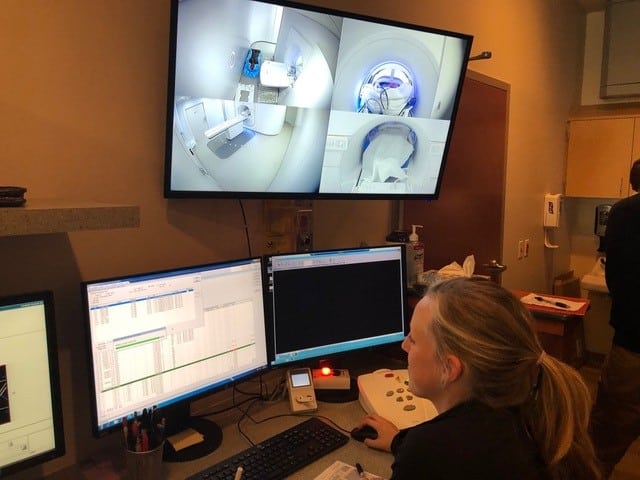
Real-time diagnostic imaging allows physicians to replan the treatment from the console area (Courtesy: C Schultz/F&MCW)
During the treatment, a specialist MR therapist is needed in addition to the standard clinical team, and in these early days a radiation oncologist and medical physicist are also in the room during treatment. Therapists who normally position the patient and deliver the treatment provide the imaging information to the physician, who then decides whether the plan needs to be changed. The physicist is then on hand to launch and verify the replan, and to check the imaging parameters that may affect the radiation dose in the “adapt-to-shape” workflow.
“Having the physicist, radiation oncologist and an extra MR technologist at the machine is an expansion of the typical workflow, but it’s not necessarily that different from the workflow when we use our regular linac with in-room CT imaging,” says Schultz. “We would envision over time that the physicist and physician might not need to be present during treatment, and they could check the output from where they’re sitting.”
Schultz is confident that MR-guided radiotherapy could be introduced at many other oncology centres. “It is really important to have access to MR expertise and to think very methodically about the workflow, but this is not just a research machine that can only be deployed at large medical centres, “ he says. “A number of clinics have already done a lot of the work around the steep part of learning curve, which will make the technology easier and easier to deploy over time.”
I originally studied mechanical engineering, where we had an elective lab associated with my modern physics course that revolved around gamma-ray spectroscopy. This, combined with a gentle nudge from the professor who would become my adviser, led me to change to physics. One aspect of the lab was a series of mock poster sessions where we had to defend our work to a panel of professors. Being a department centred on physics education, the demand on explaining the underlying physical details of an experiments was high, and it was that challenge that pushed me to learn the subject better. Around this same time, I began lingering around my soon-to-be lab, peeking in and asking questions. This led to my first research project, which included resurrecting old equipment and building up apparatus from scratch. I think for a lot of students this is where they fade out and quit, but I revelled in it. Those early challenges represent some of my most satisfying lab experiences.
Did you ever consider an academic career?
My Master’s degree was focused on thin films, and constructing and characterizing an atmospheric atomic-force microscope using a tuning-fork sensor. I was totally new to all of nanotechnology so it was a bit like being back at square one. I pivoted during my PhD, which was based around multiphoton fluorescence microscopy and ultrafast laser generation. I began graduate school with the singular goal of entering academia upon finishing. During my studies, however, I was introduced to a number of previously unknown career pathways through my peers and various academic collaborations
How did you get into instrumentation?
From the outset, my experimental work depended on me designing and building my own equipment, and I quickly learned the benefit of understanding how the tools I was using worked. Combined with the mock poster sessions, I gained an appreciation for the experimental equipment in the lab. I think there’s a benefit to working with a limited budget, which forces you to make something from scratch and inspires you to build things and build them better. We didn’t have off-the-shelf equipment, so I had to make my first controller from a circuit design tool, then print and etch it, solder the components and programme the microprocessor. I even had to build the box. Each step was something brand new to me, but that only made it more satisfying. When I went on to graduate school and worked in a lab that specialized in these efforts, my admiration for what was required for this sort of work was multiplied many times over.
What were some of the challenges in moving from academia into a business role?
Prior to taking my current role, I had never considered the costs associated with manufacturing a product. As a student making equipment from scratch, there is no consideration for someone making the same thing at a later date, and little outside of a lab notebook regarding documentation. Entering a sales position confronted me with what seemed like a strange maze of suppliers, costs, reliability, market and currency fluctuations, to say nothing of the engineering work that goes into each system or product.
What are some of your day-to-day responsibilities as a sales engineer at SIGMA Surface Science?
To my surprise, I probably read more journal articles today than I did as a graduate student. My role involves having a good understanding of the current literature and being aware of trends in a wide range of disciplines. The scientific advances that I now need to be familiar with are across a much larger scope than the singular focus you have as a graduate student.
How has your physics background been helpful in your work, if at all?
I think a physics background’s benefit always boils down to the ability to problem solve. We are trained (sometimes unknowingly) to look at complex and multifaceted problems; quickly understand the underlying principles; and develop an approach to solve the problem. Something I often find myself tapping into is my ability and tendency to do approximations, to assess whether a certain experiment or approach is feasible at all. As a physicist, you often do back-of-the-envelope calculations to get a sense of a broader topic.
Any advice for today’s students?
Two things. First, I’d say it’s important to realize that there are no boundaries as to where you can take your career, if you have built it on the foundation of physics. I offered a challenge to a group of undergraduate students to go to the jobs page of any national or international company they could think of (starting with tech companies) and search using the keyword “physics” to see how many positions pop up. The fact is that the tool-set provided by a physics education is highly valued and widely recognized, for good reason. Second, don’t stop learning. When presented with a new challenge, don’t be afraid to take it on and expand your knowledge and experience base. As long as you aren’t significantly deviating from your academic programme, you should chase these opportunities.
There is a huge race to develop quantum computers for their enormous potential applications. Theory predicts that they can perform certain algorithms, such as factoring numbers or search algorithms, much faster than classical computers. Quantum computers would not only revolutionize informatics but would impact many areas of life, for example economics and communication, as well. Now a team of scientists at Fudan University led by Donglai Feng and Tong Zhang, in collaboration with the group of Zhongxian Zhao and Xiaoli Dong at the Institute of Physics of the Chinese Academy of Sciences, have made a big step towards quantum computers. For the first time they have measured the theoretically predicted value for the conductance of Majorana zero modes (MZM) – potential building blocks of a quantum computer – inside the cores of the vortices formed by a superconductor’s current.
Zeroing in on Majorana modes
MZMs are zero-energy excitations in a topological superconductor, a material where the surface states differ from the bulk. They are their own antiparticles: if two of them meet, both of them disappear leaving behind only energy. This special property makes them ideal for topological quantum computing.
The main advantage of topological quantum computers is that they are robust against errors. In these devices quantum information is encoded in a pair of spatially well separated Majorana zero modes, and this “nonlocal” storage of information is quite robust – most error mechanisms can only give local perturbations and cannot affect nonlocal storage of information. As a result, while standard quantum computers accumulate errors from random fluctuations over time, topological quantum computers are “topologically protected” meaning only large impacts can cause errors. It is like billiard balls in the triangle: you have to shake them really hard for the balls to pop out and change positions.
It should be possible to detect the exact conductances of MZMs using tunnelling spectroscopy. Here an ultrasharp conducting tip is placed very near the surface under an electric field so electrons that would not normally cross the insulating gap between tip and surface “tunnel” across. Previously, researchers could only find a peak at zero energy in the conductance spectrum of vortex states. Although this would imply the presence of an MZM, the height of the peak was lower than expected from theory.
Confirming theoretical predictions exactly
Feng, Zhang, Zhao and Dong and their co-workers used iron selenide superconductors, more specifically (Li0.84Fe0.16)OHFeSe, which is a type-II superconductor. When put in a magnetic field, type-II superconductors form electric vortices. The scientists measured the MZMs bound to the centre of these vortices using scanning tunnelling microscopy. From the current and voltage between the surface of the material and the tip, they could calculate the conductance of states underneath the tip. They found that the value was exactly what the theory had predicted.
The team managed to establish a strong coupling to the MZM for the first time. This enabled them to measure conductance peaks with the height that theory predicts, which gives much more compelling evidence for an MZM. Moreover, the strength of the coupling is also related to how well they can control the MZM, and how precisely they can measure its properties. Strong coupling is essential to perform quantum computing operations.
There is still a long way to go to build topological quantum computers, but the team has shown that iron selenide superconductors are excellent candidate materials. The next steps are to find a way to control and perform calculations using MZMs.
In the previous episode of the Physics World Stories podcast, Andrew Glester revisited the birth of the World Wide Web at CERN in 1989. This month, Glester looks to the future of Internet technologies, profiling some of the developments that might transform our daily lives.
Glester finds out about the different ways we will connect to the Internet in the near future. Global access could be expanded thanks to WiFi provided by satellites in low-Earth orbit. Meanwhile, a more secure way of connecting to the Internet could be provided by LiFi – wireless data encoded into everyday light sources.
Looking beyond the individual technologies, the concept of an Internet of Things (IoT) holds the promise of making everyday living more convenient. Devices are already on the market, such as fridges that monitor your eating habits and automatically order replenishments. In the future, these sorts of systems could become commonplace in all aspects of society.
But as we move to an ever-more connected world, we also leave ourselves more vulnerable to cybercrime. To discuss security considerations, Glester catches up with ethical hacker Freaky Clown who describes the cat-and-mouse battle between the security services and cyber criminals.
If you enjoy what you hear, then you can also subscribe to Physics World Stories via Apple podcasts or your chosen podcast host.
Ancient Romans may have built structures that acted like invisibility cloaks long before physicists had any idea about metamaterials or transformation optics. That is the surprising claim from researchers in France, who found that the pattern of foundations in some Roman theatres and amphitheatres very closely resembles the features of electromagnetic cloaking devices. They say that these “archaeological metamaterials” could have indirectly provided protection against earthquakes, by bending seismic waves around the arenas.
Metamaterials are artificial structures comprising arrays of resonators that manipulate electromagnetic waves or sound in ways not normally found in nature. A mathematical framework called transformation optics has been developed to design novel devices made from metamaterials – including invisibility cloaks that divert microwaves round objects.
One potential application of metamaterials is the creation of structures that divert seismic waves around buildings in order to protect them from earthquakes. The idea is to surround a building with a lattice of holes or solid objects within the soil. When seismic waves within a certain range of wavelengths pass through the lattice, multiple reflections in the lattice interfere with one another destructively to create a band gap that results in a significant reduction in the shaking of the building.
Stéphane Brûlé and civil engineers at the company Ménard in Lyon, together with researchers at the Fresnel Institute in Marseille, demonstrated this idea in 2012, when they drilled a two-dimensional array of boreholes into top soil, each 5 m deep. By generating acoustic waves using a source close by, they found that much of the waves’ energy was reflected back towards the source by the first two rows of holes.
Uncanny resemblance
However, Brûlé reckons that the ancient Romans may have got there first – although unwittingly. He was on holiday looking at archaeological remains in the town of Autun in central France when he saw an aerial photograph showing the foundations of a Gallo-Roman theatre buried under a field just up the road. Although barely discernable, the markings in the field showed the outline of the first century AD building and he reckoned the semi-circular structure bore an uncanny resemblance to one half of an invisibility cloak.
This was confirmed by a photo from an archaeological study carried out a few years earlier that mapped the theatre’s foundations with much greater clarity. Superimposing that photo and one of a 20 cm-diameter invisibility cloak built by Brûlé and colleagues at the Fresnel Institute, he found that the theatre pillars and the elements of the cloak lined up almost exactly – each being arranged on a series of concentric (semi) circles that get closer to one another at smaller radii.
Brûlé then found that the same thing applied to the foundations of the Colesseum in Rome and other amphitheatres – which, unlike semi-circular theatres, are fully enclosed. In particular, he discovered that the ratio of the radii of neighbouring concentric circles (or ellipses, in the case of most amphitheatres) were almost identical. “I can’t show you the superposition with the amphitheatres yet,” he says, “but it is very impressive”.
Experience or luck?
As to how the Romans might have arrived at this design, Brûlé suggests that they may have gradually modified their amphitheatres thanks to the experience gained over the course of several centuries in highly seismic areas. But he is reluctant to offer details. Indeed, he says it might simply have been a matter of luck – that the foundations well suited to static loads also happened to resist earthquakes. “Rigorously,” he adds, “we cannot say more for the moment”.
Sébastien Guenneau at the Fresnel Institute has carried out computer simulations to test the idea but says that the complexity of real soil and its influence on the passage of seismic waves means that experiments in the field are essential. He is hoping to build a model consisting of buried concrete piles arranged in characteristic concentric ellipses with an outer diameter of at least 20 m. This scale, he explains, would be suitable for the (short-wavelength) seismic waves that propagate in soft soils.
Another French group, led by Philippe Roux at the Earth Science Institute ISTerre in Grenoble, is also applying transformation optics to structures above ground. For instance, it has shown that forests can act as metamaterials, thanks to the fact that trees with a certain distribution of heights can divert some of the energy from seismic waves away from the Earth’s surface.
Metropolitan metamaterials
Researchers are also applying this thinking to cities of the future by studying how dense groups of tall buildings such as skyscrapers can act collectively as metamaterials. The idea, says Brûlé, is that those buildings modify passing seismic waves by vibrating and then acting as secondary sources that re-emit part of the initial seismic energy. In future, he reckons, smart cities could perhaps be arranged such that buildings divert seismic waves away from central areas containing essential services or schools, and that they could even tap some of waves’ energy to produce electricity.
For the moment, however, he simply wants people to be aware that when it comes to minimizing earthquake damage the design and location of buildings matters. Scientists and engineers, he says, should “take a closer look at ancient architectures and learn from these beautiful and amazingly resilient designs.”
The study is described in a review paper on the arXiv preprint server.
Aerosol particles smaller than 2.5 μm (PM2.5) are linked to millions of premature deaths each year worldwide. In China’s Beijing-Tianjin-Hebei region, PM2.5 concentrations reach hazardous levels so often that the Chinese government restricts anthropogenic emissions during major events to ensure good air quality. Predicting the effectiveness of these measures is not simple, however. Weather conditions during the restriction period play a role, but feedback from aerosol-radiation interactions must also be considered to achieve reliable outcomes.
Where PM2.5 concentrations are high, the surface receives less shortwave radiation, decreasing temperature at ground level. This stabilizes the air column above, limiting atmospheric mixing and preventing particle dispersal.
What’s more, lower surface temperatures are typically accompanied by an increase in relative humidity, which enhances formation of secondary aerosols. Unlike primary aerosols, which are emitted directly, these particles form in the atmosphere after reactions between gaseous precursors. Sulphate, nitrate and ammonium aerosols, for example, result from oxidation of sulphur and nitrogen dioxide in the presence of ammonia. These reactions occur more quickly in humid conditions, amplifying the effect of the primary aerosol component.
To test the influence of this feedback on the effectiveness of temporary control measures, Mi Zhou of Peking University, Beijing, and colleagues at the Beijing-based Institute of Urban Meteorology, and at UCLA and Harvard University in the US, used the WRF-Chem model to simulate periods of 4-9 days with and without aerosol-radiation interactions and emissions controls.
“The inputs of the WRF-Chem model include static data, like topography and land use, dynamic data — temperature, winds and so on, and chemical species such as primary aerosols and secondary-aerosol precursors emitted in the modelling region,” explains Zhou. “It is a comprehensive numerical model attempting to illustrate the whole physical and chemical processes in the atmosphere.”
As expected, the simulations showed that emission controls improve air quality. More surprising was that, when aerosol-radiation interactions were included, the relationship between emission reduction and particulate matter was quadratic rather than linear. This is because restricting the output of primary aerosols and gaseous precursors of secondary aerosols suppresses aerosol-radiation interaction effects, interrupting the feedback cycle. The effect is especially pronounced at high aerosol concentrations.
“Our work demonstrates that implementing emission control measures will have larger-than-expected effects on reducing high PM2.5 pollution levels,” says Lin Zhang of Peking University. “This is very important for policy makers to accurately assess how effective the emission control measures are.”
The results could be relevant beyond the PM2.5 aerosols that Zhou, Zhang and colleagues focused on.
“[Aerosol-radiation interaction] effects on atmospheric stability and meteorology can also affect the accumulation and dispersion of other particulates and pollutants,” says Zhang. There are caveats, however. “Application to other pollutants needs caution since they might be influenced by different processes compared to aerosols,” adds Zhang. “For example, ozone, another critical air pollutant and a greenhouse gas, has very different chemistry processes in the air and can have a very different response to emission reductions. This is still an open question and is drawing increasing attention.”
FLASH radiotherapy (FLASH-RT), the delivery of ultrahigh radiation doses in fractions of a second, is under investigation as a cutting-edge technology to improve cancer treatment. Research and pre-clinical studies have been limited, however, by the need to use highly specialized equipment.
Medical physicists and biomedical engineers in Sweden have now developed a way to modify a conventional linear accelerator for FLASH irradiation — and to rapidly restore it for clinical use without interfering with cancer patient treatment schedules. Such use of clinical linacs could increase the pace of global research into FLASH-RT (Radiother. Oncol. 10.1016/j.radonc.2019.01.031).
Developed by Vincent Favaudon, a radiobiologist at Institut Curie, FLASH radiation delivery employs dose rates of 30 to more than 106 Gy/s, at least a few hundred times higher than conventionally used in radiotherapy. The potential advantages are significant.
An ultrahigh radiation dose delivered in milliseconds could provide more effective tumour treatment. The impact of patient motion during irradiation would be significantly minimized with this rapid delivery, reducing the need for target margins and thereby the volume of healthy tissue being irradiated. With fewer treatments, the problem of inter-fraction motion could be minimized or eliminated. Fewer and faster treatments will also allow radiotherapy treatment rooms to accommodate more patients, significantly expanding their utilization.
Linac testing
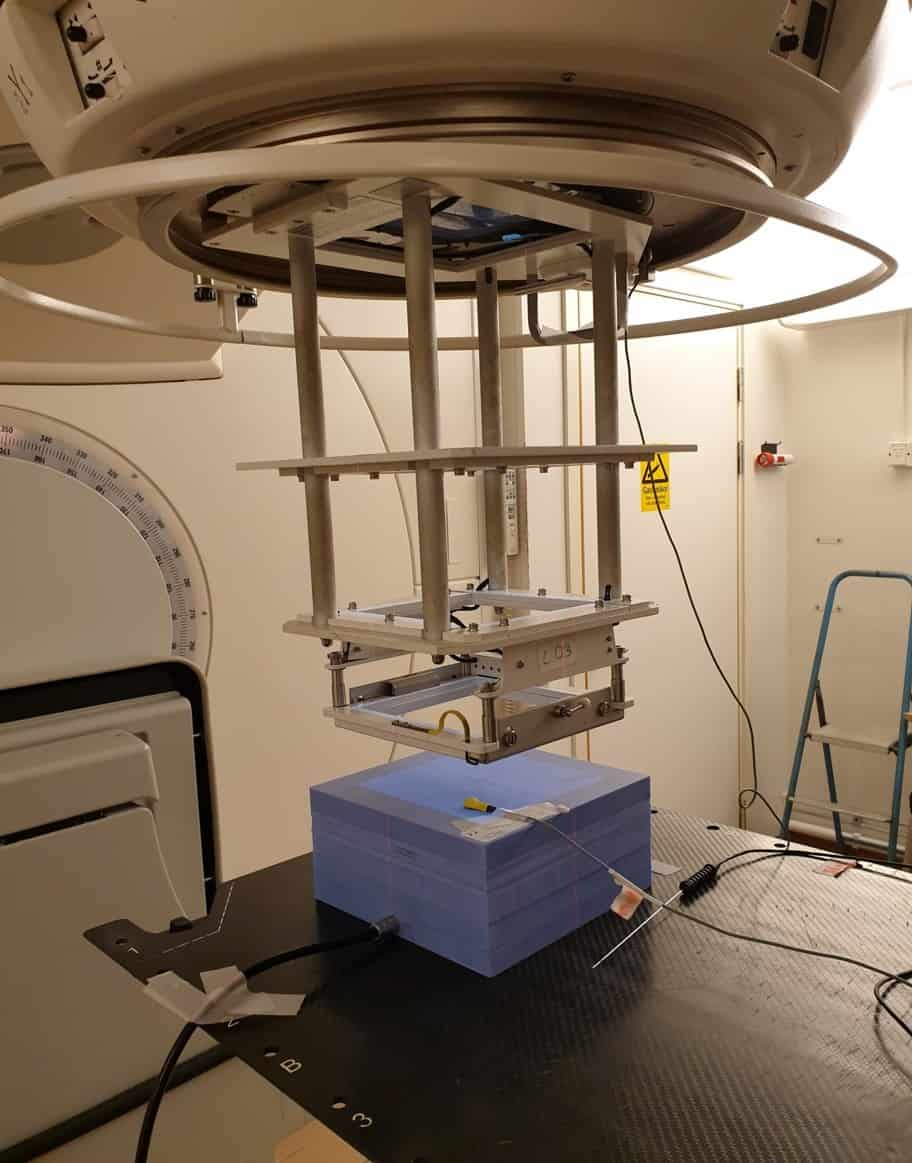
Principal investigator Kristoffer Petersson, and colleagues from Skåne University Hospital and Lund University, modified a clinical linac (ELEKTA Precise), connecting it to an in-house developed electrical circuit for pulse-to-pulse control. They controlled the radiation delivery using a diode as an electron beam pulse radiation detector: once the programmed amount of beam pulses had been delivered, the beam was interrupted. The researchers used three set-up positions with reduced distance from the target. They adjusted and optimized gun current, modulator charge rate, and beam steering values to produce a high dose rate.
The linac reached a FLASH irradiation dose rate at the cross-hair foil, multileaf collimator and wedge positions, with dose rates of at least 30, 80 and 300 Gy/s, respectively. Moving the scattering foils from the beam path increased the output to at least 120, 250 and 1000 Gy/s at the three positions.
The beam flatness was 5% at the cross-hair position for a 20 x 20 and a 10 x 10 cm area, with and without scattering foils in the beam path. Beam flatness was 10% at the wedge position for a 6 and 2.5 cm diametric area, with and without the scattering foils. The researchers have subsequently been able to increase the dose rate by a factor of four.
The researchers note that the modified linac had some stability issues. The output was high and relatively stable during the first 10 minutes following a warm-up procedure, but subsequently decreased, requiring a new warm-up to restore stability. The researchers have since resolved these stability issues, achieving a standard output deviation of around 2%, which is acceptable for pre-clinical studies.
The authors recommend that the FLASH beam should be monitored on a dose level, and not just on a pulse level, to achieve better control over the delivered radiation dose and to assess pulse-to-pulse variations.
“One way of doing this is by slightly varying the gun filament current setting and thereby the pulse amplitude, so that the delivery of a fixed number of pulses would result in the delivery of a desired dose,” Petersson tells Physics World. “We have recently tested this method and it works fine. However, the gun current value resulting in a specific pulse amplitude varies slightly from one day to another due to the wear of the filament, and this needs to be taken into account for the method to be precise.”
Studying ion collection efficiency. (Courtesy: Kristoffer Petersson)
Petersson adds that a real-time dose monitoring device would provide more sophisticated dose monitoring. “We have been able to extract the signal from the transmission chamber and are currently studying how the ion collection efficiency of the transmission chamber drops with increasing dose-per-pulse values in the beam, which, if correctly modelled, would give us this device,” he explains. “The second step would be to use the information to modify the length or amplitude of the pulses on a pulse-by-pulse basis, to ensure delivery of the desired dose.” The researchers have not yet tested this second step as it would require major linac modifications.
The team is currently performing cell studies with the FLASH beam. Using cells prepared at different oxygen concentrations, they aim to determine whether the FLASH effect is due to oxygen consumption and the delivery being too quick for oxygen levels to replenish during the delivery. This would result in tissues behaving as if they were hypoxic.
“We are planning additional studies with the team of Kevin Prise at Queen’s University Belfast, to look at bystander effects and how these vary with dose rate,” Petersson says. “We are also preparing studies on zebrafish embryos to investigate the induction of malformation and how this depends on dose rate, in conjunction with radiobiologist Marie-Catherine Vozenin at Lausanne University Hospital.”
FLASH-RT may be ready for testing in humans in three to five years. Before clinical trials can be safely performed, researchers need to improve dosimetry in beams with ultrahigh dose rates, develop a dose delivery control system, and better understand the underlying mechanisms responsible for the FLASH effect, such as oxygen consumption.
Modern scientific research, especially physics, is often conducted using complex machines that take years to build, with experiments running for decades. These projects can become full-scale institutions with large organizational structures and thousands of participants. For archivists and others interested in the history of scientific research, developing a complete picture requires an understanding not only of the work that scientists and technical staff do but also the contributions of support staff too.
Fermilab – the US’s major particle-physics laboratory based in Batavia, Illinois – exemplifies “big science”. The scale of the lab’s work has greatly increased over time. For example, when the E288 experiment discovered the bottom quark in 1977, the collaboration included fewer than 20 people. But when Fermilab’s CDF and DZero detectors announced the discovery of the top quark in 1995, each collaboration had about 450 people from institutions all over the world. Today, the lab’s planned Deep Underground Neutrino Experiment already has more than 1100 collaborators from more than 175 institutions.
For the record
In 1978 Fermilab began its archives project to collect, organize, preserve and make available material documenting the lab’s unique and ever-growing history. This involves collecting records that document the contributions of a wide range of laboratory employees and users. In addition to scientific records, the archives also include materials related to activities such as the lab’s arts and lectures series, art gallery, and ecological and educational programmes.
Yet adequately documenting the lab’s scientific programme also requires the archives to look beyond the records of physicists alone to other technical staff and non-technical support staff. Many of them collaborate with scientists at the cutting edge of technology to develop solutions to unique challenges. And while it may be less obvious to document the contributions of non-technical support staff, it is just as essential. Indeed, as organizations become larger and more elaborate, support staff often work between multiple groups and possess unique knowledge about how those organizations operate.
At Fermilab, administrative assistants are a good illustration of how important support staff are. Over the course of their careers, they work with people from many different areas of the lab. This includes scientific groups such as the particle physics division and the accelerator division to the facilities engineering services section that manages the lab’s physical infrastructure, as well as with worldwide collaborators. This gives them a unique perspective on how different parts of the lab work together and what kinds of informal lines of communication exist that might not be reflected in reporting structures. They often also know how organizational structures have changed over time and are familiar with details about how things are done that may not be captured in written procedures.
The lab has recognized the value of their knowledge by sometimes trying to keep the same administrative assistants in areas experiencing leadership changes, so the new leaders can draw on their experience. For the lab’s archivists and others interested in the history of the lab’s operations, these administrative assistants are repositories of unique institutional knowledge that scientific and technical staff may not know. However, this kind of valuable information will often not be found in the records produced by support staff. The best way to capture it is usually through oral interviews, which make their memories and observations part of the archival record.
While human memory can be fallible, these types of interviews are still a valuable complement to more traditional records. The Fermilab Archives’ oral-history programme includes, for example, interviews with not just scientists but also people such as the first lab director’s administrative assistant and selected other support staff. Interviews with non-technical staff have become more common in recent years, many of which have provided fresh insights into the lab’s history. For example, interviews with the lab’s ecologist, security chief and a telecommunications administrative assistant provide perspectives on the day-to-day operations of the lab that are not always visible to scientists but are necessary to keep the lab functioning.
Who knows?
Identifying support staff who possess knowledge that should become part of the archival record can be a challenge. Organizational charts and job descriptions do not always capture everything someone does. In scientific institutions like Fermilab, even people in jobs that seem unrelated to the lab’s scientific work may have specialized knowledge or perform functions specific to the lab that can shed light on how the science was carried out.
For instance, several long-time administrative assistants have described preparing complex scientific manuscripts for publication and the special skills they needed to learn to be able to do this. Others have talked about helping to organize international conferences where the scientists shared their latest research. Often, people with this type of knowledge can only be identified by interviewing others whose key roles are more obvious.
High-energy physics collaborations are often large even by the standards of modern scientific research, which is why oral histories with support staff are essential for fully documenting the work of a lab like Fermilab. In fact, I think other labs and researchers interested in the history of modern scientific research should take our lead. After all, oral histories are essential for creating a complete picture of everything that goes into conducting scientific research and how it is organized.