A new type of refrigerant that makes use of “colossal barocaloric effects” has been developed independently by two teams in China and Europe. The solid material undergoes changes in temperature as it is compressed and expanded. The research could lead to the development of cooling systems that do not rely on hydrofluorocarbons, which are not environmentally friendly.
As some hot regions of the world become wealthier – and as global warming continues — the demand for cooling technologies such as refrigeration and air conditioning will grow. Even when run on renewable energy, conventional refrigerators and air conditioners present a significant environmental hazard if not properly maintained and disposed of. This is because they use volatile hydrofluorocarbon fluids, which are extremely powerful greenhouse gases. Indeed, one kilogram of a typical hydrofluorocarbon has an equivalent global warming potential to two tons of carbon dioxide.
In a conventional refrigerator or air conditioner, a refrigerant is pumped around a closed system and undergoes changes from liquid to gas and then back to liquid. The expansion to a gas requires energy, which is acquired by cooling the surroundings on the cold side of the system. This heat is released on the hot side of the system when the fluid is condensed back to a liquid.
Squeezed states
This cycle can be achieved using any substance that undergoes a phase transition that involves the absorption and emission of heat. This includes electrocaloric and magnetocaloric materials, which switch between two solid phases in response to applied electric or magnetic fields. Unfortunately, heat capacities of most electrocaloric and magnetocaloric refrigerants are modest, producing cooling cycles that are too inefficient for widespread use. Another option is the barocaloric effect, which occurs when a solid material is compressed and expanded. For most materials, however, the effect is very small at ambient temperatures and pressures.
In the new research, two groups – one in China and one in Europe – have independently shown that colossal barocaloric effects can be achieved in plastic crystals at relatively modest pressures near room temperature. These plastic crystals comprise a lattice of organic molecules. At low pressures, the molecules are far enough apart that their relative orientations are effectively random, giving the system high entropy. This phase plays the role of the gas in a conventional cooling system. When the pressure is raised, however, the molecules are pushed closer together until they can no longer move independently and become a low-entropy ordered crystal. This large decrease in entropy releases a huge amount of heat. Whereas typical caloric materials show entropy changes of tens of joules per kilogram per Kelvin, some plastic crystals have entropy changes of over 600 J kg-1 K-1.
A step in the right direction for improving green cooling technologies
Daniel Errandonea, University of Valencia
Both teams used plastics based on neopentyl glycol (NPG) as their refrigerant. The entropy change associated with the phase transition (as measured by the Chinese researchers) was 389 J kg−1 K−1. Crucially, “the phase transition temperature of NPG is just around room temperature, which is most important for refrigeration applications,” explains Bing Li of the Chinese Academy of Sciences, who led the Chinese research.
Volume change
The European researchers – led by Josep-Lluís Tamarit of the Polytechnic University of Catalonia in Barcelona and Xavier Moya of the University of Cambridge – considered the entropy change not just from the phase transition itself but also from the associated volume change. They therefore measured a higher figure of 510 J kg-1 K-1 , which is on par with commercial hydrofluorocarbon refrigerants. This did, however, require higher pressures than used by the Chinese researchers.
The next step is to put the technology into practice: “The efficiency has to be directly evaluated in a real refrigeration machine, which involves many factors aside from the entropy changes we reported here,” explains Li. “We are working on designing a prototype refrigerator based on the barocaloric effect.”
“I think what the researchers are proposing is a very nice idea, and this colossal barocaloric effect is probably an order of magnitude larger than caloric effects in other materials,” says Daniel Errandonea of the University of Valencia in Spain, who not involved in the research. He does have some concern about “ how long these materials – which are organic compounds – will last if you cycle them constantly in everyday applications”. He adds that the research is “a step in the right direction for improving green cooling technologies…if the science can be transferred to other materials which are more durable it will be perfect.”
Li and colleagues describe their work in Natureand Taramrit and Moya’s team describe their work in a preprint on arXiv.
The optical laser, which will celebrate its 60th anniversary next year, has led to a host of technology applications that have changed our lives and researchers hope that its mechanical analogue – the phonon laser – will one day be just as important. A team at the University of Rochester and the Rochester Institute of Technology, both in New York, has now succeeded in making a phonon laser based on nanospheres of glass suspended in vacuum using an optical tweezer (or dipole trap). The device, which works in the mesoscopic mass range for the first time, might not only be used to help solve fundamental problems in quantum mechanics, it might also find use in precision metrology applications.
Researchers have been working on the phonon laser – a coherent beam amplifier for sound rather than light – for the last decade. In such a device, phonons (which are the smallest discrete unit of vibrations of a material’s crystal lattice) are amplified to generate a highly coherent beam of sound in the same way that an optical laser produces a highly coherent beam of light.
Expanding on the optical tweezer
A team led by Nick Vamivakas has now made the levitated optomechanical analogue to the optical laser by expanding on the optical tweezer. This optical dipole trap, as it is also known, was originally invented by American physicist Arthur Ashkin, who was recently awarded a share of the Nobel prize in physics. It relies on a highly focused laser beam to provide an attractive or repulsive force to physically hold and move micron-sized objects in the trajectory of the beam.
The new phonon laser, whose frequency can be tuned, is based on the centre-of-mass oscillation of silicon nanospheres, which is comprised of phonons, and Vamivakas and colleagues’ experimental apparatus consists of a free-space optical dipole trap in which they suspend the nanospheres in a vacuum chamber. The researchers then employ a feedback technique based on light scattering from the nanospheres. “By measuring the scattered light, we are then able to alter the way the beads oscillate and increase the output of energy as measured in phonons,” says Vamivakas.
“If we do it just right, we can cause an oscillation that starts at one amplitude, and becomes bigger and bigger, until we start to exhibit mechanical motion that is analogous to what you would see if you turned on an ordinary optical laser.”
Controlling the population of steady-state, coherent, phonons
“This technique allows us to modulate the optical potential created by the laser beam that holds the nanospheres in the trap in just the right way to produce the phonon laser,” explains Vamivakas. “The feedback signals then control the centre-of-mass dynamics of the sphere.
“One signal provides nonlinear parametric cooling of centre-of-mass phonons, while the other induces linear amplification of centre-of-mass phonons,” he says. “This allows us to control the population of steady-state, coherent, phonons – into the quantum regime, in principle.”
Mesoscopic mass regime
The new device operates in the mesoscopic mass regime – that is around 1 x 10-18 kg. This makes it different to previously demonstrated phonon lasers that worked on the microscale (1 x 10⁻⁹ kg) and atomic scale (1 x 10-25 kg).
“There was a large mass regime in between these two scales, and this is the range in which our device works,” Vamivakas tells Physics World. “It is also unique in that it makes use of a levitated object. With the exception of single trapped atoms, all other phonon lasers to date have been demonstrated in mechanically clamped or tethered platforms in which the laser is attached to a substrate.
“Using a levitated object provides a high degree of mechanical isolation not possible in these other set ups.”
Technique is readily extendable to other materials
The new laser might help advance precision metrology, he adds. What is more, the technique employed in this study, which is published in Nature Photonics 10.1038/s41566-019-0395-5, is insensitive to the structural details of the particle suspended in the optical dipole trap. This means that it could be readily extended to other materials – for example, single electrons, levitated droplets or even biological organisms.
The team, which also includes researchers from the Los Alamos National Laboratory, says that it is now busy exploring the connections between the optical laser and its phonon cousin. “We are also looking at the ways in which our laser could enhance precision measurements in levitated optomechanical systems,” reveals Vamivakas.
Researchers from the Massachusetts Institute of Technology have shown that combining light and sonic pulses can reduce symptoms related to Alzheimer’s disease (AD) and improve cognitive functions. The mechanisms behind this phenomenon are still being explored (Cell 10.1016/j.cell.2019.02.014).
Not much is known about the course of events leading to Alzheimer’s disease, but the formation of toxic β-amyloid plaques and phosphorylated tau proteins have long been described as major hallmarks of the disease. Many treatment approaches are currently being investigated, such as the use of immunogenic therapies, autoimmune responses to the disease, and even machine learning to find potential treatment targets. Li-Huei Tsai and her colleagues have an alternative strategy: trying to hijack the brain to induce specific brain waves.
In a previous study, the team from the Picower Institute for Learning and Memory showed that non-invasive 40 Hz light flicker induced gamma oscillations, a type of brain wave associated with several high-order cognitive functions that are impaired in Alzheimer’s disease. In mice that were genetically predisposed to develop Alzheimer’s disease symptoms, flashing this light for one hour a day reduced their levels of β-amyloid plaques and tau proteins, while boosting the activity of microglia, the immune cells responsible for clearing the brain of residual waste. The researchers named this therapy GENUS: gamma entrainment using sensory stimulus.
Expanding GENUS to auditory signals…
With most of the improvements limited to the visual cortex, the researchers built on these findings to expand GENUS to auditory signals and target new regions of the brain, such as the cortex linked with memory.
The researchers first replicated visual GENUS results using acoustic stimuli. After seeing the same changes in vasculature and improved cognitive performance, they combined visual and acoustic GENUS. This resulted in a wide reduction of β-amyloid plaques across the cortex. (Courtesy: Cell 10.1016/j.cell.2019.02.014)
Firstly, they verified that auditory GENUS was efficient enough to fire up neurons in regions-of-interest of the brain. They exposed the mice to trains of tones repeating at various frequencies for one hour a day over seven days and recorded neural activity in different parts of the cortex. This experiment suggested that 40 Hz auditory stimulation does induce GENUS robustly in the main brain parts considered, notably those controlling learning and memory.
The animals’ behavioural and physiological responses corroborated these results. Indeed, when mice had to recognize or locate new objects, or find their way in a water maze, the GENUS group exhibited better performance than a control group of mice exposed to random frequency sound.
Physiologically, GENUS reduced β-amyloid plaques in the auditory cortex and hippocampus, the brain centre for learning and memory. The team suggest that this clearance is enabled by the observed increase in microglia cells and change of vasculature through vasodilatation to flush residues. Finally, GENUS mice also displayed a lower level of hyperphosphorylated tau protein.
… and combining it with visual signals
Since both visual and auditory stimulation induced better cognitive function in treated mice, the final step that researchers took was to combine both types of stimuli and observe how mice responded. The effects of the combined GENUS were even greater than either alone.
Interestingly, amyloid plaques were reduced throughout a much greater portion of the brain with combined GENUS, as it elicited a unique microglia response that extended to the medial prefrontal cortex, a region that could not be reached with one week of visual or auditory stimulation alone.
A key question now is to understand why these reactions were only observed when stimuli were triggered at a 40 Hz, as mice exposed to different frequencies and pulse patterns did not display better results than the control group.
What’s even more interesting is that research has shown that neurons can encode stimuli without synchronizing their firing rate to the stimulus frequency, a pattern that has also been witnessed in the study. Only some neurons fired at a different rate in reaction to a change of auditory GENUS frequency but they were too few to generalize this observation. The population of neurons as a whole was unresponsive to variations in GENUS frequency. This means that the observed changes in vasculature, amyloid and tau protein level and behaviour cannot be explained by overall changes in firing rate.
While waiting to find the reason for this phenomenon, Tsai and her team have already tested combined GENUS in healthy volunteers to assess its safety. They are now recruiting early-stage Alzheimer’s disease patients to determine whether the results observed in mice can be replicated in humans.
Within 80 years the health of twice as many people as today could face a serious mosquito risk − and not only in the tropics.
One billion people are already in danger of mosquito-borne disease. As the world warms and climates become more hospitable to the insects that transmit dengue fever, yellow fever, Zika and other fearful viruses, that number could double by the end of the century.
And as Aedes aegypti and Aedes albopictus extend their range to the north and the south, and higher up the hill regions, tropical infections that already kill millions will spread into the temperate zones.
“Climate change will have a profound effect on the global distribution and burden of infectious diseases,” the authors warn. “Current knowledge suggests that the range of mosquito-borne diseases could expand dramatically in response to climate change.”
As temperatures go up – the planet is already 1 °C warmer on average than it has been for most of human history, thanks to profligate use of fossil fuels to pump greenhouse gases into the atmosphere, and is on course to hit 3 °C warmer by 2100 – so does the scope for disease transmission by insects that flourish in a range of temperatures.
No let-up
Infections could begin to happen year-round in the tropics, and some people could be at risk during the warmer seasons almost everywhere else. Infections, too, could become more intense.
Rising temperatures open up new ranges for carriers of potentially lethal disease, and the latest study takes a closer look at what climate models predict about disease transmission by just two species.
“These diseases, which we think of as strictly tropical, have been showing up already in areas with suitable climates, such as Florida, because humans are very good at moving both bugs and their pathogens around the globe,” said Sadie Ryan, a medical geographer at the University of Florida, who led the study.
Mosquitoes grounded?
And her co-author Colin Carlson, a biologist at Georgetown University in Washington DC, said: “Climate change is the largest and most comprehensive threat to global health security. Mosquitoes are only part of the challenge, but after the Zika outbreak in Brazil in 2015, we’re especially worried about what comes next.”
Paradoxically, rising temperatures could be good news for some at-risk populations: both the Anopheles mosquito that carries the malaria parasite and the Aedes that is host to a number of diseases are most dangerous within a range of temperatures: as the thermometer rises, it could become too hot for malaria transmission in some places, or even too hot for mosquitoes.
“This might sound like a good news, bad news situation, but it’s all bad news if we end up in the worst timeline for climate change,” said Carlson. “Any scenario where a region gets too warm to transmit dengue is one where we have different but equally severe threats in other health sectors.”
Blasting jets of air many times a second from the back of a car is an energy-efficient way of reducing air drag – according to a team of academic and industrial researchers. The team is now doing further studies of the effect to see if it could be used to create vehicles that are more energy efficient.
There are about one billion cars in use worldwide – and most have roughly the same shape. In part, this is because air drag is responsible for a significant amount of fuel consumption at moderate speeds – and to minimize drag, car manufacturers have used advanced aerodynamics to converge on an optimal car shape.
Today there is little to gain from further changes to body shape and therefore car designers are looking for new ways to reduce drag. Now researchers in France, Germany and China — including some supported by the carmaker PSA Group – have shown that drag can be reduced by 7% at 90 km/h by introducing air jets blasting pulses of air from the back of the vehicle.
Crosswind yaw
The effect of the jets was studied in a scenario that mimicked a vehicle travelling in a moderate crosswind such that air flowed past the vehicle at a yaw of 5°. Yaw is a rotation in the horizontal plane relative to the vehicle’s direction of motion. Such a crosswind upsets the symmetry of air flow around a vehicle and increases drag – which the team was keen to counteract.
The researchers installed four nozzles at the back of a simplified square-backed car model that was about 89 cm long. The nozzles were connected to a bottle of compressed air and the model was placed in a wind tunnel at a 5° yaw.
The team fired pulsed jets of air through the nozzles at two different frequencies – the low frequency being in the tens of hertz and the high frequency in the hundreds of hertz. The effect of the air jets was to reshape the vehicle’s wake. The team found that the high-frequency jets act like a virtual flap by subtly shifting the airflow, which increases the pressure on the back surface of the car. They also found that the low-frequency jets restored the symmetry of the wake, which was disrupted by the yaw. They found that jet pulses at both the high and low frequencies reduced the overall drag.
Minimizing turbulence
“The wake symmetrization equally increases the pressure on the base surface. In addition, the obtained balance between the windward and leeward shear layer has an important role in minimizing the rate of kinetic energy transfer from the mean flow to turbulence, which is also beneficial to drag reduction,” says team member Ruiying Li at the Pprime Institute in Poitiers.
Despite the early success of this experiment, much more work must be done before jets could be implemented on vehicles to reduce drag. One important challenge is to reduce the noise created by the jets.
In terms of energy consumption, the energy used by the system was much smaller than the energy savings that result from drag reduction. However, compressed air must be available for the system to work.
Reducing fuel consumption
Li told Physics World “With the jets, we are able to reduce 7% the aerodynamic drag at 90 km/h, thus reducing fuel consumption. In addition, the energy needed to supply the jets is negligible compared to the energy reduced by the drag reduction.”
More experiments are already underway, and the team is planning to optimize the drag-reduction process under changing wind conditions using active feedback control. This would make the design more appropriate for use in real-world conditions.
According to Christian Nayeri from TU Berlin, who was not involved in this study, “this work represents the state of the art in fundamental research in the field of active flow control for drag reduction of road vehicles including machine learning approaches.”
However, he believes that people trying to apply this technology to real vehicles will face many challenges. “On one hand, there is the need of reliable sensors and powerful actuators and their integration into the vehicle. On the other hand, the geometry of realistic road vehicles compared to the simplified geometry used in the study is much more complex. In fact, it deviates very much from passenger cars but rather corresponds to commercial vehicles such as trucks,” he adds.
In the latest episode of the Physics World Weekly podcast, Nobel laureate David Gross tells Hamish Johnston why particle physics is faces a significant crossroads. Matin Durrani introduces the April 2019 issue of Physics World magazine, which features “green supercomputers”, a route to developing drugs more quickly, and what Brexit means for UK science and industry.
As always, we’ll also bring you a roundup of some of the other research highlights making the headlines this week. That includes Rydberg atoms, an improvement to PET scans, and a proposal that could help protect wildlife in Artic and boreal regions. If you enjoy what you hear you can subscribe via Apple podcasts, or your chosen podcast app.
A technique that shapes delignified wood while it is wet and then densifies and dries it can be used to turn wood into a versatile engineering material that could make for a sustainable alternative to glass fibre composites. Applications in the automotive industry are possible thanks to its excellent mechanical properties.
“We began by first removing the lignin matrix (which acts as an adhesive between the wood fibres, or tracheids) in the plant cell walls and in between the cells (the cell corners),” explains Marion Frey of ETH Zurich in Switzerland, who is lead author of this study. “When wet, delignified wood is malleable thanks to the presence of water in the region between cells, which allows for shear movement between the now decoupled cells.”
Mimicking trees
The researchers exploited this property to orient the wood fibres in the direction they wanted and shape the wood into 3D shapes with the fibres perfectly aligning to the shape. This technique mimics the way trees adapt the direction in which fibres are aligned in response to changing environmental conditions or external loading.
“Upon drying, delignified wood shrinks and the distance between neighbouring cells decreases,” explains Frey. “This combined with deformation in the cell walls (and especially at the corners of cells), causes mechanical interlocking and hydrogen bonding between the cells, which leads to connected neighbouring fibres. This compensates for the removed lignin matrix and results in a dry cellulose material with high stiffness and strength.”
Tuning strength and stiffness
Frey and colleagues say they are able to tune this strength and stiffness by creating mechanical density gradients. They do this by densifying the material locally or by stacking its cellulose layers. Trees also adapt densities naturally to reduce stress concentrations under certain conditions.
Superhydrophobic shaped delignified wood. Courtesy: M Frey, ETH Zurich
The researchers studied the stiffness and strength of the material at different densities by conducting tensile tests on densified cellulose materials with fibre volume contents (FVCs) between 20% and 85%. They measured tensile elastic moduli in the range of 5 to 35 GPa and tensile strengths of between 50 to 270 MPa by changing the FVC. “It is important to note that our material is entirely matrix free,” says Frey. “The high stiffness and strength come entirely from the mechanical interlocks mentioned above.”
The wood produced can be “frozen” into the desired structure and be made water-proof by dip-coating it in a suspension of titanium dioxide nanoparticles dispersed in PDMS/THF.
Sustainable alternative to glass fibre composites
“Our work opens a new avenue for multifunctional bio-based materials with gradients encoded into their architecture,” Frey tells Physics World. “After protecting the matrix-free wood from water uptake, it could be used as a sustainable alternative to glass fibre composites. We foresee, in particular, applications in the automotive industry.”
The team, reporting its work in Advanced Science, says that it is now busy further investigating the effect of different delignification treatments on the formability and mechanical performance of the final composite. “We are also looking into functionalizing the material – with magnetic particles, for instance – and upscaling the concept for industrial applications,” reveals Frey.
Stereotactic radiosurgery (SRS) is a high-precision radiotherapy technique that’s finding particular value in treatments of multiple brain metastases. Cranial SRS, however, is also one of the most complex and challenging radiation treatments, and one that many radiotherapy departments don’t have the confidence — or access to sufficient quality assurance (QA) tools — to implement.
A team of medical physicists at the University of West Attica in Athens aims to solve this problem. They have developed an end-to-end QA procedure for cranial SRS, including the creation of patient-specific PseudoPatient phantoms. And in 2014, they established RTsafe to bring their products to the wider radiotherapy community.
“Our vision is to make cranial SRS a technique that every radiotherapy department, even small departments, are not afraid to adopt,” explains Evangelos Pappas, RTsafe’s founder and chief scientific officer. “We believe that with our tool, we can make this feasible.”
Tami Freeman spoke to Pappas to find out more.
Evangelos Pappas.
TF: What was your initial motivation for developing these QA products?
EP: While working in the clinic, I realised that the whole physics department had sleepless nights before implementing SRS in the brain. Cranial SRS has two big challenges: the highly demanding dosimetry of small beams; and the geometrical accuracy required for dose deposition. This is one reason why only the major radiotherapy institutions are implementing this technique.
I imagined that instead of treating living patients without knowing what’s going on inside their brain, we could use a PseudoPatient that interacts with radiation in the same way as human tissue. These phantoms could then be used for training, confidence building and periodic QA in SRS.
What exactly is a PseudoPatient?
The idea is to take a patient’s planning CT scan, which is anonymized and then transferred to our server, and use this to 3D print a hollow phantom with the patient’s specific bone structures and external skin surface. This PseudoPatient can be filled with water and accommodate ion chamber inserts to measure dose at selected points, or film inserts to measure dose on an elected 2D plane. We can also fill the phantom with polymer gels, which inherently provide dose distribution information in 3D for the entire brain volume.
We receive all the necessary files containing information regarding the position of the specific patient’s tumour and organs-at-risk. We can then place inserts to accommodate ion chambers at a selected position within the target(s) and in selected organs-at-risk, such as the brain stem or optic chiasm.
All users have to do is fill the phantom with water, place the ion chambers in and implement the whole treatment. They can then compare ion chamber measurements with corresponding values from the treatment planning system. In a similar way, we can place an insert for 2D film dose measurements at a suitable plane intersecting with target(s) and organs-at-risk.
So what are the target applications?
RTsafe aims to meet two main needs. One is commissioning, training, confidence building and periodic QA. We offer a great tool for training the whole radiotherapy department. For this, they can use arbitrary reference PseudoPatients.
The other part is individualized, patient-specific QA. Here, the whole treatment chain, including imaging, set-up, image guidance and treatment delivery, can be implemented using a personalized PseudoPatient. While there is no need for FDA approval for a QA device, it is required for devices involved in patient treatments. And we received 510(k) FDA clearance for our water-filled phantom last year.
Are there applications beyond cranial SRS?
We have published some papers with LMU Munich showing that our solution also seems promising for proton therapy QA. When we developed the PseudoPatient, we took into account its potential use in proton therapy. Here, the real challenge is not actually the dosimetry but knowing the proton range uncertainties. The PseudoPatient enables this, not just in a cube of water, but in a truly anatomic replica, also incorporating 3D gel dosimetry.
RTsafe has just announced a partnership with Elekta, what does this involve?
The plan is to promote safe and efficient SRS. Elekta is going to offer its customers the arbitrary PseudoPatient phantom filled with polymer gel, for use in training and system QA. Elekta wants its customers to be well trained, to be confident and to have an end-to-end QA tool so they can adopt SRS much more easily.
Finally, what does RTsafe hope to achieve next?
So far, RTsafe has worked with some large institutions, including UCLA, the Royal Marsden and many universities and radiotherapy departments in Europe, USA and South East Asia. These sites were mainly implementing single-isocentric multi-focal SRS in the brain, which in my opinion is the most challenging radiotherapy technique that exists.
Now we hope to provide our QA products more widely and to smaller institutions. We want to increase volume and decrease prices to make the PseudoPatient phantoms available everywhere. And we’d like each and every patient that receives cranial SRS to experience a personalized QA process.
Protective effect: A wind turbine coated with graphene-enhanced primer. (The Sixth Element)
For as long as steel structures have existed, the people who maintain them have had to worry about corrosion. According to the World Corrosion Organization, corrosion causes $2.5tr in damage to steel structures every year – approximately 3–4% of the annual GDP of industrialized countries. Traditionally, there have been several ways of reducing this damage and its associated costs, including galvanization with zinc, chromium and other metals. In highly corrosive environments, zinc-rich primers are often used, while in medium- to low-corrosion areas, primers with passive corrosion pigments such as phosphates may be sufficient. In both cases, the primer is followed by medium and top coats of paint.
Recently, new primers have been introduced that contain zinc along with additional pigments. These primers aim to fulfil the latest requirements for corrosion protection, which are set out in an international standards document (ISO 12944-2018). Unfortunately, zinc products, such as the commonly used zinc powder, are highly toxic to aquatic life. Users in marine environments are therefore increasingly demanding primers with a much reduced zinc content.
This is where graphene, the monolayer form of graphite, comes into play. This material was first detected in 2004, and its exceptional mechanical strength, along with its excellent electrical and thermal conductive properties, make it attractive for a range of applications. Graphene can also absorb atoms or molecules and can be functionalized by bonding different chemical groups to its carbon atoms.
Over the past 15 years, scientists and engineers have established several routes for producing graphene industrially. For applications in the electronics industry, chemical vapour disposition (CVD), which starts with a carbon-rich atmosphere and deposits a single layer of carbon atoms onto a substrate, is normally used to create graphene sheets with a high electrical conductivity. Another common route is to use a modified Hummers method, in which graphite is first oxidized, and then, through reduction steps carried out in an inert atmosphere, different graphene types are produced. Other methods include peeling off, or exfoliating, layers of graphene using a proprietary electrochemical process.
With the exception of CVD, these methods tend to produce few-layer graphene products, which are available either as a powder or dispersed in solvents, water and polymer systems. The primary particles of a few-layer graphene product might have lateral sizes of 1 µm to more than 50 µm, with a thickness of up to a few nanometers, depending on the number of layers. Even though these products are not pure graphene, their electrical and thermal conductivity and their mechanical properties are very similar to those of the pure material. Crucially, they are close enough for corrosion-protection purposes.
Corrosion, in the most common use of the word, is the electrochemical oxidation of metal (usually steel) with an oxidant such as oxygen, sulphates or chlorides to form chemically stable metal salts – that is, rust. Being a conductive material, graphene is able to influence the electrochemical reaction (together with the second complementary anti-corrosion pigment) in a favourable way, meaning less rust. The barrier properties of graphene support this effect. Additionally, graphene can strengthen the adhesion of the binder in the coating system to the substrates. This helps to prevent the (salty) water, which attacks the substrates, from separating the protective coating from the substrate.
Environmental protection
In 2012 the Chinese government issued a mandate for reducing the zinc content in zinc-rich primers, with the aim of reducing zinc oxide leaching and thus protecting the environment during the lifetime of the primers. In response, scientists at The Sixth Element began to evaluate the potential of graphene as an additional pigment in corrosion-protection coatings. By mid-2015 we had developed a 2K epoxy system – the “2K” here is industry shorthand indicating a two-component coating – containing graphene and a lower amount of zinc powder. A patent for this system has been granted in China and the US.
While we were developing our zinc-based, graphene-enhanced corrosion protection primer, our researchers made a few very important observations. One is that the graphene powder must be very well dispersed and de-agglomerated throughout the primer, because only the primary particles of graphene are responsible for its outstanding properties. Another is that adding graphene to a coating on its own will actually speed up corrosion, because steel is less “noble” (it reacts more readily) than carbon. Only when graphene is combined with other corrosion-protection pigments is it able to perform an anti-corrosion function. Under these conditions, our experiments showed that graphene acts as very good barrier against both oxidation and chemical attack from immersion in salty, acidic water. We believe this is because, for a given dry-film thickness, the number of graphene particles (with a lateral size of a few microns and a thickness of no more than a few nanometres) is much higher compared to that of standard barrier pigments, which have a spherical particle size of 10 µm and up. Essentially, salty water has to find a way around the primary particles before it can finally come into contact with the surface of the substrate. The rate of immersion is very much reduced.
We also learned that the degree of corrosion resistance for a given coating depends on the amount of both the graphene and the second, synergistic, corrosion-protection pigment. The optimum amounts differ for each second pigment used, and finding them has to be done experimentally, because so far no general theory has been established. We do, however, know that when the second pigment is zinc powder, graphene acts to strengthen the conductive network between the zinc particles. This means that the corrosion-induced current can dissipate much more easily from the surface. Additionally, graphene is able to “donate” electrons from its sp2 orbitals either to zinc or to the protons in acidic water, both of which make it harder for acidic components to attack the steel surface below the coating.
During the development of the primer system, questions were raised about whether graphene would harm the adhesion of further coatings applied on top of the primer. Extensive testing showed that this is not the case, provided the mechanical properties of the substrate, the primer and further coatings are well matched. The adhesion of further coatings to the primer very much depends on the resin system used and the general rules established for the different resin systems apply. In fact, graphene may actually enhance the adhesion of the coating to the substrate, because it acts as a reinforcing material in resin systems (resulting in a higher elastic modulus). The better the resin is adjusted to the substrate and the prevailing temperature/humidity conditions, the lower the amount of graphene that can be added without jeopardizing the adhesion of the coating to the substrate.
Salt-spray testing: samples of steel with a graphene-enhanced coating, after 2400 hours of exposure to salt spray. The samples were coated with a water-based two-component epoxy zinc primer (48% zinc, 1% graphene by dry-film weight). The coating was deliberately scratched before testing began, to clearly show its protective effect. Aside from within the scratch mark itself, there is no corrosion, and the coating is still firmly attached to the substrate at the edges of the scratch. (Courtesy: The Sixth Element)
The right formulation
Using these observations, developers at The Sixth Element have produced a 2K epoxy primer formulation (containing 25% zinc powder and 1% graphene by dry-film weight) that fulfils all requirements for highly corrosive environments, if the appropriate medium and top coating are applied. In standard salt-spray testing (using 50 ± 5 g of sodium chloride per litre of water at 35 ± 2 °C), the primer alone, with a dry-film thickness of 50 µm, could withstand more than 3000 hours in this harsh environment (see image above).
Before using this primer in a real application, independent institutes – in this case in China – tested it, along with the proposed medium and top coats (which are necessary to achieve the dry-film thickness as required by industry standards), under different conditions. Salt-water spray testing and condensation testing at these institutes confirmed that the norms valid at the time of testing have been fulfilled, so the primer was approved for use in heavy-corrosion situations such as marine environments.
The system we developed got its first “real world” test in 2015, when it was applied to the steel components of a wind farm. As this technology was then completely new, The Sixth Element and our commercial partners (a coating company that produced the graphene-enhanced coating to our specifications) had to deposit €1m as a security, just in case – for whatever reason – the coating failed, necessitating expensive repairs. After two years and several detailed inspections, we got our deposit back.
Only when graphene is combined with other corrosion-protection pigments is it able to perform an anti-corrosion function
Soon afterwards, we began testing modifications to our formula, with the aim of matching customers’ price/performance expectations. One such modification produced a solvent-based 2K epoxy system with 37.5% zinc powder and 0.35% graphene (all based on dry film) that also achieved the performance requirements set by the Chinese authorities. In another experiment, a water-based 2K epoxy system formulated with 45% zinc powder and 1% graphene showed exceptional corrosion-protection properties, withstanding 2400 hours in standard salt spray testing. However, as these examples show, there is not a linear correlation between the amounts of graphene and second corrosion-protection pigment. As no theory has been established for predicting the right mixtures, only experiments will lead to good results.
Since these initial tests were carried out, several companies have established graphene-based corrosion protection products on the market. As of December 2018, they included China’s Topsen (the first in the world); a small Greek company called Hydroton; and James Brigg, which manufactures a graphene product for the consumer market under the Hycote brand.
Future applications
After gaining experience of using graphene in conjunction with zinc powder, companies have now begun to evaluate the potential of combining graphene with phosphates and other passive corrosion-protection pigments, with an eye towards reducing zinc usage still further. In these cases, the barrier function of graphene is expected to be the dominant protection mechanism. However, if acidic water is present, graphene may also support chemical reactions between the passive corrosion-protection pigments and the metal surface. The theory is that faster reactions of this type would mean that iron salts (in most cases phosphate) form more quickly, so that the pure iron spends less time exposed to the acidic environment.
The new standards for marine environments pose a big challenge for all coating companies. Under ISO 12944-2018, manufacturers are now obligated to run several 4200-hour tests of how coatings behave under different temperatures, humidity and immersion levels. A material must pass all these tests before it qualifies for use in marine environments. We believe that graphene can play a vital role in fulfilling these requirements, or even going beyond them – thus producing better corrosion resistance at lower environmental cost.
Enjoy the rest of the 2019 Physics World Focus on Nanotechnology & Nanomaterials in our digital magazine or via the Physics World app for any iOS or Android smartphone or tablet.
PET, an established imaging modality employed for both clinical and research applications, has the potential to perform in vivo radiotracer quantitation. Such absolute quantification directly measures the physiological parameter of interest, which may yield more clinical efficacy. This potential, however, may be compromised by body motion, which degrades image resolution and alters apparent tracer uptake.
To help realise the full potential of quantitative PET, researchers at Yale University have investigated the use of the Centroid of Distribution (COD) algorithm to detect body motion and perform event-by-event non-rigid motion correction during image reconstruction (Phys. Med. Biol. 10.1088/1361-6560/ab02c2).
For each list-mode event, the COD algorithm calculates the central coordinate of the time-of-flight (TOF) bin, a surrogate for the annihilation point. These coordinates are then averaged over a short time interval (1 s in this study) to generate a COD trace. The trace comprises three components: CODY (anterior–posterior) and CODZ (superior–inferior), which have been used previously to track respiratory motion, and CODX (lateral), which the authors propose will be the most sensitive to body motion.
The COD traces include both motion-free frames (MFFs) and abrupt changes that indicate movement. To estimate body motion, reconstructed MFF images are non-rigidly registered to a reference frame. The resulting displacement represents the motion vector field between the two MFFs. These motion vector fields, along with the list-mode data and CT attenuation map, are used in the NR-MOLAR algorithm, which performs event-by-event non-rigid body motion compensated (NR-BMC) reconstruction.
According to first author Yihuan Lu, COD-based motion detection would be easy to implement in the clinic. “The only information needed to calculate COD is the PET data itself, specifically detector location and the time-of-flight information of the event,” he explains. “There is absolutely no requirement on additional systems for motion detection. In addition, computation of the COD is ultrafast and can be computed in real time during the PET scan.”
Resolution recoverythrough motion correction
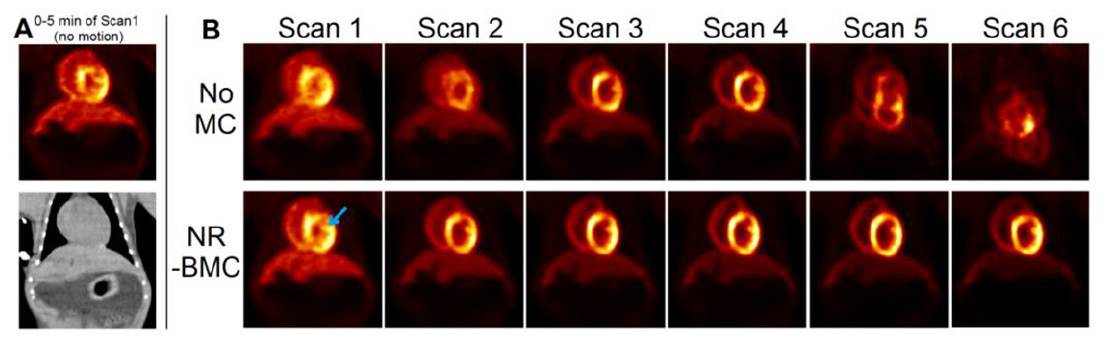
To validate their motion correction scheme, Lu and colleagues performed six consecutive 10-min PET scans of an anaesthetized monkey, 10 minutes after injection with 18F-FDG. Half way through each scan, they moved the monkey in different ways: lateral translation by 0.5 and 1 cm; rotation; reverse-rotation; and 2 cm superior–inferior translation. During the sixth scan, they moved the animal in four different ways. The CODX trace was the most sensitive to body motion, successfully detecting all nine movements.
Reconstructed images for the monkey study. (A) 0–5 min motion-free frame of the first scan with matched CT. (B) Top: reconstruction without motion correction; bottom: with NR-BMC. The papillary muscle (arrow) is visible in all the NR-BMC images, indicating effective corrections.
PET images reconstructed without motion correction exhibited significant resolution loss and blurring in cases with translation, and slight image quality degradation when the animal was rotated. Reconstruction using NR-BMC effectively recovered the resolution and contrast in all cases, with consistent spatial alignment among all scans after motion correction.
The team also retrospectively analysed four human studies and a dog enrolled in a cardiotoxicity study. In all cases, they compared their NR-BMC method with no motion correction, rigid and non-rigid post-reconstruction registration (R-PRR and NR-PRR) and rigid-body motion correction (R-BMC), which uses the COD algorithm but with rigid registration.
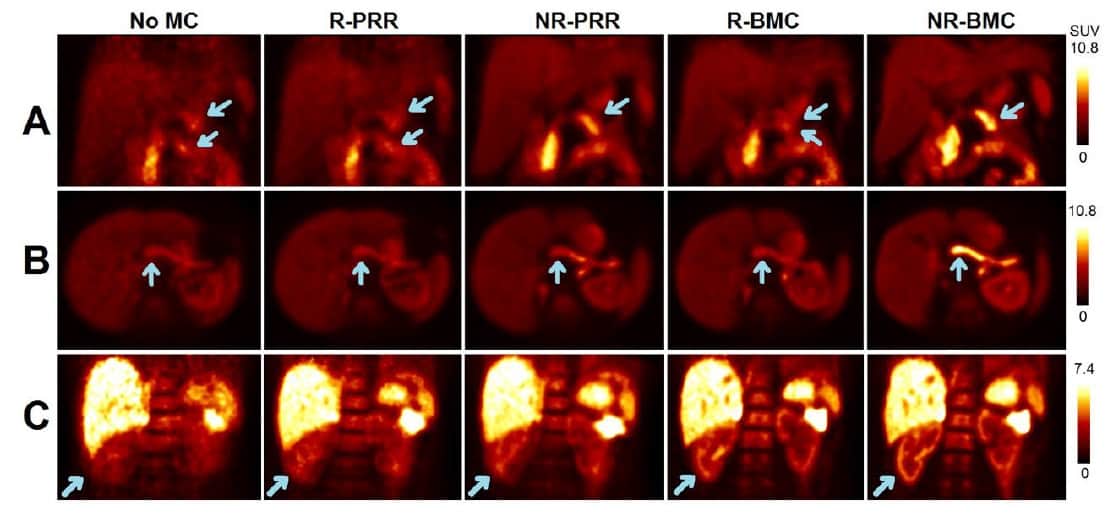
The studies included two patients imaged using 18F-FPDTBZ, which binds to pancreatic β-cells. In the first case, PET images reconstructed using no motion correction, R-PRR or R-BMC contained “two” pancreases, due to large body motion. NR-PRR substantially improved resolution and contrast, while NR-BMC outperformed all other methods for all organs.
In the second patient, who exhibited frequent rotational movements, NR-BMC again achieved the highest motion correction, particularly for organs with thin structures such as the pancreas and kidney.
Reconstructions of 18F-FPDTBZ studies (0–120 min). (A) Coronal slices through the pancreas (arrows); (B) transverse slices through the pancreas (arrow); (C) coronal slices through the kidney (arrow).
The researchers also examined a patient with non-small cell lung cancer scanned using the hypoxia tracer 18F-FMISO. In this case, motion was mainly seen in the arm and NR-BMC effectively restored the bone–muscle boundary. In another example, an 18F-FDG study of a patient with lung nodules, R-BMC and NR-BMC outperformed the other methods in terms of resolution and contrast recovery.
Finally, they examined data from the dog, which was scanned with 18F-DHMT to image myocardial reactive oxygen species. Images without motion correction were blurred, in particular the wall of right ventricle myocardium, due to body motion. R-PRR and R-BMC slightly recovered myocardium resolution, while NR-BMC and NR-PRR more effectively restored resolution.
The authors conclude that the COD algorithm with event-by-event NR-BMC can effectively detect and correct motion in PET scans of both humans and animals, for multiple tracers, with superior performance to conventional post-reconstruction registration approaches.
“Given the initial success of the proposed COD approach in single-bed body motion detection and correction, we are now working on extending its application to whole-body PET, which is a necessary step to achieve its full potential in routine clinical practices,” Lu tells Physics World. “Meanwhile, we are working on simultaneous correction of multiple motion types, for example, respiratory and voluntary body motion.”