Gravitational waves could resolve Hubble constant debate

Simulations by an international team of researchers have shown that new measurements of gravitational waves could finally resolve the discrepancy in Hubble’s constant reported using different measurement techniques. Accumulating gravitational-wave signals from the mergers of 50 binary neutron stars, the scientists found, will yield the most accurate value of the constant to date – which would not only settle the debate but also confirm whether there are issues with the current standard cosmological model.

The Hubble constant represents the rate at which the universe is currently expanding and is vital for calculating both its age and its size. The constant is also widely used in astronomy to help determine the masses and luminosities of stars, the size scales of galaxy clusters, and much more besides. However, two different techniques for estimating the value of Hubble’s constant have yielded very different results

To measure Hubble’s constant directly, scientists need to know a galaxy’s outward radial velocity and its distance from the Earth. The first of these measurements can be obtained from the galaxy’s spectroscopic redshift, but the distance to the galaxy is more difficult to determine directly.

A common way of estimating distance is to exploit so-called “standard candles” – Cepheid variable stars or type 1a supernovae that have known absolute luminosities. In 2016 the best estimate for the Hubble constant obtained this way was 73.2 km s–1 Mpc–1 – vastly different from the value of 67.8 km s–1 Mpc–1 obtained in the same year  by studying the radiation of the Cosmic Microwave Background (CMB).The discrepancy is yet to be explained, since the values should agree if the standard cosmological model is correct.

In this new study, researchers from Europe and the US attempted to reconcile these two results. The scientists exploited the concept of “posterior predictive distribution” (PPD), a methodology often used to determine the reproducibility of experimental results. PPD relies on a dynamic view of probability – in other words, one that changes as new information is obtained.

In this case the scientists implemented PPD to simulate measurements of the Hubble constant using these two different methods, and to check their consistency with the standard cosmological model. One interesting finding is that there’s at least a 6% chance that the current discrepancy in the Hubble constant is purely due to random error.

They then simulated how new independent data could help resolve the debate. Gravitational waves from merging neutron stars seemed a promising avenue to explore, since their signal yields constraints on the distance to the binary stars. Measurements of gravitational waves should therefore provide an estimate of the Hubble constant without making any assumptions about the cosmology of the Universe.

The researchers found that 50 detections of gravitational-wave signals from merging neutron stars would be needed to properly arbitrate between the two different values for the Hubble constant. Including such a dataset within their PPD simulations would, they claim, yield the most accurate value of the Hubble’s constant yet measured – with an error of below 1.8%. Judging by current progress, observations of those 50 neutron-star mergers could well be achieved within the next decade.

Full results are published in Physical Review Letters.

Tissue repair scaffold allies with immunotherapy

UBM decreases tumour growth

Biologic scaffolds — processed tissues from which the cells have been removed — are finding their place in regenerative medicine. Since they preserve the original extracellular matrix of the tissue, biologic scaffolds promote cell attachment and proliferation, enhancing tissue regeneration. Consequently, there is considerable research underway to study their use in different clinical areas.

Biologic scaffolds are also employed in tumour treatments, where tumour resection requires healing  of tissue voids. However, it was unclear whether their use had a negative or positive effect on tumour re-growth. To investigate this issue, a research team led by Jennifer Elisseeff at John Hopkins School of Medicine implanted a biologic scaffold together with cancer cell lines in mice and studied the response.  They found that the immune environment created by the scaffold impaired tumour growth (Sci. Transl. Med. 10.1126/scitranslmed.aat7973).

Triggering a specific immune response

The researchers tested a porcine urinary bladder matrix (UBM), a biologic scaffold that is approved by the US Food and Drug Administration for wound healing applications. They mixed particles of UBM with melanoma, colon or breast cancer cell lines and subsequently injected them in mice. In all cases, tumour growth decreased and animal survival increased, compared with injection of the cells alone. Since these scaffolds did not have any cytotoxic effect on the cells, the researchers inferred that the biologic scaffold was triggering an immune response that impaired tumour growth.

The team’s next step was to find out more about this specific immune response. Employing genetically modified immunodeficient mice, the researchers identified CD4 T cells (also called T helper cells, responsible for adaptative immunity) and macrophages as playing the main role in tumour growth inhibition.

Furthermore, they also identified the immune cells’ specific phenotype, and found that it was different to that normally observed in immune cells associated with tumours. In addition, this immune response was completely opposite to that observed with synthetic immune adjuvant materials (such as aluminium hydroxide and silica particles), confirming the uniqueness of the immune response produced by the UBM.

Synergy with immunotherapy

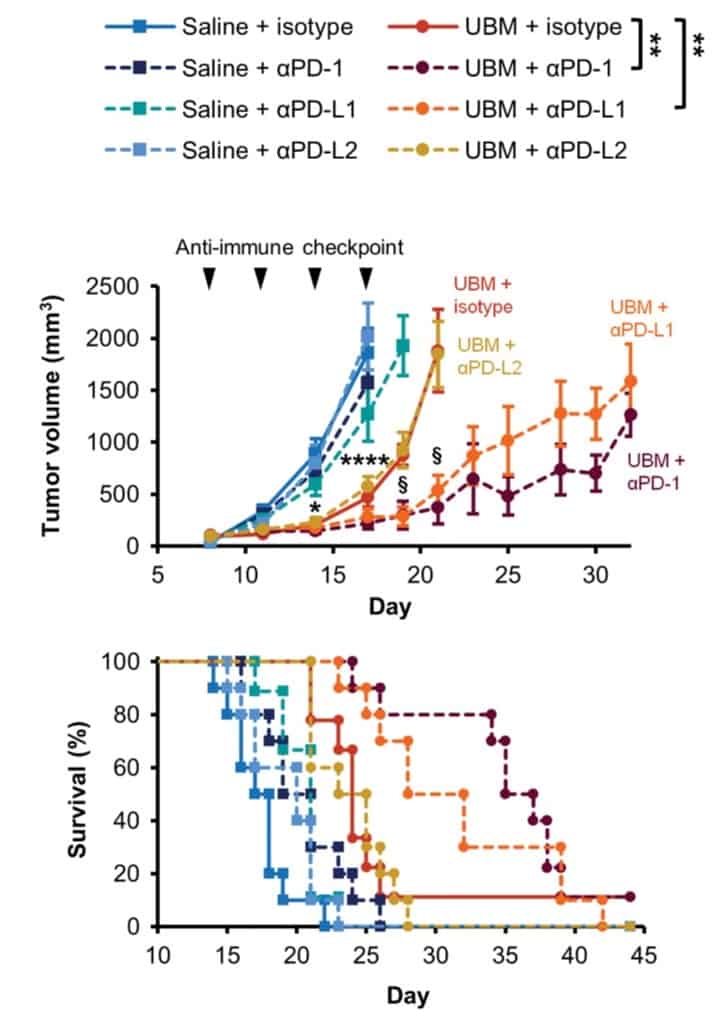
Finally, the researchers combined the UBM with immunotherapy (immune checkpoint inhibitors PD-1, PD-L1 and PD-L2). Such treatments activate the immune system against tumours and could amplify the growth inhibition from UBM.

Synergy with immunotherapy

Indeed, combining UBM with PD-1 or PD-L1 noticeably slowed down tumour growth and increased mice survival. This finding points to the potential of using this biologic scaffold in combination with immunotherapy for tumour treatment.

The team concluded that the immune response generated by the UBM has a pro-healing character that inhibits tumour growth. In addition, such impairment in cancer proliferation can amplify the effect of immunotherapy. However, despite these remarkable results, the researchers point out that biologic scaffolds are complex materials that differ in composition and source, and therefore the findings of this project may not be applicable to all biologic scaffold types. Nevertheless, this study sets a precedent for the use of biologic scaffolds in the treatment of different cancers.

Kenya eyes locations for the country’s first observatory

Researchers in Kenya are scouting locations for what would be the country’s first astronomical observatory. Mount Nyiro and Mount Kulal, both of which are in north-western Kenya near Lake Turkana, are being eyed as potential sites.  A decision is expected to be made within the next two years with the observatory possibly coming online within the next 5-10 years if given the green light by the government.

Many Kenyan astronomers returning from abroad went back and took up jobs elsewhere

Paul Baki

Kenya is situated on the equator and can access more than 85% of the sky in both northern and southern celestial hemispheres. The country has a climate that makes it ideal for astronomical observations with little light pollution and clear skies for most of the year.

Paul Baki, an astronomer from the Technical University of Kenya in Nairobi who is part of the working group to establish the observatory, says that Kenyans training in local universities currently do not have access to a research-class telescope. “Many Kenyan astronomers returning from abroad went back and took up jobs elsewhere,” says Baki, adding that the observatory will hopefully stem this brain drain by supporting training and research in the country as well as technology development.

Economic boost

At a meeting in early February at the Technical University of Kenya, staff and students discussed what engineering skills would be necessary to build an optical telescope at the observatory and how to take the project forward.

Searching for a potential site has currently been done via satellite data, but now ground-based weather facilities will be used for further analysis. This work is being carried out together with South Africa and the UK, which has given the project £140 000 from the UK Research and Innovation’s global challenges research fund.

Martyn Wells, an optical engineer from the UK Astronomy Technology Centre, based at the Royal Observatory in Edinburgh, says that the sites that have been shortlisted are in economically neglected parts of the country, which could benefit by “significant astro-tourism”.

Hachimoji DNA doubles the genetic code

Researchers in the US have built an “alien” DNA system from eight building block letters, so expanding the genetic code from four and doubling its information density. The new system meets all of the requirements for Darwinian evolution and can also be transcribed to RNA. It will be important for future synthetic biology applications and expands the scope of molecular structures that might be capable of supporting life, both here on Earth and more widely in the universe.

One of the main characteristics of life is that it can store and pass on genetic information. In modern-day organisms, this is done by DNA using just four building blocks: guanine, cytosine, adenine and thymine (G, A, C and T). Pairs of DNA strands form a double helix with A bonding to T and C bonding to G.

Four more building blocks

The researchers, led by Steven Benner of Firebird Biomolecular Sciences LLC and the Foundation for Applied Molecular Evolution, both in Alachua, Florida, have now used organic chemistry to design and make four more such building blocks that fit the size and shape of the G:C and A:T pairs and bind with them. These building blocks are P and B, which are analogues of purine, and Z and S, which are analogues of pyrimidine. These duplexes form P:Z and B:S pairs.

“We made several hundred molecules of this new synthetic genetic system and studied their ability to bind to their complementary genetic molecules,” explains Benner. “This led to rules that predict how well a sequence of synthetic building blocks, say GACTZPSB, bind to a complementary CTGAPZBS sequence.”

The researchers called their eight-letter synthetic genetic system “hachimoji” DNA (“hachi” means eight in Japanese and “moji” letter).

Hachimoji DNA also supports life

Like natural DNA, hachimoji DNA supports life in that it pairs in a predictable way and copies to make a hachimoji RNA. RNA is important for life since it is via this molecule that DNA transfers information before it is sent to proteins.

Benner and colleagues say that the new DNA also, importantly, meets the “Schrödinger requirement” for a Darwinian system of molecular evolution – an important hallmark for supporting life. “Erwin Schrödinger is best known for having created quantum chemistry, but later in his life, like many physicists, he became interested in evolution,” explains Benner. “He noted that to store information, a genetic material must have different building blocks, just like an alphabet must have different letters.”

From a physics perspective, however, these building blocks must be able to replace each other without geometrically disrupting the size or shape of the double helix to support evolution. “Our extra nucleotide ‘letters’ are designed in this way.”

Engineering enzymes to transcribe DNA into RNA

To transcribe hachimoji DNA into RNA, the researchers adapted a natural enzyme (T7 polymerase) so that it could accept unnatural genetic molecules. This is one of the main challenges when working with such synthetic DNA systems, says Benner. “Our colleague Andrew Ellington and his team at the University of Texas at Austin re-designed the T7 polymerase, which transcribes natural DNA to natural RNA, by changing amino acids in the protein and finding ones that accept hachimoji DNA to make hachimoji RNA.”

The work tells us much about what chemistry is required to support genetics, he tells Physics World. It suggests that DNA-based life forms other than those that we know on Earth may exist in the Universe. This might be important for when it comes to searching for exobiological “signatures”, he says.

It is wrong to say that hachimoji DNA is alien life though, he insists. For that, the system must also be self-sustaining and hachimoji DNA needs a steady supply of the lab-created building blocks and proteins. “As none of these are available outside, hachimoji DNA can go nowhere if it escapes the laboratory.”

Many potential applications

The potential applications are many, according to the team. “Hachimoji DNA could be used to develop clean diagnostics for human diseases, in retrievable molecular information storage, barcoding, self-assembling nanostructures, and to make proteins with extra amino acids as well as novel drugs. Parts of this DNA are already being commercially produced by Firebird.

The researchers, reporting their work in Science 10.1126/science.aat0971, say they are now busy working on engineering bacteria that accept synthetic genetic systems.

Correlations between protons and neutrons may explain 35-year-old nuclear mystery

According to the classical model of nuclear structure, the internal structure of nucleons should not change if they are bound into atomic nuclei. But it was discovered 35 years ago that quarks inside free protons and neutrons behave differently to those bound into nuclei – and the cause has remained a mystery ever since. Now researchers have taken a significant step towards solving the puzzle by using two different types of scattering experiments to relate the strength of the effect to the number of high-momentum nucleon pairs in an atomic nucleus.

According to the standard model of particle physics, the energies binding quarks inside protons and neutrons are almost 100 times larger than the energies binding those nucleons inside nuclei. In the 1980s, therefore, researchers at the European Muon Collaboration (EMC) at CERN assumed they could safely speed up their nucleon-probing experiments by using iron nuclei containing many nucleons.

“They thought there was no way the relatively small binding energy of an iron nucleus would have any effect on the quarks,” explains nuclear physicist Axel Schmidt of Massachusetts Institute of Technology.” To their surprise, however, they found that the collision cross-section per nucleon was lower than expected, implying that the momentum distribution of the quarks had changed.

This has subsequently been confirmed in other experiments in other atoms: “Every single nucleus that’s subsequently been checked has some degree of this effect,” says Schmidt, “And the bigger the nucleus, the bigger the effect.”

Alternative theory challenges the mainstream

The cause of the so-called EMC effect remains unexplained, however. “Many theories have been rejected by experiment,” says Schmidt. “Now there are really only two surviving classes of theory. I would say the mainstream view is that something about the environment of the nucleus changes the quark distribution of all the constituent protons and neutrons.”

The other theory relates the effect to transitory correlations between nucleons, which lead them to have much higher momentum than other nucleons. “Perhaps 80% of the protons and neutrons are unchanged and 20% are changed dramatically and, when we measure the EMC effect, we’re measuring the aggregate,” he says.

Schmidt and colleagues from the CLAS collaboration, which is based at the Jefferson Laboratory in the US, decided to test this hypothesis. They reasoned that “if the effect is due to pairs, then every proton–neutron pair should be like every other – whether that pair is in a carbon or a lead nucleus,” says Schmidt.

The team found a neat way to directly measure both the proportion of high-momentum pairs in nuclei and their collision cross-sections at the same time. They irradiated targets of carbon-12, aluminium-27, iron-56 and lead-208 with high-energy electrons. Some of these electrons underwent quasi-elastic collisions with the nuclei, knocking out a proton or neutron but leaving the constituent quarks undisturbed. From these, the researchers could reconstruct the momentum of the nucleon at the moment of impact.

Other electrons underwent deep inelastic scattering, obliterating a nucleon and allowing the researchers to infer the average momentum distribution of the quarks inside the nucleons. Sure enough, the number of pairs in a nucleus was linearly proportional to the strength of the EMC effect, suggesting all pairs had the same effect.

Next, the researchers made a prediction. Protons are far more likely to form high-momentum pairs with neutrons, and vice versa. Therefore, in heavy, neutron-rich nuclei, protons are more likely to be paired at any instant, making their average momentum higher – a prediction that the CLAS collaboration confirmed last year. The researchers therefore calculated average EMC effects per proton and per neutron.

As predicted, the EMC effect per neutron stayed roughly constant at atomic masses beyond 12, but the EMC effect per proton continued to increase for all measured nuclei. “We think that this lends credence to the alternative hypothesis and suggests that we need to do follow-up experiments specifically to look at the quarks inside correlated nucleons, rather than just at the nucleus in aggregate,” says Schmidt. “There’s one we’ve just started and another scheduled for a few years from now.”

“As far as deep inelastic scattering results go, the mean-field hypothesis works probably as well as the short-range correlations hypothesis,” says Gerald Miller of the University of Washington at Seattle. “The fact that the researchers can independently measure the number of neutron–proton pairs interacting and establish a correlation is a big step. That said, it’s not quite nailed down yet because the alternative hypothesis has not yet been used to calculate this second set of kinematics. That presents a challenge that proponents of the alternative hypothesis need to meet.”

The research is published in Nature.

Parenthood drives women out of science, US survey reveals

Almost half of women and a quarter of men leave full-time science-based careers after becoming a parent. That is according to a study that followed the careers of more than 4000 US-based science, technology, engineering and mathematics (STEM) professionals over an eight-year period. The research is the first to quantify the challenge of balancing parenting with STEM work and how it can contribute to the gender gap in science.

Women are underrepresented across STEM and face a variety of cultural and structural disadvantages to overcome. To investigate the specific effect of parenthood on STEM employment, sociologist Erin Cech from the University of Michigan and colleagues used data from a US-wide survey carried out by the National Science Foundation that followed full-time, initially childless STEM professionals over an eight-year period.

They were first surveyed about their circumstances in 2003 and then again in 2006, 2008 and 2010. The dataset included more than 3300 STEM professionals who remained childless over that period and around 800 who became parents within the first three years of the study period.

It is clear that without a significant change in culture and climate, policies alone will not eliminate all the major barriers for women

Miriam Deutsch

The study found that new parents were significantly less likely to remain in full-time STEM jobs than those that remained childless. Within three years of the birth or adoption of their first child, 42% of mothers and 15% of fathers had left full-time STEM employment. By the final survey in 2010, 43% and 23% of new mothers and fathers, respectively, had moved on, with 12% of new mothers and 18% of new fathers switching to full-time jobs outside of STEM. Both were significantly more likely to have changed career than childless respondents.

When those who had shifted to full-time, non-STEM employment were asked why they had quit science, 48% of fathers and 71% of mothers said the move was “family-related”, compared to 4% of those without children. After their first child, 6% of women also switched to part-time, non-STEM careers, compared with 0.5% of men. The study also found that some new parents stayed in science but cut their hours with 11% of mothers and 2% of fathers switching to part-time STEM employment, while 15% of mothers and 3% of fathers were not working by the time of the final survey in 2010.

Removing barriers

The researchers say that STEM fields must do more to address the issues parents have balancing their work with childcare. “This is a problem for science because these new parents who leave are highly trained and have experience in the workforce,” Cech told Physics World. “Their departure means a loss of knowledge and expertise that is disadvantageous for innovation and scientific inquiry.”

This issue is more pronounced for women, adds Cech, because “mothers still shoulder – and are culturally expected to shoulder – the lion’s share of childcare responsibilities”.  Cech adds that culture, institutional policies and organizational practices all need to be looked at to tackle the issue. “Policies like paid caregiver leave that are more inclusive – that include both parents – would help parents share the burden of early caregiving responsibilities,” she says. “Organizations that employ STEM professionals need to carefully consider how their policies and practices around workers with caregiving responsibilities may be squeezing out those professionals. More flexible work practices – and workplace cultures that support rather than stigmatize the use of those policies – would also help.”

Miriam Deutsch, chair of the American Physical Society’s committee on the status of women in physics, told Physics World that beyond policies to remove unnecessary, tangible obstacles, there needs to be a deeper cultural shift to improve the lives of women and mothers in STEM. “The [research] mentions various cultural and social pressures, such as the view that parents are less devoted to their careers than non-parents,” she explains. “How to impart this cultural shift is the million-dollar question. But it is clear that without a significant change in culture and climate, policies alone will not eliminate all the major barriers for women.”

Democracy under threat, a mathematician’s perspective

In this episode of Physics World Weekly we’re looking at how applied mathematics can help to understand how instabilities arise in democracies. You will hear an extended interview with Karoline Wiesner from the University of Bristol, who uses complex systems theory to analyse human systems.

Wiesner was the lead author on this recent paper in the European Journal of Physics, which applied a complex systems approach to evaluating the idea that democracy is under threat. Wiesner is interviewed by Physics World’s general physics editor Hamish Johnston who reported on the original paper at the end of last year.

If you enjoy what you hear, you can subscribe to Physics World Weekly via the Apple podcast app or your chosen podcast host.


Commercial partnership harnesses graphene to boost access to safe drinking water

The National Graphene Institute (NGI) at the University of Manchester and the UK-based water filter manufacturer LifeSaver have embarked on an 18-month research project to commercialize graphene-based water filters. The partnership builds on research at the NGI on graphene membranes, which have shown promise for cheap and effective water treatment.

One of graphene’s many useful properties is water filtration at high flow rates, with research at the NGI suggesting that graphene-oxide membranes could be used for the cheap and easy desalination of water. However, says Rahul Nair, who will lead the project at the University of Manchester, the technology is still not commercially available.

“Making a graphene-based portable water filter was our dream, and this collaboration with LifeSaver will enable that dream to be a reality sooner than later,” he says. By combining the NGI’s graphene expertise with LifeSaver’s core capability in manufacturing portable water filters, Nair hopes that the project will create graphene-based filters that will “enhance the quality and availability of safe drinking water for those who need it most.”

LifeSaver already produces portable water filters aimed primarily at global travellers. The company’s current hollow-fibre membranes have an average sieve size of about 15 nm, which is small enough to filter out bacteria, microbial cysts and viruses. Through this research partnership, the company hopes to develop and patent a market-leading water filtration product with a sieve size of 1–3 nm.  That would be small enough to remove other common contaminants, such as heavy metals, pesticides, certain chemicals and possibly even nuclear radiation.

“For travellers who only use questionable water sources for a short period of time, the risks to their health are very low with our current products,” says LifeSaver product manager Wesley Clarke-Sullivan. “However, for communities who use a single-water source continually for their whole lives, certain elements in the water that we aren’t currently able to remove could eventually have adverse effects on their health.”

While LifeSaver’s portable and reusable water filters are great for outdoor enthusiasts, the company’s mission strongly revolves around humanitarian work. Last year, for example, after a series of earthquakes hit Indonesia, LifeSaver dispatched over 2000 water purifiers to the scene, capable of delivering 11.5 million litres of safe drinking water.

The company was founded in 2007 after UK inventor Michael Pritchard created the world’s first portable water filter that could remove even the smallest known waterborne viruses. LifeSaver hopes to make a difference in the lives of the 663 million people worldwide who currently have no access to safe drinking water.

Multitasking in biological networks: is there a limit?

We have all heard of multitasking, but did you know that components of your body are also able to do more than one thing at a time? For instance, many proteins in the body are capable of catalysing more than one reaction, and the system of blood vessels in the brain is able to enhance flow and delivery of oxygen and nutrients to more than one region at once. So is there a limit to this multifunctionality? According to a new study, yes, there is (PNAS 10.1073/pnas.1806790116).

Many complex systems in biology can be thought of as networks. These networks perform tasks by controlling connections within the network, called “edges”. This view is useful in understanding biological systems at a fundamental level, which in turn can lead to improved therapeutics and biologically-inspired engineering.

A team of physicists in the US has studied tunable networks to investigate the limits to how many functions can be successfully fulfilled simultaneously. The researchers had previously been inspired to explore the properties of two different kinds of biological networks: flow networks, used to study blood flow through a network of vessels; and mechanical networks, which can be used to model  the properties of folded proteins.

The research groups of Eleni Katifori  and Andrea Liu at the University of Pennsylvania independently studied flow networks and mechanical networks, respectively. Both teams’ goal was to understand the inherent levels of functional complexity within their respective networks.

The researchers

“It was two entirely different physical networks, but in a way the same question,” says Katifori. Knowing that the two systems are mathematically related, both groups were interested in investigating whether there is a limit to the degree of task complexity  that each network is able to perform.

The authors defined “task complexity” as the number of simultaneous functions composing a specific task. They constructed the two networks by developing sets of mathematical equations that assign a cost to (flow and mechanical) networks that fail to accomplish these tasks. The researchers then used simulations to optimize or “tune” the network to control the degree of complexity of the tasks they could perform.

They found that both types of networks are able to accomplish surprisingly complex tasks. A protein-sized network can perform tasks composed of over a hundred different functions. However, they also discovered that there is a limit to multifunctionality that is almost identical in character in both flow and mechanical networks. In other words, the extent of multitasking is dependent upon the optimization conditions (constraints) that the team assigned to each network in order to accomplish multifunctionality. Upon reaching the limit of multitasking, both networks face a phase transition that determines the maximum complexity of tasks that can be tuned successfully.

“We want to understand what aspects of the network’s structure are important,” says Jason Rocks, co-first author of the study. Based on these results, one possible future direction will be to examine how the ability to perform tasks is encoded into networks. The answer to this question may help biomedical researchers learn more about enzymes (an example of a mechanical network) in order to design targeted drugs and treatments.

The team is performing ongoing studies based on this work, including the use of topology to understand the relationship between network structure and function and how robust functions are to changes in connectivity once they are tuned in.

With stars in my eyes

One of my earliest childhood memories is of my father pointing out the stars in the constellation of Orion to me. This was quite some feat – growing up in the big, bright city that is Mumbai in India, visible stars were few and far between. But despite the city glow, I learnt to read the sky, or what I could see of it, and this early foray into astronomy set me on a path in science that I have followed all of my life.

So the idea of a star-gazing manual aimed especially at children is an excellent idea. But Seeing Stars: a Complete Guide to the 88 Constellations by Sara Gillingham is so much more than a typical stellar atlas. Instead, it is a beautiful, hardbound coffee-table book, aimed at children aged 7–10, but pleasing to the eye for all. The large-format book is coloured mostly in gold and blue, and is beautifully drawn and illustrated, in a very different style from most star atlases aimed at adults – these often go for accuracy over artistry, and are quite a challenge to entertain a child with.

However, Seeing Stars is not just a picture book. Gillingham, who is both writer and illustrator, is a consummate children’s author and knows just how to pitch her language. Although I am not sure it is “the first ever children’s book to introduce budding stargazers to all 88 internationally recognized constellations”, I like that Gillingham chose to depict all of the International Astronomical Union’s (IAU) official constellations.

Seeing Stars is equal parts astronomy and mythology, with a sprinkling of history, which is a good way to provide context to star-gazing’s ancient roots. The book opens with a short and sweet primer on how to read the sky with Gillingham deftly explaining concepts such as asterisms, how to find the brightest stars in the sky, hemispheric differences in the sky. She then digs into the many ancient constellations (both mythological and the 13 zodiacal ones), as well as the modern constellations (animals, people, objects and symbols) as determined in the 17th–19th centuries.

Microscope and compasses

Each individual constellation is displayed on a double-page spread that features a tiny how-to-find-it map that shows it in relation to other constellations; a realistic connect-the-dot shape of the constellation as it appears in the sky; some key information about its main stars; and a large glossy illustration of the mythological character, object or creature for which the arrangement is named. The book ends with accurate sky maps that could be used for practical star-gazing, and other resources, such as websites and apps for young star-gazers.

The book provides an accessible overview of the night skies, and will equip readers with all the information needed to spot and name a constellation, while recalling its mythological or historical background. Gillingham’s writing is simple and clear throughout.

A particularly interesting section to me was the history behind the modern constellations, where she describes how, in the 1800s, the invention of devices such as the microscope and the compasses (see above) had such an impact on science that astronomers including Nicolas Louis de Lacaille mapped new constellations based on them.

Beautiful to look at, just like the night sky itself, Seeing Stars is sure to delight and inspire young star-gazers and adults alike.

Copyright © 2026 by IOP Publishing Ltd and individual contributors