On-board cone-beam CT visualizes delivered dose

Star-shot

Image guidance plays a vital role in radiation therapy, with on-board kilovoltage cone-beam CT (kV-CBCT) commonly used for patient alignment, motion assessment and adaptive treatment planning. Now, a US–Canadian research team has come up with a brand new application for kV-CBCT: direct visualization of the delivered dose distribution (Int. J. Radiat. Oncol. Biol. Phys. 10.1016/j.ijrobp.2018.12.023).

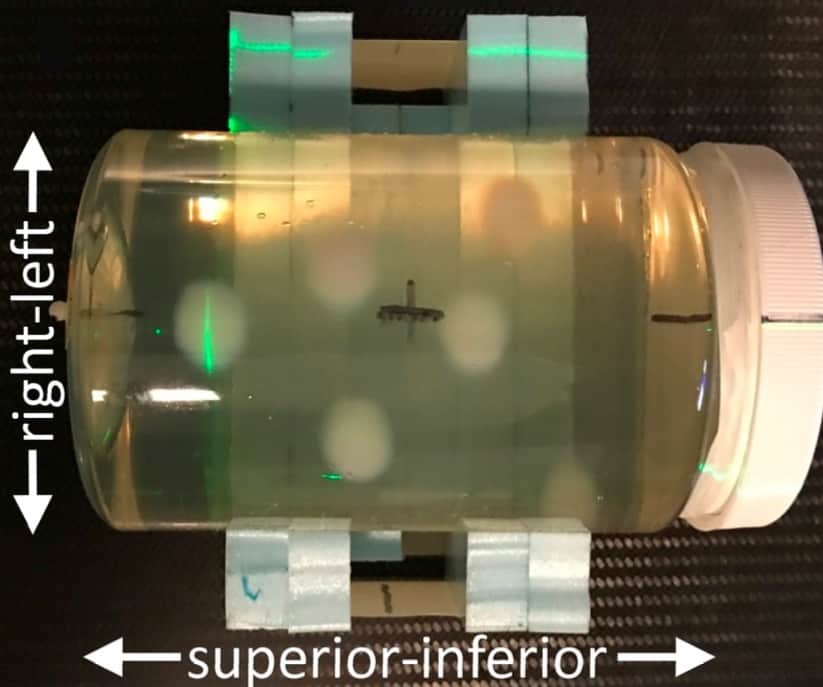
The team — headed up at Duke University and the University of British Columbia — is investigating the use of an N-isopropylacrylamide (NIPAM) polymer gel dosimeter. Exposure to radiation changes the polymer’s mass density, which manifests as a change in CT image intensity and can be measured by the on-board kV-CBCT.

“The biggest advantage of using an on-board CBCT for dose visualization is that it automatically informs the physicist precisely how the dose is aligned in the same imaging coordinate system used for patient alignment and treatment,” explains first author Justus Adamson from Duke University Medical Center. “Since all modern medical linear accelerators are equipped with CBCT, it can be applied essentially anywhere without need for additional imaging technology.”

The team’s first goal is to use the CBCT polymer gel dosimetry for quality assurance of multifocal stereotactic radiosurgery (SRS) — a treatment that has stringent requirements for spatial accuracy.
Irradiated dosimeter

Verifying spatial accuracy

In its simplest form, the quality assurance process involves aligning the dosimeter on the radiation delivery system, irradiating it and then acquiring a volumetric image with the on-board CBCT while the dosimeter is still on the treatment device. Finally, the resulting image is processed and used to verify the spatial accuracy of radiation delivery.

For this study, Adamson and colleagues acquired simulation CTs of a 9.5 cm-diameter NIPAM dosimeter and generated a multifocal SRS treatment plan for delivery on a 6 MV linac with a high-definition multileaf collimator. They designed a 4-arc volumetric-modulated arc therapy (VMAT) plan that delivered 20 Gy to six 1 cm-diameter targets.

Next, the researchers aligned the dosimeter on the treatment table and delivered the plan. They recorded a CBCT scan prior to irradiation and three further CBCT images immediately after. For comparison, they also acquired five diagnostic CTs of the dosimeter 24 hours later.

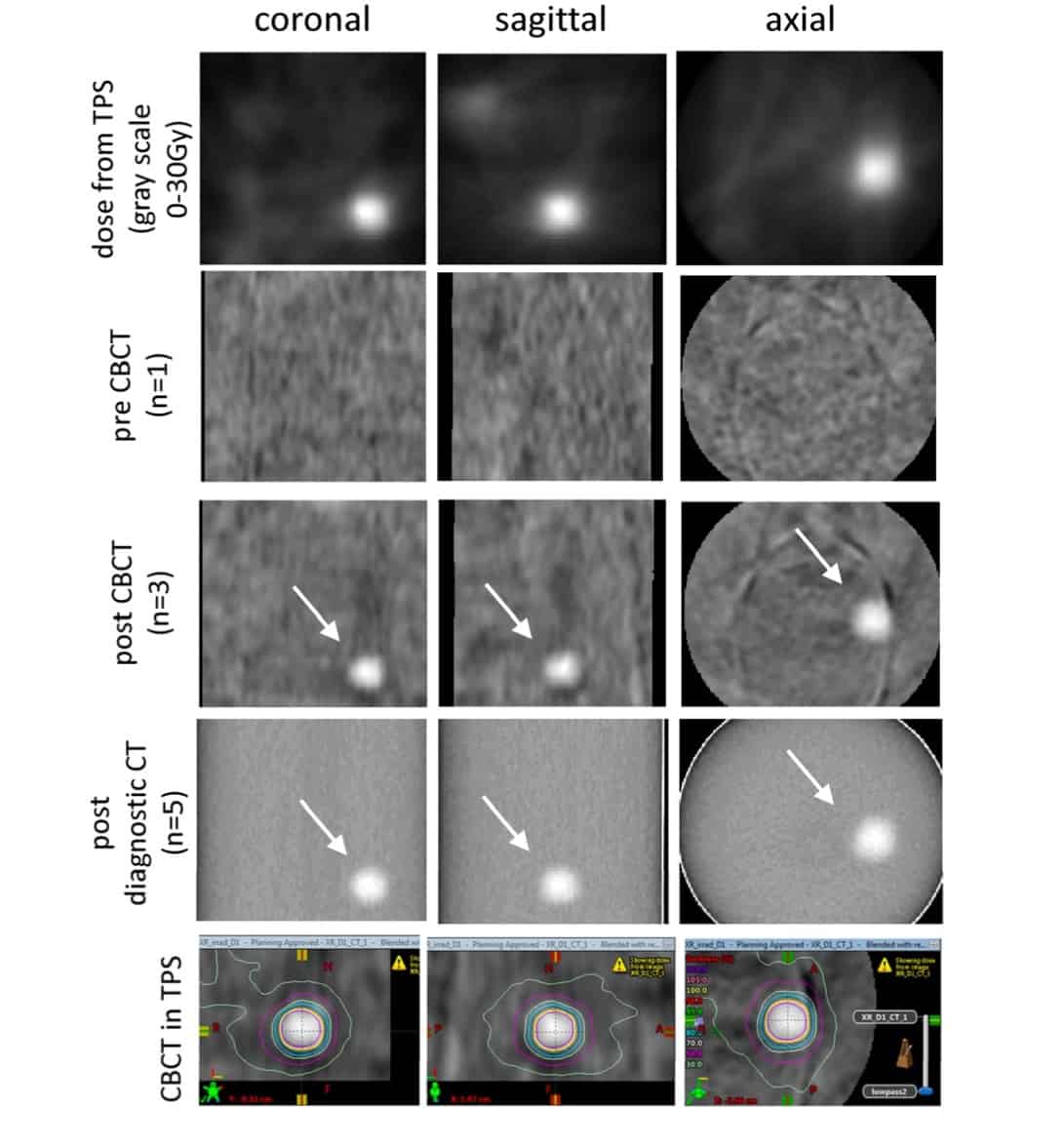
CBCT images of the irradiated dosimeter clearly showed the delivered dose distribution. The mean contrast-to-noise ratio (CNR) per target was 1.4±0.4 for individual CBCTs and 1.7±0.7 after averaging the three images.

To improve the CNR, the researchers applied a low-pass filter, which increased the CNR to 2.5±1.4. Background subtraction increased the CNR to 2.2±0.3 and 5.8±0.5, with and without the filter, respectively. In comparison, the CNR of single and averaged diagnostic CTs were 5.5±0.4 and 11.6±3.7, respectively.
Dose visualization

The centroids of prescription isodose volumes from the average CBCT agreed with those from the treatment planning system to within 1.1 mm (range 0.8–1.7 mm). For the diagnostic CTs, the centroids agreed to within 0.7 mm (0.4–0.8 mm).

Absolute dose

Adamson and colleagues also performed an absolute dose comparison using a diagnostic CT of the dosimeter. To do this, they created an absolute dose calibration curve derived from irradiating a second dosimeter with a 3-field plan that included dose gradients.

Profiles of planned and measured dose revealed that the dosimeter yielded a signal that was proportional to dose in the high-dose (above 10–12 Gy) volumes, with 3D gamma pass rates of 94.0% and 99.5%, using 5%/1mm and 3%/2mm criteria, respectively. At lower doses, however, the dosimeter exhibited nonlinear behaviour and poor dose sensitivity.

The researchers concluded that this work demonstrated, for the first time, the potential to visualize a delivered radiotherapy dose immediately after irradiation using on-board CBCT, with sufficient CNR to measure radiation and imaging system coincidence to within 2 mm.

“The accuracy in this proof-of-principle is a good start; however, we’ve already found a number of ways of improving it quite a bit,” says Adamson. “I anticipate that with ongoing improvements we will be able to achieve sufficient spatial accuracy for quality assurance purposes, even for SRS.”

The team is now investigating practical clinical applications where this technology could provide both convenience and value. “One example is radiation isocentre coincidence measurements, or ‘star-shots’,” Adamson explains. “In this case, this technology not only allows for more convenient analysis, using CBCT, but also inherently quantifies coincidence of the radiation and imaging isocentres, which is not possible with a traditional film measurement.”

“We are also actively working on improving sensitivity of the system and better characterizing the dosimeter response in the short timeframe between irradiation and CBCT acquisition,” he tells Physics World.

Christmas-competition winners

Kate Blackham Christmas jumper

It’s already February and last Christmas might seem like a distant memory, but here at Physics World we’ve been rekindling that festive feeling by sorting through the entries to our physics-themed Christmas jumper competition featured in the December issue.

Thank you to everyone who entered. We were delighted at the response and really enjoyed your brilliantly creative designs. We’re pleased to present the five winning entries, the makers of which will each receive a copy of Stephen Hawking’s final book Brief Answers to the Big Questions.

Christmas jumpers

Alexandre Dareau, a postdoc at the Insititut d’Optique Graduate School in France, and Samuel Rind, a PhD student at TU Wien Atominstitut in Austria, not only designed a jazzy jumper, but also wrote an accompanying festive paper. They claim to have found a “seasonal quantum Hall effect” ultimately linked to “exceedingly attractive physicists wearing measurably stylish and scientifically relevant sweaters”.

Kristen Coyne Christmas jumper

Special kudos to astronomy Master’s student Kate Blackham from Milton Keynes in the UK, who is studying part-time with Swinburn University, Australia, while working in publishing. She actually knitted her festive design referencing Jocelyn Bell Burnell, and even used space-themed yarns dubbed “Starlight”, “Cosmos” and “Starburst Cosmos”.

Mike Viola’s Higher physics class (ages 16–17) at Dumfries Academy in Scotland really got into the swing of the competition and sent in an array of impressive designs, with our favourite being Emma McDonald’s entry featuring the Grinch saying a scientific alternative to “Bah, humbug”.

Kristen Coyne, assistant director for public affairs at the National High Magnetic Field Laboratory in the US,  had us saying “why didn’t we think of that?!” with Santa at a less traditional north pole. And we chuckled particularly loudly at the design made by Emma Smith, a medically retired NHS staff nurse from Halifax in the UK, which referred to the Doppler effect.

Thank you again to all who took part, and congratulations to the winners.

Coffee harvests face risk from rising heat

Coffee drinkers, be warned. A combination of factors – including climate change – is threatening supplies of the beans on which the coffee harvests depend.

Latest analysis by a team of scientists at the Royal Botanic Gardens at Kew in London found that more than 60% of over 120 coffee species known across Africa, Asia and Australasia are threatened with extinction.

For many people, coffee is their favourite tipple. In the UK alone, more than 80 million cups of coffee are drunk every day. The experts at Kew say a total of 100 million people around the world depend on coffee for their livelihoods.

Climate change, together with fungal diseases and the impact of land clearances and deforestation, are all having negative impacts on coffee plants.

Coffee plants are fragile and often acutely sensitive to temperature changes, particularly those belonging to the Arabica species (Coffea arabica), the source of the world’s most popular coffee variety.

The Coffee Research Institute says Arabica plants need year-round temperatures of between 15°C and 24°C in order to maintain high production levels and good quality.

Wild coffee plants play an essential role in building up more robust plants for cultivation; cross-bred with plantation plants, they provide the genetic resources to help withstand pests and diseases. They also encourage resilience to changes in climate and improve the flavour and quality of the coffee beans.

The Kew scientists, together with colleagues in Ethiopia,
the biggest producer of Arabica coffee in Africa, used climate change models and temperature projections to gauge the future health and survival rates of wild Arabica plants.

The results of the analysis, the first ever comprehensive survey linking climate change with Arabica coffee production, will have coffee drinkers crying into their cups.

Wide extinction threat

Dr Justin Moat, who headed up the Kew study, says more than 60% of wild Arabica plants are threatened with extinction.

“The worst case scenario, as drawn from our analyses, is that wild Arabica could be extinct by 2080.

“This should alert decision makers to the fragility of the species.”

The highlands of Ethiopia and of South Sudan are the natural home of Arabica coffee. Researchers found that deforestation over the past 70 years plus more recent changes in climate could result in wild Arabica becoming extinct in South Sudan within the next two years.

“The climate sensitivity of Arabica is confirmed, supporting the widely reported assumption that climate change will have a damaging impact on commercial coffee production worldwide”, says Dr Moat.

Pay growers more

In coffee-growing areas around the world, including Ethiopia and Brazil, temperatures have been rising while amounts of rainfall have been decreasing.

The Kew study says that while bumper coffee harvests over the last two years have led to generally low prices, this pattern is unlikely to continue as crop yields decline and demand grows.

The study says coffee growers, mostly smallholders, should be paid more for their produce in order not only to improve living standards but to encourage more sustainable and innovative cultivation methods. The Yayu Project in Ethiopia is seen as a model for this form of development.

There should also be more research into wild coffee species and investment in building up collections and seed banks. 

The International Year of the Periodic Table has begun

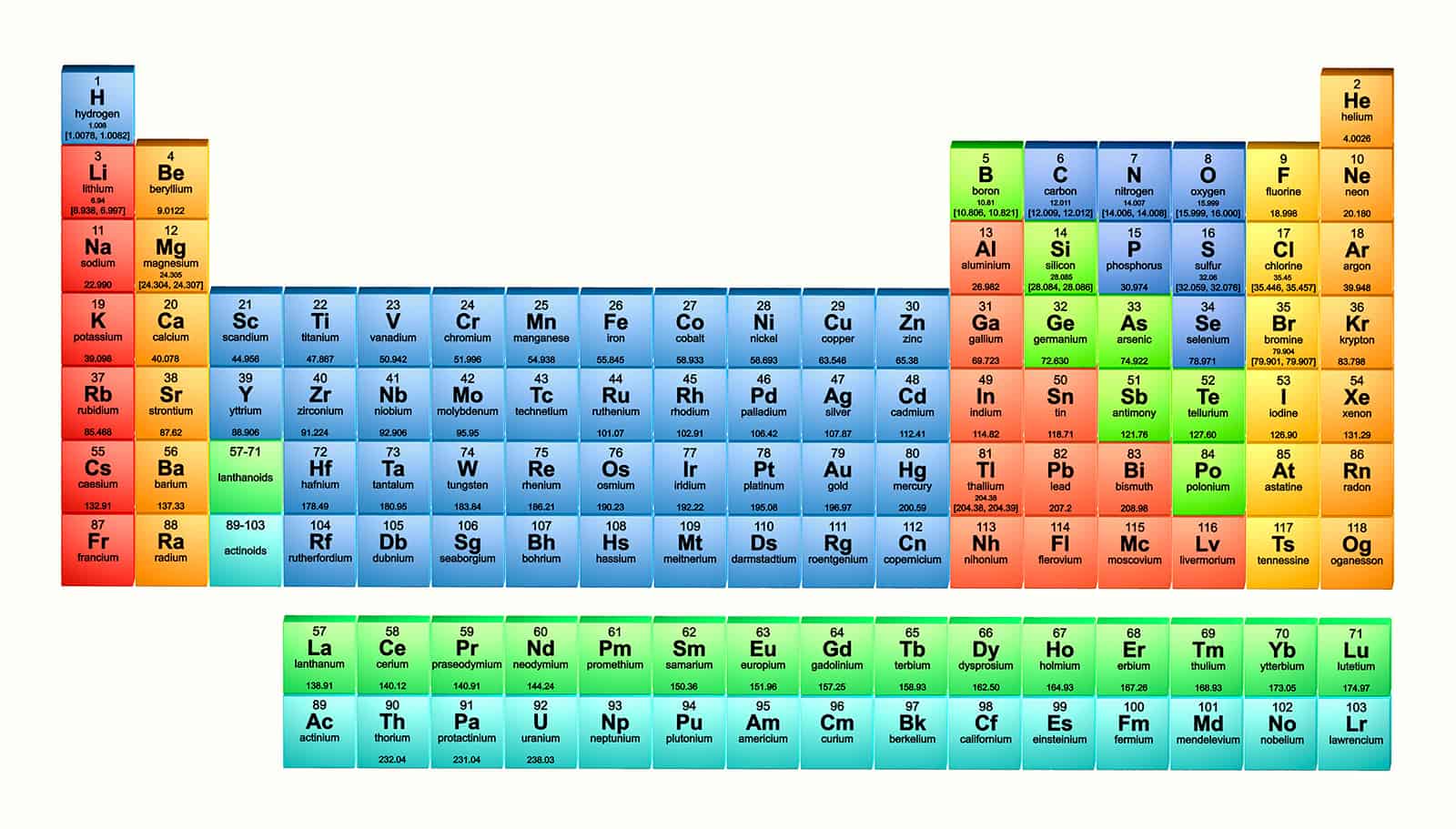
“The periodic table tells us a story – its aim to understand the essence of all things,” said UNESCO Director General Audrey Azoulay in her introductory speech at the opening ceremony of the International Year of the Periodic Table of Chemical Elements (IYPT) that took place at UNESCO’s headquarters in Paris this week.

In proclaiming 2019 as the IYPT, the United Nations says that it has recognized the importance of raising global awareness of how chemistry can help in reaching sustainable development goals and provide solutions to worldwide challenges in energy, education, agriculture and health.

“The periodic table (PT) is one the greatest achievements in science ever,” added Pierre Corvol, who is president of the Académie des Sciences at the Institut de France. When Russian scientist Dmitry Mendeleev pioneered the table 150 years ago in 1869, the existence of the atom was unknown and only 60 elements had been discovered (there are now 118) and some of the information about these 60 was even wrong. Mendeleev was visionary in that he left boxes for elements that had not yet been discovered. He also importantly predicted the properties of five of these elements and their compounds. Indeed, three of these were subsequently discovered within his lifetime.

“The PT’s longevity comes thanks to its simplicity. All schoolchildren learn about this table.”

Mikhail Kotyukov, minister of science and higher education of the Russian Federation, added that Mendeleev’s heritage “applies to all humanity”.

Celebrations all year

The IYPT opening ceremony was a joyous, almost party-like, event – with musical interludes from renowned pianist Mira Yevtich – and was a true celebration of the significance of the PT and its applications to society. It was also real kick-off to all the events planned for the year ahead around the world. These include, for example: The Periodic Table Challenge and the Periodic Table of Younger Chemists, both organized by the International Union of Pure and Applied Chemistry (IUPAC), which celebrates its centenary this year; the Postgraduate Summer School on Green Chemistry in Africa organized by the The Interdivisional Committee on Green Chemistry for Sustainable Development (ICGCSD); the International Nuclear Physics Conference 2019, organized by the Institute of Physics (IOP) and co-sponsored by the International Union of Pure and Applied Physics (IUPAP); and the International Symposium on Setting their Table, organized by the IYPT.

This event, which will take place at the University of Murcia in Spain from 11-12 February, will highlight the women who contributed to the discovery of the PT elements. These female role models include Marie Curie, who discovered radium (Ra) and polonium (Po), Bertha Karlik, for her discovery of astatine (At) and Lise Meitner, for an isotope of protactinium (Pa), to name but three oft-overlooked heroines.

The Molecular Bar at IYPT2019

During the day, there was also a chance to visit the extensive Periodic Table Exhibition, which included: The Molecular Bar, where participants could try ice cream made using liquid nitrogen; 1001 Inventions: Journeys from Alchemy to Chemistry, which is a new educational initiative; and the Zone of Novel Elements, a stand of the Joint Institute for Nuclear Research in Dubna, where elements 105 (dubnium), 114 (Flerovium), 115 (moscovium) and 118 (oganesson) have been named. Visitors could even take a selfie with Mendeleev in a specially reconstructed 19thcentury chemist’s study.

Outreach is of course highly important, especially to engage young people, as Sir Martyn Poliakoff of the University of Nottingham, who has lots of different types of PTs (of snacks, fruit, and even ties) in his office, stressed in his talk. Poliakoff has been making videos of the PT since 2008. “Quite little children have persuaded their parents to come and meet me and my colleagues in Nottingham. I tell them that the PT is like a big family photo – you sometimes can’t remember all the names of the family members but perhaps only some facts about them.”

Today’s periodic table (as of May 2017)

2016 Chemistry Nobel Laureate Ben Feringa said in his lecture that the PT is a real “hero of chemistry” and that Mendeleev taught us how we can use this table to build molecules and materials in the lab by combining different elements. “We scientists greatly value the PT because it is our common language. Thanks to Mendeleev, it is also a powerful guide to making the compounds of the future.”

Hand-made elements

The periodic table of the elements has been slowly getting bigger over the years. For a long time, it contained only naturally occurring elements, starting with hydrogen and finishing with uranium (atomic number 92). These elements, which were made in nuclear reactions that occurred at different times and different places in the universe, have half-lives comparable to the age of the Earth (about 4.5 billion years). The nuclei of elements beyond uranium have lifetimes that are less than this so need to be created in artificial nuclear reactors.

Yuri Oganessian

This aspect of nuclear physics forms an important part of the physics-related celebrations of the IYPT – remembering how the more recently discovered elements have been made and looking forward to how elements with atomic numbers greater than 118 will be created in the future. Oganesson is element number 118 and is currently the last element in the PT, found at the end of the 7th row. It is named for Yuri Oganessian, who himself gave a talk at the opening ceremony, entitled “Hand-made elements”. Oganessian is working on synthesizing and studying elements 104 to 118. He has developed methods to make these heaviest of nuclides, which led to the discovery of the island of stability of super heavy elements.

Leaving a legacy

Looking to the future, the IYPT also needs to leave a legacy that will go beyond this year’s celebrations, say Jan Reedijk and Natalia Tarasova, co-chairs of the IYPT Inter-Union Management Committee. The PT is not only about chemistry but also other science areas, like physics and biology. “It is a unique tool, enabling scientists to predict the appearance and properties of matter on Earth and in the rest of the Universe.

“The IYPT will enhance international cooperation by coordinating activities between learned societies, educational establishments and industry, focusing specifically on new partnerships and initiatives in the developing world, and establish durable partnerships to ensure that these activities continue in the future,” they say.

And as computational physicist Sandro Scandolo of the Abdus Salam International Centre for Theoretical Physics (ICTP) very aptly put it, perhaps we should consider adding two new elements to an imaginary periodic table: Ed and Rs – for educatium and researchium. “Ed would be element number 0, because zero is where everything starts, and Rs number 119.”

Cybersecurity and geckos

In this episode of Physics World Weekly, we begin with cybersecurity. Physics World industry editor Margaret Harris describes a recent training exercise she undertook with IBM’s X-Force Command. She was part of a simulation where participants were working for a company in the throes of a full-scale cyber attack.

Later in the show, Physics World’s general physics editor Hamish Johnston discusses some of the week’s research news highlights. That includes a story about a new adhesive device inspired by the microstructures of a gecko’s toepad.

If you enjoy what you hear, you can subscribe to Physics World Weekly via the Apple podcast app or your chosen podcast host.


The quantum internet comes closer

The goal of a worldwide “quantum internet” could be one step closer thanks to new experiments by researchers in Japan and Canada who have made the first ever quantum repeaters that work using an all-photonic protocol. The scheme importantly allows for the time-reversed adaptive Bell measurement, which is a key component for all-photonic quantum repeaters. It is based on optical devices alone and does not require any quantum memories or quantum error correction.

The Internet as we know it was not designed to be secure, and hacking, break-ins and espionage are unfortunately par for the course today. A quantum internet would be much more secure – as well as being much faster – since it exploits key features of quantum physics such as quantum entanglement.

Entanglement and quantum memories

Entanglement is a unique feature of quantum mechanics and allows particles with two distinct quantum states to share a much closer relationship than classical physics allows. If two particles are entangled, then we can know the state of one particle by measuring the state of the other. The very act of measuring the state of a quantum system disturbs it, however, and a third-party eavesdropper would instantly create a detectable trace, thus preventing them from stealing any information – an ultra-secure technique known as quantum key distribution.

The quantum internet would allow us to securely exchange information represented by quantum superposition states stored in quantum memories, which are very different to the binary memory in conventional computers. Researchers have already made matter quantum memories based on an atomic ensemble, a single atom and an ion trap, to name but three examples.

All-photonic quantum repeater

Repeaters and quantum repeaters

The Internet relies on a global network of optical fibre cables. Since light signals lose their intensity as they travel long distances through these cables, devices called repeaters, which boost and amplify the signals, are inserted at regular intervals along the lines.

The quantum version of the Internet would work by replacing these repeaters with all-photonic quantum ones based only on optical devices, such as linear optical elements, single-photon sources and photon detectors. They are unlike the conventional quantum repeaters made so far that require both optical devices and matter quantum memories, but are difficult to make because they need to store a quantum state at the repeater sites, which also makes them much more error prone. They are also impractical at present and expensive since they often need to operate at cryogenic temperatures.

The all-photonic quantum repeater protocol was first put forward in 2015 by theorists Koji Azuma of the NTT Corporation, Kiyoshi Tamaki of the University of Toyama and Hoi-Kwong Lo of the University of Toronto.

The time-reversed adaptive Bell measurement

Researchers led by Takashi Yamamoto of Osaka University working with the above team have now put forward a way to overcome these problems and are reporting on the first experimental demonstration for a key component of the all-photonic quantum repeater – the time-reversed adaptive Bell measurement.

“All quantum repeaters, be they standard ones or all-photonic, need to perform the adaptive Bell measurement,” explains Yamamoto. Unlike standard quantum repeaters that can retain the quantum states of photons in a material system until the measurement is made, all-photonic ones implement it in a time-reversed manner using quantum entanglement.

Proof-of-principle demonstration

“In our experiment, we prepared entangled single photons in a repeater node and confirmed that the device only teleports lossless quantum information without being disturbed by surrounding lost quantum information. This is not only the first proof-of-principle demonstration of the adaptive Bell measurement but also a key principle of all-photonic quantum repeaters.”

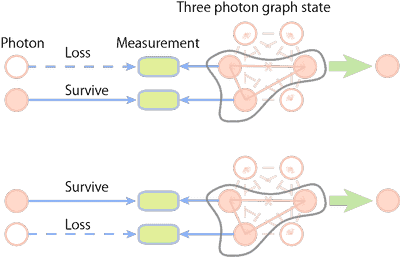
The researchers achieved their result by replacing the quantum memories in the repeater by a photonic graph state, which is an entangled state of three photons represented by a graph composed of nodes and edges. In this state, the nodes correspond to particles and edges connecting nodes represent the quantum entanglement between the corresponding particles.

TRA Bell measurement

Survived state is faithfully teleported

“For example, to efficiently perform quantum communication using an all-photonic quantum repeater located in the middle of an optical fibre linked to two users A and B, the users begin by generating quantum entanglement between their own quantum systems and photons,” explains Yamamoto. “They then send the photons through the fibre to the all-photonic quantum repeater, where the photonic graph state is generated. The state is measured using a photon interferometer.”

The team proved that its technique works by generating a three-photon graph state and detecting only photons that successfully survive their journey through the optical channels without any losses.

Towards an all-optical quantum network

The all-photonic quantum repeater has many advantages over standard quantum repeaters, he tells Physics World. “For one, it could work at room temperature. Second, it does not need any quantum interface between photons and matter since it relies solely on optical devices. Finally, it is also extremely fast, working at light speeds, irrespective of communication distance, and consumes little power.”

The researchers, reporting their work in Nature Communications, say they now plan to develop large-scale graph-state photon generators and ultra-low loss photonic circuits that allow for the time-reversed adaptive Bell measurement on a large number of photons. “These circuits will enable us to scale up an all-optical quantum network,” says Yamamoto.

Extreme rainfall events can be correlated over thousands of kilometres, study reveals

Extreme rainfall events (EREs) that occur days and thousands of kilometres apart can be synchronized, according to a study done by researchers at the Grantham Institute for Climate Change in the UK and the Potsdam Institute for Climate Impact Research in Germany. Niklas Boers  and colleagues say that understanding this phenomenon could lead to better weather forecasts and more accurate climate models.

Regional weather systems such as tropical cyclones dump rain over huge areas, so it is no surprise to find correlations between EREs at the sub-continental scale. If a hurricane brings torrential rain to one location, it is very likely that a similar downpour 100 km away is related.

Boers and colleagues found that correlations between EREs diminish as the distance between them increases to about 2500 km. Systems like this tend to obey a power law, with correlations diminishing as EREs become more distant from one another. This makes sense intuitively, since moving away from a weather complex will take you out of its influence and into areas governed by other systems.

Rossby waves

However, when EREs are separated by more than 2500 km, the team found that a different relationship takes over, and the likelihood of two such events being “teleconnected” starts to rise. The researchers attribute this long-range relationship to large-scale atmospheric patterns called Rossby waves.

To determine the details of these global-scale relationships, the team analysed satellite observations of rainfall collected daily between 1998 and 2016. Their data set consisted of a grid of 576,000 individual time series spanning 50° either side of the equator.

The researchers classified an ERE as any continuous period in which the daily rate of rainfall was higher than the 95th percentile value. Treating each grid cell as a node of a network, the researchers sought pairs of events that could be said to be synchronized – that is, EREs at two grid cells occurred within 10 days of each other.

“We tested different values for the maximum delay, but it became apparent that for three days, the global-scale pattern is only incompletely developed, suggesting that it takes longer than three days to establish,” Boers told Physics World. “Beyond 10 days, on the other hand, the spatial patterns do not substantially change, indicating that the right time scale for the global pattern to develop is roughly 10 days, on average.”

Data deluge

Even setting a relatively high threshold for what constitutes a correlation, searching such a large data set returned enough false positives to drown out the signal. Simply raising the threshold further was not helpful, as this removed genuine correlations. Instead, the researchers assumed that real teleconnections are geographically coherent: events in one region preferentially link to events in another, whereas the coincidental correlations making up the noise possess no such structure. When the data were filtered for this effect, a distinct spatial pattern emerged.

Taking EREs associated with the summer monsoon in south-central Asia as an illustrative case, the researchers found that synchronized events elsewhere on the planet clustered around particular locations, and were especially common in eastern Asia, tropical Africa, Europe, and eastern North America. The most likely processes connecting EREs over such distances are Rossby waves – large oscillations in the jet streams that are caused by the Coriolis effect.

Crossing the line

A surprise result from the analysis was that synchronizations appeared between EREs in south-central Asia and the mid-latitudes of the southern hemisphere. This was unexpected because weather systems do not typically cross the equator. Although Boers and his colleagues are confident that the synchronizations are statistically significant, they are unsure of the physical mechanism.

“It could be that the convective pulses in the Indian monsoon area are just so strong that the signal is transported to the southern hemisphere in the upper troposphere, but we currently don’t know for sure,” says Boers.

EREs are just one phenomenon that climate change is likely to exacerbate. Other kinds of extreme weather will also become more common and determining how they all relate to one another is an important goal.

“The 2010 Pakistan flood coincided with a heat wave in Russia, and from our understanding of underlying processes, I think it is extremely likely that coincidences like this are significant. We’ve only looked at extreme rainfall, and whether corresponding results are valid for other variables remains to be shown,” says Boers.

The study is described in Nature.

A smorgasbord of food-science innovation

The Physics in Food Manufacturing (PiFM) Conference earlier this month, organized by the Institute of Physics, featured a diverse menu of innovative physical techniques for the spatial interrogation and chemical mapping of food products and their constituent materials. Here’s a brief taster of just a few of the presentations to whet your appetite.

More bubbles, fewer calories

The fight against obesity proceeds on many fronts. For manufacturers of sweets and confectionery, one promising line of attack is to reduce the calorific value of their food products by using edible oil-based foams (or oleofoams) to prepare aerated chocolate bars, mousses and the like. Edible oleofoams comprise a liquid oil phase, air bubbles and a high-melting-point crystalline phase to stabilize the bubbles – a complex microstructure that in turn determines the macroscopic chemical, physical and nutritional properties of the final food product.

With this in mind, Lorenzo Metilli and colleagues in the School of Food Science and Nutrition at the University of Leeds, UK, are pioneering the use of ultrasound spectroscopy for in situ characterization of oleofoams in the food-processing line. The team reported analyses of several oleofoams, with varying lipid composition, aeration protocols and age, using broadband ultrasonic transducers in reflection mode and transmission mode. “The results show how [through-air] ultrasound spectroscopy can be a valuable tool for determining bubble-size distribution – a central feature for characterizing an oleofoam,” say the researchers.

Shedding light on the taste of chocolate

Raman spectroscopy is a non-contact, non-destructive technique that provides submicron information on the chemical and crystal structure of materials. In a series of proof-of-principle studies, Yan Wong and colleagues at Renishaw, the UK-based metrology and healthcare company, applied the technique to samples of chocolate to characterize the distribution of core ingredients such as fats and sugars – even in highly fluorescent samples such as milk chocolate.

A Raman image of white chocolate

The resulting insights, says Wong, could lead to changes in formulation and production that give improvements in the flavour, feel and stability of chocolate products. In another case study, Wong highlighted how Raman studies of bubble gum flagged up differences in the distribution of ingredients on the outside of the gum relative to the inside – differences which can affect the gum’s taste, function and stability during storage.

A hyperspectral take on meat and fish

Near-infrared spectroscopy (NIR) is widely used by manufacturers for rapid analysis of bulk food composition, whether in the lab or online. Hyperspectral NIR imaging takes that capability a step further, providing spectroscopic data for each pixel in an image to map spatial distribution of composition.

Martin Whitworth, principal scientist at Campden BRI food-science research centre, explained how he and his colleagues use hyperspectral imaging to measure the distribution and migration of food components such as fat and moisture, as well as to “zero in” on specific regions of complex multicomponent products.

Among a raft of notable use cases flagged by Whitworth is the application of hyperspectral imaging to evaluate meat quality and the freshness of fish. For meat, the Campden BRI team analysed foreribs of beef for fatty-acid composition and to predict texture based on spectra for segmented fat and lean regions. For fish, the team measured several regions of whole cod and fillets to identify the best predictors of freshness.

Shredded wheat-yield forecasts

Wheat makes up 20% of all calories consumed by humans. Just as well then that improvements in farming practices saw global wheat yields increase threefold between 1960 and 2000. That’s still not enough, with some forecasters indicating a further 60% increase in yield is needed by 2050 to meet global demand. Enhanced output is driven by cross-breeding different varieties of wheat with desirable traits or “phenotypes”, such as drought and disease resistance, though for the cross-breeding process to be efficient scientists must be able to measure these traits in a quantifiable and accurate manner.

To this end, Imran Mohamed and colleagues at the National Physical Laboratory, UK, are evaluating 3D imaging technologies more commonly deployed in controlled indoor environments such as factories. In early-stage experiments on a small outdoor wheat plot, three techniques – multistereo imaging, an NIR time-of-flight system and a structured-light laser scanner – show varying degrees of promise for producing “point-clouds” that suitable for dimensional measurements such as wheat ear size and wheat height. “There are caveats,” says Mohamed, “as all of these technologies are currently susceptible to strong wind…and a lot more work is required before we have a system that can be used on the back of a tractor.”

Food security under scrutiny

“It’s not a question of if food fraud will occur, it’s unfortunately a case of when and how badly the food supply chain will be disrupted, whether this disruption is deliberate or accidental, and if this is potentially dangerous to human and animal health.” That was the cautionary note sounded by Roy Goodacre of the University of Liverpool, UK, in a keynote address to the PiFM conference that made the case for “capable guardian” technologies to provide real-time and in-situ policing of the food supply chain.

Goodacre argues that a “point-and-shoot” approach based on Raman spectroscopy is an attractive candidate in this regard, offering handheld and through-container analysis that does not damage the sample or the container/wrapper. Among a number of case studies, Goodacre highlighted the use of surface-enhanced Raman scattering to detect “stretched” (adulterated) coconut water; also spatially offset Raman scattering for through-container analysis of counterfeit Scotch whisky and other spirit drinks.

Nobel prize-winners warn that Horizon Europe programme will put photonics sector at risk

Three Nobel laureates have put their weight behind calls for the European Commission to recognize photonics as a vital research area in the next round of its €100bn research and innovation programme, which will run from 2021 to 2027. In an open letter to the Commission, written in December but made public late in January, Gérard Mourou, Stefan Hell and Theodore Hänsch express their “deepest concern” that “photonics does not appear to remain a priority for the European Commission”.

Their intervention is not the first time that the photonics community has raised concerns about the draft funding proposal. In November the European Photonics Industry Consortium (EPIC) made a statement criticizing the proposed budget and requesting that photonics should be explicitly added as one of the priority “areas of intervention” in the upcoming Horizon Europe programme.

In their letter the Nobel prize-winners point out that Europe is now a world-leader in photonics science and innovation, a consequence of the “explicit focus and support for photonics in the current Horizon 2020 programme.” According to Photonics21, a public–private partnership supported by the European Commission to bring optical researchers and industries together, the European photonics market has the potential to triple in value to more than €200 billion by 2030. Throughout Europe around 300,000 people are directly employed in the photonics sector, while some 700,000 new jobs could be created by 2030, claims Photonics21.

Critically, however, that predicted growth depends on continued priority funding for photonics research through the Horizon Europe programme. Photonics21, echoing the concerns raised by EPIC and the three Nobel laureates, warn that technologies that are crucial for future industrial growth, such as driverless cars and rapid diagnosis of major diseases, may well be hindered “if photonics is not treated with the specialist, priority status it currently receives under the current Horizon 2020”.

Photonics is currently one of six Key Enabling Technologies (KETs) prioritized across Horizon 2020. In the new Horizon Europe programme, however, the number of KETs has been reduced to five, and photonics has been merged into a single KET with micro and nanoelectronics. What’s more, these new KETs appear to have been backgrounded, and are only vaguely alluded to in the Horizon Europe budget proposal.

Instead, the emphasis has been placed on nine high-level aims and challenges. These “areas of intervention”, such as “Key digital technologies” or “New generation internet”, rely on innovations in photonics and other technologies, but critics say that this change of emphasis does not reflect the broad scope of these underlying fields – and so important new areas of research may go unfunded and could risk future innovations.

Also at stake is the future of Photonics21 itself, which since 2005 has played an important co-ordinating role for the European photonics sector. With more than personal 3000 members, it brings together around 1700 European photonics companies and research organizations – so it came as a surprise when no photonics-industry partnership was proposed for Horizon Europe.

In their letter, Hell, Mourou and Hänsch explicitly urge the European Commission to add photonics as a tenth priority area of intervention, which should also lead to a renewed partnership between Photonics21 and the Commission. “We firmly believe that it would be a strategic mistake to remove photonics from the technologies priority list,” they write. “We therefore reiterate the importance of empowering a vibrant European photonics industry and research community, as a specific objective both within and throughout the Horizon Europe programme.”

Photonics innovations reach focal point

Some 20,000 optical scientists and engineers will be converging in San Francisco at the beginning of February for SPIE’s Photonics West and BIOS events. With two extensive exhibitions of the latest optics-based technologies, plus four international conferences covering optoelectronics, laser technologies, biomedical optics, and the emerging field of artificial and virtual reality, Photonics West has become the flagship event for the optics and laser industry. It has also become the place where many exhibitors launch their latest product innovations, some of which are highlighted below.

Glass flow cells enable optics-based gene sequencing

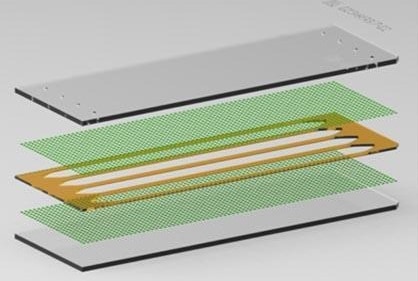
Customized microfluidic flow cells for next-generation gene sequencing (NGS) are now available from IMT AG, a Swiss company that specializes in precision glass manufacturing. NGS exploits massively parallel processes to enable rapid identification of gene sequences, which makes it popular for applications ranging from personalized medicine to detecting microbial food contaminants.

Many NGS techniques rely on fluorescence or other optical effects, in which case glass flow cells remain the technology of choice. IMT, one of the pioneers in fabricating glass microfluidic devices and biochips, now offers an automated and scalable production service for complex, multilayer microfluidic flow cells designed for various life-sciences applications – including protein, DNA and cell handling and analysis.

Schematic of a glass microfluidic structure

IMT can fabricate complete NGS flow cells to custom dimensions, layouts and biofunctionalized patterns. Flow cells can be created with micrometer or sub-micrometer feature sizes, making it possible to create patterned flow cells that increase the density of the sequencing space, reaching the optical resolution limit of fluorescent imaging systems. All the cells are sealed without disrupting the biofunctionalization.

Each customer can define the specific binding chemistry needed for their process, turning the generic platform into a customer-specific microfluidic solution. Such a flexible approach offers an effective route for outsourcing the fabrication of microfluidic cells, rather than introducing complex in-house production.

Find out more by visiting IMT at Booth #8443 at BIOS or Booth #443 at Photonics West

Hyperspectral technology sets new benchmark

A next-generation hyperspectral camera from Finnish company Senop combines rapid imaging speeds with high-resolution imaging. The firm claims that the HSC-2 camera, which makes its first appearance at this year’s Photonics West, sets a new benchmark in the evolution of hyperspectral imaging.

The HSC-2 hyperspectral camera

The HSC-2, which builds on Senop’s first-generation instrument, exploits state-of-the-art Fabry-Perot interferometer technology. The new camera can take up to 149 spectral frames per second, and offers up to 1000 freely selectable bands to provide a true spectral response in each pixel – without the need for any interpolation.

“Our clear target was to take a leap in hyperspectral technology and create a golden standard that can be used in any research field or commercial application,” says Aki Korhonen, Senop’s CEO. “The HSC-2 is a versatile tool that could revolutionize many applications, ranging from smart agriculture to the food industry or medical clinics.”

You can find Senop at Photonics West at Booth #5381, while the company’s Jussi Rautiainen will be giving a presentation about the HSC-2 at 3.00pm on 5 February 2019 in Demo Area 2 (Hall E North)

Laser system delivers quantum prowess

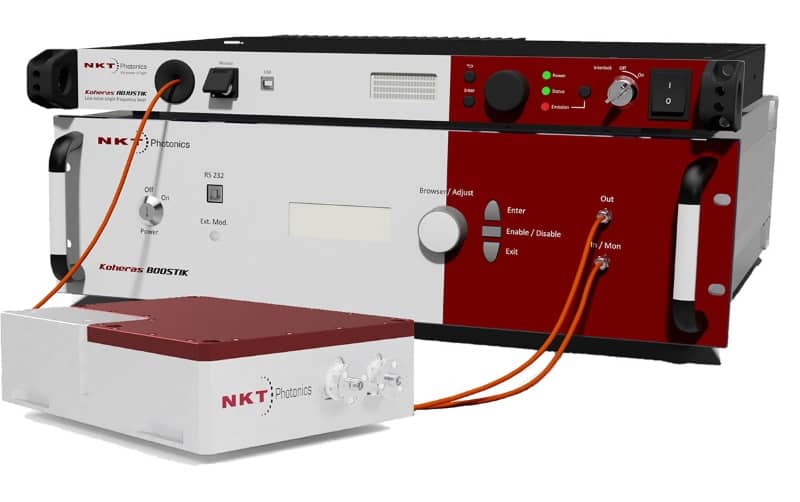
A powerful laser system for cutting-edge experiments in quantum physics has been released by NKT Photonics, based in Denmark. The Koheras HARMONIK system exploits a frequency-converted design to deliver powers of up to 7 W, along with ultralow phase noise and narrow linewidth at 775–780 nm – which makes it ideal for ultracold atom applications.

The Koheras HARMONIK laser system

The HARMONIK system has been designed for demanding techniques in quantum optics, such as Doppler laser cooling of atoms, optical trapping and producing squeezed light, as well high-precision laser interferometry and spectroscopy. The system features an all-fibre, maintenance-free design. The rugged, air-cooled package allows to handle 24/7 operation in laboratories as well as in industrial environments.

“With this very stable frequency-doubled system, we open up for a wide range of experiments within cutting-edge quantum physics”, says Søren Løvgreen, product line manager for the Koheras series. “The ultralow phase noise and relative intensity noise is particularly important for atom-trapping experiments but has many other applications in areas such as metrology and LIDAR.”

NKT Photonics will be exhibiting at BIOS at Booth #8633 and at Photonics West at Booth #633

An Italian approach to CO2 lasers

The Italian laser manufacturer El.En. is a pioneer in the development of rechargeable CO2 laser sources. Unlike conventional CO2 lasers, the company’s Blade Self-Refilling lasers are equipped with a special slot in which to insert the CO2 gas-mix cylinder, allowing an operator to easily replace the cylinder and regenerate the laser source in just a few seconds.

The laser sources in the Blade Self-Refilling series also have one of the highest energy efficiency in their category, with power options ranging from 350 to 1200W. All versions of come in the same form factor to simplify the engineering of different models with different power solutions.

The Blade-Self-Refilling laser

As well as its wide range of CO2 lasers, El.En. also supplies a series of high-performance laser-scanning heads. These include the Gioscan series of galvo motors that offer the fast acceleration needed to provide an immediate and precise response in all beam steering applications. As an independent producer, El.En. offers full technical assistance as well as the ability to build customized solutions for specific applications.

To find out more, visit Booth #5674 at Photonics West or go directly to elenlaser.com.


Copyright © 2026 by IOP Publishing Ltd and individual contributors