Physics careers and a radioactive cake

The latest episode of Physics World Weekly has a focus on careers in physics. Our first guest is Alex Petkov, a PhD candidate who is doing a 6-week work placement with Physics World magazine. Petkov speaks about the unconventional route to a PhD he has embarked upon, which provides him with more time to develop his academic interests.

Later in the show, we are joined by two members of the Society for Radiological Protection – current president Amber Bannon and president elect Peter Bryant. Bannon and Bryant were visiting Physics World’s HQ at IOP Publishing to celebrate 30 years of co-publishing the Journal of Radiological Protection (one of our colleagues even baked a cake – see the episode image). They speak about the wide variety of careers in radiological protection and the skills required.

If you enjoy what you hear, you can subscribe to Physics World Weekly via the Apple podcast app or your chosen podcast host.

3D printing mimics crystal microstructures to inspire stronger materials

A team of UK scientists has shown how atomic-scale strengthening mechanisms observed in metals and alloys can be exploited to make 3D printed structures more robust. Mimicking the microcrystalline structure of metallic materials offers a novel way to engineer so-called architected materials, creating lightweight 3D structures that are stronger than ones that have been fabricated until now. This research also opens an avenue for modelling and observing complex phenomena in metallurgy.

In the same way as crystal structures have a lattice containing atoms and bonds, these architected materials replicate this lattice structure at a larger scale with a periodic arrangement of nodes and struts. Using this concept, 3D printing can be used to recreate a lattice structure at any scale.

So far, such architected materials have only been designed to follow a simple repeated unit cell oriented in a single direction. Most crystalline materials, however, are imperfect and are comprised of many grains with random orientation of the lattice. In this new work, materials scientists from Imperial College London and the University of Sheffield have mimicked this more realistic arrangement in 3D printed structures to test whether it results in stronger materials.

Their results confirm that the atomic mechanisms exploited in metallurgy to improve alloy strength also apply to these scaled up materials. For example, increasing the number of grains and reducing their size limits the distance that cracks can propagate through the material, and incorporating grains in an architected material made it much tougher than the researchers had anticipated. “We didn’t expect that massive increase in toughness,” comments lead author Minh-Son Pham. “We expected just a 2- or 3-fold increase but it could go up to 6 or 7 times.”

Other techniques explored for strengthening materials in metallurgy include precipitation and multiphase hardening. The former is used in alloys to increase yield strength, and the researchers incorporate precipitation in their architected materials by introducing small domains in which the lattice parameter is slightly different to that of the rest of the structure.

Taking inspiration from multiphase materials – in which different parts of the architected materials are constructed with distinct lattice types – is also beneficial. For example, a layered structure of body-centred cubic lattice sandwiched within a face-centred cubic structure was found to strengthen the resulting material while limiting plastic deformation to the middle layer.

According to Pham, a near-term application of this work could be in transport, specifically in personal cars. Such architected materials could be implemented in a car’s crumple zone, he says, which absorbs a lot of inertia upon impact. This would reduce vehicle weight to improve fuel efficiency, while also maintaining the safety of the driver and passengers.

This research is a stepping stone towards enhancing the performance of man-made materials, and also offers a better understanding of the relationship between material structure and properties. Indeed, Gang Soeb Jung and Marcus Buehler from the Laboratory for Atomistic and Molecular Mechanics, Massachusetts Institute of Technology, USA comment in an article for Nature that “architected materials could be used to study more complex hierarchical structures, such as those of silk and bone, to work out which features are responsible for the structures’ remarkable properties.”

Lead author Pham also sees an exciting future ahead, now that people are starting to fully realise the potential of 3D printing.

The full results are reported in Nature.

Integrated catheter improves accuracy of heart treatment

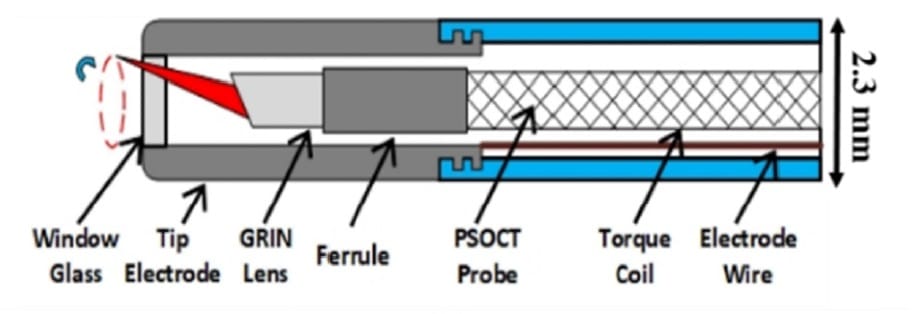
RFA/PSOCT probe

A team of US-based researchers has demonstrated how cutting-edge catheter technology can help improve the accuracy of radiofrequency ablation (RFA), often used to treat cardiac arrhythmias. So, what technology does the new catheter use — and how exactly does it work?  And what are the ongoing prospects of using it in clinical settings in the future?

Real-time tissue imaging

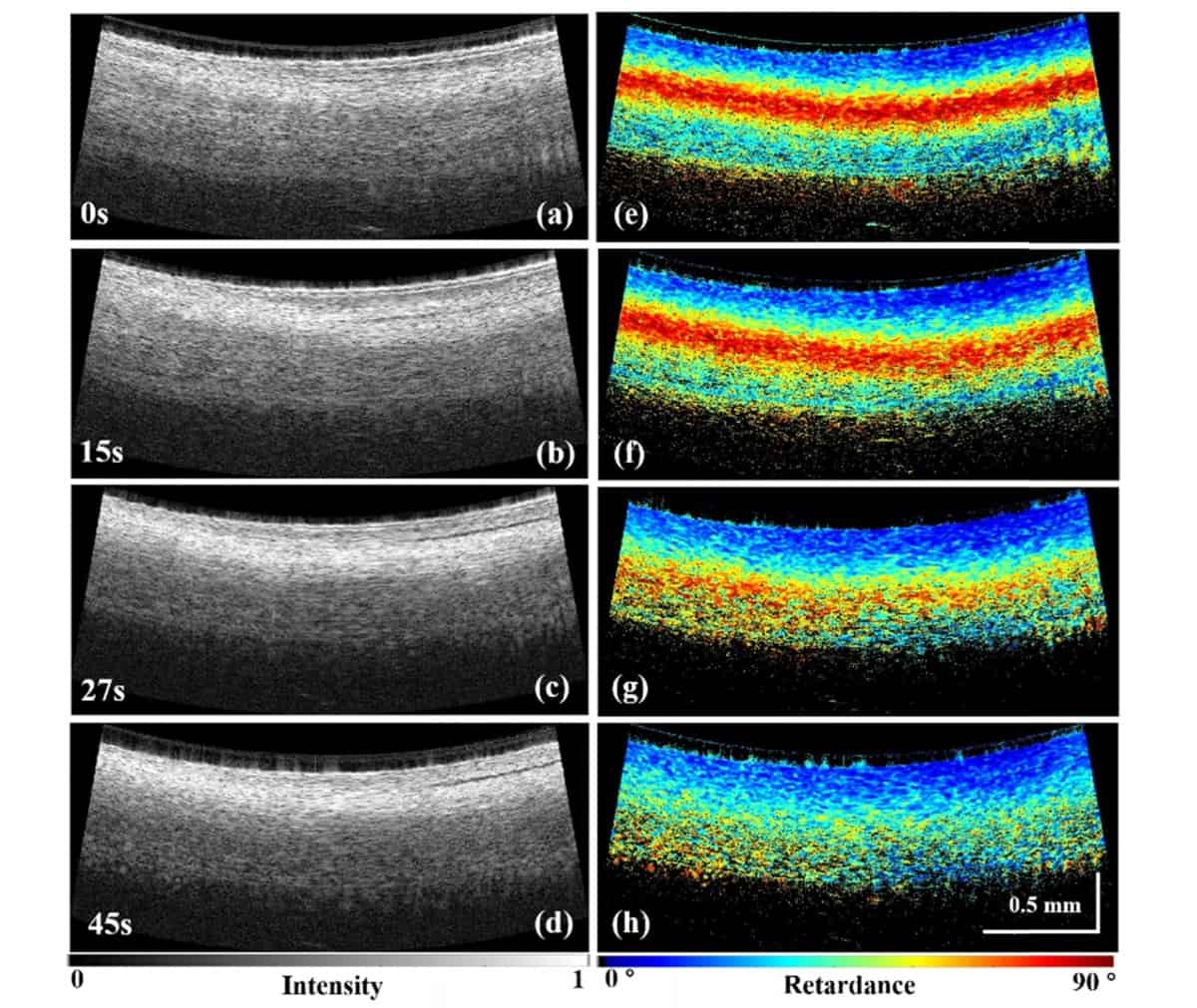
Although RFA is often used to treat cardiac arrhythmias, there is currently no way to directly monitor the formation of the ablated lesion. To increase the accuracy of this therapy, the researchers propose a novel combination of RFA with polarization-sensitive optical coherence tomography (PSOCT) to create an innovative catheter device that is capable of providing real-time, high-resolution tissue imaging.

The team demonstrated the feasibility of such an integrated RFA/PSOCT catheter by constructing and testing a prototype (Biomed. Opt. Express 10.1364/BOE.9.006400).

“We showed that the prototype can ablate normally and can image the tissue in order to confirm good catheter contact with the heart wall, and monitor that the tissue is ablated as the RF energy is delivered,” says co-author Andrew Rollins from Case Western Reserve University. Rollins prepared the paper in partnership with fellow academics at the university, as well as clinicians based at Rainbow Babies and Children’s Hospital and University Hospitals Case Medical Center.

“This validation was needed before tests can move forward to testing in large animals, and eventually to helping to treat human patients,” Rollins adds.

An RFA catheter is a 2 m-long cable that a doctor threads through a patient’s veins to their heart.  The device, which contains an electrode that delivers radiofrequency energy to burn spots on the heart wall, is used to treat arrhythmias like atrial fibrillation (AF). It does this by ablating tissue in the correct spots to stop the AF or keep it from travelling.

“PSOCT is like super-high-resolution ultrasound using infrared light,” says Rollins. “The integrated catheter has PSOCT at the tip so the doctor can see the tissue to be ablated, and hopefully do it better and safer.”

Monitoring lesion formation

According to Rollins, one of the main potential advantages of the new device is that it makes RF ablation safer and more effective.  He also points out its capacity to improve effectiveness by directly detecting whether the ablation is complete, and by helping determine where to ablate.

“It can improve safety by detecting signs of over-treatment before a complication, for example a steam pop, occurs,” he says.

Continuous improvement

Commenting on the prospects for use of the new catheter in clinical settings in the coming years, Rollins highlights the fact that the process of getting new medical technology into the hands of doctors — including the necessary steps of regulatory approval and commercialization — is long and expensive, especially for a high-stakes scenario such as cardiac catheter ablation.

“We are on the path, but there is a long way to go,” he tells Physics World. “Our next step is to demonstrate that an integrated catheter can work as intended in large animals. Then we can test the catheter in animals with disease to determine whether the technology improves the treatment. Along the way, we need to continue to improve the catheter design and develop data analysis methods and user interfaces to make the technology useful in the real-time clinical setting.”

Hellions of the solar system

Comets and asteroids are the fireworks of the solar system. Ancient, mysterious, captivating, they can dazzle the night sky or bring extinctions to life on Earth. They’re like your cousin Eddie who comes to visit every so often, full of merriment and mirth, somewhat unpredictable, always with the potential to leave the household askew or in tatters.

In Catching Stardust: Comets, Asteroids and the Birth of the Solar System, Natalie Starkey shares her fascination with these visitors from beyond, detailing how scientists study comets and asteroids to understand the 4.6-billion-year history of the solar system. That history has been unfolding its wings in the last few decades, thanks to remote missions such as NASA’s Stardust, which flew from 1999 to 2016 and returned a small capsule to Earth. There has also been Rosetta, a European Space Agency voyage that ran from 2004 to 2016 and was the first to land on a comet and analyse it in situ. Catching Stardust explains what we know about these objects and how, as well as why it matters – comets may well have brought life to Earth and have nearly ended it more than once. The book also looks at what the future might hold for space mining and planetary defence from cataclysmic impacts.

Comet sightings have been recorded for almost 3000 years, first documented by the Chinese. The Greeks named them “long-haired”, from which we get the word “comet”. Sorcerers and seers held that comets and shooting stars were omens for kings and catastrophes (King Harold II died at the Battle of Hastings in 1066, the same year Halley’s comet passed by), or were harbingers of disease and death (1347’s Comet Negra was known as the “comet of black death” as the contagion broke out in England the following year). Meanwhile, the Pawnee native Americans considered shooting stars part of their stories of reincarnation.

Catching Stardust gets into the details of these extraterrestrial visitors. Where did comets and asteroids come from, and how do we know what they’re made of? How does this knowledge inform us about the history of the solar system? It examines models such as the “grand tack hypothesis” – the proposal that during the solar system’s infancy, Jupiter moved inward to 1.5 AU after its formation, and then back outward, scattering asteroids and thinning the asteroid belt. It also covers the Nice model – which proposes that early giant planets were further inward than today and nearer one another. The book asks if such models can predict or explain what’s being learned about the dynamical evolution of the solar system and the early movement of material between the inner and outer regions.

Starkey’s book finds its stride in the second half, with chapters on the Stardust mission to comet Wild 2, the first to return samples of a comet’s dust to Earth; on future space mining of asteroids; and of how humans might protect themselves from the next Extinction Level Event (ELE).

The 2014 Rosetta mission, which tenuously and dramatically put the Philae lander on Comet 67P/Churyumov–Gerasimenko, was especially full of drama. The unguided lander bounced off the surface of the duck-shaped Comet 67P twice, until coming to rest off-kilter in the shadow of a crater wall. (In fact, scientists did not spot the lander until a few years later.) This meant the lander’s solar panels failed to catch enough sunlight, so scientists had just over two days of battery power to select and prioritize what the lander could still do with the instruments available. The tension oozed.

The Philae episode made for dramatic reading and viewing, and I would have preferred that Catching Stardust included some journalism there instead of straight narration. Quotes, for example, would have offered emotion and colour from the scientists and engineers on the human side of the mission 300 million miles away. As information returned from the lander, the team swivelled from victory to near defeat, working fast and furiously to achieve a partial victory in the end – Philae captured and analysed some dust on its first touchdown.

I was also surprised that neither the glossary nor index included the words “volatiles” or “Chicxulub”, the comet that killed the dinosaurs. These sections could each have been more extensive. As for Comet Shoemaker–Levy 9, whose fragments fell one after the other into Jupiter in 1994, it gets only the briefest of mentions in a picture and caption.

Starkey, a geologist and cosmochemist, did her PhD at the University of Edinburgh and postdoctoral work at the Open University. After graduating, her research interests shifted from Arctic volcanoes to comet and asteroid sampling, and she analysed samples from Stardust and the Japanese Hayabasa mission. Some of the best parts of Starkey’s book illustrate how scientists like her think, how they keep an open mind while simultaneously trying to zero in on the truth, and how uncertainties are an inherent part of the scientific process.

Sadly, there are few further missions planned to visit an asteroid or comet. NASA will send a craft to Psyche – a nickel-iron asteroid lying between Mars and Jupiter that’s thought to be the exposed core of an early protoplanet – but it will not launch until 2022. Still, I get a sense that the spring is being loaded for further forays into the solar system, at least among the inner planets. SpaceX has put a satellite in orbit and recovered the rocket, robotic spacecraft are tailing and landing on comets, China and India have planted flags on the Moon, companies have been formed to think about space mining and the SUV-sized Curiosity rover has roamed more than 20 km on the surface of Mars.

Rapid- and even real-time coverage on the Web shows these projects in their most raw and exciting states, making clear the infectious passion of the scientists and engineers who are meeting new technical challenges and viewing new worlds. The “we’re down on Mars” call when Curiosity reached the Martian surface in 2012 sent an unforgettable jolt of electricity straight down my spine. This is a great time to be a teenage space enthusiast, and this is a great book for them.

  • 2018 Bloomsbury Sigma 256pp £16.99hb

Sonic tomographs sound out tree rot

Forests play a major role in drawing-down and storing atmospheric carbon dioxide. Currently, an estimated three-quarters of the carbon stored on land is locked up in forest ecosystems. But when a tree experiences internal decay, it starts to release carbon back into the atmosphere. Because this decay is often not visible from the outside, it’s not clear how extensive the phenomenon is. Might we have overestimated the amount of carbon that our forests can store?

Now scientists have developed a non-destructive way to measure the amount of decay inside a tree. The results show that internal decay needs to be incorporated into our carbon accounting models.

Robert Marra from The Connecticut Agricultural Experiment Station and Nicholas Brazee from the University of Massachusetts, both in the US, carried out tomographic scans on trees, to see if they measured internal decay reliably. Deep inside the Great Mountain Forest in Connecticut, the scientists selected 72 of the three most common hardwood tree species — American beech, sugar maple and yellow birch.

Tree decay tomographs and photographs

Using novel lightweight portable tomographic equipment, Marra and Brazee generated sonic tomographs of every tree, building up a picture of the interior. Thirty-nine of the trees were then felled, and the scientists compared the tomographic images with the relevant cross-section of tree trunk, to test the accuracy of the scanning technique in identifying internal rot.

The internal state of the felled trees verified that the tomographic scans were a reliable measure of internal decay, with errors of no more than 2%.

“In some cases, the results were quite a surprise, with decay occurring in a number of trees that showed no sign of decay externally,” says Marra, who published the findings in Environmental Research Letters (ERL).

Based on the tomography alone, Marra and his colleagues were able to identify decay in the interiors of 47 of the 72 trees. The amount of decay ranged from 0.13% to 36.7%

Current carbon sequestration models don’t directly account for internal decay. Marra and his colleagues hope that their non-invasive tomographic scanning methodology can now be applied to larger-scale forest studies to develop understanding of the extent of internal decay. Ultimately the aim is to feed this information into carbon sequestration models, so that we have a clearer picture of how much carbon our forests can store.

After the FIT

The UK government’s plan to abandon the feed-in tariff (FIT) system for small renewable energy projects did not go down well, especially since it meant the loss of the export tariff. Householders who invested in a photovoltaic (PV) array on their roof have used that to offset the cost of their investment by selling any extra power they generated at a reasonable rate – 5.24 p/kWh – to their grid supplier. However, with the FiT, along with the export tariff, to be closed to new applicants from the end of March, they will get nothing for any exports.

In a parliamentary debate on the FiT in November last year, energy minister Claire Perry said she aimed to avoid that situation. It certainly looked unfair and counterproductive.

Alan Whitehead, Labour energy shadow, said “I cannot think of a better way to discourage people who might be thinking of investing in solar than telling them that they will be expected to give away to the national grid half the electricity they generate from their investment”. Perry said she “completely agreed” that “solar power should not be provided to the grid for free, and that is why I will shortly be announcing the next steps for small-scale renewables”.

But Perry reiterated the rationale for abolition of the FiT. It “has been a huge success, supporting over 800,000 installations”, but “as the market matures and installation is now possible without Government subsidy, we believe that it is the right time to close the feed-in tariff scheme”. She noted that the FiT “has cost consumers over £4.5bn to date and is scheduled to cost more than £2bn a year for at least the next decade”.

However, Whitehead pointed out that, “when we talk about the export tariff, we are not talking about a subsidy; we are talking about a payment for goods supplied. The minister has elided the feed-in tariff and the export tariff. Can she just accept that she has messed things up on this occasion, call off talk of removing the export tariff and get on with using that tariff to support future subsidy-free solar investment?”

There did seem to be some general policy confusions. Perry talked of news that a “string of private sector subsidy-free solar funds is set to open this year, particularly with business premises now taking advantage of the benefits that solar can provide in balancing their own systems. We are going through that transition with the expectation that we will see more solar deployed next year than we have previously”.

However, the schemes Perry alluded to are mostly going to be large projects, for example, ground-mounted projects like the 2.5 MW scheme in Wiltshire, developed by Public Power Solutions, a subsidiary of Swindon Borough Council, with a direct private wire connection to Swindon’s Household Waste Recycling Centre. Large ground-mounted projects like that can be commercially competitive, with the Solar Trade Association suggesting that some projects could get down to £50–60/MWh. By contrast, smaller domestic roof-top projects are unlikely to do so well, especially without the export tariff.

Perry also rather undercut the case for supporting small-scale solar FiTs by noting that there had been “a boom in some of the cheapest forms of renewable energy, including offshore wind” so that “we are now able to generate over 30% of our energy supply from renewables, which is much cheaper than putting it on individual rooftops”. That is a little convoluted and confusing, since the cheapest options — onshore wind and large solar farms — have been blocked from contract for difference (CfD) support by the government, which has also imposed tight planning restrictions on them.

That’s the way with markets, with there being no certainty that the prices that emerged would ensure a balanced development pattern.

Dave Elliott

Be that as it may, Claire Perry has now gone ahead with a consultation on the Government’s proposals for a new market for electricity export from small-scale PV solar, configured “so that people are not providing it to the grid for free”. Under the proposed “Smart Export Guarantee” (SEG), electricity suppliers would pay new small-scale PV and other energy producers for excess electricity from homes and businesses put back into the power grid.

Perry was very enthusiastic. “This new scheme could help us to build a bridge to the smart energy system of the future, with consumers firmly at its heart — not only buying electricity but being guaranteed payments for excess electricity they can supply to the grid,” she said. “It could also reduce strain on energy networks with a more decentralized and smarter local network delivering resilience much more cost-effectively, unlocking innovative products for electric vehicles and home energy storage; a win-win for consumers and the environment and a key part of our modern Industrial Strategy.”

The Business Energy and Industrial Strategy Department likewise said that “the new scheme could create a whole new market, encouraging suppliers to competitively bid for this electricity, giving exporters the best market price while providing the local grid with more clean, green energy, unlocking greater choice and control for solar households over buying and selling their electricity”. It added “the SEG would mean households and businesses installing new renewable energy generators would be paid transparently for the energy they produce — protecting consumers from cost burdens, by using established smart technology”.

 While some welcomed the move to provide something to replace the export tariff, there is a way to go still. It is just at the consultation stage. The details of the new scheme will take time to consolidate, as will implementation — one aim being that it would be integrated in with the smart meter system. So there were complaints that there would be a long period during which new PV prosumers would be getting nothing for any excess power they produced. It might take a year to sort out. Or longer, judging by the delays with the smart meter roll-out. Community projects would find that especially hard.

Labour shadow business secretary Rebecca Long Bailey also said: “Rather than a simple flat payment for energy exported to the grid, the government is proposing a hugely complex market mechanism in which large energy companies – notorious for overcharging consumers billions of pounds – can offer whatever sum they deem fit to households.” That’s the way with markets, with there being no certainty that the prices that emerged would ensure a balanced development pattern.

This episode is just the latest in a long-running saga of arguably less than ideal government policy interventions in the renewable energy field. If you want a comprehensive critical account, my new book Renewable Energy in the UK: Past, Present and Future takes you through the story in some detail. For example, on this specific FiT issue it’s interesting that in 2014 DECC’s view was that PV solar would be able to go forward “without financial support at some point in the mid-to-late 2020s”. The new policy imposes the support cut-off somewhat earlier, which some see as premature.

Gas vesicles provide new opportunities for MRI

“There are two fundamental issues with conventional MRI contrast agents,” explains Leif Schröder from the Leibniz-Forschungsinstitut für Molekulare Pharmakologie (FMP) in Berlin. “They are very insensitive and require high concentrations, and the gadolinium-containing ones impose a safety issue for certain patients.”

Along with collaborators from the California Institute of Technology (Caltech) led by Mikhail Shapiro, Schröder’s research team has developed a new type of contrast medium for MRI. This medium not only addresses the limitations of conventional contrast agents but also automatically adjusts to accommodate different amounts of hyperpolarized xenon gas (ACS Nano 10.1021/acsnano.8b04222).

The spins align

MRI is central to diagnosing and monitoring treatment of diseases. It creates images of the body by exposing water molecules in tissues to a strong magnetic field, avoiding potentially harmful radiation associated with other imaging techniques.

Contrast media, either injected or inhaled, are used to increase the sensitivity of MRI. Such media consist of contrast agents, and in some cases, targeting units that bind them to specific cellular disease sites. Agents can be detected indirectly through the water signal when they bind and exchange hydrogen atoms with those in water molecules.

This chemical exchange can be measured with greater sensitivity using hyperpolarized nuclei — an approach that has been applied to several noble gases, including xenon. Scientists can create hyperpolarized xenon gas using an optical pumping technique. This process uses laser light to pump electrons into higher energy levels and eventually align (or hyperpolarize) their spins. This polarization can be transferred onto the spin of nearby noble gas nuclei through spin exchange processes.

The most useful xenon isotope for MRI applications is 129Xe. Its prolonged hyperpolarized state can last up to several hours in gaseous form, and it can be used to image cavities in a porous sample, such as alveoli or gas flow within the lungs. Because xenon is soluble both in water and hydrophobic solvents, hyperpolarized 129Xe also can help doctors visualize various soft tissues.

However, as Schröder mentions, MRI requires a high concentration of molecules to generate a useable signal. Even using hyperpolarized xenon gas, the sensitivity of MRI remains low, meaning that many cellular biomarkers cannot be detected using current methods.

Swim bladders for xenon

The FMP–Caltech collaboration is working to improve MRI sensitivity by developing contrast media based on hyperpolarized xenon gas. Previously, they described a new class of contrast media that binds to xenon reversibly; however, how well these media could take up hyperpolarized xenon was unknown.

These new contrast media are hollow protein structures, or “gas vesicles”. Produced by certain bacteria, the gas vesicles function like the swim bladder of a fish, Schröder describes, allowing the bacteria to regulate their buoyancy in water.

New research by the FMP–Caltech team has demonstrated that the gas vesicles can adjust their influence on measured xenon signals according to the ideal gas law.

“The protein structures have a porous wall structure through which xenon can flow in and out. Unlike conventional contrast media, the gas vesicles always absorb a fixed portion of the xenon that is provided by the environment,” Schröder explains.

Therefore, the more xenon available, the more will be absorbed by the vesicles. MRI can take advantage of this accumulation and subsequent absorption.

The fraction of xenon gas that a patient inhales determines the fraction of xenon dissolved in their blood. Xenon encountering the gas vesicles in tissue will partition into the vesicles. Because much more xenon passes into the gas vesicles than with conventional contrast media, this improves both sensitivity and image contrast. This may also enable these new contrast media to identify disease markers occurring in low concentrations.

The future of gas vesicles for MRI

Schröder, Shapiro and their research teams have now produced the first MR images employing gas vesicles and hyperpolarized xenon gas. In the future, the researchers will employ gas vesicles to target different disease markers, such as binding to cancer cells or tracking immune cells. They also plan to quantify the improvements in sensitivity that can be achieved over conventional contrast agents.

What can the quantum world do for business?

It’s an exciting time for quantum technology. There are big programmes in the US, the EU and China, and the UK is at the forefront of the field. The UK government launched the National Quantum Technologies Programme in 2013 with a further £315m committed in the last budget to support development and commercialization in this area.

That’s all great, but what’s the motivation? After all, if you’re not familiar with quantum technology, ploughing such big sums of money into the field seems a leap of faith. I’m reminded of the immortal line from the movie Life of Brian, “What have the Romans ever done for us?”. The characters then provide a long list of the Romans’ practical achievements, such as aqueducts, education and sanitation, forcing them to concede that, well, yes, the Romans did a lot.

In a similar vein, the US physicist Chad Orzel once asked in an article in Forbes: “What has quantum mechanics ever done for us?” Now I’m sure Physics World readers don’t need to read his piece to find the answer. The entire telecoms industry is built around lasers and amplifier technology, which are quantum devices, even if the fibres themselves are largely classical. The key physics of the laser was, after all, contained in Albert Einstein’s famous 1917 paper, in which he introduced the idea of stimulated emission.

It’s all quantum

Quantum physics also underpins modern computers, which could not function without our understanding of semiconductors, band structures and doping. And thanks to NAND Flash memory – so named because it’s like a NOT-AND logic gate – we are blessed with “non-volatile” solid-state storage systems. So every time we turn off our mobile phones, USB sticks, memory drives or data centres, all the stored data doesn’t get wiped. Quantum mechanics delivers again.

NAND Flash memory is one of the largest segments of the global semiconductor industry, with annual sales of tens of billions of dollars. Indeed, NAND Flash fabrication plants cost several billions of dollars to build. And every time you write data onto NAND Flash, you’re using one of the most surprising and successful predictions of quantum mechanics. I’m referring to barrier penetration, or tunnelling, which allows a low-energy particle to penetrate a high potential-energy barrier.

Other applications of quantum physics include magnetic-resonance imaging, atomic clocks and satellite navigation. But the future looks still more intriguing. With further advances in computing, sensing, imaging and communications, quantum technologies will bring promising new approaches to solving global problems such as disease and climate change.

One burgeoning area is quantum computing and security, which will let us keep networks secure thanks to advanced algorithms as well as quantum keys in the form of entangled photons sent down fibres. The work will let us know if an unauthorized person has looked at the key – vitally important for secure communications.

The technology underpinning quantum cryptography has already been crammed into a satellite – so a chip on a phone won’t be too far off. Banks are going to love this stuff as an ultra-secure way of sending money. On the down side though, there’s the prospect of a “crypto apocalypse” (see “The quantum Y2K moment”).

The problem is that quantum computers, which work on very different principles to conventional computers, could quickly crack any of today’s common security systems like 128 bit AES encryption (a brute force attack would take millions of years even with the best supercomputers available today). According to the US National Institute of Standards and Technology, quantum computers will be able to crack the existing public-key infrastructure by 2029 using qubits rather than bits.

Sense of achievement

Quantum technology applied to sensing and imaging is likely to yield some amazing opportunities too. Super-accurate sensors that can map the local gravitational field far below the ground will let us discover new material resources or even just pinpoint buried pipes so that road workers dig holes in the right place. These sensors are already being trialled and, although they currently have to be transported in trucks or trains, researchers are developing smaller, more portable versions.

Chip-based atomic clocks look within reach too. Smaller, cheaper and more portable than conventional atomic clocks, they will be a key enabling technology for the position and navigation of satellite coverage. Atomic-clock time “stamping” of financial transactions will also improve the integrity of markets and our data networks.

As for quantum sensing, it has some spooky abilities. Examples include quantum radar, which has already been demonstrated using entangled photons sent over a few metres. Extending it to microwave photons could perhaps let us observe things locally and know instantly what is happening tens of kilometres away. Quantum cameras, which could create videos at a trillion frames per second, have already been used to track people behind obstacles up to 100 m from an observer.

In medicine, quantum imaging should let us non-invasively image the brain and study its electrical activity to get a better understanding of how it works, which could help to tackle conditions like Alzheimer’s and dementia.

The bottom line is that while it’s hard to predict the specific business applications and impact on society of quantum technology – just as it was when the laser, transistor and tunnelling were discovered – it’s clear that they will be huge. That’s why quantum technology is so important and why, in funding it so well, governments around the world have made a very smart choice.

Helium, not dark matter, might explain DAMA’s strong signal

A long-standing and controversial claim by physicists in Italy to have detected dark matter might be the result of the unanticipated contamination of their photomultiplier tubes (PMTs). So argue researchers in the US, who reckon that a pattern of signal pulses recorded by the DAMA detector at Italy’s Gran Sasso National Laboratory could simply have been generated by small amounts of helium leaking into the experiment – a hypothesis that they say could be easily put to the test.

DAMA, run by Rita Bernabei of the University of Rome “Tor Vergata” and colleagues in Italy and China, consists of 25 cylindrical sodium iodide scintillators, each weighing 10 kg and capped at either end by a PMT. The idea is that a tiny fraction of any dark matter particles streaming through the detector will collide with nuclei, creating tiny flashes of light. When this light reaches the photocathode in each PMT, electrons are emitted via the photoelectric effect. These electrons are then “multiplied” in a high-voltage cascade through a series of dynodes, which produce a measurable electrical signal.

Bernabei and colleagues look for a roughly 1% sinusoidal variation in the rate of dark-matter collisions throughout the year – with a peak in the summer and a trough in the winter. This would correspond to small changes in the speed with which the Earth ploughs through the halo of dark matter believed to be enveloping our galaxy. To ensure that these signals are not smothered by flashes from cosmic rays and radioactivity, the detector is located 1400 m below Gran Sasso mountain and is shielded in successive layers of copper, lead, paraffin and rock, all of which have extremely low levels of radioactivity.

No plausible alternative

DAMA’s claim to have detected dark matter dates back to 1998 but has generated much controversy because similarly sensitive experiments have not confirmed DAMA’s findings. As a result, some physicists argue that a more prosaic (but hitherto unidentified) process could account for the annual variation. Bernabei and colleagues nevertheless remain defiant, reporting last May a very large statistical confidence in their oscillation of 9.5σ and pointing out that no plausible alternative process “has been found or suggested by anyone” in more than two decades.

Now, however, Daniel Ferenc at the University of California Davis and colleagues claim to have identified just such a process. The four-strong group, made up of Ferenc, his wife and two sons – all of whom are scientists – has for some time been developing light sensors that they reckon could replace PMTs in many applications. While doing so, they realized that there was one substance – helium – that they could not prevent from entering their devices and would therefore, says Ferenc, also be a problem for DAMA.

To establish which light flashes recorded in their experiment could be due to dark matter, Bernabei and co-workers apply various selection criteria. To remove processes taking place outside the crystals they only accept signals that are simultaneously registered by the two PMTs of any given scintillator. It is also important to rule out PMT signals that are “dark noise” caused by, among other things, thermally-excited electrons being spontaneously emitted from the photocathodes. This is done by only accepting signals that are bunched together within a timeframe of up to 600 ns. This is a little more than the “decay time” of the scintillator — the typical time it takes to produce light from a dark-matter collision.

Ionized helium

But Ferenc and colleagues reckon that helium penetrating the DAMA shielding and ending up in the PMT vacuum tubes could make dark noise look like dark matter. Some dark-noise electrons could ionize helium atoms while en route to the first (positively-charged) dynode inside the device. The positively-charged ions would then be pulled back towards the cathode where they would free up other electrons.

Using a computer simulation of the kind of PMTs used in DAMA, Ferenc and colleagues found that these later “after-pulse” electrons would typically follow the initial thermal electrons with a delay nearly equal to the scintillator decay time. Such a signal could therefore be misidentified as coming from dark matter. This is unique for helium, because ions of heavier atoms and molecules would accelerate too slowly to reach the cathode within 600 ns.

Even at fairly small concentrations of helium, the team calculates two such after-pulses could be produced in both PMTs of a single scintillator at the same time at a high enough rate to explain the dark-matter signals claimed by Bernabei and colleagues.

Geological processes

Ferenc acknowledges that he and his colleagues do not know whether helium present in Gran Sasso fluctuates enough to cause a 1% annual variation within DAMA’s PMTs. But he says it is at least plausible, given that radon, which produces helium via alpha decay, is known to vary. In fact, he says, geological processes should produce far more helium than they do radon.

To test his group’s hypothesis, Ferenc says that the DAMA researchers simply need to unplug half of the 50 cables from the PMTs and then plug them back in so that they monitor coincidences between PMTs attached to different scintillators. If the annual modulation is indeed due to dark matter then it should vanish following the rewiring.

Richard Gaitskell of Brown University in the US, co-spokesperson of the LUX dark matter experiment in South Dakota, says that afterpulsing could account for at least some of the coincident signals recorded by DAMA. But he reckons that there is a “vanishingly small” chance of any significant amounts of helium reaching the PMTs, given that DAMA uses nitrogen to “purge” the surrounding environment of any unwanted gases. What would “resolve matters”, he says, are results from another suitably sensitive sodium-iodide experiment – several of which are in fact being developed.

The research is described in a preprint on arXiv.

Europe unveils successor to the Large Hadron Collider

Physicists at CERN have unveiled a blueprint for a huge 100 km-circumference particle smasher that would be used to study the Higgs boson in unprecedented detail as well as search for new physics. Today, the conceptual design report has been released for the Future Circular Collider (FCC) – an underground particle collider that would be linked with the existing Large Hadron Collider (LHC) near Geneva.

Since the LHC first switched on in 2008, the 27 km-circumference particle collider has been smashing protons together at energies up to 13 TeV in the hunt for new particles. In 2012, physicists announced they had discovered the Higgs boson with a mass of 125 GeV. This resulted in François Englert and Peter Higgs bagging the 2013 Nobel Prize for Physics for the theoretical prediction work on the particle. However, since then no particles beyond the Standard Model, such as supersymmetric partners, have been found.

While the LHC will still run for a few more decades before it is finally switched off, for more than three decades physicists have been carrying out R&D on linear colliders that could one day be the LHC’s successor. One leading design effort is the International Linear Collider (ILC), which would accelerate electrons and positrons using superconducting cavities. As electrons and positrons are fundamental particles, their collisions are cleaner than proton-proton collision at the LHC, so are ideal to study particles in great detail.

Japan is the only country that has shown interest in hosting the ILC but the Japanese government has dragged its feet in deciding whether to host the machine. This has forced physicists to recently downscale their design for the ILC from 500 GeV to 250 GeV with the Japanese government expected to give a final decision to host the ILC in March.

Yet particle physicists still see advantages in keeping with large circular colliders, not least because they have a lot of experience in building them. From 1989 to 2000, for example, CERN operated the Large Electron–Positron Collider (LEP), which was in the same tunnel that now houses the LHC and carried out precise measurements of the Z and W bosons. And given the Higgs’s relatively low mass, a circular collider would be able to produce higher luminosities without suffering huge losses from synchrotron radiation, which would affect a collider operating at higher energies of 500 GeV.

Precision studies

The FCC project was initiated in 2013 by the European particle-physics community with a meeting held the following year in Geneva to begin work on the report. The new, four-volume conceptual design report looks at the feasibility of building a 100 km circular collider and examines the physics that such a potential machine could carry out. It first calls for the construction of a 100 km underground tunnel that would house an electron-positron collider (FCC-ee). This machine would consist of 80 km of bending magnets to accelerate the beam as well as quadrupole magnets that focus the beam before colliding them at two points in the ring.

The FCC conceptual design report is a remarkable accomplishment. It shows the tremendous potential of the FCC to improve our knowledge of fundamental physics and to advance many technologies with a broad impact on society

Fabiola Gianotti

The FCC-ee — estimated to cost around $9bn of which $5bn would be used to build the tunnel — would operate at four energies over a 15-year period. The collider would begin at 91 GeV, producing around 1013 Z bosons over four years before operating at 160 GeV to produce 108 W+ and W- particles for a two-year period. While the W and Z particles have already been measured by the LEP collider, it is estimated that the FCC-ee machine would improve such measurements by an order of magnitude.

By then running at 240 GeV for three years, the FCC-ee would focus on creating a million Higgs particles. This would allow physicists to study the properties of the Higgs boson with an accuracy an order of magnitude better that what is possible today with the LHC. Finally, the collider would then be shut down for a year to prepare it to run at around 360 GeV to produce a million top and anti-top pairs over five years. More precise measurements of such particles could indicate deviations from Standard Model predictions that could point to new physics.

Once the physics programme for the FCC-ee is complete, the same tunnel could then be used to house a proton-proton collider (FCC-hh) much in the same way that LEP made way for the LHC. “The FCC could be an action reply of LEP and the LHC” says theorist John Ellis from Kings College London. “A proton-proton collider would offer the best chance to discover new particles”. 

The FCC-hh would use the LHC and its pre-injector accelerators to feed the collider that could reach a top energy of 100 TeV – seven times greater than the LHC. Yet to produce such collision energies would require the development of new magnets that operate at higher magnetic fields to steer the beam around the collider. The LHC currently works with 8 T superconducting magnets made from niobium-titanium (NbTi) alloys. Superconducting magnets are used as they allow high currents to flow without dissipating energy due to electrical resistance. The FCC-hh, however, with 50 GeV beams, would instead require 16 T magnets made from niobium-tin (Nb3Sn) superconductor.

Currently the LHC is undergoing a two-year shutdown to improve its luminosity – a measure of the rate of particle collisions – by a factor of 10. Dubbed the High-Luminosity LHC (HL-LHC) it aims to put this material to the test by using 11 T Nb3Sn superconducting dipole magnets. Yet more R&D needs to be carried out before they can be used at 16 T. Given the need for R&D as well as the high construction costs of the magnets, the estimated cost of the FCC-hh would be around $15bn, compared to around $13bn for the total cost of the LHC.

To run this endeavour as a global collaboration is truly important. This opens up the possibility of substantial in-kind contributions

Michael Benedikt

The FCC-hh would have a total integrated luminosity of around 15-20 ab-1 – a factor of 5-10 more than that produced at the HL-LHC – and corresponding to 1010 Higgs bosons being produced. It would also be used to search for new particles at higher masses than possible at the LHC as well as discover or rule-out the existence of thermal dark-matter particles known as WIMPs. As with the LHC, the FCC-hh could also be used as a heavy-ion collider, smashing together lead ions at 39 TeV to study effects such as a quark-gluon plasma. It is estimated that the collider would be operational for at least 25 years to “provide a research tool until the end of the 21st century”.

The FCC conceptual design report is a remarkable accomplishment. It shows the tremendous potential of the FCC to improve our knowledge of fundamental physics and to advance many technologies with a broad impact on society,” says CERN director-general Fabiola Gianotti. “While presenting new, daunting challenges, the FCC would greatly benefit from CERN’s expertise, accelerator complex and infrastructures, which have been developed over more than half a century.”

Show me the money

Given the huge costs of building the FCC, it would need wide support from the community and so officials at CERN have been busy building a collaboration in recent years that now consists of 135 institutions in 34 countries. “To run this endeavour as a global collaboration is truly important,” says CERN physicist Michael Benedikt, who leads the FCC project. “This opens up the possibility of substantial in-kind contributions from parties who are experts in building parts of such a machine.”

Even if physicists get financial support to build the FCC, there is the question of when to start building the machine. One option is to start by doubling the energy of the LHC to around 30 TeV with a high-energy upgrade (HE-LHC). Yet Benedikt thinks that it may be possible to bypass the HE-LHC and go straight to the FCC instead. In this case, the HL-LHC programme would run in parallel with the construction of the FCC tunnel before stopping around 2037. The FCC-ee would then start operation around 2040.

Yet CERN is not the only one developing new circular collider designs. In November, physicists in China unveiled the conceptual design for its own 100 km tunnel, which would first house an electron-positron machine before hosting a proton-proton collider operating at 100 TeV. Although construction of the Chinese collider could start earlier than the FCC, Benedikt says that there are many similarities between the two designs. “That is a good thing,” adds Benedikt. “The considerable effort by China confirms that this is a valid option and there is a wide interest in such a machine.”

Analysis: Let’s go round again?

It is a simple enough question, but the answer is proving rather tricky: is a circular or linear collider the best way forward to carry out precise measurements on the Higgs boson?

While CERN’s Large Hadron Collider (LHC) has been producing copious amount of Higgs bosons since the particle was discovered in 2012, proton-proton collisions are not the best way to study a particle’s precise properties. This is because protons are not elementary particles and so their collisions produce debris that affects the accuracy of the measurements.

That is not the case, however, when smashing together electrons with positrons and that is why particle physicists want to build such a machine to study the Higgs boson and try to spot any tiny deviations that could give hints of physics beyond the Standard Model.

For years, physicists have been designing linear colliders that would operate on the TeV scale. One such leading design is the International Linear Collier (ILC), which Japan has shown interest in hosting, albeit in a cheaper incarnation running at 250 GeV.

Due to the need to overcome energy losses from synchrotron radiation as electrons are accelerated around the ring, linear colliders offer a higher luminosity – a measure of the rate of particle collisions – compared to their circular counterparts for collision energies over 400 GeV. Yet at energies below this threshold, circular colliders have better luminosities than linear colliders — and can also host multiple detectors around the ring.

If the mass of the Higgs boson was around 500 GeV or more, most would agree that a linear collider offers the best way forward. But with the Higgs mass being 125 GeV, a rather large luminosity curveball has been thrown into proceedings. This has put circular colliders firmly back on the drawing board and for the past five years physicists have been designing possible alternatives. This has resulted in two recent proposals – the Future Circular Collider (see main text) and China’s Circular Electron Positron Collider, the design of which was released last November.

While circular designs must bear the cost of building a huge underground tunnel, they more than make up in terms of versatility and the fact that physicists have decades of experience in building them. For example, the same 100 km tunnel could also be used for a proton-proton machine operating at 100 TeV that would be used to hunt for new particles.

The technology for both an ILC and a 100 km electron-positron collider is ready, but given the eye-watering price tags for both, all designs would need a large amount of international collaboration. Indeed, it is widely understood that Japan would only offer to fund half the cost of the $7.5bn ILC.

If only one machine gets built, as looks probable, the question is which one? The battle lines have been drawn.


Copyright © 2026 by IOP Publishing Ltd and individual contributors