Belarusian sculptor Pavel Wilimaytis has created a portrait of the theoretical physicist Jim Gates who is based at the University of Maryland and Brown University.
Gates is best known for his work on supersymmetry and superstring theory as well as the connections between quantum physics and information theory. He is also known for his outreach in particular the PBS series The Elegant Universe.
Wilimaytis, who has been living in Saint-Jorioz in France for the past three years, has a hearing impairment and chooses people to sculpt based on the “human presence in their faces”.
“For the first eight years of his life, Pavel perceived the world outside of language,” Wilimaytis’ mother Natallia told Physics World. “Before he learned to understand words, he already knew how to feel people: their warmth and coldness, light and shadow, pain, tension, kindness or inner closedness. Not what a person says about themselves, but what emanates from them before any words.”
Wilimaytis noticed photos of Gates online and was struck by the physicist’s “warmth, openness and distinctive charisma”.
“There is the quiet generosity of a scientists and teacher known for his exceptional ability to open the world of knowledge to others,” notes Wilimaytis.
The portrait of Gates, standing around 30 cm tall, was first modelled in plasticine and then cast in Acrystal – a water-based mineral composite material.
The sculpture forms part of Pavel’s sculptural series devoted to figures in science and culture. The series – “The lesser-known faces of famous people” – also includes Nikola Tesla, Marie Curie and Erwin Schrödinger.
In an e-mail to Natallia, Gates noted that he was “absolutely delighted” by the sculpture.
Dental work Fitting false teeth, bridges and crowns requires an empirical understanding of how ceramics, metals and other materials interact. (Courtesy: Shutterstock/Ihnatovich Maryia)
My dentist, Dr Albora, told me I needed a new tooth. He made me bite down on a U-shaped tray filled with polyether, an elastomeric material that’s been used in dentistry for decades. I tried not to gag while the gooey stuff set. Albora then waggled it off and sent the imprint to a company on Long Island that makes false teeth. But as my tooth’s colouring was unusual, Dr Albora said I had to go there myself.
A week later I drove to Marotta Dental Studio, where Igor Binshteyn sat me in a chair, lifted my lip and inspected a tooth to the side of my upper jaw. He was helping to fabricate its replacement and needed to get the exact colour.
As Binshteyn finished, I remarked teasingly on the company’s car park, which was chock full. Do you need that many people to make false teeth? What could possibly be involved to make things smaller than the nail on my little finger?
Binshteyn laughed. “Follow me”.
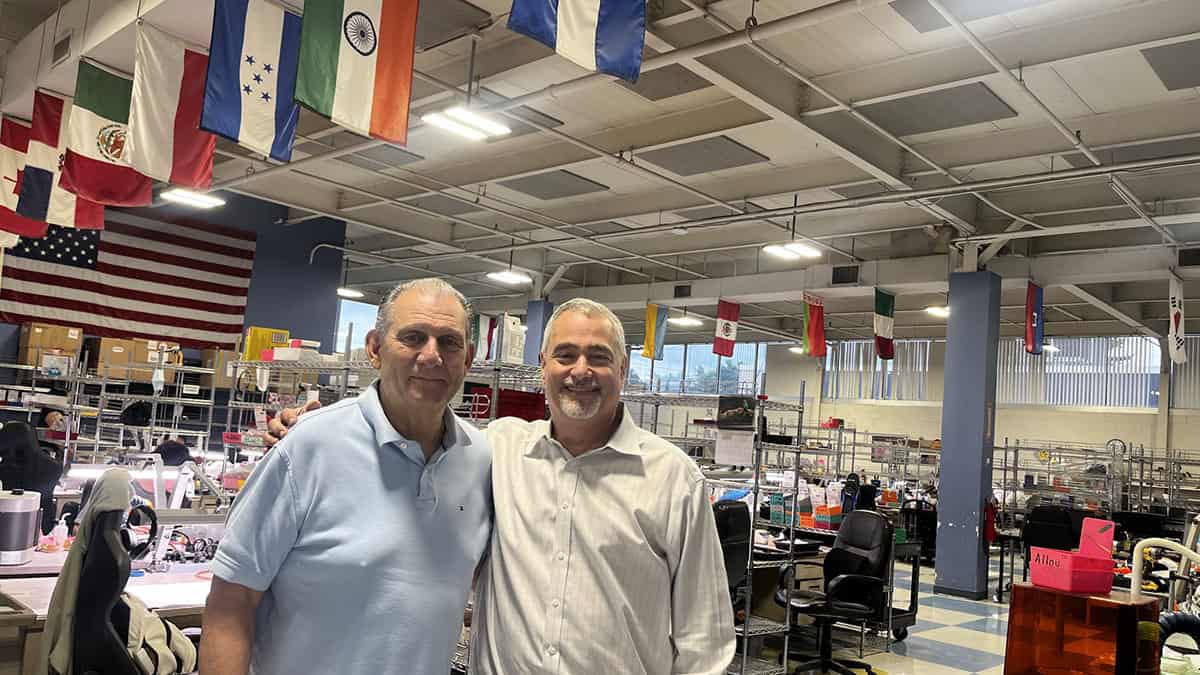
Warm welcome Lenny Marotta (left), who founded Marotta Studio in 1981 and his brother-in-law and Marotta’s vice-president, Steven Pigliacelli in the lab. The flags are for the nationalities and national backgrounds of the 50 or so technicians working there. (Courtesy: Robert P Crease)
He opened a door to a huge undivided warehouse-like space about 1200 square metres in size. Some 50 people were working at lines of tables where the steady hum of conversation was punctuated by the noise of ovens, lathes and grinding machines; imagine the sounds of a metalworking shop in a busy train station.
“Do you want a tour?” Binshteyn said.
Of course I did.
Open wide
My tour guide was Marotta’s vice-president, Steven Pigliacelli, who teaches prosthodontics at New York University. A prosthodontist is a dental specialist who has completed dental school and, in the US, has had at least three additional years of advanced training to focus on restoring and replacing missing or damaged teeth. As I learned, prosthodontists must practice materials science.
The lab has two paths for making teeth, Pigliacelli explained, each with different materials and methods. The first is known as “porcelain-fused-to-metal”, or PFM. It begins with technicians applying gypsum – hydrated calcium sulphate – to create stone replicas of the jaw and teeth from the impressions given to them by dentists such as Albora.
Gypsum has different coefficients of expansion for different dental purposes, and textbook formulas give the amounts of liquid for each kind. But Marotta employees found that tiny amounts of water must be added or subtracted to the gypsum to compensate for things like humidity and temperature before the gypsum is used. “It took us months,” Pigliacelli explained, “to realize that how it’s shipped, how it’s stored, what season it is – all these affect the material.”
I watched as a technician sectioned a stone jaw replica to cut out a tooth, turn it into a master model called a die, and test it in an articulator that mimics jaw movements. I saw another wax that die, use a lost wax technique to create a solid gypsum frame, and cast a silver-palladium alloy. That creates the metal inner core for the tooth, called a coping, which is shaped and finished before porcelain is applied. Porcelain is baked onto the coping in another area of the lab.
“The metal and porcelain need closely matched coefficients of thermal expansion or the porcelain can separate from the metal,” Pagliacelli told me. “Every once in a while a company tells us ‘We’ve got this really cool new alloy!’, but we need to match the coefficients of expansion in the ceramic material. We’re working with sensitive materials for sensitive applications, and we have to experiment with and adapt them. This stuff about materials you don’t learn in school but work out in the lab.”
Smile for the camera
The second path to making a tooth involves scanning the teeth rather than waxing a die. The electronic files are worked on in the computer, printed out, reworked and rescanned, and milled by a CAD machine using materials such as zirconia – nicknamed “ceramic steel” – and EMAX, a lithium disilicate glass-ceramic. Zirconia is extremely hard and used for teeth that endure heavy grinding forces, while EMAX is more aesthetically pleasing and often used for front teeth.
“So we have two parallel paths, PFM and digital scans”, Pigliacelli said. “It’s usually a personal choice of the dentist”. But external pressures are driving a move away from PFM, he said. Five years ago the price of palladium – a key component of the PFM alloy – soared as it was increasingly used in devices to reduce auto and other emissions. “That’s cut down on the PSM market.”
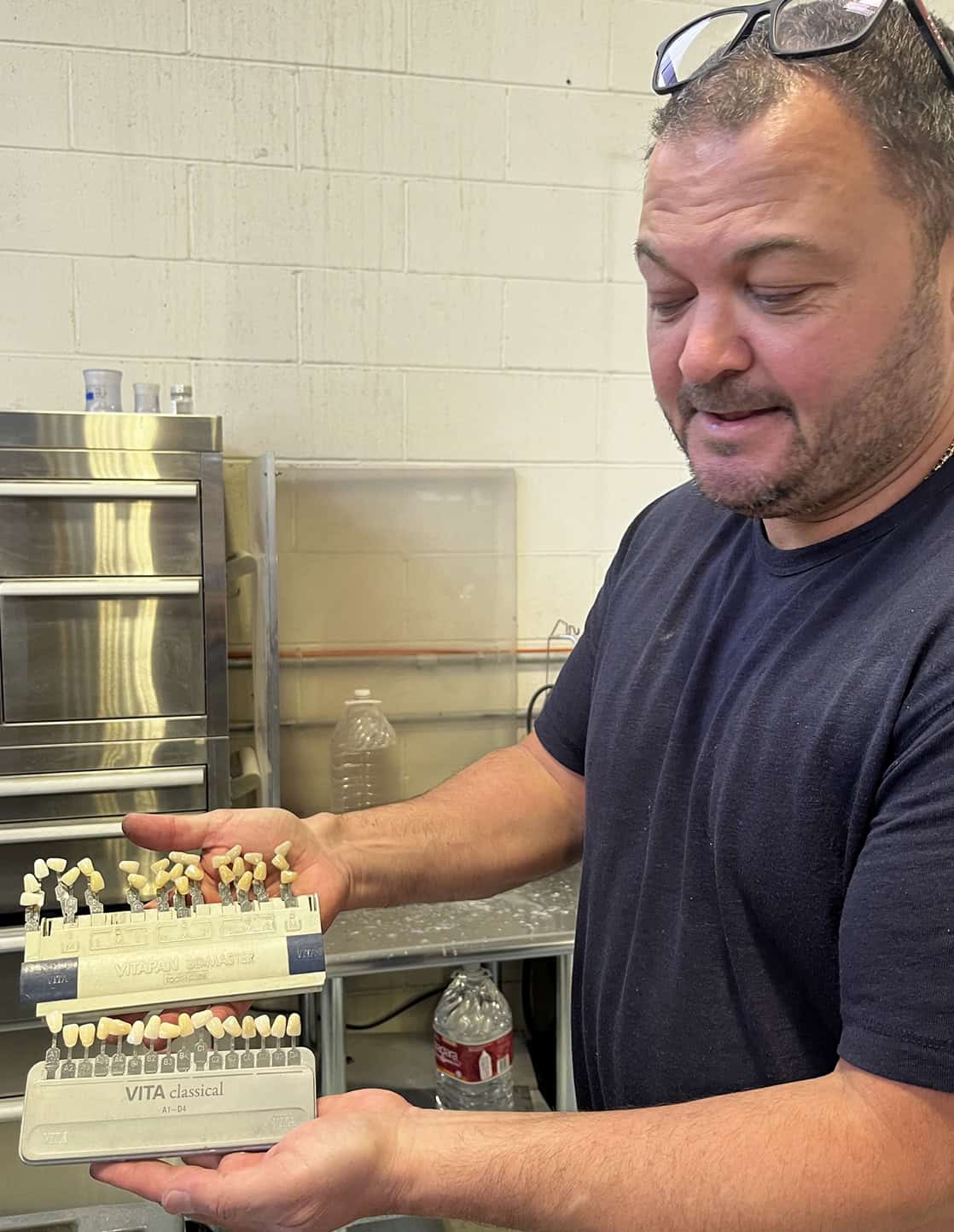
Say cheese Igor Binshteyn shows off his tooth colour guide. (Courtesy: Robert P Crease)
In another corner of the lab I ran into Binshteyn again, who was using different porcelains and ceramic stains to create colours. “Teeth are not a solid colour,” he said, “but vary in shade from reddish near the gum line to lighter colours toward the biting edge. They also vary in translucency.” (Check this out yourself.) Furthermore, the colour of a tooth must match not its neighbours but the corresponding tooth on the other side of the mouth. To make a natural-looking tooth, Igor picks out a base colour and then layers in shades of porcelain.
As my lab tour went on, Pigliacelli showed me different materials for different applications. One challenge is making teeth for a person with bulimia, whose acidic oral environment can corrode dental materials. Other challenges arise with people who have had failed implants, or temporomandibular joint – or TMJ – a disorder involving jaw joints and muscles.
On the way out I met Lenny Marotta, Pigliacelli’s brother-in-law, who had founded Marotta Studio in 1981. Marotta is fascinated by the history of dental materials, which include bone, ivory, wood, gold and silver. He showed me his collection of early prosthodontic instruments, including milling machines, furnaces, hammers and air compressors.
Later, Marotta also pointed out a strange-looking oven. “That’s for processing vulcanite, a hardened rubber material widely used for dentures before modern plastics.” But he’s been unable to find a museum interested in old prosthodontic stuff. “Nobody knows we exist,” he complained.
The critical point
I’d assumed that materials science was required to make prosthetic teeth biocompatible, corrosion resistant, and able to withstand mechanical motions such as crushing, biting and grinding. I also knew that teeth have to be made economically enough to be widely available, aesthetic enough to be desirable, and versatile enough to withstand a variety of oral environments.
But I had no idea how much materials science was required to bring all these properties together.
Back in his office, Dr Albora installed the tooth and handed me a mirror. I had to pull up my lip to see it way on the side of my mouth. “I’d have to smile before somebody notices it,” I complained. “Well,” he said, “that’s for just in case you do.”
Join us for an in-depth conversation with Xiaochuan Pan as he shares an expert perspective on the rapidly evolving landscape of advanced X-ray imaging—highlighting the breakthroughs shaping the field, what defines high-impact research, and how Physics in Medicine & Biology supports and amplifies this work. He will also explore what sets outstanding early-career research apart and offer practical strategies for increasing the visibility, reach, and long-term impact of your publications.
This session will also spotlight the research of Ronan Smith, winner of the 2025 PMB Early Career Award, who will reflect on his contributions to advanced X-ray imaging—including his award-winning paper—and how his work connects to wider developments in medical physics and imaging.
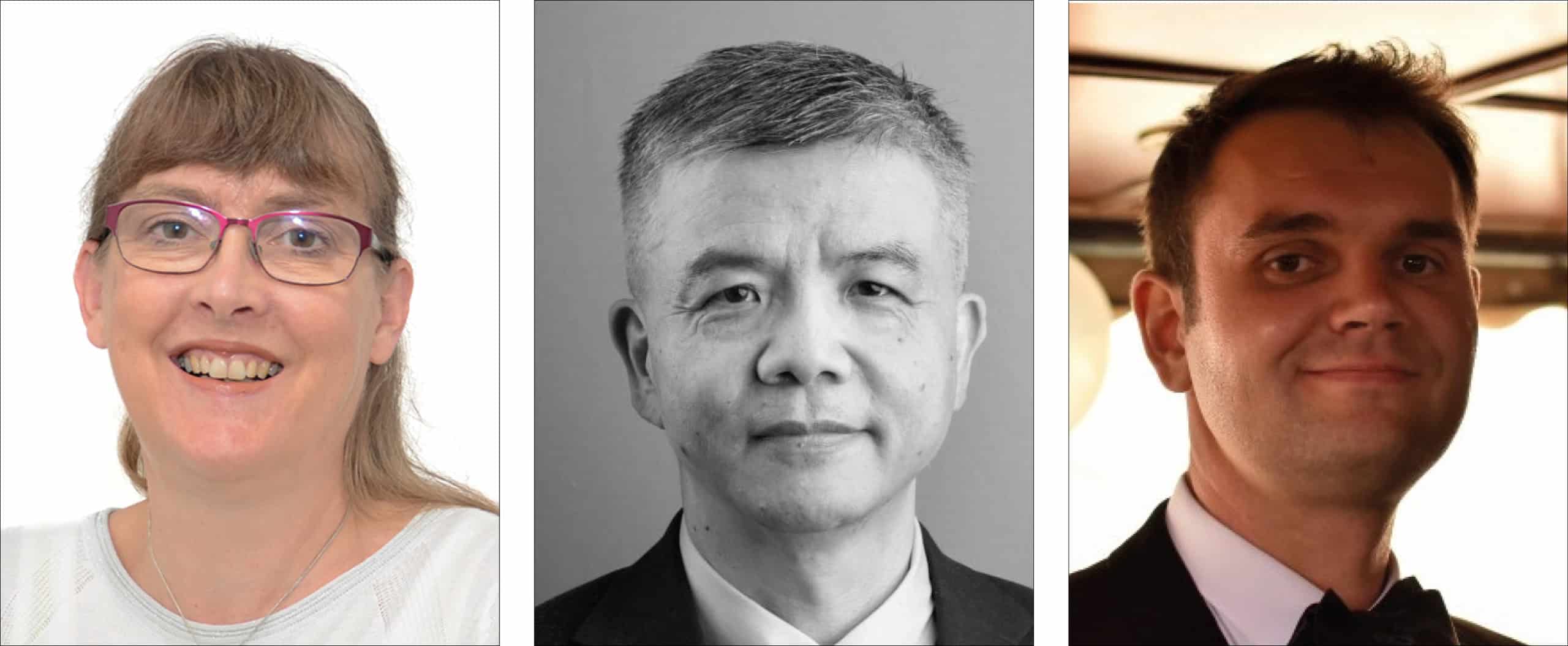
Left to right: Carol Clark, Xiaochuan Pan, Ronan Smith
Moderator
Carol Clark, Publisher,Physics in Medicine & Biology
Speakers
Xiaochuan Pan is Professor of Radiology, Radiation & Cellular Oncology, Committee in Medical Physics, the College, and the University of Chicago Medicine Comprehensive Cancer Center at The University of Chicago. His research centers on physics, algorithms, and engineering underpinning tomographic imaging and its biomedical and clinical applications. He has made pioneering, significant contributions to advanced theory and algorithms for conventional and spectral computed tomography (CT), positron emission tomography (PET), and single-photo-emission computed tomography (SPECT). He has contributed to algorithm development for digital breast tomosynthesis (DBT), digital lung tomosynthesis (DLT), magnetic resonance imaging (MRI), electron-paramagnetic resonance imaging (EPRI), phase-contrast CT, and photo-acoustic tomography (PAT). He has also developed strong translational imaging technological programs tailored to specific applications of biomedical and/or clinical significance. Xiaochuan is a Fellow of AAPM, AIMBE, IAMBE, IEEE, OSA, NAI, and SPIE.
Ronan Smith is a physicist interested in better ways of X-ray imaging. He completed his PhD at Southampton University (UK) in 2023, developing a technique called dark-field X-ray imaging, before moving to the warmer climate of Adelaide University in Australia as a grant-funded researcher in the School of Medicine. He focuses on developing and implementing imaging techniques for challenging and dynamic environments, such as the respiratory system. His current area of research is novel ways of analysing and understanding a new method for dynamic lung imaging called X-ray Velocimetry, with side projects looking at dark-field X-ray imaging.
About this journal
Physics in Medicine & Biology. The international journal of biomedical physics and engineering, published by IOP Publishing on behalf of the Institute of Physics and Engineering in Medicine (IPEM)
Neuroscientists are debating a seemingly simple question: which way does a seizure propagate in the brain? Answering such a question could advance our understanding of epilepsy, but requires the development of cutting-edge microscopy techniques that are far from simple. Researchers from the University of Georgia have now developed an improved light-sheet microscope with the ability to perform fast 3D imaging of zebrafish seizures.
Reporting their findings in Biomedical Optics Express, the researchers found that seizures originated in the hindbrain and propagated forward (anteriorly). This corroborates a previous study examining 3D imaging of zebrafish seizures, but contradicts two earlier studies of 2D imaging (reported in Frontiers in Neural Circuits and eNeuro) that observed propagation in the reverse direction.
“I think the discrepancies about the direction of seizure propagation point to the need for more imaging,” says Peter Kner, an engineering professor who led the research efforts at the University of Georgia. “I believe we still don’t know how probabilistic the behaviour is and what factors are important.”
Adding a third dimension
The microscope developed by Kner and his team uses a so-called light sheet — a thin pancake of light that selectively illuminates a single 2D plane of a sample. This technique strongly reduces background noise from other planes that are not illuminated. Fluorescence light from the sample plane passes through a series of lenses, orthogonal to the light sheet, which reimage the sample onto a camera.
“There have been several papers analysing seizure events in zebrafish by looking at 2D imaging. So, the motivation here was to extend that work to 3D imaging”, explains Kner. Compared with other microscopy techniques, such as confocal microscopy, Kner’s team wanted to develop a solution for simple, fast and large field-of-view imaging in all three dimensions.
Light-sheet microscopy works inherently in 2D. To extend it to 3D, the researchers dynamically swept the light sheet through different planes of their sample. To keep the illuminated plane in focus at all times, they synchronously shifted the imaging system’s focal plane using an electrically tunable lens (ETL), which has a focal length that changes with applied current.
While this sounds straightforward in theory, in practice, adjusting the ETL introduces distortions or optical aberrations that degrade image quality. The researchers compensated for wavefront distortions using a deformable mirror whose shape was carefully calibrated at each axial plane imaged.
A wider view of seizures
Using predetermined settings for the deformable mirror, the team imaged volumes of 499 x 499 x 148 µm at a rate of four volumes per second. They also reported a fivefold increase in the area over which imaging remained near-diffraction-limited compared with uncorrected microscope images. These achievements allowed them to image zebrafish seizure propagation in real time under their microscope.
“This work adds pragmatic utility to 3D light-sheet microscopy for fast volumetric dynamics,” says Sixian You, an electrical engineering professor at the Massachusetts Institute of Technology who was not involved in this research. While deformable mirrors have been used to correct ETL aberrations before, she emphasizes that the advance comes from pre-calibration of the corrections; this is what makes the fast, wide field-of-view imaging possible. “I expect the same approach will transfer readily to other scanning modalities that stand to benefit from tunable lenses,” she adds.
After imaging the zebrafish continuously over a 2.5 min period, the researchers found that seizures propagated from the back of the brain to the front, and that the seizures subsided over tens of seconds. The findings add one more data point towards elucidating the statistics of seizure propagation which, if better understood, could aid epilepsy treatments in the future.
Kner’s team hopes to extend this work by next exploring different strains of zebrafish.
In Texas, US, electricity demand is expected to grow because of rapid population growth, increased adoption of electric vehicles, expansion of AI data centres, and other societal and industrial developments. Most of Texas’ electricity system is managed by the Electric Reliability Council of Texas (ERCOT), which operates a grid that is largely independent from the rest of the United States. Combined with the state’s rapidly changing demand patterns, this makes Texas an important test case for exploring future energy scenarios.
In this work, the researchers developed a framework to model how different sources of electricity demand growth could affect the Texas grid through to 2050. They separately examined the impacts of population growth, electrified heating, electric vehicles, large industrial loads such as data centres, and electrification of oil and gas operations.
The study found that electric vehicles have the greatest impact on peak electricity demand because charging tends to occur at similar times of day, creating sharp increases in demand. In contrast, large industrial loads, including data centres, cryptocurrency mining, hydrogen production and manufacturing facilities, have the greatest impact on overall electricity consumption because they often operate continuously. Electrification of heating had a smaller net effect because heat pumps increase winter electricity demand while simultaneously reducing summer electricity demand through more efficient cooling.
The findings suggest that different types of demand growth require different grid solutions. Battery storage is particularly effective for managing the sharp demand peaks associated with electric vehicle charging, whereas growth from data centres and other large industrial loads is most economically met through additional natural gas, wind and solar generation. The study also showed that uncertainty in future demand could lead to dramatically different grid expansion requirements by 2050.
A key impact of this work is demonstrating that the source of future electricity demand can be just as important as its size, since different demand drivers require different investments in generation, storage and grid infrastructure. The framework developed in this study could help planners, investors and policymakers make more informed decisions about future electricity systems.
N = 4 super Yang-Mills is a highly symmetric quantum field theory that physicists use as a model system for exploring ideas in quantum gravity and string theory. The researchers study interactions between small and large excitations of the theory. The small, or light, excitations are super gravitons, which can be thought of as particle-like ripples of spacetime. The large, or heavy, excitations are giant gravitons: extended brane-like objects that arise when a graviton carries a very large amount of angular momentum. The goal is to understand how the light excitations behave in the presence of these heavy objects.
To study this, the authors analyse a four-point correlation function containing two light (L) and two heavy (H) operators, known as an LLHH correlator. These correlators are notoriously difficult to calculate directly because doing so requires detailed knowledge of how the supergravity fields couple to the giant graviton and its fluctuations. The key idea of the paper is to treat the pair of heavy operators as a zero-dimensional defect. This reformulates the four-point function as a two-point function of light probes in the presence of the defect, allowing bootstrap techniques to be applied.
Using this defect framework together with bootstrap techniques, the authors compute all strong-coupling four-point functions involving two maximal giant gravitons and two supergravitons of arbitrary dimension. They also uncover a partially broken higher-dimensional hidden conformal symmetry that organizes these correlators. Finally, they determine the leading interaction-induced energy shifts for a complete class of double-particle states associated with the defect and argue that the defect picture provides the natural description of heavy-light correlators more generally. This establishes a powerful new framework for studying giant gravitons, non-planar effects, and aspects of quantum gravity and strongly coupled quantum field theories.
Material behaviour is traditionally determined by chemistry. Free electrons in metals give rise to conductivity, unfilled orbitals make elements reactive. Metamaterials, on the other hand, have properties that come mainly from its internal design, not just from what it is made of.
These types of materials are characterised by a specifically designed larger-scale repeating pattern that interacts with waves in a chosen way. Invisibility cloaks are one such example. These are designed so that waves bend around an object and then recombine on the other side, making the object scatter much less light, sound or another type of wave.
The challenge is designing metamaterials to give you exactly the properties that you want. Two equations come into play.
The Laplace equation. This describes steady-state conditions with no oscillations or waves and has only one free parameter. It is easy to use but the metamaterial properties you can get are often limited.
The Helmholtz equation. This describes oscillations – sound waves, light waves etc. To use this equation, the wave medium usually needs two material parameters. For acoustics, these are equivalent to mass density and bulk modulus, which together determine how sound travels. Harder to work with, but more powerful.
The goal of new research from a team of researchers from China and Singapore is to have the best of both worlds. They were able to develop a mathematical correspondence between these two equations and use it to design metamaterials with new properties. Counterintuitively, they found that less complicated designs can achieve more. This less-for-more approach doesn’t try to design every aspect of how a wave behaves, but instead starts with a simpler, more manageable problem to access a wide range of useful effects.
The team used acoustics as testbed to demonstrate the power of their work. They demonstrated a range of novel phenomena such as three-dimensional freeform conformal cloaking, an experimentally validated waveguide cloak and the hyperbolic invisibility mentioned earlier. Because the technique is based on equations shared by several types of waves, their approach could also be applied to water waves and electromagnetic waves. This makes it a broadly transferable strategy for designing metamaterials
Real devices will still face practical limits from losses, dispersion and the need to approximate continuous material properties with fabricated structures. However, this new work does offer a practical method to design new metamaterials with exotic properties, and to manipulate waves beyond conventional constraints.
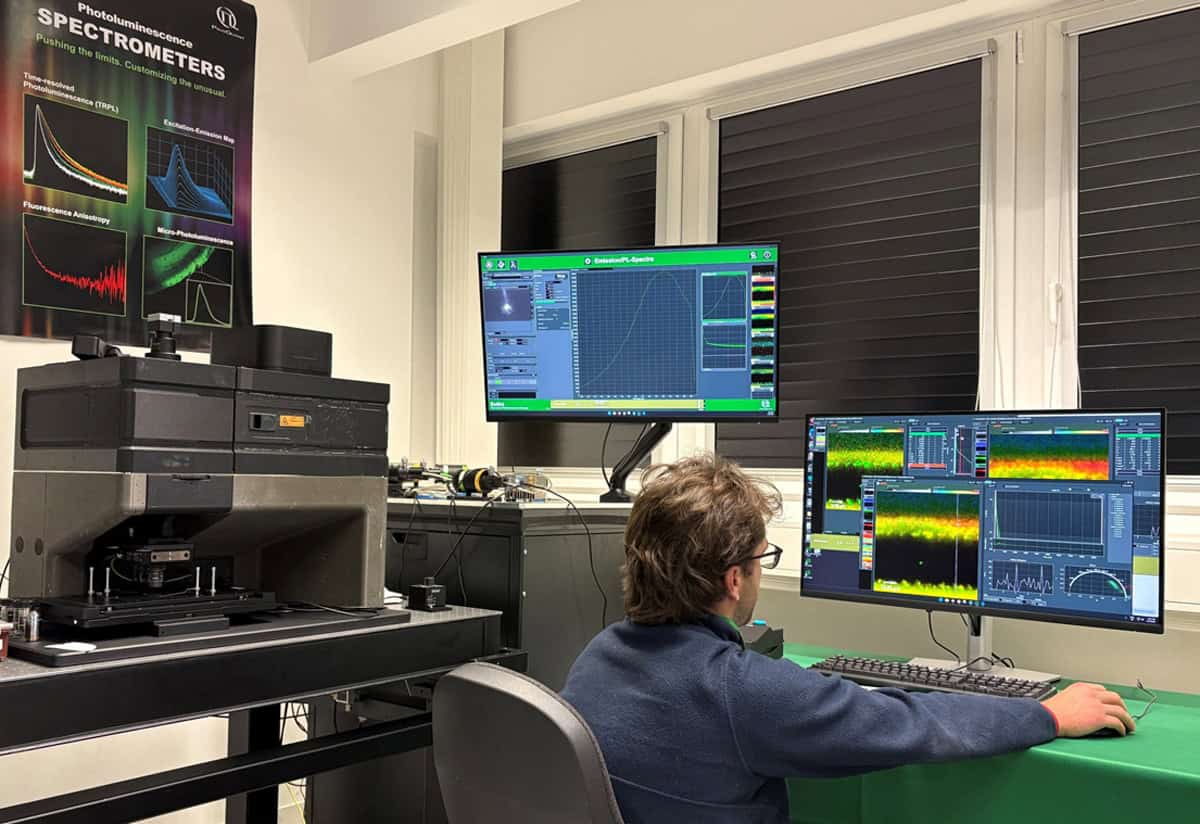
Maxim Simmonds measuring perovskite solar mini module samples with Solira. (Courtesy: PicoQuant)
When evaluating new materials for optoelectronic applications – perhaps promising solar panel materials like halide perovskites or semiconductor compounds for microLED displays – optical characterization is almost always the materials scientists’ first port of call. And up to now steady-state photoluminescence (PL) has been the de facto workhorse for this task.
This non-destructive and highly sensitive technique involves optically exciting a sample and recording the integrated intensity and wavelength of re-emitted photons. Through this, researchers gain a quick understanding into a material’s electronic structure, optical transitions and emission characteristics.
However, these spectra alone can be misleading. Materials with substantially different microscopic properties can generate similar steady-state PL results, masking the fundamental physical dynamics that govern the material’s performance in the real world. To gain deeper understanding of a given material, a more comprehensive and correlated approach is needed.
Blinding average
The core issue lies in the fact that steady-state PL provides a time-integrated view of the emission and depending on the measurement geometry, may also average over spatial variations. Steady-state PL records a static equilibrium in which charge carrier generation balances recombination. This means that, on its own, it does not directly reveal how these excited charge-carriers evolve and ultimately dictate how a device manipulates energy and light.
For example, although two semiconductor thin films may show identical steady-state emission, they can perform very differently in a real device. One film might have long carrier lifetimes consistent with low non-radiative losses – useful in solar cells, for example – while the other could suffer from high defect densities that are masked by strong light absorption or intense excitation light.
Conversely, weak emission does not necessarily mean poor material quality. Again using a layered solar cell as an example, dim luminescence often signals fast, beneficial charge extraction across an interface rather than harmful defect recombination (where structural imperfections convert charge-carrier energy into wasted heat). Because steady-state measurements only show an overall average, they cannot separate these competing mechanisms.
Resolving in time, space and spectrum
Time-resolved PL (TRPL) is a key technique in illuminating these hidden dynamics. Unlike steady-state PL, which continuously bathes a sample with light, TRPL uses a short laser pulse and measures how the photoluminescence intensity evolves afterwards. This can reveal carrier dynamics over timescales ranging from picoseconds to microseconds.
TRPL is particularly important in materials where local variations strongly influence device behaviour. For instance, it can expose the difference between regions that exhibit long-lived emission consistent with efficient radiative recombination, and those that exhibit fast decay caused by, for example, defect recombination.
Of course, steady-state PL averages over time and space, and therefore TRPL only solves part of the problem. Spatially resolved TRPL addresses the missing spatial dimension. Combining a high-precision, motorized XY stage with TRPL’s precise timing, spatially resolved TRPL forms a 2D map that directly correlates localized structural features – such as grain boundaries and defects – with variations in carrier kinetics across the surface.
Complementary to these techniques is time-resolved emission spectroscopy (TRES), which combines spectral selection with time-resolved detection to measure how emission dynamics vary across the spectrum. By recording wavelength-dependent decay behaviour, TRES reveals how different spectral contributions evolve following excitation.
In short, where TRPL reveals kinetics over time and spatially resolved TRPL locates variations in space, TRES adds a spectral dimension, showing how the emission spectrum evolves after excitation. This allows researchers to track changes in the distribution of photon energies over time to understand carrier evolution and gain insight into the mechanisms underlying material behaviour.
A correlative approach
Though powerful in isolation, reconciling insights across these different instruments is slow and prone to errors. There can be microscopic differences between samples or even within positions in a single sample that dramatically alter emission spectra. Moreover, moving a sample between separate instruments is fraught with difficulty, potentially damaging the sample or causing delays that lead to sample degradation.
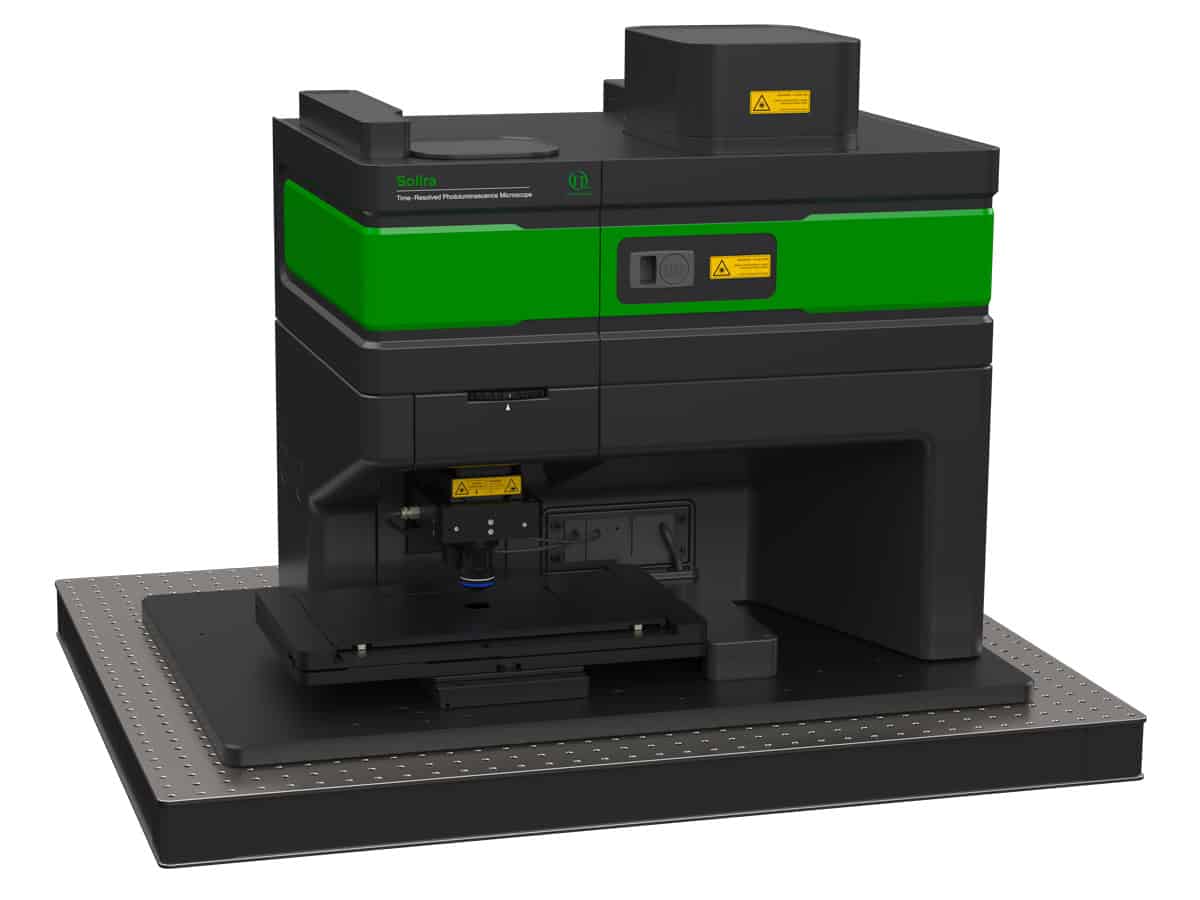
PicoQuant’s Solira, an all-in-one time-resolved photoluminescence microscope for flexible optical characterization of materials and optoelectronic devices. (Courtesy: PicoQuant)
More comprehensive and reliable physical insight comes when temporal, spatial and spectral factors are recorded correlatively on the exact same sample region. This need for correlation is the motivation behind PicoQuant’s Solira, an integrated workflow platform for steady-state PL, TRPL, spatially resolved TRPL and TRES (the latter when combined with the complementary FlexLambda Kit), as well as additional imaging techniques, such as hyperspectral imaging, required for different scientific questions.
Bringing these techniques together within one configurable microscope system means a materials scientist can gain a more informed interpretation of material behaviour. For instance, they can identify the relevant emission bands at selected points of interest with steady-state PL. They can then wield TRPL to measure the associated decay kinetics, before perhaps applying TRES to resolve how those kinetics vary across the emission spectrum.
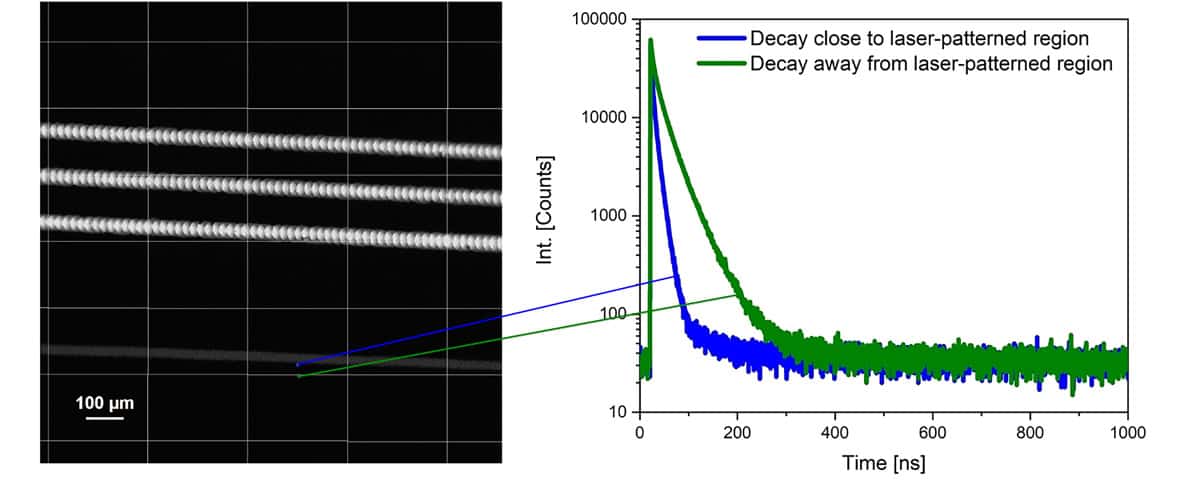
TRPL decay curves recorded at positions close to and away from a laser-patterned region of a perovskite solar mini module sample. The decay measured adjacent to the structured line exhibits faster PL decay dynamics compared to the unmodified region farther from the laser-patterned area. (Courtesy: PicoQuant)
Bright demonstration
The power of this correlated approach was demonstrated recently by Professor Eva Unger’s group at Helmholtz-Zentrum Berlin, Germany, with measurements carried out by Maxim Simmonds. Investigating perovskite solar mini-modules, the team worked with PicoQuant and used Solira to locate precise laser-patterned lines – microscopic scribes used to interconnect individual cells in a solar module – before verifying emission from the active layer. Localized TRPL measurements then revealed significantly faster decay dynamics next to these laser cuts compared to the pristine bulk material, indicating altered carrier recombination or diffusion near structured features.
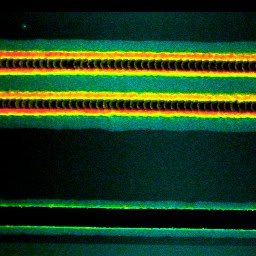
Spatially resolved TRPL image recorded from a sample of a perovskite solar mini module, showing photoluminescence lifetime differences between laser-patterned lines and bulk material. The structured regions remain photoluminescent, indicating that the laser process modifies local photophysical properties rather than completely removing the emissive material. (Courtesy: PicoQuant)
However, point measurements alone were not enough to discern whether the laser had fully removed the perovskite or merely modified it. Switching to spatially resolved TRPL imaging on Solira revealed that measurable photoluminescence persisted along the laser-patterned lines. This showed that laser structuring had altered local photophysical properties rather than eliminating the active layer – a conclusion only made possible by consistently mapping charge-carrier dynamics across temporal, spatial and spectral dimensions together on one setup.
As semiconductor materials and optoelectronic devices become more complex, optical characterization tools must keep pace. By unifying these tools within an integrated workflow platform such as Solira, materials scientists now have the means to paint a more complete picture of material characteristics and thereby unlock the next generation of innovative functional materials.
Vacuum fluctuations can enhance superconductivity in a bulk material. This is the new finding from researchers in China and the US who have put forward the concept of “vacuumtronics”. This is a new way to tune superconductivity without chemically altering a material, applying pressure to it or driving it with intense light.
In quantum electrodynamics, a vacuum is not empty but is host to fluctuating electromagnetic fields in which pairs of virtual particles are continuously being created and annihilated. Such vacuum fluctuations are thought to be responsible for phenomena like the Lamb shift, spontaneous emission and the Casimir effect.
In recent years researchers have been looking into the possibility of exploiting these fluctuations to change the properties of bulk matter. This is challenging because the fluctuations are extremely weak and produce little measurable change in macroscopic quantum states. They can, however, be amplified by a factor of 100 or even more using structures like resonant cavities. Indeed, such enhanced vacuum fields have already been exploited to modify material properties like chemical reactivity, topological states and conductivity.
In theory, vacuum fluctuations could be used to modulate superconductivity too, but until now this had never been demonstrated in an experiment.
Split-ring resonant “dark cavity”
In the new work, an experimental team led by Changgan Zeng and Guanghui Cheng at the University of Science and Technology of China (USTC), partially embedded the layered superconductor niobium diselenide (NbSe2) inside a specially designed near-terahertz split-ring resonator, referred to as a “dark cavity”. The researchers then systematically compared the superconductivity of the NbSe2 outside and inside the cavity by measuring the resistance of the material as a function of temperature.
They found an increase of up to 5.4% in the superconducting critical temperature, Tc, of NbSe2 within the cavity compared with regions outside it, even although both samples came from the same NbSe2 flake.
Higher current and field
The researchers say they also observed substantial increases in the critical current and critical magnetic field near Tc. This is exciting, says Cheng, because the cavity is dark: no light shines on the material and no energy is actively pumped into it. “Instead, the effect arises from the ever-present electromagnetic fluctuations of the quantum vacuum.”
One of the challenges in the experiments, he explains, was to distinguish between genuine vacuum-fluctuation effects from more mundane explanations, such as sample inhomogeneity, strain or device fabrication-related effects. He says he and his colleagues invested considerable effort in control experiments to rule these out.
Zheng and Cheng’s theorist colleagues Qingdong Jiang from Shanghai Jiao Tong University and Frank Wilczek from the Massachusetts Institute of Technology (MIT) department of physics developed a theoretical model to explain the underlying mechanism behind the effects observed. Within a Ginzburg–Landau framework, they put forward the hypothesis that the superconducting state exchanges virtual photons with the dark cavity, which lowers the energy of this state and thereby strengthens superconductivity. And, when the characteristic energy of the cavity mode matches the low-energy superconducting fluctuations, the NbSe2 device exhibits resonant enhancement, producing the peak in superconductivity enhancement, explains Jiang.
Wilczek adds “In most practical physics experiments, the vacuum serves merely as the passive stage on which such phenomena play out”. “Our work shows that the background itself can become an actor – engineered to strengthen superconductivity and reshape the behaviour of quantum matter.”
The work establishes quantum-vacuum engineering as a new non-invasive way to tune superconductivity, Zeng tells Physics World. “Although the temperature enhancement we demonstrated is modest, it is a proof-of-principle for what could become a broadly applicable approach. It could be relevant to superconducting circuits, quantum sensors and other quantum devices, where non-invasive control of superconducting properties would be particularly valuable. More broadly, such engineered vacuum fields could also be used to control states of matter other than superconductivity.”
The China–US team says it would now like to further enhance the effect through improved cavity and material design and continue to investigate the underlying microscopic mechanisms in collaboration with theorists.
When it comes to power, the pair think it should be possible to generate sufficient energy even for a large city and without the need for nuclear power.
They estimate it would be possible to generate 3 GW of electricity using kilometre-tall towers covered with photovoltaic arrays. Not only that but it would be possible to manufacture solar panels on the Moon given the amount of silicon on the surface.
Yet it is not good news when it comes to water consumption. We have known for well over a decade that the Moon’s poles contain water ice, possibly as much as a billion tonnes, with Moon-orbiting craft mapping out likely locations in great detail.
Even assuming one billion tonnes of water on the Moon, if nothing was recycled then a city of a million would last only a few years, while a population of 100,000 would run for 20 years before running dry.
Even when recycling the water with an efficiency of 98% – as performed on the International Space Station – a city of a million would only have enough water for around a century.
The authors say that to sustain a lunar city of that size would require improving water-recycling efficiencies beyond 99.5%, reducing water usage through vertical farming or simply finding more water on the Moon.
So for now it sounds like a Moon village may be the only possibility. The authors state that a town of around 10,000 people, for example, may be sustainable for several centuries.