MR guidance is emerging as a powerful tool for real-time monitoring of radiation treatments, offering excellent soft-tissue contrast and the ability to track intra-fractional tumour motion. Hybrid devices for MR-guided photon-based radiotherapy are now in clinical use. But to date, no such combined system exists for proton therapy.
Now, a team from OncoRay at the Helmholtz-Zentrum Dresden-Rossendorf (HZDR) has integrated a low-field open MR scanner with a static proton research beam line and shown that, in principle, simultaneous proton irradiation and in-beam MRI is technically feasible (Phys. Med. Biol. 10.1088/1361-6560/aaece8).
Proton therapy is highly sensitive to anatomical changes in the beam path, which impairs the targeting precision when treating mobile tumours. The goal is to conform the beam to the exact shape of the tumour tissue, thus sparing as much of the surrounding normal tissue as possible. But currently, there is no direct way to visualize tumour motion during irradiation.
“We don’t know exactly whether the proton beam will hit the tumour as planned,” explains Aswin Hoffmann, head of the MR-guided radiation therapy research group at HZDR. Therefore, physicians today have to use large safety margins around the tumour. “But that damages more of the healthy tissue than would be necessary if radiation were more targeted. That means we are not yet exploiting the full potential of proton therapy.”
Unwanted interactions
Hoffmann and his team want to change that. Working in cooperation with IBA, their objective is to use real-time MR imaging during proton therapy to improve the targeting accuracy. So why has this not been achieved previously?
One major obstacle when developing MR-guided proton therapy is the electromagnetic interactions between the MRI system and the proton therapy equipment. MRI scanners need highly homogeneous magnetic fields to create geometrically accurate images. The proton beam, however, is generated in a cyclotron, in which electromagnetic fields force charged particles onto a circular trajectory and accelerate them. The proton beam is also steered and shaped by magnets, whose magnetic fields can interfere with the MRI scanner’s homogeneous magnetic field.
“When we launched the project three and a half years ago, many international colleagues were sceptical. They thought it was impossible to operate an MRI scanner in a proton beam because of all the electromagnetic disturbances,” says Hoffmann. “Yet we were able to show in our experiments that an MRI scanner can indeed operate in a proton beam. High-contrast real-time images and precise proton beam steering are not mutually exclusive.”
Another potential difficulty is that when electrically charged particles move in the magnetic field of an MRI scanner, Lorentz forces will deflect the beam from its straight trajectory. However, the researchers were also able to demonstrate that this deflection can be anticipated and thus corrected for.
System studies
The cyclotron at OncoRay delivers a proton beam into its therapy room, as well as into an experimental room with a horizontal static research beam line. Hoffmann and colleagues used the latter for their research activities. To assess the mutual effects on the beam and the MR images, they installed an open MRI scanner in the path of the proton beam.
They first tested MR imaging performance on a healthy volunteer and a patient with a soft-tissue sarcoma of the upper arm, both with the proton beam line switched off. The observed quality of the anatomical MR images was rated sufficient for target volume definition and positioning. They also acquired images of a tissue-mimicking phantom — without the beam, with energized beam line magnets and during proton irradiation – and saw no visible beam-induced image degradation.
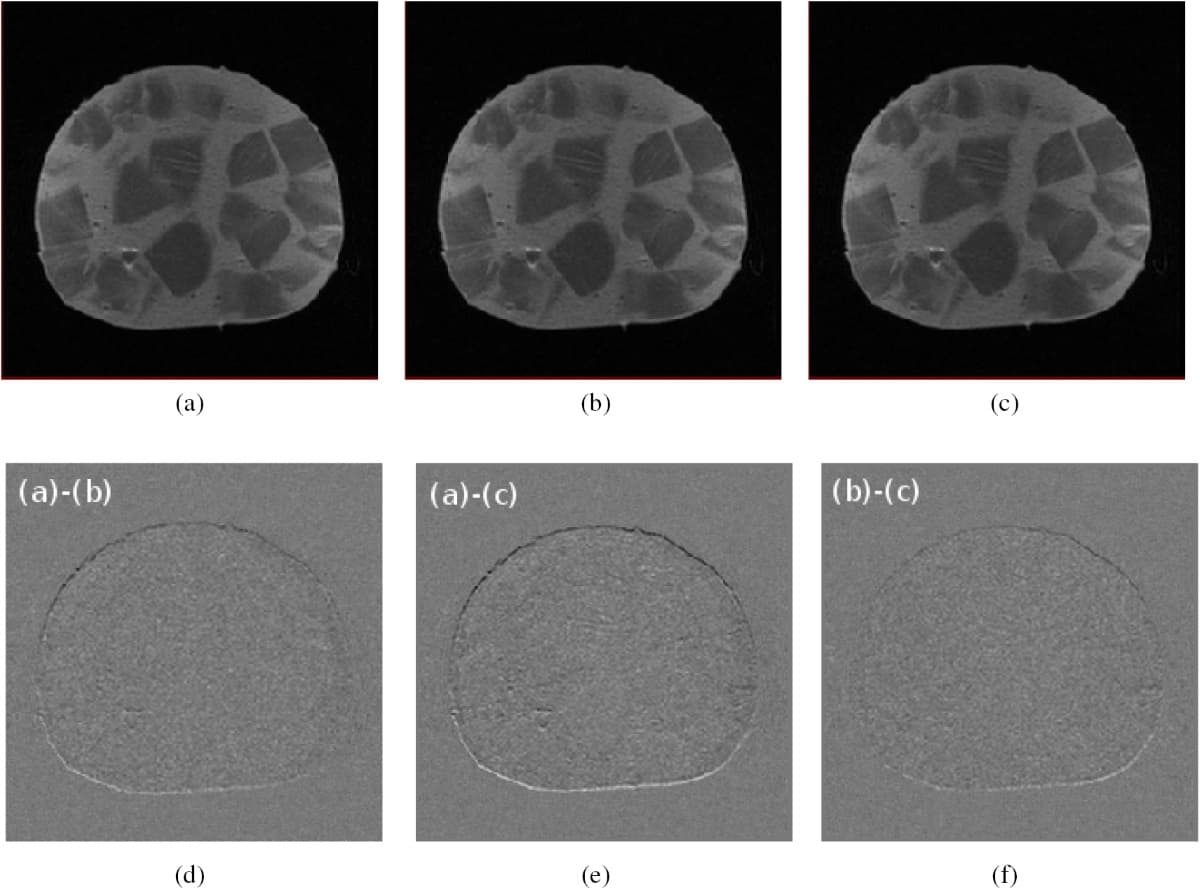
MR images of a mixed sausage without the beam (a), with energized beam line magnets (b) and during proton irradiation at 215 MeV (c). Difference images (d–f) show a sub-millimetre uniform shift in (vertical) frequency-encoding direction. (Courtesy: Phys. Med. Biol. 10.1088/1361-6560/aaece8)
In a second series of experiments, the team imaged a piece of Dresden mixed sausage, again without the beam, with energized beam line magnets and during proton irradiation. Difference images between the three conditions revealed a sub-millimetre, spatially uniform shift in frequency-encoding direction, which can be corrected for. No additional artefacts or deformations were observed, indicating that no severe image degradation was introduced by either the beam line magnets or the beam itself.
“When the Dutch research group studied imaging for their MR-guided photon therapy device in 2009, they used a pork chop,” Hoffmann notes. “In 2016, Australian researchers demonstrated their MR-photon therapy device on a kangaroo steak. Since we also wanted to go regional for our prototype in MR-guided particle therapy, we used Dresden mixed sausage.”
The researchers concluded that their proof-of-concept study showed the technical feasibility of simultaneous proton beam irradiation and in-beam MR imaging. The project is currently entering its next phase, with the goal of developing the world’s first clinical prototype for MR-guided proton therapy.
“Our mission is to individualize proton therapy biologically and to optimize it technologically towards its physical limits,” says Hoffmann.
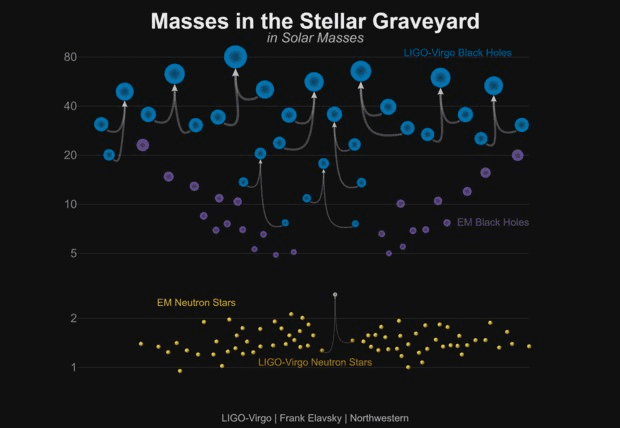
Merging masses: chart showing the ten black-hole mergers (top) and one neutron-star merger (bottom). Also shown are black holes and neutron stars observed using electromagnetic (EM) radiation. (Courtesy: LIGO-Virgo/Frank Elavsky/Northwestern)
Physics working on the LIGO and Virgo gravitational-wave detectors have announced the observation of four more black hole mergers. The events have come to light after additional analysis was performed on data gathered during the second run of the detectors in July and August of 2017.
The observations were made at around the same time as the first-ever detection of gravitational waves from a merger of two neutron stars – an event called GW170817. Indeed, six separate gravitational-wave events were seen in less than one month of observation time by the detectors.
The two LIGO detectors are in the US – one in Livingston, Louisiana and the other in Hanford, Washington. The Virgo detector is located near Pisa, Italy. Since 2015, the gravitational-wave detectors have observed 10 black-hole mergers and one neutron-star merger.
“In less than three years gravitational wave detections have given us direct evidence of the existence of black holes and binary neutron star collisions,” say LIGO–Virgo team member Sheila Rowan of the University of Glasgow.
Massive merger
The most massive of the newly announced mergers is dubbed GW170729 and was spotted on 29 July 2017 (the number indicates the year, month and day of the observation). It is the largest merger seen so far and is believed to have involved the coalescence of two black holes, one weighing in at more than 50 solar masses and the other more than 34 solar masses. The event happened about 5 billion years ago and created an 80 solar mass black hole and converted about 5 solar masses into gravitational waves – some of which made the long journey to Earth.
GW170729 was seen by both LIGO detectors, but not by Virgo, which was not running at the time. Also seen by just LIGO is the newly-announced GW170809, which created a black hole of about 50 solar masses.
Also in the catalogue of new observations is GW170818 was seen by LIGO and Virgo just one day after the GW170817 neutron-star merger and involved creation of a black hole of about 55 solar masses. The fourth new merger is called GW170823 and created a black hole of about 60 solar masses.
Multimessenger astronomy
An event seen by all three detectors is significant because it gives astronomers a much better idea of where in the sky the merger occurred. This is important for multimessenger astronomy, whereby telescopes are pointed at the source of gravitational waves to try to detect electromagnetic radiation – and possibly neutrinos – created by the merger. While additional signals have yet to been seen from black-hole mergers, radiation ranging from radio waves to gamma rays has been observed in the aftermath of the GW170817 neutron star merger. This provides important insights into the object (most likely a spinning black hole) that was created by the merger.
The LIGO and Virgo detectors are currently being upgraded and their third run will begin next year. “It’s an incredibly exciting time,” says David Shoemaker of the Massachusetts Institute of Technology, who is spokesperson for the LIGO Scientific Collaboration. “The next observing run, starting in Spring 2019, should yield many more gravitational-wave candidates, and the science the community can accomplish will grow accordingly.”
The new events, plus previously announced detections are described in two preprints on arXiv. One preprint catalogues all mergers seen so far, while the other looks specifically at what LIGO–Virgo tells us about binary black hole populations in the universe.
There is much more about the detection of gravitational waves in the second episode of the Physics World 30th anniversary podcast series in which Andrew Glester speaks to scientists who played crucial roles in building the LIGO detectors and analysing the signals they produce.
Next year will see the world celebrate the 50th anniversary of one of the most incredible human endeavours – the first Moon landing. While the names of the first two men to set foot on the Moon will forever be remembered in history, it is likely that the name Wally Funk will ring no bells for most people. But it should. Funk was the youngest of NASA’s First Lady Astronaut Trainees, or FLATs, selected by NASA physician William Randolph Lovelace II to take part in a privately funded project testing women for spaceflight in the early 1960s. Wally Funk’s Race for Space – written by physicist-turned-broadcaster Sue Nelson – documents the Mercury 13, the world’s first all-woman astronaut squad, who regrettably never flew in space.
In Women with the Right Stuff, an award-winning BBC World Service documentary made by Nelson and Funk in 2016, the endlessly energetic 78-year-old Funk states “The only thing a woman needs to compete in a man’s world is ability.” Funk and her dozen Mercury 13 colleagues were not only entirely able, but utterly exceptional. They passed rigorous medical examinations, had extensive flying experience and were easily as patriotic and passionate as the male astronauts part of the historic Mercury Friendship 7 mission that, in February 1962, saw John Glenn become the first American in orbit. Funk broke all records (including those of all her male counterparts) by spending 10 hours and 35 minutes in a sensory isolation tank. The reason that the Mercury 13 did not become astronauts was not that they weren’t qualified – it was because they were women.
Wally Funk’s Race for Space is not only the story of a historic space mission that never happened, but a story of frustration, friendship and feminism. What starts as a tale of sisterhood – the programme was originally funded by Jacqueline Cochran, an aviation pioneer – becomes a contemporary tale of betrayal. The final test in their training was never conducted, and the Mercury 13 programme was suddenly shut down in 1961. A year after their funding was withdrawn, two of the Mercury 13 took their case to the US House Subcommittee on Space. President Eisenhower had dictated that all astronauts must have experience flying military jets, but in the 1960s women weren’t allowed join the Air Force flight programmes. Cochran eventually provided testimony against the programme, and Glenn – whose own journey to space relied on the mathematics of NASA’s female “computers” – was worried it would disrupt the “social order”. Unfortunately, this investigation into the capabilities of the 13 female astronauts took place two years before sexual discrimination was made illegal by the 1964 Civil Rights Act. Only a couple of years later, Russia would send Valentina Tereshkova, the first woman cosmonaut, to space – and she wasn’t even a pilot.
Funk’s public rejection never deflated her eagerness – at the time she was only 21 years old, and decided she would go to space with or without NASA. In the decades since she has kept fit, been part of further astronaut selection tests and trained thousands of young pilots. In 2010 she even bought a $200,000 ticket to be part of Virgin Galactic’s SpaceShipTwo. Her relentless excitement for space travel is evident on every page and, despite never having been remotely interested in becoming an astronaut myself, I found myself inspired, thanks to her endless optimism and tenacity. Funk does not waste any energy on resenting NASA, and is only temporarily flattened when she meets Jessica Meir, a member of NASA Astronaut Group 21, who shows little interest in the story of the Mercury 13.
At a time when women are still fighting to gain the recognition that they deserve, Wally Funk’s Race for Space is much more than a biography. It is bigger than Nelson calling out the transparent sexism of the space sector in the 1960s. It is the story of a 20-year relationship where, through adventures and discussions, Nelson makes up for everything that Funk missed out on by not being the first woman in space. Together they travel the world, from NASA to the European Space Agency, Virgin Orbit to the BBC, meeting eminent engineers and astronauts. Nelson could not be a better person to write this book – empathetic and enthusiastic, with a contact list that easily rivals the well-connected Funk. In fact, there are so many fascinating threads that I found myself folding over page corners, keeping lists of names and dates to research, wishing that there was a proper appendix and index of everyone Funk and Nelson met.
After the success of Hidden Figures (both the film and the book), and the announcement of the third ever female Nobel prize winner in physics, Wally Funk’s Race for Space feels immensely important and timely – like the world is finally waking up to women’s contributions to science and engineering. Indeed, Funk’s fascinating story has not gone overlooked by producers – Amazon, Netflix and ITV America are all developing television series about the FLATs.
In 2019 Wally Funk will turn 80 years old. She is still just as fearless and committed as she was when she was selected to be one of the Mercury 13. She still wears a Space Shuttle mission patch on her flight suit and introduces herself as an astronaut candidate when she visits space centres. I will keep my fingers crossed that she eventually makes it into space. Thanks to Nelson, Wally Funk’s legacy will not be forgotten.
The intimate relationship between music and physics – beyond that of mere longitudinal waves – provides a sound basis for an introduction to scientific phenomena. In When the Uncertainty Principle Goes to 11: or How to Explain Quantum Physics with Heavy Metal, author Philip Moriarty seeks to explain the microscopic world of quantum physics through the amplifier of heavy metal. Picture Jean-Baptiste Joseph Fourier – he of Fourier transform and analysis fame – in tight leather trousers, with even wilder hair than his portraits suggest, wielding an “axe” and performing to thousands of screaming fans. The result is a book that teaches as much about heavy-metal genre history to a physicist as it teaches physics to a metalhead. Beware though that a casual read will prove inadequate to fully appreciate the book’s contents, as it delves into some very heavy topics.
Moriarty’s passion for both subjects is evident in his writing and, from his contribution to YouTube channels like Sixty Symbols, it is clear that he is no stranger to making dense physics intelligible to non-experts. As someone with limited listening history when it comes to this particular kind of music, I found that Moriarty, a physicist at the University of Nottingham in the UK, assumes no genre expertise from his reader. Instead, he provides helpful examples and abundant footnotes to ease one in to the realm of guitar shredding and mosh pits.
Alternative take: Philip Moriarty uses heavy metal as a basis to discuss quantum physics. (Courtesy: Pete McPartlan)
When the Uncertainty Principle Goes to 11 – complemented by artist and animator Pete McPartlan’s beautiful sketches (see top and above) – starts off on familiar ground, with an introduction to concepts such as volume (the amplitude of a sound wave) and pitch (its frequency). This then leads into Fourier analysis, energy conversion, crowd dynamics and quantum physics. Indeed, Moriarty states early on that the book will not shy away from technical and involved discussions about physics. This means that, although not a textbook, the book does contain explanations that need more than a single read to fully comprehend them – you may find yourself going back and forth a lot to properly grasp each topic. It also includes several equations and graphs that take some effort to digest, especially if you are unfamiliar with physics notations.
The reader should bear in mind that, while it uses music as a narrative tool, When the Uncertainty Principle Goes to 11 remains a book about physics. Heavy metal does not, however, feature as a gimmick alone. Each topic gets examined using terms and situations that metalheads would be acquainted with. A detailed appendix allows the reader to continue their journey should they wish to, but I will admit to not spending too much time going over the specifics contained there.
Through the use of music, Moriarty takes his readers from the infinitely large stage of the whole universe and its very origins, to the infinitesimally small performances of individual subatomic particles. The aforementioned Fourier makes his presence felt regularly, which is unsurprising given his many contributions to physics. But if you were expecting a treatise on quantum physics alone, you might leave with a sensation similar to one after a concert that did not live up to its full promise; quantum physics just does not get as much attention as one would expect from the book’s title and premise. This is entirely understandable when you recognize that Moriarty takes the reader on a journey through a lot of other physics over the course of the book in order to be able to begin a discussion on the quantum world. But in what he does cover, Moriarty devotes several pages to debunking the pseudoscience and “woo” peddled by those who co-opt terminology from quantum physics to make seemingly profound statements about one’s place in the universe.
Despite its technical treatment, the book offers plenty of “interactivity” in the form of YouTube videos of song snippets mentioned in the text or audio samples of the experiments conducted by the author. In fact, the book has an accompanying YouTube channel dedicated to these sound samples. Although viewing the videos involves lots of putting down the book and typing on a computer, they prove invaluable in understanding the physics Moriarty covers.
Moriarty also turns up the nostalgia factor to 11. The writing is full of whimsical references to metal bands of yore and their albums, while song names and lyrics are used for chapter titles or epigraphs as well as section headings. He succeeds in resonating with the reader throughout the book, but some might find the musical meanderings in the writing a little too forced. From personal experience, the Venn diagram of physics aficionados and metalheads has a large overlapping area. Indeed, When the Uncertainty Principle Goes to 11 seems to be written as much for the author himself as it is for the seemingly tiny slice of the metalhead subculture who are as-yet-uninterested in physics. That said, if you are a heavy-metal connoisseur who has been just a little too afraid to peer into the technical depths of quantum physics, you will find that Moriarty’s book, full of familiar contexts references, strikes the right note.
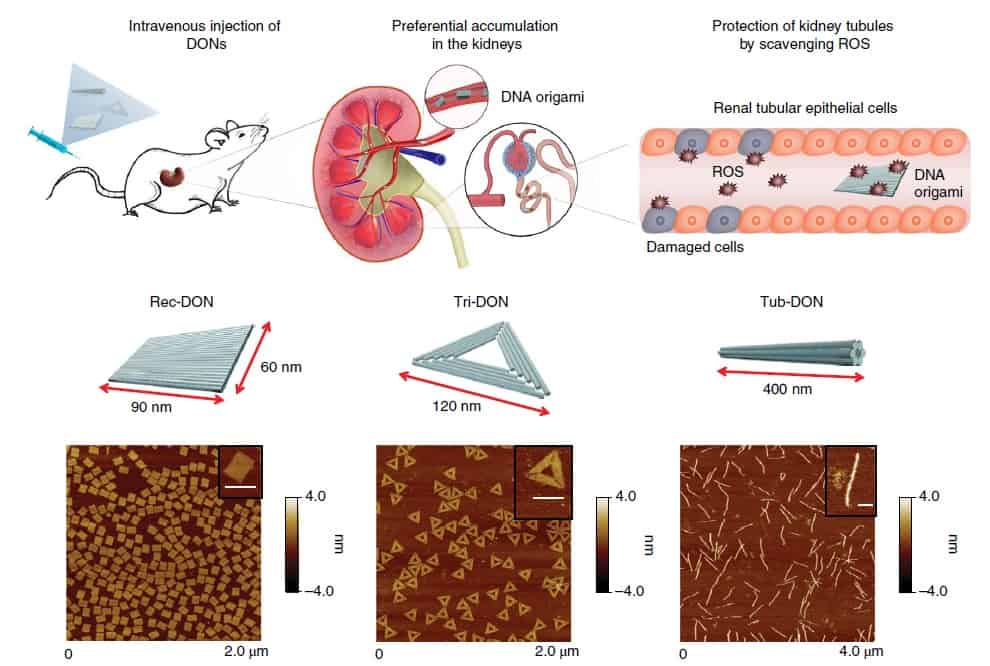
Schematic representation of the use of DNA origami nanostructures (DONs) to treat acute kidney failure. The triangular, rectangular or tubular nanostructures are injected in mice to target the kidney and react with ROS, protecting kidney cells. (Courtesy: Nature Biomed. Eng. 10.1038/s41551-018-0317-8)
Acute renal failure occurs due to a fast accumulation of nitrogenous species in the urine, which results in reactive oxidative species (ROS) that damage kidney cells. It is a relatively common affliction and, although there are some available therapies such as N-acetylcysteine, acute renal failure has no effective treatment.
Nanomedicine — or design of materials at the nano-scale for biomedical applications — has undergone enormous advancements in the past decade, including the development of technologies for kidney targeting. Until now, however, researchers have had limited success at developing nanomedicine therapies that effectively target acute kidney failure.
Folding DNA to target the kidney
DNA nanotechnology permits manipulation of DNA to form tailored nanostructures — or DNA origami nanostructures (DONs). It makes use of the DNA bases coupling (intra- and inter-molecular Watson-Crick base pairing) to build complex nanostructures. Now, an interdisciplinary research collaboration from USA and China has published a study in which they employ DNA nanotechnology to treat acute kidney failure (Nature Biomed. Eng. 10.1038/s41551-018-0317-8).
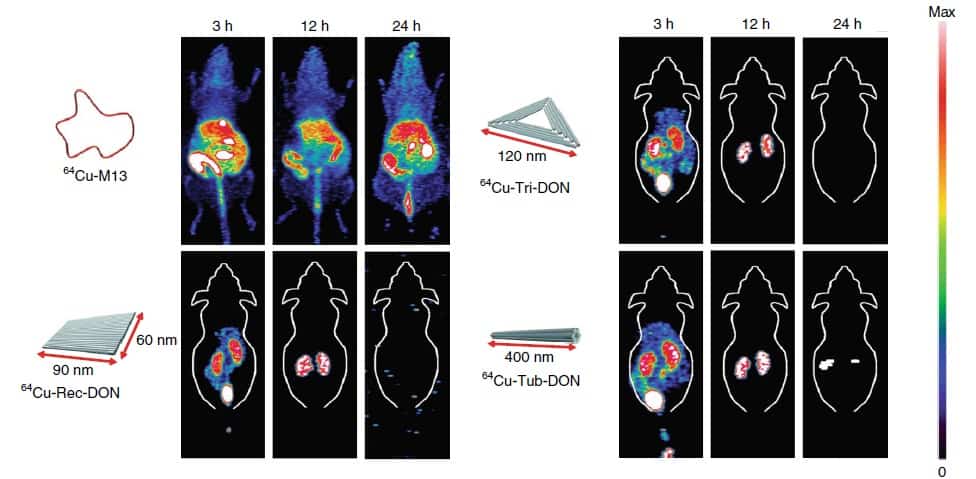
The researchers designed DNA strands to produce DONs with rectangular, triangular and tubular shapes, using a simple annealing procedure. Then, they radiolabelled the DONs and injected them into healthy mice to assess their accumulation in the kidneys. Interestingly, the researchers observed that of the three kinds of DONs, the rectangular shapes showed the most efficient renal accumulation. In addition, after 24 hours, all the DONs were completely cleared from the mice bodies by excretion.
Afterwards, the research team tested whether or not the rectangular DONs also accumulated in the kidneys of mice suffering from acute kidney failure. They observed that rectangular DONs did indeed accumulate in the diseased kidneys. The renal uptake of the DONs was attributed to three factors: the DNA folding protecting the DNA from enzymatic digestion in the blood; the negative charge of DNA preventing the attachment of proteins and accumulation in the liver; the specific shape and nanometric size of DONs allowing them to penetrate the kidney filtration barriers.
PET images of labelled single-strand DNA and DONs after injection in healthy mice, showing that DONs accumulate in kidneys. (Courtesy: Nature Biomed. Eng. 10.1038/s41551-018-0317-8)
DONs healing kidneys
Finally, the researchers questioned whether the rectangular DONs could have a healing effect in kidneys. They hypothesized that DONs can alleviate the damage of ROS on kidney cells, since their bases neutralize the oxidizing agents.
First, in vitro experiments with the DONs confirmed the neutralization of ROS and the protective effect on cells. Later, the researchers treated diseased mice with either rectangular DONs, N-acetylcysteine or unfolded DNA. Remarkably, the rectangular DONs had the same therapeutic effect on recovering renal function as high doses of N-acetylcysteine — the current gold standard treatment. Additional experiments also confirmed the low immune response, low toxicity and lack of secondary effects of the DONs.
The work resulted in an effective treatment based on DONs, targeting kidneys in mice with acute renal failure. The team believe that, despite the outstanding results, further investigation is still needed to improve kidney targeting by DONs. They foresee the drug-loading and production of DONs on a large scale, which would represent a great advancement for the cheap and effective treatment of a wide spectrum of renal diseases.
Citizen scientists have outperformed physicists in creating Bose–Einstein condensates (BECs) of ultracold atoms. That is the finding of an international team of scientists and social scientists, which ran the first-ever optimization challenge in which the public was able to create a BEC remotely by manipulating laser beams and magnetic fields. Optimization experts using state-of-the-art algorithms took a similar challenge and both groups created BECs containing more atoms than the physicists who had built the experiment – even though the physicists had months to perfect their techniques.
By studying the behaviour of the 600 citizen scientists who participated, the team has uncovered insights into what makes human problem solving unique. As well as providing hints for creating advanced algorithms based on human intuition, the study suggests how to exploit the best of human and artificial intelligence in the future.
The research was done by Jacob Sherson and colleagues at Aarhus University in Denmark, Ulm University in Germany and the University of Sussex in the UK. Sherson and some of his colleagues have been involved in the ScienceAtHome project, which develops games that use the brainpower of the general public to solve quantum science challenges. In 2016, they described how more than 10,000 players of one of these games – Quantum Moves –had efficiently optimized operations that could run a hypothetical quantum computer. “[With Quantum Moves], we documented that humans can contribute to solving complex challenges,” says Sherson. “With our current work we now take on the challenge of starting to answer how they contribute.”
Atom cloud
This latest research involves an experimental set-up in Aarhus, where rubidium-87 atoms were captured in a trap made of two laser beams and a magnetic field. The atoms were then cooled to form a BEC by lowering the intensity of the laser beams and magnetic field gradient. When the traps were turned off, the atom cloud was imaged to reveal the total number that had formed the BEC – which is a quantum state of matter that has a wide range of applications including quantum sensing and simulation.
Players from across the world were connected in real-time to Aarhus through an online cloud interface. Through this, an individual player could change the laser beam and magnetic field parameters, which were then turned into experimental sequences in the lab. Roughly 35 s later, the player received their result.
Perhaps unsurprisingly, optimization experts working with a highly effective optimization algorithm found an optimal solution, superior to the previous best, in about 100 iterations. For the citizen scientists, Sherson and colleagues built a user interface called the Alice Challenge that turned the problem into an interactive and engaging game. Over the course of two weeks, 7577 solutions were submitted and realized in the lab. And from this, players managed to create a BEC containing 2.6 million atoms, a new record for the experiment.
New ways of thinking
Sherson explains that the solutions differed markedly and were both distinct from previously known ways of generating BECs. Furthermore: “We took the solutions of both the [experts] and the citizen scientists and stretched and compressed them in duration,” he adds. “We found that they exhibited very different degrees of robustness, illustrating that it is useful to have ways of generating very different solutions.”
The social scientists in Sherson’s team were given the unique opportunity of analyzing how the citizen scientists individually and collectively searched for solutions within the real-world Alice Challenge. They found that in contrast to algorithms, which make small steps to iteratively improve on a current solution, humans adapt their search strategies according to how they are performing. Well-performing players make small changes to optimize their solution, whereas poorly performing players will often innovate and try something completely new. As the latter see success, they gradually adapt to the former’s strategy, and vice versa.
We and many other scholars believe that the future will lie much more in hybrid intelligence platforms: interfaces that optimally exploit the best of human and artificial intelligence
Jacob Sherson
Human intuition is shown to be both valuable and hard to replicate in algorithmic form. Sherson suggests that the study shows how future algorithms could take inspiration from how humans make intuitive jumps by identify patterns from very little data. He also sees the potential of combining the best of both worlds: “We and many other scholars believe that the future will lie much more in hybrid intelligence platforms: interfaces that optimally exploit the best of human and artificial intelligence”.
BEC expert Tobias Lausch from Technische Universität Kaiserslautern, who was not involved in the study, likes the approach and idea the researchers implemented in their experiment, though he feels “it is a pity that there was not enough data gathered to study all aspects of the human performance and had to focus only on the initial search behaviour”.
He agrees with Sherson that a hybrid approach to optimization is promising: “Most optimization strategies based on evolutionary algorithms randomly seed parameters,” he says “A citizen scientist in this sense is a very welcome seed.”
The team is now turning their attention to applying the results of the study by combining the large BEC with single atom manipulation in order to create a neutral atom quantum simulator, a precursor to a generic quantum computer.
That’s because the lead feature in this month’s issue is all about the physics of fireworks. Sourcing good images of these beautiful explosions was a blast; in fact you could say we were fizzing with options.
Firework displays can be spectacular – and you may be looking forward to one on New Year’s Eve – but have you ever wondered how people organising massive public displays plan what they’ll look like? Fireworks are “one-shot” products so planning them can’t be easy.
In the feature, Pierre Thebault, former deputy general director of the LACROIX Group, explains the history and science of fireworks. He’s one of a band of “pyrotechnicians” constantly seeking new ways to create more spectacular fireworks that are safer and do less damage to the environment too.
You can enjoy the December 2018 issue of Physics World magazine via our digital apps for iOS, Android and Web browsers. (membership of the Institute of Physics required). Let us know what you think about the issue on Twitter, Facebook or by e-mailing us at pwld@iop.org.
For the record, here’s a run-down of what’s in the issue.
• A united society for Europe – The European Physical Society has been a voice for physicists in the continent for 50 years. Rüdiger Voss, its current president, talks to Matin Durrani about the challenges ahead
• Beauty and the biased – A recent talk at CERN about gender in physics highlighted the widespread biases that litter science. Philip Moriarty says we need to do more to tackle such issues head on
• Nobel impact – With this year’s Nobel Prize for Physics being awarded for “groundbreaking inventions in laser physics”, James McKenzie examines the value of basic research to business
• The X-reality files – Robert P Crease seeks your suggestions for novelists and artists who use physics to reach deeper truths
• Whizz-bang science – Fireworks have become a hallmark of celebrations around the world. Pierre Thebault looks beyond the bright colours and loud bangs, to the array of scientific methods that pyrotechnicians use to improve the safety, environmental impact and spectacle of fireworks
• Game on – Creating games for quantum computers offers an engaging way of exploring and testing their capabilities, writes James Wootton
• A graphic tale of entanglement – James Kalakios reviews Totally Random – Why Nobody Understands Quantum Mechanics: a Serious Comic on Entanglement by Tanya Bub and Jeffrey Bub
• The quantum heretics – Iain Dale-Trotter reviews What is Real: the Unfinished Quest for the Meaning of Quantum Physics by Adam Becker
• Thirteen tales that must be told – Jessica Wade reviews Wally Funk’s Race for Space: the Extraordinary Story of a Female Aviation Pioneer by Sue Nelson
• Strings and theories – Achintya Rao reviews When the Uncertainty Principle Goes to 11: Or How to Explain Quantum Physics with Heavy Metal by Philip Moriarty
• Fuelling the planet – Working at the interface of academia and industry in the energy sector makes for exciting research, as John Irvine tells Anna Demming
• Once a physicist – Meet Paul Bate, director of NHS services at Babylon Health.
• Winter yarns – Top of our wishlists this Christmas are these physics-related festive jumpers, created by Physics World features editor Sarah Tesh.
Grégoire Ribordy, chief executive officer and co-founder of ID Quantique. (Image credit: ID Quantique)
What led you to set up your company?
A number of factors. One was that QKD was just starting to gather interest from – well, not users exactly, but businesses that were interested in the technology in general. The other was that I was finishing my PhD and didn’t know what to do. I didn’t feel I would be good in an academic career, so I felt ready to try something else. Also, another start-up, MagiQ Technologies, had just been founded to commercialize QKD, and we had some early contacts with them. That made the possibility seem more concrete.
Who helped you start the company and what did they contribute?
There were four co-founders. Two of them were my PhD advisors at the University of Geneva, Nicolas Gisin and Hugo Zbinden. They were mentors, and they helped us get access to some expensive equipment at the beginning. The fourth co-founder was an electronic engineer, and in quantum technologies the engineering part is just as important as the physics (maybe even more so, now). We worked together to build prototypes.
How did you get funding?
The company was started in October 2001: after the dot-com crash, after the 11 September terrorist attacks, and way before Europeans knew about venture capital. Switzerland is also extremely unfriendly to start-ups in terms of funding because there is no public money available; it’s friendly in other ways, in the sense of being an efficient place to do business, but not with funding. That meant we had to bootstrap, and one thing we did right (and that we continue to try to do today) was to ask ourselves, “What can we sell quickly?”
In the beginning, we had a prototype QKD system: an Alice (sender) and a Bob (receiver). We had taken the first step towards creating a product by taking all the lenses and other components from our optical table and putting them in a standard 19-inch rack. The most challenging part of doing that was that at the time, the single-photon detectors used in the receiver needed to be cooled with liquid nitrogen. This was not so practical, so instead we mounted the detectors on thermoelectric coolers (Peltier coolers). That way, we could take our boxes to banks and telecommunications operators, plug the box into the wall and do demos.
We were super-proud of this prototype, but it was a university prototype. Lots of things were missing. When we showed it to businesspeople, they’d say, “Well, okay, that’s nice, but there’s still a bit of engineering needed.” We needed an alternative revenue opportunity, so we took the detector out of the box, developed a separate detector module and started selling it to former colleagues in the research community. And the funny thing is that we got our first sizeable order, for something like $100 000, before the company officially started, when the product itself was just a list of specifications on an A4 piece of paper. We were lucky that people trusted us enough to place an order for $100,000 to a non-existent company for a non-existent product.
Our other funding strategy was to find support in the form of prizes and awards for start-ups. For example, we won the Swiss Technology Award, and that gave us an opportunity to present at CEBIT, which is a big information technology trade show in Hanover, Germany. We were at the Swiss national pavilion, and one night, five minutes before the show closed, a guy came and said, “You know, I want to invest in quantum technologies. Are you interested?” This was our first business angel. He invested €1m, three years after we started the company, and that was when we were really able to build a team to industrialize our QKD and QRNG [quantum random number generation] technology.
What are you working on now?
We’re working on integrating QKD into more and more applications. The first use case for QKD, which is now more than 10 years old, is to do encryption in a point-to-point network. If you’re a government, for example, and you want to communicate securely between two sites, you buy two boxes and they will basically encrypt everything once you have the interface set up to use the keys. That was what we sold to banks and to governments for 10 years. Now, though, we are seeing interest in the telecommunications market for making encryption part of the 5G network, but to do that you need to interface to traditional telecoms equipment rather than encrypters. That’s one of our big projects – to, in a sense, take our QKD device, open the right interfaces to key management and network management systems, and get everything certified not only for security, but also for reliability.
What do you know now that you wish you’d known when you started the company?
That it’s all about people and motivating people. When you talk to venture capitalists, they always say “we invest in teams,” but I think there’s a good reason for that. When you go into a new market or a new technology, you need to have a credible vision, but you also need to adapt, and that’s based on the ability of the people around you. Also, some people are good for certain phases of a company’s development, but later, you need to find a way to bring new expertise in – ideally in a proactive rather than a reactive way.
What sorts of skills became important (or less important) as the company grew?
I would say physics is less important, because there’s a big community out there doing the physics, and we can read their papers and implement their ideas. We need to understand enough physics to understand the papers, but the details are less important. Engineering is more important when you need to make a product that works. You also need sales and marketing skills. We made this transition maybe six to eight years ago, and the next big challenge will be ramping up so that we’re able to manufacture 1000 devices instead of 100. There are certain things you can do when you make a small number of devices, such as relying on a single supplier for a particular component, that need to change once you become industrialized.
What’s your advice for someone starting a quantum technologies firm now?
Get good business advice as soon as possible. This might be through a mentor, but if you are a PhD student, your mentor is typically your adviser, and in most cases they won’t know much about running a business. So you might want to bring in independent directors to your board who will offer another perspective. We did that after about seven years and it brought a lot of value. Getting that kind of expertise will save you time on stupid, operational questions — they’ve answered those questions already, so you don’t have to make the same old mistakes yourself.
The other thing I’d mention is that in Europe, we still have a big challenge in terms of getting funding for companies to grow. It’s easy to find seed funding – the first few millions that will let you develop a first product. But it’s very challenging to go for the next €5–10m to grow the company. Hopefully, that’s an area where the European community – not necessarily the EU, but people in Europe – can find a solution. Otherwise companies will go elsewhere to look for funding, to Asia or the US, and then there’s a chance that the centre of gravity will move away such that the economic benefits of the research done in Europe will not occur in Europe.
Winfried Hensinger wants to build a computer the size of a football pitch. He’s aware that the idea may be a tough sell. Scientists and engineers have laboured for decades to transform the room-sized machines of the 1940s and 1950s into devices that fit on a desk, in the palm of your hand, and even – as with a chip unveiled at IBM last March – inside a grain of salt. Why would anyone take such a gigantic step backwards?
The answer lies in the architecture of Hensinger’s proposed machine. Instead of performing calculations with classical 0s and 1s, the computer he and colleagues at the University of Sussex in the UK hope to build would exploit the quantum properties of a billion ytterbium ions. Hensinger’s blueprint calls for these ions to be kept aloof from their environment with magnets and individually shuttled into interaction zones within a vast grid of microfabricated traps, using a field of microwave radiation to control their movements. The result, he says, would be a computer that can unravel “tremendously complicated problems that would take billions of years to solve on even the fastest supercomputers”.
Hensinger’s dream is exceptional in its scope, but his goal is far from unique. In recent years, governments and corporations such as IBM and Google have poured billions into quantum-computing research. Thanks to their investments, and the efforts of thousands of scientists worldwide, it is no longer absurd to think that a large-scale quantum computer will – somewhere, and in some form – become a reality. It won’t happen overnight, of course; today’s state-of-the-art devices boast no more than a few dozen qubits, and Hensinger acknowledges that it would take a “massive” amount of work (and around £100m) to scale his current prototype up to the billion-qubit level. But he insists that overcoming these challenges is a matter of “engineering, not physics”, and the mood among quantum physicists is generally buoyant. Few would bet against a universal quantum computer emerging sometime in the next 20 years.
There’s just one problem: when that happens, it may break the Internet.
A quantum problem…
To understand why quantum computers pose such a threat, consider the encryption systems that keep nefarious actors from eavesdropping on credit card details and other sensitive data sent over the Internet. Most of today’s encryption systems are built around “trapdoor functions”: mathematical problems that are easy to solve if you have a certain piece of knowledge, but hugely difficult if you don’t.
One example is RSA, a widely used public-key cryptography algorithm based on the factorization problem. The RSA algorithm begins by selecting two prime numbers at random and multiplying them to get a third number. This third number becomes part of the public key used to encrypt data. Decrypting those data, however, requires the private key, which derives from the prime factors themselves. But no efficient classical algorithm for calculating these prime factors has ever been found, so if the number to be factored is sufficiently large – the current RSA standard is 617 digits long – even the fastest computing clusters cannot break the encryption.
Quantum computers are different. In 1994 the mathematician Peter Shor devised an algorithm that allows quantum computers to factor large numbers much more efficiently. Hensinger estimates that his first-generation, football-pitch-sized machine could factor a 617-digit number in 110 days, and potentially as little as 10 days if the error rate of each quantum operation could be reduced. Other common public-key systems, such as those based on Diffie-Hellman or elliptic-curve cryptography, are similarly vulnerable. “[The Internet] is secure if you assume that these maths problems are hard,” explains Henry Semenenko, a final-year PhD student at the University of Bristol, UK. “With a quantum computer, they are no longer hard.”
In Semenenko’s words, the impending failure of widely used encryption methods constitutes a “quantum Y2K moment” – a latter-day counterpart to the bug that, 20 years ago, left experts scrambling to fix systems and computer code that could not handle dates beyond the year 1999. The potential for disruption is certainly analogous. Asked for examples of organizations that would suffer if public-key cryptography suddenly became insecure, Chris Erven – Semenenko’s PhD supervisor at Bristol’s Quantum Information Institute – rattles off a list that includes banks, telecommunications firms and healthcare providers, as well as power plants, shipping facilities and other critical infrastructure systems. Rupert Ursin, a physicist at the Austrian Academy of Sciences in Vienna, concurs. “The usual suspects, ranging from health to governments and the military, are only the tips of the iceberg,” he warns.
There is one crucial difference between the quantum Y2K moment and its classical cousin. Whereas the original bug was well-localized in time, the quantum version is, appropriately, fuzzier. “It’s kind of annoying, because with Y2K it was pretty clear-cut that on 31 December 1999, you were going to have a problem in a couple of seconds,” Erven says. “This one is sort of nebulously spread over a number of years.”
One source of uncertainty is that nobody knows for sure when a cryptographically useful quantum computer will be built. Michele Mosca, an influential scientist and co-founder of the Institute of Quantum Computing at the University of Waterloo, Canada, has suggested that there is a 50% chance of it happening by 2031. Others in the field are bolder. John Prisco, chief executive of the US-based cybersecurity start-up QuantumXchange, thinks it could take as little as three years. Predictions of between five and 10 years are not uncommon.
A second complicating factor is that for some types of data, the quantum Y2K moment has already arrived. “The central argument has always been that if there’s a quantum computer, it could potentially decode these cryptographic keys,” says Rob Thew, a physicist at the University of Geneva, Switzerland. “But what we see now is that you can just store all those data, and in the future, when you’ve got your quantum computer, you can decrypt.” Hence, any encrypted information that needs to remain secure for more than (say) 10 years is already at risk, even though the computers that could decrypt it don’t yet exist.
Examples of such information abound. Medical records are meant to be kept confidential throughout patients’ lifetimes, and sometimes for 10 or 20 years after their deaths. Companies and, especially, governments have secrets they would like to protect indefinitely. You don’t have to be paranoid to think of further examples, and Prisco – whose own personal information was stolen in 2015 as part of a massive data breach at the US government’s Office of Personnel Management – believes that well-funded, determined eavesdroppers are harvesting some of these data already.
…with a classical solution?
The good news is that a massive information security crisis is far from inevitable. “The reason there was no Y2K disaster is because people put money into it and worked on it and fixed the problem,” notes Kenny Paterson, an information security expert at Royal Holloway, University of London, UK. “I think much the same is true here.”
Broadly speaking, approaches to the quantum Y2K problem fall into two categories. The more straightforward – advocated by Paterson and other cryptographers – would be to replace vulnerable cryptographic methods like RSA with alternatives that will resist attacks by eavesdroppers with quantum computers. To that end, in 2016 the US National Institute of Standards and Technology (NIST), launched a competition for a new “post-quantum” encryption standard. The first round of this competition closed in 2017, having garnered 69 submissions. Paterson (an author on two of the submissions) says that each proposed system has strengths and weaknesses. Some post-quantum methods, for example, use relatively short strings of data in their public keys, but require a lot of effort to compute. Others are computationally cheap at the expense of longer keys. The process of testing algorithms and weighing up their merits is expected to take another 5–7 years, but the outcome, Paterson says, will be “a portfolio of algorithms in which we have some reasonable level of confidence”.
For some applications, though, “reasonable confidence” may not be good enough. “Post-quantum cryptography tries to find [problems] that are difficult even for a quantum computer,” says Stephanie Wehner, a physicist at Delft University of Technology in the Netherlands. “But it is actually not proven that any of them really give quantum security.” Tim Spiller, a physicist at the University of York who also directs the UK’s Quantum Communications Hub, says that because we don’t have a large-scale quantum computer yet, it is hard to know what such a machine might be able to do, or what algorithms it might run. Erven notes that some algorithms once thought to be “safe” later turned out to have flaws. If you want your data transmissions to stay secure at a deep, fundamental level, he argues, you may need encryption that incorporates sophisticated physics as well as sophisticated mathematics.
Physics-based security
That’s where the second approach comes in. Like all the other physicists interviewed for this article, Erven, Spiller and Wehner are experts in quantum cryptography. In this type of cryptography, keys are not transmitted in the form of binary 0s and 1s. Instead, the keys in quantum cryptography consist of strings of photons in randomly generated quantum states. When a sender (Alice) transmits these photons to a receiver (Bob), anyone who tries to eavesdrop on their conversation will have to measure some property of the photons. But the principles of quantum physics state that if they do, they will change the photons in a way that alerts Alice and Bob to the attempted hack and renders the key useless. In principle, then, quantum key distribution (QKD) is secure against any type of eavesdropper, even one equipped with a powerful quantum computer and an infinite amount of patience. As Wehner puts it, “the eavesdropper can happily compute onwards until the heat death of the universe and nevertheless not learn the message.”
But despite its theoretical allure, QKD does have significant practical limitations. Chief among these is that quantum keys don’t travel well. As the distance between Alice and Bob increases, losses in the optical fibres connecting them reduce the rate at which they can exchange keys. After a couple of hundred kilometres, the number of usable photons becomes unmanageably small. So, to keep things running smoothly, QKD systems typically use links measuring between 100 and 150 km – long enough to build direct connections between users within metropolitan areas, or to link a company’s big-city headquarters to a data centre in the suburbs.
To send keys over greater distances, though, these short links must be daisy-chained together via a system of “trusted nodes”. At each node, the quantum signal is measured and then re-transmitted. Several countries have developed such chains already; Quantum Xchange is currently rolling out a network of trusted nodes in the US north-east corridor (see image), while the UK is constructing a link between Bristol and Cambridge. In Paterson’s view, however, trusted nodes are an eavesdropper’s dream. “The reason we’re using cryptography in the first place is that we don’t trust the intermediate nodes on the network,” he observes. “People often talk about, ‘Oh, but the Chinese have built a 1000 km QKD network from Shanghai to Beijing’. Great! But it has these so-called ‘trusted nodes’ along the way. People who are using this network have to trust the Chinese government not to eavesdrop on their communication at these intermediate points. Well, good luck with that.”
The first phase of Quantum Xchange’s planned QKD link uses a system of so-called “trusted nodes” to connect the island of lower Manhattan in New York City to New Jersey, over the Hudson River, where many financial institutions house their back-office functions. A planned second phase will extend the network up and down the US East Coast, to the cities of Boston and Washington, DC. (Image credit: Quantum Xchange)
Physicists are pursuing several strategies for improving QKD’s real-world security and extending its reach. Thanks to better detectors and photon sources, the maximum distance between QKD nodes keeps ticking upward; the latest record of 421 km was set in November 2018 by researchers at the University of Geneva, the US multinational Corning and a Swiss QKD firm, ID Quantique. Another strategy is to build “quantum repeaters” that perform the same function as a trusted node, but without turning the quantum signal into a classical one that an eavesdropper could read. Today’s quantum repeaters are laboratory devices at best, but Wehner, who co-ordinates a cross-European R&D effort called the Quantum Internet Alliance, thinks the technology could be ready for deployment in 10 years.
A third strategy is to distribute quantum keys via satellites rather than optical fibres. That wouldn’t address the cryptographers’ “trusted node” criticism, but it might make QKD possible in areas where it currently isn’t. Iain Monteath, a security innovation consultant at the telecommunications firm BT, notes that optical satellite technology has its own drawbacks. Daylight and cloud cover are, he says, “challenges”. However, he believes these problems can be overcome with good ground-station networks, and in some places there is little alternative. “Until someone lays a trans-Atlantic cable – other oceans are available — with quantum repeaters or trusted nodes every 150 km, it’s going to be hard work to do it any other way,” he says.
Joining forces
In the past, efforts to build a “quantum safe” Internet have foundered amid mutual distrust between quantum physicists and cryptographers. “The two communities didn’t know each other, they didn’t talk to each other, and that created some bad feelings,” says Grégoire Ribordy, co-founder and chief executive of ID Quantique. Some traces of that acrimony remain. Paterson denounces trusted nodes as “propaganda on the part of the physics community” and bemoans the “quantum factor” that makes QKD an easier sell than complex mathematical problems. But he is also collaborating with Erven, Spiller and others in the Quantum Communications Hub to understand how post-quantum cryptography and QKD could work together. “My job is to act as the recalcitrant voice of the classical cryptography community,” he says. “The people I’m criticizing are also my friends and they know that my job is to criticize what they’re doing.”
Spiller, for his part, is emollient about the merits of post-quantum cryptography. “I think the longer-term vision is that you’ll have secure communications in some combination of quantum-secure hardware and mathematical crypto, as long as it’s thought with good reason to be immune to attack by quantum algorithms,” he says. Wehner observes that, since QKD employs symmetric keys, rather than the public/private pairs used in RSA, post-quantum cryptography makes a better replacement for today’s public-key encryption systems. “I view these techniques as somewhat complementary,” she says. “They have different use cases and different levels of security and different situations where you might want to prefer one over the other.”
Security-conscious firms should investigate both options, Ribordy suggests. “The first question that each company should ask itself is, ‘Where am I at risk?’” he says. Organizations that process information with a lifetime of less than two years can probably afford to do nothing at all. Those holding information that needs to stay secure for 10 or 15 years may wish to make their current systems more “crypto-agile”, ready to accommodate a switch to post-quantum cryptographic methods or full-fledged QKD.
Making that transition won’t be easy. Since QKD requires changes to hardware, not just software, Paterson thinks it has “a much tougher hill to climb” than post-quantum cryptography. But even software-based solutions will require effort. As with the original Y2K bug, Ribordy says, “You understand the problem, but patching is difficult. If you run a fleet of thousands of ATMs that use old-type crypto, it’s not like you push a button and then there’s new software everywhere.”
In Monteath’s view, the “right” approach to the quantum Y2K problem also depends on the answer to a completely non-technical question: how paranoid are you about your data? “Parts of industries are saying, ‘Post-quantum crypto is fine, thank you very much; it looks like that will do the job,’” he says. “But there’s another side that’s saying, even if a quantum computer doesn’t come along, let’s have a look at some of the encryption schemes that have been shown to be flawed because they were written by a human being rather than sewn into the fabric of the universe. Which one would you trust?”
Albert Einstein never really reconciled himself to a quantum-mechanical world. “The more success the quantum theory has, the sillier it looks,” he grumbled in 1912. Since then, the theory has nevertheless proved fabulously good as a framework for explaining how the world works at the microscopic level. However, until quite recently there has been a notable absence of mass-produced consumer technology based on uniquely quantum effects. Whereas past advances in, for example, electromagnetic theory underpinned revolutions in communication technology and power generation — revolutions that have dramatically changed the way we organize our lives and run our societies — we have not yet seen quantum theory do the same.
Of course, one could argue that semiconductor technologies, quantum dots, nuclear magnetic resonance (NMR) devices, electron microscopes and lasers are all examples of mass-produced quantum technologies. To some extent, that may be true. However, as others have noted (see Physics World May 2012 pp16–17), these “first generation” technologies do not directly harness uniquely quantum phenomena such as superposition, uncertainty or entanglement within individual quantum states to perform a task or achieve a result. Such effects lie, instead, in the realm of so-called “second generation” quantum technologies.
This second generation promises to take us into a new era far beyond today’s familiar digital technology landscape. While quantum technology can encode information into the familiar 0s and 1s of the binary world, it can also encode information as mixed combinations of both a 0 and a 1 simultaneously. This is the qubit, the quantum analogue of the digital bit, and if its counter-intuitive properties can be harnessed, the results will lead to advances in technologies as varied as computing, artificial intelligence, measurement, sensing, timing and imaging — to name just a few. Such advances have the potential to disrupt many sectors of the economy, including not only IT, computing and telecommunications but also engineering, transport, navigation, finance, defence and aerospace.
Not so silly
In 2013 the UK government announced a plan to invest £270 million to develop and commercialize quantum technologies, with the aim of placing the UK in a leading position within the global quantum technology marketplace. As a first step in this plan, a national funding body, the Engineering and Physical Sciences Research Council (EPSRC), established a programme for quantum technologies – a programme implemented, in the main, through several “hubs”. Each hub consists of a network of academic and industrial partnerships, focused on one of five core areas: time-keeping; sensing and measurement; imaging; communications security; or computing. The hubs’ goals are not only to develop a quantum technology manufacturing capability in each sector, but also to develop services around various core technologies.
Of course, industry at large is not unaware of the potential opportunities associated with second-generation quantum technologies, either in these sectors or elsewhere. The extent to which these opportunities, as seen from the industry perspective, align with the goals of the EPSRC’s national programme is an open question, and one worth examining in some detail. Perfect alignment was always unlikely, as industry researchers have different priorities and pressures to those in academia. Businesses are typically cautious in planning research and development (R&D) investments and may not have the freedom to invest in the sorts of “blue skies” research that government-funded projects enjoy. Nevertheless, where alignment does occur, this could indicate a strong market for the types of quantum technology prioritized by the EPSRC. Conversely, in areas where there is no alignment, there may be opportunities for the national, government-funded research programme to push the technology forward, to the point where it begins to attract commercial interest. To get a better sense of how this works (or might work in the future), let’s look at each hub area individually.
Time-keeping
The UK has long been a world leader in time-keeping technology, and its scientists have twice produced revolutions in the field. In the mid-18th century, John Harrison’s model H4 marine chronometer made it possible to reliably and effectively measure longitude at sea from anywhere on the globe. Almost 200 years later, scientists at the UK’s National Physical Laboratory created the world’s first caesium atomic clock. In their own way, both inventions drove an expansion of commerce: Harrison’s chronometer by enabling reliable navigation to support global trading routes, and the atomic clock by underpinning the “trading route” of global digital communications.
The two inventions are also linked in another way. Modern global navigation relies on satellite systems such as the US-operated Global Positioning System (GPS), which in turn rely on precise time-keeping signals transmitted from space-borne atomic clocks. These time-keeping signals are also widely used by telecommunications operators and power generation companies to coordinate the operation of infrastructure. Even international financial institutions routinely use GPS time-keeping signals to “time-stamp” rapid automated-trading transactions, making it possible to trace and co-ordinate individual trades.
The GPS system is, however, vulnerable to interference or failure. This raises the risk of disruption to telecommunications, critical power supply infrastructure and financial markets. Accordingly, one goal of the UK’s national quantum technology programme is to make highly accurate, terrestrial atomic clocks that can be used as a reliable and routine back-up against disruption of space-borne timing signals. To this end, the programme aims to develop a new generation of atomic clocks that are much more accurate than existing systems. The best atomic clocks currently available hold their accuracy to within a few nanoseconds per century, but these devices are big enough to fill a room. Researchers within this hub are therefore working on atomic clocks that are smaller, more robust and portable than today’s state-of-the-art systems.
Sensing and measurement
Superpositions of quantum states are highly delicate things. The wave-like nature of quantum particles makes them extremely sensitive to the extended environment around them. For some applications, particularly quantum computing, this is a problem, as the fragility of qubit states makes it difficult to maintain them long enough to perform quantum operations. In sensing and measurement, however, the very delicacy of quantum superpositions makes them ideal as the basis for precise sensors.
This new generation of sensors aims to exploit the quantum nature of atoms by using lasers to trap them in minute clouds, at very low temperatures. Low temperature means a low average atomic velocity, and that means the de Broglie wavelengths of the atoms will overlap and interfere. The pattern made by this interference is very sensitive to influences from the local environment. Hence, quantum sensors may be used to measure electric, magnetic or gravitational fields, as well as other properties such as temperature, acceleration, rotation or pressure.
Quantum gravitational sensors have attracted particular interest as potential tools for subterranean surveying. Because they sense gravity very precisely, such “quantum gravimeters” could be used in civil engineering applications, or to detect groundwater reserves and deposits of minerals, oil or gas. They work underground or underwater where satellite navigation fails, and could in theory be deployed from space, rather than in local ground-based units. To investigate these possibilities (and more), NASA recently placed a cold-atom device on the International Space Station (ISS). Dubbed “the coolest experiment in space”, the Cold Atom Laboratory (CAL) uses cold atoms to make precision measurements of gravity.
The underlying technology for the CAL was developed by ColdQuanta, a spin-out of the University of Colorado in the US that recently raised $6.75m in venture funding. The company has also established an office in Oxford, UK, and they hope to develop cold-atom quantum technologies for quantum computing as well as sensing and measurement. According to ColdQuanta CEO Dana Anderson, commercial interest in this area is “exploding”, despite factors that have, in the past, prevented it from being operated outside specialist labs. “We took a critical look at what technological gap is preventing rapid forward progress,” he says. “It’s in the progression from laboratory settings into commercial settings. We aim to fill that gap and enable practical quantum tech systems.” As an example, Anderson mentions a recent customer who got a system similar to the one on the ISS running within six hours of taking it out of the box.
Imaging
Cameras that can take pictures around corners might seem like the stuff of science fiction, but they are a key area of development for the UK’s quantum imaging hub. These specialized cameras send out laser pulses that illuminate a point on the ground in front of them. The resulting scattered light then hits an object lurking unseen around the corner, bounces off it, and re-enters the camera’s field of view, where it is detected. The ability to build up detailed images via this indirect method is down to the cameras’ exquisite sensitivity, which enables them to detect single photons efficiently with short exposure times, and thus to “see” around corners.
Another focus for the quantum imaging hub is known as “ghost imaging”. While not involving spectres as such, the technology is certainly spectral in the physics sense of the word. Conventional cameras capture the same wavelength of light used to illuminate the imaged object. Not so with a quantum “ghost” camera. Instead, the object is illuminated with one wavelength of light, but imaged with a different one. To do this, experimenters must generate beams of entangled photons: one beam to illuminate the object while the other beam separately illuminates the camera, forming an image of the object. Entanglement allows the first beam to influence the image formed by the second.
Secure communications
Clearly, both around-the-corner imaging and ghost imaging would not work without single-photon detectors and sources of entangled photons. These technologies are also key enablers for quantum cryptography. Cryptographic keys are ubiquitous in modern-day communications, allowing data to be encrypted before transmission and decrypted after reception. In one widely-used encryption method, known as public-key cryptography, the public key typically consists of large, randomly-generated numbers, while the private key is the (also very large) prime factors of those random numbers. As long as it remains difficult to calculate the prime factors, this method remains safe. However, prime factorization is one of a handful of problems that a (so far hypothetical) large-scale quantum computer could do with ease. Hence, come the day when such computers exist, come the “crypto-apocalypse” or “quantum Y2K moment” when current cryptographic key distribution will fail spectacularly. A more subtle point is that encrypted communications can be recorded and saved for a later date. Some communications, from government agencies for example, could still be sensitive a decade after first being sent. This means that we need secure our data now from attack by quantum computers that may exist in the future.
Quantum key distribution (QKD) offers a potential solution to this problem. This method encodes the key not in large random numbers, but in the states of quantum particles – for example, in the polarization state of a photon. Communications are sent from the transmitting party (Alice) to the receiving party (Bob) using these encoded quanta. Quantum theory tells us that if a third party (an eavesdropper, or Eve) should intercept and read any of the data in the quantum channel, then the states of the hacked quantum particles will be altered. This alteration can be detected by Bob, who warns Alice about Eve. Alice may then send a new key or use a different communications channel.
For QKD to work properly, would-be quantum communicators will need reliable sources of quantum light for Alice to encode; effective detectors for Bob; and reliable random number generators for both of them. QKD was first introduced with single photons acting as information carrier, sometimes referred to as “discrete-variable” QKD. This requires the use of single-photon sources and detectors. Later, QKD with continuous variables was introduced as a promising alternative using coherent states of light. The advantage of continuous-variable QKD lies in the efficient, high-rate and cost-effective detection using homodyne receivers as opposed to single-photon counters.
“The promise of quantum communications is incredibly exciting, as it represents a new means to share information that is fundamentally secure,” says Robert Young, who co-founded Quantum Base, a spin-out of the UK’s Lancaster University that specializes in quantum security technology. The challenge, Young explains, is to bring this new technology to the masses, which will require simple, low-cost devices that can be produced in bulk and integrated into the next generation of electronics. “At Quantum Base we don’t want to limit the potential of QKD to the few with deep pockets, so we’re focused on developing scalable, practical products,” he says.
Computing and artificial intelligence
A number of different systems have been proposed as the basis for a powerful, universal quantum computer. The UK is among the world leaders in photonic quantum computing. The core elements necessary for photon-based computers include single-photon sources to provide qubits; optical logic circuits for executing operations on them; photon detectors to read computational outputs; and memories for storing the qubits. An alternative approach – the focus of efforts by several companies, including D-Wave Systems, Google, IBM and Intel – uses superconducting qubits, while arrays of cold ions or neutral atoms also offer certain advantages.
In the last of these approaches, researchers use lasers to trap and cool the atoms until they are virtually motionless – the same basic starting point as the quantum gravimeters discussed earlier. Then, after lining up the atoms in single file, electrons in neighbouring cold atoms are promoted into highly excited states (known as Rydberg states) with energies just shy of the atoms’ ionization energy. This process, in effect, inflates the atoms so that they are big enough to interact with each other. In principle, these highly excited (but still neutral) atoms could provide the superposition and entanglement needed to create the qubits for performing quantum calculations.
While a universal quantum computer is still an indeterminate number of years away, there is a growing (though not universal) consensus that the so-called “quantum annealer” developed by D-Wave is indeed directly exploiting quantum effects. Interestingly, the structure of the quantum annealer is not dissimilar to that formed by the connections in a neural network. This has spawned development of so-called quantum neutral networks formed by coupling a classical neural network to a quantum annealer. The annealer “trains” the classical neural network using data obtained by processing qubits to solve problems that would be intractable with classical processors.
The speed and efficiency of the D-Wave processor opens up new possibilities in artificial intelligence – and particularly in machine learning, where huge volumes of data must be rapidly processed in order to train computers to perform tasks such as object recognition and classification. Machine learning has already been applied to problems in numerous sectors, including robotics, driverless vehicles and medical diagnostics, and the potential to add quantum capabilities to the mix has not gone unnoticed.
What lies ahead
The 20th century saw the rise of technologies underpinned by electromagnetics and materials science. Electronics, computing and communications grew into vast new industries, providing devices that have changed the way we live our lives and organize our society. Second-generation quantum technologies have the potential do the same again, and if commercial indicators (such as patent applications and other features of the intellectual-property landscape) are anything to go by, we may already be seeing the beginnings of this process.
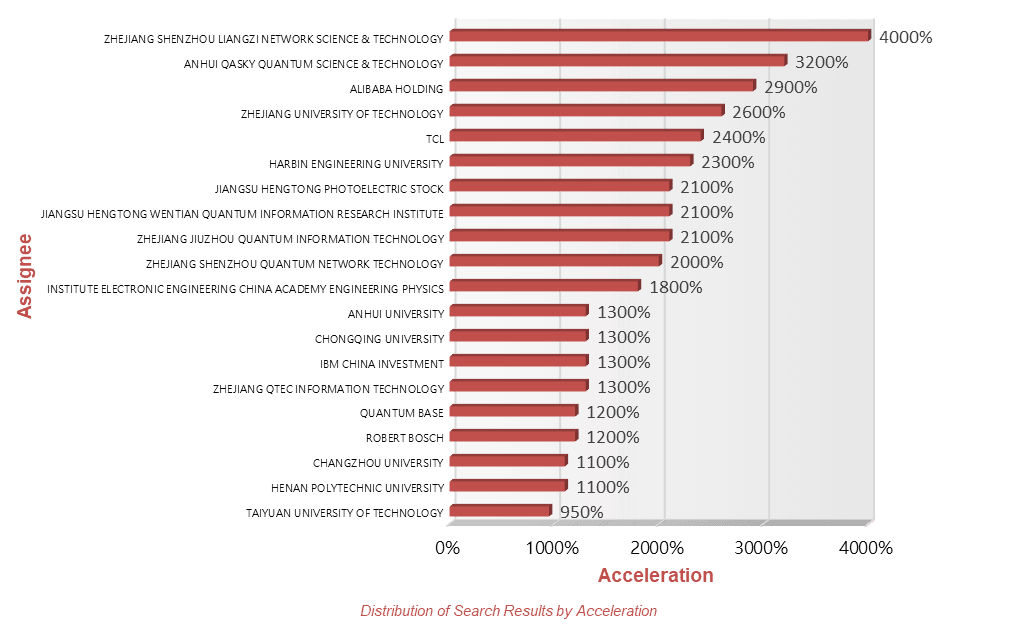
While the UK’s £270 million quantum technologies programme was among the first and largest globally, other counties are also committing a lot of money and energy to developing quantum technology. Following the passage of the National Quantum Initiative Act in summer 2018, the US plans to increase the size of its quantum technology programme significantly. The European Union’s “Quantum Manifesto”, which calls for a €1 billion investment in quantum technology, was launched in October 2018 as part of the EU’s Horizon 2020 research and innovation programme. China’s quantum technologies programme is well-advanced, with notable successes such as the Quantum Experiments at Space Scale (QUESS) satellite that test (and of course showcase) technologies developed by researchers there. In addition, Chinese companies and institutions are patenting aggressively (see figure). The governments of Canada, Australia and Japan have also invested in quantum technology programmes.
Who’s active in quantum patents? This acceleration chart shows the companies with the largest expansion in their quantum-related patent portfolios over the last five years. Chinese companies dominate intellectual property expansion, with a US company, IBM (in China), and a UK company, Quantum Base, also accelerating significantly.
Ultimately, however, the speed at which these quantum technology programmes translate into commercially successful enterprises will depend on solving practical business problems such as the scalability and cost of product manufacture. The easier an established technology business is able to adapt to a new quantum technology – by, for example, limiting disruption to its existing manufacturing principles and product portfolio – the quicker the uptake of that technology is likely to be. This seems to be reflected in today’s patent landscape (see heat map below), which is dominated by large technology companies that appear to be investing in quantum technologies that are, at face value, sympathetic to the company’s existing technology base.
Hot topics: This heat map shows the distribution of technology areas, by patent classification code, covered by the top 20 patent filers. Highest activity relates to quantum well lasers, with Fujitsu, Nichia, Panasonic, Sharp, Sony, Sumitomo and Toshiba featuring heavily in this area. Samsung, Canon, Sumitomo, Sharp and Sony feature heavily in nano-optics technology areas, with Canon also patenting in relation to vertical cavity lasers. Microsoft Technology Licensing, IBM and Hitachi focus more on quantum computers, with Toshiba and NEC patenting in relation to quantum key distribution.
For example, several giant Korean and Japanese electronics firms appear to be focusing on semiconductor-based quantum well lasers, quantum optics and QKD (see top figure and below). Similarly, computer and software giants such as Microsoft, Samsung and IBM have concentrated on quantum computers and quantum optics, potentially including various “enabling technologies” that make it possible to manipulate single photons for quantum-state control, entanglement and superposition.
Top patent filers: terrain map with top patent filers highlighted to show trends in technology focus. Most of these patent filers appear widespread among the technology areas. (Courtesy: Questel)
However, the patent landscape appears to be relatively sparse in several of the development areas targeted by the UK’s national programme. In particular, we have seen relatively low patent activity in fields related to atomic clocks, cold-atom technology, quantum optics or quantum processors as applied to neural networks. While the field of quantum computers shows a few hot-spots in terms of patent-filing activity, it, too, lags far behind areas like quantum-well lasers and other semiconductor-based quantum-confinement light sources, such as quantum dots.
Our conclusion, therefore, is that the UK’s quantum technology programme has identified gaps in the quantum technology marketplace that are not being filled by the existing big technology providers – or at least, not yet. Government funding, coupled with the academic freedom to pursue new and disruptive innovations, is surely key to accelerating developments in these fields. But will this translate into successful new industries and businesses in the UK? Anderson, of ColdQuanta, thinks it will. “I deeply applaud the UK government for realizing that quantum technology has a commercial advantage,” he says, adding that his company has developed a UK base for that reason. “Quantum is here to stay. Hype is present, but tools really are available to perform at the quantum limit. You must work at that limit to be competitive.”