Why gradually does it for maximizing strength

From bone to spider silk, examples of hierarchical structures conferring untold strength to materials abound in nature. While materials scientists have been quick to mimic the approach to enhance mechanical properties, why these structures improve strength is not always well understood. Now, through a series of systematic experiments and atomistic simulations of nanotwinned copper structures, researchers in China and the US have not only shown that gradient structures can increase the strength of these materials, but also reveal the mechanisms behind these enhanced mechanical properties. They believe that the work may allow a more informed approach to the application of gradient structures to strengthen other material systems.

This work provides insights into combining structural gradients at different length scales in order to push forward the strength limit of materials

Crystal twinning refers to the growth of separate crystals with shared lattice points, so that the energy of the interface is lower than a regular grain boundary between arbitrarily oriented crystals. Twin boundaries can affect the crystal’s mechanical properties by blocking dislocations – defects in the crystal lattice arrangement that can move through the crystal. The motion of the twin boundary itself can also alter the stress and strain behaviour of the material. As a result, twin boundaries play a key role in many metallurgical processes, including shock hardening, cold work and quenching.

Huajian Gao and Lei Lu and colleagues at the Institute of Metal Research and University of Science and Technology of China in Shenyang, China, and Brown University in the US, used electrodeposition to grow twinned copper samples with crystal widths and heights that gradually increase in size from 29 nm and 2.5 μm to 72 nm and 15.8 μm. While in isolation the twinned crystal component with the smaller grain sizes have greater yield strengths, the total gradient structure was even stronger at 481 ± 15 MPa – comparable with commonly used structural stainless steels. The researchers also noted higher work hardening rates for the gradient structures than the individual components.

Know your strengths

Copper is widely used as a building material so that studies revealing how to improve its strength have intrinsic value. However, Gao, Lu and colleagues were able to take their analysis further, explaining why increasing the structural gradient of twinned structures increases the material’s strength, opening the way for strategically engineering material properties using gradient structures.

Transmission electron microscopy analysis revealed bundles of concentrated dislocations in which the researchers identified two modes – one with a recognized role in controlling plastic deformation when the load is perpendicular to the twin boundary, while the other mode is prevalent in thin films, multilayered composites, and highly oriented nanotwinned structures. Atomistic simulations revealed that the way these two modes interact and move adds to the crystal’s strength. These bundles of concentrated dislocations are absent in twinned crystals without the gradient structure.

They conclude that “the gradient nanotwinned strengthening concept proposed in this work provides insights into combining structural gradients at different length scales in order to push forward the strength limit of materials and may be essential to creating the next generation of metals with both high strength and high ductility.”

Full details are reported in Science.

Hot new exhibition about the Sun and prospects for commercial fusion

In this episode of Physics World Weekly Hamish Johnston describes his visit to the opening of a major new exhibition at the Science Museum in London. The Sun: Living With Our Star – which runs until 6 May 2019 – is a treasure trove of objects that document humanity’s fascination with the Sun through the ages. You’ll hear from the lead curator Harry Cliff and the curator of infrastructure and built environment, Oliver Carpenter.

One of the objects at the exhibition is a prototype tokamak that has been loaned by the UK-based company Tokamak Energy. It illustrates the scientific and commercial efforts to create “mini Suns” here on Earth in the search for an energy supply based on nuclear fusion. Later in the podcast, Physics World’s James Dacey is in conversation with Melanie Windridge, a communications consultant with Tokamak Energy, who speaks about the prospects for commercially viable fusion. Windridge wrote an article for the October 2018 issue of Physics World about why fusion energy always seems to be 30 years away.

If you enjoy what you hear, then you can subscribe via the Apple podcast app or your chosen podcast host.

Redefining the kilogram: the November 2018 issue of Physics World is now out

Cover of the November 2018 issue of Physics World magazine

It’s hard to believe that the kilogram is still based on a lump of metal in a vault in Paris. But that all looks set to change this month at a meeting of scientists and policy-makers in Paris, where it should be redefined in terms of the Planck constant.

The imminent redefinition of the kilogram – and other SI units that are still based on physical phenomena artefacts – is the cover story of the November 2018 issue of Physics World magazine, which is now out in our digital apps for iOSAndroid and Web browsers.. We don’t want to be rude, but the cover shows an h, the symbol for the Planck constant, kicking the kilogram into touch.

The story’s been written by science writer Benjamin Skuse, who explains why the International Prototype Kilogram is set to get the boot this month as part of a wider overhaul of SI units. Elsewhere in the special issue, Helen Margolis from the UK’s National Physical Laboratory tells you all you need to know about optical clocks, while Stephen Ornes guides you through “smoots”, “garns” and other weird and wonderful units that usually go under the radar.

Plus there’s the usual great mix of reviews, careers and the ever-popular Lateral Thoughts page.

Remember that if you’re a member of the Institute of Physics, you can read the whole of Physics World magazine every month via our digital apps for iOSAndroid and Web browsers. Let us know what you think about the issue on TwitterFacebook or by e-mailing us at pwld@iop.org.

For the record, here’s a run-down of what’s in the issue.

• Celebrating a century of progressPhysics Uspekhi was set up 100 years ago to support the fledgling physics community in the Soviet Union. A century later, the journal’s current editor-in-chief Valery Rubakov talks to Matin Durrani about the future of Russian physics

• Expanding the skills base – Five years after the creation of a multi-institution graduate school for physics PhD students, Peter McDonald and James West outline the lessons learned

• New views on unitsRobert P Crease explains why philosophers are fascinated by the redefinition of SI units

The thing about thingsJames McKenzie explores how physics and physicists can turn the hype about the Internet of Things into reality

• A brief history of timekeeping – From sticks in the ground to caesium atomic clocks, humans have been keeping track of time with increasing accuracy for millennia. Helen Margolis looks at how we reached our current definition of the second, and where clock technology is going next

• An upcoming change to SI units – due to be officially approved this month – will mark the end of a long journey from defining quantities in terms of objects to using precise, unchanging and universal constants of nature. Benjamin Skuse tells the story

• It’s all smoots and garns – SI units are a scientist’s best friend, but there are also some unusual scales of measurement available. Stephen Ornes looks at the stories behind some of the world’s more weird and wonderful units

• Here comes the SunHamish Johnnston reviews The Sun: Living With Our Star at the Science Museum, London

• Hawking’s manifesto for scienceMatin Durrani reviews Brief Answers to the Big Questions by Stephen Hawking

•  Computing memories – Margaret Harris reviews The Cryotron Files: the Strange Death of a Pioneering Cold War Computer Scientist by  Iain Dey and Douglas Buck

• Skills for start-ups – Entrepreneur and physicist-for hire Volker Türck reveals histips and tricks for setting up a successful business

• Once a physicist – meet Anand Kamalakar, a Brooklyn-based documentary film director, producer and editor whose work includes Salam – The First ****** Nobel Laureate

Physics and art in 2½DSidney Perkowitz on a new kind of art-form

3D acoustic crystals go topological

Researchers at Nanjing University in China have succeeded in fabricating the first 3D pseudospin-valley coupled acoustic topological insulator. The structure is made up of layers of acoustic topological pseudospin-valley coupled “saddle” surface states that greatly reduce backscattering of sound waves – something that could be useful for making sound filters and sensor devices. The work could also help advance the emerging field of acoustic pseudospintronics.

Sound scatters from most material surfaces and creates echoes that can not only be distracting to listeners but also reduce the efficiency of devices like sound filters and hearing aids. The new 3D topological acoustic crystals made by a team led by Ming-Hui Lu and Yan-Feng Chen could help overcome this problem by transmitting sound in certain directions without much backscattering.

Acoustic version of a topological insulator

Topological insulators are materials that are electrical insulators in the bulk but can conduct electricity on their surface via special surface electronic edge states in which electrons cannot backscatter for topological reasons. Researchers have recently started to look at making an acoustic version of a topological insulator from a phononic (or sonic) crystal – the acoustic equivalent of a photonic crystal.

Just as the periodic variation of the refractive index in a photonic crystal means that only certain wavelengths of light are able to pass through it, a periodic variation in the acoustic properties of a phononic crystal means that only phonons with frequencies outside the phononic band gap can propagate. Such crystals are made by embedding cylinders of one material in a different background medium, with the properties of the phononic band gap depending on the size and periodicity of the cylinders. Sound waves travel on the surface of these crystals but not through their bulk.

Lu and colleagues’ new 3D phononic topological crystals are made of stacked double-layer honeycomb lattices containing two kinds of phononic “atoms” in each layer. Each of these atoms is created from a triangular prism resonant cavity with five interconnecting tubes.

Saddle surface states

The researchers constructed a four-fold degenerate point in the band structure of the stacked layers by first splitting them into two two-fold degenerate layers. They then used certain phonon states (the Bloch states) present in the energy bands to couple the pseudospins on the atoms in the structure. “Our crystal has a screw symmetry and its band structure can be changed so that it goes from being a 2D topological insulator to a 3D one by rotating it and then stacking it in different directions (see above image),” says study lead author Cheng He.

“The way the 2D surface states disperse resembles a saddle shape and, in our work, we construct the surface states using two opposite saddle surfaces.”

Calculations and experiments by the researchers reveal that sound waves at frequencies between 18 to 22 kHz move easily across any defects, disorders and bends on the lattice and do not backscatter very much. This is analogous to the behaviour of electric conductivity on the surface of a topological insulator.

Opposite pseudospins propagate in opposite directions

“The most important property of such acoustic surface states is their robustness to backscattering from bends and defects,” says He. “By studying the acoustic pseudospin-momentum dependent propagating behaviour in the crystal lattice, we found that this behaviour comes from the fact that opposite pseudospins propagate in opposite directions.”

The researchers, reporting their work in Nature Communications 10.1038/s41467-018-07030-2, say that reduced sound wave backscattering in these 2D surface states might be used to make improved sound filter and sensor devices, such hearing aids that channel sound more efficiently through the ear canal. They might also be used to study acoustic pseudospintronics, which resembles spintronics except that it exploits pseudopsins on phonons (created artificially by changing the lattice symmetry in a phononic crystal) rather than (intrinsic) electronic spins. “Indeed, we plan to use acoustic pseudospins to design prototype devices,” He tells Physics World.


Quark deconfinement drives supernovae in blue supergiant stars, say astrophysicists

The conversion of neutrons and other baryons to a quark-gluon plasma in blue supergiant stars could lead to supernovae explosions. That is the conclusion of David Blaschke of the University of Wroclaw and an international team of astrophysicists, who have calculated that such events could be observed via the distinct neutrino signals that they emit.

At the ends of their lives, blue supergiant stars, which can be over 50 times the mass of the Sun, may collapse to form remnants partly comprising a sea of free quarks and gluons. These events, which would emit two powerful neutrino pulses in rapid succession, could help to explain how such stars can undergo supernovae, when some conventional models suggest they should just form black holes.

When stars heavier than about nine solar masses have exhausted all the hydrogen in their cores, they continue fusing helium into carbon and oxygen. They then fuse a series of ever heavier elements, ending with the fusion of silicon into nickel, which decays to iron. At this point, the process stalls because no energy can be obtained by fusing iron nuclei. When the mass of the inert iron core exceeds the Chandrasekhar limit of 1.44 solar masses, it can no longer support itself against its own gravity. The nuclei are therefore crushed and a flood of neutrinos are emitted in a few milliseconds, heating the outer layers and until they are blown away in a giant supernova explosion.

What happens next is less predictable. The remnants of stars just above the nine-solar-mass limit form neutron stars. In stars above about 70 solar masses, however, this neutrino heating mechanism is not efficient enough to cause a sufficiently-strong explosion for the outer layers to escape the gravitational potential well of the core. The ejected material therefore falls back in and a black hole is formed. In between these limits, however, the details are unclear.

Quark-gluon plasma

In 2009, Irina Sagert of Goethe University in Frankfurt, Germany and colleagues suggested that, if the material ejected by the neutrino heating mechanism collapsed back onto the core, the rise in density could cause the baryons (mainly neutrons) at the centre of the core to be crushed. As the strong nuclear force becomes weaker at shorter distances, the quarks that make up the baryons would no longer be bound into individual baryons. Instead quarks would move around freely in a quark-gluon plasma.

The energy released by such a phase transition could re-ignite as a supernova, blowing off the outer layers and producing a neutron star stable against further collapse.  However, the equation of state for the quark-gluon plasma used in the 2009 study predicted neutron stars heavier than about 1.6 solar masses should collapse into black holes. “Since then, one has observed two neutron stars with about 2 solar masses,” says nuclear astrophysicist Friedrich Thielemann of the University of Basel in Switzerland, one of Sagert’s collaborators, “That means this equation of state was not correct.”

Armed with a more sophisticated model of the quark-gluon plasma and greater computing power, researchers have now produced a more detailed model of a two-stage supernova in a star of 50 solar masses. Having initially undergone core collapse, it undergoes a phase transition into a proto-neutron star, producing a strong pulse of neutrinos. Within a few hundred milliseconds, it has expanded tenfold and begun to collapse again.

Shock front

As the shock front propagates inwards, the pressure rises at its centre, and almost immediately the centre begins to undergo a second phase transition to a quark-gluon plasma. This releases more energy and triggers a second, more powerful shock front propagating outwards. This stops the inward-propagating rebound from the first shock at a radius of 80 km just 1.2 s after the initial blast. The supernova then expands to several thousand kilometres in radius within a few milliseconds. The remnant is a neutron star of about two solar masses with a quark-gluon plasma core.

The optical signals produced by such supernovae could vary widely, say the researchers. However, such events would give one unambiguous signal: “From the first shock we have a neutrino signal and then, from the conversion to quark matter, we have an antineutrino signal,” explains team member Blaschke. Modern neutrino detectors such as Super-Kamiokande in Japan have millisecond time resolution. Therefore, if such a supernova occurred in our galaxy, the presence of two sharp signals barely a second apart – one of neutrinos and one of antineutrinos – should be detectable. “Any signals from extra-galactic events would be diluted so much that they are not detectable,” says Blaschke. The researchers are also investigating the potential to find evidence of quark matter in the gravitational wave signals from neutron star mergers.

Thielemann is cautiously impressed: “It’s a very nice prediction and it’s a possible scenario,” he says. “The equation of state is a little bit tuned to make this possible, but it’s within the uncertainties of present day experiments. One has to wait to see whether one can see such a supernova explosion with two neutrino bursts.”

The research is published in Nature Astronomy.

Here comes the Sun

The Sun exhibition entrance

As winter approaches here in the UK, the dark and dreary days are a reminder of how important the Sun is to our daily lives. Fortunately, there is a bright spot at the Science Museum in London, which has just launched an exhibition called The Sun: Living With Our Star. The exhibition runs until 6 May 2019 and is a treasure trove of objects that document humanity’s fascination with the Sun through the ages.

The oldest object I spotted in the exhibition was a Babylonian cuneiform from about 750 BC that refers to sunspots – possibly observed by looking at the Sun through fog or clouds. Sunspots were not a good omen to Babylonian astronomers, who interpreted them as a sign of famine. What is clear from the exhibition is that people have obsessed over sunspots for millennia. Another stand-out object on show is a large painting of a group of sunspots done in 1864 by the Scottish amateur astronomer and industrialist James Nasmyth. The painting captures in exquisite detail the solar granules, which are created by convection currents of plasma – to me, they resemble squirming maggots. Also on display are photographs of the Sun and its spots taken in 1870 at Kew Observatory by Elizabeth Beckley, who was one of the first female employees of an astronomical observatory.

Babylonian tablet

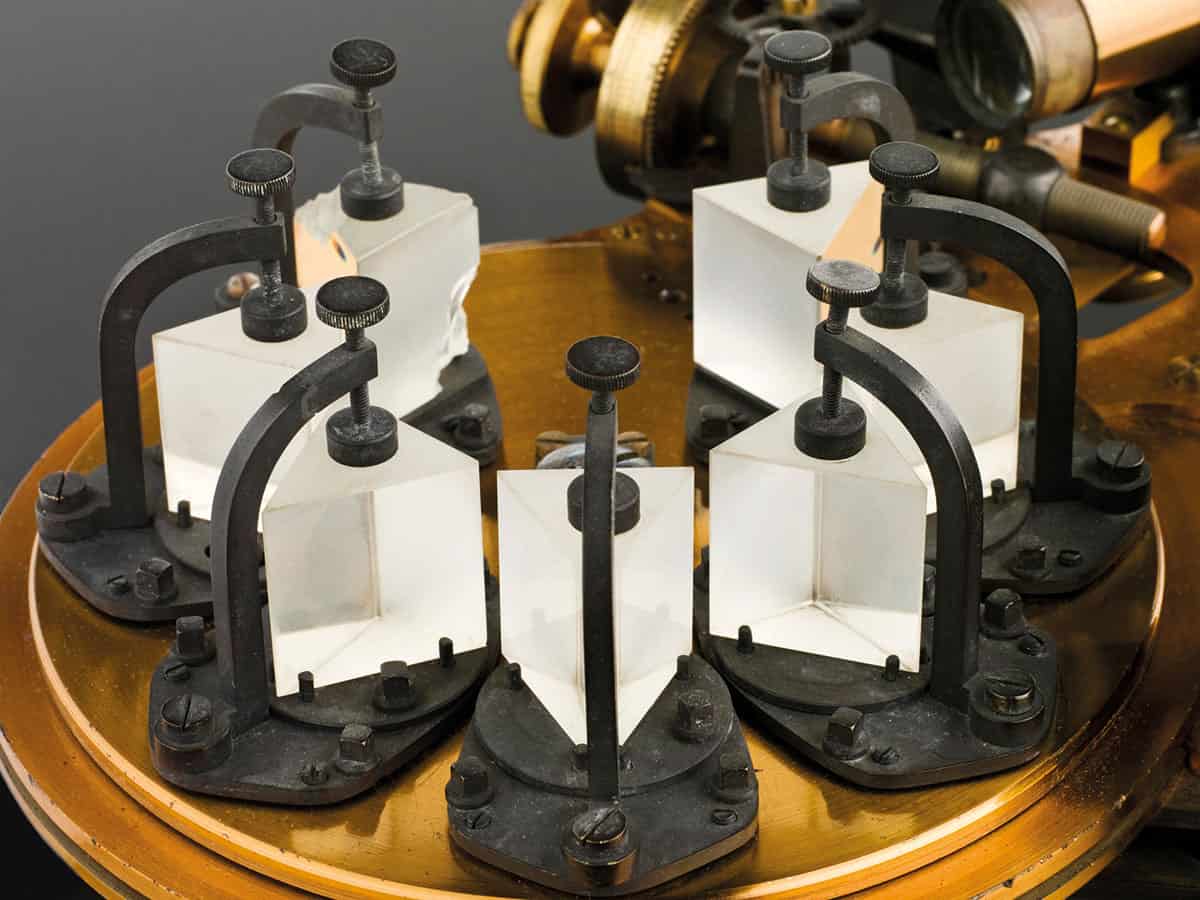
The Sun exhibitionBy coincidence, the Science Museum is next door to the Royal College of Science (now part of Imperial College London), which was home to the solar observatory where, in 1868, Norman Lockyer spotted a spectral line in sunlight that had never been seen before. He named it helium after Helios, the Greek god of the Sun. Featured in The Sun exhibition is the spectrograph that Lockyer used to discover helium – a beautiful wood and brass object with seven glass prisms arranged in a circle.

Fast forward to the 21st century and you will find two instruments that will be used on the European Space Agency’s Solar Orbiter. These are a magnetometer, which will measure the magnetic field carried by the solar wind as it rushes past the spacecraft; as well as an electron analyser, which will measure the flux of electrons within the solar wind. Like Lockyer’s spectrograph, the electron analyser is a lovely coppery colour and both modern instruments have the same high degree of craftmanship as the 19th-century instrument.

The Sun exhibition

Possibly the largest and surely the most hubristic object in the exhibition is a prototype tokamak that illustrates the scientific and commercial efforts to create “mini Suns” here on Earth. On loan from UK-based company Tokamak Energy, this device sustained a hot plasma for 29 hours in 2015. Those developing tokamaks and related technologies have a noble goal of generating clean energy via sustained nuclear fusion. However, a poignant reminder of the challenges they face can be found in the exhibition, where a model of the UK’s Zeta experiment is on display. Zeta gained notoriety in 1958 when its scientists announced that they had achieved fusion. On display are newspaper stories saying that fusion reactors could soon provide the energy equivalent of 10 tons of coal for just two shillings – which at the time would buy a loaf or two of bread.

If you cannot get to London for the exhibition, its chief curator Harry Cliff has written a book with Katy Barrett, who is curator of art collections at the Science Museum. It is called The Sun: One Thousand Years of Scientific Imagery and is published by Scala Arts & Heritage Publishers (£20/$28 120pp). Cliff and the Science Museum curator Oliver Carpenter are featured in the Physics World Weekly podcast.

  • The Sun: Living With Our Star; Science Museum, London; Open until 6 May 2019


Micellar platform provides cell-specific drug delivery

There is currently great interest in creating efficient cell-targeted drug delivery systems that can provide an alternative to existing treatments such as chemotherapy. Promising emerging options include peptide amphiphiles, which are lipid-conjugated peptides that form spherical hydrophobic structures called peptide amphiphile micelles (PAMs). Due to the hydrophilic surface and hydrophobic core, these structures can easily be loaded with a variety of small molecule drugs. In addition, they can be efficiently used to accomplish cell-specific delivery.

Given the desirable modularity of this system, Bret Ulery and his team at the University of Missouri have combined peptide amphiphiles with antitail amphiphiles, lipid-conjugated DNA fragments, to yield novel biomaterials. These combination micelles can be readily fused, or annealed, with an aptamer, a DNA sequence with highly specific molecular targeting, which can be used to preferentially associate with desired cell populations. The resulting micellar platform, termed Aptamer~A/PAM, has been recently shown capable of differentially targeting leukaemia cells (Physical Biology 10.1088/1478-3975/aadb68).

Production schematic

Stable and specific micelles

After fabricating micelles, the researchers demonstrated that they were sufficiently stable in various biological fluids and small enough to be taken up and processed by the cells. Such stability and internalization capacity enables this new device to target a very specific group of cells and then disassemble and release the desired drug to them. This supports their potential utility as a clinical drug delivery system.

The team also provided evidence that micelles specifically interacted with NALM6 cells, a leukaemic cell line. First, the researchers observed that the micelles effectively targeted this cell line. Then, when they introduced a minimal modification in the aptamer, the research team observed that micelle binding to the cells decreased dramatically. Moreover, after testing another similar cell line (LM138) as a negative control, the researchers observed no specific association of their Aptamer~A/PAMs. All of these experiments showed the specificity of their new biomolecular material.

Great potential

The successful synthesis and desirable properties of the engineered technology support the potential of the Aptamer~A/PAM system to serve as an alternative approach for drug delivery. The cell specificity of this system could overcome the drawbacks of leukaemia treatments such as chemotherapy by limiting damage to non-target cells. Moreover, this technology is not limited to this specific cancer, since micelles can be customized for other clinical applications by employing other bioactive peptides and different aptamers.

Although this study shows promising results and represents an important advancement in PAM drug delivery, further work will reveal the full potential of the Aptamer~A/PAM technology. Future studies carried out by Ulery and his team will focus on better understanding the interaction of cells with the platform and its performance in vivo.

Getting engaged: what encourages the public to marry up with environmental research?

To paraphrase Alison Robinson of the UK’s Natural Environment Research Council (NERC), the Engaging Environments programme plans to take public engagement away from the penguins, volcanoes, earthquakes and dinosaurs that her six year-old son likes and instead communicate about the issues that people have conversations about. Robinson was speaking at the programme’s symposium in Bristol to mark its funding of six projects over the last year.

Listening to people was a key theme, with Carl Stevenson of the University of Birmingham, UK, detailing Encompass, which has worked with community organizing charity Citizens UK to find out what people want to know and whether environmental science can be an asset to them, rather than trying to promote this science to people whether they’re interested or not.

To most people numbers don’t speak, they’re a barrier

Pierrette Thomet

Encompass employs “brokerage”, bringing researchers and people together. People are often interested in the hyper-local, such as rubbish in the street, and it’s important to match up their self-interest with environmental research, Stevenson’s colleague Caroline Gillett told Environment and Energy at Physics World. Litter picks, for example, can reveal how much we’re throwing away and lead to conversations about recycling and pollution. Concerns about traffic or speeding, meanwhile, can segue into research about air quality and atmospheric science, and landscape-planting projects could bring in experts to talk about biodiversity.

Art of engagement

Rather than bringing artists and scientists together to collaborate, the Climate Stories project aimed to teach scientists to find their own artistic voice and think about how to communicate their research in other ways. “To most people numbers don’t speak, they’re a barrier,” said musician and artist Pierrette Thomet, so using a story, a picture or a poem may work better. Thomet explained that the defined structure of a poem puts a personal experience into a framework that others can tap into; art can enable a connection point with another person. Science, on the other hand, can’t as it’s so precise.

As part of Climate Stories, 20 scientists in the Exeter area took part in a three-day workshop with a singer songwriter, printmaker, writing tutor and theatre professional. This allowed the researchers to “think about their work in new terms” and “through others’ eyes”, according to Thomet. “Science is telling stories, so is the arts,” she said. Following the workshops, not only did scientists change their approach, with one colleague including a poem in a presentation to DEFRA, but the arts coordinators changed their practice too, with some visiting the Met Office archives to inspire their work.

Climate Stories principal investigator Peter Stott of the UK Met Office and University of Exeter co-led a writing workshop at Exeter’s Royal Albert Memorial Museum. Members of the public looked at Arctic objects whilst Stott talked about climate science, and Sally Flint led a writing workshop. Other workshops took place at Sidmouth Amateur Dramatic Society Youth Group and Farms for City Children. Stott and Thomet see the Climate Stories project as a blueprint for extension to other disciplines.

Words were also important to the Future of Our Seas, which, as Ian Rowlands of Incredible Oceans explained, helped scientists in Oban and Plymouth find a shared language and make their work relevant to people’s lives, then set them loose on the public at the Plymouth Pirate Days Weekend and West Highland Yachting Week. One result, available at the symposium, was Sounds West Coast, a collection of seaweeds in petri dishes that, when you waved your hand over them, played different sounds; this demonstrated how noise pollution in the oceans makes it hard for animals to go about their daily lives. In the panel discussion at the end of the day, Rowlands’ words were strong: “we’re all in a car about to go off a cliff and we’re arguing about who should relay the message”.

Participate, participate

Opening Up Science for All saw Hilary Geoghegan of the University of Reading, UK, and colleagues investigate how to bring environmental science and the public together and initiate participatory public engagement. UCL has developed a MOOC on citizen science, Geoghegan told delegates, and charity Earthwatch has training materials too, whilst The European Association of Citizen Science is now sharing best practice. Involvement levels vary — they peak when the public co-creates and designs the experiments, Geoghegan explained.

Harriett Richardson of the UK’s National Centre for Atmospheric Science, meanwhile, detailed how the Climate Communication Project has examined public engagement with climate change in the UK, investigating what works best, and engaging with community groups in order to build up a resource for all.

Playing devil’s advocate in the symposium’s Provocation session, Savita Wilmott of The Natural History Consortium said she thought that business was a key part missing from engagement projects, with organisations often bringing business in at the end and asking for money.

In the ensuing discussion, delegates suggested that “we can join other people’s conversations, not have them join ours” and cited Sport England as doing a good job at looking not at who’s missing, but who feels able to walk through the door.

The sixth project under the Engaging Environments umbrella is a little different – it’s the glue that brings all the other projects together, according to Sophie Duncan of the National Co-ordinating Centre for Public Engagement (NCCPE). In the wrap-up session, Duncan called for more interdisciplinary training so that groups can work better together, whether that’s politicians, big business, researchers, charities or activists. “I’m hoping we won’t go off the cliff, we’ll find a roadmap,” Duncan added. “We won’t do that by sitting in separate rooms saying we need to find a common language.”

So, what’s next? Putting its money where its mouth is, NERC plans to invest £1.3 m over the next three years in a single project to engage the UK public with contemporary issues in environmental science. What that project is remains to be seen.

New evidence reveals ancient collision of the Milky Way

The halo of the Milky Way mainly comprises the remnants of a pre-formed structure of stars that merged into our galaxy about 10 billion years ago, researchers in France and the Netherlands have concluded. The researchers studied new data from ESA’s Gaia Space Observatory alongside spectral information from the Sloan Digital Sky Survey, and they concluded that stars from the object, which they have termed Gaia-Enceladus, are chemically and kinematically distinct from other stars that formed from dust and gas in our galaxy.

The Milky Way is a spiral galaxy comprising a disc, with a bulge at its centre, that rotates roughly in step. “The Sun and the vast majority of the stars in the galaxy tend to move in orderly, circular orbits around the centre,” explains astronomer Amina Helmi of the University of Groningen in the Netherlands, who led the new research: “The way you get stars on these orbits is to form them from gas clouds in the Milky Way itself.”

Surrounding this disc, however, is a more diffuse halo of stars with more random orbits. “From models, we knew that if galaxies had experienced mergers, then most of the stars from the object that merged would be in the halo,” explains Helmi. “But the big questions included how many stars in the Milky Way’s halo came from galaxies that merged with ours and what kinds of galaxies these were.”

The Gaia Space Observatory, run by ESA, is methodically cataloguing light sources in the night sky. Within the Milky Way, its telescopes can often resolve individual stars. The first data was released in September 2016, revealing information about the magnitude, position and motion of over 2 million stars. Incredibly, the second data release, in April 2018, increased this figure to about 1.3 billion. “That has allowed us to address so many interesting questions, and in particular to figure out how the Milky Way was assembled,” says Helmi.

The researchers looked at the orbits of individual stars in the halo. They noticed that, although they were far less regular than the orbits of stars in the disc, many of them were dynamically correlated, orbiting backwards relative to the rest of the galaxy. This implied they had come from the same source. The researchers then cross-referenced the Gaia data on the stars’ orbits with data from APOGEE-2 (Apache Point Observatory Galactic Evolution Experiment), part of the Sloan Digital Sky Survey, which had captured the spectra of the light from a sample of the stars.

From analysing their emission spectra, the researchers dicovered large variations in the elemental compositions of the dynamically correlated stars. There are, however, correlations between the abundances of specific elements that indicate the stars had formed in the same environment. “You can see chemical composition as a way of labelling a star’s place of formation,” explains Helmi. These differences between the stars’ compositions implied that they had formed at different times and were therefore at different stages in their stellar evolution.

Detailed analysis led the researchers to conclude that the stars ranged between 10 and 13 billion years in age. This implies, say the researchers, that Gaia-Enceladus formed about 13 billion years ago and formed stars continuously until about 10 billion years ago – when it collided with and merged into the Milky Way. At this point, simulations suggest the gas and dust would have been drawn out of the galaxy, preventing any further star formation: “As soon as you lose the gas you lose the fuel for forming new stars,” explains Helmi, “so the last stars to be formed in a galaxy give you a time stamp for when that galaxy was accreted.”

The researchers estimate that, at the time of accretion, Gaia-Enceladus was about 25% of the size of the Milky Way. This leaves little room in the halo for stars from other sources. “It was a big surprise to find that the vast majority of the stars in the halo today actually come from a single object,” says Helmi. The researchers suggest the energy from the collision may explain the high velocity of some stars in the disk.

Poul Erik Nissen of Aarhus University in Denmark describes the research as “important”. In 2010, he and a colleague noted the distinctive chemical features of many halo stars. “The present paper confirms the existence of such stars in the inner Galactic halo and finds evidence that they are due to the encounter of a single massive dwarf galaxy with the Milky Way,” he says. He is more circumspect about the researchers’ links between the merger and high velocity stars in the disk, saying that “further studies” are needed.

The research is published in Nature.

Try the Physics World dark-matter flowchart: what kind do you prefer?

Dark matter is the name given to the mysterious stuff that makes up some 27% of the universe. This flowchart, composed by former Physics World feature editor Louise Mayor in 2014, guides you through the many options for what it could be. (Click to enlarge or open in a new tab and zoom in for the full detail.)

Physics World flowchart outlining the possible options for dark matter

It’s just for fun, but our flowchart will help guide you through the maze of possible options for this stuff, be it familiar stuff like massive compact halo objects (MaCHOs) or non-baryonic matter like neutrinos, WIMPS, gravitions, sterile neutrinos or maybe even axions or something to do with supersymmetry. Or perhaps you’d just rather modify our theories of gravity instead.

The flowchart was originally published in the July 2014 special issue of Physics World on the dark universe, one of the features in which was “Theories of dark side” by physicist Jeff Forshaw. Enjoy the flowchart!

Copyright © 2026 by IOP Publishing Ltd and individual contributors