Stereotactic body radiation therapy (SBRT), which delivers an ablative radiation dose in a few fractions, provides a potent treatment option for patients with liver metastases. To minimize normal tissue damage, SBRT requires highly conformal dose delivery, making it essential to compensate for respiration-induced liver motion.
One option is to perform treatment planning and patient positioning based on the mid-position CT, which represents the time-averaged tumour position, and then add margins to account for uncertainties. This approach, however, relies on a stable mid-position. Any baseline drifts during radiation delivery will change this mid-position with respect to the treatment beam.
Researchers from the Netherlands Cancer Institute (NKI) propose to compensate for such baseline drifts by continuously adjusting the beam aperture according to the motion of the tumour mid-position — a technique called tumour trailing. They investigated whether the use of tumour trailing on the Elekta Unity MR-Linac could provide superior target coverage to non-adapted treatments (Int. J. Radiat. Oncol. Biol. Phys. 10.1016/j.ijrobp.2018.09.011).
The MR-Linac provides real-time monitoring of intra-fractional tumour motion using cine-MRI. “This ability to monitor the tumour is a crucial enabler for trailing,” explains first author Martin Fast. “By addressing the systematic baseline motion, tumour trailing ideally complements mid-position-based treatments or gating approaches that excel at mitigating periodic motion.”
Fast notes that the NKI began clinical treatments on its MR-Linac last month. “While we started with prostate and rectal cancer, we are actively preparing to roll-out MR-Linac treatments for oligometastatic liver patients,” he says.
Treatment simulations
Fast and colleagues began by simulating tumour trailing delivery of liver SBRT, for 17 patients with oligometastatic liver disease previously treated on a conventional linac. They replanned all cases for MR-Linac delivery and simulated treatments in silico using a dedicated machine emulator. Tumour trailing was performed by adjusting the segment apertures according to the averaged tumour position (measured using cine-MRI) over the preceding three respiratory cycles.
The researchers chose to average position measurements from three cycles to balance the trailing lag against accuracy. They determined that imaging the tumour at a frequency of 1 Hz was sufficient to combat motion detection uncertainties: for a respiratory period of 4 s, the effective trailing lag was 6.5 s and the resulting beam-to-mid-position misalignment (for drifts of up to 10 mm) was less than 1 mm.
The simulations modelled respiratory motion as a superposition of periodic motion (with a patient-specific amplitude) and one of five baseline motion scenarios: no drift; continuous linear drift; a single baseline shift halfway through treatment; periodic drift; and MRI-measured baseline drift from three volunteers. The researchers simulated scenarios with and without tumour trailing, and calculated the resulting dose distributions.
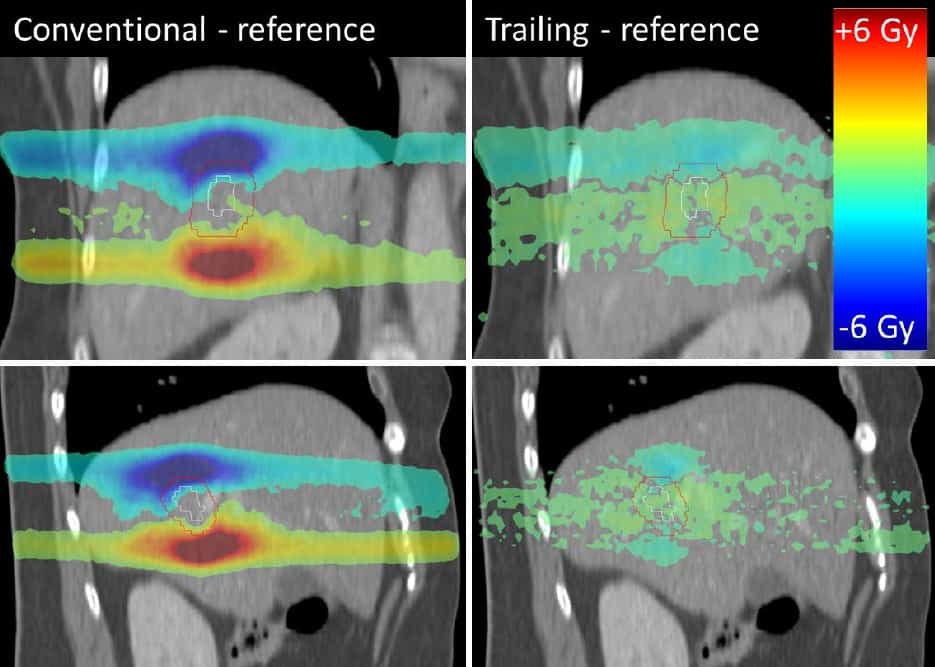
Results showed that tumour trailing on the MR-Linac mitigated the dosimetric impact of baseline motion. For the median GTV D98% (dose received by 98% of the gross tumour volume), for example, trailing led to dose increases of 1.9 Gy (linear drift), 1.2 Gy (single shift), 0.7 Gy (periodic drift), and 1.5, 0.8 and 0.5 Gy (for the three measured drifts) per fraction compared with conventional delivery.
Comparisons with the reference no-drift scenario revealed that tumour trailing restored the dose distributions to those achieved without baseline motion. With trailing, the median residual dose deviations were no greater than 0.7 Gy per fraction.
Experimental validation
To validate tumour trailing on the MR-Linac experimentally, the researchers used a programmable motion phantom to perform continuous periodic motion (4 s period, 15 mm peak-to-peak CC amplitude) along with a linear drift. The phantom insert contained a spherical target and two layers of Gafchromic EBT3 film. They delivered the treatments established in the in silico study to the phantom, and used gamma tests to compare films irradiated using conventional or trailing delivery with films irradiated in the reference scenario.
The phantom experiment confirmed the predicted dosimetric gains. Compared with conventional delivery, tumour trailing increased the local gamma pass rate from 40±3% to 82±19% (3%/1 mm), 49±3% to 98±3% (3%/2 mm) and 58±4% to 99±1% (3%/3 mm).
The authors concluded that tumour trailing offers a robust way to compensate for baseline motion during MR-Linac treatments, without increasing delivery time. “Deploying tumour trailing clinically is on our roadmap for 2019,” Fast tells Physics World. “Prior to the clinical introduction, several technical and logistical hurdles such as implementing effective online quality assurance procedures need to be overcome.”
Wet seasons in the Amazon are getting wetter, according to satellite images and observations on the ground. Rainfall increased by at least 180 mm from 1979 to 2015, but what’s driving this long-term trend?
Researchers in China and Brazil found that more than half this change could be due to warming of the tropical Atlantic. Establishing such links is crucial so scientists can better advise on how to safeguard major environmental assets. The Amazon rainforest is a significant sink of carbon dioxide and long-term changes in precipitation could compromise this.
“As rainfall increases during the wet season, photosynthesis is weakened and the growth rate of rainforest plants may slow,” writes the team in Environmental Research Letters (ERL). “These processes affect the energy exchange and the carbon cycle, and beyond that, the precipitation changes could lead to habitat loss and may even result in species extinction.”
The researchers’ atmospheric simulations suggest that variability in sea surface temperatures dramatically increases the convergence of moisture transport over the Amazon region.
The group tested the idea using a single climate model and is keen to clarify the processes taking place in more detail.
Zhu has followed how oceans have warmed in previous decades. “Because warming oceans will have impacts on land, it is a natural next step to consider important ecological regions such as the Amazon rainforest,” he says.
The rainforest provides around 20% of the Earth’s freshwater discharge and the Amazon basin is an important convective centre, serving as a global source of heat and moisture.
To determine the full picture for Amazon rainfall, Zhu and his colleagues point to a range of mechanisms. Scientists have shown previously that precipitation here is associated with the South American monsoon system. Studies also note the influence of the El Niño Southern Oscillation, which enhances precipitation in east-central South America and decreases equatorial precipitation during the wet season.
Statues at the entrance of the Quantum Flagship kick-off event in Vienna’s Hofburg palace.
Members of the European quantum science community gathered in Vienna today to kick off a 10-year, €1bn European Commission (EC) initiative that aims to position Europe at the forefront of the emerging quantum technologies industry.
Speaking in a glittering hall within the former palace of Austria’s Hapsburg emperors, Gustav Kalbe, head of the EC’s High Performance Computing and Quantum Computing Unit, explained that the “core idea” of the new Quantum Flagship is to take scientific results out of university labs, bring them to fruition and build an industry around them. “There are still many scientific challenges to be solved, but we are now at the point where we can begin giving the taxpayer a return on their investment,” Kalbe said. The flagship’s many industrial partners, he added, are “no longer following by the sidelines” but making active contributions.
The projects chosen for the flagship’s initial, €132m phase, which runs through September 2021, reflect this emphasis on applied science. Although basic-science proposals made up almost two-thirds of the 140 submissions to the flagship’s steering committee, 12 out of the 20 accepted projects focus on applied research – a strategy that several audience members called into question during a lively open-floor debate.
In response, physicist Jürgen Mlynek, who chaired the committee, pointed out that the flagship was specifically designed to build links between academia and the private sector. “In the US, companies like Google and Microsoft are putting hundreds of millions of dollars into this field, mostly in quantum computing, and nobody cares if they burn $100m or $200m – they are sitting on piles of cash,” he said. “I don’t see a company in Europe that is willing to put hundreds of millions of euros into quantum technologies, so we have to do things differently…Our goal is to contribute to jobs and wealth creation in Europe.”
More ambitiously, Mlynek explained, the flagship hopes to create a pan-European secure quantum network, build the world’s first advanced quantum computer, and develop quantum technologies that can support drug design, navigation for autonomous driving and ultrasensitive diagnostics in healthcare.
During the kick-off, co-ordinators of funded projects within each of the four “pillars” of the flagship – quantum communication, computing, simulation and metrology/sensing – outlined how they will work together. The quantum communication pillar, for example, includes efforts to develop quantum repeaters, which are needed to transmit qubits over long distances. It will also define industry standards and certification mechanisms for quantum random number generators. Stephanie Wehner, a physicist at Delft University of Technology in the Netherlands and co-ordinator of the Quantum Internet Alliance project, notes that several of these technologies will be useful for quantum computing as well as communications.
Further details of the flagship are available at https://qt.eu.
Being able to manipulate and monitor single electrons in predesigned atomically-defined structures has been a long-standing goal for condensed matter physicists. A team led by Robert Wolkow of the University of Alberta in Edmonton, Canada, has now succeeded in doing just this. As well as being useful for fundamental studies, such designer lattices could also be used to make atomic circuits in the future.
“We are now able to play with single charges (electrons) in atomically-defined structures of our own design for the first time,” explains team member Mohammad Rashidi, who is also at the Nanotechnology Research Centre and Quantum Silicon, both in Edmonton. “Previously, this had only been done on isolated atoms and molecules on insulating substrates. In our work, we can place atoms at will and compose structures of dangling bonds on a hydrogen-terminated silicon surface. We can then follow how electrons ‘jump’ between the atoms in the artificial atom structures.
“We create and erase the dangling bonds (which are silicon atoms missing a hydrogen atom to bond to, unlike their closest neighbours) with atomic precision using the scanning tip of an atomic force microscope (AFM),” he says. “This technique allows us to design specific arrangements of dangling bonds with precisely tuned interactions between them and allows for a huge range of possibilities for targeted experiments in engineered designer structures beyond those that chemists can synthesize.”
AFM tip mechanically lifts a silicon atom
AFM is a widely-used ultrahigh-resolution technique that allows researchers to observe extremely small objects, even down to single atoms. It works by sensing the topography of a sample as it scans across it thanks to an extremely sharp tip mounted on a resonating cantilever.
The Edmonton researchers have used the AFM for something other than just imaging. As well as creating and erasing dangling bonds in artificial atomic structures, they have also used it to mechanically lift silicon atoms in the structures. This process, which makes the silicon atoms want to become negatively charged, is quite different to conventional techniques that use the bias voltage on the tip to electrically control the charge state of individual atoms.
AFM tip can “see” which atoms have one extra electron
“When the tip interacts with the atoms on the material’s surface, the resonance frequency of the tip shifts and you can use this frequency shift signal to map out the interactions between the tip and the material surface,” explains team member Thomas Dienel. “In our experiments, we exploited the atomic precision of the AFM to image a structure containing several silicon atoms and unambiguously say which ones have one extra electron and are thus negatively charged,” he tells Physics World. “We can record a large number of these images and create a time-dependent movie of our structure that ultimately allows us to visualize electron movement.”
There are two main types of forces that affect the frequency at which the AFM tip resonates: Coulomb interactions from the charges present on the atoms in the sample and van der Waals forces. “These two forces have slightly different distance-dependent decay rates – that is, they contribute in different amounts depending on the tip-sample distance,” says team member Wyatt Vine. “We made precise measurements of these decay rates to distinguish between the two types of forces at various surface sites. We were thus able to calculate that the force required to lift a silicon atom so that it becomes negatively charged is 75 pN.”
Important first step to making atomic circuits
The work is an important first step to making atomic circuits, adds Vine. “It also opens the way to investigating more complex fundamental physics that has only been studied theoretically until now, such as testing and quantifying quantum interactions in predesigned artificial atomic lattices (like those that have recently been made from defects). Our technique could be used to realize simple ‘toy’ equations that physicists often make use of to explain various phenomena, but which are often too simple to be found directly in nature.”
“Another idea of ours is to fabricate larger assemblies of dangling bonds with slightly different coupling between them and see how complicated many-body electron interactions evolve,” reveals Dienel. “Classically, these would be difficult to compute but if we can set up the correct initial electron populations and then ‘let them go’ to see how they evolved, we could obtain interesting information.”
An acoustic tractor beam that can bend sound around an obstacle to levitate an object on the other side has been created by researchers in the UK. Dubbed SoundBender, the device combines an ultrasound transducer array with an acoustic metamaterial.
In recent years, researchers have used transducer arrays to build sonic tractor beams that can create complex acoustic holograms to manipulate objects in mid-air. Acoustic metamaterials are engineered materials with structural properties that do not usually occur naturally. They have been used to produce acoustic holograms, bend beams of sound and create static acoustic levitation devices. But the team behind the SoundBender, based at the University of Sussex, say that these technologies have key limitations.
Devices based on transducer arrays cannot bypass obstacles that lay between them and the levitating object. Furthermore, the complexity, or resolution, of the sound fields they produce is constrained by the physical size of the transducers. An important drawback of using acoustic metamaterials is that the shapes of the sound fields they create are static and cannot be adjusted.
Dynamic, real-time control
By combining a transducer array with acoustic metamaterials, the researchers say, you can move past these limitations. The metamaterial produces a more complex field of sound than possible with a transducer array, while the array of transducers adds dynamic, real-time control to the metamaterial’s static hologram.
“A metamaterial is passive (like a lens for light), so we can theoretically put more energy in the sound,” Gianluca Memoli tells Physics World. “Each unit cell in the metasurface becomes like an additional source, which encodes phase engineering on the sound going through – just like an holographic plate. The only problem is that metamaterial-based holograms are static.”
SoundBender was unveiled earlier this month at the 31st ACM User Interface Software and Technology Symposium in Berlin. It comprises a metamaterial created from 16 different 3D-printed bricks on top of a programmable array of 16×16 off-the-shelf loudspeakers, operating at 40 kHz. The metamaterial provides a low modulator pitch to create high resolution – but static – acoustic fields. The transducer array adds dynamic amplitude and phase control of the field.
The team used SoundBender to create self-bending beams of sound that can bypass obstacles to create acoustic holograms. One experiment involved creating a pressure point to provide haptic feedback above a solid object. The team also levitated a polystyrene bead above a LEGO baseball figure and passed sound around the flame of a candle (see video).
If we start thinking of sound like light, imagination becomes the limit
Gianluca Memoli
The sound field can also be stretched and steered, which allowed the team to move the haptic feedback point. They could also shift the position of the levitated bead by 2 cm on the horizontal axis and 8 cm up and down they were even able to adjust the angle of the candle flame.
“Controlling where sound goes is [currently] expensive and limited in capability, and therefore we need tens of speakers to have sound that goes behind obstacles – like while blasting tumours with ultrasound behind the ribs,” Memoli says. “In a world where sound management is becoming a key aspect of our everyday life, we show that control can be achieved at the source, augmenting existing sound technologies with metamaterials. If we start thinking of sound like light, imagination becomes the limit.”
Asier Marzo, a researcher at the University of Bristol, who was not involved in Soundbender, but has worked with some of the Sussex team in the past, says, “A metamaterial can achieve better focusing since the elements are smaller than the ultrasonic emitters of a phased-array. Combining metamaterials and arrays seems like a great idea, I would like to see if this combination improves the focusing at all points or just at certain positions. Levitating around an object has interesting applications in medicine and human-computer-interaction. Perhaps metamaterials could be applied to remove the annoying side lobes – undesired secondary focal points – that are generated by most of the phased-arrays.”
“Gravitational waves, yet to be convincingly detected, promise to open a new astronomical window.” Those are the words I wrote for Physics World in early 1989. Today, with six detections of gravitational waves confirmed over the past three years, I am delighted to see how many of the predictions I made in that article have come to fruition.
Almost exactly a century after they were predicted by Albert Einstein in his general theory of relativity, the first detection of gravitational waves – produced via the collision and subsequent merger of two black holes – was made by the Laser Interferometer Gravitational-wave Observatory (LIGO) detectors in the US, on 14 September 2015. Since then, four more black hole coalescences have been reported. Although the initial observation took all of us completely by surprise, it was a much-awaited discovery. These observations provide the first direct proof that black holes exist; that they can be in binary orbits; and that there is a family of black holes of tens of solar masses, which were not thought to exist.
To add to the excitement, we have now also detected gravitational waves and gamma rays produced by two coalescing neutron stars. The observation was made possible once the newly upgraded Virgo detector in Italy joined forces with LIGO in August 2017. Not only did these detectors witness the spectacular merger of the two ultracompact dead stars, but more than 70 other telescopes and arrays world over picked up the electromagnetic radiation the event produced. Such emissions are known to be associated with a “kilonova” – a type of event that may be responsible for producing a large fraction of the heavy elements, such as gold and platinum, in our universe. Observing such a source so soon after Virgo joined the search was amazing for those of us who had been waiting so long to see anything.
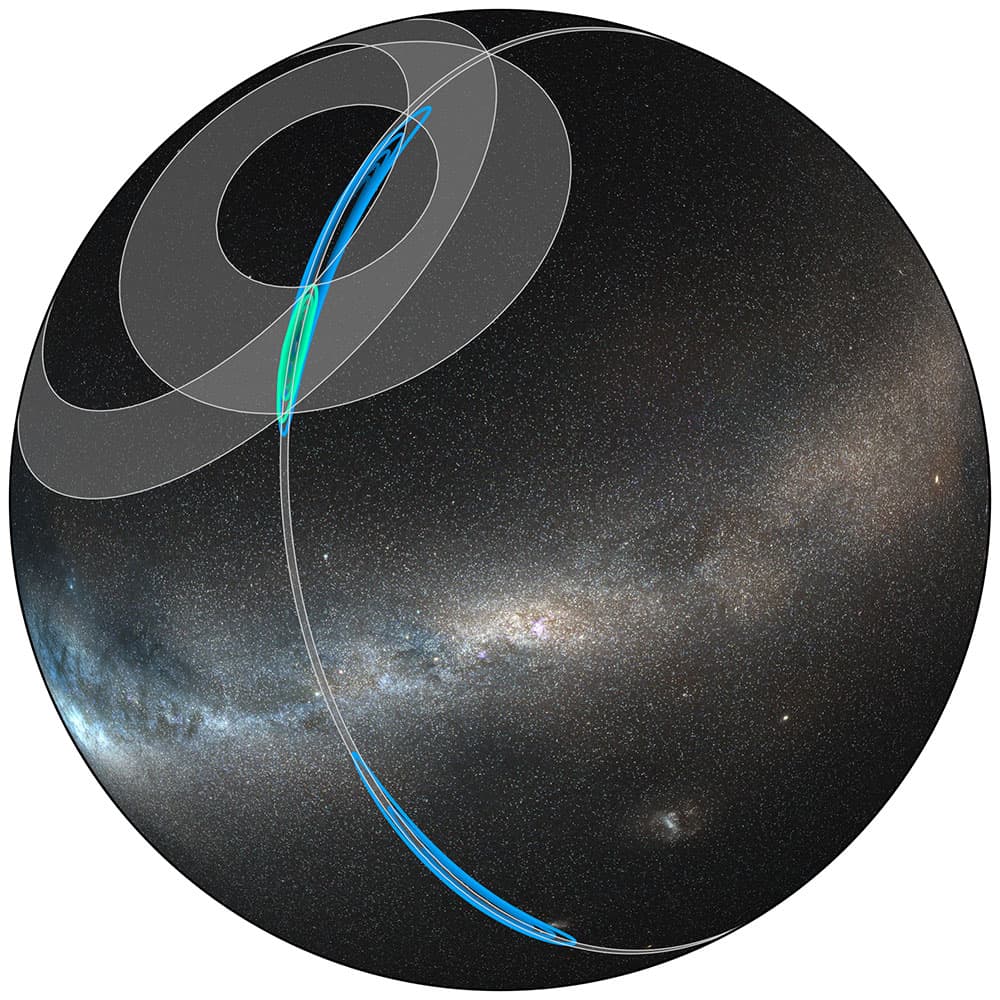
Universal data: Pinpointing the source of the gravitational-wave signal produced by colliding neutron stars. (Courtesy: LIGO/Virgo/NASA/Leo Singer/Axel Mellinger)
Looking back
So how did we get from the situation I described 30 years ago to where we are now? Well, it is an intriguing and sometimes tortuous story.
During the 1980s, prototype interferometric gravitational-wave detectors were being developed by teams in Garching, Germany; in Glasgow, Scotland; and at Caltech and the Massachusetts Institute of Technology (MIT) in the US. During the following decade, detector sensitivities were achieved at a level such that, if scaled up to much longer baselines, they would potentially allow the detection of signals from coalescing compact binary systems. Improving detector sensitivity was a real struggle, but I recall how it was spurred on by a strong spirit of competition between the research groups involved.
Long-baseline detectors compare the lengths of two arms at right angles to one another, in a Michelson-type interferometer arrangement, with each arm holding a large mirror (hung as a pendulum) at its far end. A measurement is made by splitting a laser beam between the two arms, and comparing the phase of the returning light, as it bounces back from the mirrors. As a gravitational wave of a particular polarization propagates normal to the plane of the detector, one arm will initially increase in length and the other decrease and vice versa. Longer arms create a more sensitive instrument because gravitational waves cause a strain in space–time, and so the distance change between the mirrors is greater the further apart they are. In addition the arms are artificially lengthened by forming Fabry–Perot cavities – resonant optical cavities – in each arm.
Early in 1983 a study for possible long-baseline instruments in the US was published on the instigation of Rainer Weiss, Kip Thorne and Ronald Drever (last year, Weiss and Thorne, together with Barry Barish, won the Nobel Prize for Physics for their efforts in building LIGO). Further proposals for such instruments were worked up in Germany and Italy starting in 1985; while a year later, the UK planned a detector based in Scotland. By 1989 progress on all fronts was encouraging and prototype sensitivities continued to improve. Research groups in Germany and the UK were also encouraged by their respective funding agencies to stop competing and join together, to submit a single proposal for a detector system to be located in either Germany or Scotland.
Based on the earlier US study, and bolstered by results from the prototype experiments, a construction proposal for the LIGO interferometers was submitted by Caltech and MIT to the US National Science Foundation. This proposal was for three long-baseline interferometers: two with arms 4 km long, and one with 2 km arms. One 4 km detector and the 2 km instrument were to be in the same vacuum system – subsequently constructed at Hanford in Washington State – while the other 4 km instrument, in its own vacuum system, was constructed in Louisiana.
Change afoot
Policy-makers in Germany and the UK were also seriously discussing funding for such efforts, with the Science and Engineering Research Council (SERC) in the UK considering stumping up cash for the first stages of construction. But in 1990 two significant events put an end to the possibilities of a detector in Scotland. First, a new chairperson was appointed to SERC who was not a supporter of gravitational-wave research – he found a “black hole”, not in the universe, but in the finances of the council. This meant that there would not be any UK funding for a long-baseline detector. Second, reunification occurred in Germany. The former East Germany was far behind what had been West Germany in terms of investment and scientific infrastructure. In order to start reinvigorating research in the former East, the priority for science funding moved to setting up new institutes and attracting academics to this part of Germany.
This was a significant blow to me and my colleagues, particularly in Scotland. We had fought hard to get planning permission for a detector site in Tentsmuir Forrest, near the former Royal Air Force base at Leuchars on the east coast of Scotland. The opposition from locals was very vocal as many thought we were planning a new secret weapons facility, while others thought the lasers would harm the wildlife. Persuading the relevant authorities that neither was the case had been challenging and fun; but it seemed it had all been for nothing.
It wasn’t all plain sailing for our US colleagues either, as internal difficulties with the project management were causing major problems. However, by 1994 these issues with LIGO had been resolved. Luckily there was also a change in the research funding structure in the UK, with the formation of the Particle Physics and Astronomy Research Council, and gravitational waves were once more considered for funding. The situation had also improved in Germany, and under the leadership of Karsten Danzmann, a new joint German–UK detector called “GEO 600” was conceived, and construction began at Ruthe near Hannover.
Ever-improving: A LIGO engineer works on the transmission monitor suspension. (Courtesy: Caltech/MIT/LIGO Lab)
Novel features
The LIGO detectors in the US were designed to have 4 km long arms, while the Virgo detector in Italy – the brain child of Alain Brillet and Adalberto Giazotto – was to have 3 km long arms. However, both financial and site restrictions limited the arm length of the German–UK detector to 600 m, meaning that GEO 600 would have further challenges to overcome for it to compete with the longer detectors. To do this, we incorporated some new features into the device: we used a technique known as “signal recycling”, which allowed tunable signal enhancement over its operating band. The device also used fused-silica fibres rather than metal wires to suspend the silica mirrors, to reduce thermal noise effects, particularly at low frequency; as well as lasers of advanced design.
Both LIGO and GEO 600 were meant to begin operating in early January 2001. It was an exciting but stressful time for those of us in GEO, as we were having some “technical difficulties” with the detector, and felt our honour was at stake. Just when it seemed as though LIGO would begin before us, an earthquake in the US damaged one of its detectors, allowing us to catch up. Soon after, LIGO and GEO began operating (joined by Virgo in 2003) and ran until 2010. As is now well known, no gravitational-wave signals were detected during that entire observational period. This was not unexpected though, and indeed the original LIGO proposal had acknowledged that sensitivity enhancements would have to be made at a later time for there to be a real chance of success.
It was decided that both LIGO detectors would be upgraded, and would adopt the advanced technologies already trialled by GEO – giving birth to the experiment’s current incarnation, the “Advanced LIGO” (aLIGO) system. More sophisticated active seismic isolation systems were developed in the US; the suspension systems for the silica mirrors, using silica fibres, were supplied by the UK; the lasers were made in Germany; while parts of the optics were fashioned in Australia.
The aLIGO interferometers at Hanford and Livingston – both with two 4 km arms, and no 2 km interferometer – became operational in September 2015. The revolutionary first detection was made almost immediately – in fact, while the detectors were still being calibrated. Thanks to the new seismic isolation, and lower thermal noise from the suspensions, aLIGO had achieved the sensitivity needed to make this first discovery in 2015. The upgraded Virgo detector, meanwhile, came online in August 2017 – just in time to enable better sky location of the colliding neutron stars, allowing us to confirm that the collision was indeed the source of the short gamma-ray burst.
Neutron chirp: Spectrogram combining the signals from both LIGO detectors (Courtesy: LSC/Alex Nitz)
Looking ahead
Both LIGO and Virgo will be further enhanced to continue improving their sensitivity in the coming years. A new detector, KAGRA, in the Kamioka mine in Japan is also expected to join the network in 2019, while a version of the aLIGO detector will soon be under construction in India. What we are experiencing is the opening up of a new area in observational astronomy – that of gravitational multimessenger astronomy, which has enormous potential to help us better understand how our universe formed and evolved, and what it is today.
Much more is to be discovered, and to do so, our detectors will also extend into space, with the Laser Interferometer Space Antenna (LISA) – a joint mission between the European Space Agency and NASA that is expected to launch in around 2035. This space-based gravitational-wave observatory will consist of three identical drag-free spacecraft – each holding proof mass mirrors – placed at the vertices of a virtual equilateral triangle in space, with sides 2.5 million kilometres long, in a heliocentric orbit.
The relative lengths of the “arms” – the distance between each craft – will be monitored by laser interferometry. LISA will extend the frequency range of observations down to the sub-millihertz regime (a frequency region not accessible to ground-based detectors). It should therefore allow us to study, among other areas, the interactions of supermassive black holes in merging galaxies, as well as make it possible to track some coalescing systems from very low frequency, through to the higher frequencies detected here on Earth.
Third-generation ground-based detectors with longer baselines and higher sensitivity – such as the Einstein Telescope in Europe and Cosmic Explorer in the US – are also being proposed. Together, LISA and the Earth-bound observatories should allow us to pick up gravitational signals from the majority of the known universe.
The last three decades have led us to what has been a remarkable and groundbreaking time in astronomy, and I believe that the next three will hold a wealth of new science, with many surprises still to come.
The effectiveness of proton therapy using pencil-beam scanning technology can be offset by the interplay effect, in which relative motion between the tumour and the scanning proton beam causes deviation of the delivered dose distribution from the original treatment plan.
The interplay effect has been widely investigated in adult patients but minimally in children. Now, researchers at St. Jude Children’s Research Hospital have investigated the effect of interplay between respiration-induced tumour motion and spot-scanning proton beams on internal target volume (ITV) coverage in paediatric patients. They performed simulations for a sample of patients, aged from two to 19 years, who had previously received radiotherapy for abdominal tumours (Int. J. Particle Ther. 10.14338/IJPT-17-00030.1).
Led by Chia-ho Hua, the team of medical physicists and radiation oncologists selected 10 representative patients who were treated with photon-based radiotherapy for neuroblastoma, Hodgkin lymphoma, osteosarcoma and Wilms tumour. The group had a maximum tumour motion ranging from 1.2 to 13.5 mm, respiration rates of 18 to 37 breaths per minute, and ITV of 11.2 to 295.8 cm3.
The patients underwent free-breathing 4D MRI and 3D CT as part of the treatment planning process. The authors generated a virtual 4D CT data set by spatially registering the 4D MRI data to the 3D CT data, and used it to plan a hypothetical proton treatment and calculate the corresponding 4D dose distribution. This approach provides a radiation-free method for detection of soft-tissue motion and enables image orientation along the primary direction of respiratory motion.
The researchers developed two-field proton treatment plans using single-field uniform dose (SFUD) optimization that expanded the ITV by 5 mm to generate the planning target volume (PTV). The plans achieved uniform dose to the PTV in which the hot spots did not exceed 110% of the prescribed dose. They note that in the original static plans, hot spots were kept below 110% and cold spots above 98.5% of the prescribed dose.
The authors calculated 4D dose distributions, taking into account the interplay effect, for comparison with the nominal dose distribution. They simulated the motion interplay effect by assigning each spot in the static plan delivery sequence to one of 10 respiratory-phase CTs, and by using the actual patient breathing trace and the specifications of a synchrotron-based proton system.
After summing individual respiratory phases to produce accumulated dose distributions, Hua and colleagues compared the resulting dose–volume histogram with that from the static plan. To evaluate the interplay effect, they calculated dose to 98% and 2% of the ITV and the percentage of the ITV receiving at least 95% and 99% of the prescribed dose.
They reported that motion interplay did not significantly increase the hot spot dose or decrease the cold spot dose by more than 3% for a given treatment fraction. Motion interplay caused minimal changes in the delivered dose in four patients who had a maximal vertical target motion of less than approximately 5 mm. These patients, aged two, four, six and nine, had neuroblastoma with tumours located in the retroperitoneal space.
While the interplay effect was almost negligible for young children with minimal superior–inferior target motion, teenagers with more extensive target motion had different interplay effects. An 11-year old patient who had the greatest amount of tumour motion exhibited the worst coverage loss. This was comparable to a 15-year old patient with metastasis from osteosarcoma, who experienced significant interplay effects manifesting in tumour coverage and dose inhomogeneity.
The researchers note that patients with tumour motion less than 10 mm would have had better tumour coverage with increased fractionation, but fractionation alone did not appear to further mitigate the interplay effect beyond six fractions.
Patient selection
The authors recommend that consensus guidelines on implementing pencil-beam scanning proton therapy for adult lung cancer and lymphoma patients are used as starting points for treating paediatric patients with proton therapy. They note that optimal mitigation strategies need to consider how well a paediatric patient will cooperate, the effects of sedation on respiration, and issues relating to tumour size and location.
“We hypothesize that children and adolescents with tumour motion of less than 10 mm can be safely treated with spot-scanning beams, as long as the beam angles are properly chosen and the tumours are not particularly deeply situated,” they wrote. “With a greater tumour motion than 10 mm, techniques such as respiratory gating and repainting should be considered.”
“St. Jude is currently using proton beams to treat abdominal tumours,” Hua tells Physics World. “However, we proceed with caution and select only appropriate candidates to treat with scanning proton beams. Smaller motion extent and focal treatment are two of the major criteria.”
For children and adolescents with larger tumour motion in the abdomen or thorax, based on 4D CT and 4D MRI evaluation, the clinical physics team is implementing advanced motion management techniques to safely and effectively deliver proton beams.
“Research like our interplay effect study allows us to predict which patients with moving tumours may be better candidates for pencil-beam scanning proton therapy and which patients need more aggressive motion management to prevent underdosing tumours and overdosing adjacent critical organs,” says Hua. “Such clinical research has been rare for paediatric cancer patients but is critical in protecting this most vulnerable population.”
The plan involves intensifying farming methods and the near-doubling of irrigated land for wheat production by 2035, from 3.9 to 7.7 million hectares. According to the study, however, even a modest growth in population will swiftly consume the extra yield from this expansion.
“As about 30% of wheat is irrigated globally, the challenges Egypt is facing are similar to other countries trying to increase agricultural production,” says Senthold Asseng of the University of Florida, US. “What we learn from our study in Egypt will also apply to other parts of the world.”
Egypt is the world’s largest importer of wheat, growing only half of its total consumption. Demand is expected to triple by the end of the century. To improve food security, the Egyptian government hopes to make the country self-sufficient in wheat by expanding irrigated desert land using water from beyond the Nile, such as from the Sudd wetlands of South Sudan via the long-delayed Jonglei Canal.
To see how far this will go to meet Egypt’s wheat demands, Asseng and colleagues performed computer simulations of crop yields under different climate change scenarios. They found that, under the “most likely” scenario of high greenhouse-gas emissions, crop yields per hectare will decline due to rising temperatures. And, if population growth remains at its current level of 2.2% a year, the demand for wheat will outpace wheat production, and Egypt will never become self-sufficient, despite the expansion of irrigated land.
If population growth falls, the researchers found that Egypt would, with its programme of expanded production, become self-sufficient in wheat in the near future. However, demand would outpace supply again come the 2040s, and the country would be forced to import once more.
“Feeding a growing world population will be a challenge not only for Egypt due to negative impacts of climate change on food production and limits to fresh water,” says Asseng. “While some of the food crisis might seem far away, we are all contributing to climate change via CO2 emissions and are also connected with each other via trade and migration of people fleeing regions of crisis.”
Asseng believes this and other challenges in food security can only be solved via international research networks such as the Agricultural Model Intercomparison and Improvement Project (AgMIP), which involves more than 1,000 scientists worldwide.
“The big challenges of food security can’t be solved by individuals, a single institution or country alone,” says Asseng. “Through AgMIP and the collaborations within, we apply climate, crop and economic models to better understand climate change impacts on agriculture and food security and to prepare for adaptation measures.”
Researchers at the Massachusetts Institute of Technology have discovered that monolayer tungsten ditelluride (WTe2) is superconducting at ultralow temperatures despite its very low charge carrier density. And that the state of the material can be electrically tuned from being a superconductor to an insulator. More importantly still, it could be used to engineer Majorana zero modes – a key step towards making a topological quantum computer.
“We recently confirmed in experiments that the insulating phase of monolayer WTe2 is a topological insulator,” explains team leader Pablo Jarillo-Herrero. “This means that it is the first material that can be electrically tuned over a wide range – all the way from being a topological insulator to a superconductor. This makes it an excellent candidate for engineering Majorana modes according to the famous Fu-Kane proposal.”
Special surface electronic states
Topological insulators are materials that are electrical insulators in the bulk but can conduct electricity on their surface via special surface electronic states that are highly robust to noise and disorder. Since they are protected, these states can be useful for engineering Majorana “zero modes”, which could be used as quantum bits (qubits) in topological quantum computers.
Majorana particles (particles that are in fact their own antiparticles) were first predicted by the Italian physicist Ettore Majorana in 1937. These particles obey “non-Abelian” statistics, which means that quantum information encoded in them would be highly resistant to decoherence. Decoherence is one of the main obstacles to overcome when it comes to developing practical quantum computers.
Jarillo-Herrero and colleagues discovered superconductivity in monolayer WTe2 when they were studying its topological insulating phase in a van der Waals field effect transistor made from the material.
WTe2 superconducts at carrier densities of just 5 x 10¹²/cm2
“In this device, we used boron nitride, which is a dielectric material, and graphite as the gates,” explains Jarillo-Herrero. “We don’t usually expect superconductivity to occur in such a transistor because the carrier density induced by the dielectric gating structure is typically between just 1012 to 1013/cm2 and 2D superconductors require densities of around 1014/cm2. However, we found that when we cooled down our monolayer WTe2 device to ultralow temperatures of less than 1 Kelvin, we observed superconductivity, which is remarkable.”
The result is unequivocal he says: “Monolayer WTe2 superconducts at carrier densities of only about 5 x 10¹²/cm2. And this is how we observe a transistor-like (reversible) electrostatic on/off switching of superconductivity in the material.
“Why it superconducts at such low densities remains an open and interesting question, however, and is something for the condensed matter theory community to answer.”
“Excellent material for studying Majorana physics”
The devices could be used to make highly controllable superconducting nanodevices, including photodetectors that make use of sharp superconducting transitions, he tells Physics World. However, what is really exciting to us is the possibility of realizing the first topological quantum computer from them.
“Our results are reported in two Science papers, one published this week and another earlier this year. The work clearly suggests that monolayer WTe2 could make an excellent material for studying Majorana physics. Creating new devices in which the Majorana modes indeed occur is an obvious but significant next step in our study. Another direction is to explore other types of 2D materials that also boast similar topological properties.”
Goldpaint’s image (above), which was taken in Moab, Utah, depicts formations of red rocks together with the Milky Way in the distance. As well as winning the £10 000 top prize, Goldpaint’s image will be on display along with other selected pictures at an exhibition at the Royal Observatory Greenwich that will run until 5 May 2019. The competition received over 4200 entries from over 90 countries. The winning images are available here.
Some scientists have laws named after them, or even particles and elements. But how many can claim to have their own beer? Well, Peter Mansfield can now be added to that roster after Matthew Davies from the International Centre for Brewing Science at the University of Nottingham teamed up with the Nottingham-based Castle Rock Brewery to create an ale to celebrate the life of the Nobel-prize-winning physicist.
The 4.2% ABV Sir Peter Mansfield ale is a “five-malt bitter” with “four hop varieties” that are added at various stages throughout the brewing process. The beer will be available in pubs across the East midlands and Yorkshire in the UK and is officially being launched today at the VAT and Fiddle pub in Nottingham.
Finally, Stephen Hawking, who died in March at the age of 76, may have just released his final book as well as his final paper, but now nearly two dozen items from Hawking’s estate will go up for auction next week by auctioneer Christie’s. The items include a motorised wheelchair that Hawking used in late 1980s and early 90s that has a guide price of £10 000 to £15 000 as well as a copy of The Brief History of Time, which is signed with Hawking’s thumbprint and estimated to fetch between £2000 and £3000.
The item that is expected to raise the most, however, is a signed copy of Hawking’s PhD thesis – one of five known copies to exist – that is expected to go between £100 000 and £150 000. The online auction will begin on 31 October and close on 8 November, so get bidding.