On 16 October NASA scientist Jeremy Harbeck was on a flight heading towards A68, the iceberg with a surface area of 5800 sq km that split from the Larsen C ice shelf in the Antarctic Peninsula in July 2017. En route, he snapped a photo of a much smaller iceberg that was unusually regular in shape. And that photo has garnered more than 17,000 likes and 8000 retweets on Twitter.
From yesterday's #IceBridge flight: A tabular iceberg can be seen on the right, floating among sea ice just off of the Larsen C ice shelf. The iceberg's sharp angles and flat surface indicate that it probably recently calved from the ice shelf. pic.twitter.com/XhgTrf642Z
“I was actually more interested in capturing the A68 iceberg that we were about to fly over, but I thought this rectangular iceberg was visually interesting and fairly photogenic, so on a lark, I just took a couple photos,” says Harbeck.“ I often see icebergs with relatively straight edges, but I’ve not really seen one before with two corners at such right angles like this one had.”
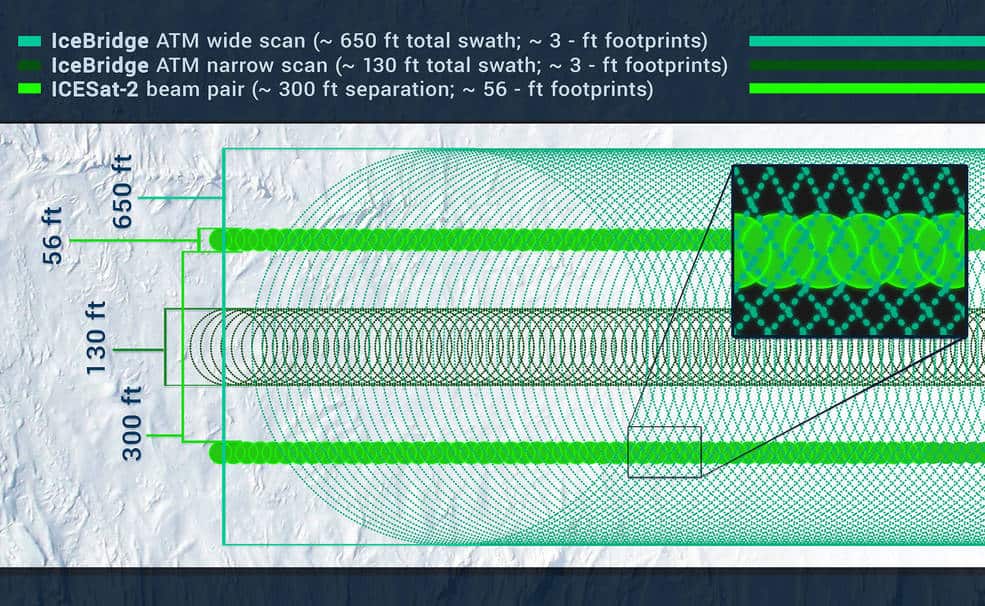
The flight was part of a five-week long aerial survey of sea and land ice for Operation IceBridge. Launched in 2009, the same year that the original ICESat (Ice, Cloud and land Elevation Satellite) mission ended, IceBridge aims to maintain continuity of laser-altimetry measurements between ICESat missions. This year flights follow the orbits of ICESat-2, which launched in September, enabling scientists to compare the measurements from air and space.
“After a decade of flying both poles every year, we’re finally bridging the two ICESat satellite missions,” says Joe MacGregor of NASA’s Goddard Space Flight Center, US, who is IceBridge project scientist. “It’s hugely satisfying to be part of building this key observational record of change in the polar regions. This campaign is our second-to-last Antarctic campaign and it is arguably the most scientifically diverse that IceBridge has ever done.”
The campaign, according to MacGregor, will revisit classic IceBridge targets such as flights along glacier flowlines that have been surveyed since 2002 and long-term sea ice flights, as well as new targets across West Antarctica. “More than two dozen of these mission designs are relevant to both IceBridge and ICESat-2,” he adds.
A new fluorescent imaging probe that can image Gram-negative bacteria in the human lung in real time could be used to find out whether a patient is suffering from a bacterial infection. The device, which has been tested in a small clinical study, opens up a whole new field in medicine and could make for a new diagnostic platform for pneumonia and other infections, say the researchers at the University of Edinburgh who developed it.
Patients with respiratory disease can contract Gram-negative pulmonary infections such as pneumonia in hospital. The problem is unfortunately even worse for patients who are on mechanical ventilators in intensive care units. It is, however, extremely difficult to diagnose these infections, but doing this is crucial if they are to be treated before they become potentially fatal. Indeed, existing techniques like lung biopsies are not without risk, and routinely employed molecular sequencing approaches like the polymerase chain reaction (PCR) that “amplify” potentially dangerous microbes in samples taken from the patient are oversensitive and often produce false positives. This means that the patient might be given massive doses of an antibiotic that she or he doesn’t need.
Direct imaging
Researchers of the PROTEUS Hub and the Centre for Inflammation Research at Queen’s Medical Research Institute at the University of Edinburgh say they have now overcome these problems with their new water-soluble fluorescent imaging probe that can directly image Gram-negative bacteria in human lungs. The device contains two components, explains team leader Kev Dhaliwal: “a targeting ligand based on a modified antibiotic (an antimicrobial cyclic peptide) called polymyxin (PMX); and a reporter fluorophore, made of 7-nitrobenz-2-oxa-1,3-diazole (NBD), whose fluorescence increases within the increasingly polar environment of the bacterial membrane. This fluorophore thus ‘lights up’ brightly when it specifically binds with a lipid (lipid A) of a lipopolysaccharide on the membrane surface.”
The researchers tested their probe on six patients with bronchiectasis, a chronic pulmonary disease, and were able to successfully identify Gram-negative bacteria, such as K. pneumoniae and H. influenzae. They administered a microdose of the NBD-PMX using an intrapulmonary catheter during a bronchoscopy procedure and imaged lung airways and alveoli immediately afterwards using a technique called optical endomicroscopy.
Safe but more work needed
Although the NBD-PMX is safe for biological cells, Dhaliwal and colleagues say they will have to do more research to make sure that the technology is safe for long-term, repeated use. The probe is not able to detect an important Gram-negative bacterium called P. mirabilis either since this pathogen does not bind to PMX. P. mirabilis causes nosocomial pneumonia and is particularly dangerous for patients whose immune systems are weak. The cost of the probe will also have to be evaluated, add the researchers.
Finally, although Gram-negative bacteria are the main culprits for causing infection during lung transplants and infections in intensive care units, Gram-positive bacteria or multiple bacterial species may also be responsible for diseases like pneumonia, they warn. “We thus need to develop a matching Gram-positive imaging agent such as fluorescently-labelled vancomycin and also multiplex with inflammation probes, all of which we are currently developing,” Dhaliwal tells Physics World. “Our platform is nonetheless a proof-of-concept that shows much promise as a new diagnostic and monitoring tool for lung infections. It is an exciting development in molecular imaging and significantly adds to current technologies,” he says.
Pain, tingling and numbness in the hands, legs and arms are common symptoms of peripheral nerve injuries. Typically caused by trauma or acute compression, they are considered a significant problem for public health, making up 2-5% of all trauma cases.
Researchers at Washington University School of Medicine in St Louis and Northwestern University have developed an implantable device that can deliver scheduled electrical stimulation to targeted peripheral nerves after surgery has been completed. Their research, published in Nature Medicine, has shown that these electrical pulses help with the nerve regrowth and enhanced muscle recovery in rats.
Wilson Ray, John Rogers and their colleagues wrapped a wireless, biodegradable device around the injured nerve and inserted it into rats with peripheral nerve damage. They programmed the device to deliver electrical pulses at intervals for about two weeks before the device was naturally absorbed into the body.
Currently there is little that can be done to speed up the rate of recovery from nerve injuries. Patients may use physical therapies and pain killers to aid healing, and much of current research focuses on pharmacological approaches such as the application of growth factors and immunosuppressants to stimulate injured nerves. However these studies have had mixed results.
For severe cases, which require surgery, electrical stimulation is applied to the injured nerves as it has been shown to enhance recovery. Electrical stimulation activates the release of proteins promoting nerve regrowth, enhancing the ability of nerve cells to regrow quickly. However, this stimulation only occurs during surgery, and once surgery has finished, the ability to provide electrical stimulation to the nerve ends. The novel method described here is unique in achieving positive results post-surgery.
The device is entirely biocompatible and bioresorbable comprised of a radio frequency power harvester, and an electrical interface, which connects to a targeted nerve. The harvester makes use of a silicon nanomembrane radio frequency diode in addition to a Mg/SiO2/Mg capacitor, a PLGA substrate and an inductor. When radio frequency is passed through the transmission antenna, electrical stimulation is delivered to injured sciatic nerves in rats. The researchers provided one hour per day of stimulation for one, three and six days and a control of no stimulation at all. The recovery was measured over the following ten days. In all cases, any electrical stimulation was better than none at all, improving the muscle mass and strength. The study also found that the more days of applied electrical stimulation, the quicker the improvement in muscle strength and nerve signalling.
This transient electronic device disappears into the body after treatment has been completed, negating the need to put patients through a second operation to remove the device. The bioresorbability of the device provides a unique ability to deliver electrical stimulation before dissolving and leaving the body without a trace.
The researchers have successfully varied the thickness and the composition of materials in the device to tailor its disintegration into the body. These features enable the device to deliver electrical stimulation to patients in ‘doses’ over days or weeks after the surgery depending on the needs of patients. The researchers envisage that devices using transient engineered technologies could one day provide an alternative to compliment pharmaceutical treatments for conditions in humans. This enables the researchers to carry out exciting further work in determining the optimal parameters for regeneration and functional recovery of the peripheral nerves.
The epithelial–mesenchymal transition (EMT) is a process by which polarized epithelial cells undergo multiple biochemical changes enabling their transfer into a mesenchymal cell phenotype, which is characterized by an enhanced migratory capacity, invasiveness and elevated resistance to cell death. Although it is known that EMT plays an important role in tumour metastasis, the regulation mechanism is still to be elucidated.
Three-dimensional bioprinting has emerged as a useful tool for the study of cancer mechanisms, because it can mimic the in vivo microenvironment of tumour cells by the precise control of cells and biomaterials. Now, a team of researchers from Tsinghua University, Chinese Academy of Medical Sciences and Drexel University has implemented a 3D printed cervical tumour model to study the EMT process (Biofabrication10 044102). Their findings provide a better understanding of the regulation mechanism of EMT, for use in future therapeutic programmes.
The researchers used HeLa cells (the oldest human cell line, derived from cervical cancer cells) to fabricate a cervical tumour model with a cuboid structure, with interconnected channels to facilitate sufficient transfer of nutrients, oxygen and metabolic waste. After printing, the cells proliferated and grew, confirming that the construct represents an advanced cancer model.
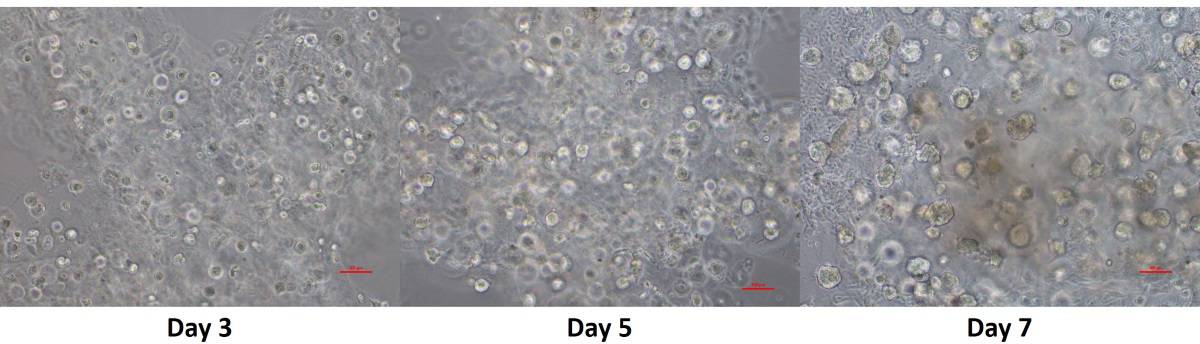
Formation of cellular spheroids in the 3D-printed HeLa constructs.
EMT can be induced or regulated by different factors and cytokines (small proteins that play an important role in cell signalling), with TGF-β (transforming growth factor beta) considered the major inducer of EMT in a variety of cell types and tissues.
As such, the authors evaluated the effect of TGF-β treatment on HeLa cells and their EMT phenotype by looking at the protein expression of target biomarkers like E-cadherin, together with snail (which shows the acquisition of a mesenchymal phenotype), vimentin and N-cadherin. The results indicated loss of epithelial markers and the acquisition of mesenchymal markers, suggesting that EMT was achieved in the 3D-printed HeLa cell construct.
Further, to confirm that EMT was induced by TGF-β in the 3D printed cervical cancer model, the authors treated the 3D-printed HeLa cell construct with disulfiram (an anti-alcoholism drug) and the EMT pathway inhibitor C19, 24 hours before TGF-β induction. As expected, HeLa cells kept a more epithelial-like appearance after this treatment. The results of real-time PCR (polymerase chain reaction) indicated that the treatment with disulfiram and C19 inhibited the TGF-β-induced EMT process by modifying the expression of EMT-related proteins.
Inhibition of TGF-ß-induced EMT by disulfiram (DSF) and C19, in a 3D-printed cervical cancer model.
The authors have established a cervical tumour model by 3D printing of HeLa cells and achieved the EMT process by TGF-β treatment. These results may help researchers to better understand the regulation of cervical cancer metastasis.
The physicist Lawrence Krauss has announced that he will retire from Arizona State University (ASU) in May next year for “new and different challenges and opportunities”. Krauss was put on paid leave by ASU in February following allegations of sexual misconduct that first came to light through an investigation by Buzzfeed. The ASU then opened a review into the allegations “to discern the facts”. Following Krauss’s decision to retire, that review has now closed.
Krauss is a prominent theorist and cosmologist who has written several popular-science books and appeared in TV documentaries. He was also the founder of the ASU’s Origins Project, but after the allegations emerged, Krauss stepped down as director. In late September, the ASU announced that the Origins Project was being “transitioned” into the Interplanetary Initiative and would be led by Lindy Elkins-Tanton who is director of the ASU’s school of Earth and space exploration. Krauss also resigned in February as chairman of the Bulletin of Atomic Scientists, which is best known for its “Doomsday Clock”.
In a statement on Twitter on 21 October, Krauss noted that the ASU had accepted his request to retire on 16 May 2019 – shortly before he turns 65 – and that the university has now closed its review process following a “conciliation procedure”. Krauss says that he chose to retire because, he claims, the regulations of the Arizona Board of Regents say that he would only be able to “test the credibility of my accusers” if he first agreed to be dismissed. “The nature of the review process I experience included incomplete access to evidence and accusations during the investigations, no opportunity to cross-examine witnesses or be represented by a lawyer during the investigation interviews,” Krauss notes.
However, the ASU denies that Krauss would have had to be first dismissed before he could present his own case. “[Krauss’s] description of our review process is inaccurate. It does provide an opportunity for the person against whom allegations are made to have a hearing at which they can present witnesses and evidence in their own defense and cross-examine adverse witnesses,” says an ASU statement sent to Physics World. “Should he have chosen to move forward with the review process, this would have taken place before any final decisions were made regarding dismissal. Krauss chose to retire rather than to move forward with that process.”
The statement adds that Krauss will keep “whatever retirement benefits he had accrued as of the date of his retirement, but will not accrue more” adding that he now remains on leave and will not teach, “nor is he allowed to take any actions on behalf of ASU”.
Moving on
An ASU report, which was obtained under a public-records request from BuzzFeed and made public yesterday, outlines instances of misconduct that have been levelled at Krauss. The 33-page document then lists a catalogue of instances where Krauss was alleged to have violated the ASU’s policies, including a complaint that he had “touched the breast of another female attendee at a convention in Australia while the female was taking a selfie photograph of the two”.
The incident is alleged to have occurred on 26 November 2016 during a gala reception and dinner at the end of the first day of the event. The document also details how Krauss allegedly “propositioned” a woman “for a threesome” as he discussed her potential “involvement/employment with the Origins Project”. Krauss, the report states, “acknowledged that this conversation occurred but characterized it as a joke”.
The ASU report, dated 31 July, includes a covering letter written to Krauss by Mark Searle – ASU’s executive vice-president and university provost. In the letter, Searle notes that the investigations found that Krauss had violated the university’s policies on discrimination, harassment or retaliation and its code of ethics. “Your behaviour as found in the determinations is unprofessional, reflects a failure of leadership and is extremely disappointing,” says Searle, adding that he had passed the findings on to the dean of the College of Liberal Arts and Sciences for “appropriate responsive action”.
All we want as victims, survivors and supporters is a fair and transparent process
Emma Chapman
In his 21 October statement on Twitter, Krauss maintains his innocence to the allegations. “To be clear, I have never harassed or assaulted anyone and have most certainly not exhibited gender discrimination in my professional dealings at the University or elsewhere,” he states, adding that he has not received any complaints from his students, staff, colleagues or participants in Origins events from the university. “I am confident an appeals process that impartially examined all evident, including the evidence I had prepared for the conciliation process, would lead to an outcome in my favour,” he adds. Kraus says that the “experience over the past seven months” has led him to believe that even “following such an outcome” he cannot continue to work at the ASU.
‘No excuse’
Emma Chapman, from Imperial College London, who is a campaigner on sexual misconduct in higher education, told Physics World that there are “several worrying and common factors” in the agreement between Krauss and the ASU. This includes the “acceptance that retirement benefits will be kept despite a previous finding of fault” and that the agreement “requires every employee of ASU to refrain from making disparaging statements regarding Krauss’s reputation”. Chapman, who is a member of the 1752 Group – a UK research and lobby organization that aims to end sexual misconduct in higher education – says that such an “institution-wide gagging order” occurs regularly in even the most serious cases of sexual misconduct.
“The issue with settlements like this is that it strikes at the heart of fair justice and prevents accountability on the perpetrator and indeed the institution for their role in enabling the behaviour,” says Chapman. “All we want as victims, survivors and supporters is a fair and transparent process, that is always carried out to conclusion and the outcome made public.” Chapman adds that without this there can be no lessons learned and “no confidence” in preventing sexual misconduct from happening again. “I find it absolutely incredible that after one year of very high media exposure on issues of sexual harassment, even within academia, a university has still chosen to pursue this route,” she says. “There is no excuse anymore.”
The ASTRO Annual Meeting takes place this week in San Antonio, Texas. Among the top-rated abstracts highlighted at the meeting, several presented the latest findings from studies of stereotactic ablative radiotherapy (SABR). SABR, also known as stereotactic body radiation therapy (SBRT), is a precision treatment that delivers high radiation doses in a single, or just a few, treatment fractions. Here is a small selection of the studies presented at this year’s event.
High doses improve survival in ‘incurable’ patients
Metastatic cancer is generally considered incurable. A multi-centre trial has challenged this idea by demonstrating that SABR greatly increases survival in patients with a variety of oligometastatic cancers.
“Traditionally, when a patient had a cancer that spread to other parts of their body, such as to their bones or brain, they were considered to be incurable,” explains lead author David Palma from Lawson Health Research Institute. “But there’s a theory that if a patient only has a few spots of cancer returning, those spots could be killed with radiation or surgery to improve their survival. Now we’ve been able to show, for the first time in a randomized trial, that high-dose radiation can effectively treat these limited recurrences.”
The trial, called SABR-COMET, included 99 patients with a range of cancer types and up to five metastatic lesions. Patients were randomized at a 1:2 ratio into two treatment arms: palliative standard-of-care (SOC) treatment; or SOC plus SABR to all metastatic lesions.
Patients who received SABR lived considerably longer than those who did not, with a median overall survival of 41 months, compared with 28 months in the SOC arm. SABR also doubled the time that patients lived without cancer growth, from six months for those who received standard radiation therapy to 12 months in the SABR arm.
Treatments with SABR led to more negative side effects, with 30% of patients experiencing grade 2 or higher adverse events, compared with 9% in the SOC group. There were, however, no differences in quality-of-life measures between the two groups.
“Stereotactic radiation therapy needs to be delivered carefully and by an experienced team, and there is a small risk of very serious side effects, as well as mortality,” says Palma. “But overall, for patients whose cancers have spread, and who are not expected to survive otherwise, the overall survival benefits of SABR appear to outweigh these risks.”
The team is now planning a follow-up study that will enrol patients with up to 10 metastatic lesions. “We don’t know the upward limit of how many tumours can be treated with SABR,” says Palma. “The concern is the amount of radiation exposure a patient can tolerate. We don’t know yet what the safe boundaries are. We’ve been very conservative, as this is a new technology.”
Prostate cancer patients benefit from SBRT
A growing body of evidence supports the use of SBRT to treat low- and intermediate-risk prostate cancer; but some concerns still exist regarding its long-term efficacy and safety. To address these concerns, a research team has analysed data from 10 institutional trials and two large multi-institutional studies of SBRT for prostate cancer.
The results confirmed that SBRT has an efficacy and toxicity profile that compares favourably with conventional radiotherapy and brachytherapy. “This study should allay the fears of those who prefer to undertake a shorter treatment course that they can do so safely and with the same, positive outcomes they would receive from a longer course of treatment,” says lead author Amar Kishan from UCLA.
Radiotherapy is typically delivered in small daily doses over a multi-week period, but because prostate cancer cells appear unusually sensitive to higher daily doses of radiation, it’s possible to compress the treatment down to 4 or 5 treatments in about 1.5 weeks, Kishan explains.
The team examined the outcomes of SBRT in 2142 prostate cancer patients: 55.3% with low-risk disease; 32.3% with favourable intermediate-risk disease; and 12.4% with unfavourable intermediate risk disease. Most patients were treated daily or every other day with doses of 33.5–40 Gy delivered in four or five fractions. A small percentage received concurrent androgen deprivation therapy.
None of the patients died from prostate cancer. Overall, 6% experienced recurrence and 0.6% experienced distant metastases. Seven years after treatment, 95.5% of patients in the low-risk group, 91.4% in the favourable intermediate-risk group and 85.1% in the unfavourable intermediate-risk group were free from biochemical recurrence. Overall survival rates at seven years were 91.4%, 93.7% and 86.5%, for low-risk, favourable and unfavourable groups, respectively.
Severe toxicities were rare: 0.6% of patients experienced grade 3 acute genitourinary (GU) toxicities and 1.9% experienced grade 3 late GU toxicity. There was just one late grade 4 GU toxicity and one late grade 4 gastrointestinal toxicity.
“These numbers are identical, if not superior, to other types of more commonly used radiation techniques,” says Kishan. “There is no evidence of worse toxicity with SBRT. We have shown that this method is both safe and effective and should be a standard treatment option for patients with low- and intermediate-risk prostate cancer.”
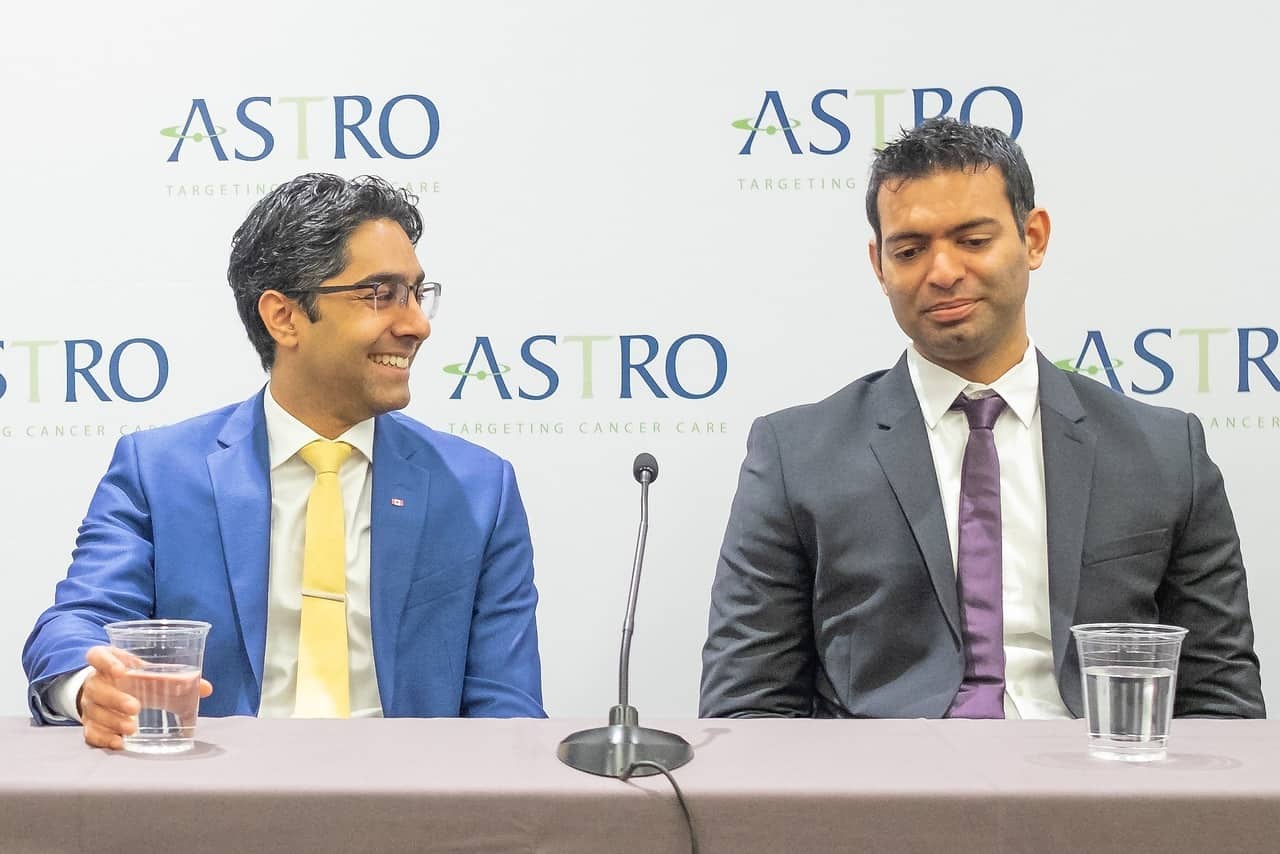
Rohann Correa (left), a radiation oncology resident at London Health Sciences Center in Canada, and Amar Kishan (right), an assistant professor at the University of California, Los Angeles. (Courtesy: ASTRO)
SABR is effective for patients with only one kidney
Renal cell carcinoma (RCC), the most common form of kidney cancer, is typically treated surgically — but SABR is emerging as a potential alternative. Now, an analysis of the largest dataset of solitary kidney patients to receive SABR has shown that it is as safe and effective for patients with one kidney as for those who have two.
“Although RCC historically has been considered resistant to conventional radiation therapy, the high doses and high precision achievable with SABR overcome this resistance,” says lead author Rohann Correa from London Health Sciences Center. “Kidney SABR is thus emerging as a versatile, non-invasive outpatient treatment requiring one visit or a few visits.”
Correa and colleagues analysed data from 223 patients who underwent renal SABR at nine institutions, 81 of whom had a solitary kidney. While total dose and number of fractions were lower in the solitary cohort, the median biologically-effective dose was 87.5 Gy in both groups.
With a median follow-up of 2.6 years, SABR provided 98% two-year local control and 98% two-year cancer-specific survival for RCC patients with a solitary kidney. These rates were not significantly different from those for patients with two kidneys. Overall survival was similar for both cohorts: 81% for the solitary group and 82% for the bilateral group.
SABR slightly impacted renal function, with a similar decline in estimated glomerular filtration rate (eGFR, a measure of kidney function) for both cohorts. None of the solitary kidney patients required dialysis, while six in the bilateral cohort did. “We were somewhat surprised that SABR could achieve such a high local control rate without more significantly impacting renal function in the solitary kidney setting,” says Correa.
“Treatment of RCC in the solitary kidney setting poses a unique management challenge, since a careful balance of minimizing nephron loss and maximizing cancer control is essential,” Correa concludes. “Recognizing the challenges of randomized controlled trials in this unique and somewhat-rare population, we hope that our large, international dataset will significantly advance the paradigm of kidney SABR, increasing awareness and access for patients facing this challenging management scenario.”
In October 1988 Anthony O’Dowd was working as a physicist at CERN, developing hardware for the OPAL experiment on the Large Electron-Positron Collider. Two years later, he joined IBM’s offices in Hursley Park, UK, expecting to do similar work on the device drivers that link hardware to computer operating systems. But on his first day at IBM, O’Dowd discovered that there had been a slight change of plan. “I was going to work on this new thing called ‘software’,” he recalls.
In that same month, another physicist, Paul Gosling, was employed at a now-defunct telecommunications firm called STC Technologies. At first he specialized in radar signal processing, but after two years he changed jobs, moving to work on sonar at what was then Ferranti-Thomson. “It was Ferranti first, then Ferranti-Thomson and [then] Thomson-Marconi,” he says, ticking off the names of his employer’s various incarnations with well-practised ease. “Then various other companies came in and we merged with Racal to become Thales.”
The summer of 1988 also saw the start of Angelo Amorelli’s post-PhD career. By October that year, just as Physics World was starting, the Cambridge-trained chemist had a job in the refining group at BP’s research centre in Sunbury, UK, where thousands of scientists and engineers worked on everything from solar panels to food science. “It had quite a scientific feel to it,” he says. “Like a university chemistry department. It was an easy transition.”
Graham Batey had made a similar switch a few years before, joining Oxford Instruments in 1985 after using one of the company’s dilution refrigerators during his PhD. “That was my foot in the door,” he says, adding that his first job involved designing dilution refrigerators for customers who, like him, were mostly interested in fundamental physics research.
O’Dowd, Gosling, Amorelli and Batey have a lot in common. Despite spending all or most of their careers with the same employer, they have seen substantial changes in their respective industries. They have also risen to senior positions: O’Dowd is a distinguished engineer and solution architect for blockchain at IBM; Gosling is vice-president for engineering at Thales; Amorelli is head of group research at BP; and Batey is chief engineer for ultralow temperature at Oxford Instruments Nanoscience. And as it happens, their employers have something in common, too. BP, IBM, Oxford Instruments and three of Thales’ predecessors were all among Physics World’s first advertisers, hawking their services, products or job vacancies alongside two dozen other firms in the magazine’s inaugural October 1988 issue.
These 30 companies make up a cross-section of the industrial-physics community as it was three decades ago. The list is notably varied, with both giant multinationals and small outfits represented in the magazine. Ads for consultancies appeared in the same pages as ads for laser specialists and manufacturers of vacuum equipment, and there were no fewer than seven different companies with the word “instruments” in their names. There were also a few wildcard advertisers, including an insurance agency, a hotel and – plus ça change – a campaign to “Save British Science”.
Physics-based firms that advertised in that issue are, of course, merely a sample of the range of hi-tech businesses from 30 years ago. Many major players (including several that went on to advertise with the magazine later) are absent from it. Even so, the varied fortunes of this disparate bunch of companies reveal a lot about how the landscape of industrial physics has changed – as well as a few ways it hasn’t.
Closure and consolidation
Let’s start with the bad news. Of the 30 advertisers with physics at the core of their business (a definition that excludes the wildcards and a handful of scientific publishers), two – Cryophysics Ltd and Lucas CEL Instruments – filed their last accounts sometime around the year 2000 and no longer exist. A third, Alliant Computer Systems, was mentioned prominently in an October 1988 ad for an upcoming conference, but ran into financial problems soon after and went bankrupt in 1992.
Exceptional strength: Oxford Instruments still sells a version of the 18 T magnet that featured in this ad from the October 1988 Physics World. (Courtesy: Oxford Instruments)
The rest, however, have proven remarkably resilient. Amazingly, Oxford Instruments even sells the same 18 T magnet that appeared in its advert (above), although Batey is quick to point out that the device is “smaller now” and has extra features such as a pulse-tube refrigerator and a recondenser for boil-off gas. Other survivors include VAT Vacuum, a Switzerland-based valve manufacturer; and Thales’ defence-sector rival BAE Systems, which was known as British Aerospace until it bought Marconi Electronic Systems in 1999. All told, 11 companies out of the original 30 still exist in a form that observers from 30 years ago would recognize.
As for the remaining 17 – well, this is where it gets complicated. A handful were bought out by employees and now operate as similar businesses under different names. Zenon Palacz joined one such firm, VG Isotopes, in July 1988, and is now managing director at a successor called Isotopx. Despite a complicated series of buyouts, mergers and de-mergers – a journey that Palacz summarizes as “quite a ride” – the company continues to sell thermal ionization mass spectrometers and other scientific instruments from its base in Cheshire, UK.
For the most part, though, companies in this 17-strong group have been bought by larger organizations and then more or less been absorbed into them. This category includes three firms – Pilkington Electro Optic Materials, Racal Services and Rediffusion Simulation – that became part of Thales. Asked about the consolidations, Gosling says simply that there were “too many players in the market”, adding that the boundaries between defence and civil technologies have blurred. “Some of these businesses that were predominantly defence businesses have diversified,” he explains. “If you look at things like autonomous cars, for example, that’s a civil application, but we know there’s also a lot of interest in maritime autonomy for mine-sweeping.” This blurring process isn’t new: in 1991, nine years before the merger that created Thales, another part of Racal was split off to become the mobile-phone giant Vodafone.
Same name, new look
The defence sector is not the only one to have experienced extensive consolidation and diversification. Amorelli notes that BP, like many other oil and gas majors, underwent a period of diversification in the late 1980s “because oil was meant to run out by the mid-1990s”. When that didn’t happen, the company shed several of its peripheral operations – including its food business, BP Nutrition – to focus on its core. Then, in the late 1990s, falling oil prices triggered a series of mega-mergers with Amoco, Arco, Castrol and others. According to Amorelli, that produced major shifts in both the company’s overall structure and its activities at Sunbury. “One of the things that has changed significantly for BP is globalization of our activities,” he says. “We ended up with a portfolio of research centres.” As a result, the diverse, university-like centre he joined in 1988 is now “more of a business park with some technology and engineering embedded”.
We recognize that we can’t do everything, and I think that’s a big change from 30 years ago
Other shifts have also left their mark on the Sunbury centre. “We recognize that we can’t do everything, and I think that’s a big change from 30 years ago,” Amorelli says. “Companies traditionally would do almost all their research and development internally. Now we do a certain amount, but we are quite happy to work with third parties that have complimentary capabilities.”
BP’s involvement in solar and wind energy is one example of that co-operation. When Amorelli was the company’s head of technology for wind, he says, “people asked me whether we should be investing in the development of wind turbines, but there were so many great companies out there already”. Instead, he explains, “we focused on what we could do, which is investing in projects and bringing clean energy to the market”.
Similarly, BP no longer employs physicists to work on semiconductor technologies for solar panels – the subject of its recruitment advert in the first issue of Physics World. Instead, it recently invested $200m in partnering with an experienced firm, Lightsource, which develops solar-power assets in Europe and beyond. The emergence of a specialized semiconductor industry also influenced BP’s decision to exit solar-panel research. As Amorelli explains, once economies of scale took over semiconductor manufacturing in East Asia, it was no longer profitable elsewhere.
For other companies in Physics World’s original group of advertisers, however, this same trend led to fresh opportunities. When Kurt Sonderegger started working in VAT Vacuum’s all-metal valve business in 1990, “researchers were our main customers – there were only little industrial applications on the side”, he recalls. Then the company started getting queries from semiconductor manufacturers, and its focus began to shift. Today, Sonderegger’s colleague Arno Zindel, a member of VAT’s board, calls research customers “the deepest root that VAT has”. In terms of sales volume, though, their main clients are manufacturers of semiconductors, flat-screen displays and – yes – solar panels.
The computer says go
The biggest changes to industrial physics stem from the rise of computing and the Internet. “Thirty years ago, we had two computers here at VAT,” Sonderegger says, a note of wonder creeping into his voice. “We used them for the stock-keeping of parts.” At BP, says Amorelli, “I can remember telexing refineries to give them advice, and that advice was in response to a sample that had taken three weeks to get to us. Now a courier like DHL will deliver that sample in a day or two, you can analyse it much more quickly with automated samplers and then we can e-mail the result within hours.”
Batey, of Oxford Instruments, agrees that better automation, coupled with the rise of “dry” or cryogen-free technologies, has made his company’s products much easier to use than they were 30 years ago. “We’ve got computers now that can open up all the right valves automatically,” he says. “Users can focus on their experiment rather than spending two or three days getting the system cold enough – they can just press a button and come back later and it’s ready.”
For IBM, the impact of the computing and Internet revolutions has been even more profound. The new thing called “software” that O’Dowd started working on in 1990 is now “absolutely everywhere and touches every business process”, he says. The rise in the amounts of data handled by that software has also been tremendous. Just ask Peter Waggett, who is IBM’s director of emerging technologies, having joined the company in 1997 when it acquired his then-employer, Data Sciences Ltd. Before that, as an astrophysics PhD student at University College London in 1984, he had a part-time job (“basically beer money”) backing up the physics department’s computer system. “I used to put the whole department on two 12-inch tapes,” Waggett recalls. “Everybody did all their research on that system.”
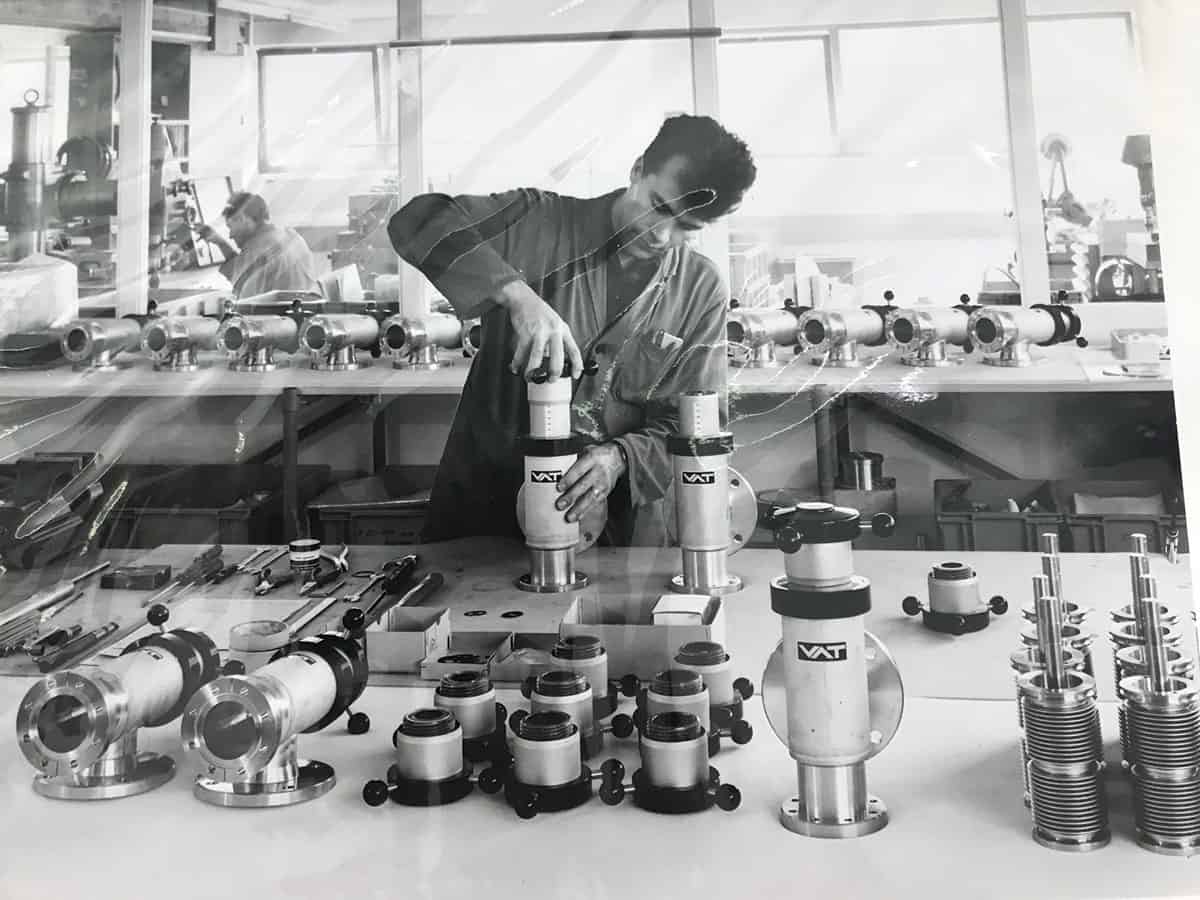
Down the line: A photo from VAT Vacuum’s assembly process during the 1980s. (Courtesy: VAT Vacuum)
These days, O’Dowd observes, all those data would fit onto a device the size of a sugar cube. Meanwhile, the data challenges he faced at CERN in the 1980s have become ubiquitous. “Large datasets were the preserve of scientists in ivory towers,” he says. “Nowadays they are commercially relevant in a way they just weren’t before. Think about social-media feeds, think about retail – it’s just vast.”
The computing revolution also helped transform Thales from what Gosling calls “a very hardware-focused business” to one that is much more about mathematics, algorithms and systems engineering. When he joined its predecessor in the early 1990s, the company designed many of its own computers. “That was core to what we did for sonar because sonar systems need a huge amount of computing power,” he explains. Now, the company tends to buy its computers off-the-shelf. As a consequence of Moore’s law, Gosling says, “We worry less about computer power and more about the sophistication of the mathematical algorithms and the software implementation of those algorithms.”
Increasingly advanced software has wrought more subtle changes, too. “When I first started, you had to write an awful lot of software yourself if you wanted to do any mathematical modelling,” Gosling says. “Today you can do very complex signal-processing tasks with tools that you can buy from the market.” As a result, he says, “We found that our intellect has to be diverted in a different direction. I don’t know quite how to put this, but things that we found difficult 20, 30 years ago are now very much easier because of the tools we use. That means we can focus on much more complex problems that we probably hadn’t even time to think about.” As an example, he cites cybersecurity, which “wasn’t big on the list of things to worry about 30 years ago – it just didn’t exist”.
The next three decades
Asked to peer into their (re-engineered, computerized and Internet-connected) crystal balls, scientists at Physics World’s original advertisers offer a variety of answers. Zindel observes that VAT, which had been family-owned for more than 50 years, was sold to an investment group in 2014 and subsequently entered the stock market. The resulting injection of capital, he says, has enabled the company to grow more rapidly in response to ongoing demand from the semiconductor industry. Gosling, for his part, is concerned about the UK’s supply of scientists and engineers. Unprompted, he adds that Thales and other hi-tech firms need to work harder to improve their diversity. The fact that all the scientists interviewed for this article are male and white reflects both the field as it was 30 years ago and the lack of progress since.
There is, however, plenty to be excited about. Amorelli is enthusiastic about the potential of fuels derived from biological substances such as sugar cane. He also waxes lyrical about the cheap computing power that enables his BP colleagues to produce detailed models of fluid flow and features below the Earth’s surface – tasks that were well beyond their 1980s counterparts. Batey mentions computing, too, but of a different type. Oxford Instruments’ markets, he says, now tilt more towards applied and industrial research than they did 30 years ago, and the recent emergence of quantum computing is a contributing factor.
For O’Dowd, the advent of quantum computers is just the latest in a long line of transformations. “If you’re going to have a career that lasts decades, you’re going to expect loads of different technology waves,” he says. “The PC was just emerging in the mid-1980s, then you had the whole of the Internet come along, web servers, Linux, then artificial intelligence and now neuromorphic computing and blockchain and quantum computing. All this stuff came along.”
As a member of the physics community, O’Dowd feels he has an advantage in dealing with change. “Physicists have some really good coping strategies because they’re fundamentally interested in how things work,” he says. “Rather than seeing new things as, ‘Oh my God, it’s a threat, all new stuff is rubbish’, we have a mindset that says, ‘That’s interesting. What’s going on there? What’s that all about?’ ” Regardless of how big, diverse or sophisticated they become, these are questions that companies in physics-based industries will surely be asking for many years to come.
Around the world, cities are beginning to think in terms of meeting their energy needs from renewable sources, to limit air pollution and climate change problems. Over 100 cities now claim to get at least 70% of their electricity from renewables, compared to 42 in 2015, and many more are aiming for high proportions, as part of a drive to “100% renewables”. With cities responsible for over 70% of global carbon emissions from energy use, that is to be welcomed, but it’s worth being a little clearer about what’s meant by “100% renewable” cities.
For rural communities, the growing appetite of cities for their resources may be perceived as a threat. Rural areas very often do not meet their own needs with locally produced energy; so how could they consider supplying other territories?
CLER, Energy Cities and Réseau Action Climat
Rooftop PV solar is ideally suited to use in cities but there are limits to the surface area available. Multiple occupancy high-rise buildings all share one roof, and land for ground-based units is scarce. Bio waste can provide some energy but, in general, given the spatial constraints and high urban energy use, it is unlikely that many cities can generate all their power from renewable sources within the city boundaries. They will have to import some of it from rural areas. That is nothing new. Cities already import most of their energy, as well as their food and water. Cities can reduce emissions by reducing energy use and generating some renewable energy from within their boundaries, but they will also have to import.
Internal ratio
Some idea of the relative ratio of the internal to imported energy that will be needed is provided by the results of the EU Energy Cities initiative. It found that, by 2013, the 13 cities involved in the programme could meet 44% of their energy needs from locally produced energy, some of that involving the use of fossil fuels. However, the renewable proportion (4.38 TWh) was only around 16% of the local generation total (26.77 TWh), or about 7% of total energy use. It should hopefully be possible to increase the “local generation” total, some of which can be low carbon, and, crucially, to boost the renewable proportion achieved by initiatives like this; these cities had, reportedly, tripled their renewables share since 2010. What’s more, with low-cost PV, it should now be possible to do much better than 7%, and even better in the future.
An updated Energy Cities/CLER/RAC report (PDF) did indeed suggest that by 2050 Frankfurt could be producing 25% of its energy from internal renewable sources and getting 25% from renewables in the wider metropolitan area. The report also noted that Malmö in Sweden was aiming for 50% from inside the city, with both these targets backed up by a 50% cut in energy use. Even more dramatically, Frederikshavn in Denmark was aiming for 100% from the greater Frederikshavn region by 2050.
These are ambitious, possibly optimistic, targets, with in most cases some power still imported. The report notes that when aiming for this sort of goal “in most cases, a city or metropolitan area, due to its density, will not be able to cover its energy needs with 100% renewable energy produced on its territory, even after markedly reducing them. It will therefore have to outsource wood, electricity and biogas, as it already does for food”.
Rural relationships
It seems likely that cities will need to build good relationships with their hinterland. The report warns that “for rural communities, the growing appetite of cities for their resources may be perceived as a threat. Rural areas very often do not meet their own needs with locally produced energy; so how could they consider supplying other territories? And rural or suburban territories which have had to put up with city annoyances in the past (installation of an incinerator, landfill site or the spreading of sewage sludge) are unwilling to see their environment spoilt to satisfy the needs of city dwellers.”
Rural or suburban territories which have had to put up with city annoyances in the past (installation of an incinerator, landfill site or the spreading of sewage sludge) are unwilling to see their environment spoilt to satisfy the needs of city dwellers.
CLER, Energy Cities and Réseau Action Climat
Rural communities have always serviced cities, most obviously by producing food, and earned a living from doing so. When the latter has not been the case, or rural communities have not been otherwise compensated, there have sometimes been significant conflicts, for example, when rural valleys are inundated to create reservoirs primarily to provide water for cities, or when major hydro projects are built for large-scale energy production with power fed to the national grid. Local communities have strongly opposed some large hydro projects in developing countries as they stood to enjoy few of the benefits but incur most of the impacts. Battles like that are still occurring around the world.
Objection or win-win?
Conflicts on that scale have yet to occur in relation to UK wind and solar farms but there have often been objections to them and, if more are needed to service cities, local rural residents may ask why they are having to accept environmental and amenity loss in order to meet the needs of city dwellers.
The Energy Cities report faces up to this but, perhaps optimistically, says “here lies an opportunity to create a win-win relationship between urban and rural land areas. Cities have an interest in providing financial or technical support for the development of renewable energy production in neighbouring rural areas, thereby cementing local economic development and resilience. Likewise, rural communities, some of which are already engaged in a positive energy community approach, may also develop relations with cities, offering them access to their resources whilst keeping control of the projects and benefiting from locally generated revenue.”
These seem very reasonable as aims and aspirations, seeking out shared interests, but the devil will be in the detail. There will be many issues to resolve, not least the terms of trade, so as to maintain stable and reliable energy supply and cordial co-operative relationships. What the Energy Cities report calls a new social solidarity, rather than an exploitative relationship. It will be interesting to see how it goes. It won’t be easy for cities to get to 100% renewables, with transport probably the hardest issue to deal with, but technologically, it does seem possible to think in terms of renewables, from a range of sources and locations, supplying most of the energy needed by cities.
I have written a chapter developing the ideas above for a new book Sustainable Cities, out next year.
“It’s how close medical physics is to everyday life,” says Elena Marimón Muñoz, summing up her passion for the field. After five years studying largely pure physics in her hometown of Valencia, Spain, Muñoz enjoyed radiation physics, but was more interested in applications. “I had a couple of subjects related to medical physics and I really liked it.”
Keen to live overseas, she completed a master’s in medical physics at the University of Surrey, followed by a six-month placement at Dexela in London, now a subsidiary of Varex Imaging. The company develops X-ray detectors for imaging systems such as computed tomography (CT) scanners. Muñoz enjoyed the work and is still there as a detector physicist more than six years later. Part of a multinational image processing team, she assesses new detectors during the design process, analysing the quality of images they produce.
In June, Muñoz also submitted her engineering doctorate (EngD) thesis based on two research projects she did at Dexela. An EngD is an industry-sponsored PhD-equivalent degree for those more inclined towards industrial R&D. “I like industrial research because it enables me to contribute to new innovations, but provides more stability than academia.”
In one project, Muñoz’s research was in breast cancer screening, working to improve image quality and cut the radiation dose to patients by removing scattered X-rays. “Scattering is a big problem in mammography because it increases the noise and makes diagnosis more difficult,” she says.
To remove scatter, conventional detectors use expensive metal grids that also absorb the valuable non-scattered photons used to construct the image. Instead, Muñoz used post-processing, predicting the scatter using Monte Carlo simulations, then removing it from the images. “Breast cancer affects over a million women every year and early detection is key to improve the outcome of treatment. It’s very gratifying to work on something that could help diagnose women better.”
Toshiro Tsubouchi became fascinated by radiotherapy when he stumbled across it online, as a master’s student in quantum engineering in Nagoya, Japan. “It was very interesting and surprising to me that radiation could be so useful in treating cancer,” says Tsubouchi, originally from Kyoto. Eight years later, he is a physicist at the Osaka Heavy Ion Therapy Centre.
Particle therapy uses protons and heavier ions to deliver a sharp spike of dose at a certain depth in the body; which is defined by the particles’ energy, as compared to the gradual drop-off provided by photons in conventional radiotherapy. Consequently, tumours can be more precisely targeted, reducing side effects.
As it is a brand-new facility, it’s an exciting time at Tsubouchi’s centre, which uses a 17 m diameter synchrotron to accelerate carbon ions to therapeutic energies. The centre will begin treating patients this month, and once they arrive, Tsubouchi will focus on planning and checking patients’ treatments and routine checks of the beamlines.
Tsubouchi joined the centre in April following a PhD at Osaka University. While his thesis focused on photons, he pursued his interest in particles as a side project, investigating grid therapy – research that he hopes to continue in his new job. The technique uses a comb-like array of narrow beams, instead of a conventional solid beam, to reduce the dose to healthy tissue further still.
Both projects were theoretical, using Monte Carlo simulations. The chance for Tsubouchi to grow his programming skills is now paying dividends in his job. “Sometimes the data we want to analyse are not suitable for commercial software. In that case we need to write the programs ourselves.”