Feeding the growing US demand for beef produced from cattle raised only in pastures could push animal numbers up to 100 million from the nation’s current 70 million. What’s more, a switch to purely grass-fed systems would likely bring higher environmental costs, including more methane emissions, unless the public reduced its meat consumption.
“We were interested to see what biophysical barriers might exist: whether the land and environment could sustain consumers replacing some or all of their consumption with grass-fed beef,” says Matthew Hayek of Harvard Law School, US, who teamed up on the study with Rachael Garrett of Boston University, US.
The goal was to provide food shoppers, chefs, diners and policy-makers with more information about the potential impacts of exclusively grass-fed beef compared to feedlot-finished beef, where cattle herds eat mainly grain whilst in confined quarters to speed up their weight gain before slaughter.
In the absence of feedlot-finishing, current US pastureland is likely to only support around 27 million cattle, the team found. If cropland-raised forage is included in the definition of grass-fed then the resulting supplemental feeds could support an extra 34 million cattle, taking the total up to 61% of the current beef supply.
One of the report’s big takeaways is that only reductions in beef consumption can guarantee reductions in environmental impact. But what would eating less beef mean for the US cattle industry? Beef is big business, generating $67 billion in domestic sales and exports, according to national reports.
“Grass-fed beef typically sells for nearly a 50% higher price than conventional beef,” says Hayek. “If consumers continue to pay a higher price for grass-fed beef, farmers could profit despite producing less overall.”
It’s clear from Hayek and Garrett’s study that moving from feedlot-finished to entirely grass-fed meat production is going to require more land, or massive increases in the productivity of existing pastures. Although it’s worth reiterating that such impacts would diminish if the public chose to eat less meat after switching products. Ultimately, as Hayek points out, the decision rests with consumers.
“I think the flood hazard is the Achilles’ heel of the United States,” says Carol Friedland in this wide-ranging interview about the effects of hurricanes on homes and other buildings. Friedland – a researcher based at Louisiana State University – examines whether current building regulations are fit for purpose against hazards associated with hurricanes.
She believes that buildings are fairly well protected against wind hazards, but planners and local authorities need to adapt to the increasing risk of flooding due to heavy rains and storm surge. According to Friedland’s calculations, homes and businesses are protected 7 times more from wind hazards than from flood hazards.
Recent high-profile hurricane events such as Katrina, Irma and Harvey have revealed the strengths and vulnerabilities of various US cities. Part of Friedland’s work also involves modelling how hurricane risks are changing due to sea-level rise and increased subsidence. She believes that we need to look at flood hazards from a more dynamic perspective, rather than relying on historic data.
Urban resilience
Courtesy: iSeeChange
For more information about how the US is responding to flood risk, see the Physics World short documentary, Testing the Waters in New Orleans. The film explores how scientists are working with residents in the Gentilly district of New Orleans to help make their neighbourhood more resilient to flooding.
Before looking at some of the papers in the first issue in more detail, could you give us your view of some of the hot topics coming up?
We are very happy with this first issue because we got submissions that reflect some of the most challenging topics in a lot of different types of materials. The Journal of Physics: Materials is a new journal that aims at gathering different types of communities working in a range of emerging materials, or materials that are more traditional but investigated for their properties in regards to new technologies.
In this first issue we have quite a number of papers related to the world of atomically thin-layer materials – graphene and related materials. In addition we have some papers related to the properties of organic materials or amorphous glass materials. In most cases these contributions start with a breakthrough in terms of the fabrication of the material, and secondly there is characterization, and then a connection to application. So this is something that is very interesting for our journal because each contribution is covering the value chain of using materials for a particular application.
Then there are other contributions addressing fundamental questions in new classes of materials, especially in topological matter –we have one contribution on topological insulators and one on Weyl semimetals. These materials present properties that are very robust to defects, and can be investigated for applications in information and communication technologies, as well as ultrasensitive devices and so on.
What is a metallic glass and what does it mean when it is rejuvenated?
Glass is contrary to a crystal – it’s an amorphous material and very disordered. Metallic glasses are amorphous materials that are interesting for different types of applications – such as thermomechanical responses because the way they conduct heat can be modulated under mechanical stress – but a very important issue is to understand the aging of these materials. When these materials are used for some mechanical application, you want to keep this property as long as you can, but as you cycle the deformation the material will age and this property will deteriorate.
So what you would like to have is a reversible process, and what you want to avoid is making a deformation that results in permanent change in the structure. However this type of low mechanical deformation will still in time start to impact on the structure and after some cycles the material will deteriorate.
There was a recent development showing how to rejuvenate metallic glasses using low temperatures but there was a problem using molecular dynamics to explain the results, what do the authors of this Journal of Physics: Materials paper report?
The paper in Journal of Physics: Materials is an interesting step forward using molecular dynamics simulation to investigate the thermoelastic property of metallic glass and to figure out how much rejuvenation you can actually foster in the system by proper thermal treatment or mechanical treatment at low temperature.
Examples of the initial and final configurations for germanium at different densities. Credit: Journal of Physics: Materials
In what ways do nanoporous and amorphous materials differ?
Porous materials have a high density of vacancies – it’s like the cheese we have in France, Gruyere – a large part of the system is empty. Whereas amorphous materials are more disordered – the randomness is more generic and no part of the material is empty. Porous materials can have interesting applications in that you can embed another material and they can interact with the inner part of the material, whereas an amorphous material without this degree of vacancy will not be able to play this role.
With PorosityPlus, Amanda Barnard from Australia and co-workers propose a very interesting study based on the development of software – that they also release – that can investigate and identify the type of pore or vacancies that are created in silicon, germanium or diamond, depending on the conditions. As they mention at the end of the paper, we are in the century of reverse engineering, that is, we have a lot of applications, each with a certain figure of merit, and we want to have a material that will respond to this figure of merit – so from the application you design the material that will be useful for you. So this software and this type of tool is very interesting in the framework of matching learning or data mining from a database of many possible materials where you can optimise what is the best, for instance what can become highly porous materials.
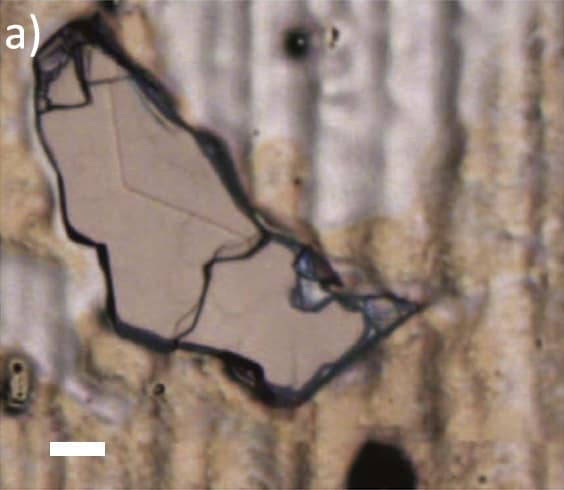
Optical micrograph of a large h-BN crystal exfoliated on a copper foil, fully covered with graphene after the growth. Credit: Journal of Physics: Materials
First what is the benefit of growing graphene on hexagonal boron nitride?
Once you can encapsulate graphene in hexagonal boron nitride – which is also atomically thin layers – you have a perfect way to protect the graphene’s quality. It is a dielectric material so if we deposit it on the right surface it also allows deposition of flatter graphene.
So it’s a very interesting combination for a lot applications in electronic devices. Beyond the fact that the association of these materials displays other interesting properties, one of the big challenges is large-scale growth of both together by CVD [chemical vapour deposition]. This work is reporting a very interesting methodology in order to get simultaneous large-scale growth of hexagonal boron nitride and graphene altogether in the same experimental process.
So could this enable large-scale use?
Exactly – all the beauty of graphene is in terms of physics, and its use for applications is related to the high quality of the material. Most of the devices that have been investigated so far having this high quality have been fabricated by so-called mechanical exfoliation: so you start with the graphite and exfoliate one layer of graphene and then do the same with a high-quality hexagonal boron nitride crystal. But in the process of transferring the layers you accumulate a huge number of defects because it is not easy.
On the contrary, with CVD growth you have all the gases and materials in the same experimental set up, and so you would grow first in this case boron nitride and then grow the graphene on top. You don’t change the atmosphere, you don’t change the condition, and you don’t transfer, so you reduce the density of defects and this is really nice. And actually in this paper they characterize the resulting carrier mobility for instance and they got really encouraging results. This challenge they have tackled is one of the most important challenges today for graphene and 2D materials research, so I’m really happy to have this paper in the issue.
Optical image of a typical T-shape encapsulated plasma resonance capacitor sample obtained by etching a broad boron nitride-graphene-boron nitride stack. Credit: Journal of Physics: Materials
What makes plasmons particularly interesting in graphene?
When you shine light on the surface of metallic materials you excite collective modes of vibrations of the electrons, and so you transfer the information you are conveying with light onto the electrons – it’s a conversion of energy and information. Contrary to metals what we gain with graphene is we can tune the charge densities with an external electric field. So we can tune the properties of the plasmons that are created with light, which is something we couldn’t do with metals before. This additional tunability of the plasmons in graphene is unique.
People have been working on plasmons in graphene in quite a high energy range because they need to reach a certain quality in terms of the plasmonic resonance. The problem is this energy range makes for easy coupling between the graphene and substrate, so the plasmons then become coupled to other surface modes of the substrate – phonons and things like that – and this reduces their quality and lifetime etc.
So what has been achieved in this paper, by encapsulating graphene between two boron nitride layers they could achieve high-quality graphene where the graphene is disconnected from the substrate thanks to the boron nitride. So then they could have excitation of plasmons that are very weakly coupled to any other source, giving access to plasmon characteristics that were not within reach when we had just graphene on the substrate. (This device is made by exfoliation as mentioned before so it is not large-scale, just one device.)
So then we could have very complex plasmon-driven devices that could be much more efficient in, for example, detecting microwave vibration or for wireless communication or sensing. So this ultrasensitivity is opening up a new perspective in the field.
Do you see potential for developing this work by direct CVD as described by the previous authors?
Fantastic question, and actually this is what these two different groups of people should do! It is clearly a necessary step to bring a discovery or demonstration, a proof of concept to one device and then to upscale to see how the device will function at large scale, under conditions with more defects etc. But they can be grown at wafer scale. So if we want to integrate a lot of these plasmon-based electronic devices, we can have hundreds or thousands or millions of them on a chip.
So these two papers are very illustrative of the challenges of research in 2D materials – on the one side you have the forefront of research trying to really get high-quality research devices, and then trying to explore what is unique about these 2D materials, and to demonstrate that they can really bring high value in terms of applications. Then on the other side you have people making efforts to integrate these materials and to upscale their growth so that they can be practical for industries in the medium term.
These materials were predicted theoretically in 2005 – in fact in 2005 a lot of things happened, also the discovery of graphene – then it took a couple more years to have an experimental demonstration, proof that these materials actually existed and could be fabricated. Since then the field has been growing in terms of the community and the interest. What makes them so interesting is they provide a new dimension for surface states with certain spin properties that can be used in the world of spintronics.
These materials have a very high spin-orbit coupling and because of their inner symmetries and the spin-orbit coupling, they have a bulk bandgap – they are insulators – but conducting surface states. These conducting surface states are very robust to any imperfection at the surface, which is why you say they are protected by topology. This strong protection of surface states, where the bulk is insulating, is a unique property of this class of topological matter.
Beyond all the interesting properties that people have been looking at so far, one very exciting property is a new quantum phase called the quantum anomalous Hall effect. It has been proposed to use magnetic impurities so that these magnetic impurities can break the robustness of these surface states and reopen a gap. But then other states are formed at the boundaries of the surface, and those states are again topologically robust and convey a type of quantum Hall effect. And this is very interesting for the standardization of conductance – the material can serve as a standard of the conductance unit because those states convey a single quantum conductance channel. In addition these states can be used to encode information and to make a kind of intransitive sensor, and so on.
What have the researchers done in this piece of work?
It turns out that doping the surface with these magnetic impurities has been studied for a long time. But the result has been very controversial, and depending on the type of magnetic dopant – manganese, cobalt or iron – people were finding different results. In some cases it would open a gap and you get this quantum anomalous Hall effect, and in some cases it was not possible. So there was a need for a much more microscopic investigation of how a particular type of magnetic impurity segregates and interacts on the surface.
What we expected is that in order to have this gap opening and the formation of these additional bondless states, we need to have these magnetic impurities interact with each other and create a magnetic state at the surface, which would be a ferromagnetic state. So this cannot happen in any kind of condition it all depends on the type of magnetic impurity, on the type of topological insulator where you deposit these impurities, and also on the density, which determines whether they will segregate or not.
What is reported in this very interesting paper is microscopic studies of the interaction in two cases – manganese and cobalt. For the first time they can provide very valuable information about how these different types of magnetic impurities behave in terms of creating or not long-range ferromagnetic ordering, which will then drive the opening of a gap and the possible formation of this quantum anomalous Hall effect.
Where do you see the field going next – does this settle the controversy?
I think this really is a step forward – they really differentiate the manganese from cobalt with a total difference between between both types of magnetic impurities. But they also show that even if you take the one that can generate ferromagnetic ordering, you can tune these properties by changing the electronic density by doping, or by changing the concentration on the surface. So again this is the tunability that they investigated and reveal. And tunability is always interesting because then you can really have a recipe, which tells you not just how to generate a property, but also how to switch it on and off just by an external electric field, for example. So I think that is opening a new dimension of research in this field.
And the authors also mention that they are very interested in spin configurations named skyrmionic states, which is a very complicated spin texture of the magnetic impurity that has potential applications in next-generation memories or spintronic technologies. I think they are opening a window to search for more complicated magnetic states at the surface. So it really is a fantastic paper to have in our journal because they are clarifying some of the controversy, but also opening a new dimension for this type of research.
Photograph of the plastic nanogap PLED device with a-Lith fabricated Al-Au nanogap structures on a PET substrate. Credit: Journal of Physics: Materials
What do the researchers mean by adhesion lithography here?
This is a specific technique that they have developed to obtain very narrow nanoscale structures, to really start to embed nanopatterning in these organic light-emitting diodes (OLEDs). So this is really based on chemistry, and they contrast this chemistry with other types of technology that can go down to very short scales in terms of patterning.
The breakthrough and the idea is to really start to develop a generation of nanoscale light sources that can become mainstream in the next-generation of let’s say ultrahigh definition and small size displays. We see OLEDs are becoming mainstream in many applications including smartphone technologies. But having a nanoscale source of light is also very interesting in the world of biotechnology and biolelectronics, where the miniaturizaiton of the light source provides an interesting property to control certain kinds of reaction induced by light at the nanoscale.
So this paper is another interesting study where there is an advance in terms of fabrication and this advance in terms of fabrication is connected to characterization of the material that is produced and really shows the perspective in terms of application. So this is again a very timely illustration of what the Journal of Physics: Materials aims to become, aims to be – that is, showing the community where we are going today in terms of the forefront of materials, and what is the prospective landscape in terms of applications.
What can they do with adhesion lithography that they couldn’t do before?
The main point is to bring metallic electrodes very very close together, with an interelectrode distance of just a few nanometres or 10 nm at most, but also to have a very large control of the aspect ratio of the electrode geometries. Then the organic material is deposited on top and bridges the gap to emit light so they have a green-light-emitting OLED. This type of lithography gives variability and versatility in terms of controlling the aspect ratio of the different materials in place, allows them then to have a versatile platform that will adapt to the needs of the application – type of light to be emitted, the dimension and so forth, and the architecture and integration of the light source on the same substrate.
Also of interest to me, they develop a technology that can be embedded on glass or plastic substrates. So this becomes a low-cost technology, and this is a very important part of the work. If you base your technology on silicon only and you want to go to miniaturization the cost is increasing higher and higher as you narrow down the size of the device. In this case glass and plastics are very common materials, the cost is very low and their technology is chemically driven so it doesn’t really add an additional cost. Instead it brings versatility, complexity in terms of the possible architectures, and it brings a light source at the nanoscale – that’s a new dimension for a lot of applications.
Suppose there were a worldwide apocalypse that would swallow up all scientific knowledge in one gulp and you could save one of these papers, which would it be?
That is a tremendously complicated question! You know I don’t think one paper will save the whole of humanity. All the papers we have been talking about today are really papers that are positioned at the forefront of peer-reviewed research and the developments of material science and technology. My guess is those papers will serve in the next years and probably decades to come in providing society with technology that is much more energy efficient. This is really one of the main challenges that we are facing today because the waste of energy in current technology is too high, and consumption is too high. Materials with improved performance means the cost in terms of energy consumption will be reduced, and this is very important for the challenge that society faces today. So maybe I would say if you have to choose one journal, maybe Journal of Physics: Materials would be one of the best to keep.
What attracted you about this journal to take on the role of editor in chief?
I accepted the offer to join as editor in chief because I was really convinced that this journal had a place to occupy – a territory to propose for various communities that was not really available elsewhere. We have to say that there are many many journals – actually the emergence of new journals is a bit impressive and overwhelming – and we see that the journals are focusing more and more on a narrower scope. Journal of Physics: Materials on the contrary wants to emphasise the quality of the science but wants to keep a large landscape so that we have a platform where advances in novel materials or the foundation for technologies will knit together and inspire other authors publishing in the journal to collaborate – as we may have with the two groups publishing on graphene related research. So that’s what we expect, and that’s why I think the journal is really bringing new value for a scientific publication, and this is why I decided to join.
I’m very happy to be so supported by IOP and the publisher of Journal of Physics: Materials. Things have been very smooth and this first issue is a great encouragement for us to proceed. We also selected a senior advisory panel and we have an editorial board, and our success is mostly due to the large contribution and excitement of many of the members of these communities. It’s not so easy – when you launch a new journal you don’t have a clear position in the landscape and you don’t have an impact factor so it’s not so straight forward for people submitting their paper because there is no impact factor and the paper cannot be tracked for a year or two. Having so many colleagues in so many different fields of materials science so enthusiastic has been a great support and encouragement for me. I think we have a very good expectation of the journal because most of our colleagues are very proactive, we have a lot of focus issues in the pipeline and another issue coming soon – they are completely driven by suggestions of editorial board members or members of the advisory panel. And it’s unbelievable how motivated most of them are and that’s a great sign for the journal to become one of the standard bearers in the years to come.
Many common materials such as glass, compacted sand and toothpaste have a solid’s rigidity but a liquid’s disordered microscopic structure. Despite their diversity, however, such “amorphous solids” share many mechanical properties. Now, Eric DeGiuli of the École Normale Supérieure in Paris has devised a field theory inspired by particle and condensed-matter physics that he says can describe how any amorphous solid behaves when subject to stress.
The atoms and molecules within amorphous solids are locked together in space but lack the uniform crystalline structure of conventional solids. This non-crystalline arrangement confers many useful properties, including the ability to withstand large forces. Many modern buildings, for example, are built using pre-stressed concrete, while some mobile phones are made from metallic glass – an amorphous solid that has many metallic properties, such as electrical conduction, but which is much stronger than a metal.
However, when glass and other amorphous solids are subject to shear stress they undergo an “avalanche” effect. A certain level of stress makes one portion of the material unstable, which then leads to instability on another portion, and so on. This makes it hard to predict at what level of stress an amorphous material will break up, so engineers often have to build in large and costly safety margins.
Invaluable theory
Scientists have observed this avalanching by compressing nanometre-high pillars until they collapse. But extrapolating those results up to macroscopic sizes is “quite challenging”, says DeGiuli given the need to consider materials with a wide range of shapes and composition. This, he says, makes a good theory invaluable. “Theory can guide you to make materials with specific properties,” he says.
That is easier said than done. Thanks to their regular crystalline structure, normal solids exist at a global energy minimum and their mechanical properties are therefore relatively easy to predict. Amorphous solids instead sit in what are known as metastable states. When molten silicate is cooled down very quickly it is not able to reach equilibrium and gets stuck in a local energy minimum, so becoming glass. Without any external forcing the material will retain that state forever – its molecules remaining in fixed relative positions. DeGiuli says that developing a theory that can predict how these different metastable states are “sampled” has proved a headache.
One approach is to assume that each small volume within an amorphous solid responds elastically when the material is subject to stress. This might explain how stress fields in glass behave. But this does not seem to apply to sand – experiments showing that grains of sand do not interact with one another elastically when the material is compacted.
Isotropic equilibrium
In his latest research, DeGiuli instead relies on two very straightforward assumptions. One, that amorphous solids are essentially isotropic – the same in all directions. And two, that such materials are in mechanical equilibrium, which means that each small volume within them experiences no net force or torque.
DeGiuli is not the first person to work from these assumptions. In 2009, Bulbul Chakraborty and Silke Henkes of Brandeis University in the US built on a statistical-mechanics model developed by Sam Edwards at the University of Cambridge in the 1980s in order to describe how stress is distributed within granular solids such as compacted sand. That model assumed that a material is equally likely to end up in any of the metastable states available to it.
To avoid the difficulty of defining and then counting metastable states, DeGiuli instead takes a more macroscopic approach. In a paper in Physical Review Letters, DeGiuli describes how he used renormalization, a mathematical scheme that reveals how the behaviour of a physical system depends on the scale used to view that system. First used in particle physics in the 1970s, renormalization has been adapted by DeGiuli to analyse a non-equilibrium system for the first time. In doing so, he could characterize a potentially infinite number of metastable states by just a handful of mathematical terms by probing materials at scales far bigger than the size their constituent particles.
Mountainous landscape
To explain his approach, DeGiuli makes an analogy between an amorphous solid and rainfall hitting a mountainous landscape – the idea being to work out where the water will end up. “I was able to construct a theory that only considers the special parts of the phase space – the rivers and lakes – rather than every point on the landscape,” he says.
DeGiuli’s field theory is more general than that of Chakraborty and Henkes, being applicable to all amorphous solids rather than just granular solids. It also predicts how stress is correlated across materials in three dimensions (rather than being limited to two). To put his theory to the test, he now plans to use it to model the mechanical behaviour of glass at low temperatures and see if he can predict certain anomalous-looking results seen in experimental data.
Not everyone is convinced by the latest research, however. Anaël Lemaître of the Laboratoire Navier in Paris, who has demonstrated the existence of long-range stress correlations in amorphous solids, argues that DeGiuli’s analysis is not rigorous because it is still based on Edwards’ model. “Sam Edwards was very careful when he introduced his theory that it was just based on an ‘analogy’ with statistical mechanics,” he says. “It may provide insights but cannot support a general proof on the properties of amorphous solids."
“The unique research focus of the Cancer Research UK City of London Centre will lay the foundation for the future of precision medicine, where existing treatments are combined with, or even replaced entirely by the latest biological therapies, with the hope of achieving lasting cures for more cancer patients," says Iain Foulkes, Cancer Research UK’s executive director of research and innovation.
Biotherapeutics include any type of treatment that is produced by, involves or manipulates living cells. Such therapies are based on biological processes in cells, which can be engineered to help fight cancer. Examples include therapeutic antibodies, cell-based therapies, vaccines and gene therapies. Immunotherapy, for instance, harnesses the body’s own immune system to eliminate cancer cells and has transformed treatment of some types of cancer.
The research includes three programmes. Programme 1 will focus on developing new biological therapies. One priority here is analysing the tumour microenvironment to understand how the patient’s immune system interacts with cancer cells. Programme 2 will look at combining biotherapeutics with other methods to maximize the effects of treatment. Finally, programme 3 will focus on the evolution of cancer and how targeted biotherapies can be used to overcome rapid changes in tumour genetics.
“There have already been huge advances in biotherapeutics and there’s enormous potential to transform how we approach the hardest to treat cancers like brain tumours and lung cancer," says Tariq Enver, centre lead at UCL. "Our ambition is for the Centre to stimulate further economic activity in biotechnology in London. London’s hospitals will also become flagship centres for treating patients with these new biological therapies, setting the standard for healthcare providers all over the world.”
Cancer patients from large parts of London, including some of the most deprived areas of the city, will have the opportunity to take part in pioneering research as part of their treatment.
“We believe that, in the future, the biotherapeutics field will transform cancer care," adds Charles Swanton, Cancer Research UK’s chief clinician. "However, there are several research challenges still to tackle. We need to understand why some patients respond to these new treatments while others don’t, and how to identify which patients might experience harmful side effects. Most importantly, we need to optimize their activity to offer more patients access to these therapies who may benefit."
“We now know more about the genetic diversity within tumours, how they evolve, and the body’s immune response to cancer, than ever before," Swanton points out. "There’s a huge opportunity to use this knowledge to develop novel biological therapies that combat tumour evolution and to inform how best to use them in combination with other cancer treatments.”
The City of London Centre will gather expertise from each partner institution, including specialists in imaging, clinical trials and tumour evolution. Research will span all cancer types, including a focus on childhood cancers, where researchers hope to build on recent progress treating children with immunotherapies.
The centre will also provide multiple new opportunities for collaboration and training. This is the first time that these leading London institutions have partnered to tackle cancer on such a large scale.
“Cancer won’t be cured by a biologist or a clinician alone,” says Enver. “We need physicists, chemists, engineers and mathematicians -- researchers from many different disciplines -- to come together to tackle the disease in new and innovative ways. The Cancer Research UK City of London Centre will be a catalyst for this scientific collaboration.”
How can spider webs withstand large impacts while remaining sensitive enough to detect and trap small flying insects? Researchers in China, the US and Australia say they may now have solved this mystery. Their new findings will not only help us better understand why spider webs are so robust but they could also help in the development of new types of impact-resistant structures for engineering applications.
Almost all biological materials have evolved exquisite structures perfectly adapted to their function, explain the researchers, who are led by Xi-Qiao-Feng of Tsinghua University and Huajian Gao of Brown University, Rhode Island. Some well-known examples include silkworm cocoons, seashells and sponge endoskeletons. Spider webs are particularly impressive since they are not only lightweight, but are also strong and elastic. As such, they are able to withstand loads from things like predator impacts, gusts of wind and raindrops.
These remarkable properties come from the fact that spiders can spin different types of silks, each with very different mechanical properties, but which work in synergy. Radial silk, for example, made of major ampullate threads, is stiff and supports the frame of the web. Spiral silk, on the other hand, which the spider generates from its flagelliform gland, is more flexible and soft. And, while radial silk is smooth and non-sticky, spiral silk threads are coated with a thin layer of glue. Thanks to Rayleigh instability, this coating breaks into uniformly distributed droplets, forming a unique bead-chain.
Uniform energy absorption
Feng, Gao and colleagues have now found that the mechanical properties of spiral silk vary significantly along the radial spokes that extend outwards from the centre of a web. These functional gradients are present regardless of thread thickness, the size of the web or the characteristics of an individual spider and make the web resistant to impacts at any point on its structure, say the researchers. What is more, thanks to the silk’s optimal mechanical properties, a web can absorb energy almost uniformly everywhere.
The researchers obtained their results by studying webs spun on special wooden frames by Araneus ventricosus spiders in their lab. They examined the silk threads under a polarized optical microscope and measured the diameter of each spiral and radial silk thread at least five times. They then used averaged diameters to calculate the tensile stress of the threads using a uniaxial nanomechanical tensile testing machine that has a load resolution of 50 nM and an extension resolution of 34 nm. These tests allowed them to calculate the threads’ strength and elasticity. They also measured the number density of the glue droplets on the spiral silks as the spiders constructed their webs and connected the web spokes.
The team performed finite element simulations too to study how the webs absorb energy. The 2D orb web model used in their simulations consists of 10 radial threads of 30 cm in diameter and 10 spiral threads. The radial silks are distributed uniformly with an angle of 36° between any two neighbouring silk threads while the spiral silks are evenly spaced 15 mm apart. To simplify matters, they assumed that both radial and spiral silks are linear elastic and that a flying insect, for example, induces a concentrated force of 50 μN perpendicular to the web plane. They calculated the stress experienced by the web and by how much it displaces when the insect lands on different silks in the web.
Spurred on by their findings, the researchers, reporting their work in Applied Physics Letters 10.1063/1.5039710, say that they now plan to look into the “striking dynamics” of spider webs during prey capture. “The principle gleaned from our study could also offer us insights to designing impact-resistant structures,” they say.
Graphene has been used to convert gigahertz-frequency electronic signals into high-harmonic, terahertz-frequency signals with extremely high efficiency. The work exploited the nonlinear properties of graphene to achieve terahertz conversion and was done by researchers in Germany at the Helmholtz Centre Dresden-Rossendorf (HZDR), the University of Duisburg-Essen (UDE) and the Max Planck Institute for Polymer Research.
Most electronic devices we use today exploit the semiconducting properties of silicon-based materials to create high-frequency signals to maximize processing speeds. Calculations have suggested that graphene – a sheet of carbon just one atom thick –could be much better suited to this task. Indeed, theoretical studies suggest that graphene could deliver signals at frequencies thousands of times higher than those created by silicon. The predicted response arises from the highly efficient nonlinear interaction between light and matter which takes place in graphene, due to its unique electronic band structure. However, no previous studies had yet achieved this conversion in the lab.
To observe the effect, the German researchers, led by Hassan Hafez at UDE, used graphene containing a large number of mobile electrons that originate from the interaction between the graphene and the substrate onto which it was deposited. When excited by rapid, gigahertz-frequency electromagnetic pulses in ambient, room-temperature conditions, these mobile electrons rapidly shared their energy with bound electrons in the material.
Electron vaporization
This causes the overall system of electrons to undergo a process that is comparable to a heated fluid making the transition from an electronic “liquid” phase to a hot “vapour” in just trillionths of a second. In turn, the graphene’s conductivity undergoes strong, rapid changes and this drives the multiplication of the frequency of the original gigahertz pulses.
This highly efficient nonlinear response results in three distinct converted signals, with three, five and seven times the frequency of the original pulses – bringing them into the terahertz range. “We have now been able to provide the first direct proof of frequency multiplication from gigahertz to terahertz in a graphene monolayer and to generate electronic signals in the terahertz range with remarkable efficiency,” explains Michael Gensch at HZDR.
The team’s result reveals a more promising future for the use of graphene in electronic devices than ever before. UDE’s Dmitry Turchinovich says, “The nonlinear coefficients describing the efficiency of the generation of this third, fifth and seventh harmonic frequency were exceptionally high”. He adds, “Graphene is thus possibly the electronic material with the strongest nonlinearity known to date. The good agreement of the measured values with our thermodynamic model suggests that we will also be able to use it to predict the properties of ultrahigh-speed nanoelectronic devices made of graphene.”
Prototype sensor with scintillating fibre inserted partially into an artificial vein. (Courtesy: Josh Knowland)
Cancerous cells have a higher metabolic activity than normal healthy cells, and clinicians use this characteristic to trace cancer metastasis within a patient’s body. 18F-flurodeoxyglucose (FDG), a glucose analogue, is a frequent candidate for these types of assessments as its distribution correlates to metabolic activity. This distribution can then be evaluated by capturing the gamma-ray signals emitted within a patient using PET. Static PET images enable a qualitative assessment of the distribution of the radiotracer, but to improve disease prediction, a more quantitative approach is required.
A kinetic analysis of radiotracer distribution over time would provide quantitative results. However, this requires ongoing measurement of radiotracer concentration in blood. A few methods for continuous radio-tracing exist, but there are logistical and technical issues that make them impractical for clinical use. For instance, one method requires continuous blood drawing from a patient, while another relies on non-specific input functions generated from population-based patient data.
Frustrated by existing tools, Charles Scarantino, a retired radiation oncologist, and Josh Knowland, an electrical engineer, co-founded Lucerno Dynamics to develop clinically useful devices based on scintillation detection of radiation. They describe a prototype device that they’ve developed and report on the initial feasibility tests in blood vessel mimics (J. Nucl. Med. Technol.10.2967/jnmt.118.212266).
“Our motivation was to develop a simpler, patient-friendly method of measuring the concentration of radiotracer,” says Knowland. “Our approach would be personalized to the individual patient, would not require additional patient time in the PET scanner, and would not require sampling of blood for external handling and measurement.”
A simple system
The device is constructed from polystyrene-based scintillating fibres that convert radioactive energy into visible light. The fibres don’t have the power to distinguish gamma-ray radiation; instead they detect the beta particles emitted by the radiotracer. There are some preclinical examples of the use of scintillation fibres in animal tissues and blood vessels, but Lucerno Dynamics hopes to build on these studies and develop a new device for future use in humans.
Knowland’s team integrated commercially available scintillation fibres into a venous access catheter. Critical to prototype development was the need to minimize light loss, and so the team developed processes to couple the fibre to a highly sensitive silicon photomultiplier, which converts light into an electrical signal for measurement.
Prototype fibres of two different diameters (0.25 and 0.50 mm) were inserted into artificial veins – thin-walled plastic tubing filled with varied concentrations of radiotracer. In this way, the team tested performance characteristics such as linearity and sensitivity, as well as the inner-vein-signal to outer-vein-“noise” ratio.
“We were able to successfully measure radiotracer concentration within the artificial veins,” says Knowland. “The device output was linear over the range of concentrations expected clinically and it produced approximately 450 counts per second per mega-Becquerel per millilitre.”
A scintillating future
Lucerno Dynamics are highly positive about these initial feasibility tests, but point out a number of challenges they are working to overcome. “It was more difficult than we anticipated to position and align the fibres within the artificial veins. When a fraction of a millimetre can matter, you must be very precise and careful,” Knowland explains. The team also aims to increase device sensitivity and investigate a greater range in vein diameters.
Another major consideration is that the current standard and best location for measuring radiotracer concentration is in arterial blood, not venous. Arterial access is more difficult and painful, which is why the team have focused on venous access here. “We hope to show that modifications can be made to the kinetic analysis models to allow for the use of venous blood instead,” said Knowland.
The scientists are also working to miniaturize the electronics for clinical use, and hope to soon validate the safety and efficacy in animal, and then human studies. “The device would be a sterile, single-use device that reduces the difficulty of measuring the input function and brings the power of kinetic analysis out of research and into the treatment process for all patients,” said Knowland.
Researchers in the US have shown that they can manufacture sub-micron fibres of collagen faster than ever before using a technique they have dubbed “pneumatospinning”. The technique, which makes use of high-speed air jets to form the microfibres, can produce both isotropic and anisotropic collagen strands – which is essential if the material is to be exploited in biomedical applications such as tissue repair. The technology could be used to make new medical devices as well as repair existing ones, and to make topical dressings for burns, ulcers and wounds.
Pneumatospinning in action
Collagen is currently manufactured using electrospinning, a well-established bottom-up fibre production method that dates back to at least the beginning of the last century. It can be used to generate 3D fibrous scaffolds for tissue-engineering applications, and can produce fibres with diameters ranging from tens of nanometres to several microns.
There is a problem, however, in that electrospinning normally involves using caustic solvents. These denature the fibres, resulting in structures that are weaker and less stable than native collagen fibrils. The technique also typically creates unaligned fibres, which cannot be used for applications such as connective tissue repair that require highly aligned material. Perhaps most importantly, pure collagen microfibres can only be synthesized very slowly using this process, which means that it cannot be used to produce large quantities of material on a commercial scale.
Creating cytocompatible microfibres
Researchers led by Michael Francis, who is the chief science officer of Embody LLC in Norfolk, Virginia, have now found that a benign solvent (acetic acid) can be used to dissolve type I collagen (Biofabrication10 045004). The solvent can then be volatized using high-speed compressed air jets, allowing the collagen I to polymerize into cytocompatible microfibres. This pneumatospinning technique uses the air jets not only to extend the flow of a biopolymer (in this case pure telocollagen and atelocollagen) but also to evaporate the solvent from the polymer solution to produce sub-micron fibres.
Francis and colleagues have also produced a blended microfibrous biomaterial by pneumatospinning collagen with poly(D,L-Lactide) using dimethyl sulfoxide (DMSO), another benign solvent. All type I collagen starting material was obtained from calfskin.
“We spent a lot of time and energy developing the benign solvents for this study so that our approach might better translate to clinical applications,” says Francis.
Better tensile properties
In the next part of the study, the researchers cross-linked the microfibres to create collagen scaffolds. Subsequent analysis revealed that the scaffolds contain regularly sized fibres that had not undergone any deleterious chemical changes during the pneumatospinning process.
SEM of aligned pneumatospun collagen
The pneumatospun collagen has many advantages over collagen produced by conventional methods, says Francis. “The first is that it can be better assembled from the bottom up. This means that it has an improved molecular structure and better tensile properties compared to electrospun material. What's more, stem cells cultured on this collagen also attach robustly, which proves that the material is biocompatible." The technique can be used to produce both isotropic and anisotropic collagen strands, which is particularly valuable for applications that require highly aligned fibres.
Francis believes that the technology offers huge potential both for fabricating new medical devices and for coating existing devices to repair them. “The collagen produced could also be used to repair ligaments, tendons and nerves, as well as to make fibrous dressings for burns and ulcers and topical meshes for wounds," he told Physics World. "It might even be used to coat other materials, such as polymers and metals, to improve graft integration and compatibility.”
The researchers, reporting their work in the IOP journal Biofabrication, say that they are now hope to exploit the collagen structures for in vivo wound healing. “We have also started to look at pneumatospinning pure collagen, again from benign solvents, that is stable in water without cross-linking. We have already obtained successful preliminary results here and further studies will ultimately help us to translate this technology to the clinic.”
Read our special collection “Frontiers in biofabrication” to learn more about the latest advances in tissue engineering. This article is one of a series of reports highlighting high-impact research published in Biofabrication.
The result, which highlights one of the areas of climate change research where Africa lags behind other continents, is part of a broader effort by Veronika Jorch of Thünen Institute of Climate-Smart Agriculture, Germany, and colleagues to establish a pan-African research infrastructure for greenhouse gas emissions.
The researchers believe that such an infrastructure would help in climate change prediction, mitigation and adaptation for the continent.
“A research infrastructure does not just appear like mushrooms after a bit of rain,” says Jorch. “It is a long process, and various factors have to come together.”
The team believes the infrastructure should include an extensive network of greenhouse-gas monitoring stations; a common goal to study the data from those stations and develop strategies for climate-change mitigation and adaptation; people to run the infrastructure; an international network of partners from different sectors; and long-term political and financial stability. It should also have a name. Europe’s greenhouse-gas research infrastructure, for example, is known as the Integrated Carbon Observation System (ICOS).
Africa has some elements of a research infrastructure, but according to Jorch it is particularly lacking in its international network. “There are enough potential partners and the willingness to build the network, but […] there is no long-term funding,” she says. “This means that the available corresponding greenhouse gas data are patchy and heterogeneous.”
Jorch and colleagues, who are based at more than 15 institutions across Africa and Europe, have taken the first steps to establishing a pan-African research infrastructure as part of the SEACRIFOG project, funded by the European Union’s Horizon 2020 framework. This part of the SEACRIFOG project, which Jorch coordinates, included an engagement with key stakeholders, a definition of key terms and an assessment of existing infrastructure.
The results showed that the number of observational stations in Africa was well below that in Europe or the US. For instance, the density of Global Atmospheric Watch stations, which measure levels of greenhouse gases, aerosols and other reactive gases, is almost 25 times lower than in Europe. The density of recordings is particularly poor in important ecosystems such as wetlands, the researchers say, but is greater in populated areas.
Stakeholders, meanwhile, raised concerns with the researchers about data quality and accessibility, and the lack of international networking, among other issues. In the final step, the researchers identified the key measurements needed to fill in the knowledge gaps.
“This future research infrastructure will allow us to understand better, and consequently predict better, the drivers, impacts and feedback loops between African ecosystems and climate change in the long term,” says Ana López-Ballesteros at Trinity College Dublin in Ireland.