Elevated intracranial pressure following an accident can lead to brain injury and spinal cord damage. Currently, such pressure increases are detected using a sensor that’s surgically inserted into the patient’s skull in an operating theatre. A new tool offers the potential to perform diagnostic tests at the scene of the accident, using non-invasive ultrasound eye examinations to detect elevations in intracranial pressure.
The tool was developed by researchers at SINTEF, in collaboration with paediatric neurosurgeon Llewellyn Padayachy from the University of Cape Town and Red Cross War Memorial Children’s Hospital. The project was launched by a study involving 16 paediatric patients in South Africa: eight who suffered from elevated cranial pressure and eight with normal levels. “We obtained good results with high levels of clinical accuracy, and using these were able to further develop the technology,” says SINTEF researcher Reidar Brekken.
The research group in Cape Town has now completed a new study of 28 patients, in which the ultrasound data were analysed using software developed by the SINTEF team. This study included children undergoing invasive intracranial pressure measurement as part of their clinical management. Prior to these measurements, the researchers acquired ultrasound images of the optic nerve sheath and processed them to obtain the deformability index (DI), a parameter quantifying the pulsatile nature of the optic nerve sheath.
Results showed that the DI was significantly lower for patients with high versus normal intracranial pressure. A DI cut-off value of 0.185 of below demonstrated 89.5% sensitivity and 88.9% specificity. Combining the DI with measurement of optic nerve sheath diameter (ONSD) improved the sensitivity to 94.7%. The team also saw improved correlation with intracranial pressure measurements when using a combined analysis of DI and ONSD (Operative Neurosurgery 10.1093/ons/opy231).
The first version of the ultrasound device was manually-operated and demanded high levels of specialist expertise. Now, the team has incorporated artificial intelligence into the technology to make it more user-friendly. This will enable many more people to operate the tool and enable intracranial pressure measurements to be carried out at an earlier stage — allowing ambulance personnel to perform examinations at accident scenes, for example.
“For the most part, artificial intelligence assists by automating the measurement process,” explains Brekken. “Whereas previously we had to input data manually and identify structures displayed on the resulting image, our aim now is that the only thing an operator has to do is place the ultrasound probe on the patient’s eye. The machine will then identify the structures and deliver the measurement results.”
Brekken emphasizes that performing clinical assessments at accident scenes will make a significant difference to the patient. “It will help to save lives and prevent potential brain damage,” he says. “It will also be less expensive to implement because there will be no need to transport patients for costly surgical interventions in operating theatres in order to perform an examination.”
The team now intends to further advance and quality assure the technology, as well as develop the artificial intelligence component into a diagnostics tool. Immediate plans include testing the device on 200 patients suffering from head injuries, in collaboration with neurosurgeon Eirik Helseth at the Ullevål University Hospital. This will be the first time that the technology will be tested on adults.
The researchers are also looking into ways to exploit this technology beyond the examination of head injuries. “It isn’t just traumas such as blows to the head that cause elevations in intracranial pressure,” says Brekken. “Other neurological conditions, such as brain tumours and haemorrhaging can also result in pressure increases.”
The device is currently being commercialized by the company NiSonic.
Austrian researchers have bad news for those nations alarmed about climate change: the Arctic thaw means the chances that the world will exceed the global warming limit set by international agreement are high – and getting ever higher with every tiny shift in the planetary thermometer.
Methane is a greenhouse gas far more potent than carbon dioxide. And as it seeps into the atmosphere, the chances that the world will overshoot its promise to contain planetary warming to “well below” 2 °C increase.
This target was agreed by 195 nations at a summit in Paris in 2015. The promise implicit in this historic decision was that the world would by 2100 be no hotter than 1.5 °C above historic levels.
Global average temperatures have already risen by about 1 °C in the last century, thanks to unconstrained combustion of fossil fuels that deposit ancient stored carbon back into the atmosphere in the form of ever more carbon dioxide.
But, says an international team led by Thomas Gasser of the International Institute for Applied Systems Analysis in Austria, there are prodigious amounts of carbon stored in the world’s once permanently frozen soils. As these are released, the chances are that global warming will accelerate.
“Permafrost carbon release from previously frozen organic matter is caused by global warming, and will certainly diminish the budget of CO2 we can emit while staying below a certain level of global warming,” Gasser says.
“It is also an irreversible process over the course of a few centuries, and may therefore be considered a ‘tipping’ element of the Earth’s carbon-climate system that puts the linear approximation of the emission budget framework to the test.”
The message behind the formal language of a paper in the journal Nature Geoscience is simple: the world has less time to act than the presidents and prime ministers who signed the Paris Declaration may think.
It is one thing to slow the rate of global warming by drastically reducing fossil fuel emissions and restoring the world’s forests so as to arrive at a limit; quite another thing to overshoot the limit and then try to reduce the planetary temperature, the latest study suggests. There is no simple correlation between burning coal or oil and the planetary temperatures that follow.
“Overshooting is a risky strategy and getting back to lower levels after an overshoot will be extremely difficult. However, since we are officially on an overshooting trajectory, we have to prepare ourselves for the possibility that we may never get back to safer levels of warming,” Gasser says.
“Policymakers should understand that there is no elementary proportionality between cumulative CO2 emissions due to human activity and global temperature, as previously believed, and that overshooting may have serious consequences.”
This episode of Physics World Weekly has a laser focus on one thing: the 2018 Nobel Prize for Physics. On Tuesday, Arthur Ashkin, Gérard Mourou and Donna Strickland joined the pantheon of Nobel laureates for their “groundbreaking inventions in the field of laser physics”. Ashkin scooped half the prize for his work on “optical tweezers and their application to biological systems”. While Mourou and Strickland share the other half “for their method of generating high-intensity ultrashort optical pulses”.
Physics World’s general physics editor Hamish Johnston is in conversation with multimedia editor James Dacey about the prize. Of course, one of the notable aspects of this year’s prize is that Donna Strickland is the first woman to win a physics Nobel for 55 years. Regrettably, Strickland is only the third woman in history to win the prize, after Marie Curie (1903) and Maria Goeppert Mayer (1963). Strickland features in the podcast, in a phone conversation with the media shortly after the prize announcement (audio courtesy of the Royal Swedish Academy of Sciences).
At the end of the podcast, Dacey also gives a round-up of the other news stories from this week. That includes CERN’s decision to suspend the Italian theoretical physicist Alessandro Strumia, pending an investigation into Strumia’s controversial presentation at an inaugural CERN workshop on high-energy theory and gender.
If you enjoy the podcast, then you can subscribe via the Apple podcast app or your chosen podcast host.
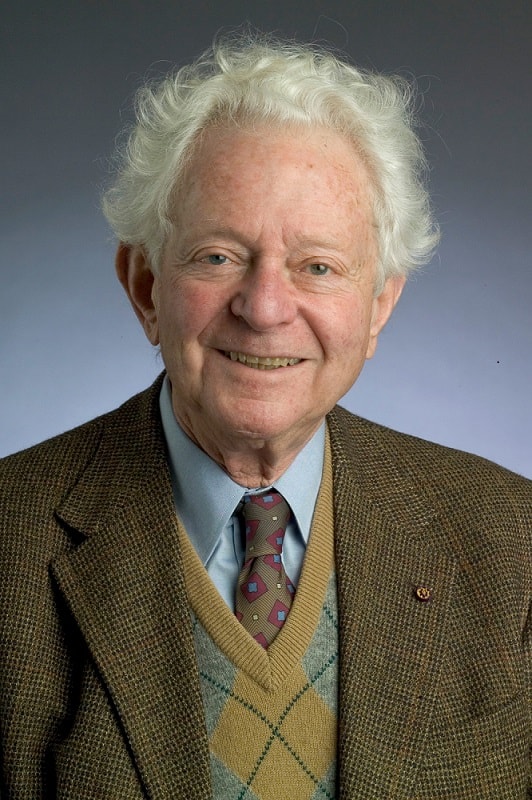
Particle pioneer: Leon Lederman. (Courtesy: Fermilab)
Leon Lederman, the US particle physicist who shared the 1988 Nobel Prize for Physics with Melvin Schwartz and Jack Steinberger, died on 3 October aged 96. Lederman pioneered experiments at Brookhaven National Laboratory (BNL) in the early 1960s that led to the discovery of multiple types of neutrino. He also served as director of the Fermi National Accelerator Laboratory in Illinois.
Born in New York City on 15 July 1922, Lederman studied chemistry at City College New York graduating in 1943. After three years serving in the Second World War, Lederman was awarded a PhD in physics from Columbia University in 1951. He then remained at Columbia University until 1978 before succeeding Robert Wilson as head of Fermilab – a position he held until retiring in 1989.
Lederman made a number of pioneering contributions to particle physics, particularly neutrino physics. Neutrinos are particles with no electrical charge that interact very weakly with matter – making them extremely difficult to detect. Their existence was first predicted in 1930 by Wolfgang Pauli and first detected in 1956 when Frederick Reines and Clyde Cowan spotted electron antineutrinos emitted by a nuclear reactor, for which the pair went on to win the 1995 Nobel Prize for Physics.
[Lederman’s] leadership helped to shape the field of particle physics, designing, building and operating the Tevatron and positioning the laboratory to become a world leader in accelerator and neutrino science
Nigel Lockyer
In 1957 the Italian physicist Bruno Pontecorvo suggested that multiple types, or “flavours”, of neutrinos exist and that they can change, or “oscillate”, from one to another. That was confirmed in 1962 when Lederman – along with Schwartz and Steinberger – observed the existence of the muon neutrino in experiments using Brookhaven’s Alternating Gradient Synchrotron. This involved firing a beam of high-energy protons into a metal beryllium target. The resulting cascade of particles included muons – a heavier version of the electron – as well as neutrinos. A 13.5 m-thick steel wall was then used to remove all the particles except neutrinos, which were detected by watching the sparks created when the particles interacted very occasionally with the atoms in a ten-tonne aluminium detector.
Because the neutrino reactions in the detector only ever produced muons, rather than electrons, they concluded that neutrinos must come in at least two types – muon neutrinos and electron neutrinos. It was for this work that the trio shared the 1988 Nobel Prize for Physics. A third type of neutrino – the tau – was predicted in 1975 and discovered in 2000.
The “god particle”
The discovery of multiple types of neutrinos was not the only major contribution Lederman made to particle physics. In the 1950s he was part of a team working at the BNL that discovered the long-lived neutral K meson. As head of Fermilab, Lederman also led the team that discovered the bottom quark as well as headed the effort to build the Tevatron collider – which was the world’s highest energy particle collider from 1983 to 2010.
Lederman was also passionate about education and outreach. In 1985 he helped found the Illinois Math and Science Academy and as director of Fermilab he established the ongoing Saturday Morning Physics programme for students to learn more about particle physics. In 2008, he even set up a stall on the corner of 34th Street and 8th Avenue in New York City where he answered science questions from the public.
Lederman is also known for his 1993 book The God Particle: If the Universe Is the Answer, What Is the Question?, in which he attempted to rename the Higgs particle as the “God particle”. The term failed to convince particle physicists who stuck to the original name for the boson that was first discovered at CERN’s Large Hadron Collider in 2012.
Along with the Nobel prize, Lederman was awarded the 1965 National Medal of Science, the Wolf Prize for Physics in 1982, the Enrico Fermi Award in 1992 as well as the Vannevar Bush Award in 2012 for exceptional lifelong leaders in science and technology. In May 2015 Lederman’s Nobel Prize gold medal was sold at auction for $765 000 to help pay his medical bills following a diagnosis of dementia.
“[Lederman’s] leadership helped to shape the field of particle physics, designing, building and operating the Tevatron and positioning the laboratory to become a world leader in accelerator and neutrino science,” says current Fermilab director Nigel Lockyer. “[He] had an immeasurable impact on the evolution of our laboratory and our commitment to future generations of scientists, and his legacy will live on in our daily work and our outreach efforts.”
A handheld “biopen” capable of 3D printing cartilage tissue could for the first time be used during surgery to treat cartilage injuries and osteoarthritus. The extrusion-based device, which prints live stem cells embedded in a hydrogel material, produces constructs that look and behave just like natural articular tissue (Biofabrication10045006).
“This is in stark contrast to conventional reparative cartilage made of fibrocartilage, which is very different in structure to physiological cartilage, inferior in quality and not durable,” say the researchers, a multidisciplinary team that includes surgeons, biologists, physicists and engineers. “Our technique and the scaffolds we are able to produce provide much hope for treating patients suffering from cartilage injuries and osteoarthritis.”
Cartilage is a highly specialized tissue that has so far proved difficult to replicate using conventional tissue engineering techniques. Its special mechanical properties arise from the fact that it contains only a few cells, does not contain blood vessels, and has a distinct 3D collagen fibre structure comprising aggregated proteoglycans in an organized matrix.
While some success has been reported for surgical treatments that exploit engineered cartilage tissue, existing procedures require two separate operations: one to remove the damaged tissue, and another to replace the tissue once it is repaired. What’s more, surgeons report a high failure rate – partly because pre-fabricated scaffolds might not perfectly match the defect, and partly because the implanted tissue is not similar enough to natural cartilage to survive for long inside the body.
Researchers believe that treatments using human stem cells could offer a solution, but few studies have been reported to date. In this new work, reported in the journal Biofabrication, scientists from the University of Melbourne, the University of Wollongong and the St Vincent’s Hospital of Melbourne provide in vitro evidence that their new biopen could enable human stem cells to be 3D printed inside the operating theatre. The ultimate aim is to enable surgeons to “sculpt” patient-specific structures in real time, creating scaffolds that perfectly match the geometry of the defect and achieve the best possible contact between the bioscaffold and the host tissue.
The team tested their approach with human-derived mesenchymal stem cells (hADSCs) that had been harvested from the infra-patellar fat pad of donor patients with osteoarthritis. Once the stem cells had been embedded in a hydrogel material, the resulting bioink could be extruded through the biopen to create a cell-laden bioscaffold.
One key feature of the new biopen is a specially designed nozzle that allows cells and biomaterials contained in separate cartridges to be extruded co-axially. The inner core of the extruded material contains live stem cells, while the outer shell contains cross-linked material that provides rigidity to the printed construct.
In this study the researchers used the biopen to print 3D scaffolds laden with stem cells, which were then cultured in vitrofor eight weeks in the presence of cartilage-forming media. “Thanks to a series of sophisticated histological, molecular and imaging techniques, we confirmed that the tissue that developed within the constructs forms, appears, and behaves like articular cartilage,” say the researchers. “This material is expected to be as durable as real cartilage.”
This detailed in vitro analysis is a crucial step towards full-scale clinical trials. The group has already shown that the device could be used in a real-world setting through preliminary in vivo experiments in a large animal model, and more extensive in vivo testing will be needed before the biopen can be tested on humans.
At the same time, the researchers are investigating whether the same technology could be applied to other organs and clinical scenarios, while also looking at ways to speed up and streamline the processes needed during surgery.
“We are refining our methodology to upscale the production of the inks used in the device, and to fine-tune how to harvest and prepare the mesenchymal stem cells,” they say. “We are also aiming to develop a protocol that will enable one-step harvesting, preparation and delivery of the cells during surgery.”
Read our special collection “Frontiers in biofabrication” to learn more about the latest advances in tissue engineering. This article is one of a series of reports highlighting high-impact research published in Biofabrication.
Patients receiving stereotactic body radiotherapy (SBRT) for central lung tumours face an increased risk of central airway toxicity, which in some cases may be potentially life-threatening. Markerless 3D monitoring of the proximal bronchial tree (PBT) could help manage this risk by tracking the position and motion of airways relative to the tumour, while offering a more reliable tracking option than reflective or implanted markers. Accurate real-time position monitoring could alert users to interrupt radiation treatment if the PBT position deviates beyond a pre-determined threshold.
Researchers at VU University Medical Center have investigated PBT motion monitoring using a markerless template matching and triangulation technique, based on kilovoltage (kV) projection images acquired during linac gantry rotation. Their study demonstrated that the technique is technically feasible for use during central lung SBRT (Radiother. Oncol. 10.1016/jradonc.2018.08.007).
Lead investigators Max Dahele and Wilko Verbakel from VUmc’s department of radiation oncology, together with doctoral student Colien Hazelaar and colleagues, conducted a feasibility study of markerless 3D position monitoring using kV projection images, which offer the capability for simultaneous visualization of tumour and airway position. They examined cone-beam CT (CBCT) projections of a 3D printed thorax phantom and clinical data, and employed prototype software for template generation, template matching and triangulation to determine bronchus motion in three dimensions.
Four-dimensional CT is used for treatment planning to determine a patient’s breathing motion and relative positions of organs-at-risk (OAR). However, these positions may change during the actual treatment. Internal and external markers can be used to monitor motion during treatment, but any marker is just a surrogate and may not capture the actual motion of the airway. This is not the case with real-time markerless position monitoring of the airways themselves.
Matching motion
The researchers created a 3D printed phantom consisting of soft tissue, bony structures, airways, lungs with blood vessels, and three lung tumours (Med. Phys. 45 92). They simulated irregular breathing motion by automatically moving the treatment couch, and acquired kV images for a full arc at 15 frames/second. Two structures, representing the left and right PBTs, were delineated on the planning CT scan. They also performed fluoroscopy during MV irradiation, acquiring images at 7 frames/second.
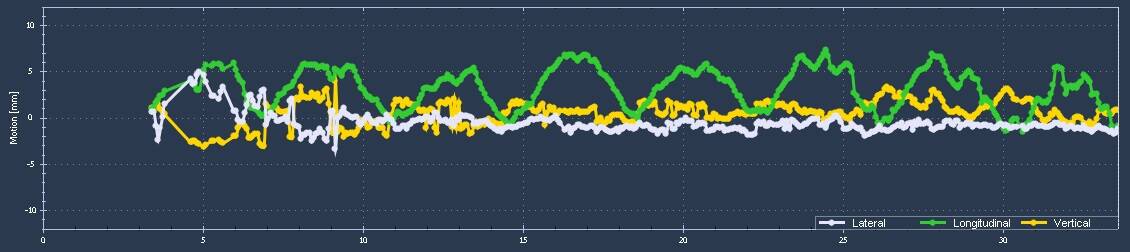
A typical trace showing the motion of a patient’s airway. (Courtesy: Wilko Verbakel)
In addition, the researchers retrospectively analysed full-fan CBCT images (without irradiation, with 470-500 images per dataset) from 10 patients who had undergone free-breathing stereotactic or hypofractionated lung irradiation. All patients had tumours located within the field-of-view of a full-fan CBCT scan, with half of the tumours on the right side of the lung. The PBTs were similarly delineated.
The authors used prototype software (template-based tracking and the Sequential Stereo algorithm) to create 2D reference templates for every degree of gantry rotation. The templates included the delineated airways plus a 4 mm isotropic margin to include the airway walls. They selected the template associated with the gantry angle closest to the projection image. They matched the templates to the projection images for 2D PBT position using normalized cross-correlation; and used multiple registrations triangulated to determine the 3D position.
The right PBT had a better matching performance than the left PBT, which the authors attributed to the mediastinum being more obscured on the left side. In the phantom, the 2D right/left PBT position could be determined in 86.6%/75.1% of the CBCT datasets without MV irradiation; the 3D position (excluding the first 20°) was determined in 84.7%/72.7% of datasets.
In the patient dataset, there were no remarkable differences in matching performance between the left and right PBT, with 2D position determined in 89.8% of each dataset, 3D position in 76.4%, and 3D position (excluding the first 20°) in 85.1%. The authors suggested that performance could potentially be improved by analysing more data and creating more optimal triangulation parameter settings. They note that dynamic adjustment of kV and mA might offset poorer results of template matching when image quality was poor. They also advised that a different structure with distinguishable features could be used, such as branches of the PBT.
“We are currently using the same software for continuous spine position tracking during spine SBRT delivery,” Verbakel tells Physics World. “It is updated sub-second, and the accuracy is in the order of 0.3 mm. If the spine position during radiation delivery is more than 1 mm off, we interrupt the treatment for a new setup CBCT scan (Int. J. Radiat. Oncol. Biol. Phys.101 1253).”
“We can also use the software for lung tumour position monitoring during breath-hold lung SBRT delivery,” he explains. “Since there can be large inter-breath-hold variation, we like to monitor if the tumour is indeed within the PTV. In case the tumour moves outside the PTV, we interrupt the treatment and do a new breath-hold, or a new setup CBCT scan (Phys. Med. Biol.63 115005).”
Leading the way: Julia Higgins has been ever-present in UK physics over the last three decades. (Courtesy: Imperial College London)
Let’s rewind the clock to 1988. What were you doing back then?
I was a reader here in the chemical-engineering department at Imperial College in London. I was running a group, doing research on polymers using neutron scattering. I was just beginning to focus on polymer mixtures and blends, which became a main theme of my work. But I was also starting to do things with the research councils, for example serving on research-council committees.
What were your main scientific interests?
I was looking at the thermodynamics of polymer mixtures and seeing what happens if you add shear flow – in essence if you stretch or stir the system. When polymer materials are processed, they’re subject to quite strong rheological forces. People were beginning to suggest that viscoelastic effects would affect the miscibility so they might or might not stay mixed when processed. I was just starting to set up research in that area, which became quite fruitful in the 1990s and beyond.
What were your main professional concerns at the time?
Getting enough funding. There was a period in the mid-1980s when I had no research grants. I kept getting responses from the Science and Engineering Research Council saying [my proposals are] alpha quality but just below the cut-off. I had five or six research students funded by various mechanisms but no postdocs. And that’s quite difficult, to run a group with no postdocs. You need some senior people. Fortunately, my career was still advancing and I became a professor the following year.
What have been the highlights of your research over the last 30 years?
People studying polymer mixtures and blends wanted to see individual molecules, but to distinguish one molecule from all the others near it you need a labelling technique. Neutron scattering offered that, because the neutron is scattered differently by a deuterium atom than by a hydrogen atom. And it’s not difficult, chemically, to make polymer molecules where all the hydrogen has been replaced by deuterium. So thanks to neutrons, we were able to look at the shape of the molecule, at what happens when you stretch them, and what happens when they phase separate.
What would you say were the biggest breakthroughs overall in physics in the last 30 years?
The trouble is you tend to think of big physics, don’t you? So things like the Higgs boson and gravitational waves. A lot of interesting stuff has also been done using space missions. But that isn’t all of physics. It’s the glamorous bit, but there’s a lot of very exciting physics going on at smaller scales that doesn’t require great big pieces of apparatus.
How has that kind of smaller science changed?
In my own field, three things have happened. One is that chemical synthesis has become more sophisticated. People can now make the polymers that I need, with the right size, with the right nuclei in them. So we now have much better controlled materials. Second, the modelling of materials has improved hugely. And third, there have been advances in techniques like synchrotrons, spallation neutron sources and nuclear-magnetic resonance. People used to say physicists do beautiful experiments on rubbish samples, while chemists make beautiful samples, but don’t do very good experiments. That’s all changed.
Would you say life has become easier or harder for researchers in the last three decades?
My observation is that life’s got harder for young academics, who have so many pressures on their time. For a lecturer starting out [in the UK], getting funding is more difficult, especially if you’re in a university further down the pecking order. And the Research Evaluation Framework means there’s more pressure from your university to go and get that funding. Teaching also takes more time because it’s got to be so accountable. The psychological pressure on young staff is definitely worse.
Life’s got harder for young academics, who have so many pressures on their time
Julia Higgins
What about physics students: are they more demanding than they used to be?
They expect a lot more. They want detailed lecture notes given to them. We tended to lecture, and expect the students to take notes. Now they want more contact time and fast feedback on their work. They also expect us to provide model answers to past exam questions, as well as to problem sheets.
How else has physics education in the UK changed over the last 30 years?
I remember an article back then saying that even if we recruited every student studying physics in a UK university into teaching, we still wouldn’t fill the gap in teacher numbers. I’m not sure that much has changed since then – we have some terrific teachers, but there just aren’t enough of them. And that in turn is because the number of students doing physics is still too low – and the number of girls is dreadfully low. The Institute of Physics (IOP) has been doing a lot of work looking at gender prejudices about subject choices, which shows there is a culture of unconscious bias in our schools that’s much stronger than in the rest of the world.
If you could wave a magic wand, what would you do to get more people studying physics?
I’d introduce a Baccalaureate system [where students study a range of subjects] rather than forcing pupils to do three A-levels. Reducing pupils’ choices to just three subjects puts us on a hiding to nothing as too many people drop out of physics. I’d love to create loads of physics teachers, but no-one can produce them in the short term. That would make a big difference. More generally, I’d change the pressure we have to finish education at the age of 21 or 22. If everyone is going to be working until they’re 90, why couldn’t we extend the period of education so that people don’t just do a broader mix of subjects in school, but at university too?
There have been huge advances in communication technology over the last 30 years – have they helped or hindered researchers?
I remember in 1987 I went on a sabbatical in Germany and the visit all had to be set up using the postal system. We didn’t have e-mail, and faxes were only just coming in. Now if you want to organize a round trip to Germany, you just lob off e-mails to all the people you want to see. Back then we were also only just beginning to get diagrams drawn on computer. Now if you look at posters on the wall in any laboratory they’re beautiful. We had to make posters using Letraset. Seriously. I was still doing most of my talks using foils and an overhead projector. Online publishing has changed things too. Instant access to journals and back catalogues has made a big difference – we don’t have to go traipsing off to the library and clambering round the stacks. It’s just so easy.
So we can communicate and work faster – but has that raised the quality of research?
Students these days do quite sophisticated model fitting to their data without blinking. When I first did neutron scattering, I had data on magnetic tape or cards. And to analyse it, we had to write our own programs. Now I’m not advocating we go back to the past, but the fact that data are plotted automatically can mislead about the quality of the answer you’re getting. So there are different traps for students now than we had back then.
Nurturing talent: Julia Higgins is a strong supporter of female scientists, with her eponymous award – given last year to physicist Jess Wade – honouring those who have helped women at Imperial College, London. (Courtesy: Imperial College London/Fergus Burnett)
You’re the first woman to be a fellow of both the Royal Society and the Royal Academy of Engineering. Are you content with the progress women in physics have made over the last 30 years?
Oh, no. Things have improved but not nearly enough. When I became a professor the year after [Physics World started] I doubled the number of female professors in the whole of Imperial. Two of us were in this department and nobody anywhere else. The proportion of female professors [at Imperial] is now about 20%, partly because we have now got a medical school and there are more women in that field. It’s undoubtedly much better than it was, but it’s still not equal numbers.
Have you seen a change in the way colleagues talk about diversity?
In the late 1990s I was involved in setting up the Athena project and the first diversity committee [at Imperial]. It was focused specifically on female academics, because there were so few of them and we weren’t changing the numbers. Now, Imperial has a very strong diversity and equality committee, directly under the provost. It has all sorts of events year on year, celebrating the women’s academic achievements There are even a few portraits of women to dilute the heavy male presence on the walls.
Do you think quotas can help more women into senior roles?
I’m not a fan of quotas because I don’t know any woman, including myself, who would like to have been picked because they were a woman. Quotas don’t solve the problem. However, I am in favour of positive action. In some departments, when your shortlist doesn’t have any women on it, you have to go back, re-look at the applications, and get some women on the shortlist. So you can do positive intervention. You can go out and find the women and say, come and apply. We will look after you, even though you don’t promise them the job.
There have been a few high-profile cases of sexual misconduct involving various physicists in research years. What’s your reaction to them?
It’s appalling. Any relationship where you have a mismatch in power is dangerous. So if you have a man running a group and a woman who is the research student or the assistant, that produces the possibility of harassment or misbehaviour. I think it’s always been going on but people now feel more empowered to speak about it. It’s the misuse of power that’s really at the root of the problem. It doesn’t happen between equals in the same way – at least, that’s my observation. Institutions need mechanisms in place for dealing with it, such as the IOP Juno scheme.
Have you suffered any sexism?
Oh, yeah. Let me give you two examples. I was once on a big Royal Society committee and the chairman was late arriving, so somebody else took his place. I happened to be sitting next to the replacement chairman when the real chairman came in. He sat down beside me, looked at me and said: “Could you get me a cup of coffee?” Well, I thought, he’s got to chair the meeting so I went and got him a coffee. A little bit later in the meeting, he turned to me and asked: “And can you tell me the arrangements for lunch?” The people in the meeting saw my face and told me afterwards I looked like thunder. But you know? I just said “No” and then explained who he should ask. And I think he was more embarrassed than I was. So that was one example.
And what was the other instance?
About 10 years ago I was chairing one of the Research Assessment Exercise’s “super panels”, which brought together several subject panels, so the participants didn’t really know each other. Somebody came up to me and said: “Very nice to meet you. Are you the nice lady who arranged my travel?” Now, I was standing with two other female fellows of the Royal Society and we just laughed at him. To make that sort of mistake is just crass. Well, I can laugh as I’m in a position of power now, but would it have worried me at the start of my career if I’d been assumed to be the secretary? Actually, I don’t think so because back then it was so unusual to have a woman that people tended to know who I was.
What’s the best way of dealing with the gender bias in physics?
I think we have to be careful to maintain sanity and some sense of humour. My personal observation is, most of the time when people make these mistakes, once it’s drawn to their attention, they’re more embarrassed than anything. But there’s still a lot of education to do.
Do you think women can do more to support each other?
The problem is women often don’t put themselves forward for top positions. Women sort of think well, I’m not quite up for it. So they’re probably not asking their colleagues, would you support me for whatever it is. I don’t think there’s an obvious prejudice, but I think there’s a lack of numbers. If you look at nominations for fellowship of the Royal Society, we do work proactively to make sure women get nominated.
What about collaboration with industry. Has that improved over the last 30 years?
No. I think things have got worse, at least in the industries I deal with. You can still have very good collaboration with businesses, but when I started out, the firms I was involved with still had some very good scientists on their own staff in the sort of bridging role, into the universities. Relationships were easy to foster. Fewer companies these days have a research department. Building bridges is hard because the contact people aren’t there and so universities are having to move more towards industry to try and bridge the gap.
Coming back to your career, what of your many roles have you enjoyed the most?
Definitely as foreign secretary of the Royal Society. I was travelling the world and deeply involved with the science community. It was exciting and hugely enjoyable. In terms of making the most difference, it would have to be my role setting up and then chairing the Athena project. Actually, now being IOP president is pretty good fun. I’m enjoying that, too.
Do you still see a role for member societies like the IOP?
Yes, I do. Scientists need to communicate what science is all about to the rest of the community, because those of us who understand science are a minority. Learned societies have a very important role to play in that by supporting their members to meet each other, to keep their enthusiasm going, and transmitting that enthusiasm. Because frankly, in terms of being a good citizen, knowing something about science is important for everyone as so much of what’s going on in society depends on science. And with our new building [at King’s Cross, London] and all the facilities it’s going to have, the IOP is going to do a great job.
There’s never been a female president of the Royal Society. Would you fancy it?
I’m too old now. That’s a really big job to do.
If you were a student today, would you still do physics?
Yes. I loved the subject. I had a great physics teacher. She’s now 92 – a terrific person. The moment I started learning physics, I thought that was the only subject I was ever going to do at university. So yes, I would definitely study physics again.
Julia Higgins: why Brexit is “disastrous”
(Courtesy: iStock/egal)
A lot of your career has involved working with researchers from other nations. What do you think about the UK leaving the European Union (EU)?
It’s disastrous. Of course, there was a lot of international co-operation before the UK joined the EU. In fact, CERN was never anything to do with the EU. Nor was the Institut Laue-Langevin. But the EU’s Marie Curie fellowships for postdocs have changed mobility within Europe hugely. We’d always accepted young scientists from the rest of Europe to do research here, but suddenly there was funding to bring them with their own grants. There’s also research money for individuals from the European Research Council (ERC).
How will Brexit affect UK research?
We will lose a lot that we gained, which is a pity. Even though some of these big shared facilities aren’t EU facilities, a lot of the collaborations that work there are funded under various EU schemes. There will also be a lot lost in terms of mobility around Europe. It’s now so easy to employ PhD students, postdocs and young staff from other countries in Europe. You don’t need work permits. You just bring them in. Getting work permits used to be a nuisance. It took effort – and you didn’t always get them easily.
Have you seen any effects already at Imperial since the Brexit referendum?
I personally haven’t. In fact, I am involved in setting up collaboration between a young colleague here and somebody from the Netherlands. But anecdotally, people are saying they’re worried. A lot of non-UK European colleagues at Imperial have become very uncomfortable about their position in the country.
Do you see any negatives in the fact that about a quarter of all faculty in UK physics departments are now EU nationals?
I think it’s great. I can’t see anything bad about that at all. It’s a net gain to this country. The US has for years welcomed scientists from all around the world and kept the best. And it hasn’t done the US any harm in terms of its research capabilities.
Could there be any upsides to Brexit?
It will depend on how the government responds. In a sense, we haven’t had to bother about funding international collaboration in the European context because it’s been dealt with through the ERC and the Framework [business-focused] programmes. If we were to put more money into really good collaborations with China or North America, for example, we might see some interesting things emerge. At the moment, there’s relatively little money available from the research councils for running collaborative projects between the UK and the US.
Observations of Jupiter and Saturn’s largest moon Titan have been used to boost our understanding of how methane could contribute to future climate change. The study was done by William Collins of the Lawrence Berkeley Laboratory in the US and colleagues. They have identified several different scenarios in which methane heats the Earth by absorbing sunlight. The researchers say that their findings should be included in future reports by the Intergovernmental Panel on Climate Change (IPCC).
Carbon dioxide, methane and some other molecules in the atmosphere act as greenhouse gases by absorbing infrared radiation coming off the Earth and re-emitting in a downwards direction. This prevents significant amounts of heat from being radiated into space. Methane is known to be a potent greenhouse gas and while there is much less of it in the atmosphere than carbon dioxide, methane levels have been rising steadily for decades.
As well as absorbing infrared radiation from the Earth, methane also absorbs some shorter-wavelength solar radiation before it reaches Earth’s surface. “Think of the energy flow in the climate system like an economy: you have an input which is sunlight and an output which is heat,” explains Collins. “Methane is warming the climate system in two ways: first by absorbing heat and secondly by absorbing sunlight.”
Future mitigation models
Collins says he first identified the effect of methane’s shortwave absorption on Earth’s climate in 2006. Shortly afterwards, the physics was incorporated into the detailed IPCC models of Earth’s present and future climate. It was omitted, however, from what Collins describes as “the handy, back-of-the-envelope formulas” used to model various scenarios to mitigate climate change. In 2016, however, climate scientist Keith Shine of the University of Reading in the UK and colleagues showed that these shortwave effects are significantly stronger than previously thought, concluding they needed to be incorporated into future mitigation models.
There was a catch, however, because many of methane’s short wavelength absorption lines have never been resolved in laboratory studies. “If you look at the outer planets with very methane-rich atmospheres, it is obvious that methane is absorbing sunlight in the visible all the way out to violet,” says Collins. “All that absorption has been omitted from climate models to date. The first thing we asked was, is that omission important?”
I realized that we could use Jupiter and [Saturn’s largest moon] Titan as natural laboratories
William Collins
Collins – who trained as an astronomer – knew astronomical data could provide the answer. “I realized that we could use Jupiter and [Saturn’s largest moon] Titan as natural laboratories for the absorption,” he explains. “If you find a planet that’s incredibly rich in methane, you can have the planet pass between a satellite and the Sun and watch the transmission from the Sun to the satellite change as you pass through different layers in the atmosphere.” This allowed the researchers to deduce upper limits for the absorption of methane at poorly-studied wavelengths and conclude that, at the relatively low concentrations in Earth’s atmosphere, it could be ignored: “The laboratory measurements we currently have are good enough for looking at climate change on Earth,” says Collins.
Newfound confidence
With this newfound confidence, the researchers then modelled how methane’s absorption on Earth varies with the seasons, between years and at different locations. They reached several intriguing conclusions. High-altitude clouds, for example, reduce methane’s net absorption by reflecting light back into space before it reaches the methane. Conversely, low altitude clouds increase absorption by methane by reflecting sunlight back up into the methane, giving it a second chance to be absorbed. Similarly, they concluded, methane has a particularly strong effect over desert regions such as the Sahara, where the ground tends to reflect more light. Overall, the researchers conclude that their findings are robust enough to be incorporated into the IPCC Sixth Assessment Report, due in 2021.
Shine, who was not involved in the current research, agrees that the work is significant: “Most calculations of the greenhouse effects of gases have tended to ignore the effects of solar radiation directly absorbed by the gases,” he says. “It’s only in the last couple of years that they’ve been properly quantified and shown to be quite a significant contributor. This [research] goes beyond what was done before and shows the geographical distribution of the extra heating due to methane: it’s a very thorough and useful.” The astronomical observations are “a real novelty”, he says, “it’s just a slight shame that the result of that novelty wasn’t to change the results by a huge amount”.
The thinking was that as climate changes, warmer temperatures in the north will kick plant growth off earlier in spring, boosting productivity and increasing the amount of carbon stored in vegetation. But this brake on climate change may not take place – new research has found that following warmer springs, plant productivity may decrease later in the season.
“The concern is that climate models used to predict future climate change impacts are not reflecting what the observations clearly show,” says Wolfgang Buermann of the University of Leeds, UK. “The earlier onset of spring was thought to aid plant productivity into the summer and autumn months. However, we can see that when there has been an early warm spring plant productivity pays the price later in the year. It appears that valuable resources needed for plant growth such as water are not available in abundance and when consumed early in the growing season are lacking later on.”
Buermann and colleagues looked at 41 million square kilometres of land north of the 30th parallel using 30 years’ worth of satellite images. In many areas, particularly in western North America, Siberia and temperate eastern Asia, plant productivity suffered later in the season.
“Northern regions have experienced substantial warming since the early 1970s, changing how many ecosystems function,” says Buermann. “There has been a limited understanding of the full impact of shorter winters and longer summers on plants until now. The availability of satellite images has allowed us to survey all of the world’s northern regions and get a full picture of how plants are reacting to the shifting seasons”.
Abundant plant growth increases water demand and evaporation, which could prevent plants having enough water later in the year. Certain plants may also have a naturally predetermined growth period, so that an earlier growth spurt results in earlier decay.
The findings indicate that current climate models underestimate the reduction in plant productivity and so overestimate the amount of carbon being absorbed by terrestrial ecosystems throughout the year.
“Based on future climate predictions, warmer springs are set to become the standard,” says Buermann. “There is a great need to make sure our models are accurately incorporating the effects of warmer springs on our ecosystems and how this in turn impacts climate change. Without this we cannot accurately predict how global temperatures may continue to change, the effect this could have on weather or the potential threat to public health.”
The satellite observations revealed the northern hemisphere becoming greener in spring but 13–16% per cent of the total land area showing adverse effects on plant productivity in later months. Some 5% of land area benefitted from the spring productivity boost later on. This contrasts with current carbon cycle models, which show adverse effects for 1–14% of land and beneficial effects for 9–54%.
“We already knew that the temporal course of plant growth has shifted significantly as a result of climate change,” says Matthias Forkel of the Vienna University of Technology, Austria. “These mechanisms are complicated and regionally different. Unfortunately, that changes the climate forecasts in an unpleasant direction. We have to assume that the consequences of global warming will be even more dramatic than previously calculated.”
The team reported the findings in Nature.
This article is based on a press release from the University of Leeds, UK.
Further evidence that a giant moon the size of Neptune is orbiting a Jupiter-sized planet 4000 light-years away has been put forth by astronomers using the Hubble Space Telescope.
Hints of what could be the first known exomoon (moon outside the Solar System) first came to light in 2017, after Alex Teachey and David Kipping of Columbia University in New York found some unusual behaviour in its parent planet, Kepler-1625b. NASA’s Kepler Space Telescope discovers planets by watching for the small dip in starlight as the planet moves across the face of its parent star. These dips are periodic as the planet orbits the star, but Kepler-1625b’s transits seemed out of kilter. Sometimes the transits would occur a little earlier, or a little later, than predicted.
Such events are called transit timing variations (TTVs). They are usually seen in compact planetary systems, such as those around red dwarf stars, where the planets are very close together and are able to gravitationally tug upon one another to affect the timing. However, Kepler-1625 is a Sun-like star and there is no evidence for another nearby planet. Some other object is therefore pulling on Kepler-1625b, with Teachey and Kipping reasoning that it must be a moon. The only snag is that to impart such a large TTV, the moon must have a mass similar to Neptune.
Complex motions
Despite the exomoon’s huge size, proving its existence has been difficult. This is partly because the transits of moons are more complex than planets, says Teachey, who points out that “the moon can show up before the planetary transit, or after, but never in the same place twice, unless you observe a large number of transits”.
The planet’s wide orbit means that Kepler only saw three transits of the planet during its original four-year mission. The system appears faint in the sky so no ground-based telescopes have been able to make follow-up observations. So enter the Hubble Space Telescope.
Using Hubble for 40 h in October 2017, Teachey and Kipping were able to observe another transit of the planet with the space telescope’s greater resolution, which is four times sharper than Kepler’s. Sure enough, the planet was observed to transit 77.8 min late, but most intriguingly there was a hint of a smaller object transiting just after the main transit of the planet had ended. This secondary transit could be a exomoon.
Inclined orbit
Teachey and Kipping compared the observations to a range of various models – including some that did not include a moon – that could potentially explain the data. They found the best match to be a Neptune-sized exomoon, named Kepler-1625b i, on an inclined orbit at a distance of 35 to 45 planetary radii from Kepler-1625b.
“I’m not sure if we can call it ‘surprising’, since we have no other examples of exomoons so far, but I didn’t expect to find an inclined moon,” says Teachey. This inclination of 45° to the orbital plane of the planet is far greater than the 5.1° inclination of Earth’s Moon. It could be a hint as to the exomoon’s origin. However, given that the existence of such a large, oddball moon had not even been predicted until now, astronomers will struggle to explain how it got there.
An obvious question is: can an object with the diameter and mass of Neptune truly be classed as a moon, or is the pair a ‘double planet’? The location of the centre of mass in the system may define this, but Teachey is nonplussed about the debate.
“The mass ratio that we derive [between the moon and the planet] is only about 1.5%, so I’d call it a moon,” he says. “But I’m not too hung-up on this distinction – it’s a semantic argument as far as I’m concerned.”
Dearth of detections
Astronomers have been sifting through data from Kepler for evidence of exomoons since the planet-finding mission launched in 2009. Kepler-1625b i is the first to be claimed, but the long wait and dearth of other detections has “not surprised” Michelle Hill of the University of Southern Queensland, Australia, who earlier this year was the lead author of a paper calculating the possibility that there could be more moons in habitable zones around stars than there are planets.
“I feel we are on the cusp of an era of exomoon detection and that once our instrument sensitivity improves there will be a wealth of moon detections,” says Hill. That could begin with NASA’s new Transiting Exoplanet Survey Satellite (TESS) mission, which is charged with looking at much brighter stars in the sky, and could offer better opportunities for spotting exomoons.