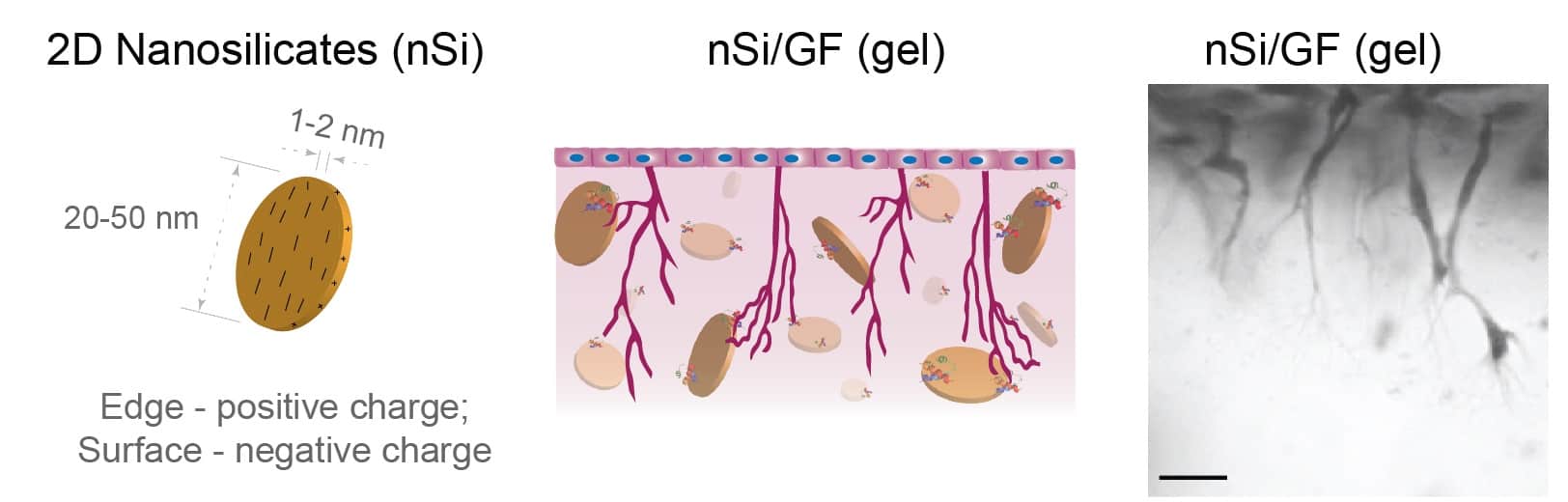
Schematic of nanosilicate; growth factor-loaded nanosilicates; the resulting invading structures. (Courtesy: Wiley; D Howell et al. Adv. Biosys. 10.1002/adbi.201800092)
Stimulation of angiogenesis — the growth of new blood vessels — can be used to treat heart disease or promote wound healing. Meanwhile, inhibition of angiogenesis can be used as a therapeutic for cancer, ophthalmic conditions and other diseases. The delivery of proangiogenic therapeutics is thus a significant area of interest in the drug delivery research field. In this context, synthetic 2D nanomaterials are emerging as ideal structures for regenerative medicine applications, due to their biocompatibility and homogeneous physical and chemical characteristics.
Corresponding author Akhilesh Gaharwar.
With this in mind, a team of researchers from Texas A&M University are investigating the use of 2D nanosilicates as a platform technology to deliver proangiogenic growth factors to stimulate angiogenesis. This platform has the potential to be broadly used for growth factor delivery and release (Adv. Biosys. 10.1002/adbi.201800092).
Nanosilicates are 2D disc-shaped nanoparticles that interact with biomolecules. The interaction is electrostatic and results in the adsorption of the molecules on the surface of the nanosilicates. The authors confirmed this by adding proteins into a nanosilicate solution. The results suggested that the proteins adsorbed onto the nanosilicates and were released slowly over a course of weeks.
Next, the authors used a 3D invasion assay to examine the effect of growth factor-loaded nanosilicates on the sprouting step of angiogenesis. They did this by including proangiogenic proteins (such as VEGF, FGF and PDGF) to stimulate the invasion of endothelial cells into a basal 3D collagen matrix (the nanosilicates were incubated with growth factors and then mixed into collagen matrices).
The results indicated that the minimum concentration of nanosilicates required to sequester growth factors is 0.015%, and that at this concentration, the cells penetrated the collagen matrices and formed sprouting structures.
The researchers also tested the effect of nanosilicates on the mechanical properties of collagen matrices, concluding that a low concentration of nanosilicates (0.015%) does not affect the mechanical properties of the matrices. Thus, they examined the effects of nanosilicates in the 3D collagen invasion system, observing that growth factors appear to release from the nanosilicates quickly and were homogenously localized throughout the collagen matrix. These results indicate the ability of the nanosilicates to deliver angiogenic factors in specific combinations and efficiencies to direct cellular invasion.
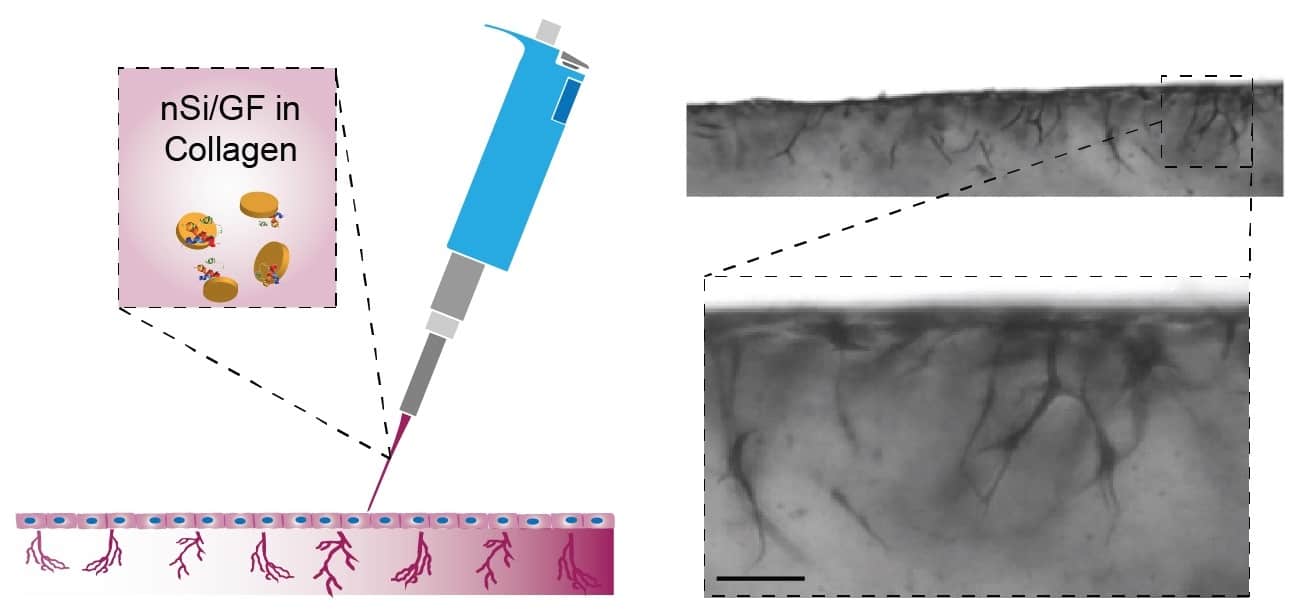
Nanosilicates offer the unique ability to pattern the delivery of growth factors. (Courtesy: Wiley; D Howell et al. Adv. Biosys. 10.1002/adbi.201800092)
In another interesting development, the authors fabricated injectable collagen-based scaffolds that could be patterned by the inclusion of growth factors, and observed the invasion of endothelial cells. This method has potential applications in tendon or ligament repair.
The study demonstrates the ability of nanosilicates to deliver growth factors to induce an angiogenic response. The results also show the huge potential of nanosilicates for delivering biomolecules, thus paving the way for new therapeutics.
Few people question that 2D materials can do great things, but the real sixty-million-dollar question is what they will actually be used for. While the Nobel prize has recognized achievements in a range of fundamental and applied fields over the years, few have been followed by such an explosion of research activity or such great expectations for fast returns on the investment as the award for graphene in 2010. Interest in graphene has spawned the discovery of a whole brood of 2D materials, each with their own unique claims for making a real-world impact. Developing quick and easy fabrication approaches can be a crucial step between idea and industry, and here a number of recent reports have upped their game.
MXene spray
Two-dimensional materials that have attracted attention since the discovery of graphene include not just lone contributions like phosphorene, silicene and stanene, but also whole families such as transition metal dichalcogenides. In 2011 studies led by researchers at Drexel University revealed the MXenes, a family of 2D transition-metal carbides, nitrides, and carbonitrides with true to form an embarrassment of riches in terms of exotic and potentially useful properties. Now Yury Gogotsi and team at Drexel have demonstrated that by dissolving the MXene Ti3C2 in water they can produce a highly conducting ink or paint. What is more they show that spraying a film of this paint onto a surface can produce an antenna on the surface that can connect to the Internet of Things with no need for additional circuitry. The exceptional properties of the MXene means that a sprayed on Ti3C2 antenna can outperform silver ink by a factor of 200 and even beats graphene by a factor of 50.
MXenes have also attracted interest for capacitors and energy storage and conversion technologies, a potential application that has attracted more than one review. This week Wee-Jun Ong from Xiamen University Malaysia, Neng Li from Wuhan University of Technology in China and colleagues provide a detailed review on the catalytic properties of this class of materials. “Importantly, countless investigations on MXene for photocatalysis and electrocatalysis are progressing rapidly and a game-changing breakthrough in artificial photosynthesis (H2O splitting, CO2 reduction, and N2 fixation) has emerged most recently,” Ong, Li and colleagues explain as they highlight the gap the review aims to fill. After a summary of some of the preparation techniques, and the key structural and electronic properties of these materials they provide an overview of MXene-based catalysis for a number of reactions that are particularly important for not just green energy but also reducing the damage to the environment of certain chemical industries and the combustion engine, including oxygen reduction and evolution reactions, hydrogen evolution reactions, pollutant degradation, and nitrogen and carbon dioxide reduction.
Easy films
Nanfang Yu, Yuan Yang and colleagues at Columbia University in the US have also addressed environmental issues with their passive cooling polymer paint. They show how dissolving the right polymer in the right ratio of water and solvent can produce paint that dries with nano- and microscale and air voids just the right size to optimize reflection of sunlight and radiation of thermal energy to cool surfaces several degrees below ambient temperatures. At several hundred nanometres thick the coatings are far from 2D materials but like the spray on antennas, the ability to paint on the coating rather than having to produce it as a film in factory makes it much more accessible.
The report comes not long after researchers in Spain and Singapore describe a one-pot method for producing ultrathin films of a metal organic compound for flexible 2D electronics. Their films of [Cu2I2(TAA)]n where TAA is thioacetamide are just 4 nm thick and harbour memristive properties. Lead author Miriam Moreno-Moreno suggests the films may find use in fitness wristbands to monitor heart rate, and adds, “The future of 2D flexible electronics will rely on making conducting ultrathin films of materials that are mechanically robust and flexible in a simple but controlled manner.” While no doubt the attention conferred by the Nobel Prize for graphene has helped 2D materials research to take off it may be fabrication technology developments like these that give the commercialization prospects of 2D materials wings.
Three decades and counting: the 30th-anniversary issue of Physics World is now out
Whether you were around in 1988 or not, it’s time to sit back and see just how much physics has changed over the last three decades with the 30th-anniversary issue of Physics World magazine, which is now out in print and via our digital apps for iOS, Android and Web browsers.
When the Institute of Physics (IOP) launched Physics World in October of that year, the Cold War was still on, the Web didn’t exist and Stephen Hawking had just written A Brief History of Time. High-temperature superconductors were all the rage and some people even wanted to build a huge underground particle collider in Texas.
Remember that if you’re a member of the Institute of Physics, you can read the whole of Physics World magazine every month via our digital apps for iOS, Android and Web browsers. Let us know what you think about the issue on Twitter, Facebook or by e-mailing us at pwld@iop.org.
For the record, here’s a run-down of what’s in the issue.
• The future for learned societies – Paul Hardaker explains why learned societies like the Institute of Physics must stay relevant to the modern world
• The online revolution – Steven Hall revisits the huge changes in journals publishing over the past 30 years
• The changing face of physics – Julia Higgins, president of the Institute of Physics, talks to Physics World managing editor Matin Durrani
about her career and how life for physicists has changed since the magazine was founded 30 years ago
• A solid (state) success – James McKenzie reflects on the impact of the solid-state laser, a device in its infancy when it became the subject of one of the first articles in Physics World
• Do you philosophize? – Physicists grapple with the challenges of philosophy far more often than you might think, as Robert P Crease reveals
• Back to the future – From financial woes and teacher shortages to major projects being delayed or cancelled, many issues facing physicists 30 years ago remain just as pertinent now as they did then. Michael Banks investigates
• Triumphs and frustrations – Particle physics has flourished over the past 30 years but, as Christine Sutton points out, there are still few signs of any cracks in the Standard Model
• Temperature’s rising – After three decades of slow-but-steady progress, the field of high-temperature superconductivity is generating excitement once again. Jon Cartwright explains
• Ignition pending – Reproducing the energy of stars here on Earth could revolutionize how we fuel our lives. But why does fusion energy always seem to be 30 years away? Melanie Windridge investigates
• A shining example – Since Physics World started, optics-based technologies have revolutionized the way we communicate. Jeff Hecht looks at how these methods have spread since their days in the lab
• It’s an ad, ad, ad, ad world – Margaret Harris looks back at some of the companies that advertised in the first issue of Physics World – and finds out how the industrial physics community has (and has not) changed
• A wave of discovery – James Hough outlines the last 30 years of gravitational-wave astronomy, from building prototype detectors to making a revolutionary discovery
• The physicists’ library – To compile the ultimate science reading list, Tushna Commissariat talks to some of today’s top physicists, writers and broadcasters
• Medical physics: a broad spectrum of careers – From clinical roles to jobs in industry and academia; from computational simulations to testing new scanners, Jude Dineley delves into the many job options available for medical physicists around the world today
• Snapshots through time – Physics, physicists and Physics World have transformed over the past 30 years, and will continue to do so. In this specially commissioned illustration, Clifford V Johnson takes us to the past, present and future of a physics lab.
UPDATE: CERN has suspended Alessandro Strumia from any activity at CERN with immediate effect, pending investigation into his presentation last week.
The CERN particle-physics laboratory in Geneva has described an invited talk given last week at the lab by an Italian physicist as “highly offensive”. The presentation was given on 28 September at an inaugural CERN workshop on high-energy theory and gender by Alessandro Strumia of the University of Pisa. In the talk, he claimed that men, not women, face discrimination when seeking jobs in physics.
Strumia is a theoretical physicist whose research interests include particle physics, astrophysics and cosmology. He is not a CERN employee but has an office at the lab. He is listed as the principal investigator of a European Research Council grant that is hosted by CERN and runs until 2020.
Strumia’s presentation included graphs and tables that analyse the citation records of papers written by male and female physicists. In the talk, he stated that these data show that “top authors are man, man,…man”. He also claimed that data related to academic hiring show that women with fewer citations were being hired over men with greater numbers of citations.
Passed over
Indeed, in one slide, Strumia claimed that he was passed over for a job at Italy’s National Institute for Nuclear Physics, despite having many more citations than the successful female candidate.
Speaking to BBC Radio, Strumia said: “If you want to be hired, it’s easier to be a woman”.
The physicist Jess Wade from Imperial College London, who also spoke at the CERN workshop, told the BBC that Strumia’s presentation was “insulting” and based on “simplistic” ideas. Wade added that many of the women in the audience were early-career physicists on short-term contracts who rely on senior researchers like Strumia for their next job. She said it was “really frightening” that a person in a position of authority would give such a presentation.
CERN has removed a video of the presentation from its website along with Strumia’s slides. However, the slides are available on Google Drive.
“The disproportionate exposure of national parks derives from the location of extensive park areas in extreme environments,” says Patrick Gonzalez of the University of California Berkeley, US. “A higher fraction of the national park area is in the Arctic, at high elevations, and in the arid southwestern US.”
By the end of the century, rising levels of greenhouse gas emissions could push up average temperatures in US national parks – which cover 4% of the country – by as much as 9 °C, according to estimates by the researchers.
“Changes could occur faster than the abilities of many plant and animal species to migrate to stay in suitable climate spaces,” says Gonzalez, who carried out the research with colleagues from the University of Wisconsin-Madison, US.
Using data from weather stations scattered throughout the US, climate researchers have created maps of the average annual temperature and rainfall totals at points approximately 800 metres apart over much of the US. In this study, the team used these maps to calculate historical temperature and rainfall trends within the parks and over the US as a whole. (Courtesy: Patrick Gonzalez)
Consequences of rising temperatures include increased wildfire in Yellowstone National Park, Wyoming, extensive mortality of Joshua trees (Yucca brevifolia) in Joshua Tree National Park, California, and possible extirpation of the pika, a small alpine mammal, from Lassen Volcanic National Park, California.
Records show that annual precipitation has declined significantly across 12% of the national park area. Annual rainfall across the US as a whole has increased, in contrast.
The team reports that national parks in Alaska are most exposed to temperature increases while Hawaii, the Virgin Islands, and the southwestern US are most exposed to precipitation decreases.
The extent to which these scenarios play out is considered to be strongly dependent on the amount of greenhouse gases emitted from vehicles, power plants, and other human sources between now and 2100.
“Compared with the highest emissions scenario, reduced emissions would lower the rate of temperature increase in the national parks by one-half to two-thirds by 2100,” says Gonzalez.
The scientists hope their findings will help develop adaptation measures for fire management and invasive species control, and other ways to protect parks against hotter and drier conditions.
“The next steps involve helping national parks apply the data to specific issues,” says Gonzalez. “For example, based on the analyses of climate change vulnerability, parks can preemptively target prescribed burning and manage wildland fire to reduce future fire risks.”
A new flexible, artifact-free and lensless fibre-based imager can reconstruct high-quality images thanks to a trained deep neural network. The device, which is the first of its kind, transmits the images through disordered fibres thanks to an effect called transverse Anderson localization and works even for objects that are located several millimetres away from the fibre input face without the need for any additional distal optics. It might find use in practical endoscopy and other imaging applications.
Fibre optical endoscopes (FOEs) are routinely employed in biomedical research and for diagnosing disease and in surgery. They can be used in situations where conventional microscopy does not work very well. FOEs can also be implanted in patients, so allowing their health to be monitored over the long term.
Researchers have recently improved how light is transmitted through these devices using a novel light transmission scheme called transverse Anderson localization. This effect prevents the spread of light in the direction perpendicular to the direction in which light is propagating by a randomly disordered glass-air fibre cross-section.
“Ordinary” Anderson localization is named after US physicist Philip Warren Anderson, who was the first to identify the effect back in 1958 as the interference of waves scattering from random impurities in a crystal. This interference can abruptly halt (or “localize”) the propagation of the wave. Anderson subsequently went on to win the 1977 Nobel Prize for Physics for his work. The transverse Anderson localization effect was first identified in 2008 by Moti Segev and colleagues at the Technion – Israel Institute of Technology.
GALOF
The glass-air Anderson localized optical fibre (GALOF) scheme has many advantages over conventional multimode fibres (MMFs). For one, it can support thousands of optical modes in a random structure and unlike MMFs, these optical modes are oblivious to whether the fibre is bent or straight. What is more, imaging can be done without extra lenses or mechanical parts – as long as the object is positioned next to the input face of the GALOF.
GALOF can also directly transit high-quality images though fibres as short as a metre long thanks to its low attenuation of less than 1 dB/m for visible wavelengths. These images are comparable to those obtained though some of the best commercial fibre bundles available today.
Current GALOF-based FOEs are still far from perfect though. One of the main problems is that the image plane of an object needs to be located in the direct vicinity of the GALOf’s input face, as mentioned.
Enter deep learning technology
A team of researchers led by Axel Schülzgen at the College of Optics and Photonics at the University of Central Florida in Orlando has now employed deep learning technology to overcome this problem to create a flexible, lensless FOE that produces artifact-free, high quality images by combining GALOFs with deep learning algorithms.
Deep learning is a relatively new field of research that is already being applied to solve a number of imaging-related problems. “In contrast to conventional methods of optimizing images, deep learning algorithms can ‘learn’ how complicated optical waves propagate through the whole imaging set up without having any prior knowledge of them,” explains Jian Zhao, who is lead author of this study.
“In our work, we applied a particular type of deep neural network called a convolutional neural network (CNN). We combined this algorithm for image reconstruction with a specially designed GALOF (made of silica) for image transmission. This fibre consists of a random mix of tiny glass structured and air voids. Since the trained network ‘understands’ the physics of the image transport system, no lenses or other optical elements are needed to relay images.”
The researchers made their GALOF using fused-silica tubes and a tried-and-trusted stack-and-draw fabrication technique. The diameter of the random structure is about 278 μm and the air-hole filing fraction in the structure around 28.5%. It is 90 cm long.
Transverse Anderson localization
To generate images, they used a beam of laser light with a wavelength of 405 nm. As light passes down the fibre, it cannot scatter into the plane normal (or “transverse” to the direction of light propagation) because of the fibre’s random structure. Since the disorder does not continue along the length of the fibre, however, the light is free to travel along this direction.
To show that the technique works, the team sent images measuring tens of microns across along a section of the fibre. They created the images by a placing a small stencil containing the letters UCF (short for “University of Central Florida”) and CREOL (short for “College of Optics and Photonics”) as the object. The image size of the object is 112 × 200 pixels and the stencils were obtained from the Modified National Institute of Standards and Technology (MNIST) database of handwritten digits.
Once the images had come out from the opposite end of the fibre, the researchers demagnified them by a factor of four and then captured them on a CCD detector.
Unique properties
“Our new system has three unique properties,” Zhao tells Physics World. “First, it transmits high quality images without any artifcacts. Second, no distal optical elements are needed to image objects that are not completely adjacent to the fibre facet and that are even several millimetres away. And third, the same image reconstruction algorithm can be used whether the fibre is bent or straight. This means no time-consuming retraining of the neural network is necessary, even if the fibre is bent by 90°.
“Combining image transmission and reconstruction is a very active area of research and integrating advanced fibre designs and deep learning strategies in this way will improve the performance of next-generation imaging systems,” he says. “Thanks to the exceptional features of our system, we hope that it will help in the design of future micro-endoscopic devices that are minimally invasive.”
The team, reporting its work in ACS Photonics 0.1021/acsphotonics.8b00832, says that it is now busy optimizing its device and using it to image biological objects, such as various types of cells. “We are also working on making a movie to demonstrate video rate image transmission and retransmission,” reveals Zhao. “In the future, we would like to look into the possibility of 3D imaging with our device, but to do this we will need to develop new deep learning algorithms and experimental systems.
“We would of course also like to collaborate with medical experts to tailor our system to their requirements.”
“The Standard Model has survived intact for another year,” declared particle physicist Don Perkins from the University of Oxford three decades ago. “But is this a triumph or a frustration for physics?” Perkins’ remarks appeared in the October 1988 edition of CERN Courier magazine in a report about the 24th International Conference on High Energy Physics (ICHEP), which had been held in Munich a few months earlier.
Although Physics World did not report on the meeting, the Courier went on to say that the Standard Model was standing up to the closest inspection, revealing no cracks, while anomalous results seemed to be going away. Looking back on these words, they seem to me just as appropriate today, despite so much having happened in particle physics in the intervening 30 years.
Missing pieces
The key details of the Standard Model of particle physics, to which Perkins was referring, were well known three decades ago (see box). But there were missing pieces and unanswered questions. For example, both the sixth (“top”) quark and the sixth lepton – the tau neutrino – remained undiscovered. Perhaps more crucially, the Higgs boson was also missing.
“The Higgs is the most arbitrary part of the model,” said Paul Langacker, who was then at the DESY lab in Hamburg, when summarizing the Standard Model at that 1988 ICHEP meeting. “The only thing that can be said with complete certainty is that the mass of the Higgs particle, if it exists, must be between zero and infinity!”
Other questions were also highlighted at the conference. Do B0 mesons exhibit the subtle difference between matter and antimatter, known as charge–parity (CP) violation, which had already been seen in the lighter K0 mesons? Do neutrinos have mass and can they oscillate from one type to another? Can quarks roam freely at extreme temperatures and densities, in a “quark–gluon plasma”? And why have fewer solar neutrinos than expected been detected here on Earth?
The answers to some of these questions were soon revealed as new, powerful particle colliders came on the scene. These machines took studies of the Standard Model to a new level, probing it ever more deeply and with increasing precision over the next decade and more. Key to these developments were the SLACLinear Collider in the US and the Large Electron–Positron (LEP) collider at CERN, which began to fulfil their missions as “Z factories”, with the first results on the boson’s “width” in 1989. This measurement proved that there could be only three types of lightweight neutrino, and hence only three “generations” in the families of quarks and leptons.
Standard thinking
(Courtesy: Fermilab)
The Standard Model of particle physics, which rose to prominence during the 1970s, unites the electromagnetic, weak and strong forces in a single theoretical framework. Together, the model describes all non-gravitational interactions between particles of matter, which comprise six charged quarks and six leptons, three of which are charged (the electron, muon and tau) and three uncharged (the neutrinos).
The interactions between these matter particles are propagated by field particles: the photon plus the charged W bosons and neutral Z boson for electroweak interactions, and eight gluons for the strong interactions described by quantum chromodynamics. In the basic theory, all particles are massless. The Standard Model therefore requires an additional element to allow the W and Z particles, for example, to differ from the photon (and the gluons) by being massive.
This extra component takes the form of an additional field, with the particles gaining mass by interacting with it. Associated with the field there is (at least) one spin-zero boson, known as the Higgs boson, after the British physicist Peter Higgs.
The top quark was duly found at the Tevatron proton–antiproton collider at Fermilab in the US in 1995, and the tau neutrino was seen at last in 2000 in an experiment that used protons from the Tevatron to generate a neutrino beam. A year later, the BaBar and Belle experiments, which produced lots of B mesons at small, high-intensity electron–positron colliders in the US and Japan, respectively, found CP violation in the decay of these B particles.
And, after heavy-ion collisions at CERN had revealed tantalizing glimpses of quark–gluon plasma in 2000, the Relativistic Heavy Ion Collider in the US went on to yield definitive and surprising results on this new state of matter. By 2005 these had shown that, rather than being the expected gas, the plasma behaves like an almost perfect liquid.
There were also important findings at large, imaginative experiments looking at natural sources of particles. In 1998 the team using the Super-Kamiokande detector in Japan found that neutrinos created in the atmosphere oscillate from one type to another as they travel through the Earth. This phenomenon is possible only if the particles have mass – the first indication of physics beyond the Standard Model.
Half a world away, researchers at the Sudbury Neutrino Observatory in Canada had, by 2002, finally solved the mystery of the missing solar neutrinos. By detecting neutrinos of all types, they showed that previous experiments, which were sensitive only to electron neutrinos, had missed the fraction that change type as they travel from the heart of the Sun.
The Higgs and beyond
By the time of the 20th anniversary of Physics World in October 2008, many of the questions posed at the time of the magazine’s launch had been answered. But a crucial one remained: where is the Higgs boson? Fortunately, a new accelerator had just been completed at CERN – the Large Hadron Collider (LHC). Discovering the missing boson was high on the list of challenges for huge teams of researchers at the ground-breaking machine.
In 2012 the massive cost and human effort paid off, with the first observations of the long-sought particle. It weighed in at around 125 MeV/c2 – some 130 times heavier than the proton. Moreover, following the start of its experiments in earnest in 2010, the LHC began investigating the Standard Model, B-meson physics and the quark–gluon plasma to deeper levels than ever before.
Exciting discoveries elsewhere opened other new horizons too: studies of antihydrogen took off at CERN with the production of the first large quantities of this ephemeral stuff in 2002; the LIGO experiment in the US made its historic, first observation of gravitational waves in 2015; and this year the IceCube neutrino observatory at the South Pole has found the first evidence for a distant source of high-energy cosmic neutrinos. The latter two developments in particular reflect the strengthening links between particle physics, astronomy and cosmology, which have led to the birth of “astroparticle physics” as particle physicists have transferred their skills to detecting a variety of cosmic messengers.
Future challenges
It might seem that the items on the “shopping list” from that 24th ICHEP meeting 30 years have all been ticked off, but other questions from that time remain unresolved and new ones have joined the list. At this year’s ICHEP in Seoul – the 39th event in the series – Langacker, who is now at the Institute of Advanced Study in Princeton, was on hand once again to summarize progress.
While he drew attention to how well the Standard Model works in describing matter down to 10–16 cm – despite the incessant probing both at the LHC and elsewhere to prove otherwise – Langacker also highlighted current questions. What, for example, is the nature of dark matter and dark energy, which we now know form, respectively, 26.8% and 68.3% of the mass-energy of the universe? Is there a supersymmetry between the particles of matter and the particles that mediate their interactions – and can new particles required by this symmetry help to explain dark matter? What is the origin of the matter–antimatter imbalance that allows the existence of the matter universe? Is string theory, a leading contender for a quantum theory of gravity, verifiable?
The answers to these questions are certain to occupy particle physicists over the next 30 years. They will do this by pursuing higher intensities, for example at the High-Luminosity LHC scheduled to start up in 2025, as well as going to higher energies at potential new colliders, both linear and circular. There is also a vibrant programme of research in neutrino physics both at accelerators and at nuclear reactors.
Away from accelerators, ingenious experimental searches for physics beyond the Standard Model continue, including the increasingly sensitive hunts for weakly interacting massive particles, which could constitute dark matter. Meanwhile “multimessenger” studies in astroparticle physics, which combine measurements from cosmic rays, neutrinos, gravitational waves and other cosmic signals, seem bound to offer more exciting revelations about the observable universe.
All this and more may lead to a new Standard Model that describes the universe as far as we can see, as particle physics continues to probe the smallest scales and the highest energies
To paraphrase Langacker at ICHEP 2018, all this and more may lead to a new Standard Model that describes the universe as far as we can see, as particle physics continues to probe the smallest scales and the highest energies. Perhaps in 30 years’ time, Perkins’ remarks will no longer ring true and whoever summarizes ICHEP 2048 – should such a conference still exist – will be talking of an entirely new Standard Model of nature.
Modelling the potential of tr-NIR imaging to visualize brain atrophy progression. (Courtesy: Biomed. Opt. Express9 4094, OSA)
Neurodegenerative disorders such as Alzheimer’s disease are often associated with brain atrophy. During disease progression, the brain loses neuronal tissue and reduces in size inside the skull. The left-over space then fills with additional cerebral spinal fluid (CSF) — making CSF variation a potential biomarker for the presence of Alzheimer’s disease.
Currently, visualizing such structural changes is achieved using MRI or X-ray CT, neither of which are suitable for time-resolved monitoring, due to high costs or the risks of repeat exposure to ionizing radiation. Instead, a research team from Greece and Italy has proposed the use of non-invasive time-resolved near-infrared (tr-NIR) measurements to track brain atrophy during disease progression (Biomed. Opt. Express9 4094).
“While MRI and CT excel in term of resolution, if we aim to extract only one specific feature we could rely on more efficient imaging techniques,” explains first author Daniele Ancora from the Institute of Electronic Structure & Laser at FORTH. “Tr-NIR imaging is fast, cheap and harmless. After positioning a NIRS head-cap with sources and detectors, data acquisition would be near-instantaneous, enabling measurements of a wide range of patients with very little economic and resource effort.”
Computational models
Ancora and colleagues employed a computational approach to study the potential of tr-NIR for visualizing atrophy progression. They generated two brain structure models — a simple cylindrical model and a more complex human-head atlas — and used Monte Carlo photon propagation to simulate the results of a longitudinal experiment.
The cylindrical 4-layer mesh volumes used in the simulations and the locations of source and detectors on their top layer. (Courtesy: Biomed. Opt. Express9 4094, OSA)
The simple models comprised 100-cm diameter cylindrical mesh volumes, with layers representing skin and skull (SS), CSF, grey matter (GM) and white matter (WM). In each mesh, the SS and GM tissues had constant thickness, the CSF size increased to mimic Alzheimer’s progression and the WM tissue decreased accordingly. The researchers examined seven CSF thicknesses, from 0.0 to 15.0 mm. They placed time-resolved photon detectors on the SS surface to create concentric detector ring arrays and simulated a pencil-beam source incident upon the centre of each mesh.
For the head model, the team started with the human-head mesh structure Colin27 and used meshing tools to implement an erosion algorithm that reproduced brain shrinkage. They built 11 meshes: stage 1 to 10 of disease progression and stage 0 for the original Colin27 model. They positioned a pulsed beam source perpendicular to the SS surface on the right hemisphere and placed four time-resolved photon detectors next to it.
The researchers used the mesh-based Monte Carlo tool to resolve photon diffusion within the models. To account for variation in tissue optical properties among individuals or disease stages, they employed two different CSF scattering coefficients: considering CSF as a nearly transparent non-scattering layer; and having more turbid optical properties.
To simulate a realistic measuring system, the team experimentally acquired the instrument response function (IRF) of a typical fNIRS detector. They convoluted this measured IRF with the simulated photon distributions to estimate its impact.
DTOF distributions
The team first assessed the distribution of time-of-flight (DTOF), which carries information about photon diffusion, for the seven cylindrical models. At early detection times, increasing CSF thickness did not result in significant variation in DTOF. This is expected, since early photons spend most of their time in the superficial SS layer and not in deeper tissue regions.
At later photon gating times (greater than 2500 ps), however, photons may have travelled through the SS into the CSF layer. Here, brain shrinkage visibly changed the slope of the detector response, with higher CSF thicknesses corresponding to less steep slopes. The researchers observed a steep slope change during the initial increase in CSF thickness, suggesting higher sensitivity at early stages of brain atrophy. The change in slope with CSF thickness was not exactly the same for the two scattering coefficients, but the overall trend was preserved.
The change in the slope of the late photons of with CSF thickness. The solid lines represent the strongly scattering CSF, the dashed lines show weaker scattering CSF. (Courtesy: Biomed. Opt. Express9 4094, OSA)
Results for the human head model were comparable, with increasing CSF thickness flattening the slope of the DTOF at late gating times. For both models, convolution with the IRF did not affect the slope of the late-timing DTOF curve, suggesting that CSF variations can be measured using a real instrument.
The modelled detector response was also affected by the scattering coefficient, with increased CSF scattering flattening the slope in a similar manner to the CSF thickening. “In a hypothetical scenario in which both parameters vary, we would still be able to see an effect on the response curve,” explains Ancora. “A change in CSF optical parameters might actually be another indicator of disease progression, but to assess that we need more investigations, such as spectroscopy.”
Ancora notes that Tr-NIR spectroscopy is available in almost all tr-NIR systems and could enable simultaneous acquisition of response functions over whole visible-NIR spectrum. “The optical turbidity of the CSF might vary differently in separate spectral windows, giving us another tool for evaluating possible variations connected with disease,” he says.
The next step will be to verify the computational results with experimental evidence. “For this, we could make use of the existing tr-NIRS facilities at Politecnico di Milano,” Ancora tells Physics World. “If the experiments match our numerical predictions, we will consider to taking this forward in a real clinical scenario.”
Radio-frequency (RF) antennas, which are used in the Internet of Things, could now be created using a simple, one-step spray-on technique thanks to new work by researchers at Drexel University in the US. The antennas, which are tens of nanometres to a few microns thick, are made of titanium carbide – a material that belongs to the family of 2D transition metal carbides and nitrides known as MXenes – and could allow any object to become connected.
The MXenes have the chemical formula Mn+1Xn, where M is an early transition metal (such as titanium, vanadium, niobium and molybdenum) and X is carbon or nitrogen. They were discovered by the Drexel researchers in 2011, who have been studying them since. Now, the team, led by Yuri Gogotsi of the Department of Materials Science and Engineering, says that the MXene titanium carbide (Ti3C2) can be dissolved in water to create a highly conducting ink or paint.
This coating can transmit and direct radio waves even when it is applied in a very thin coating, say the researchers, which means that it could be sprayed onto a variety of objects and surfaces, be they rigid or flexible, without adding additional weight or circuitry. “This is a first, since current fabrication methods of metals cannot make antennas thin enough and applicable to any surface, in spite of decades of research and development to improve the performance of metal antennas,” says Gogotsi.
In their experiments, the researchers made a 100-nm-thick translucent MXene antenna using the conducting Ti3C2film. They designed their device to work at 2.4 GHz, which is the frequency used for Wi-Fi and Bluetooth applications. This antenna has a reflection coefficient (the ratio of the reflected wave’s amplitude to the incident wave’s, or how much energy is reflected) of less than -10 dB. By then increasing the antenna’s thickness to 8 μm, the team measured a reflection coefficient of -65 dB, which is 98% of its predicted maximum value.
Current flow is skin deep
The new antennas are as good as their traditional, but much thicker, counterparts made from metals like gold, silver, copper and aluminium, whose performance is limited by an intrinsic property known as the skin depth, say Gogotsi and colleagues. This is the thickness of the material through which the electrical current responsible for the RF radiation actively flows. In copper, for example, the skin depth at 2.4 GHz is 1.33 μm, while for silver and aluminium, the values are 1.29 and 1.67 μm respectively. This means that the thickness of antennas made of these metals should be at least 5 μm to allow for sufficient space through which current can flow, and this can prove to be too big for some wearable and transparent device applications.
The problem of skin depth can be overcome by using materials like conductive polymers or nanomaterials, such as graphene and carbon nanotubes, in such antennas, but the snag here is that these are poorly conducting. According to Gogotsi’s team’s measurements, the new MXene antennas are 50 times better than graphene and 200 times better than silver ink antennas when it comes to preserving the quality of radio wave transmission.
“The MXene antenna not only outperformed the macro and micro world of metal antennas, we went beyond the performance of available nanomaterial antennas, while keeping the antenna thickness very low,” says team member Babak Anasori. “And, unlike other nanomaterials fabrication methods, that require additives, called binders, and extra steps of heating to sinter the nanoparticles together, we made antennas in a single step by airbrush spraying our water-based MXene ink.”
The researchers have already successfully sprayed their antenna ink onto rough surfaces like cellulose paper and smooth ones like polyethylene terephthalate (PET) sheets. They say they would now like to find the best ways to apply it onto a wider variety of surfaces, including glass, yarn and even skin. They report their work in Science Advances 10.1126/sciadv.aau0920.
From wind and wave energy to machine vibrations and the simple act of walking down a street, mechanical movement of any kind can be fuel with the aid of triboelectric nanogenerators (TENGs). Now researchers at the University of Surrey in the UK led by S. Ravi P. Silva have used a description of TENG behaviour based on the fundamental equations of electromagnetism – the Maxwell equations – to optimize TENG designs to maximize their efficiency.
Maxwell-based models
“TENGs were first invented by Prof Zhong Lin Wang’s research group at Georgia Tech,” says Ishara Dharmasena, a final year PhD student at Surrey University, and lead author of the report on these results. TENGs generate electric potentials through the transfer of electrons, charged particles or charged material as two dissimilar surfaces come into contact. Anyone who has rubbed their feet along a carpet to give their friend an electric shock will be familiar with this type of phenomenon.
In the latter half of the nineteenth century James Clerk Maxwell laid out four equations that could sum up all electrostatic and magnetic behaviour in his theory of electromagnetism. Since the invention of TENGs in 2012 it has been possible to show how their output signal relates to Maxwell’s displacement current, as Wang pointed out in Materials Today. Dharmasena and colleagues were keen to take this further.
“In my research I developed a whole theoretical framework covering these devices and then I studied how the electric fields in these devices behave using Maxwell’s equations,” Dharmasena tells Physics World. “Now in this Advanced Energy Materials paper, we used the basic theoretical model to develop and describe how the output power behaves inside a TENG device.”
In the report the researchers point out that optimizing the TENG performance requires maximizing both the source current which Is proportional to the frequency of the TENG layer movement – and matching the TENG impedance with the external load the TENG is transmitting its power to. Dharmasena describes how he characterized the output power of different TENG devices and devised a method – “TENG impedance plots” – to describe the time variant impedance and power output characteristics of these devices. Using these tools he analysed different motion parameters, including frequency, amplitude and the nature of the contact. “This basic model was expanded to analyse the effect of each motion and device parameter,” explains Dharmasena. “I then devised a rule to optimize all these parameters to make more efficient triboelectric devices.”
TENG models could help optimize motion energy harvesters including wind energy.
Getting the most bang per buck
There are a number of considerations to take into account in TENG design, and there may be limited control for some of the conditions of their operation. However, the researchers were able to highlight the benefits of higher input motion frequencies, and, amplitudes up to a saturation point. They also found that the outputs improved with the larger device size, and thinner layers, provided the layer is thick enough to hold the triboelectric charges. These criteria can help to guide the choice of device structure to optimize frequency and amplitude for a given environment such as machine vibration or vehicle movement.
Wang, the original inventor of TENGs, who was not directly involved in these latest results, commented on the importance of these results. “The displacement current was first introduced by Maxwell in 1861, which later predicted the existence of the electromagnetic wave. By adding a surface charge density contributed polarization term in the displacement current, I successfully derived the output of piezoelectric and triboelectric nanogenerators (2016). In this paper, Silva’s group has fully analysed the power output characteristics of TENGs by vigorously analysing their impedance behaviour as a function of excitation source and device parameters, which will guide the design and performance optimization of TENG. This is important progress toward the future applications of TENG.”
Dharmasena and Silva are now working with a leading international apparel manufacturer, MAS Holdings from Sri Lanka, to develop wearable technologies based on TENGs. “We are producing fabric-based triboelectric structures using printing techniques and other mass-manufacturing techniques so we can address largescale manufacturing problems themselves,” says Dharmasena.
Challenges remain, such as the potential need to encapsulate the devices to protect them from water, as well as the issue of sporadic output, which need modifying and modulating. However, Dharmasena and Silva hope to address these issues while developing the potential application of the devices.