Green light for South African radio telescope

South Africa has given the go-ahead for a radio telescope that will study dark energy, detect fast radio bursts as well as track neutral hydrogen gas on cosmic scales. Costing R70 million ($5m), the Hydrogen Intensity and Real Time Analysis eXperiment (HIRAX) will consist of 1024 dishes, each 6 m in diameter, located in the Karoo region of South Africa and will map about a third of the sky during four years of operation.

One of the main aims of HIRAX will be to pinpoint the location of fast radio bursts – high-energy astrophysical phenomenon that consist of millisecond radio pulses. “The origin of these flashes is still a mystery,” says Kavilan Moodley, HIRAX team principal investigator. “They’re hard to detect and localize since they’re so brief and most telescopes only observe a small region of the sky.” HIRAX’s large field of view will allow astronomers to observe large portions of the sky daily so, in principle, when the flashes happen the instrument will be more likely to see them.

[HIRAX and MeerKAT] could give us a fuller view of some phenomena than one telescope alone could do

Fernando Camilo

Since 2016 researchers have been testing eight prototype dishes at the Hartebeesthoek Radio Astronomy Observatory (HartRAO) outside of Johannesburg. Yet during investigations they identified the need to limit interference so changed the focal ratio – a ratio of the telescope’s focal length to its diameter – of the dishes to 0.25 compared to 0.38.

Engineers are now working to design and build four new prototypes with the smaller focal ratios to install at HartRAO by the end of the year. Engineers will then construct an eight-dish prototype followed by a 128-dish “pathfinder” in the Karoo later next year. A further 512 dishes will be added to the array in early 2020 with the remainder being put in place later that year.

A fuller view

When fully operational, HIRAX will require a petascale computer to process up to 6.5 terabits of data per second as well as infrastructure to compress this data by a factor of 50–100. Moodley adds that the project will lead to many benefits for South Africa such as being used to train students, attract foreign scientists as well as increase collaboration with industry.

Although HIRAX has been developed independently from other radio telescopes such as the MeerKAT radio telescope also located in the Karoo, there will be some overlap in what they study. “Both telescopes could give us a fuller view of some phenomena than one telescope alone could do,” says Fernando Camilo, chief scientist at the South African Radio Observatory. HIRAX’s lowest operating frequency is 400 MHz – much less than MeerKAT’s 580 MHz – and according to Camilo that will let it see further back in time.

The project has so far secured $1.4m from the University of KwaZulu Natal and South Africa’s National Research Foundation. Officials are now looking for funding sources for the remainder of the cash to complete the project.

A calculated risk

What led you to start Swiss Neutronics?

In the 1990s, I began developing so-called “supermirror” coatings, which help to transport neutrons in an efficient way from the source to the instruments. At the time, I worked as a scientist at the Paul Scherrer Institute (PSI) in Switzerland, and my task was to scale this coating technology up so that we could produce many square metres of mirror for the SINQ spallation source at PSI. I was successful at this, but it was a little bit tedious to make the coatings and then watch established manufacturers of neutron guides take our products, glue them together to produce guides, and then sell them back to the PSI. At one point my supervisor, Albert Furrer, said to me, “Peter, why don’t you start a company?” but I responded “No, I’m on my own – the risk is too high.”

Then, in 1999, five of us – three scientists (including Furrer and me) and two engineers – were all sitting together during a coffee break discussing future projects at PSI involving neutron guides. I usually work quite hard and don’t take many breaks, so it really was an accident that we were all there together. Somehow, it came up that this would be a good time to start a business, and within a few weeks we had signed contracts with PSI that allowed us to use their facilities to produce the coatings and also gave us a licence to make and sell them. That was the start of Swiss Neutronics AG.

What skills did the different co-founders bring to the company?

As neutron scientists, we all knew exactly what we needed in terms of the technology, and our engineers were trained in building instruments, so they knew about the importance of making sure the supermirror technology could interface with instrumentation. Beyond that, I would say that Furrer is a very good scientist and organizer, and I had a lot of contacts with people who might be interested in our technology. But it wasn’t like you sometimes read about, where you have one innovative person with lots of knowledge who is looking for a financial officer, an engineer and somebody who does advertisements to help them start a company. We were just good friends who happened to be there drinking coffee, and we were good at speaking to each other and working together in an open way.

How did you get funding for your venture?

At that time, it was fairly easy to found a spinoff from PSI – we simply had to agree to pay a licence fee for the products we sold, and the institute was very generous in allowing us to do business from our existing offices and in permitting us to use laboratories and the facility for producing the supermirror coatings. That was great, because it meant the financial risk was very low; we just paid for our offices and machinery on a daily or hourly basis. It also helped that in the same year we founded Swiss Neutronics, I got a professorship at the Technical University of Munich (TUM), which is very open to entrepreneurship; our university president is very happy when he can tell politicians about professors and scientific personnel getting involved in founding companies. So I had an open door to work at Swiss Neutronics as my side job.

How did the business expand?

At first, we only produced coatings – we did not do anything else. But then – and this was actually before I started my professorship – I was approached by the TUM with a suggestion that we deliver approximately 50% of the neutron guides for their new neutron source, the FRM-II. At that time, we had no experience of building neutron guides, but we got some initial payments when we signed the contract for the FRM-II, and we used it to rent or buy the equipment we needed, such as a laboratory space, a machine for grinding glass and alignment tables to put together the guides. And then we were lucky, because just as the FRM-II contract ran out in 2003, we got a second large contract with the UK’s ISIS neutron source, and that helped us get other customers. In 2004 we took the next big step and bought our own sputtering plant – and, soon after, a building to put it in, because it didn’t make sense to install our new plant in a rented room. Until then, we had used the sputtering plant at PSI, but after that we had our own facilities in addition to the one at PSI and we could start developing them further.

I chair a group that operates five beam lines at FRM-II, and I can bring this knowledge into the company and vice versa. That is a big advantage

What are your plans for the future?

A few years ago, several big neutron facilities – J-PARC in Japan, the SNS in the US and Target Station 2 at ISIS – all completed upgrades at around the same time. The period after that could have been difficult for us, with not much new business, but we saw this coming and we chose to expand into other technologies, such as polarizing equipment and metrology. Now the core business is growing again because several neutron centres are upgrading their beamlines or new facilities such as the European Spallation Source are being built, so we plan to expand, but in a reasonable way. We are going to concentrate on projects that are really interesting for us, such as those that involve supermirrors with large angles of reflection. We are also going to keep developing new technologies. Some of the things we do, such as super-polishing metal substrates so that the only roughness is on an atomic scale, are driving the technology for neutron scattering more than many research centres do. And we can do this because we are involved in neutron scattering: for example, I chair a group that operates five beam lines at FRM-II, and I can bring this knowledge into the company and vice versa. That is a big advantage.

What do you know now that you wish you’d known when you started?

A better question might be, “What do you know now that you’re glad you didn’t know then?” But to be honest, I don’t know what I would have done in a different way. We have always been extremely conservative and we have always concentrated  on improving our performance, but it’s also fair to say that we were very lucky. We made good decisions at the right time. We didn’t expand too quickly. We found the proper moment to leave PSI and rent our own manufacturing facility. We identified the correct moment to buy our own building. We invested in equipment at the right time. And maybe this was possible because we had extremely good technical staff members; people who were very involved in our business and flexible enough to work overtime if required. But you do need to be lucky to some degree. You cannot do business without being lucky.

Do you have any advice for someone starting their own firm?

When you start a company, the first five years are the most difficult. You should not expect to earn a lot of money in that time. So my advice is, if you can, start your company in what I call “luxury conditions”. Throughout my time at Swiss Neutronics, I have always had a position at a laboratory, university or other large-scale facility. That meant I always had an income, so I knew that I (and my family) would survive even if the company failed. So I tell my physics students that they should think about making a business out of their knowledge, but to do it alongside their main profession, at least at the start. Then, as soon as you feel you have enough customers, you may decide to give up your position at a university or at another company and become 100% involved in your own business. If you can do that, that’s what I would propose, because then not much can go wrong.

The universe could be caught in a loop and a natural nuclear reactor

Claims of new evidence that the universe is cyclic and undergoes multiple big bangs is discussed in this episode of the Physics World Weekly podcast. Physics World editors Hamish Johnston and Michael Banks also talk about how a natural underground nuclear reactor could help us deal with radioactive waste.

If you enjoy the podcast then you can subscribe via iTunes or your chosen podcast app.

Liquid metallic deuterium glimpsed by physicists using intense lasers

New insights into how high pressures transform hydrogen into a liquid metal have been gleaned by crushing samples of deuterium using intense laser pulses. The research was done by an international team of physicists, who say that their study of the hydrogen isotope clears-up some discrepancies in results from previous experiments.

Hydrogen sits atop the alkali metals in the periodic table so it is not surprising that hydrogen could have a metallic phase. However, the element forms diatomic molecules over a wide range of temperatures and pressures and this makes it an insulator under normal conditions.

For nearly a century, increasingly powerful calculations have predicted that under very high pressures, hydrogen’s molecular bonds will break and the material will become an atomic solid – or liquid at higher temperatures. Under these conditions, hydrogen is expected to be a metal.

Confusing results

The required pressures are extremely high – in the 100s of gigapascals – and are very difficult to achieve in the laboratory. While several groups have reported evidence for liquid metallic hydrogen, the results have been confusing.

Now, Peter Celliers at the Lawrence Livermore National Laboratory LLNL) in California, Alexander Goncharov of the Carnegie Institution for Science in Washington, DC and an international team have done a series of experiments to try to gain more insight into how liquid deuterium becomes metallic at high pressures and high temperatures.

Deuterium is an isotope of hydrogen that contains a neutron in addition to a proton – essentially doubling its mass. This leads to a significant “isotopic shift” that is expected to cause the insulator-metal transition to occur under slightly different conditions compared with hydrogen. Doing experiments with hydrogen and well as deuterium provides an important test of any theory that claims to describe hydrogen at extreme pressures.

Copper piston

The team began a measurement by condensing a thin layer of liquid deuterium between two solid plates. One plate is a copper “piston”, which is mounted on a hollow capsule called a “hohlraum” and the other plate is a transparent window. When intense pulses from LLNL’s National Ignition Facility laser strike the holhraum, it blows apart and forces the piston plate against the window.

The team made optical measurements of pressure, reflectivity and other properties of the deuterium over a timescale of about 35 ns. The team then calculated the temperature of the liquid using theoretical assumptions – this is necessary because measuring temperature is extremely difficult in such “dynamic” measurements.

During the compression process, a series of pressure waves travel through the deuterium. This ramps-up the pressure of the deuterium to about 600 GPa and the temperature to nearly 2000 K.

On reflection

At low pressures, the liquid deuterium is transparent to light – which means that it is an insulator. As the pressure rose to about 150 GPa, the liquid absorbed light and became opaque. Then, at about 200 GPa the liquid began to reflect light as would be expected if it was making a transition from and insulator to a metal.

The researchers say that their observations provide valuable information to physicists who are trying to develop accurate computer simulations of the properties of hydrogen at extreme pressures and temperatures. This is of great interest to physicists studying the interiors of gas-giant planets such as Jupiter, which are believed to contain liquid metallic hydrogen.

LLNL’s Marius Millot says, “These results are a true experimental tour de force and are particularly important because they provide a very stringent test on the different varieties of numerical simulations that one can use to predict the properties of planetary constituents at high pressure — necessary to model the internal structure and evolutionary processes of Jupiter and Saturn.”

Phase diagram

According to Isaac Silvera of Harvard University, the ultimate goal of this and other experiments is to map-out the phase diagram of hydrogen to determine the boundary between the insulator and metal phases as a function of pressure and temperature. This has proven difficult to do using dynamic experiments, which rely on calculated temperatures.

Indeed, these calculations may be the origin of discrepancies between different dynamic experiments – and could also explain discrepancies between some dynamic and static measurements that are apparent at lower pressures.

Static measurements are made by squeezing hydrogen in diamond anvil cells, where it can be studied for long period of time and its temperature measured accurately. The problem with static measurements, however, is that they cannot reach the same high pressures as the dynamic experiments.

Silvera and colleagues have just performed a series of static studies of dense fluid deuterium (and hydrogen) and his results are in some agreement with the LLNL work. This suggests that the temperature calculations done by Celliers and colleagues are robust. However, Silvera does say that he disagrees with how the LLNL team interprets temperature plateaus in their data as being related to the onset of the light-absorbing phase, rather than the onset of the metallic phase.

The LLNL study is described in Science and Silvera’s recent work is described on arXiv.

Novel takes on MR-linac dosimetry

With the introduction and proliferation of MRI-guided radiotherapy systems, there’s a crucial need to develop MR-compatible strategies for absolute dosimetry and beam measurement. At the recent AAPM Annual Meeting, delegates heard about two novel approaches for MR-linac dosimetry.

Water calorimetry

Humza Nusrat from Ryerson University described the development of a portable water calorimeter for MR-Linac dosimetry. The work is being performed under the supervision of Arman Sarfehnia in the radiation treatment program of Odette Cancer Centre, Sunnybrook Health Sciences Centre. “Water calorimetry involves measuring the minute temperature rises that result from radiation exposure to water,” he explained.

Calorimetry is of particular interest as it provides a direct measurement of absolute absorbed dose and can be used as a primary standard. Radiation-induced temperature changes, however, are on the order of millikelvins and thus require highly sensitive detection devices. Another challenge is the “heat defect”, in which radiation-induced chemical changes in the water cause the temperature rise to differ from that expected for complete conversion of absorbed energy.

Nusrat and colleagues designed the water calorimeter using finite element method analysis to optimize thermal stability and performance. To address the heat defect problem, they enclosed the heat detectors (thermistors) within a glass vessel containing highly pure water saturated with hydrogen gas.

The calorimeter was constructed using MR-compatible plastic and ceramic components, and the portable water tank containing the glass vessel was operated at 4°C to minimize heat transfer. Thermal stability was also maintained using hydraulic stirrers and thermal insulators. “We have designed and built a water calorimeter that can operate in variety of radiotherapy settings,” said Nusrat.

The team used the device to perform calorimetry measurements on the Elekta MR-linac. The calorimeter was clearly visible in a 1.5 MR image, enabling its accurate positioning within the radiation field. They recorded initial measurements with the magnetic field switched off.

Following the calorimetry, the thermistors were removed from the glass vessel and replaced with a thimble ionization chamber to compare dosimetry results. The water calorimetry results agreed with the ion chamber dosimetry to within 2%, with the calorimeter recording a slightly higher dose.

Nusrat noted that improving the window insulation may improve this correspondence further. The next step in this project, he says, will be to repeat the calorimeter measurements with the magnetic field switched on.

Cherenkov checks

Presenting in the same conference session, Jacqueline Andreozzi of Dartmouth College discussed the use of Cherenkov imaging for beam measurements in MR-linacs.

Jacqueline Andreozzi

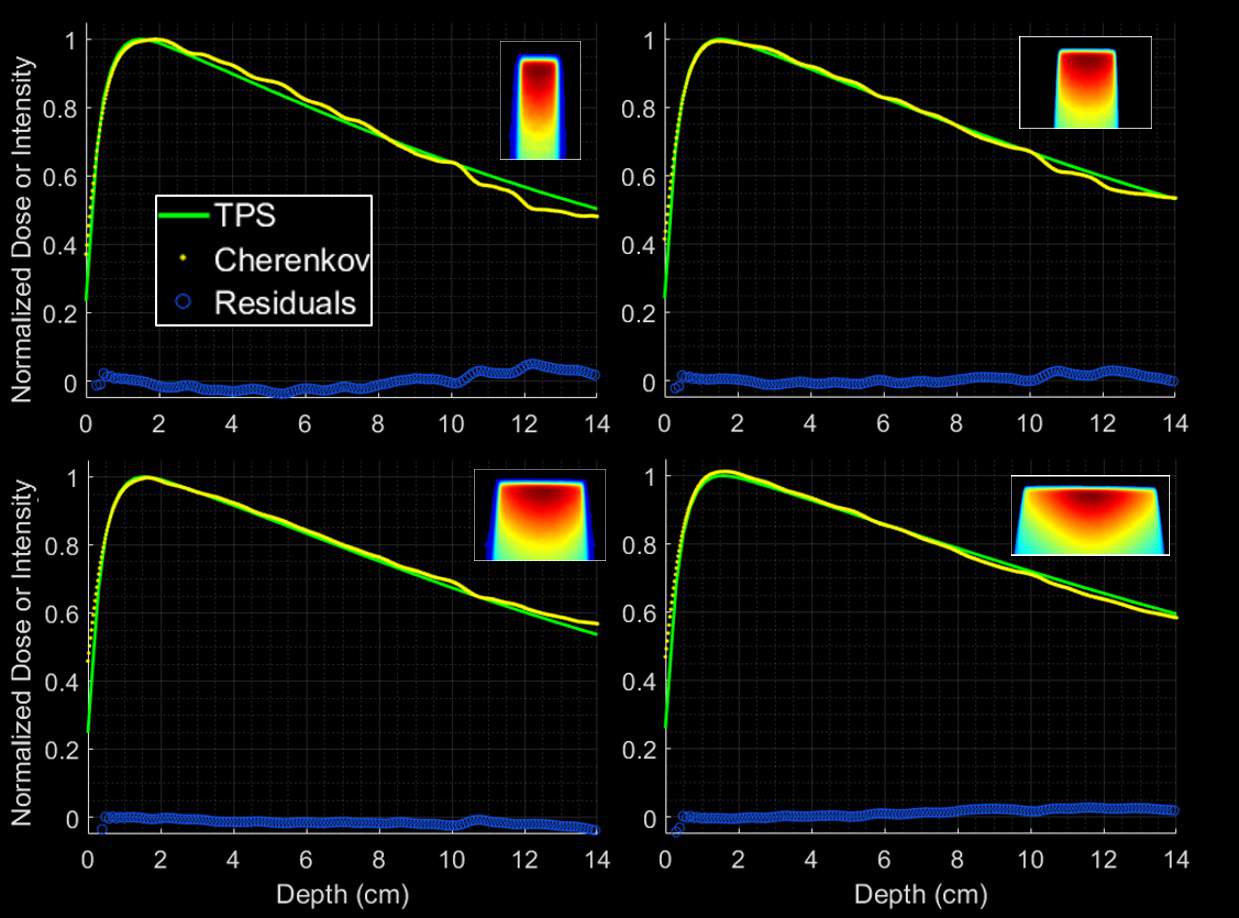
Cherenkov light is produced by the therapeutic photon beam as it passes through tissue, or water. Here, the Dartmouth researchers used an intensified CMOS sensor to measure Cherenkov emission in a water tank irradiated by an MR-linac. They employed a remote triggering device to synchronize image acquisition to the radiation pulses.

Andreozzi explained that, although most Cherenkov light is emitted in the blue spectrum, and the team’s sensor is more sensitive to red/near-infrared photons, they demonstrated in simulations that the number of detected Cherenkov photons is proportional to radiation dose.

The researchers irradiated the tank with 6 MV beams from the MR-linac, from the largest possible (24.07 x 27.20 cm) to the smallest (2 x 4.15 mm) field size. They used the Cherenkov images, which represent a 2D integration of the delivered dose, to create projection percentage depth-dose (PDD) maps. These were then compared to summed projection images of dose from the treatment planning system (TPS).

Andreozzi first described measurements on larger beams, with field sizes of 4.98 x 4.98, 9.96 x 9.96, 14.94 x 14.94 and 27.2 x 24.07 cm. For these beams, PDD measurements from Cherenkov projections matched those from the TPS, with an average error of 0.8%, for example, for the smallest of these beams.

PDD plots

In agreement with the team’s previous findings on a Co-60-based MRI-guided radiotherapy system, the results confirmed that real-time Cherenkov measurements can provide an accurate, quick check of beam output with no correction factors necessary.

Moving onto smaller field sizes, Andreozzi pointed out that despite delivering more dose (1000 MU per image, compared with 200 MU for the larger beams), Cherenkov intensities for small beams are a fraction of those for large beams. “Small beams present a challenge, because we are limited by the efficiency of collecting photons,” she explained.

Here, average errors were 3.7%, 0.31% and 0.44%, for field sizes of 2 x 4, 8 x 8 and 16 x 16 mm, respectively. Andreozzi noted that it may be possible to increase the signal-to-noise ratio by increasing the aperture size. Results should also be improved with the use of a new blue-sensitive camera. “The blue-sensitive camera provides a 150% average dose increase; this will translate nicely to small beams,” she said.

Andreozzi concluded that Cherenkov imaging provides a rapid, repeatable and MR-compatible beam measurement method for MR-linacs, with the potential to be expanded to small beam dosimetry. “We are studying the same technology to experimentally image dose variation due to the electron return effect in MR-linacs, as well as to develop a technique for rapid, quantitative alignment of the MRI and radiotherapy isocentres,” she tells Physics World.

Could skyrmions solve the baryogenesis problem?

Magnetic nanoparticles known as skyrmions and their antiparticle equivalents can behave very differently, according to new calculations by researchers in Sweden, Germany and France. This unexpected new finding could have important consequences for any potential technologies involving these particles, such as next-generation data storage and information processing devices.

Skyrmions are swirling vortex-like magnetic spin structures that extend across a few nanometres in a material and can be likened to 2D knots in which the magnetic moments rotate about 360° within a plane. They are now known to occur in many materials and were first observed in experiments about 10 years ago. They show much promise as the building blocks for next-generation memory, low-power binary logic operations and magnetic data storage technologies that have a higher density than today’s disk drives. This is because they can be made much smaller than the magnetic domains employed in these devices and be efficiently controlled with spin currents. They might also be used in neuromorphic and stochastic computing schemes.

Before we can understand the importance of the new result, we need to refer back to electronic circuits for a moment. “These rely on the motion of electrons, and according to electrodynamics theory, would work just as well with positrons – the (extremely rare) antiparticle equivalent of electrons,” says Joo-Von Kim of the Université Paris-Saclay, who led this research effort together with Bertrand Dupé of the University of Mainz and Ulrike Ritzmann of Uppsala University. “The only difference is that electrons and positrons respond in opposite directions under electric fields and are deflected in opposite directions in a magnetic field because of the Lorentz force.

“In the same way, skyrmions and antiskyrmions are deflected in opposite directions in response to a force that is described by the so-called Thiele equation,” he explains. “This equation has worked sufficiently well until now to describe phenomena that researchers have observed in hundreds of published studies. Like our colleagues before us, we naturally assumed that the kinematics of antiskyrmions could be described by simply changing the sign of the topological charge in the Thiele equation, but we have found that things aren’t as simple as this.”

Two important deviations

In their study, the researchers calculated the motion of skyrmions and antiskyrmions in an ultrathin ferromagnetic film (1-2 atoms thick) using electrical currents, so providing a torque on the magnetic moments in the material through spin-orbit interactions. “At low applied currents, the film behaves as expected: opposite topological charges in the material are deflected in opposite directions,” says Kim. “However, two important deviations from the Thiele equation occur when we increase the applied current.

“First, the motion of skyrmions and antiskyrmions no longer mirror each other: skyrmions continue to travel in straight lines as before, but antiskyrmions begin to travel along a curved trajectory. As the current is increased further, these trajectories begin to look like trochoids, which are similar to the curve traced out by the pedal of a bicycle being pedalled along a straight path.”

The second deviation occurs when the amount of energy transferred to the system from the applied current is increased, he adds. “We found that the trochoidal motion can create skyrmion-antiskyrmion pairs here. For each pair, the skyrmion created propagates away in a straight line while the antiskyrmion remains close to the point at which it was created thanks to its trochoidal motion.”

New source of skyrmion-antiskyrmion pairs

“To our surprise, we found that each antiskyrmion thus created becomes a new source of skyrmion-antiskyrmion pairs, a process that produces a large number of these particles,” Dupé tells Physics World. “The result?  A ‘gas’ of skyrmions and antiskyrmions begins to form. Because of how these particles move and then collide, we generally find an excess of skyrmions in this gas, however. This is remarkable given that the initial state of the system is a single antiskyrmion.

“Again, if we make an analogy with electrodynamics, this would be like firing a single positron through a strong magnetic field and getting a gas of (mainly) electrons in return.”

The results could have important consequences for any potential applications involving skyrmions. “First, our discovery of the existence of trochoidal motion puts an inherent speed limit on how fast skyrmions and antiskyrmions can travel along straight lines – something that has been largely ignored to date,” says Ritzmann. “We believe that any future circuit or device that exploits skyrmions for transmitting information would have to take this limit into account.

“Second, the asymmetry we saw in the dynamics between skyrmions and antiskyrmions, naturally leading to an excess of skyrmions, means that we can readily generate skyrmions with a single antiskyrmion ‘seed’. Being able to produce skyrmions quickly in this way will be an advantage for when it comes to making future devices from these particles.”

How common could such phenomena actually be?

On a more fundamental level, the researchers say that this asymmetry might even provide a clue as to why there is more matter than antimatter in our universe. “If we make a bold analogy beyond electrodynamics that extends to particles and antiparticles in general, then we also have a concrete example here of how an imbalance of antimatter and matter can arise in a physical system,” states Kim. “This imbalance only occurs at high energies, where the pair creation process combined with asymmetric dynamics leads to an excess of skyrmions (matter).”

“It would be premature of us to suggest that the baryogenesis problem might be solved with skyrmions and antiskyrmions, but it is an intriguing result nonetheless,” adds Dupé. It may even provide inspiration to particle physicists and cosmologists working on the topic.”

The team, reporting its work in Nature Electronics 451, says that it would now like to study the other more exotic particle states (with a higher topological charge) that exist in the material system they studied. “These states are less stable than skyrmions and antiskyrmions, so it will be more challenging to measure their dynamics,” says Ritzmann. “We also plan to look into additional materials systems and find out how common such phenomena actually are. Ultimately, we hope that our studies will encourage experimentalists to look for antiskyrmions, and skyrmion–antiskyrmion pair creation events in the lab.”

‘Twistronics’ tunes 2D material properties

Researchers at Columbia University in the US have developed a new device structure in which they can vary the “twist” angle between layers of 2D materials (such as graphene) and study how this angle affects their electronic, optical and mechanical properties. The measurements, which are carried out on a single structure rather than multiple ones (as was the case before), could advance the emerging field of “twistronics” – a fundamentally new approach to device engineering.

“In recent years, researchers have realized that the weak coupling between different layers of 2D materials can be used to manipulate these materials in ways that are not possible with more conventional structures,” explains Cory Dean, who led this research effort together with James Hone. “One dramatic example is being able to modify their electronic properties by varying the angle between the layers.

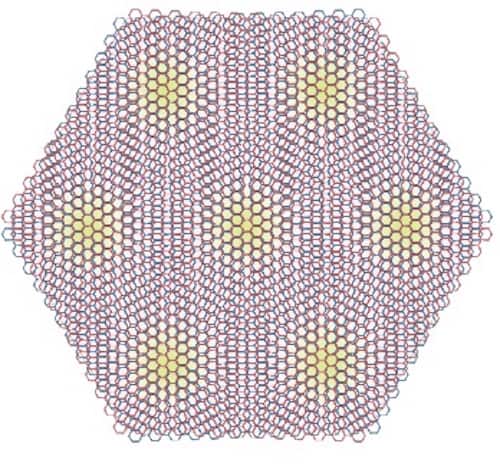
“For instance, graphene (a 2D sheet of carbon atoms) normally does not have a band gap. It develops one, however, when placed in contact with another 2D material, hexagonal boron nitride, which has a closely matching lattice constant. The layers of graphene and boron nitride form what is called a large “Moiré superlattice”. By then twisting the layers so that they become misaligned and the angle between them becomes large, the band gap disappears.

Magic-angle graphene superlattice

“Simply varying the angle between 2D material layers thus means that graphene can be tuned from being metallic to semiconducting. Indeed, researchers at the Massachusetts Institute of Technology (MIT) recently discovered that placing two layers of graphene together, but rotated relative to one another at the ‘magic’ angle of 1.1° turns the normally metallic material into a superconductor.”

Achieving this variety of electronic properties in conventional materials normally requires changing their chemical composition. The ability to vary the electronic property of a 2D material simply by altering the twist angle between its layers is therefore a fundamentally new direction in device engineering, he adds.

Single device

Until now, researchers needed to make a whole new device for each different twist angle. This often involved fabricating a large number of devices, which also made it difficult to resolve angle-dependent effects independent of sample-to-sample variations.

“What is more, many of the interesting angle-dependent characteristics (such as the above-mentioned superconductivity in twisted bilayer graphene), could only be observed within a very narrow range of the target angle,” says Dean. “We have now succeeded in making a single device whose layers we can continuously rotate locally while measuring its physical and electronic properties. This is a new platform that allows us to switch between an arbitrary number of complementary states in the device.”

So how did the Columbia team do this?  “Our technique takes advantage of the low interfacial friction that naturally exists between layered 2D materials,” Dean tells Physics World. “There is no strong chemical binding between the layers so they slide over one another easily. Indeed, this is the reason that graphite is used in pencil lead and that both graphite and boron nitride are used as dry lubricants in industry.”

In their fabrication process, the Columbia researchers studied graphene/boron nitride heterostructures and designed a device in the shape of a gear that they intentionally made so that it was rotatable. “We then employed techniques previously developed in our lab to mechanically pick up this nano-sized gear (made of boron nitride) and place it over the top of the active area (graphene). Once in place, we used an atomic force microscope to push along one tooth of the gear, causing it to rotate.”

Proof-of-principle

This proof-of-principle shows that we can achieve and control rotation in graphene/boron nitride heterostructures, and can dynamically vary the electrical, optical and even mechanical properties of a device made from these structures, he says.

“Notably, we demonstrated that the energy gap observed in graphene is tuneable and can be turned on or off on demand just by changing the orientation between the layers,” adds Rebeca Ribeiro, who is lead author of the study.

As for applications, the work could help in the development of new kinds of switching technologies, such as tuneable sensors and tuneable electro-mechanical and electro-optical based devices, says Dean.

The researchers, reporting their work in Science 10.1126/science.aat6981, say that they are now busy studying emerging phenomena that come from interactions between the 2D material layers. “The discovery of superconductivity in twisted bilayer graphene results from the interaction between single layers of graphene, neither of which superconduct on their own. We believe that we might be able to introduce, and turn on and off, similar effects, such a spontaneous magnetic ordering and topologically protected band gaps, with controlled twisting.

“Until now, we have only studied graphene and boron nitride but there exists a large class of 2D materials that can be integrated with one another in similar ways. These materials can be metallic, insulating, semiconducting, magnetic and superconducting.

“At the most basic level, our study shows that there is a fundamentally new way to control these materials that just doesn’t exist in conventional semiconductor heterostructures. It therefore opens the door to a whole new field of research in which material properties can be varied by simply twisting material layers.”

How to answer cosmic queries

When you create a blog (Astroquizzical) whose sole raison d’être is answering questions from the general public about space, you anticipate that there will be some unusual questions coming your way. But some of these are so unexpected and stray so far afield from the sorts of questions that, as a trained scientist, I would pose, that you really have to stop and think about how best to answer them.

These unanticipated queries come in three broad forms. The first are questions that have mixed up or jumbled concepts, and what brings you pause is how to best untangle the knot of confusion. This gets us into questions like “How come the signal from our spacecraft doesn’t get lost on the way back to Earth? Wouldn’t objects in between them and us block the signal?” To answer this takes an understanding that spacecraft must ping information back to Earth, that astronomical distances make this task harder, and that a solid object (like a planet) must do something to that signal. What is missing from this picture, though, is a grasp of how fundamentally empty most of space is. To answer this, I must go into a combination of the emptiness of space, even in the relatively dense solar system, and the limitations of our solar-system explorations so far. It’s certainly true that we can’t hear from Mars when it’s on the other side of the Sun. But for spacecraft like NASA’s New Horizons probe, which is much further away than Mars, the signal from the craft can spend its time zooming through the mostly empty solar system, arriving safely at Earth without ever having to bounce off a planet.

The second type of perplexing questions are those from children, who have, in their deep curiosity, invented a theory, but with no background material whatsoever. These questions are often the most unexpected, but can usually be answered using a relatively straightforward path – children want to know how it works, so there’s not so much untangling of existing knowledge to do. These questions can, however, be the most amazing scenarios you’ve ever heard. One of my all-time favourite questions was passed on by the parent of a five-year-old, who wanted to know if the universe was tiger-shaped, surrounded by dinosaur bones. I unabashedly love this cosmological hypothesis, which, in this case, even the child was not so certain of. Fortunately, the tests which have told us that the universe is fundamentally flat also (alas) rule out a tiger-shaped universe.

A five-year-old wanted to know if the universe was tiger-shaped, surrounded by dinosaur bones. I unabashedly love this cosmological hypothesis

The last are people who aren’t super-confused, have a little bit of information in their heads and have come up with some fantastical scenario, but can’t figure out how that scenario would work given their existing information. This is the set of questions for which I usually have to do the most work. All of the submitted questions require a degree of research to answer them, but these hypotheticals often require me to extract numbers from technical papers, make some assumptions, and work out some values that are useful for that scenario. This is where “if you didn’t burn up, could you surf on the Sun?” fits. “If you could divide the Sun into two half-sized Suns, what would happen to the Earth?” “Can you actually take an entire star and pull it into a planet sized object, the way they did in Star Wars?”

While these ones are my favourites to answer, they are simultaneously the trickiest. How do you figure out if you could surf on the Sun? What’s the density of the surface of the Sun relative to water? A billion times less dense. Ok, so what if you make the surfboard bigger? That’s a possible solution – increase the surface area, and you can increase the buoyant force from the Sun. But you’d need to have a surfboard 26 m long, and it would need to weigh barely as much as a mosquito in order to float on the surface – a technologically impossible task. To actually balance a human on board, you’d have a surfboard the size of Manhattan.

What about half-sized suns? This question boils down to “are two suns of 50% the mass of the Sun equal in brightness to 1 Sun?” The answer to this is no – 50% of the mass only gets you 10% of the light, so at a maximum, the Earth would be getting 20% of the light it currently receives. If you don’t like winter now, you’d really dislike the planetary deep freeze that the Earth would endure if we split the Sun in half. Mercury would start to look balmy at that point, but with Mercury’s strange rotation, both the days and the nights would be lengthy.

Can you compress a star into something smaller? Sure, but that would be at the expense of whatever you hope to use to contain the star, because if you compress a star, you wind up with some kind of stellar remnant – a neutron star or black hole. The gravitational forces surrounding these objects are extreme, and would rupture any rocky structure surrounding it. And if you cut deeply into a planet the way that Starkiller Base did, you’d have a lava trench, as the mantle of the planet would be exposed.

These are only a few of the many questions that have been answered. There’s a backlog of equally excellent questions waiting for me to get to them, and even more answered in my new book Astroquizzical: a Curious Journey Through Our Cosmic Family Tree.

Aurora experts need to talk about STEVE

Back in 2016, the Alberta Aurora Chasers Facebook group brought a new atmospheric phenomenon – a narrow band of purple and white light – to the attention of scientists. Now, a team from the US and Canada has found that such STEVE events are probably not caused, as auroras are, by charged particles precipitated into the upper atmosphere. Instead a new ionospheric mechanism may be responsible.

“Our main conclusion is that STEVE is not an aurora,” says Bea Gallardo-Lacourt of the University of Calgary, Canada. “So right now, we know very little about it. And that’s the cool thing, because this has been known by photographers for decades. But for the scientists, it’s completely unknown.”

To come up with this finding, the team used All-Sky Imagers based on the ground in eastern Canada and data from a NOAA Polar Orbiting Environmental Satellite (POES) that happened to cross a STEVE event on 28 March 2008 at the centre of the All-Sky Imager field-of-view. The light from this STEVE covered roughly 1000 km from east to west but was only tens of kilometres wide. An aurora had appeared beforehand.

The POES-17 satellite did not detect any charged particles raining down to the ionosphere during the STEVE event, indicating it was probably produced by an entirely different mechanism. The team has dubbed STEVE a kind of skyglow, rather than an aurora.

The first research paper about STEVE was published in Science Advances in March 2018. That team, which included Gallardo-Lacourt, found that there was a stream of fast-moving ions and super-hot electrons passing through the ionosphere where STEVE was visible. It wasn’t clear, however, whether these particles were responsible for producing the event.

STEVE was originally named after the 2006 animated film Over the Hedge in which animals call an unknown object Steve to make it less scary. Later scientists proposed a backronym, with the letters standing for Strong Thermal Emission Velocity Enhancement.

Next Gallardo-Lacourt and colleagues plan to investigate whether the streams of fast ions and hot electrons in the ionosphere create STEVE’s light, or the light comes from higher up in the atmosphere. To fully understand STEVE’s secrets they will need particle measurements from more STEVE events.

Gallardo-Lacourt and colleagues reported their findings in Geophysical Research Letters.

  • This news article is based on a press release from the American Geophysical Union.

β-CUBE delivers high-performance small-animal PET

 MOLECUBES

Preclinical PET is an ideal research tool for studying small-animal models of disease. To optimize systems for imaging the minute features of mice, developing small-animal PET scanners with high spatial resolution and high sensitivity is a longstanding goal.

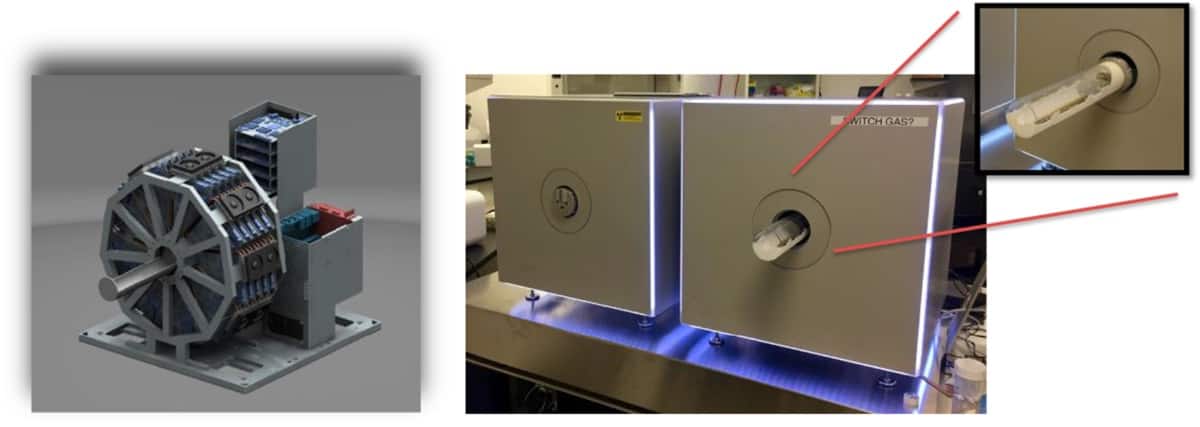
Ghent University spin-off MOLECUBES recently launched a line of dedicated small-animal scanners, including the β-CUBE (PET), X-CUBE (CT) and γ-CUBE (SPECT) systems. The β-CUBE is lightweight, compact (54 cm3) and enables bench-top imaging of both mice and rats. The first β-CUBE and X-CUBE scanners were recently installed in the Small Animal Imaging Facility at the University of Pennsylvania. The team has now reported the findings of a detailed performance evaluation of its β-CUBE (Phys. Med. Biol. 63 155013).

“The main challenge in PET imaging of mice is developing a scanner that offers functionality and practicality for high-throughput imaging, as well as excellent performance,” says first author Srilalan Krishnamoorthy. “The combination of high spatial resolution and high sensitivity is very important – this leads to images that have excellent statistical quality with the ability to achieve quantitatively accurate measurements of radiotracer uptake.”

System specifications

The β-CUBE detector comprises an 8 mm thick monolithic LYSO scintillator coupled to an array of silicon photomultipliers. The monolithic scintillator delivers high intrinsic spatial resolution and enables depth-of-interaction (DOI) measurement. A total of 45 PET detectors arranged in five rings provides a scanner diameter of 7.6 cm and an axial length of 13 cm – suitable for whole-body imaging of both rats and mice.

The PET scanner can be used individually, or in combination with the X-CUBE micro-CT scanner. The animal bed is easily transferred into the X-CUBE, and the 3D PET and CT images are automatically co-registered. The CT acquisitions can be also used to perform all attenuation and scatter corrections necessary to obtain quantitative PET images.

The team first measured the spatial resolution of the β-CUBE using a 22Na point source embedded in an acrylic cube. The source was placed at the scanner centre and stepped radially across the detector field-of-view (FOV). Reconstructing the PET data with a 3D filtered back projection algorithm revealed an excellent spatial resolution of better than 1 mm over the entire FOV.

“The scanner has excellent spatial resolution that is uniform over the imaging FOV, due to its ability to compensate for parallax error in the image reconstruction process,” explains Krishnamoorthy. “This capability is due to the sophisticated monolithic detectors that enable the DOI of the gamma rays within the crystal to be measured.”

Using the same point source, the researchers measured a maximum absolute sensitivity of 12.4% at the scanner centre, using a 50% energy window (255-765 keV). With a 15% energy window (435-588 keV), as is routinely used for animal imaging, they measured an absolute peak sensitivity of 5.7%.

The researchers also used NU-4 standard line-source mouse and rat phantoms to measure scatter fraction (scattered events/scatters plus trues) and noise equivalent count (NEC; trues squared/total counts). They recorded scatter fractions of 11.3% and 15.7%, with the mouse and rat phantoms, respectively. Peak NECs were 300 and 160 kcps in the two phantoms, using the 15% energy window and measured with 900 μCi in the phantoms.

Derenzo phantom

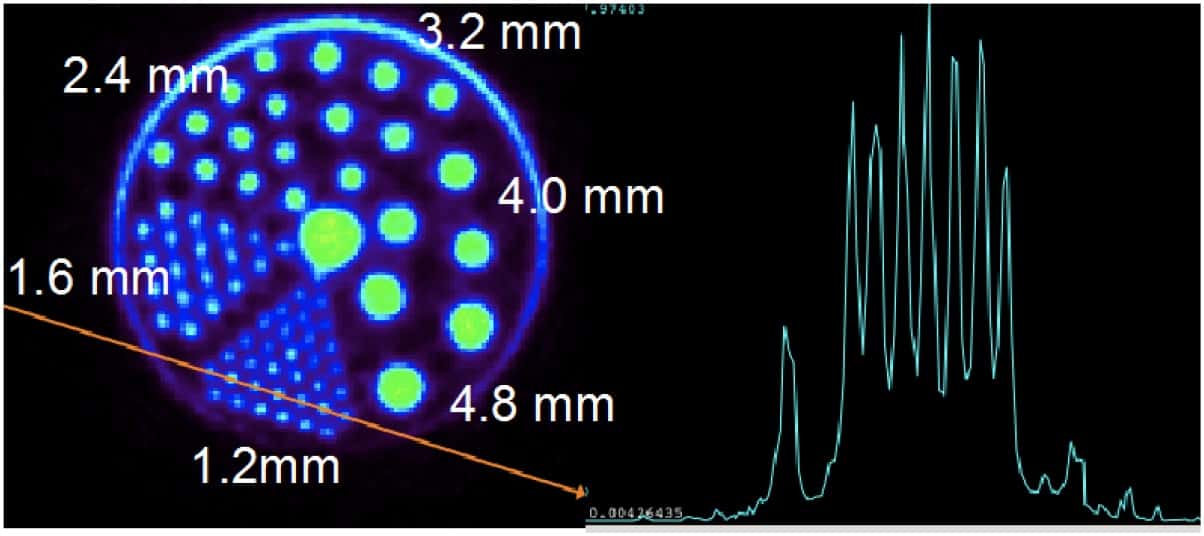
Images of the NU-4 image quality phantom (reconstructed using CT correction of attenuation and scatter) revealed an image uniformity of 7.4% and spill-over ratio of 8%. The researchers measured a contrast recovery of about 70% for 2 mm-diameter rods and full recovery for rods of 3 mm or larger. They also imaged a Micro Derenzo hot rod phantom, and saw that the smallest 1.2 mm rods were clearly visualized and well separated.

Animal investigations

Krishnamoorthy notes that, thanks to an in-house cyclotron and an excellent radiochemistry group at the University of Pennsylvania, the Small Animal Imaging Facility team has used the β-CUBE to perform animal studies with a variety of novel PET radiotracers, in many areas of oncology, neuroscience and cardiology.

In one investigation, they used 18FDG PET to investigate inflammation in osteoarthritis of a rat’s temporomandibular joint (TMJ). They performed a 15-min static PET scan 1-hour post-injection, immediately followed with a CT scan. The co-registered images delineated the small structure of the TMJ from the surrounding jaw, leading to a more accurate measurement of the FDG signal and improved tracking of disease progression.

PET and PET/CT images

In a second example, the researchers describe a lung tumour imaging study in mice, using a 15-min static PET scan 1-hour post-injection of 18FDG. They note that the superior spatial resolution and contrast recovery allow better visualization of smaller structures in comparison with their older system, which has 2 mm spatial resolution.

“We are currently working on optimizing our current imaging protocols to fully utilize the MOLECUBES PET and CT scanners,” Krishnamoorthy tells Physics World.

Copyright © 2026 by IOP Publishing Ltd and individual contributors