Organic molecules found in ancient Martian rocks

Organic molecules have been found in ancient rocks under the surface of Mars. The discovery was made by NASA’s Curiosity Rover by drilling into mudstone that was laid down 3.5 bn years ago at the bottom of a Martian lake. The molecules found include sulphur-rich thiophenes, aromatic hydrocarbons, such as benzene, and aliphatic hydrocarbons such as propane.

While the presence of these molecules does not prove that life once existed on the red planet, the discovery suggests that conditions on Mars could have been like those here on Earth when life first emerged more than 3 bn years ago.

The discovery is reported in the journal Science by NASA’s Jennifer Eigenbrode and an international team of scientists. They used Discovery’s Sample Analysis at Mars (SAM) instrument to examine samples that had been gathered from Mars’ Gale crater using a drill that can probe 5 cm below the surface.

SAM works by heating rock samples to release any organic compounds that may be present. The emitted gases are then analysed using a gas chromatograph mass spectrometer and a laser spectrometer.

This is not the first time that Curiosity has detected organic molecules, but previous measurements were considered unreliable because of possible sample contamination and unwanted chemical reactions.

Curioser and curioser

While such organic compounds could have been produced by ancient life – or could have provided a food source for ancient organisms – it is also possible that the molecules were created in the complete absence of life. “Curiosity has not determined the source of the organic molecules,” explains Eigenbrode.

Apparently barren and devoid of life today, scientists believe that Mars may have once been a more hospitable environment. Data gathered by Curiosity in 2015 suggests that the Gale Crater was once home to streams and lakes of liquid water. Now, scientists know that some of this water contained molecules that could be associated with life.

NASA associate administrator Thomas Zurbuchen says the agency wants to keep searching for signs of life on Mars. “With these new findings, Mars is telling us to stay the course and keep searching for evidence of life”.

In a second paper in Science, NASA’s Christopher Webster and an international team describe how they have used instruments on-board Curiosity to measure a seasonal variation in methane levels in the Martian atmosphere. The study, which ran for three Martian years (about five Earth years), found that methane concentration in the summer was nearly three times higher than in the winter.  Webster and colleagues say that the variation cannot currently be explained by processes known to occur on Mars.

Sounding out lasing in silicon

Combining photonics and electronics would bring the advantages of speedy optical data transfer to the increasingly miniaturized world of electronics. Ideally photonics and electronics elements would be seamlessly integrated but many traditional photonics components are tricky to replicate in silicon, a fundamental challenge being a source of light on-chip. Now researchers at Yale University, Arizona University and the University of Texas at Austin show how this hurdle may be tackled using a silicon Brillouin laser.

When a material is strained, its refractive index changes due to “Brillouin scattering” from strain-induced deformations. In a crystal this strain may be due to acoustic vibrations in response to the electric field from an intense beam of light – stimulated Brillouin scattering. Put this scenario in a ring structure where the optical gain from stimulated scattering overcomes roundtrip loss and you have a Brillouin laser.

While the power and flexibility of Brillouin lasers has already attracted notice, as Peter Rakich, and Nils Otterstrom at Yale University and their co-authors point out in a report of their work, Brillouin interactions are markedly weak in conventional silicon photonic waveguides. The trick with this latest work was devising a silicon system with “unusually large Brillouin coupling”.

Narrowing in on Brillouin lasing in silicon

For the Brillouin lasing silicon system the researchers fabricated a racetrack structure from single crystal silicon on insulator. They then removed the insulator under the two long edges and it is these two suspended waveguide sections that produce large intermodal Brillouin gain.

Investigations of the system by injecting continuous wave pump light into an asymmetric cavity mode and analysing the “Stokes” scattered light emitted into a symmetric cavity mode revealed a 3% slope efficiency of input versus output power.

Another notable feature of the system’s response was the spectral compression – the curve describing the spectra of the Stokes emission narrowed by a factor of around a thousand to a line width with a resolution-limited value of just 20. This kind of monochromatic single-frequency output is a typical feature of lasers. Despite a high degree of acoustic spatial damping and lack of phonon feedback spectral compression occurred as long as the temporal acoustic dissipation rate was lower than that of the optical field.

Full details are reported in Science

Rio de Janeiro unveils huge science graffiti

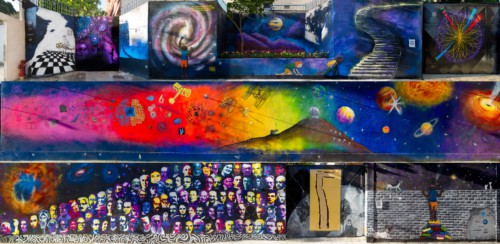
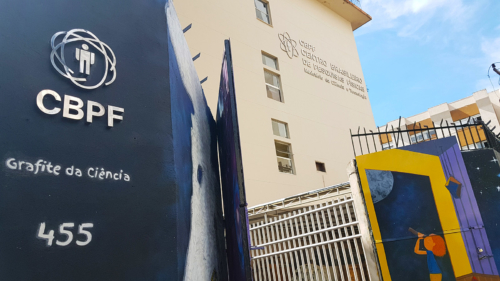
The Brazilian Center for Physical Research (CBPF) in Rio de Janeiro has today inaugurated what it calls the largest urban graffiti dedicated to science.

Spanning 240 m2, the graffiti occupies the walls that enclose the institute. It is divided into eight segments that each touch on a specific theme including “the particle that changed Brazil”, “from nano to the macro” and “in search of more”. The “highlight”, according to the CBPF, is “constructors of science”, which features the faces of 100 scientists and is inspired by the famous painting “Operários” in 1933 by the Brazilian modernist painter Tarsila do Amaral.

This work allowed me to see the world differently

Gabi Tores

The graffiti artwork was led by Gabi Tores who is an arts student at the University of the State of Rio de Janeiro. The mural took 600 hours to complete using 110 litres of paint and 324 spray cans. “I fell in love with the project when I realized that this interaction with the public would be unique and we were bringing an innovative concept to this type of urban art,” says Tores. “This work allowed me to see the world differently. In particular, I realize the value of science and how it is so close to us, but sometimes we do not even realize it.”

Hidden puzzles

The CBPF carries out research into a range of topics from nanotechnology to high-energy physics, is one of the top physics institutes in the country. It also serves as the main hub for the academic Internet infrastructure on which a variety of other scientific institutions rely, such as the Brazilian National Cancer Institute. During the 2016 Olympic Games in the city, the institute’s facilities were even used as the headquarters for the event’s digital security.

The graffiti also apparently holds various hidden puzzles that are associated with science and technology, the answers to which you can submit on the project’s website. Those that solve what the CBPF dub the “hardest” puzzles will even receive a prize, which may include a visit to the CBPF, or – if the budget allows – a trip to the CERN particle-physics lab near Geneva.

See more images of the artwork below.

Wall art
Wall art
Grafite da Ciência-Vista parcial da entrada lateral do CBPF com elementos do mural-Crédito NCS-CBPF
Grafite da Ciência-Vista parcial das áreas Abstracao e Misterio-crédito NCS-CBPF
wall art

World’s great cities hold key to fossil fuel cuts

Governments anxious to reduce the national use of fossil fuels and limit climate change now know where to start: in the great cities. New research has confirmed what with benefit of hindsight should have been obvious – that the 54% of humanity that lives in the cities now accounts for more than 70% of global energy use.

And a new study of the so-called “carbon footprint” of 13,000 of the world’s urban areas has identified the most effective places to start. “The top 100 highest footprint cities worldwide drive roughly 20% of the global carbon footprint,” says Daniel Moran, of the Norwegian University of Science and Technology.

“This means concerted action by a small number of local mayors and governments can significantly reduce national carbon footprints.”

Matching information

Moran and colleagues from Japan, the US and Sweden report in the journal Environmental Research Letters that they defined cities as densely populated, contiguously built up urban areas, often straddling administrative boundaries. From space, Manchester and Salford in the UK would look like one city; Manhattan and Brooklyn, in the US, or Tokyo and Yokohama in Japan, would fade into each other.

The researchers then matched all the information they could find about existing carbon footprints – estimates of energy consumption – with national statistics on spending patterns, regional purchasing power data and a population map.

Cities – historic concentrations of people, business, industry, government, legislation, learning and inventiveness – are also concentrations of economic growth: 600 urban centres are thought to account for about 60% of global gross domestic product.

Cities may drive climate change, but they are also concentrations of people who will be most at risk, not just because cities are hotter than the surrounding countryside, but because, as the world warms, more people in more cities become increasingly vulnerable to extremes of heat and flood.

The message of the study is simple: when it comes to reducing fossil fuel use, carbon footprint and emissions of greenhouse gas, mayors, governors, councils and city bosses have as much opportunity as national governments – and more direct influence.

The scientists assembled their list of 13,000 cities from data from 187 of the world’s nations. Altogether 195 nations in 2015 in Paris agreed to work together to contain global warming, driven by fossil fuel use and consequential increases in atmospheric carbon dioxide, to, if possible, no more than 1.5 °C above historic levels by 2100.

In fact, the world has already warmed by around 1 °C on average in the last century: the challenge is to act in time to stop global warming rising to catastrophic levels.

Several surprises

And the new study delivers some useful places to begin. The top 100 cities are home to only 11% of the world’s population but drive 18% of the global carbon footprint.

The top three – Seoul in Korea, Guangzhou in China and New York in the US – are no surprise, but other metropolitan areas with unexpectedly large carbon footprints include Cologne in Germany, Manchester in the UK and Montreal in Canada.

Of the top 200, 41 cities – and these include Cairo in Egypt, Dhaka in Bangladesh and Lima in Peru – are in countries where both total emissions and emissions per head are low. But many of the world’s most carbon-intensive cities are in the world’s richest nations: that is, their civic authorities have the resources with which to act.

“The fact that carbon footprints are highly concentrated in affluent cities means that targeted measures in a few places and by selected coalitions can have a large effect covering important consumption hotspots,” says Moran.

Sterile neutrinos, climate change and smart cities

In this episode of Physics World Weekly, we look first at the results from Fermilab, which provide evidence for a new type of particle known as a sterile neutrino. Researchers at the Mini Booster Neutrino Experiment (MiniBooNE) say their findings offer a tantalizing glimpse of physics beyond the Standard Model of particle physics. But not everybody agrees.

Later in the programme, Liz Kalaugher speaks about international agreements on curbing fossil fuel emissions and the likelihood of meeting them. She explains why there has been a recent flurry of research papers on the impacts of 1.5 °C warming compared with 2 °C.

Finally, James Dacey explains the concept of “smart cities” – what it means and why we need them. He discusses a recent interview he had with sustainability researcher Bauke de Vries of TU Eindhoven in the Netherlands. De Vries is involved in the Brainport Smart District, a smart city test site being developed near the Dutch city of Helmond.

If you enjoy what you hear, then you can also subscribe to our monthly podcast, Physics World Stories, which you will find on iTunes and other podcast directories.

Muon antineutrino oscillation spotted by NOvA

The best evidence yet that muon antineutrinos can change into electron antineutrinos has been found by the NOvA experiment in the US. The measurement involved sending a beam of muon antineutrinos more than 800 km through the Earth from Fermilab near Chicago to a detector in northern Minnesota. After running for about 14 months, NOvA found that at least 13 of the muon antineutrinos had changed type, or “flavour”, during their journey.

The results were presented at the Neutrino 2018 conference, which is being held in Heidelberg, Germany, this week. Although the measurement is still below the threshold required to claim a “discovery”, the result means that fundamental properties of neutrinos and antineutrinos can be compared in detail. This could shed light on important mysteries of physics, such as why there is very little antimatter in the universe.

Neutrinos and antineutrinos come in three flavours: electron, muon and tau. The subatomic particles also exist in three mass states, which means that neutrinos (and antineutrinos) will continuously change flavour (or oscillate). Neutrino oscillation came as a surprise to physicists, who had originally thought that neutrinos have no mass. Indeed, the origins of neutrino mass are not well-understood and a better understanding of neutrino oscillation could point to new physics beyond the Standard Model.

Pion focusing

NOvA has been running for more than three years and comprises two detectors – one located at Fermilab and the other in Minnesota near the border with Canada. The muon antineutrinos in the beam are produced at Fermilab’s NuMI facility by firing a beam of protons at a carbon target. This produces pions, which then decay to produce either muon neutrinos or muon antineutrinos – depending upon the charge of the pion. By focusing pions of one charge into a beam, researchers can create a beam of either neutrinos or antineutrinos.

The beam is aimed on a slight downward trajectory so it can travel through the Earth to the detector in Minnesota, which weighs in at 14,000 ton. Electron neutrinos and antineutrinos are detected when they very occasionally collide with an atom in a liquid scintillator, which produces a tiny flash of light. This light is converted into electrical signals by photomultipler tubes and the type of neutrino (or antineutrino) can be worked-out by studying the pattern of signal produced.

The experiment’s first run with antineutrino began in February 2017 and ended in April 2018. The first results were presented this week in Heidelberg by collaboration member Mayly Sanchez of Iowa State University, who reported that a total of 18 electron antineutrinos had been seen by the Minnesota detector. If muon antineutrinos did not oscillate to electron antineutrinos, then only five detections should have been made.

“Strong evidence”

“The result is above 4σ level, which is strong evidence for electron antineutrino appearance,” Sanchez told Physics World, adding that this is the first time that the appearance of electron antineutrinos has been seen in a beam of muon antineutrinos. While this is below the 5σ level normally accepted as a discovery in particle physics, it is much stronger evidence than found by physicists working on the T2K detector in Japan – which last year reported seeing hints of the oscillation.

In 2014-2017 NOvA detected 58 electron neutrinos that have appeared in a muon neutrino beam. This has allowed NOvA physicists to compare the rates at which muon neutrinos and antineutrinos oscillate to their respective electron counterparts. According to Sanchez, the team has seen a small discrepancy that has a statistical significance of just 1.8σ. While this difference is well within the expected measurement uncertainty, if it persists as more data are collected it could point towards new physics.

Sanchez says that NOvA is still running in antineutrino mode and the amount of data taken will double by 2019.

Phase-contrast CT reveals impact of microbeam radiotherapy

PCI-CT

Neuro-radiosurgery is evolving to become more effective and less destructive to healthy brain tissue. One emerging approach is X-ray microbeam radiotherapy (MRT), a spatially fractionated radiation delivery method being investigated for the treatment of malignant brain tumours. MRT irradiates tissue with a synchrotron beam reshaped into arrays of highly collimated, micrometre-thick microbeams. The approach administers spatially-restricted peak doses of up to hundreds of gray to both healthy and tumour tissues

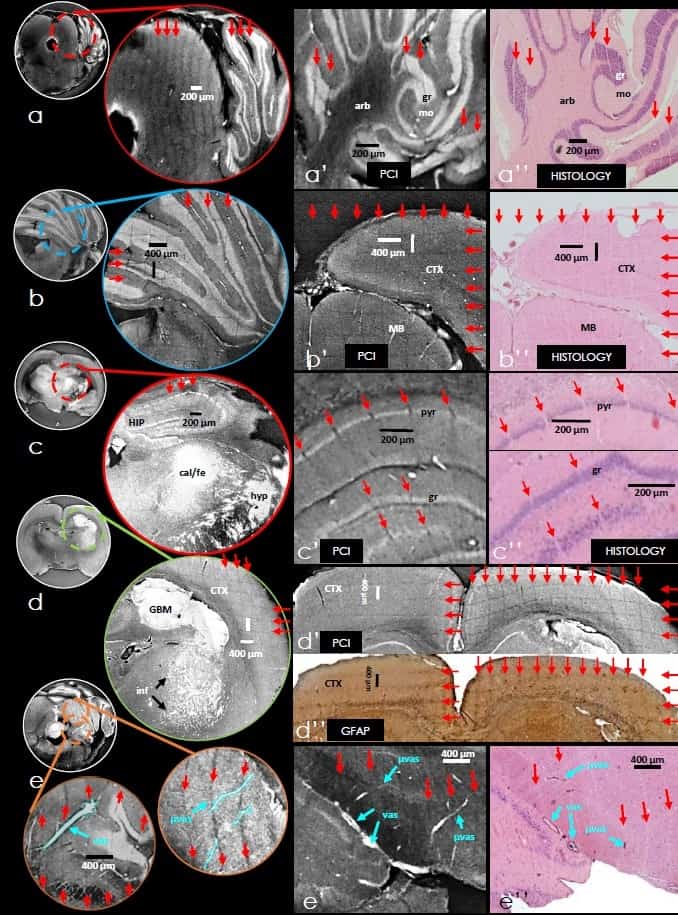
To study the effects of MRT, a European research team has used X-ray phase contrast CT (PCI-CT) – an experimental high-resolution imaging technique – to perform ex vivo studies of normal and cancerous rat brain morphology after treatment at the European Synchrotron.

The researchers found that PCI-CT could detect the effects of MRT throughout target tissue areas and distinguish cancerous tissue morphology, necrosis, and intra-tumour accumulation of calcium and iron deposits. It visualized brain anatomy and micro-vasculature in 3D. Importantly, PCI-CT displayed high soft-tissue contrast without requiring a contrast agent, enabling effective 3D segmentation and renderings of complex brain structure (Int. J. Radiat. Oncol. Biol. Phys. 10.10.1016/j.jirobp.2018.03.063).

High-resolution insight

For the study, Giacomo Barbone from Ludwig Maximilians-Universität München and co-authors implanted glioblastoma cells in the brains of six rats. They treated these rodents plus three healthy controls with a variety of different MRT protocols.

Following MRT, the rats were sacrificed 45 days later, and their brains were extracted for imaging. The researchers then acquired PCI-CT image datasets with 3000 projections over 360° in half acquisition, giving an overall horizontal field-of-view of 30 mm. They reconstructed images using standard filtered back-projection algorithms and computed brain vessel 2D maximum intensity projection (MIP) maps. To obtain a comparable MRI dataset to validate PCI, the authors imaged one cancerous brain sample with a pre-clinical 9.4T MR scanner.

The authors reported that the full structure of a healthy brain (including cerebellar, cortical, thalamic, and hypothalamic structures) was well visualized in both sagittal and coronal slices. Brain sub-region anatomy could be visualized in the coronal slices.

They observed cancerous brain tissue within striatum, thalamic and hypothalamic regions, as well as inside lateral vessels. These were visible as regions of higher phase-contrast relative to normal brain parenchyma. The PCI signal within glioblastoma tissue was generally higher than in normal nervous tissue. Necrotic areas in the centre of tumour masses generated low PCI signal. Calcium and iron accumulation within degenerating cancerous tissues created intense bright signals in PCI.

The researchers identified brain blood vessels in normal and tumour-bearing tissues throughout the PCI data. They were able to segment hyper-dense features to create 3D vessel-network trees, and create 2D MIP maps by superimposing several consecutive image slices. Larger superficial blood vessels in the subarachnoid space were visualized as bright tubes, and intra-cortical vasculature and capillaries as bright tubules. Deep hyper-dense microvascularization had the visual appearance of either an organized network or a “chaotic bundle” wrapping around the glioblastoma in a tumour-bearing cerebrum.

Tissue effects caused by MRT were also well visualized. Brain tissue was marked with 50 μm parallel lines of ablation from the spatially-fractionated microbeams, and hypo-dense comb-like patterns were seen. PCI clearly showed the morphology of MRT-targeted local vasculature and microvasculature, as well as intra-cortical microvasculature, cancerous lesions, MRT-driven tissue ablations and minute cerebral structures.

One potential benefit of PCI is that it does not require extensive sample preparation. The sample does not need dissection, making it well-suited for some post-mortem morphological brain analyses. In addition, PCI concurrently visualizes tumour tissues, healthy tissues, micrometric angio-structure, and the effects of high-dose ionizing radiation in a “one-shot” image.

The researchers believe that PCI could be employed to precede and guide histological analysis. Because PCI can quantify tissue volume modifications, the technique could potentially also be used for studies of brain tumour tissue radio-resistance or to assess drug efficacy in experimental models of neurodegeneration.

Has fishing given cod a ‘depth sentence’?

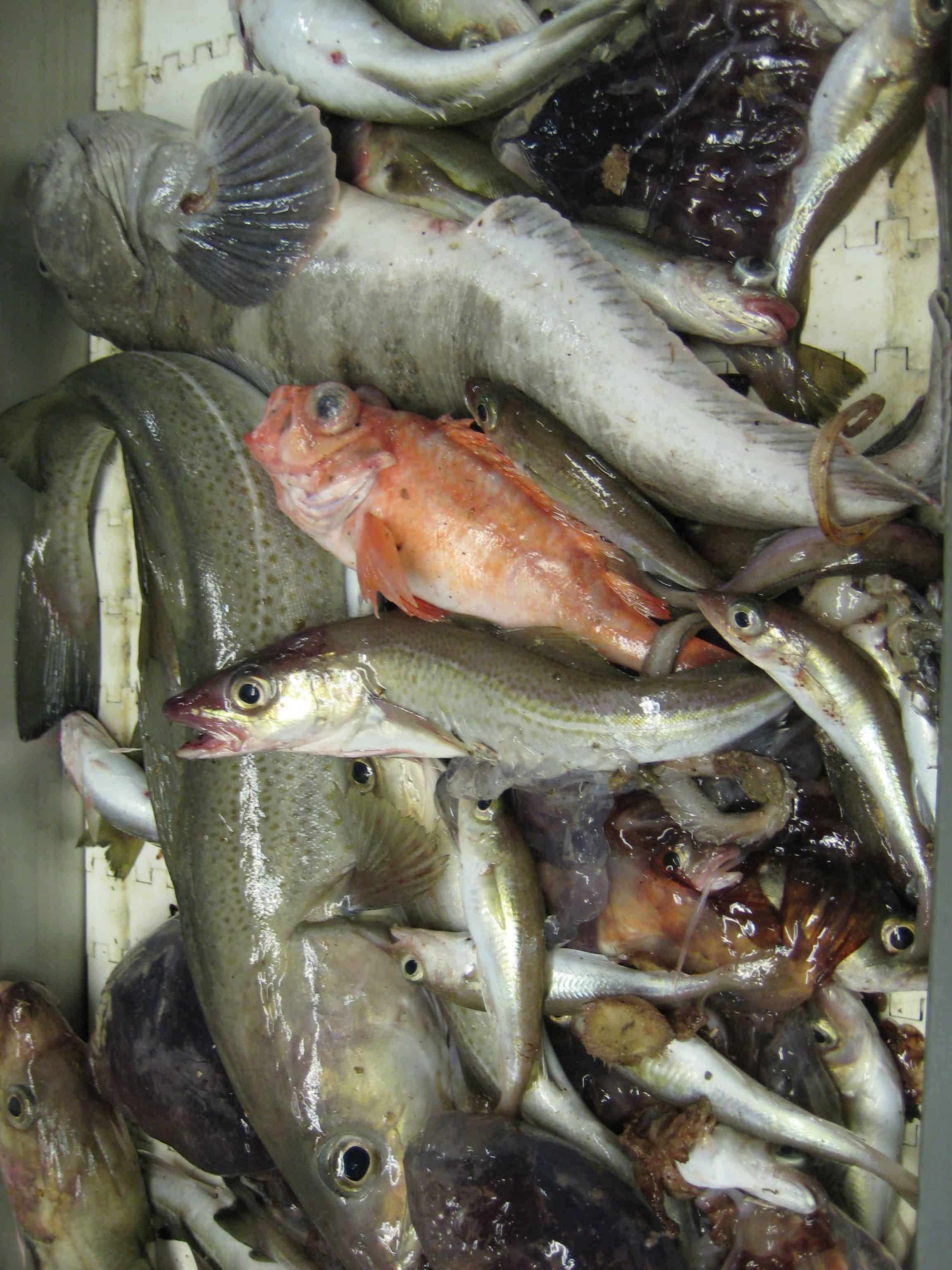
Photo of Atlantic cod and other fish species

Back in the early 1900s British scientist Walter Garstang and Germany’s Friedrich Heincke discovered that plaice in the North Sea swam deeper as they grew bigger. This trend was found in many other species of fish and became known as Heincke’s law.

Now a team from Canada has discovered that the “law” may not be due to fish biology but instead down to fishing. The Canadians’ interest began through recent reports that marine fish are heading deeper and moving north because of climate change. These studies, however, did not consider the bigger-deeper trend, which puzzled Kenneth Frank of Bedford Institute of Oceanography, Canada.

Initially, Frank and his colleagues reasoned that reduced fishing pressure in many areas of the ocean may have permitted fish to live longer and grow bigger, so that they would move deeper.

“But we also realized that most commercial fishing operations prefer to capture bigger fish – as well there are often minimum size regulations – and to fish in the most productive areas, such as on banks or plateaus that are relatively shallow,” says Frank. “All fishermen know about the importance of banks and the high catches they can yield relative to other ocean areas.”

The researchers decided to look at the role that size-selective fishing, i.e. targeting larger fish, could play in the distribution of commercial species. They used data on the depth distribution by age of Atlantic cod on Canada’s Scotian Shelf, to the southwest of Nova Scotia. There have been scientific surveys here every year since 1970.

“Virtually all the fish species that exhibit the bigger-deeper trend are targeted by commercial fishing,” says Frank. “As a result of their commercial importance, such species tend to have long-term, readily available data describing their distribution and abundance.”

The data from the Scotia Shelf indicated that cod swam deeper by about 100 m over the course of their lives, according to Frank. But the team found that the commercial fishing itself could have altered the distribution of the fish by size and age.

“We discovered that a simple population model that simulated the behavior of the fishery – in terms of selectively capturing older fish in shallower water – reproduced the depth distribution of cod that was observed during the scientific surveys,” says Frank. “The agreement between the model results and the field observations were stunning.”

Intensive fishing took place on the Scotian shelf until cod stocks collapsed in the early 1990s; the Canadian government imposed a moratorium in 1992.

“When there was no fishing, the bigger-deeper trend was not evident,” says Frank of the Scotian Shelf data. “Rather, adult cod of all age groups occurred at similar, rather shallow depths located on the productive banks. There was a suggestion of deepening among the younger cod – two and three year olds – amounting to about 10 m but beyond that age, up to age 12, no change in depth was evident.”

This indication that when there’s no fishing, Heincke’s law does not apply to older fish has several implications.

“There is a vast literature attempting to explain both the ecological and evolutionary significance of the bigger-deeper trend that we, as a scientific community, will want to revisit,” says Frank. “Further, the many recent studies that have interpreted deepening as a response to climate change need to be tempered by the fact that these studies did not consider age or sizes of any of the species. Moreover, the effects of fisheries exploitation were not considered.”

Frank believes that all future studies of changes in the distribution of marine and freshwater fishes must factor in the effects of selective fishing while addressing the potential role of climate change and habitat preferences. “It is not sufficient to look just at one factor in isolation from the others,” he says.

Now the team plans to look at the depth distribution patterns of haddock, pollock and silver hake. “These other species have different life styles and different types of fisheries exploiting them so we will modify our population models,” says Frank.

The researchers are also interested in the repercussions of removing fish from depths they would normally occupy. “When subjected to high fishing pressure it is possible that older/larger fish living in deeper water may be experiencing food shortages or possible metabolic stresses which may influence their reproductive capacity and ultimately their survival,” says Frank. “One might consider this a ‘depth sentence’ as a by-product of size-selective fishing.”

Frank and colleagues reported their findings in PNAS.

Intellectual property

You may or may not have been aware, but 26 April was World Intellectual Property Day. Observed annually, the event was set up by the World Intellectual Property Organization to “raise awareness of how patents, copyright, trademarks and designs impact on daily life” and “to celebrate creativity, and the contribution made by creators and innovators to the development of societies across the globe”.

Intellectual property (IP) has played a big part in most of my previous Transactions column, just as it has in most of the businesses I have been involved in. IP – alongside skilled, educated people and “know-how” – is key to ensuring that the efforts put into research and development benefit those who create it.

In my March column, I examined the roles played by Joseph Swan and Thomas Edison in developing lighting technology, and how having a patent early but not acting on it lets others duplicate and surpass your developments to win the commercial race. Last month, meanwhile, I described how both Ted Maiman and Gordon Gould had good claims to have invented the laser. Gould, however, would appear to have had poor advice, because he didn’t patent his idea, incorrectly believing that he needed to demonstrate a working device first.

TV stars

Another great IP battle was over the invention and commercialization of television (TV). The first working TV system was demonstrated by Scottish inventor John Logie Baird on 26 January 1926. However, the first mechanical television system was not terribly practical – in short it was not something you could put in your home. It did, though, demonstrate the potential of the new technology.

The race to develop a practical electronic TV system took place between the US-born inventor Philo Farnsworth and the Radio Corporation of America (RCA). It was a David and Goliath story spanning 15 years and involving patents, lawsuits, schoolteachers, financial might and some less-than-ethical practices. The battle also nearly broke Farnsworth.

Born in Utah in 1906, Farnsworth came up with the concept for the electronic TV as a 14-year-old schoolboy watching the way crops were sown and harvested on his family’s farm – line by line, in what became known as raster scanning. By 1927 he had filed patents on his technology and worked on his invention enough to secure investment. And by the early 1930s Farnsworth had developed working systems and formed a partnership with a radio manufacturer called Philco to bring it to market.

Although it might seem odd why anyone would want to buy a TV at this point as there was nothing to watch, RCA saw the potential. Founded in 1919 as a wholly owned subsidiary of General Electric, RCA was a major manufacturer of radio receivers. It had set up the US national radio broadcasting network (NBC) and owned more than 2000 radio technology patents.

Under the leadership of its general manager David Sarnoff in the 1930s, however, RCA changed its business model. The firm turned its competitors – rival manufacturers who were then making 75% of all radio receivers – into its customers by licensing its own patents to them. RCA could therefore make money both from licensing technology and from the broadcast services that provided the content that fuelled the demand for the hardware.

Sarnoff saw the threat of TV to his radio empire – but also the opportunity it presented. RCA therefore started investing massively in development, hiring Vladimir Zworykin (a talented inventor and engineer from Westinghouse) who had patented an electronic TV concept in 1923. RCA flexed its might via its radio patent-licence agreement and Philco stopped working with Farnsworth. And when Sarnoff tried to buy the patents and Farnsworth refused, RCA used its financial and legal might to try to claim priority of the Zworykin patent.

The legal fight, which began in 1933, dragged on for 15 months with the core of the case being whose patent contained a viable working electronic television system. In the end it was Farnsworth’s high-school science teacher’s testimony and a 1922 sketch that won the case. It was not, though, the end of the story. RCA filed costly appeals to drain Farnsworth’s coffers, hoping to keep the case in court until the patents ran out. The firm also tried to create a workaround for Farnsworth’s patents to make a viable TV, developing a great product that was launched in 1939 at the New York World’s Fair.

The killer blow

Unfortunately for RCA, it used elements of Farnsworth’s design. Despite having tried to work around the Farnsworth patents for years, in 1939 Sarnoff eventually agreed to license Farnsworth’s patents to put the best product on the market. But once America entered the Second World War in 1941, all manufacturing was dedicated to the war effort, which halted production of the TV.

The killer blow for Farnsworth occurred in 1946 when his patents expired. RCA jumped at the fact that anyone could now use his technology, creating the first TV network from its radio network NBC and selling 10 million of its TV sets in the US in just three years. By the end of the 1950s, television had become the world’s most popular form of entertainment.

In all these stories there is a key message to inventors and innovators: get good IP advice early on

James McKenzie

In all these stories there is a key message to inventors and innovators: get good IP advice early on. And if any of this has struck a chord with you, you might be interested in an event at the Daresbury Laboratory in the UK on 22 June, organized by the Business Innovation and Growth Group of the Institute of Physics, which publishes Physics World. Entitled “IP and why you need to know about it”, it should be an invaluable guide especially to those working in small firms, covering details of how the patent system works and how to get patent coverage for your ideas.


Spotting submarines from the air: the June 2018 issue of Physics World is now out

Cover of the June 2018 issue of Physics World

How can you use sound to locate submarines from the air? That’s the question tackled in the cover story of the new issue of Physics World magazine, which is now out. Marking the centenary of the Royal Air Force (RAF), the feature has been written by Jason Furlong from the Royal Canadian Air Force and John Ryder – an RAF pilot who studied physics and is a long-standing member of the Institute of Physics (IOP), which publishes Physics World.

Much of the challenge focuses on analysing the strange and complex behaviour of sound in what is a noisy underwater world. Maritime patrol aircraft crews do this by dropping sonobuoys containing hydrophones at strategic points to record signals and send them back to a transceiver on the plane. It’s the crew’s job to then analyse the complex data using mathematical models to pinpoint a sub’s location.

Elsewhere in the issue, find out how the first trillionaire could be made in space, possibly by mining an asteroid, and discover why some cosmologists still aren’t sure if dark energy is the right explanation for the accelerating universe. Plus we look at the importance for inventors of acquiring intellectual-property rights and find out why applying for grant money is still so hard.

Remember that if you’re a member of the Institute of Physics, you can read the whole of Physics World magazine every month via our digital apps for iOSAndroid and Web browsers. Let us know what you think about the issue on TwitterFacebook or by e-mailing us at pwld@iop.org.

For the record, here’s a run-down of what else is in the issue.

• Physicists target the dark photon – An Italian experiment is to hunt for hypothetical particles that could carry a fifth force, as Edwin Cartlidge reports

• New NASA boss divides opinion – Jim Bridenstine’s appointment as the next head of NASA has garnered praise and disapproval, as Peter Gwynne reports

• The power of images – Enrico Sacchetti argues that the saying “a picture is worth a thousand words” is truly apt when it comes to the photography of large physics
experiments

• What is physics like? – Robert P Crease wants to know your most discerning metaphor for doing physics

• Intellectual property – James McKenzie reflects on the importance of intellectual property, which is a key part of commercializing technology

• The dark-energy deniers – The discovery that the universe is expanding with increasing speed may have bagged a Nobel prize, but some cosmologists are still not sure if dark energy is the explanation for it. Keith Cooper looks at the arguments for and against this mysterious phenomenon

• Hunting submarines from the air – Far above the ocean’s surface, aircraft hunt for an unseen enemy below the waves. To mark the centenary of the Royal Air Force, tactical co-ordinator Jason Furlong and pilot John Ryder describe how they use physics to find submarines

• The asteroid trillionaires – The race to the riches of asteroids is on, with several private companies vying for funding to become the first space miners. Andrew Glester digs into the issues involved in making money from asteroids

• Riding the gravity wave – Benjamin Skuse reviews On Gravity: a Brief Tour of a Weighty Subject by Anthony Zee

• The wow and the woo – Philip Moriarty reviews Quantum Sense and Nonsense by Jean Bricmont

• The perils of proposals – With its complex procedures, unknown evaluations and unconscious biases, applying for research funding is no mean feat. Dalmeet Singh Chawla investigates if it is time to revamp the grant-funding process

• Once a physicist – Meet Arie van ’t Riet an artist in the Netherlandswho uses X-ray equipment to create “bioramas” X-ray portraits of animals and plants

• Reality science – Jeremy Baumberg on dystopian future science funding

Copyright © 2026 by IOP Publishing Ltd and individual contributors