Orfit Industries’ polymer science group has harnessed the power of nanotechnology to help improve cancer treatment. Nanor, a thermoplastic material enhanced with nanoparticles, has been developed to precisely immobilize patients during cancer treatment using radiation therapy. Limiting the movement of the patient results in more targeted treatment delivery and the potential for improved patient outcomes.
Nanor is the thinnest and strongest material that has so far been used for immobilization during cancer treatment. The nanoparticles increase the strength of the thermoplastic mask material, which helps to limit patient movement while allowing precise targeting of the tumor. Because the material is so thin, the Nanor mask fits on the patient like a surgical glove. It adapts perfectly to the patient anatomy, contributing to limitation of movement, increased comfort and accurate treatment delivery resulting in improved patient outcomes.
Nanor Thermoplastic is FDA 510(k) cleared and is available as part of the High Precision Patient Immobilization Systems available in North America and worldwide.
For more information about Nanor thermoplastic immobilization, visit www.orfit.com/nanor
Radio frequency identification (RFID) chips can be used to keep track of human organoids, according to new experiments by researchers in the US and Japan. Combining organoids (which are samples of human tissue grown from stem cells that mimic organs) with digital technology in this way could prove useful for advancing drug testing and monitoring transplant patients.
RFID is a cost-effective technology that is widely used in applications as diverse as train and bus passes, toll-collection on highways, livestock tracking and clothing tags to deter shoplifters. In 2017, the world RFID market was estimated to be worth US$11.2 billion and it is expected to grow by 10% annually.
In recent years, researchers have been looking to employ RFID in healthcare. Medical applications now include an oral “digital pill” to monitor some chronic conditions. This device emits radio frequency signals that can be sent to a smartphone or other device in real time, thus providing important data to help a patient take the appropriate medications at the right moment.
Embedded RFID chips
A team led by Takanori Takebe of the Cincinnati Children’s Hospital Medical Center, Tokyo Medical and Dental University and Yokohama City University has now done something completely different and has embedded RFID chips into human organoids for the first time.
Organoids can be thought of organs in miniature. They are increasingly being employed in biomedical research for studying diseases since they have the same structure, function and phenotype as human organs. This is because they are grown from induced pluripotent stem cells (iPSCs), so they divide, differentiate and self-assemble in the same way as the iPSCs themselves. As such, they can be used to test the effects that certain drugs have on our organs in ways that more traditional cell cultures can’t.
The researchers introduced RFID chips into organoids by taking advantage of natural cavitation processes that take place when organoids self-assemble into 3D structures during growth. “In this way, we succeeded in introducing the RFID microchips without disturbing the organoids,” says Takebe. “We did this by mixing the chips with a cell culture inside a gel.”
Technique tested on liver organoids
The team tested out its technique on liver organoids containing commercially available RFID chips 0.4 mm in size. The organoids were grown from 10 different iPSC lines from both healthy and diseased donors.
“We found that 95% of the 96 test organoids successfully incorporated the chips,” says Takebe. “The organoids were undamaged by the procedure and were shaped normally, secreted normal liver proteins and transported bile as expected.
“Surprisingly, there were almost no differences between organoids containing a chip and those without,” he tells Physics World.
The researchers used the RFID chips to measure lipid accumulation in organoids grown from healthy iPSCs and those grown from iPSCs taken from patients with fatty liver disease. They were able to distinguish between both groups in their experiments.
RFID chips are robust
“Although we have only introduced RFID microchips into organoids so far, I imagine that we could also embed other types of micro-devices using our technique,” says Takebe. “In this way, we could potentially sense, record and track different types of behaviour in live organoids. This would open new avenues in drug testing, advanced biological studies and even post-transplant tracking.”
RFID chips are known to be robust and, not surprisingly, they remained so in the organoids tested. For instance, they continued to function normally after being frozen to temperatures of nearly -200°C and then thawed, embedded in paraffin and at a range of different pHs. “These are all the types of conditions they might need to survive in to be useful in research,” explains Takebe.
The researchers, reporting their work in iScience 10.1016/j.isci.2018.05.007, say that they will now try to produce the hybrid organoids on a larger scale. “We are working on integrating a high-speed printer to do this. We are also looking to develop a system that can scan organoid radio frequency and fluorescence signals at the same time for real-time monitoring of the structures.”
South Africa has inaugurated a new optical telescope that will scan the southern sky for supernovae and other extreme events. The 65 cm MeerLICHT (meaning “more light” in Dutch) telescope, which features a 110 megapixel camera, was inaugurated in late May at the South African Astronomical Observatory, near Sutherland.
The telescope will team up with the MeerKAT radio-telescope array – the country’s precursor to the Square Kilometre Array, which is currently being built – to search for cosmic explosions in both the radio and optical data and get a better understanding of the physics of these energetic events.
“Such a coupling of an optical telescope to a radio telescope has not been done before on this scale,” says Patrick Woudt, co-principal investigator of the MeerLICHT telescope, who is based at the University of Cape Town. “To match the wide field of view of the MeerKAT telescope, we required a special optical design of the telescope, which gives us nearly three square degrees on the sky with a single detector.”
Developing human capital and multi-wavelength astronomy is a great strategy
Arvind Vimal Ramessur
Woudt adds that MeerLICHT will also serve as a prototype for an array of three similar telescopes that will be placed at an observatory in Chile to search for optical counterparts of gravitational waves.
A better perspective
Arvind Vimal Ramessur, an astronomer based at the Hartebeesthoek Radio Astronomy Observatory near Johannesburg, who is not part of the project, says the launch of MeerLICHT is another milestone in astronomy, especially for Southern African astronomers and engineers. “Observations of the sky made with different wavelength will give us a better perspective and provide us with additional information of any sources of interest,” he says. “Developing human capital and multi-wavelength astronomy is a great strategy. Such endeavours mean more training programmes and projects for our young Southern African graduates to pursue research in astronomy and engineering.”
The MeerLICHT consortium is a collaboration between the European Research Council, the Netherlands Research School for Astronomy, Netherlands Organisation for Scientific Research, South African Astronomical Observatory and the universities of Amsterdam, Cape Town, Manchester, Oxford and Radboud Nijmegen.
Embolization, cutting off the blood vessels that feed tissue growth, is under investigation as a minimally-invasive cancer treatment. The approach, which starves tumours of blood supply and nutrients, typically involves injecting drugs or lodging nanoscopic beads directly into blood vessels. Recently, scientists have explored another option: gas embolotherapy.
Gas embolotherapy is based on the injection of droplets – with diameters from tens to hundreds of nanometres – into feeder vessels surrounding the tumour. These droplets are then exposed to ultrasound, which transforms them into microscopic gas bubbles via acoustic droplet vaporization (ADV). The bubbles grow large enough to block feeder vessels, such as the arterioles, thereby cutting off the tumour’s blood supply.
Now, a research team from China and France has discovered that these bubbles could also be used as potential drug delivery systems (Appl. Phys. Lett.112 233701).
“We have found that gas embolotherapy has great potential to not only starve tumours by shutting off blood flow, but also to be used as a source of targeted drug delivery,” said first co-author Yi Feng, from Xi’an Jiaotong University.
The researchers previously used ADV to starve the tumour by blocking blood flow in the arterioles. They found that the bubbles not only blocked the arterioles, but that other gas bubbles made their way into the capillaries, resulting in vessel rupture.
In this latest study, the team performed gas embolotherapy on ex vivo rat tissue, to further explore the dynamics of the bubbles inside capillaries. The tests involved bubble formation in droplets of dodecafluoropentane (DDFP) in a bovine serum, which were injected into the blood flow.
The bubbles produced in the DDFP accumulated, sometimes merging, as they lodged themselves in the capillaries. At one point, the researchers observed a local vessel invagination (inward movement of the microvessel), which they believe was caused by the interaction between the bubble and vessel and led to a capillary rupture.
These findings suggest that gas embolotherapy could provide a two-in-one approach to cancer treatment – shutting off blood flow from the arterioles and delivering drugs through the capillaries. In addition, chemotherapy drugs could be kept localized for longer periods of time because blood flow has been shut down.
“In cancer therapy research, scientists are always interested in answering two questions: how to kill the cancer effectively and how to reduce the side effects of chemotherapeutic drugs,” said corresponding author Mingxi Wan. “We have found that gas embolotherapy has the potential to successfully address both of these areas.”
The researchers are now building an imaging system to apply the ADV gas embolotherapy method in rats.
China is moving into the world picture in many spheres, not least energy. The nation saw Trump’s clean energy cull and COP 21 Paris accord exit as ducking out of global leadership, but warned that “no matter how hard Beijing tries, it won’t be able to take on all the responsibilities that Washington refuses to take”.
However, China is leading the pack with more renewable energy capacity installed (around 550 GW in 2016) than any other country, with some major projects, and more investment than anyone else. It is also shutting coal plants, in part as a response to the massive air quality problems that emerged after its breakneck economic expansion based mainly on coal. As noted in my earlier post on China, the National Energy Administration claims that: “between 2016 and 2020, we plan to halt construction or suspend building of new power plants with a total capacity of 150 GW, and shut down 20 GW of outdated capacity”. The nation is also experimenting with a carbon market. Clearly it wants to get on top of the carbon problem, although that may mean it just imports more gas, which also offers a partial and short-term response to the air pollution issues.
The more sustainable option is of course to expand renewables. Hydro remains the largest renewable (at around 350 GW), but in terms of new renewables, wind has led the way, with over 170 GW installed by 2017 (GWEC data), although PV is now catching up with over 120 GW in place. There are some impressive solar projects on land and also on lakes: China’s largest floating PV array so far is 40 MW, but a 150 MW project is under way. Though recently the growth of PV has been slowing.
One reason is that, as capacity has built up, there have been continuing curtailment problems with PV solar, as had already occurred with wind. With wind, the main resource areas are often remote from load centres and grid links can be poor. With PV, although sunlight is ubiquitous, some regions get more than others. So, in some cases, local curtailments for both technologies can be very high. As I noted in an earlier post, as a result, NEA, China’s National Energy Administration, has decided that, while grid and integration improvements are made, no new PV capacity would be added before 2020 in Gansu, Xinjiang and Ningxia provinces, and no new wind plants approved in Jilin, Heilongjiang, Gansu, Ningxia, Inner Mongolia and Xinjiang between 2017 and 2020.
It certainly was a problem. Greenpeace has said the PV curtailment rate across China rose 50% in 2015 and 2016, with over 30% of available power in the north-western provinces Gansu and Xinjiang failing to reach the grid. Curtailment of surplus wind output had reached 20% in 2016 nationally, much more in some remote locations with poor grid links, 43% in worst-case Gansu province. However, progress has been made, and it fell to 33% there, and 15% nationally last year. Now efforts are being made to get curtailment down to 30% in the worst locations, Gansu and Xinjiang, and to 20% in Jilin, Heilongjiang and Inner Mongolia, with the expectation being that it could be completely eliminated in Heilongjiang, Jilin and Ningxia, while Inner Mongolia is expected to reduce curtailment to below 5%.
Despite these infrastructure problems, wind and PV are clearly the cheapest new options, with estimated average generation costs of US$60/MWh, compared to nuclear, which currently gets a guaranteed support tariff of US $70/MWh.
China’s total installed wind power capacity is expected to reach 291 GW by 2020 and PV growth is also likely to boom, perhaps closing the gap with wind. But other renewable electricity options are also being explored, including wave energy. The Guangzhou Institute of Energy Conversion is involved in the development of a new kind of semi-submersible barge-type wave energy converter called the Sharp Eagle, where the wave energy-absorbing buoy resembles an eagle’s beak. A 10 kW device was tested in 2012 and sea tests for a 100k W Sharp Eagle are now under way. As elsewhere, attention is now also turning to clean heat, with solar, biomass, waste and geothermal included in a new plan. And China is running a regional test, with a province seeking to run on 100% green power.
However, China is still also seeking to expanding its nuclear programme from its current 3.9% (from 35.7 GW) to maybe around 6% (with 58 GW) by 2020. That seems unlikely to be achieved by 2020, given recent delays, but the programme is certainly very ambitious in global terms, although it has to be put in perspective. Renewables, including hydro, already supply around 10 times more power in China than nuclear, and its wind output has overtaken that from nuclear, with wind still expanding fast, along now with PV. By contrast, there have been problems with some of the new nuclear projects, most recently welding faults at the new EDF-derivative plant. Overall China’s nuclear programme has had its fair share of problems and delays. And the recent slowdown has dismayed those who look to China to rescue nuclear from the doldrums.
While the expansion of conventional nuclear may have slowed, there is some progress with new nuclear tech and possible new applications. China’s 250 MW HTR-PM high temperature pebble bed helium-cooled reactor (still being built) can, it’s said, be used in Combined Heat and Power mode, to vary the ratio of electricity to heat output. Possible heat applications are seen as “desalination of seawater for human consumption, production of hydrogen, or a wide range of other high temperature heat applications in industry”.
So what is the bottom line for China? Not everyone likes China’s politics and human rights record, but its energy programme is impressive. The country’s overall plan is to get 20% of its energy from low carbon sources by 2030, and renewables look like they will make up the bulk of that – they already supply around 25% of electricity and about 12% of energy. China does have big problems with curtailment and weak grids. And also, crucially, with coal. But it is working on the grids, and its coal phase-out is speeding up. And it aims to spend $750 billion on wind and solar by 2030. As a start, in 2017, it invested $132.6 billion in clean energy, up 24% on 2016, setting a new record, and dwarfing the US investment of $56.9 billion – only a 1% rise on 2016. So, as Trump’s cut-backs begin to hit the USA, and the EU slows down, China should stay well in the lead on renewables globally.
It is true that China did not sign up to very stringent targets for carbon in the Paris COP 21 accord, which was one reason why Trump wanted out of the agreement, since the US had signed up to what he saw as unfair targets. The Paris accord US target was a 26–28% domestic reduction in greenhouse gases by 2025 compared to 2005, making its best effort to reach the 28% target. China did, however, commit to a peak in carbon-dioxide emissions by 2030, with best efforts to peak earlier. It also pledged to cut emissions per unit of GDP by 60–65% of 2005 levels by 2030, potentially putting it on course to peak by 2027. It could no doubt try harder, but then so could everyone else – and the US now seems to have left the field open.
Meantime, China is, these days, a major player in Africa. About a third of the new energy capacity there has been led by Chinese funding, around half of it being for renewable energy projects. But they are not alone – Western countries and companies are also keen to invest in what could be a vast new market. See my next post and the new Palgrave Pivot book I’ve produced with Terry Cook: Renewable Energy: from Europe to Africa.
The science-fiction writer Stanisław Lem tells a wonderful story about a crazy tailor. This tailor knows nothing about people or animals or plants. He’s not even interested in them. All this tailor does is make random clothes, with different holes and tubes for heads or feet or legs or branches or other things that stick out. The clothes get stored in a giant, free warehouse, and if people come by with octopuses or centaurs or butterflies or trees they are almost certain to find something in that warehouse that fits.
That’s how maths works, Lem says. Mathematicians make structures without knowing or caring whether they fit anything. If these structures happen to be useful to someone, that’s wonderful. But it has nothing to do with why the structures are actually created.
That’s only one of several good metaphors I’ve heard for what it is like to do mathematics. Another is by the British mathematician Andrew Wiles, who is best known for solving Fermat’s last theorem. Doing mathematics, he told an interviewer on the Nova TV show, is like taking a journey through a dark and unexplored mansion. “You stumble around bumping into the furniture,” he said, gradually learning where each piece of furniture is. Finally, you determine where the light switch is, turn it on, “and suddenly it’s all illuminated.” Then you move to the next dark room, learn its furniture, and so on.
Metaphors and zingers
Maths metaphors are related to what might be called maths zingers. An example is the Hungarian mathematician Alfréd Rényi’s remark that “A mathematician is a machine for turning coffee into theorems.” Another example is the philosopher Bertrand Russell’s comment that “Mathematics may be defined as the subject in which we never know what we are talking about, nor whether what we are saying is true.”
Both metaphors and zingers aim to get you to see a subject – maths, in this case – in a new way. But while the purpose of a metaphor is mainly educational and enlightening, the purpose of a zinger is mainly to make you laugh. Lem’s metaphor, for instance, is instructive because it highlights something that is often not obvious to outsiders: the fun and imagination of doing maths. Wiles’s metaphor, meanwhile, highlights the exploratory character of maths. Rényi’s and Russell’s remarks reach more for the chuckle than for the enlightenment.
But there’s a cost to both metaphors and zingers, for even as they highlight some aspects of the subject, they do so at the price of de-emphasizing and often distorting other aspects. Part of the collateral damage of Lem’s metaphor, for instance, is that it suggests that the work of those whose role it is to determine whether these dreamed-up structures fit things in the real world – physicists, say – is, comparatively speaking, unimaginative drudgework.
Physics metaphors
These maths metaphors by Lem and Wiles make me wonder if there are any equally vivid and enlightening metaphors to express what it is like to do physics.
I know of many terrific metaphors that illuminate specific concepts and discoveries in physics. Take for instance that concocted by physicist David Miller of University College London in the early 1990s, in response to a challenge from the then UK science minister William Waldegrave to come up with the best way to explain the Higgs field and boson to the public. Miller’s metaphor, for which he won a bottle of champagne from Waldegrave, compared the Higgs field to party-goers at an animated cocktail party. People walking through the room are like particles, with heavier ones being like more popular figures whose progress is impeded by partygoers who throng around them. This, by the way, is the metaphor that Peter Higgs himself told Physics World that he liked most.
But is there a metaphor for expressing the activity of physics itself – what it does and how it relates to the world? There are a few that I have come across, but none as vivid and effective as those that Lem and Wiles had for maths. Richard Feynman once famously compared physics to sex: “Sure, it may give some practical results, but that’s not why we do it.” It’s catchy, yes, but more zinger than metaphor. Dramatizing the sharp distinction between activity and results is interesting, but strangely enough reflects more the perspective of an academic rather than a physicist working outside academia. Feynman’s remark aims for the laugh.
Is there a metaphor for expressing the activity of physics itself – what it does and how it relates to the world?
Robert P Crease
Feynman crafted a deeper metaphor at the beginning of his Lectures on Physics. There he compared the world to a giant chess game played by the gods, with scientists being observers who are only allowed to watch and who collaborate in guessing the rules. This is enlightening in that it captures the fundamental character of the activity, as well as the role of observation and guesswork. Its downside is that it reflects the perspective of theorists rather than experimentalists. Experimentation, as I have often argued, involves the design, building and staging of performances, which the theorists then observe in order to guess the “rules”. But that material, performative side of physics is entirely left out of Feynman’s otherwise clever remark.
So here’s my challenge to Physics World readers: surely you have produced, or can devise, more sharply focused metaphors – and funnier zingers – for the activity of physics. Send them to me and I’ll report on them in a future column.
The term “smart city” is something of a buzz term, but what does it actually mean? In this extended video interview, Bauke de Vries of TU Eindhoven in the Netherlands introduces some key concepts and explains why we need to seek innovative solutions for our built environments. De Vries, a researcher with a focus on sustainability, describes how academics are working with local authorities and commercial companies to create “smarter” urban infrastructures in the Netherlands. Among the projects is the Brainport Smart District – a testbed for smart city concepts in the Brandevoort neighbourhood near Helmond.
Higgs bosons produced in conjunction with a pair of top quarks have been observed independently by physicists working on the CMS and ATLAS detectors at CERN. In both cases the statistical significance of the observations are well above the 5σ that is usually considered a discovery in particle physics. The results could open the door to a better understanding of the Higgs field, which gives fundamental particles such as electrons and quarks their unique masses.
In 2012, physicists working on the ATLAS and CMS detectors on CERN’s Large Hadron Collider (LHC) announced the discovery of the Higgs boson. First proposed in 1964, the particle and its associated field arise from a symmetry-breaking event that occurred in the very early universe. This created a uniform scalar field known as the Higgs field that pervades all space. Elementary particles such as leptons, quarks and the W and Z bosons “acquire” their distinct masses by coupling to this field.
Higgs particles are created at the LHC when protons are smashed into each other at energies as high as 13 TeV. There are many ways that a Higgs particle can be produced in a collision, including several processes that also create a top quark and a top antiquark. These processes are relatively rare, corresponding to about 1% of the Higgs particles created in LHC collisions.
Studying these processes is, however, of great interest to physicists because it provides an insight into how top quarks acquire their extremely high mass by coupling with the Higgs field. This, in turn could provide important clues about the microscopic mechanism that caused the Higgs field to emerge and fill space and time, which is poorly understood. The strong nature of the Higgs-top quark coupling also means it should be relatively straightforward to detect any possible deviations from the Standard Model, which could point to new physics.
Rapid decay
Physicists have so far obtained only limited evidence for the Higgs field coupling to the top quark, rather than making a full-blown discovery. The evidence has been both indirect and direct, with the latter requiring the identification of the Higgs particle and the top quarks produced in the collision. This is tricky, because all three particles decay far too rapidly to be detected themselves, meaning instead that their decay products have to be observed.
Writing in Physical Review Letters, physicists working on the CMS detector report the first discovery-level observation of the co-production of the Higgs particle and a top quark-antiquark pair. The observation involved sifting through huge amounts of data taken at proton-proton collision energies of 7, 8 and 13 TeV – looking for a number of different decay paths that can be taken by the top quarks and the Higgs. One route that was studied, for example, involves the Higgs boson decaying to a pair of bottom quarks whilst the top quarks decay to produce at least one electron or muon.
The CMS collaboration also calculates the Higgs-top quark coupling strength, finding it larger than that predicted by the Standard Model. However, this result has a relatively low statistical significance of about 1σ.
Higher production rate
Meanwhile, physicists working on the ATLAS experiment at the LHC have released a preprint of a paper that describes how they have also discovered Higgs production in conjunction with top-quark pairs. Again using data from 7, 8 and 13 TeV proton-proton collisions, the ATLAS analysis identified the production process at a statistical significance of 6.3σ. The ATLAS team also calculated the rate at which Higgs bosons are created along with a top-quark pair for 13 TeV collisions. While their value is slightly larger than that predicted by the Standard Model, it agrees within experimental uncertainty.
“These measurements by the CMS and ATLAS Collaborations give a strong indication that the Higgs boson has a key role in the large value of the top quark mass”, says Karl Jakobs, spokesperson of the ATLAS collaboration.
Fabio Cerutti of ATLAS says that observing the Higgs -top quark production is “a very important result and a milestone in high-energy physics that was one of the main goals of run 2 of the LHC,” which began in 2015 and will end this year.
“The policy with the highest priority is to strongly promote fully battery electric-powered vehicles to achieve the goal of deep decarbonization in the transport sector,” says Runsen Zhang of Hiroshima University. “In addition, social transformations such as lifestyle change and low-carbon urban reorganization could be effective.”
Currently, around a quarter of global carbon dioxide emissions are from transportation. Future savings will need to take place alongside a predicted growth in the demand for transport driven by increased car use and buoyed by a rise in domestic shipping.
“The stronger the mitigation intensity, the more transport-specific policy is required,” says Zhang, who worked with colleagues at the National Institute for Environmental Studies in Tsukuba and Kyoto University.
The group considered the interaction between transport policies, global dynamics of transport demand, mitigation potential, and the cost of meeting goals to limit warming to below 2 °C and 1.5 °C.
The researchers looked at energy efficiency improvements and innovations in vehicle technology — particularly in the deployment of electric vehicles — as well as developments in public transport and increasing the car occupancy rate. They coupled detailed transport models with the integrated assessment models used to guide environmental policy. The work provides more information on the interplay between mitigation options and the dynamics of the macroeconomy, including trends in GDP.
The study assumed that the cost of electric vehicles continues to decline over the coming decades, and the researchers note that liquid fuel savings can be realized directly by the deployment of hybrid vehicles. Such designs are predicted to become a significant fraction of new vehicle sales in the interim before road transportation becomes fully electric.
The simulations reveal that technological policy interventions have the potential to make a significant impact on emissions. However, fossil fuel use could be difficult to eliminate entirely — at least until solutions can be found for electrified shipping and aviation — which points to the need for negative emissions to balance this.
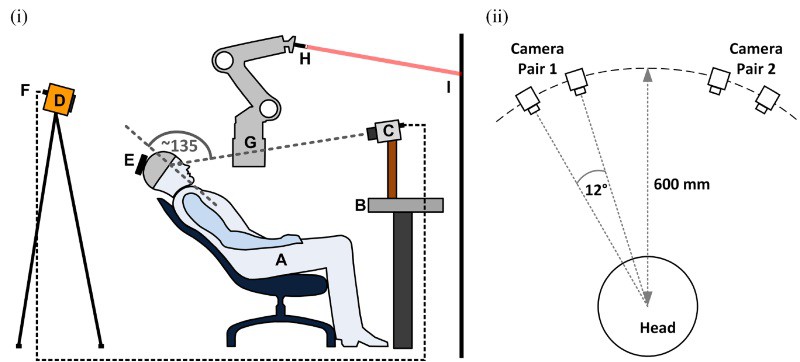
(i) Volunteers (A) reclined in a seat in front of an optical bench (B) on which the markerless tracking system (C) was mounted. A marker-based tracking system (D) tracked a marker (E) affixed to the back of the head on each trigger from the markerless system (F). A robot (G) was used to project the beam of a laser pointer (H) onto the wall in front of the volunteer in a controlled motion sequence (I). (ii) Top view of the cameras showing their configuration with respect to the head.
Head motion during PET, SPECT and CT brain scans can cause artefacts and degrade image quality. While motion compensation can dramatically reduce such degradation, motion-compensated brain imaging protocols are not in routine clinical use – likely due to the lack of a practical head tracking method that can be easily integrated into a busy clinical workflow.
Optical tracking provides high-accuracy motion information, but most optical systems are marker-based, requiring attachment of markers to the patient’s head. Attached markers can fairly easily become decoupled from the underlying rigid head motion, and more rigid fixation is invasive. Instead, University of Sydney researchers are investigating markerless optical tracking, which detects and matches distinctive facial features to determine head pose. In their latest study, they assess this approach for clinical brain imaging (Phys. Med. Biol. 63 105018).
“Marker-based approaches tend to be limited to just a few salient features whereas our marker-free approach can benefit from many distinctive features across the face,” explained first author Andre Kyme. “Marker-based approaches also require more interaction with the patient and specific training for technologists performing the scans. So going marker-free should, in principle, simplify the scanning process.”
Tracking comparisons
The markerless tracking system comprises four CCD cameras arranged in pairs and directed at opposite sides of the face. During data acquisition, frames comprising four synchronized images are continuously collected at 30 Hz. For each frame, distinctive features are detected and matched across images to determine 3D head landmarks. As features are matched, the system constructs a database of landmarks and their associated descriptors. This database, which grows steadily throughout the scan, is used by a tracking algorithm to estimate the changing head pose.
Kyme and colleagues studied 16 volunteers in a mock imaging scenario replicating typical geometries used for PET, SPECT and CT brain imaging. As they expected tracking performance to depend in part upon the patient’s skin tone, they included volunteers of European, Asian, Middle Eastern and African American ethnicities. Some subjects had facial hair, spectacles or a headscarf, which could also potentially influence tracking.
To compare markerless tracking with a validated marker-based system, the subjects also wore a swim cap or headband with a large marker attached. Each volunteer performed a series of head movements while 4000 frames were collected simultaneously from both tracking systems.
The researchers investigated a range of methods to optimize the accuracy of the markerless tracking algorithm, and quantified their impact by computing the motion tracking accuracy in each case. This was achieved by generating a point cloud in the centre of the brain, then computing the root-mean-square-error (RMSE) of the displacement between the estimated (markerless) point locations and reference marker-based locations.
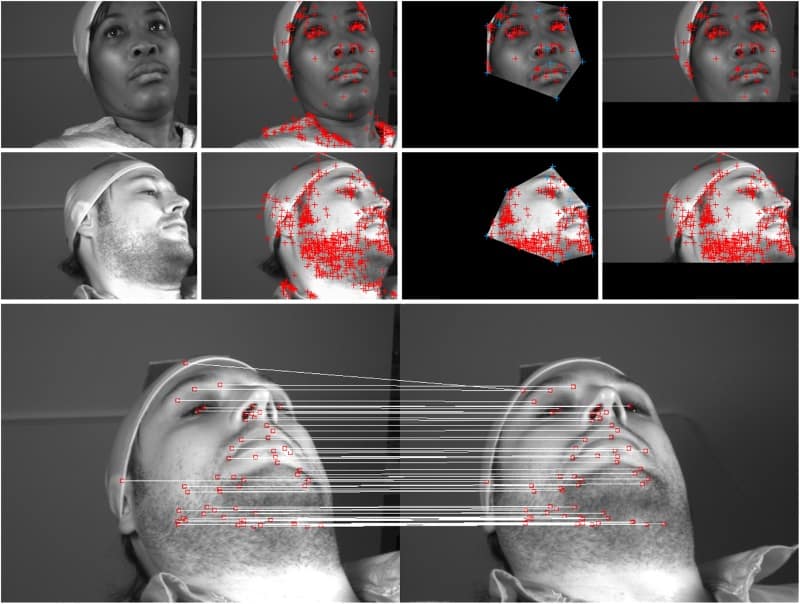
To remove background features from areas such as the neck, clothing and hair, the team examined two background masking approaches: strip masking, a rudimentary mask formed by rejecting fixed margins around the image edge; and facial masking, determined using 16 facial landmarks.
Feature detection with no background masking (column 2), facial masking (column 3) and strip masking (column 4). The raw images are shown in column 1. The bottom panel shows feature matching after applying the facial mask.
Using strip masking, 50-70 facial landmarks were typically used for pose computation. The feature matching process was extremely reliable, with very few false matches recorded. And though the system found fewer features on darker skin, due to generally lower contrast, it successfully tracked motion in all volunteers.
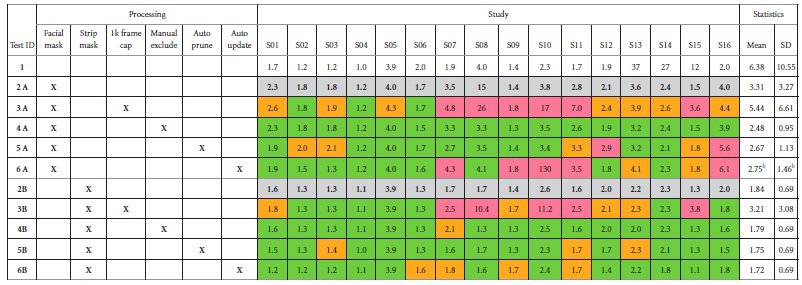
In 12 of the studies, omitting background masking had little influence on the RMSE, while for the others, the RMSE was up to 18 times worse. Strip masking consistently outperformed facial masking. These results suggest that background masking is important, but that a highly subject-specific mask is unnecessary.
The researchers also addressed non-rigid motion, which is uncorrelated with head motion. One approach is to manually exclude frames affected by obvious non-rigid motion, such as smiling, talking or other facial movements, before performing pose estimation. This exclusion resulted in equal or better RMSE in nearly every case. A second option is to update the location of database landmarks each time they were re-observed. Updating the landmarks resulted in equal or better accuracy performance in all studies.
RMSE (mm) for different processing regimes for all volunteers. Green indicates that the RMSE was equal to or better than the reference RMSE (grey), orange denotes that the RMSE was worse by up to 20%, red indicates that the RMSE was worse by more than 20%.
Next, the team examined frame capping, in which a cap is set after which no more new landmarks are generated. They showed that when landmarks from the head had been sufficiently sampled for a given subject, there was no added value in continuing to grow the database. Therefore, if possible, it is better to cap the database to improve the efficiency of pose estimation.
Finally, they tested on-the fly automatic auto “pruning” of unreliable database features and found that this usually improved the accuracy performance of the algorithm.
Overall, markerless pose tracking achieved a mean accuracy of 1.7 mm across all studies, and as low as 1 mm for individual studies. Ideally, tracking accuracy should be better than half the intrinsic scanner resolution: approximately 2, 4 and 0.25 mm, for state-of-the-art PET, SPECT and CT systems, respectively. Thus markerless tracking easily satisfies the requirements for PET and SPECT brain imaging, and has potential for use with higher-resolution CT systems.
The researchers are now looking to test the method clinically in a PET/CT scanner. “We are also adapting our method to in-bore tracking of the head in MRI, where only small areas of the forehead are visible through the head coil,” said Kyme.