Shake-up to US graduate education needed, panel warns

The US must make big changes to graduate education in the sciences and related fields if it is to meet the evolving needs of students. That is according to a report published on 29 May by the National Academies of Sciences, Engineering, and Medicine, which looks at graduate education in science, technology, engineering, and mathematics (STEM) subjects. The report calls for increased emphasis on teaching and mentoring of students as well as recognition that increasing numbers of graduate students will find careers outside of academia.

The report was commissioned in the wake of increased evidence that many graduate programmes do not prepare their students for work. “Continuous, dramatic innovations in research methods and technologies, changes in the nature and availability of work, shifts in demographics and expansions in the scope of occupations needing STEM expertise raise questions about how well the current STEM graduate education system is meeting the full array of 21st-century needs,” the report notes.

The bottom line is that the US education system is in need of modification

Alan Leshner

To identify causes and solutions to the problem, the 17-strong panel spent 18 months studying data, commissioning analyses of research on educational practice, and holding focus groups with students, faculty members, university administrators, industry leaders, and policymakers. “We wanted to centre our attention on the students themselves,” notes panel member Keith Yamamoto, vice chancellor for science policy and strategy in the University of California at San Francisco.

The result is a catalogue of characteristics of ideal graduate education and a list of core competencies that all Master’s degree and PhD students should develop. These include developing a broad technical literacy coupled with deep specialization in an area of interest, communicating the results of their work, as well as considering the ethical and societal issues associated with it.

“If we do not ask ourselves serious questions about incentive structures, focused solely on peer-reviewed articles, quantitative numbers of articles, and research funding, then I fear we will have lost the opportunity to really make a difference in our students and our country,” says panel member Suzanne Ortega, who is president of the Council of Graduate Schools.

Lagging behind

The report notes that the US education system needs to become more student-centred rather than focusing primarily on the needs of institutions of higher learning. “[Programmes] must be realigned to increase the relative rewards for effective teaching, mentoring, and advising,” the report notes. “Unless faculty behaviour can be changed the system will not change.”

Alan Leshner, chief executive officer emeritus of the American Association for the Advancement of Science, who chaired the panel, says that those contacted during the preparation of the report have responded positively to it. “We see coming down the road a whole group of changes,” says Leshner. “The bottom line is that the US education system is in need of modification.”

Leshner adds that he does not know when the panel’s recommendations could become reality, but says that major improvements in students’ experience could happen within the next five to 10 years. “Physicists manage with great success to work in large teams and recognize each individual’s contribution,” he told Physics World. “The rest of science is lagging behind the physics community in that regard.”

Topological semimetals go thermoelectric

When topological nodal semimetals are placed in a strong magnetic field, they become very good at converting heat current into electric power. That’s the new result from researchers at the Massachusetts Institute of Technology, who say that the efficiency of these materials in fact becomes much higher than the upper limits known to exist for any other class of thermoelectric material known today.

“This is exciting because if we can get really good at converting heat current to electric power by exploiting the thermoelectric effect, this will allow for a lot of useful technologies,” says physicist Brian Skinner, who led this research effort together with colleague Liang Fu. “For example, we could recover the waste heat from a car engine or a power plant and use this heat to power electrical devices. Or we could make new kinds of refrigerators or heaters that are very efficient and have no moving parts.”

Boosting the thermoelectric effect

A temperature gradient applied across a solid material containing free charge carriers (electrons and holes) produces a voltage gradient as the carriers migrate from the hot side of the material to the cold side. The strength of this thermoelectric effect is characterized by its thermopower (or Seebeck coefficient), which is the ratio of the voltage difference to the temperature difference across a material.

Finding materials with a large thermopower is crucial for developing devices that can transform waste heat into useful electric power. Most thermoelectric materials made thus far don’t have a very large thermopower, and so can’t be used in real-world practical applications. This is partly because it is difficult to provide enough thermal energy to electrons so that they can cross the material’s energy bandgap and migrate across the material.

Skinner and Fu have now found that they can overcome this problem by applying a strong magnetic field to doped nodal semimetals. “We studied the generic behaviour of these materials theoretically, and then looked specifically at lead tin selenide (PbSnSe),” explains Skinner. “The thermoelectric properties of this material have been found to have interesting features under intense magnetic fields of 35 Tesla.”

In PbSnSe, electrons and holes move in opposite directions under a strong magnetic field, explains Skinner. “Electrons move towards the cold side of the material and holes towards the hot side. Since both holes and electrons contribute additively to the thermopower under a high magnetic field (rather than subtractively as in the absence of a field), in principle you could get a bigger and bigger voltage out of the same material just by making the magnetic field stronger.”

18% of heat converted into electricity

Thanks to theoretical simulations, the researchers were able to calculate the material’s figure of merit, the ZT, which is a measure of how close a material is to the theoretical limit for generating power from heat. They found that under a magnetic field of around 30 Tesla, PbSnSe can reach a ZT of around 10. This is about five times larger than the value for the best thermoelectric materials available today, they say.

“This means that if the material is heated to about 500 K (around 227 °C), under such a high field, it should be able to convert 18% of that heat into electricity,” adds Skinner. “To compare, materials with a ZT of 2 can only convert 8%.”

But a magnetic field of 30 Tesla is huge, admits Skinner, and for such materials to be practical in everyday applications they would need to work in the 1-2 Tesla range. “To achieve this, we would need extremely clean topological semimetal materials containing few impurities,” says Skinner. “Although PbSnSe is relatively clean, there might be better materials that could generate the same amount of thermopower under a smaller magnetic field.”

The researchers, reporting their work in Science Advances, say they will now be looking at other classes of materials. “In the present study, we investigated the ‘Dirac semimetals’, but there are new classes of materials that have been discovered recently that might be just as good for the applications we have in mind,” Skinner continues. “What we’re hoping is that our results will kick off a flurry of activity investigating thermoelectric effects in semimetals under large magnetic fields.”

Dunes of frozen methane spotted on Pluto

Dunes made of frozen grains of methane have been spotted on the surface of Pluto. Blown by winds blowing at speeds of up to 40 km/h, the sand-sized grains travel across the dwarf planet’s Sputnik Planitia ice plane and form dunes that push up against a mountain range.

The features were spotted by a team of geographers, physicists and planetary scientists while studying detailed images of Pluto’s surface that were taken in July 2015 by NASA’s New Horizons spacecraft.

The dunes cover an area less than 75 km across and are believed to be relatively young – possibly forming within the past 500,000 years. Sputnik Planitia is thought to comprise mostly frozen nitrogen, with small amounts of methane and carbon monoxide ice also present.

The researchers believe that the sublimation of nitrogen from solid to gas results in the release of methane grains. The grains are then transported by the wind in a process called saltation, which is also responsible for sand dunes on Earth.

Instantly recognizable

The study was led by researchers at the UK’s University of Plymouth, the University of Cologne in Germany and Brigham Young University in the US. “When we first saw the New Horizons images, we thought instantly that these were dunes but it was really surprising because we know there is not much of an atmosphere,” says Brigham Young’s Jani Radebaugh.

Plymouth’s Matt Telfer adds that the team “had to work hard to explain how it was possible to get the supply of sediment, a non-cohesive surface and wind you need for dunes”.

Eric Parteli from Cologne points out that the low gravity and low atmospheric pressure on Pluto mean that much lower winds are needed to drive saltation on Pluto as compared to Earth. Temperature gradients in the ice caused by solar radiation could also boost the process, he says. “Put together, we have found that these combined processes can form dunes under normal, everyday wind conditions on Pluto.”

The observations are described in Science.

Can choosing who produces your meat harm the environment less?

Producing some beef uses 50 times more land and emits 12 times more carbon dioxide equivalent than lower impact beef. That, and the similar differences for other foodstuffs, offers opportunities for mitigating the environmental impact of food, according to analysis that looked at 38,700 farms and 1600 processors, packaging types and retailers worldwide.

“Two things that look the same in the shops can have very different impacts on the planet,” says Joseph Poore from the University of Oxford, UK. “We currently don’t know this when we make choices about what to eat. Further, this variability isn’t fully recognized in strategies and policy aimed at reducing the impacts of farmers.”

Poore and colleague Thomas Nemecek from Swiss agricultural research institute Agroscope assessed the environmental impacts of 40 major foods in a meta-analysis of hundreds of studies. They compiled the most comprehensive database of its type so far.

“Food production creates immense environmental burdens, but these are not a necessary consequence of our needs,” says Poore. “They can be significantly reduced by changing how we produce and what we consume.”

Feeding 7.6 billion people is degrading terrestrial and aquatic ecosystems, depleting water resources and driving climate change, Poore and Nemecek write in Science. Currently, the world’s food supply chain creates around 13.7 billion tonnes of carbon-dioxide equivalents, which is 26% of man-made greenhouse-gas emissions. Agriculture covers 43% of the planet’s ice- and desert-free land, with 87% of this area producing food and the rest dedicated to products such as biofuels, textile crops, wool or leather. And two-thirds of freshwater withdrawals are for irrigation.

Across all the foods the pair examined, one quarter of producers contributed on average 53% of each product’s environmental impacts, the researchers found. That means reducing the impacts of the most harmful production could make a significant difference. Just 25% of beef production, for example, creates roughly 1.3 billion tonnes of carbon-dioxide equivalent and uses around 950 million hectares of land.

The team recommends that food producers use digital tools to assess their environmental impact and discover the options for reducing it. But it’s a complex business when conditions on the ground are so varied.

“One of the key challenges is finding solutions that are effective across the millions of diverse producers unique to agriculture,” says Poore. “An approach to reduce environmental impacts or enhance productivity that is effective for one producer can be ineffective or create trade-offs for another. This is a sector where we require many different solutions delivered to many millions of different producers.”

On low-emission Northern European barley farms, for example, halving land use can increase greenhouse gas emissions per kilogram of grain by 2.5 times, and acidification by 3.7 times.

When it comes to meat, reducing the impact of production may be less effective than cutting consumption altogether. Even low-impact beef producers created 6 times more emissions and used 36 times more land than those growing peas, the study found. And a low-impact litre of cow’s milk needed almost twice as much land and created almost double the emissions as an average litre of soy milk.

For those in the US, where meat consumption is high, a plant-based diet could reduce food’s greenhouse and other emissions by up to 73%, the results showed. Worldwide the drop in food’s greenhouse gas emissions would be 49%. Global agricultural land would also decrease by roughly 3.1 billion hectares, some 76%.

“This would take pressure off the world’s tropical forests and release land back to nature” says Poore.

Alternatively, halving consumption of animal products by avoiding the highest-impact producers would result in 73% of the plant-based scenario’s greenhouse emission reduction. What’s more, reducing use of products such as oils, alcohol, sugar and stimulants by one-fifth by avoiding high-impact producers could cut their greenhouse gas emissions by 43%.

These approaches would require communicating producer – not just product – environmental impacts to consumers, the team says, through environmental labels in combination with taxes and subsidies.

“We need to find ways to slightly change the conditions so it’s better for producers and consumers to act in favour of the environment,” says Poore. “Environmental labels and financial incentives would support more sustainable consumption, while creating a positive loop: farmers would need to monitor their impacts, encouraging better decision making; and communicate their impacts to suppliers, encouraging better sourcing.”

US renewables struggle under Trump

In line with his electoral promises, US president Donald Trump has tried to revamp much of the US energy system, backing coal against renewables, cutting support for climate change research and supporting nuclear power. His most visible action internationally was to indicate his intention to pull the US out of the Paris COP21 climate agreement, but nationally his policies have been just as divisive, with Obama’s Clean Power Plan being attacked and climate policies reversed, along with the linked “social cost of carbon” methodology. That was widely attacked as environmentally irresponsible.

Trump’s main national priority seemed to be to cut federal spending on energy projects he didn’t approve of. However, he only initially identified £100m in possible cuts from the planned 2018 climate and energy allocations. Apparently Obama had managed to stash much of the climate/energy funding in hard-to-cut programme areas. But Trump persevered and came up with more substantial cut proposals. They included a 69% cut for the Department of Energy’s Office of Energy Efficiency and Renewable Energy, and a 31% cut for the Environmental Protection Agency (EPA), filleting the energy programme. Overall, around $1.4bn of clean energy spending was set to be cut. And in all, reportedly, around £3.6bn from energy and climate spending. However, most of the proposed budget cuts were in the event successfully resisted. Indeed, some were reversed. But Trump is now back seeking even larger (72%) DoE budget cuts for 2019, with US energy secretary Rick Perry backing the plan. Some of that now seems to be going ahead. The US House Appropriations Committee has just approved a $243m funding cut for the 2019 energy efficiency and renewable energy programme, but backed a $58m rise in R&D funding for fossil fuels.

Internationally, Trump announced that “the United States will withdraw from the Paris climate accord”, but he added that it will begin negotiations to re-enter either the Paris accord or a really entirely new transaction on terms that are fair to the United States”. The rest of the world was horrified, and it was made clear that renegotiations were not on. But the exit will take three years to enact. Meantime, the rest of the world seems likely to just get on with it, with China and the EU in the lead.

However, the US will still, it seems, stay in the game globally. In June last year Perry said “The United States will continue to be actively engaged in the development of global energy and the world leader in the development of next generation technology…including nuclear, fossil, LNG and renewables.” He also looked to “technological advances such as carbon capture (CCS) that can leverage the abundant resources we have available in an environmentally responsible way”. He continued, “The United States will continue to be a leader in energy technology, development, and delivery. We will serve as an example to the rest of the world on how to achieve economic, energy, and environmental goals simultaneously.”

Evidently the US wants to exploit its large coal and gas reserves to the full, but how much CCS will be taken on board is unclear – the US flagship project has been cut back.

So carbon emissions could well rise significantly, reversing the current trend: between 2007 and 2015 US CO2 emissions fell by 12%, with a 20% decrease in electricity sector emissions, 50% of that due to gas replacing coal and 40% to renewables replacing coal.

However, Trump’s Paris exit delighted the US far right. You can see why in cash terms. For example, the exit means that the US can stop donating money to the linked Green Fund – so far the US has released $1bn of the $3bn it promised. Not so good for poor countries reliant on aid to try to deal with climate change. Or for the planet, with the US no longer operating within the emission reduction targets set by the Paris accord.

All very worrying. And Trump’s policies are certainly impacting on the market. Some solar companies are failing, though this may be part of a wider boom–bust cycle. But certainly solar PV took a big hit from Trump’s new solar cell import tariff, initially set at 30%, aimed at China, though it may “only” lead to a 11% cutback in US sales and resultant staff lay-offs. Certainly, it was widely seen as an unfortunate setback.

All this is set against a backdrop in which renewable energy costs are falling dramatically around the world, and in the US. So renewables are still likely to move ahead, especially since many US companies, states and cities plan to carry on with their green energy plans. The Federal Production Tax Credit, which has supported wind over the years, may be cut back, but the state level Renewable Portfolio Standard (RPS) system will continue, although perhaps at a lower level.

With costs falling, subsidies may in any case be less necessary. PV may be unstoppable, especially with the advent of cheaper batteries. Tesla’s Elon Musk has even claimed that the whole US could be run on 100 square miles of PV backed up by his Powerwall batteries. There’s also the floating PV idea.

It may have been something of a wild card, but there were reports that Trump had picked up on PV and had proposed a solar wall along the US-Mexico border: a maybe 1000-mile long, 40–50 foot high PV-clad construction. That was seen as pretty silly. It would be a long way from most cities and, being isolated, might be prone to attacks, theft and vandalism. The economics were also seen as marginal. Trump reportedly claimed it was his idea: “We’re thinking about building the wall as a solar wall. Pretty good imagination, right? It’s my ideas.” However, the idea had, it seems, first surfaced a year earlier in an oppositional antiTrump context.

The real wild card was Trump’s support for nuclear power. This has been in steady decline in the US, with old plants closing early as gas and renewables undercut their economics, and only one new project now going ahead – Vogtle in Georgia. Even the generally pro-nuclear US Department of  Energy’s EIA suggested that the nuclear contribution would fall from 20% now to about 11% by 2050. That actually seems optimistic. Certainly the decision to halt construction of the 40%-finished VC Summer AP1000 plant, after $9bn had been spent on it, was a blow to US nuclear expansion hopes.

Trump, however, insisted it could be revived: “We will begin to revive and expand our nuclear energy sector, which I’m so happy about, which produces clean, renewable and emissions-free energy. A complete review of US nuclear energy policy will help us find new ways to revitalize this crucial energy resource.”

To that end, Rick Perry announced $30m to support development of advanced nuclear energy technology with Small Modular Reactors being one feature, though there have been problems with some SMR proposals. More significantly, he sought to initiate a revamp of energy market rules to better value energy sources that can supply continuous power – essentially, coal, gas and nuclear. That was seen as potentially counterproductive  and economically unwise.  In the event, this move was rebuffed.

As can be seen, battles continue over each of Trump’s policies, including the EPA’s move to scrap the Clean Power Plan regulations on emissions, with some states and cities ignoring the new policies and joining the fight back.

So what’s the bottom line? Despite everything, renewable are still progressing, PV and wind now surpassing 10%. Wind is at over 80 GW, and offshore wind is at last picking up, with plans for near 8 GW. PV too is booming – 33 GW so far. Overall, wind and PV are claimed to have avoided $88bn in US health costs by reducing pollution.

Last year, the US invested $56.9bn on clean energy according to BNEF – up 1% on 2016, so it is still moving ahead. The US moved up to number two globally in Ernst and Young’s annual renewables investment attractiveness index. The 2018 US Federal Energy Regulatory Commission’s Energy Infrastructure Update suggests that US renewables could hit 257 GW by 2021, more than doubling their current 123 GW (excluding hydro, currently at 100 GW), with proposed net additions by utility-scale wind and solar maybe totalling 133 GW by 2021. Meanwhile, FERC suggests that there may be a net decline of 18.7 GW for coal, 6.6% of current capacity, and a nuclear drop of 2.3 GW, 2.2% of current capacity. Longer term, the latest official EIA projections have PV supplying 14% of US electricity by 2050, with wind and solar “accounting for 64% of the total electric generation growth in the reference case through 2050”.

Even so, the old tech will not all disappear quickly. Coal use may be on the way out globally, and coal mining is threated in the US, with big impacts locally. But it still continues and, with shale gas use booming, US coal exports have soared by 60%. New nuclear may be mostly stalled, but subsidies for old US nuclear plants are being negotiated, challenging renewables.

So the future remains uncertain, with brave efforts to map out a different path, like Jacobson’s “100% renewables by 2050” study, being dissed by some critics. Just at the point when other studies were coming to similar conclusions – the US, like most other countries, could get to 100%, or at least 80%.

In my next post I will look at China, where things are somewhat different.

Space politics, cosmological models and a proton mystery

In the latest episode of Physics World Weekly, Hamish Johnston is in conversation with James Dacey about his recent trip to the April meeting of the American Physical Society (APS). Taking place this year in Columbus, Ohio, this annual conference focuses on just a few disciplines, including particle physics, nuclear physics and astrophysics. Johnston shares some of his highlights from the meeting, including clips from some of the scientists he met.

First up, Coral Wheeler from Caltech is talking about modelling the large-scale properties of the universe. She explains how her research could help to solve the “missing satellites problem” in the Lambda cold dark matter cosmological model. Next up, Laura Grego of the Union of Concerned Scientists explains why she is worried about the increasing militarization of space. Then finally, Randolph Pohl from Johannes Gutenberg University Mainz sheds light on the mystery surrounding the radius of the proton.

If you enjoy what you hear, then you can also subscribe to our monthly podcast, Physics World Stories, which you will find on iTunes and other podcast directories.

Current counts for measuring air pollution

Interview with Jordan Tompkins

Air pollution is responsible for 6.5 million deaths worldwide each year according to a World Health Organization report made public in 2016. An important measure of air pollution is the concentration of airborne particles. As part of the Department of Environment, Food and Rural Affairs (DEFRA) network, the National Physical Laboratory (NPL) calibrates and maintains three particle counters. We visited NPL during their Open House earlier this month and spoke to Jordan Tompkins, higher research scientist in the gas and particle metrology group at NPL, about how they “count” individual nanoparticles in Amperes.

What you would like to do is pass a particle through a laser [beam], it breaks the laser [beam], you count the particle,” says Tompkins. “Nanoparticles are too small to do that, so you have to grow them.”

He explains how the counters heat up the alcohol butanol and then cool it through a condenser containing the nanoparticles. “The nanoparticles act as nucleation sites, so now you have a blob of butanol where the nanoparticle was, and this is big enough to break the laser,” adds Tompkins.

The information collected by the counters is limited to the size distribution and the number concentration. To find out what the particles are made of would require catching them in a filter over a period of time for further analysis, which would miss transient events such as a surge in concentration as a lorry passes.

“The particles can be anything, but you do see elevated concentrations at roadsides,” says Tompkins. “For example, there is a monitoring site at Marylebone Road and you see higher concentrations there than you would see at a background urban site or a rural site.”

Linking to SI units

The work on these particle counters takes place in one of the ampere labs at NPL. The counters actually charge each particle and with a known flow of particles, it is then possible to convert the concentrations of the number of particles into a current in amperes.

Why not just leave the concentrations as measured in particles? “The SI units are really well defined so if you are linked to one of those your measurement is also very well defined,” explains Tompkins. “If you’re not linked to one of those you end up with higher uncertainties in your measurement.”

In November the General Conference on Weights and Measures (CGPM) will vote to redefine four of the SI units – including the ampere – in terms of fundamental constants. A lot of the work to enable these redefinitions also stems from experiments at NPL.

Charged dark matter could explain chill in early universe

A recent astronomical observation that the ordinary matter in the early universe was much cooler than expected could be explained if a small proportion of dark matter has a tiny electric charge. That is the claim of Julian Muñoz and Abraham Loeb at Harvard University in the US, who say that further evidence to confirm or refute their hypothesis should be forthcoming in the next few years. However, some astrophysicists remain sceptical of the original observation itself.

Although dark matter has yet to be detected directly, its existence is the leading explanation for why large-scale structures such as galaxies appear to contain much more mass than can be seen using telescopes. Attempts to detect electric charges in dark matter have always drawn a blank, so astrophysicists have assumed it to be completely neutral: "We know from our galaxy and nearby galaxies that dark matter is fairly cold and collisionless," says Muñoz, "which means that it shouldn't have a charge because things with charges collide and interact."

Recently, astronomers used the EDGES radio telescope in Australia to observe radiation emitted just 180 million years after the Big Bang -- when the first stars ignited. At this cosmic dawn, astrophysicists expect that interstellar hydrogen gas would be cooler than cosmic background radiation. This is because stars and stellar remnants would have yet to reheat the gas. Cool gas can absorb cosmic background radiation at 21 cm wavelength, which corresponds to an atomic spin transition in hydrogen. The EDGES team observed an absorption signal - redshifted by the expanding universe to several metres' wavelength - that was much stronger than expected. This suggested that the gas was much cooler than predicted by astrophysical models.

New force?

In a theoretical paper published earlier this year in Nature alongside the EDGES results, astrophysicist Rennan Barkana of Tel Aviv University in Israel offered an explanation. He proposed a hypothetical interaction between normal matter and dark matter, with dark matter assumed to be the colder of the two. If normal and dark matter could interact and exchange energy, the normal matter would cool down and absorb more energy from the cosmic microwave background. "We argue the Barkana paper required a new force entirely between the dark matter and [normal matter]," says Julian Muñoz. However, such a force should also act between particles of normal matter, and there is no evidence of this.

In a new paper published in Nature, Muñoz and Loeb argue the data could be explained more naturally if a small proportion of dark matter carries a tiny fractional electric charge. This charge could be too weak for direct detection by any previous experiments: "We mean maybe a million times smaller than that of the electron," says Muñoz. Moreover, if the vast majority of dark matter were neutral, the effects on galactic dynamics would not be visible today. At the cosmic dawn, however, the density of the universe would be much higher than today and the temperature of the gas would be lower - making the particles slower moving. Any electromagnetic interaction between dark matter and normal matter would therefore be much stronger.

Muñoz and Loeb are now looking to astronomers using several other telescopes in attempts to replicate the EDGES observations. In the future, the HERA radio telescope in South Africa is planning to observe fluctuations in the 21 cm absorption line at progressively higher redshifts (further back in time). If the researchers are correct, says Muñoz, then, at redshifts near the cosmic dawn, HERA should detect stronger absorption signals where there is thought to be more dark matter, as the hydrogen gas should have been cooled further in these regions of the sky.

More data needed

Alan Rogers of Massachusetts Institute of Technology - a member of the EDGES collaboration -  cautions that there are other potential explanations for the signal, such as a hotter cosmic background at the time: "My main motivation at this point is getting more data from the field and helping other groups with similar experiments," he says. "EDGES is the only data we have right now that's showing this: that situation obviously has to change before what we've seen is going to be taken as definitive."

David Spergel of Princeton University agrees. He is sceptical, however, that the EDGES experiment will survive replication, noting that the foreground noise in the experiment was "about ten-thousand times brighter than the signal". "I think one measure of [the Muñoz and Loeb] paper is that it shows - if the EDGES result was correct - how complex a model would be needed to fit the data," he says. "That would make the discovery more important because we would learn a tremendous amount about the properties of dark matter. On the other hand, the requirement on what you'd need in terms of new physics is pretty demanding. I think for many of us this makes it even less likely the experimental result will be confirmed by future data. Though the nice thing about science is: we get more data; we learn which measurements are correct and which ones aren't!"

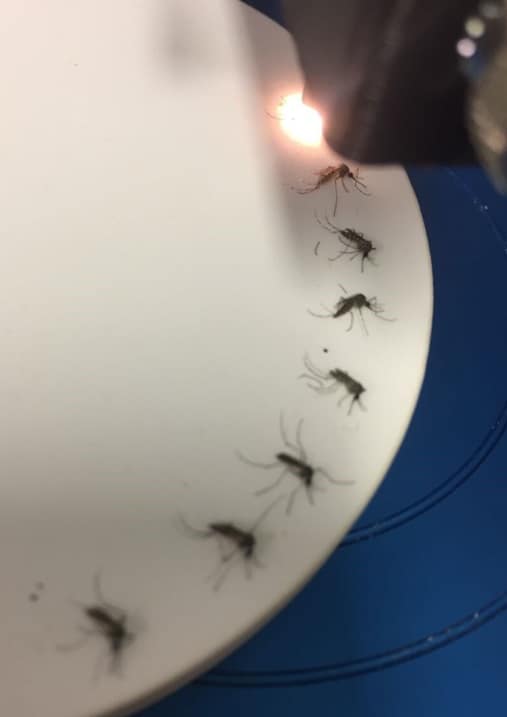
Shining light on mosquitoes detects Zika

Zika virus can now be detected inside mosquitoes 18 times faster and 110 times cheaper than before – by shining light on them. Researchers have used near-infrared spectroscopy (NIRS) to detect Zika virus in laboratory mosquitoes for the first time (Science Advances 10.1126/sciadv.aat0496). The team, led by Maggy Sikulu-Lord from the University of Queensland, working with colleagues from Brazil and the USA, tested NIRS as an alternative to the current approach: reverse-transcription polymerase chain reaction (RT-qPCR).

NIRS generates different spectra based on the chemical composition of the mosquito. While it is not understood which chemicals are responsible for the difference in spectra between infected and uninfected mosquitoes, the spectra are different enough to distinguish the two with more than 90% accuracy seven days after infection.

Why screen mosquitoes?

Zika virus became a major health concern in 2015 when an epidemic in Brazil was linked to microcephaly, a condition where babies are born with small heads. The virus can also cause Guillain-Barre syndrome, a neurological disorder, in adults. Female Aedes aegyptis mosquitoes transmit the Zika virus, but a study from 2016 found that only 0.9% of these mosquitoes carry the virus. To identify the infected mosquitoes, rather than wasting containment efforts on the over 99% of uninfected mosquitoes, called for a quick, simple and cheap screening method.

NIRS analysis of mosquitoes

The low rate of infected mosquitoes means that an efficient screening programme would need to screen thousands of mosquitoes in a day. RT-qPCR is too slow and too expensive to work on such a large scale, first author Jill Fernandez and her team argue. NIRS, on the other hand, does not need sample preparation and therefore lends itself to high throughput screening that can be performed by non-expert staff.

The researchers fed half of their mosquitoes blood infected with Zika virus and the other half with uninfected blood. After four, seven and 10 days, they used NIRS to analyse the head, abdomen and thorax. While head and thorax samples provided the most accurate distinction between infected and uninfected mosquitoes, abdomen samples still gave at least 80% accurate predictions and can be used when head and thorax are not available.

Getting NIRS “field ready”

The results suggest that NIRS might be a suitable screening tool for Zika virus in mosquitoes. However, several questions need to be answered before NIRS is “field ready”, as the authors point out. The method needs to be tested on mosquitoes caught in the wild, rather than ones bred in a laboratory, because there is more variation among wild mosquitoes and because they may be damaged. Further, it needs to be tested whether the method can distinguish different types of viruses inside the mosquito. After all, Aedes aegyptis mosquitoes can not only be infected with Zika but also with other viruses such as Dengue, which causes Dengue fever.

One limitation of NIRS is the initial price. Sensitive NIR spectrometers currently cost $60,000, an investment that is made good after screening 10 000 mosquitoes. Whether less sensitive spectrometers, which are available for less than $500, could distinguish the mosquitoes equally well remains to be investigated. The authors hope that a demand for cheap and sensitive NIR spectrometers will bring the price down and that further savings can be made by increased speed as staff become familiar with the instrument and method.

NIRS has been used for various applications in agriculture and medicine for decades, but only in the last ten years was its value in the field of infectious diseases discovered. This is the first time that NIRS has been used to detect pathogens in mosquitoes. Should it turn out to be a useful tool to detect Zika in the field, other mosquito-transmitted diseases might benefit from the development too.

Internet searches reveal heat adaptation across India

What can the use of Internet search terms related to air conditioning tell us about human’s capacity to withstand periods of hot weather? How hot is too hot and does living in a warmer part of the country help you adapt?

Researchers from the Netherlands and UK analysed regional Internet search frequencies, which are provided by major search engines such as Google, to find the answers.

The team wanted to quantify the adaptation potential of individuals living across different climate zones and at the high end of the temperature range in India, where access to health data can be limited.

“We believed that searches for air conditioners could provide an interesting proxy for heat discomfort in the social context of India as air conditioners are ‘high in demand’ products for the already large, but still growing, middle class,” says Tanya Singh from Wageningen University & Research.

By correlating regional peaks in the use of search terms related to air conditioners with regional temperature data, the scientists approximated the point at which people started to register heat discomfort. State-level heat thresholds ranged from 25.9 °C in Madhya Pradesh in central India to 31.0 °C in Orissa to the east.

Local adaptation occurred at state level, the team found. The higher the average temperature in a state, the higher the heat threshold. But the search term analysis also emphasized that it’s not just the high temperatures that are important.

A large temperature variation over the course of the year appeared to lessen people’s potential to adapt to extreme heat. In other words, cold winters may make it harder for people to adapt to high summer temperatures.

“Our results were confirming a common hypothesis within the heat adaptation literature,” says Singh. “It shows how big data can be used as proxies in situations where real-life data is missing.”

Internet access is on the rise in India, paving the way for future studies. In the current work, the researchers were able to gather statistically significant data from 17 Indian states. Together, the results cover a large proportion of the Indian peninsula and represent a range of different climates.

Joining Singh in the project were Christian Siderius of the Grantham Research Institute, UK, and Ype Van der Velde of the Vrije Universiteit Amsterdam. The scientists, who published their work in Environmental Research Letters, believe there is potential to take the technique further, for example, creating the basis for an early warning system for signs of heat stroke.

Copyright © 2026 by IOP Publishing Ltd and individual contributors