Once a physicist: LeeAnn Janissen

LeeAnn Janissen

What sparked your initial interest in physics?

I have always been a keen observer of whatever was going on around me. My family used to go camping when I was a child, and I remember spending a lot of time just looking at plants and rocks and textures and how light looked different in various situations. I absolutely loved when the park rangers would give nature talks explaining how everything fits together. When I started studying physics in school at age 15, it seemed that this was the discipline that tried to get at the basic workings of everything. I was very drawn to that idea, and so I studied particle physics, which looks at the very smallest, basic building blocks of nature. That interest is still fundamental to how I approach projects today; both in my research in developing trading-strategies, as well as in my ceramic art practice.

Did you ever consider a permanent academic career in experimental particle physics?

Yes, I think that when I began my PhD at Carleton University in Canada I really wanted to do research as a job. At that stage, I didn’t really have much of an understanding of what the rest of an academic career entailed, in terms of teaching and other such commitments. I was part of the OPAL experiment on the LEP accelerator at CERN, and I lived in France for one and a half years collecting data. Working at CERN was an amazing experience and I’m grateful to have had that opportunity. By the end of my time at CERN, I realized that a career as a particle physicist wasn’t the best fit for me. I still wanted to wander around and learn about all the other parts of the world that I could see around me.

How did you make the shift into the stock market, and what were some of the challenges of moving from academia into the finance industry?

I had already decided to leave academia when I returned to Canada from CERN, to write up my dissertation. One of my office mates showed me an ad that he had clipped out of the newspaper that said, “Wanted: PhDs in quantitative disciplines. No experience in finance required.” This was just at the start of the development of “derivatives and options pricing models” – Citibank was an early leader in that field, and the head of derivatives in Toronto had a PhD in engineering. He reasoned that it was easier to take a person with a PhD and teach them finance, than it was to take a finance grad and teach them the quantitative-modelling skills that were needed. I applied, got the job and started work about a month after my PhD defence.

There are many cultural differences between academia and the finance industry. Some are related to hierarchy and decision making, others are related to status and who adds the most value to the process. But one thing that both fields share is a clear sense of purpose: in academia the focus is on knowledge, discovery and dissemination; while in finance, the focus is on maximizing value for shareholders.

How did your interest in pottery begin?

I started taking evening classes in the late 1990s as a creative outlet from my very analytical and often stressful day job. Right from the start, I loved clay as a medium, as it can take almost any form imaginable. There are several stages the clay must pass through on the way to the final object: from the raw wet clay, to forming on the potter’s wheel, to the drying stage, and then glazing and firing. Each stage has its own chemistry, and its own physical constraints. In many ways, working as an artist was a 180° change – I went from a fast-paced corporate job to a quiet, solitary pursuit with no real deadlines at all. But at the same time, being a ceramic artist has allowed me to connect with people in surprisingly meaningful ways.

What are some of the projects and exhibits you are currently working on as an artist?

I have a line of functional porcelain that I call “Luna-ware” that is inspired by the Moon, and I sell this work at craft shows and local galleries. I also make sculptural pieces that are variations of what I call “fractal landscapes”, where I work with the clay at a particular stage of wetness, such that the natural mountain-like, fractal texture of the clay emerges.

For the past year and a half, I’ve taken a small pause in my ceramics practice because I’ve been involved in creating a new equity trading strategy for a hedge fund. This has been an exercise of re-engaging with writing code and analysing data that has awakened the analytical muscles in my brain once more. Now that fund has stabilized and I’m able to come back to my ceramics practice, I’m keen to explore some of these themes in my ceramic work. For example, I’m starting to investigate how digital techniques can be incorporated into ceramics, either though digital forming through 3D printing in ceramics, or through incorporating types of data-driven imagery.

How has your physics background been helpful in your work?

My physics training has given me a way of looking at and making sense of the world. Physics is a discipline of formulating a model, calibrating it to everything we know, and then finding the edges to try and see beyond this model so we can build the next one. The activity of building models to understand and control the unfathomable is still a central inspiration in my art practice. In a practical sense, I learned versatile, analytical skills that are highly transferable. People often think that in physics you don’t need “people skills” but I think that, in the context of modern, collaborative physics research, social skills are just as important as quantitative ones. Certainly, my experiences with physics collaborations helped prepare me for working in a corporate environment.

Any advice for today’s students?

Reflecting on my professional journey, I think that I’ve used a kind of “gradient search” method of career development where I look at the immediate next steps available and choose the one that feels right. I think the best advice I can give today’s students is to be honest about what success would look like for you. Is it the freedom of having a lot of money? Is it being in a leadership position? Is it the admiration of being an acknowledged expert in the field? Is it inspiring and enabling the next generation? All of those goals are worthy, but each will lead you to a different place, so it’s worth trying to imagine which one would be the best fit for you.
Bilayer electron transport material helps improve perovskite solar cells

Researchers in China and Switzerland have succeeded in making highly efficient metal-halide perovskite solar cells containing fluoride-doped tin oxide nanocrystals. The new cells boast a photovoltaic efficiency as high as 20.2% and an open-circuit voltage of 1.13 V and can be fabricated in a simple, low-temperature solution-process.

Metal-halide perovskites have the chemical formula ABX3, where A is typically Cs, methylammonium (MA), or formamidinium (FA), B is Pb or Sn, and X is I, Br, or Cl). They are one of the most promising thin-film solar-cell materials thanks to the fact that they can absorb light over a broad range of solar spectrum wavelengths. Charge carriers (electrons and holes) can also diffuse through them quickly and over long lengths. All these good properties mean that researchers have been able to increase the power conversion efficiency (PCE) of solar cells made from these materials from an initial 3.8% (in 2009) to nearly 23% today. This makes their PCE comparable to that of silicon.

Open-circuit voltage lower than expected

Recently, researchers have started to finely tune electron transport layers (ETLs), such as those made from titanium dioxide nanocrystal thin films, close to planar perovskite materials to further increase charge carrier transport. There is a problem however in that the open-circuit voltage (VOC) of devices made from certain perovskites (those with a bandgap of between 1.59 and 1.63 eV) and these ELTs remains lower than that predicted by theory.

The VOC depends on several factors, including the energy level difference between the ELTs and the perovskite light absorber materials. A big difference may lower the VOC.

“To increase VOC, we thus need to build up a functional interface with well-matched energy bands to avoid excessive band offset while accelerating charge carrier extraction and transport,” explains co-team leader Mingkui Wang of Huazhong University of Science and Technology in Hubei.

Fluoride-doped tin oxide bilayer ELT

The researchers say they have now made a new ETL material from fluoride-doped tin oxide (F:SnO2) to do just this. They fabricated perovskite solar cells using a 50-nm-thick F:SnOlayer to contact a 500-nm-thick layer of (FAPb3)0.85(MAPbBr3)0.15 using a simple low-temperature solution-process technique. They then thermally annealed the films at 180 °C for one hour in air.

Wang and colleagues were able to determine that the optical bandgap slightly broadens with F doping levels. “These observations can be explained with the filling of states in the conduction band of the perovskite film thanks to quasi-Fermi level lifting as a function of increased charge concentration (according to the ‘Burstein-Moss’ effect),” explains Wang.

The quasi-Fermi level is the Fermi level that describes the population of electrons separately in the conduction band and valence band when they are displaced from equilibrium. This displacement can be caused by applying an external voltage or light energy.

Well-matched energy bands improve the VOC

Photocurrent density−voltage (J−V) measurements of the solar cells tested under the routinely employed global AM (air mass) 1.5 G (global) condition, or AM1.5G irradiation (100 mW cm-2), also revealed that the VOC of the devices increased (from 1.03 to 1.1 V) as the F doping level increased.

“It appears that the well-matched energy bands contribute to the observed improvement of the VOC,” explains co-team leader Michael Grätzel of the Ecole Polytechnique Federale de Lausanne.

“This exciting result means that our technique is a feasible way to produce transparent conductive substrates plus electron transport layers in a single process for making high-performance perovskite solar cells modules on the large scale,” Wang tells Physics World.

Full details of the research are reported in Nano Letters 10.1021/acs.nanolett.8b01440.

Physicists show how bacteria swim towards regions of higher viscosity

A number of microorganisms have a talent for viscotaxis – movement through fluids to areas of thicker consistency (or higher viscosity). Now, Benno Liebchen and colleagues at the Heinrich-Heine-Universität Düsseldorf in Germany and the University of Twente in the Netherlands have proposed a mechanism for how these tiny swimmers navigate up the viscosity gradient. The team’s computer simulations and theoretical calculations show that viscotaxis is a purely physical mechanism driven by specific types of body shape. The research could lead to the design of robotic viscotactic swimmers that deliver drugs to regions of high viscosity in the body.

Sperm and bacteria are among many types of biological micro-swimmers that alter their motion in response to changes in their surroundings. Some bacteria, for example, will move in the direction of increasing concentration of chemical signals produced by food – a process called chemotaxis. Viscous fluids like mucus also stimulate motion in certain microorganisms. For bacteria such as Spiroplasma and Leptospira interrogans, the ability to navigate towards more viscous regions is useful because they are poor swimmers in low-viscosity fluids. Biologists had speculated that viscotaxis could be a receptor driven mechanism similar to chemotaxis, but visco-receptors have never been found and no systematic theory or mechanism of viscotaxis existed.

Writing in Physical Review Letters, Liebchen and colleagues describe how they created a framework to study viscotaxis of micro-swimmers in slowly varying viscosity fields. Initially the team used computer simulations to examine viscotaxis of a variety of simple passive particle shapes, and then they turned their attention to mimicking linear micro-swimmers as multi-bead bodies.

Generating viscous torques

The team found that swimmers with uniaxial body shapes that display symmetric rotation around their body axis do not display viscotaxis. But nonuniaxial body shapes, like that seen in Spiroplasma and Leptospira interrogans – which have spiral shapes — display a mismatch of viscous forces acting on different parts of the swimmer. The asymmetry of these forces causes the swimmer to automatically rotate up the viscosity gradient. This viscous torque eventually balances, stabilizing the positive viscotactic movement of the swimmer.

It was also observed that, remarkably, even if nonuniaxial swimmers began a simulation moving in a negative viscotactic direction, they can slow their movement and gradually move in the opposite direction, up the viscosity gradient.

The physicists then developed a general theory of viscotaxis to try and understand the phenomena for more complex body shapes and different swimming modes. Expanding this theory to non-linear swimmers, the calculations showed that negative, as well as positive viscotaxis is possible, depending on body shape and movement type.

Liebchen now plans to work with experimentalists to test their general theory of viscotaxis. In the future he hopes that their findings could also be applied to design synthetic swimmers with negative or positive viscotactic characteristics. This could help refine drug targeting in complex biological systems.

Life in the Paralympics ‘pit lane’

Imagine working hard for four years, training relentlessly, going away for months on end to practise in snow, triumphing over injuries and setbacks, and then finally making it to the Pyeongchang Winter Paralympic Games in South Korea. You head out with the rest of the sledge-hockey team onto the ice for your first game. You’re subbed on and things are going great; you’re rapidly gliding over the ice. Then, smack! A head-on collision throws you onto the ice. You can’t feel it, but you’ve broken your ankle, and you’re out of the match and the rest of the tournament. All that hard work for one minute of Paralympic competition.

However, there is a lifeline for competitors in the form of the “prosthetics pit lane” – a repairs workshop tucked away discreetly in the Paralympic village. There’s a huge amount going on inside, as I found for myself while assisting with emergency repairs and maintenance work at this year’s Winter Paralympic games. The sledge-hockey repair was what I first got to see. A plaster-cast mould was taken of the athlete’s leg to create a leg protector, so they could continue to play. Next, a soft foam layer was made for comfort while wearing the protector. With this moulded foam in place, a “Cellacast” layer was formed – exactly the same material used in hospitals for casts when you’ve broken bones. A durable hard layer is crucial in sports like sledge hockey where the collisions are brutal. Once set hard, the protector was cut into two pieces so that it could be put on. This particular repair went right down to the wire, as it was required for a game that evening. The athlete came by and saw the final touches before running to catch the bus to the hockey arena, putting the pressure on the repairs team. They finished just in time and this athlete then went on to score the only goal for Sweden in these games.

These are the kind of heart-warming stories that taking part in the Paralympics is all about. Making these moments possible is the team in the Ottobock repairs workshop, consisting of about 30 people from 11 different countries. Athletes need to be able to describe the problem, so they cover as many languages as possible. Ottobock is a German company that specializes in making and supplying prosthetic limbs; and the available equipment and materials at the Paralympic workshop is limited compared to their normal workshops. But that doesn’t hinder the team from rising to the repair challenges, be that a wheelchair puncture or making an entirely new prosthesis.

At the games, repairs are rapid, and you never know what’s coming next. A shock for me was seeing so much sewing. A zip had broken on the only ski jacket for the one athlete representing Tajikistan. Without the jacket he could not compete, so we set about fixing the zip, eventually resorting to sewing in some Velcro to do the jacket up. Perhaps the next games should have a few resident needleworkers.

The prosthesis can crudely be viewed a little like flat-pack furniture, in that there’s an Allen key that will adjust every screw on it

Peter Franzel, who heads the company’s involvement in the Paralympics, hits the nail on the head when it comes to prostheses, saying that “nobody really cares about [the prosthetics] until the Paralympics, where they become normal.” Despite this lack of widespread appreciation, there have been some very significant developments in the area. Ottobock started developing prostheses after veterans of the Second World War were struggling to lead an everyday life with their wooden prostheses. Today the company is a leading manufacturer and developer in the field of prosthetics and orthotics. One key step was making prostheses modular; a series of connected parts that attach to a custom-made socket. This socket then attaches to the patient’s stump. It can crudely be viewed a little like flat-pack furniture, in that there’s an Allen key that will adjust every screw on the prostheses, so you can put a whole series of things together. The modular advantage is most of the components can be easily swapped out if they become broken or damaged. Ahead of the games, several tonnes of spare parts were shipped out for this very purpose. This made for entertaining store-room rummaging, finding boxes of feet and hands.

Beyond fabricating prostheses, the team also fit its patients with the prosthesis, which requires balancing of forces through the joints. In the case of legs, a stump can stick out at quite an angle, so initially all the measurements and angles of the legs are taken. Every module in the prosthesis has a pyramid-based attachment so adjustments are made with pairs of screws. To aid the alignment, there’s kit involving two cameras and a balance board. The board feeds back weight distribution across each leg and hip rotation. A lot of people don’t put enough weight onto their prosthetic leg, so this is an important part in learning how to move about with a prosthesis. The cameras reveal how the weight is loaded through the joints in each leg. Small tweaks in the alignment of the prosthesis can correct this force line, so that it passes through the hip and knees at the correct points to minimize adverse impacts on the body.

It was an exciting, humbling and insightful experience seeing the repairs workshop in action. I was constantly amazed at the passion and dedication from the Ottobock team, and the wonderful sense of community around the Paralympic village.

Designs on a high-performance motor BCI

Intracortical brain-computer interfaces (BCIs), which use microelectrode arrays to record action potentials from neurons, could enable people with motor disabilities to communicate and interact with the world around them. BCIs rely upon a consistent relationship between neural firing rates and desired movement commands. Intracortical recordings, however, can be unstable, leading to challenges with maintaining BCI performance.

To address this challenge, a research team from the University of Pittsburgh has performed a detailed study to quantify the length of time that action potentials from the same neuron, or group of neurons, can be recorded from motor cortex (J. Neural. Eng. 15 046016).

“Many researchers in this field agree that intracortical recordings are unstable, but very few have quantified this,” explained Jennifer Collinger from the University’s Rehab Neural Engineering Labs. “We had the opportunity to quantify stability in human intracortical recordings, which anecdotally, some researchers have suggested might be more unstable than recordings from non-human primates.”

Data classification

Collinger and colleagues examined two subjects with tetraplegia who had implanted intracortical microelectrode arrays. They recorded neural data from Subject 1 during 287 BCI sessions over 33 months, and from Subject 2 in 51 sessions over six months.

John Downey

For all sessions, when the measured signal crossed a pre-defined threshold, a 1.6 ms snippet of the signal was saved. The researchers then sorted the snippets into “units” – collections of events with similar waveform shapes recorded from a single electrode. These units could be single-neuron action potentials, multi-neuron waveforms, or a collection of indistinct low-amplitude threshold crossings.

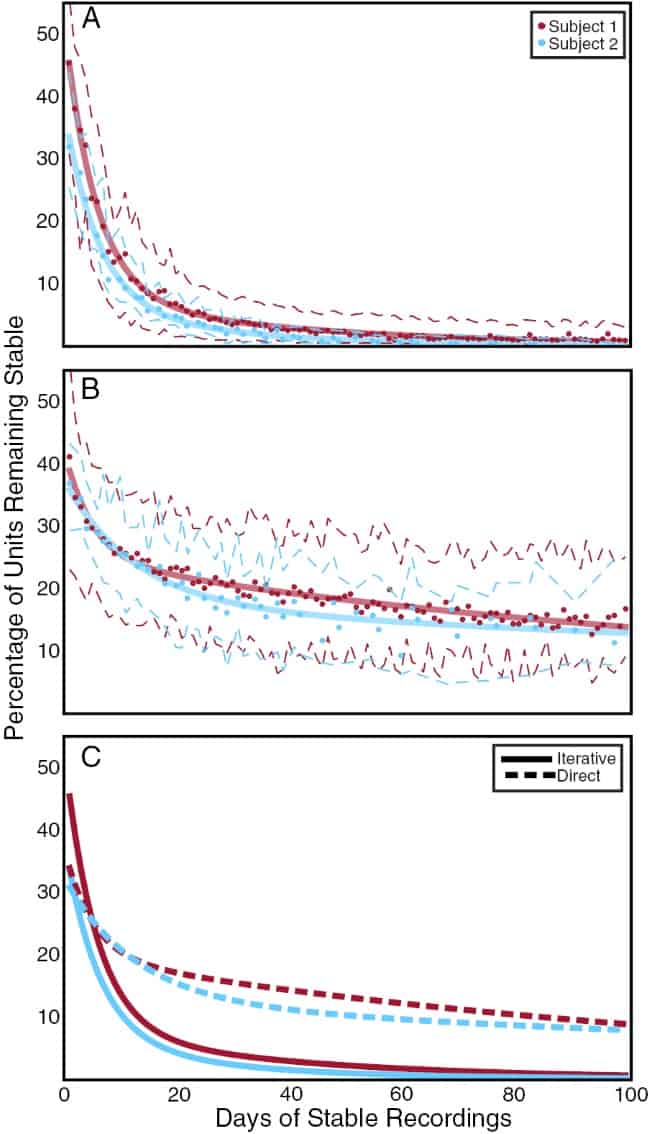
The team classified each unit according to its waveform shape, mean firing rate, autocorrelation and cross-correlation with other units’ firing; they then determined changes in these parameters between test sessions. They quantified unit stability over time using two methods: iterative-comparison, where each session is compared to the next; and direct-comparison, which compares each session to all following sessions.

Estimates of recording stability

All sessions demonstrated a sharp initial decline in the number of stable units, plus a small group of long-lasting stable units. Fitting the data with a two-term exponential enabled the researchers to categorize each unit as unstable, moderately stable or highly stable. They note that this is a coarse classification and that future continuous wireless recordings could provide more detailed temporal profiles.

Using the more conservative iterative-comparison method, 47.1% of units recorded from Subject 1 were unstable, 44.7% showed moderate stability (with 16.3% of these becoming unstable each day) and 8.2% showed high stability (2.6% becoming unstable each day). Subject 2 had 61.4% unstable units, 32% with moderate stability (15.3% becoming unstable each day) and 6.6% with high stability (3.7% becoming unstable each day).

The direct-comparison approach characterized a larger percentage of units as highly stable: 19.7% and 12.5% for Subjects 1 and 2, respectively. For both subjects, nearly 20% of units were classified as moderately stable.

Single day stability

The team also examined stability within a single day, collecting data every hour for seven hours. For both subjects, 72-80% of units were stable across two consecutive recordings. The iterative-comparison approach estimated that stable units were lost at a rate of 8.7% and 12.5% per hour, for Subjects 1 and 2, respectively, while direct-comparison estimated decreases of 3.6% and 5.8% per hour.

To provide a rough estimate of overall unit stability, the researchers combined data from the between- and within-day experiments. Using iterative-comparison, approximately 25% of units were stable on the order of hours, 47.5% on the order of days and 7.5% on the order of weeks. With direct-comparison, approximately 45% of units were stable for hours, 17.5% for days, and 12.5% for weeks.

Predictive characteristics

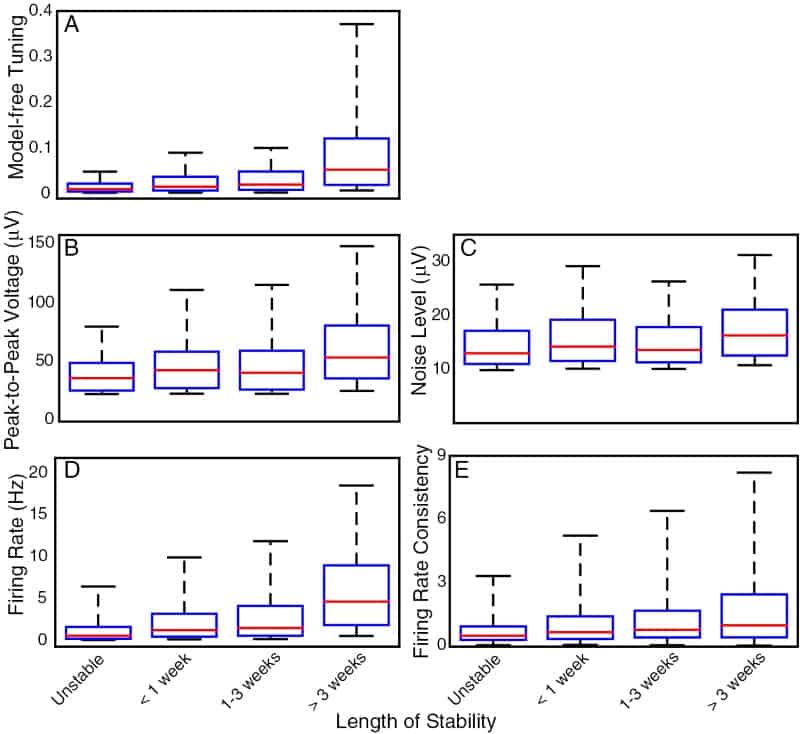
The researchers also investigated whether any particular unit characteristics could distinguish stable from unstable units. They observed that unstable units generally had lower noise levels, lower peak-to-peak voltages, lower firing rates, less firing rate consistency and lower model-free tuning than units that were stable for at least one day.

Predictive characteristics

Using a regression model to predict unit stability revealed that higher firing rates were most predictive of prolonged stability, with higher peak-to-peak voltage and model-free tuning values also correlated with longer stability. These characteristics could be used to identify units that would provide more stable long-term recordings, with the aim of creating more reliable intracortical BCIs.

One important criterion for a clinical BCI is to minimize device recalibration, for example by identifying stable units in real time and only using these for BCI control. “We have not tested this explicitly, but we have a good idea of which unit properties are common for highly stable units, so this would provide a starting point for creating a stable BCI decoder,” Collinger explained.

The researchers are now developing approaches to minimize recalibrations. Their analysis predicts that a 96-channel array would provide at least 15 stable units for between nine and 29 days. “We are also interested in how task-context might impact the functional stability of intracortical recordings,” said Collinger. “For example, we might record from the same neuron on two different days, but if it responds differently when the task conditions change, our BCI system will view it as unstable.”

Superfluid chirality mapped using MRI

Topological domains have been imaged in superfluid helium-3 using magnetic resonance imaging (MRI). A team of physicists led by Yutaka Sasaki at Kyoto University used the technique to view regions of common chirality as they emerge spontaneously in thin superfluid films. The technique promises to boost our understanding of the complex behaviour of the superfluid state of matter as well as the nature of related types of superconductivity.

When helium-3 is cooled to millikelvin temperatures it becomes a superfluid – a fluid with zero viscosity that can flow forever without any of its kinetic energy being dissipated as heat. Helium-3 atoms are fermions, which normally do not form a superfluid, but in this case the atoms pair-up to behave like bosons – which can form a superfluid. This pairing makes the physics of superfluid helium-3 very rich indeed, and of great interest to physicists studying the topological nature of matter.

Theoretical studies suggest that as helium-3 is cooled to create a superfluid, it forms macroscopic topological domains. Within individual domains, superfluid atoms share the same angular momentum, which gives each domain a certain chirality. However, no previous studies have managed to confirm these ideas experimentally and imaging these structures would reveal the shapes of macroscopic wave functions in the superfluid.

Excited nuclei

Now, Sasaki and colleagues have used MRI to take direct images of these superfluid domains. Widely used in medical and industrial imaging, MRI works by exciting nuclei in a sample using oscillating magnetic fields and then observing the radio-frequency signals emitted by the nuclei as they decay back to their ground states. The nature of the signals are very sensitive to the immediate surroundings of the nuclei, so MRI is very good at mapping the composition of an object.

This effect was useful to the researchers, as they predicted that the nuclei of superfluid atoms in different domains – therefore with different chiralities – would emit their own characteristic radio waves, helping them to distinguish topological structures. The team tested their prediction using thin films of helium-3 superfluid cooled to 2 mK, obtaining images of the quantum condensates at a spatial resolution of 10 µm.

As they predicted, the team saw chiral domains as large as 1 mm across in the MRI signal. The domains were separated by walls, characterized by dark lines where the signal fell away. To test how the texture emerged, the physicists cooled the helium-3 film below its transition temperature several times. Every time, the number of domains and their locations on the film were different – meaning the superfluid’s topology arises spontaneously. This distinguishes superfluids from other fluids, where domains form either because of impurities in the material or from conditions in the surrounding environment.

Writing in Physical Review Letters, the team also reports that when they cooled the film far below the superfluid transition temperature, the domains were relatively stable over longer periods of time.

What’s the outlook for bioenergy with carbon capture and storage?

Simply ramping up the deployment of bio-energy with carbon capture and storage (BECCS) may not be enough to guarantee an acceleration in meeting climate targets. Analysis based on a complex set of Earth system models shows that achieving net negative carbon dioxide emissions is also strongly linked to the geographical location of bio-energy feedstock.

The study draws attention to the importance of maintaining tropical forests and their vital role as carbon sinks. Allowing deforestation in the tropics to facilitate large-scale BECCS appears to tip the balance towards higher atmospheric concentrations of carbon dioxide near the end of the century.

Run using high-performance computing facilities in Norway, the analysis illustrates that the trade-offs and side effects of growing bio-crops must be evaluated on a global scale to provide the full story.

“We need to assess this technology from all angles,” said Helene Muri, who started the project when at the University of Oslo and is now based at NTNU. “The findings of my study show how tricky it could be to apply BECCS in the ‘right’ way.”

Muri points out that of the 400 Intergovernmental Panel on Climate Change scenarios that have a 50% or better chance of less than 2°C warming, 344 assume the successful and large-scale uptake of negative emission technologies such as BECCS. Guidance on where to place bio-crops will be a key input.

Muri’s study focuses on the climate response of two different large-scale BECCS deployment scenarios. The first involves increased harvesting for BECCS predominantly through re-planting on abandoned agricultural sites. In the second scenario, bio-crops grow in cleared woodland – largely in tropical and extra-tropical areas, including Africa, east Australia and South America. In the simulation runs, the projects are estimated to cover between four and five percent of the non-glaciated land surface by 2100.

“About half a million CPU hours were used to generate the data for this study using the Norwegian Earth system model, which took several weeks to complete on multiple processors,” said Muri. The fully coupled simulations feature an interactive carbon cycle and include the effects of climate on crop yields.

But the opportunities don’t stop there. “There is also a need to assess the more regional details of BECCS, and how different feedstocks can be best used in different areas,” Muri said.

Muri reported her results in Environmental Research Letters.

Engineering a career in terahertz

You don’t have to be a rocket scientist to work at NASA’s Jet Propulsion Laboratory (JPL) in Pasadena, California, though it probably doesn’t hurt. That’s what condensed-matter physicist turned radar engineer Ken Cooper discovered when he joined the federal laboratory in 2006. Although it is best known for the development of a slew of different spacecraft – Explorer 1, the first US satellite, was launched by JPL in 1958 – this national research facility has a vast array of missions and projects today. It covers everything from robotics to interplanetary spacecraft, from earth sciences to planetary monitoring systems and technologies.

Cooper has spent the last dozen years as a radio-frequency (RF) microwave engineer at JPL. During that time he has moved from developing terahertz imaging radars and transceiver arrays for national security applications, to building submillimetre-wave molecular spectroscopy and radar techniques for atmospheric studies. But what made Cooper, a physicist by training, switch to an engineering-focused role in industry? I spoke to Cooper to find out what drove his self-described “non-ballistic career trajectory”, and to find out how his PhD in physics gave him the necessary tools and skills for a career as an engineer.

What sparked your initial interest in physics and what influenced you to pursue the subject at PhD level?

As a kid, I was always interested in science and physics. By middle school I started reading some popular books such as Stephen Hawking’s A Brief History of Time. In college, although I was considering medical school, I liked physics best. I decided that I would try and stick with the subject as long as I was successful. I got good grades and I felt like I wanted to study physics at a deeper level. I interviewed for one job towards the end of college, through a recruiter, but mainly I was focused on getting into graduate school. I did my PhD in condensed-matter physics at the California Institute of Technology, followed by a postdoc in superconducting quantum computing at the National Institute of Standards and Technology and the University of California, Santa Barbara. Ultimately, I found my way to JPL, which I’ve found to be very fulfilling, so I don’t regret leaving academia.

How did you make the move from research into the more industrial aspects of terahertz technology?

After my postdoc, I found a number of groups at JPL doing activities that I would have fitted very naturally into. Unfortunately, they didn’t have any open positions at the time. Now that I’m here, I can see how such a situation arises – you very rarely have enough extra funds to hire people. You get research grants to do very specific tasks with personnel that you already have on the staff. In general, JPL or NASA is not a growing institution, and it’s very hard to break in.

But I really wanted to work at JPL, so I reached out to a number of contacts. I was lucky that the head of the terahertz technology group, who also had a background in physics, saw something in me, and fortunately made me a job offer in 2006. I thought I would be doing things more in line with my expertise, but because of what projects were available then, and how I hit the ground running, I just ended up running in a different direction. Despite working as an engineer, I haven’t diverged that far from physics – indeed, I work with other physicists who are now doing engineering.

What were some of the challenges you experienced when you first began working as an engineer at JPL?

There were a lot of challenges. I could list 20 of them easily. Some that come to mind are learning the new skills and concepts of terahertz technology. When I got here, if I wanted to know what 1 dB or 5 dB was, I would have to calculate it in my head or on a calculator. Now I’ve memorized it, because I use them so much. There is a gap of some knowledge to get into radio-frequency engineering from another field.

Working in an engineering environment was a challenge, especially once I had to work on proposal writing and project management. There are very structured ways that you have to plan out a project in engineering: you have milestones, and you have a schedule, and you have a team. You must describe to your sponsor exactly what you’re going to do and when you’re going to do it, even if you know it’s very unlikely to go that way. In the well-funded physics teams I had been in, a student or postdoc almost never had to worry or think about that. You just got to explore new physics. You weren’t thinking about trying to hit this milestone by that date – you had a general sense of where you were going. At a NASA lab, it’s much more organized and engineering-oriented, and I had to adapt to that way of working and thinking.

Were there other differences you noticed when it comes to a physics rather than an engineering approach to solving a problem?

At JPL I work with researchers across a wide spectrum of scientific fields. While there are plenty of people with backgrounds similar to mine, there are also many who come from different technical areas with their own knowledge and experience. To me, this is one of the main benefits of working here. A close colleague of mine, for example, is an expert when it comes to radio and electronics. I come from a device-physics background, so we made a good team. It has been great to find people whose skills are complementary to my own, and develop relationships with them. There are also colleagues I think of as theoretical engineers. These are very bright individuals doing complex analytic tasks, way beyond my head as an experimentalist. It was rewarding to get to know them and learn how they approach problems.

What projects are you working on now?

My two main projects involve millimetre-wave radar and submillimetre-wave spectroscopy. As far as the radar projects go, I’ve transitioned from security applications to NASA-oriented science applications. One is a 95 GHz Doppler radar to measure plumes that come out of comets or icy moons in the solar system. This is a technology-development project and not an actual instrument that will fly. We’re maturing the technology so that it could potentially go on a future mission. It’s what we would call “lower technology readiness level” and it’s more academic from that point of view.

The second project involves earth science. We use a radar that is tuned near 180 GHz, where there’s a strong water-absorption feature in the atmosphere. We’re building it to be able to resolve profiles of humidity inside clouds. This is very important for climate models, for weather predictions and for understanding cloud formation. We hope to deploy this radar on an aircraft and do actual measurements in the field, so it’s a very exciting project. As far as the physics perspective is concerned, I’m still on the experimental side of things, developing new measurement techniques, collecting data, building hardware.

As an engineer now, do you still find that your physics background helps?

I think it does. Although you could do my job if you trained as an electrical engineer from the start, I do see some differences, especially when I get caught up a little bit more than other colleagues in wanting to know the details behind certain studies. For example, where someone else might be satisfied with looking up what the cross-section is of water molecules at 557 GHz, I found a paper describing how to calculate this using Einstein coefficients. Thanks to my physics background, I could delve into that a bit more than some engineers I work with. That’s not necessarily better, and it’s not necessarily more useful to do that, but it’s more rewarding for me.

When it comes to physics and engineering, there’s a degree of mutual admiration. As a physicist, I feel like I don’t have training or expertise in certain software packages especially, or expertise in very complex RF design. On the other hand, device engineers I work with might look at my background and wish they had the deep training I did in semiconductor physics, Fermi levels, gallium arsenide and all sorts of such details. I don’t think either perspective is true – in the end, we work together and use all our skill sets.

Have you got any advice for today’s physics graduates, who are starting out in their careers?

I think it’s very good training to get a PhD in physics. When you tackle difficult problems, you learn what it means to be an expert in something, and you also learn humility. You should also have a passion for science and a love for learning – then, scientific research, whether in academia or industry, can be a very rewarding career to pursue. A PhD in physics gives you skills that are transferable to a number of industries. If you decide you want to make a change when you’re in your 20s or 30s, I think you can do that, and find ways to succeed in many different fields.

SuperNova Green deactivates proteins on the nanoscale

SuperNova Green (SNG) is an effective new tool for the deactivation of proteins within cells. Developed by Yemima Dani Riani and the Nagai lab at Osaka University, the tool consists of a genetically encoded protein that reacts to light by generating damaging reactive oxygen species (ROS) in a small area around the molecule. These singlet and superoxide radicals damage neighbouring proteins enough that they become deactivated. Such a tool joins a growing arsenal of so called “optogenetic” actuators: genetically encoded light-activated proteins that can switch on or off spatial signalling pathways within cells, locally, on the nanoscale (BMC Biology 16 50).

Why destroy proteins with light?

Signalling pathways in cells depend on multitudes of molecular machines convening, accumulating and splitting apart again, in a vast molecular communication network. Super resolution microscopy has confirmed that there is a nanoscale component to this regulation that allows cells to elicit highly adaptive control over cell function. Direct links to such function have so far been hard to discern, and one reason is that the tools for altering such pathways on the nanoscale don’t exist. Dani Riani and colleagues have now introduced a new iteration of optogenetic tool, which can be hardwired into cells, fused to a protein and targeted for deactivation using laser light.

Depending on the size of the area illuminated with blue light, the length scale of protein deactivation can be altered. By concentrating the beam, single groups of proteins can be targeted, and by widening the beam, entire cells can be ablated, while their neighbours remain intact.

Yemima Dani Riani

In the study, the Nagai group showcased whole-cell ablation. By selectively targeting the mitochondria in cancer cells, SNG could kill cells outright. The probe is relatively sensitive, so 2 min of illumination was all that was needed to kill the cells. This whole-cell application could be useful for studying the elasticity or mechanics of cells in the developing spinal cord (neural tube), for example, as an alternative to high powered laser ablation, which tends to damage nearby cells and makes measurement difficult.

The group showed that selective nanoscale protein inactivation is possible without significant damage to non-targeted proteins. By testing the effect of SNG on two tagged proteins that were very close to each other in the cell membrane, they demonstrated that only the SNG-tagged protein was affected. In this case, they targeted pleckstrin domains – short lengths of protein that bind to lipids in the cell membrane. When the pleckstrin domain is inactivated, the protein moves away from the membrane and into the cytoplasm. Sure enough, in these experiments, the signal in the cytoplasm only increased for SNG-tagged proteins, due to ROS-based destruction of the pleckstrin zone.

Why is SNG better?

Imaging multiple targets in cells allows for elements of signalling pathways to be visualized down a microscope. Much effort has gone into linking function to signalling, and one powerful method is to view both cause and effect at the same time. The authors point out that using SNG allows you to do this, by deactivating proteins with a short excitation wavelength (blue), while imaging something else, for example calcium dynamics, using a probe at a higher wavelength. This demonstrates a clear advantage of this new probe.

Additionally, SNG can deactivate proteins without flavin mononucleotide (FMN), which is present in many cancer cells, but is not always present in all somatic cells at the concentrations required by other optogenetic protein deactivators. SNG is also much simpler than other protein inactivation strategies, such as “anchoring away” (using a signal sequence to mislocalize a protein away from its functional location in a cell) or photo-induced oligomerization (engineering special proteins that bind to each other upon irradiation, and then fusing them to two separate proteins-of-interest).

Another method of deactivation is the use of the CRY2 system, which causes oligomerization of two protein targets, separately tagged with the two optogenetic components of the CRY2 system. The oligomerization causes non-physiological clusters, ablating protein function. The authors argue that their system is superior in its simplicity: only one laser is required for only one optogenetic protein, overcoming the barriers of cumbersome dual protein tagging, which can affect cell function and health.

Is SNG deactivation irreversible?

In the paper, the authors describe irreversible deactivation of a protein by SNG as an advantage for long-term study. This is of course true in theory – ROS-based damage to proteins affects covalent and ionic bonds, and is therefore irreparable. In practice, however, Dani Riani confirms that the protein has potential to be used for studying transient effects on very labile proteins such as cofilin – an actin regulator protein targeted by previous optogenetic tools developed in the Nagai lab.

Cytoskeletal regulation of nanocluster characteristics is still largely unexplored, as is the study of cell-wide changes resulting from the perturbation of a fast moving spatial signalling network. By using SNG to perturb such a protein (cofilin, for example), in conjunction with super resolution imaging of a related signalling protein (integrin, for example), researchers may have a powerful new tool to link nanoscale machinations to cell function.


Exploiting mussel technology to glue tissue

Surgical tissue adhesives, biomaterials capable of “gluing” tissues such as skin wounds, are the subject of much research effort. Such adhesives work by forming crosslinks (stable chemical bonds) between the proteins of the tissue. Many of the new strategies to develop tissue adhesives try to imitate the crosslinks that mussels employ in nature to attach to surfaces. However, the current chemical approaches in surgical glues that mimic mussel crosslinks still present major drawbacks, such as inflammation or toxicity.

One strategy to overcome these limitations is the use of enzymes produced by mussels to create such crosslinks; but their purification and use also present several complications. To address these issues, Nathaniel Hwang and Byung-Gee Kim, together with their group at the Seoul National University, have developed a system to produce hyaluronic acid and gelatin gel crosslinked with tyrosinase, an enzyme implicated in the formation of mussel adhesions. Here, however, the tyrosinase was produced in genetically modified bacteria. With this novel technology, the researchers were able to develop a tissue adhesive system that is sprayable and injectable (Biomaterials doi: 10.1016/j.biomaterials.2018.04.057).

Fabricating tyrosinase-loaded systems

The team’s first task was to produce and characterize the enzyme. To this end, the researchers developed two genetically modified bacteria cell strains (Streptomyces avermitilis and Bacillus megaterium) to produce two different types of tyrosinase. They purified the enzymes and then compared them to a third commercial tyrosinase derived from mushroom. The tyrosinase from the modified bacteria Streptomyces avermitilis presented the highest activity (acceleration of chemical reactions). This only happened in the presence of hyaluronic acid or gelatin, which the researchers related to a better “docking” of the reactive molecule in the enzyme. In addition, the hyaluronic acid-gelatin hydrogels containing tyrosinase did not cause any harm to cells in vitro, overcoming the cytotoxicity limitation.

Improved enzyme activity

Secondly, the researchers fabricated hyaluronic acid and gelatin hydrogels with both tyrosinases. Again, the tyrosinase from Streptomyces avermitilis was the fastest at forming the gels, and had the most favourable mechanical properties, confirming previous observations. This capability to create fast (50 s) and stable crosslinks is an attractive feature in a surgical adhesive. Furthermore, these properties can be tuned as desired by adjusting the quantity of hyaluronic acid or gelatin.

Good enough to “glue” tissues?

Once the researchers had proved the efficiency of the enzyme at creating crosslinks, they tested how it performed as a tissue adhesive. During mechanical tests, the hyaluronic acid and gelatin hydrogel glued mouse skin much better (adhering for a longer time and enabling greater stretching) and showed impressive results when compared with studies employing other tissue adhesives.

To create an injectable system, they added salt to the hydrogel to reduce its viscosity. The hydrogel recovered its properties after injection into a liquid environment, due to diffusion of the salt. Furthermore, when injected under the skin of mice, the engineered hydrogel caused no inflammation. After 28 days, it was fully resorbed and replaced with host tissue. Moreover, it was also able to recruit cells. These results suggest a positive effect of the adhesive hydrogel in the healing of wounds.

Sprayable hydrogel

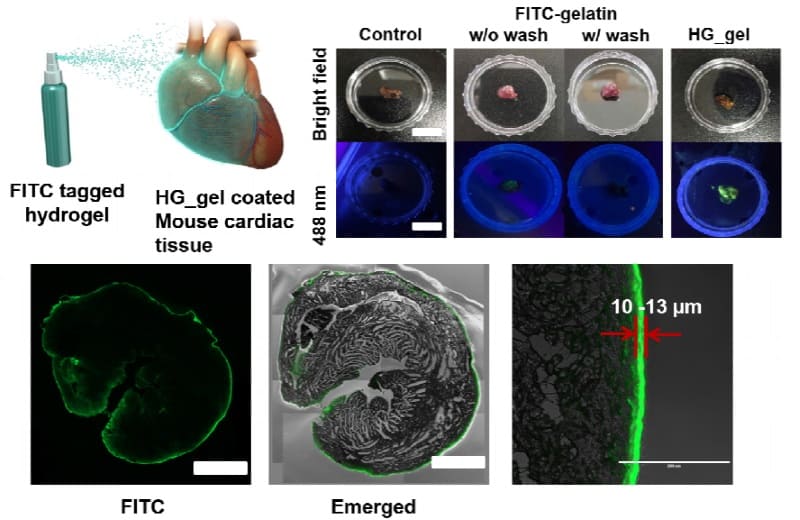
As a proof-of-concept, the researchers also developed a sprayable aerosol system employing the same solution as for the injection. The system effectively coated glass surfaces and recovered its properties in wet conditions, as seen in the injectable system. Taking a step further, they showed that the aerosol could coat a mouse heart, creating a stable film.

A potential new surgical tool

The authors have developed a tissue adhesive based on a novel enzymatic crosslinking system. The technology can be employed as a sprayable or injection-based system, which provides even more potential for further applications. In addition, due to its good compatibility with cells and after injection, the adhesive also shows potential as a system to carry and deliver cells for cell therapy strategies. All of these properties show promise for creating a future surgical tool for tissue engineering and regenerative medicine.


Copyright © 2026 by IOP Publishing Ltd and individual contributors