At IOP Publishing, which publishes Physics World, we have been engaging with the Japanese scientific community for decades. A large proportion of the community we serve – including researchers, librarians, funders and society partners – are based in Japan. We set up our first office in Tokyo back in 2002. Today, the office is located on a quiet, sakura-tree-lined street in Nihonbashi. We are particularly proud to be the publishing partners for the Japan Society of Fluid Mechanics (JSFM) and the Japan Society of Applied Physics (JSAP) on their society publications. Articles from these prestigious Japanese journals, through our platform IOPscience, have been downloaded across the globe, with readers from across 140 countries and more than 4000 institutions.
IOP Publishing is proud to be the publishing partner for the Japan Society of Fluid Mechanics and the Japan Society of Applied Physics
Elaine Tham
The Japanese Journal of Applied Physics (JJAP) has a distinguished legacy dating back to 1962, and has published scientific papers from four Japanese Nobel laureates in physics to date. This year, JSAP’s letters journal Applied Physics Express (APEX) celebrates 10 successful years of publishing new findings of the highest scientific quality in applied physics, while JSFM’s journal Fluid Dynamics Research recently celebrated its 30th anniversary.
Beyond our work with partners, IOP Publishing is also continuously shaping its own portfolio of journals, books, conference series and journalism to meet the ever-changing needs of the global scientific community. Recent journal launches – such as Quantum Science and Technology, Nano Futures and Multifunctional Materials – aim to attract the highest-impact research from leading institutions, including many in Japan.
We are also constantly striving to deliver more impact, recognition and value to our customers through innovation in our publications. In the past 18 months, for example, we have initiated rapid publication of the accepted version of the author’s manuscript on our publishing platform, partnered with Altmetric and Digital Science to embed Altmetric badges into article pages, and also trialled “double-blind” peer review on two journals. And last July we joined the American Physical Society in signing the ORCID open letter, thereby committing to collecting ORCID IDs from authors submitting to journals following stated best practices.
We recognize that the success of our publications depends on contributions from the research community. In 2017 more than 1000 reviewers from Japan helped ensure the scientific rigour and quality of our publications through the peer-review process, with 54 receiving one of IOP’s prestigious “Outstanding reviewer” certificates.
IOP Publishing also has a new partnership with Publons, which enables our reviewers to receive recognition for their contributions to scholarly communication across journals and publishers. Reviewers can capture their review history and link to their ORCID profile with a click of a button. Since launching Publons, about 40% of peer reviewers have opted in to Publons.
Our newly launched Publishing Support site, meanwhile, provides free advice and guidance to help researchers navigate the publishing process. With step-by-step guides, videos and frequently asked questions on everything from submission to publication and beyond, Publishing Support will help researchers along every step of their journey as an author, reviewer or conference organizer.
Physics World has been covering the latest advancements in Japanese science and research facilities throughout its 30-year history. In November 2017 the Physics World editorial team gave a talk at Tokyo Institute of Technology, advising the audience on how to boost the visibility and impact of their research using today’s digital tools.
On behalf of all my colleagues at IOP Publishing, I would like to thank all members of the scientific community who support our publishing programme and our mission. We will be attending the 65th JSAP Spring Meeting (17–20 March, 2018) at Waseda University, Nishiwaseda campus as well as the 73rd JPS Annual Meeting (22–25 March, 2018) at Tokyo University of Science, Noda campus. Please visit our booths in the exhibition hall of these two conferences, and have a chat with our staff about publishing with IOP journals or books.
Physics World has created a collection of articles about physics in Japan, from the best recent research to career opportunities and the changing funding and policy landscape.
In his office on the fourth floor of the Department of Earth and Space Science at Osaka University, Hikaru Kawamura, president of the Physical Society of Japan (JPS), hands me a brochure. It lists all 13 Japanese physicists who have won a Nobel prize, starting with Hideki Yukawa in 1949 for his theory of the nuclear force, and ending with Takaaki Kajita in 2015 for detecting atmospheric neutrino oscillations at the Super-Kamiokande underground lab. (Two of the physicists – Kenichi Fukui and Hideki Shirakawa – were awarded the chemistry Nobel prize.)
It is an impressive roster, but Kawamura, who leads a society with 17,000 members, admits he is “not optimistic” that Japan will be as prolific in terms of Nobel prizes in the future. As he points out, most Nobel laureates win their awards for work done 20 or 30 years ago. But with Japanese physics being – in his view – “not so popular as it used to be”, Kawamura is not sure how long the country will have to wait before another Japanese physicist wins a Nobel prize.
The way forward
The situation was different when Japan saw science as a way for it to revitalize after the devastation of the Second World War. Indeed, Kawamura, 63, recalls one of his school teachers who “used to talk about Yukawa like he was a god”. The country’s post-war investment in science and technology helped to turn Japan into one of the wealthiest nations in the world – it is either the third or fourth biggest economy on the planet (depending on which criterion you use) and home to numerous hi-tech giants.
Kawamura still thinks Japanese physics is strong, picking elementary particle physics, solid-state physics, astronomy and materials as fields where the country is world-leading. But he is worried about the declining output of Japanese physics and falling numbers of people doing PhDs in the subject. He is also troubled by the government cutting back on funds for “unconstrained” research at the expense of projects earmarked for specific targets. “There is a general concern in the community for fundamental science in future,” he warns.
One reason for the tightened research cash is Japan’s demographics. Plummeting birth rates and a steady rise in the average age at which Japanese people die have not only led to Japan’s population falling by just over 1% since 2010 to 126 million, but has also left the government facing rising social-security costs to support an ageing population. And with the number of 18-year-olds as a fraction of the total population halving over the last 30 years, it has left science – and science funding – on a slow but steady downward slide.
Writing in a statement when he was elected president of the Japan Society for Applied Physics (JSAP) for a two-year term in 2014, Satoshi Kawata – a photonics physicist from Osaka University – said that the cuts were creating “cutthroat competition between scientists”, who were being worn out “at the cost of freewheeling thinking”. Coupled with increasing administrative duties, endless meetings, a pressure to publish, and the constant writing of grant applications, many Japanese researchers lack time to be truly creative.
RIKEN’s president Hiroshi Matsumoto has called Japan’s plummeting international competitiveness a “crisis”
The difficulties were also highlighted in a Nature Index supplement published in March 2017, which noted that while the total number of publications indexed in the Web of Science across the world rose in all fields in the 10 years to 2015, Japan has not kept pace. In every scientific field, except mathematics and astronomy, the country produced fewer papers in 2015 than a decade earlier, with physics dropping by more than 20% during that time. Hiroshi Matsumoto, president of the RIKEN research institute, went so far in a recent issue of RIKEN Research as to call the plummeting international competitiveness a “crisis”.
Cultural issues
One way Japan is trying to boost science is to lure more overseas researchers to the country. In many regards, Japan is an attractive place for outsiders, especially if you are young, adventurous and have no family ties. People are warm and welcoming, crime is low and the country’s culture is unique. The food is great – if you like fish, that is – and transport is incredibly efficient. One Japanese rail firm had to apologize last year because one of its trains departed 20 seconds early. And with Japan strong in so much of physics, there is bound to be a lab or institute that matches your expertise.
But other factors make moving to Japan tricky for outsiders. The language is hard to learn, although if you are based at a research institute, you will find English is widely spoken in the lab. But if you have a partner and they are not a scientist, it won’t be easy for them to find a job outside academia unless they can already speak Japanese, potentially leaving them feeling isolated. Foreign researchers with children will also find that the Japanese school system is tough above kindergarten level, forcing most overseas scientists to send their children to expensive private, international schools. Tuition fees at the American School in Japan, for example, stand at ¥2.6m (about $23,000) per year.
Another challenge facing foreign researchers is that Japan’s research system is strongly hierarchical, with a lot of power placed in certain hands. To succeed, you need a supportive boss who will mentor and guide you. If someone higher up in your institute does not like you or sees you as a rival, they can easily turn off funding or side-line your work. “Powerful bureaucrats and power-brokers can destroy the research activities of competitors in a merciless manner,” says one foreign physicist who works in Japan but wishes to remain anonymous.
Dubbed “power harassment”, this suffering at the hands of influential people is not confined to academia. The Japan Times last year reported that about one in three workers in Japan had experienced some form of it over the previous three years, up from one in four in a previous poll in 2012, according to a survey of 10,000 workers by the health, labour and welfare ministry. About 41% of those harassed failed to take action, with most saying that even if they did, nothing was likely to be done. Some did nothing because they feared speaking out would damage their career progression.
Power harassment is tolerated because the Japanese are by nature passive people who do not wish to rock the boat
Handling such difficulties is harder if you are not Japanese and the researcher who spoke to Physics World believes power harassment is tolerated because the Japanese are by nature passive people who do not wish to rock the boat. “They know that bosses here are very powerful and the employees do not have real protection. In the West, harassment is no longer tolerated the way it was decades ago. Such cases are openly discussed in the West, but they are hidden in Japan. The harassment that researchers receive in Japan is the elephant in the room. Power always corrupts. Huge power can be abused and it is often abused.”
Power imbalance
Most Japanese universities have few foreign scientists, who tend to be early-career postdocs or senior visitors who are either on sabbatical or retired. One exception is Oliver Wright, an applied physicist from the UK who has been a full professor at Hokkaido University for more than 20 years, having first moved to Japan in the 1980s. “I think power harassment is a problem, but not in my case,” he admits. “I was parachuted into a full professor position with lots of power, so I could fight my ground with impunity. But I hear stories from friends and acquaintances about their suffering under powerful people.”
However, Wright is wary of criticizing Japan out of context, pointing out that other countries and cultures have similar problems too. “I know professors in the UK who keep their PhD students or postdocs in limbo for years because of their perfectionist attitudes to finishing journal papers, so the researcher’s career is ruined,” he says. “That’s also power harassment.” Indeed, his university is trying to tackle the problem, with staff encouraged to report any problems, although Wright concedes that “hardly anyone usually will dare to complain”.
One initiative to make it easier for foreign scientists to forge long-term careers in Japan is the World Premier International Research Center Initiative (WPI), administered by the Japan Society for the Promotion of Science. It began in 2007 with the creation of five institutes, with each being required to have at least 30% foreign scientists. Perhaps the best known of the nine current centres is the Kavli Institute for the Physics and Mathematics of the Universe (Kavli IPMU), which aims to understand the origin, composition and fate of the cosmos. Located on the University of Tokyo’s Kashiwa campus, it marked its 10th anniversary last year.
Kavli IPMU has performed better than expected in terms of its international make-up, with about half of its 140 researchers coming from abroad. “I think that having an equal percentage of Japanese to non-Japanese also makes people from abroad feel more comfortable,” says its director Hitoshi Murayama. The strong international flavour at Kavli IPMU is reflected in the fact that 60% of the 450 papers its staff publish each year are written with international co-authors. Papers written by researchers at most other Japanese universities, in contrast, have barely 10% of foreign co-authors.
Another aim of the WPI centres, which include the Earth-Life Science Institute in Tokyo (see “Opening doors” box), is to shake up the Japanese university system by being less rigid and more innovative. Those efforts seem to be paying off at the IPMU, where Murayama, who spends around half his time at the University of California, Berkeley, was initially the only person at the University of Tokyo to hold such a joint position with a foreign institution. Now there are 72 staff at Tokyo with a joint appointment. “I am no longer an anomaly,” he says.
Opening doors
Earth-Life Science Institute (ELSI).
Another research centre under the World Premier International initiative (see main text) is the Earth-Life Science Institute (ELSI), located on the campus of the Tokyo Institute of Technology. Set up in 2012, it has around 100 staff – in everything from astrophysics to microbiology – who want to understand how life began on Earth and apply that knowledge to the search for life on other planets.
The ELSI has made quick progress in boosting the visibility of foreign researchers in Japan. When John Hernlund – ELSI’s vice director – joined the institute in 2013 he was the first permanent foreign researcher to work at Tokyo Tech. Now, there are 43 other international researchers at ELSI.
Yet Hernlund, who works in astrobiology, is well aware of some of the practical frustrations of working in Japan. When the ELSI was founded, for example, it sought to recruit scientists by placing job adverts in the media. But Hernlund and colleagues quickly discovered there was no process at the university to do this as conventional advertising was not how universities in Japan traditionally brought people in.
He and other staff members were therefore forced to dip into their own pockets to pay for the advertisements and, although they eventually got reimbursed, it took nearly a year to sort the problems out and put in place a system should anyone else at the university want to follow suit. “This is why reform is so important,” says Hernlund, who hopes that such changes will “propagate outside ELSI”.
Given the institute’s funding is guaranteed only for another five years, ELSI is now trying to diversify its income to guarantee its future. Hernlund notes the temptation to even turn away from the WPI programme itself to help the institute become self-sustaining and have more flexibility than it would do if it stayed in the system. One avenue being explored to do this is by attracting more private funding.
The 2018 Physics World Special Report: Japan is now out
The Physics Society of Iran (PSI) has voiced concern over a recent case of faked peer review by an Iranian researcher. In January, the research integrity blog Retraction Watch reported that academic publisher Elsevier had begun retracting 24 papers with the same corresponding author, Ahmad Salar Elahi, who is a physicist based at the Plasma Physics Research Center at Islamic Azad University (IAU) in Tehran. Writing in a letter to Ivan Oransky, a co-founder of Retraction Watch, the PSI president Mohammad Reza Ejtehadi condemned Elahi’s behaviour as “unethical”.
Rigged, faked or compromised peer review usually happens when authors submit a fake e-mail address for peer reviewers they suggest when submitting their work to a journal. Feedback on manuscripts is then generally favourable and provide little criticism, persuading journal editors to accept and publish the work in question.
Our image in the international scientific community is important for us
Mohammad Reza Ejtehadi
Mahmood Ghoranneviss, dean of the Plasma Physics Research Center at IAU, confirmed to Physics World that Elahi had been removed from all duties at the centre and referred to the institution’s disciplinary committee. “The report of the frauds by Ahmad Salar Elahi caused a very strong negative reaction among Iran’s scientific communities,” notes Ghoranneviss. “The news was received with consternation and triggered an angry backlash among Iranians scholars and scientists.”
Correcting distortions
In his letter to Retraction Watch, Ejtehadi wrote that the PSI “strongly condemns” such misconduct, believing that the majority of the Iranian physics community is free from such digressions. “Our image in the international scientific community is important for us and we are careful to correct any distortion of this image caused by misbehaviour of a few faculty members,” he told Physics World.
Journal papers by scholars in Iran have increased 20-fold since 1979 and this is not the first case of high-profile research misconduct in the country. In 2016, BioMed Central and Springer retracted 58 papers by 282 scientists in Iran after an investigation found “evidence of plagiarism, peer review and authorship manipulation, suggestive of attempts to subvert the peer review and publication system to inappropriately obtain or allocate authorship”. However, Behzad Ataie-Ashtiani, a civil engineer at Sharif University of Technology in Tehran who has written about academic misconduct in Iran, says the boost in the country’s research output is mostly due to increased investment in research and not fraud.
Elahi did not reply to a request for comment from Physics World.
Delivering radiation in comb-like arrays of beamlets rather than a solid beam, grid-based radiotherapy exploits the dose-volume effect to spare healthy tissue in the beam’s path. Successfully realised, the approach could enable repeat treatments and is a potential strategy for increasingly popular hypofractionated treatments that deliver larger, and potentially more harmful, doses per fraction.
While the bulk of grid therapy research has focused on X-rays, in new work, the tissue sparing potential of carbon ions has been demonstrated by a Japanese-Swedish collaboration, using simulations. In a methodological advance, first author Toshiro Tsubouchi of Osaka University and colleagues also devised “goodness” criteria, enabling quantitative comparisons of different grid setups (Med. Phys.45 1210).
The researchers had the particular goal of sparing tissue near deep-seated tumours. “It’s in these [organs] in which the most severe side effects appear after radiotherapy and radiosurgery … where the high dose volumes spread out from the target,” said Albert Siegbahn, senior author and physicist at Stockholm University.
Dosimetrically, carbon ions are a promising candidate, as a significantly lower beam divergence than photons or protons helps preserve the dose valleys between beamlets at depth. In the current study, for example, a nominal 3 mm wide beamlet was 3.3 mm wide at a depth of 9 cm.
Additionally, while beamlets less than a millimetre wide have dominated research to date, carbon ion beamlets of millimetres wide have two key advantages. They can be generated with existing clinical spot-scanning technology and are more robust to geometric uncertainties such as organ motion. A drawback, however, is a significant drop in normal tissue tolerance as beamlet width increases. Consequently, Tsubouchi and his collaborators examined grids using both a 0.5 mm wide beamlet and a 3 mm wide beamlet.
The researchers framed their investigation as an optimization problem, seeking the beamlet separation that minimized the valley-peak dose ratio (VPDR) 5 mm from the target. Simultaneously, two further criteria stipulated that the target dose should be uniform and higher than the entrance dose.
Grid arrangements
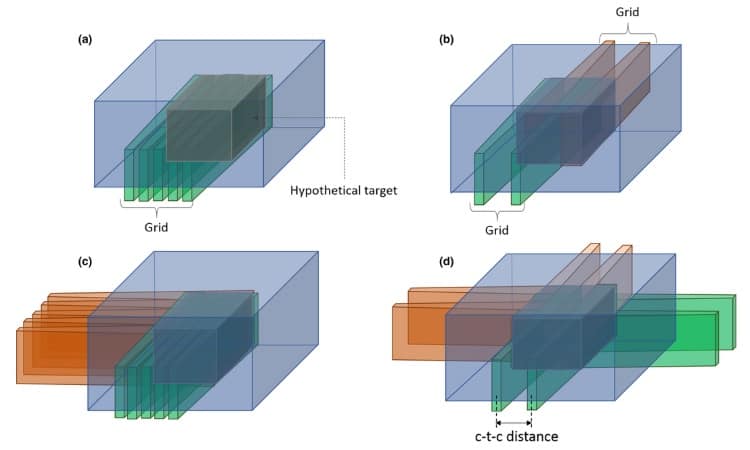
The team carried out Monte Carlo simulations for a 2-cm cubic target located in the centre of a 20-cm cubic water phantom. The target was irradiated with spread-out Bragg peaks with four different grid arrangements, ranging from a single grid to an orthogonal “crossfiring” of two pairs of opposed, interlaced grids.
The investigated grid arrangements
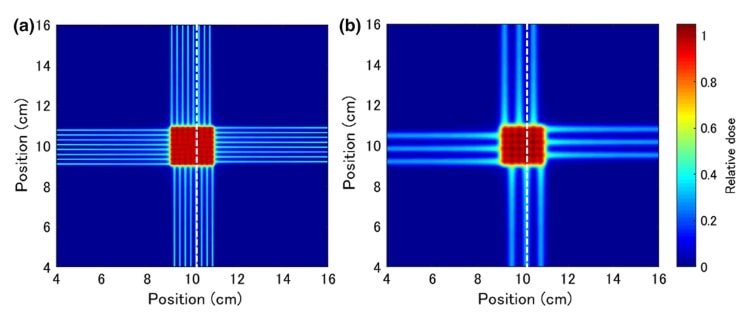
Using a single grid, the researchers found that spacings of 1.0 mm (0.5 mm beamlet) and 3.2 mm (3 mm beamlet) that achieved uniform target coverage provided minimal dose sparing close to the target. For example, 5 mm from the target, VPDR values exceeded 0.9.
In contrast, the four-grid arrangement resulted in significantly lower doses outside the target. Here, uniform target coverage was achievable using greater spacings of 2.4 and 6.4 mm, for the 0.5 and 3 mm beamlets respectively. They resulted in VPDR values of 0.22-0.24 near the target.
Simulated 2D-dose distributions
Based on their findings, Tsubouchi and his collaborators are developing the technique further. “From a theoretical point of view, we are pretty confident,” said Alexander Valdman, co-author and radiation oncologist at Karolinska University Hospital in Stockholm. “We know that we can deliver a safe dose to the target while maintaining the grid pattern down to the target and preserving the tissue.”
In the first instance, the authors see brain tumour cases not cured by conventional radiotherapy as the cohort most likely to benefit from a clinical trial. Here, critical structures in the brain are likely to have already received a significant dose, contra-indicating additional, conventional treatment. Fixed intracranial anatomy and immobilization that minimize geometric uncertainties would also make accurate grid placement less challenging. “This is where grid therapy could really shine,” said Siegbahn.
In ongoing work, the authors are investigating the physical implementation of carbon ion grid therapy in experiments. The researchers are also developing ways to evaluate and compare carbon ion grid therapy with conventional treatments.
Delay in slowing rising sea levels is dangerous. Each five-year delay in limiting global carbon emissions into the atmosphere now will increase sea level rise for the next three centuries.
This warning is based on computer models of global warming and sea level rise – but a second study based on very precise measurements over the last 25 years confirms that the models are reliable – and that sea level rise is already accelerating.
As sea levels rise, then so does the level of storm damage to coasts and coastal cities: a recent study of the coast of South Carolina warns that financial losses caused by hurricanes could rise by 70% by 2100.
And, for the doubters, a fourth piece of research delivers the ultimate in hard evidence: winter storms off the Irish coast have shifted boulders that weigh up to 620 tons (630 metric tonnes) and hurled smaller boulders of up to 100 tons far above the high tide mark.
German scientists report in the journal Nature Communications that they started from the premise that sea level rise must happen in decades to come because of fossil fuels already burned, to release ever greater proportions of greenhouse gases into the atmosphere.
In Paris in 2015, 195 nations vowed to contain climate change and reduce emissions. At some point, these emissions must peak and start to fall. The question then becomes: does it make a difference if this peak comes a little later in the century?
It does. Climate scientists can’t be sure how much sea level rise is in the pipeline – by 2300, sea levels could be 3 metres higher than today – but they can be sure that any delay will be expensive.
“Every delay in peaking emissions by five years between 2020 and 2035 could mean an additional 20 cm of sea level rise in the end,” said Matthias Mengel from the Potsdam Institute for Climate Impact Research.
And his co-author Carl-Friedrich Schleussner said: “The Paris Agreement calls for emissions to peak as soon as possible. This might sound like a hollow phrase to some, but our results show that there are quantifiable consequences of delaying action.”
Global sea level rise has not been steadily increasing: it has been accelerating. US researchers report in the Proceedings of the National Academy of Sciences that they examined 25 years of satellite data to find that the water lapping at the world’s coasts is rising, and the rate of rise is getting faster, as the ice caps in Greenland and Antarctica start to melt at a greater rate.
By 2100, on present evidence, the sea will have risen 65 cm. “That is almost certainly a conservative estimate,” said Steve Nerem, of the University of Colorado Boulder, and a member of the US space agency NASA’s sea level change team.
Conservative assumption
“Our extrapolation assumes that sea level continues to change in the future as it has over the last 25 years. Given the large changes we are seeing in the ice sheets today, that is unlikely.”
This is intellectual territory already well explored: researchers have repeatedly established that sea level rise is increasing; that the cost to human society will be enormous; and that with the combination of rising temperatures and higher tides, more destructive superstorms are all but inevitable.
Engineers in the US decided to try to put a more precise cost to come of these yet-to-happen superstorms. They report in the journal Sustainable and Resilient Infrastructure that they used climate models to simulate hurricane size, intensity, track and landfall locations for 13 coastal counties in South Carolina, under two scenarios.
One scenario presumed that ocean temperatures remained unchanged between 2005 and 2100. The other assumed that they would warm in line with climate predictions in a worst-case state, one in which humans went on burning fossil fuels at an ever-increasing rate.
They found that in the first scenario, a once-in-25-years hurricane would cause $7bn worth of damage in the area. But if oceans continue to warm, this damage rose to a notional $12bn.
These outcomes were based on computer models. But another research team in the US has delivered down-to-earth evidence of what storms really can do.
Boulder shunters
They report in the journal Earth-Science Reviews that they surveyed 100 sites in western Ireland, after the winter storms of 2013-2014, and documented the displacement of 1153 boulders.
They had been studying the coast for years and they knew where 374 of these boulders had come from, so they could also pace out the distance each was displaced.
One of these mobile masses was almost 240 cubic metres and weighed 620 tons. That is the equivalent of six blue whales. The second largest weighed 475 tons. Some smaller boulders had been shunted 222 metres inland, and 26 metres above high water.
Such scholarship is more than academic. Around 40% of the people on the planet live by the sea. Engineers, coastal scientists and city authorities need to know what storm waters can do.
“Now that we know what storm waves are capable of, we have much more information for policy makers who are responsible for preparing coastal communities for the impact of high energy storms,” said Rónadh Cox, a geoscientist at Williams College, Williamstown in Massachusetts.
The first-ever studies of industrially produced membranes made from small-diameter carbon nanotubes have revealed that these materials are as good in terms of characteristics and performance as small-scale laboratory prototypes. The experiments also bring to light some important phenomena that could be put to good use in applications such as water desalination, air purification and separating industrial gases, to name but three.
“Our work is the first to test carbon nanotube (CNT) membranes made on the large scale by a start-up company, which is quite different to previous studies that looked at CNT membranes made in small batches exclusively for laboratory work,” explains team leader Benny Freeman of the University of Texas at Austin. “Having access to such materials in such large quantities, and at so low a cost, is an exciting development.”
Freeman and colleagues at the University of Connecticut and Mattershift, a New York City-based start-up, decided to study how gas and water transports through these membranes to find out if their characteristics and performance in this respect matched those of previously studied lab-scale prototypes. “We indeed found that they did, but we were also able to observe some important phenomena that had only been predicted for small-sized CNTs before now, but were not very often observed in experiments.”
Surface diffusion along the CNT inner wall
The inner diameters of the tubes, which are so-called arc discharge CNTs, were between just 0.67 and 1.27 nm. At such a small scale, researchers predict that there should be certain transport mechanisms at play, including surface diffusion along the nanotube inner wall. “The type of transport here is quite different to conventional Knudsen diffusion or viscous flow,” says Freeman. “In particular, it is much faster than Knudsen because absorption phenomena begin to become important here.
“For example, we found that propane diffuses through these membranes as fast as helium, even though propane is 11 times heavier and would normally be expected to flow through much more slowly. We believe that the fast transport rate comes from the affinity of hydrocarbons for the inner CNT wall.”
Absorption effects are important
The researchers also observed that water flows through the membranes 1000 times higher than predicted by Hagen-Poiseuille flow, a result that is in agreement with previous studies on lab-quality materials. Another important finding is that CO2 diffuses through the tiny tubes quicker than nitrogen gas in a mixed transport experiment. Once again, this behaviour is likely due to absorption effects, says Freeman.
“These are the phenomena that Mattershift would like to exploit to separate fuels and biofuels from dilute sources, such as water, using very little energy,” he tells nanotechweb.org. “Removing CO2 from air using these membranes and catalytically reducing it to ethanol and other liquid transportation fuels might also be a possibility.”
Indeed, Rob McGinnis, Mattershift founder and CEO says that this has already been done using conventional technologies but that it has been too expensive to be practical until now. “Using our tech, I think we’ll be able to produce carbon-zero gasoline, diesel and jet fuels that are cheaper than fossils,” he writes in a company press release.
Towards real-world applications
Mattershift also says that it is working on using these membranes to extract ethanol fuel from sources like corn, sugar cane and cellulosic fermentation broths in a way that will reduce fossil fuel use for such renewable fuels by as much as 90% – by replacing distillation with a technique called pervaporation.
“We are looking forward to finding out what this new class of membranes can do in such industrial gas and energy applications,” adds Freeman. “Our lab is a leader in these fields and having access to these commercial CNT membranes will hopefully lead to new real-world applications.”
The rise of the smartphone brings brands challenges as well as solutions. Davor Sutija explained to attendees at innoLAE2018 how near-field communication technologies provide a secure and simple connection between brands and consumers that advanced electronics fabrication units, like Thin Film Electronics in Silicon Valley, can now roll out at the scale of billion-unit volumes – a “perfect storm” of contributing factors that may bring ubiquitous near-field communication technologies to the marketplace.
About Davor Sutija
Davor Sutija is CEO of Thin Film Electronics ASA, and has worked with the company since January 2010. He graduated from the Jerome Fisher Management and Technology program at the Wharton School, before obtaining his PhD from the University of California, Berkeley, in Chemical Engineering, and was a Hertz Fellow at Lawrence Berkeley Labs. Since then, previous positions include Senior Vice President, Product Marketing, at FAST, a Microsoft subsidiary, and founding CEO at SiNOR AS, a producer of electronic and PV-grade silicon ingots. Currently a member of the Advisory Board for Orbotech, he has also served on the board for the Organic Electronics Association (OE-A) from 2012 through 2015, as well as on the Board of Directors for a number of technology firms including SensoNor, Birdstep and Owera.
About Thin Film Electronics
Thin Film Electronics ASA (“Thinfilm”) provides both the hardware and cloud-based reporting and analytics for mobile marketing smart-packaging solutions based on near-field communications. Hardware components include printed tags, labels and systems that include sensors and wireless communication, with competitive costs-per-function for all products.
Publicly listed as a Norwegian company, Thin Film Electronics ASA (“Thinfilm”) has global headquarters in Oslo, Norway; US headquarters in San Jose, California; and offices in Linköping, Sweden; San Francisco; London; and Shanghai. More details at Thin Film Electronics
Progress in organ-on-a-chip technology could enhance the screening of new pharmaceutical drugs, potentially reducing the number of expensive failures as new formulations move beyond early-stage development. One key problem is that drug behaviour is affected by differences in kidney performance between animals and humans, which makes it difficult to translate test results from one species to another. At the most extreme, drugs that are safe and efficacious in animal studies may be toxic to humans if given in the same amounts.
A kidney model on a chip
To show how microfluidic devices containing immobilized animal or human cells can help to bridge this gap, researchers based in the US and Korea have used a so-called “perfused kidney-on-a-chip” to compare the toxic impact of a broad-spectrum antibiotic called gentamicin when administered at the same dose, but in two different ways.
The team – led by Shuichi Takayama, now at Georgia Tech, and including Se Joong Kim on sabbatical from Seoul National University – mimicked the drug clearance profile for a single injection by starting the cell exposure at 19.2 mM (millimolar) of gentamicin and reducing the dosage by half every two hours over a 24-hour period. In the second regimen, the researchers continuously infused the kidney cell-containing chip with 3 mM of gentamicin, again for a period of 24 hours.
“The ease with which you can temporally modulate drug exposure is one of the strengths of microfluidics over conventional static cultures such as dishes or microwells,” says Takayama.
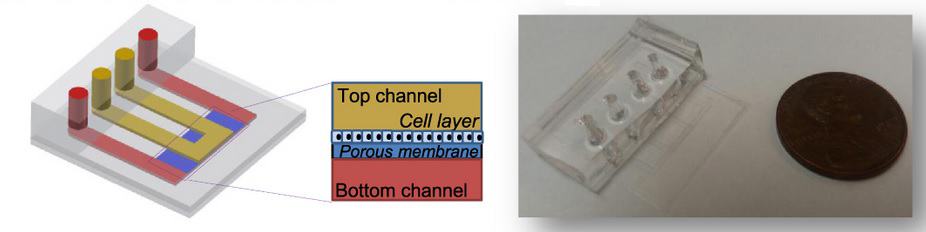
Microfluidic techniques such as the set-up used by Takayama and his team can generate physiological microenvironments for a variety of tissues and organs, making them applicable for evaluating a wide range of treatments. The device developed for this study consists of a top channel and a bottom channel separated by a porous membrane, which accommodates the cell layer.
In the study, published in the journal Biofabrication, the researchers illustrated that different pharmacokinetic profiles can be readily recreated in a kidney-on-a-chip system. Also, by using physiologically and clinically relevant sub-lethal cell-injury markers, the group was able to show how different drug administration regimens can affect the kidney.
Looking at the data, the injection mimicking regimen led to lower cytotoxicity compared with continuous infusion, which the team attributes to less disruption of cell–cell junctions.
“We are encouraged by the ability to resolve sub-lethal cell injury responses to different pharmacokinetic profiles imposed on the kidney cells,” comments Takayama. “Our next steps are to scale up the method and make it more accessible and user friendly.”
This article is one of a series of reports reviewing progress on high-impact research originally published in the IOP Publishing journal Biofabrication.
“The Internet has many benefits for society but also the potential to destroy the authenticity of modern society and modern science.” Those remarks were made by the renowned electrical engineer Hiroshi Inose from the University of Tokyo some 25 years ago as Internet services were starting to be introduced in Japan. This warning is also relevant today and I still recall it when discussing science and technology policy that is related to issues such as artificial intelligence and big data.
Digital technologies are crucial for knowledge creation and transfer, not only for business and lifestyle but also for education and science. However, Japan’s traditional education and research system must be reformed to meet society’s growing demands as well as the changing global landscape of science. In the past decade, the Japanese government – as well as the country’s science and education communities – have made considerable efforts to make education more flexible and multidisciplinary from elementary to tertiary level. While institutional reform has been happening, the way we evaluate students has not yet developed and spread into classrooms and laboratories.
Science and technology policy in Japan has also been changing from a traditional focus on research and development to innovation. The highest science and technology advisory board to the Japanese prime minister – the Council for Science, Technology and Innovation – recently added innovation to its name, while the government’s research budget has swiftly changed priority from basic to applied research and innovation. Many Japanese Nobel-prize winners – the numbers of whom have been increasing in recent years – are growing concerned with such trends. They claim that Japan’s focus on science is gradually declining, and the motivation and spirit of young students and researchers is being discouraged.
Building bridges
During the earthquake and tsunami that hit north-east Japan in March 2011 resulting in the Fukushima nuclear accident, most of Japan’s scientific societies, government advisers and academics could not take timely and effective action. They lacked an emergency advice system as well as sufficient data collection methods and expertise. Japan’s science and technology community therefore lost trust among the public, politicians and administrators. Before Fukushima, around 80% of respondents to a poll carried out by Japan’s National Institute of Science and Technology Policy trusted science, but that percentage halved following Fukushima. Those sentiments have still not yet recovered after seven years.
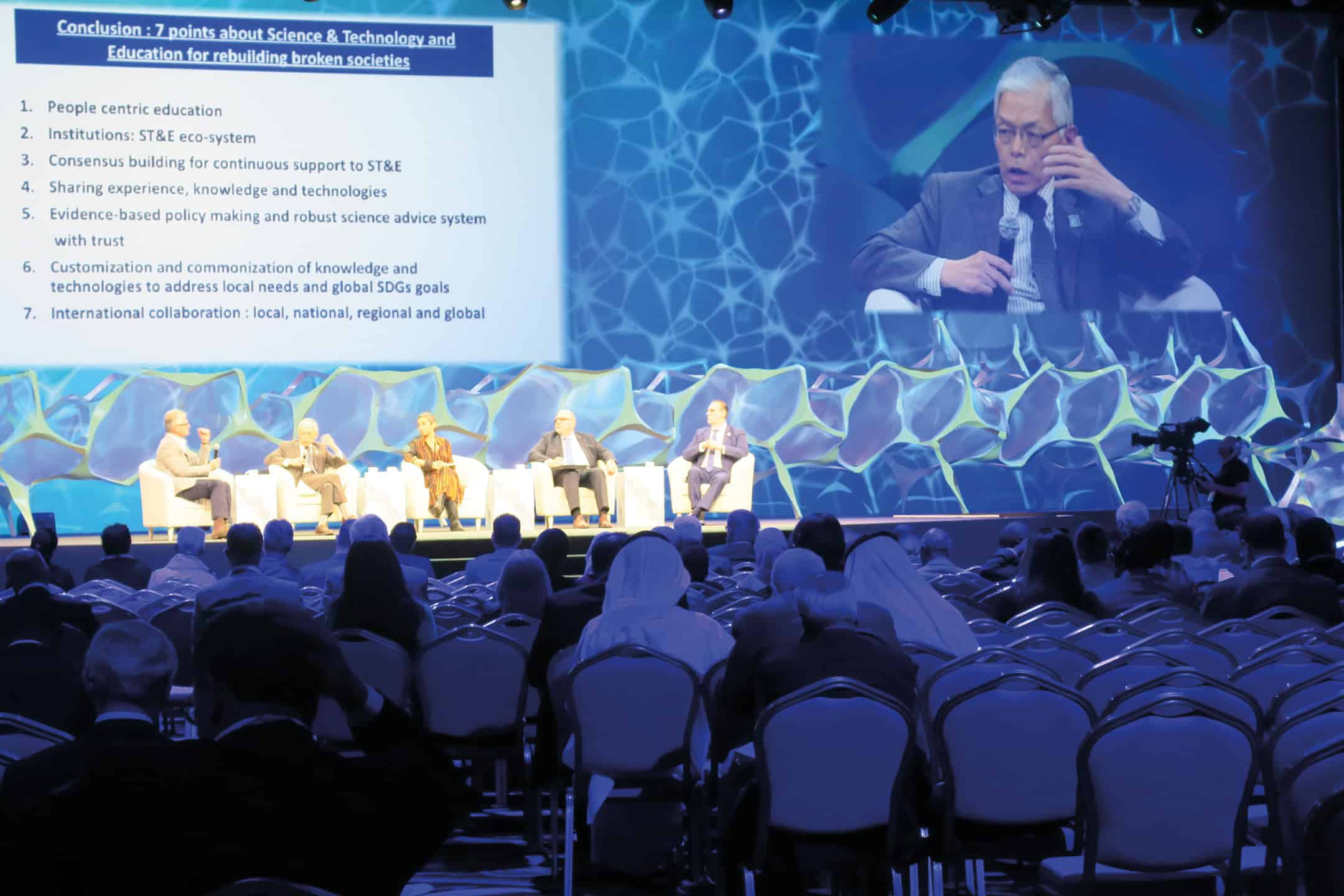
Science for society Tateo Arimoto speaking at the World Science Forum in Jordan in November 2017.
After Fukushima, the Science Council of Japan completely revised its 2013 code of conduct for scientists and in 2015 Japan’s foreign ministry appointed a chief science and technology adviser to advise over global issues such as the United Nations Sustainable Development Goals. This appointment raised the recognition and importance of science diplomacy with policymakers.
Another issue facing Japan’s science activities is that they are declining relative to other countries. The country needs to prioritize education and basic science in parallel with reforming education and science to be more open, flexible, inclusive and to better support promising younger generations.
Around six years ago, the National Graduate Institute for Policy Studies, along with the universities of Tokyo, Hitotsubashi, Kyoto, Osaka and Kyushu, began a programme to make policy more evidence-based and to train students, researchers and mid-career government officials to have a more open and multidisciplinary mindset. As one of the people behind the project, I believe it has worked to build bridges between science and policymakers. Indeed, our programme has been recognized as being effective and trustworthy, but we still have more progress to make.
In recent years, some universities have tried to add liberal arts curricula such as philosophy, history, social science and communication, to the traditional education courses for graduate students in physics, chemistry, biology and engineering. I have been involved in teaching and debating at several classes. According to many of these students, they appreciate discovering new ways of thinking and taking part in discussions beyond the boundaries of their own discipline, organization, gender, generation or nation. In doing so, they appreciate how their research can make an original contribution to knowledge and society from a diverse perspective.
Two leading international science councils – the International Council for Science and the International Social Science Council – made the historic decision last year to merge and form a single global entity called the International Science Council (ISC). The new body will strengthen international, interdisciplinary collaboration and support scientists to advance science and address global issues for the greater good. The International Union of Pure and Applied Physics subscribes to the following core values of the ISC: excellence and professionalism; inclusivity and diversity; transparency and integrity; innovation and sustainability; scientific education; and capacity development.
The country needs to prioritize education and basic science in parallel with reforming education and science to be more open, flexible, inclusive and to better support promising younger generations
According to my experience discussing sustainable development and science and technology with people in developing countries, Japan is an important role model for those nations’ own futures. They see Japan’s long-term focus on education, science and technology, knowing that the modernization of this non-western country over the last 150 years has been tough but worthwhile in the end.
We now need to build a global platform for sharing knowledge, data, expertise and experiences for sustainable development. It is high time, both in Japan and across the world, to rethink what science is, who a scientist is and why science is so important in the changing world.
For more about Japan, check out the latest Physics World Special Report Japan
“Life uh… finds a way” is one of Jeff Goldblum’s many great lines in playing chaos theory mathematician Ian Malcolm in Jurassic Park. In his wry style, Malcolm is pointing out nature’s cunning habit of thriving, even when humans interfere with natural habitats. Or put another way, you can place a giant fence around a T. Rex but it’ll still find of way of eating you in the end.
What’s that you say – Jurassic Park’s not a nature documentary? You’ve just ruined my childhood. Anyway, this week I’ve been in the Netherlands investigating a more modest “life finds a way” scenario, involving the humble harbour porpoise (Phocoena phocoena). I’ve been working with US filmmaker Saskia Madlener to shoot a film about how marine wildlife responded to the creation of Windpark Egmond aan Zee (OWEZ), the first offshore wind farm built off the Dutch North Sea coast. Perhaps surprisingly, a study published in 2011 found that the porpoise population in this zone – 10–18 km from the coastal town of Egmond aan Zee – is larger now than it was just before the windfarm existed.
Reef effect
Obviously, it’s great news for the porpoises. But the presence of mammals so high up the food chain is also an indicator of a thriving ecosystem. The study led to the intriguing suggestion that the underwater infrastructure of offshore windfarms can create sheltered reef environments, with better foraging opportunities than an otherwise homogenous sea floor. Hard substrates can host small organisms, which become prey for fish, which in turn become prey for porpoises. So on the face of it, offshore windfarms might be a win–win situation – a renewable-energy source whose very existence can allow marine wildlife to flourish.
Windpark Egmond aan Zee. (Courtesy: NUON)
Now come the many caveats, of which I’ll just name a couple. First up, a separate study published in 2013 of the Nysted windfarm in the Danish western Baltic sea found the opposite result. The harbour porpoise population dramatically reduced during the construction of that windfarm and had barely recovered 10 years after the construction was complete. Secondly, it needs to be noted that fishing is now prohibited at the Egmond aan Zee windfarm, which has led to a significant reduction in shipping traffic in the area. So is the thriving marine life just a product of the area becoming a protected zone? Presumably, many of those fishing boats are still active – so has it simply shifted the environmental impact elsewhere?
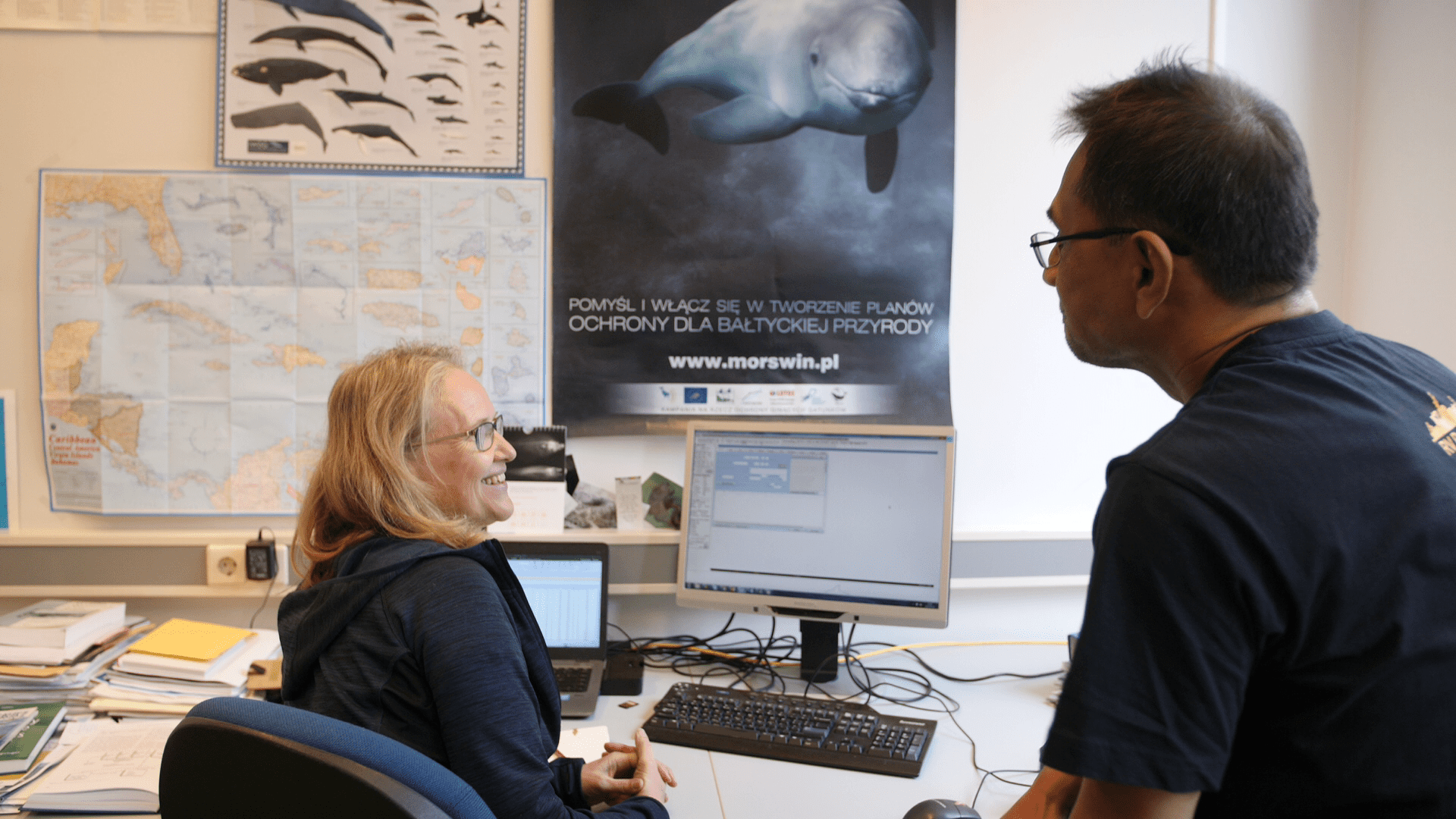
These are some of questions we will explore in the film, which will be published on this site in the next few weeks. We visited the small port city of IJmuiden where we interviewed Meike Scheidat, a marine researcher from Wageningen University who led the 2011 study. We wanted to discover the strengths and limitations of the study, which involved tracking the echolocation click-activity of porpoises by suspending hydrophones from buoys. Scheidat’s office contained a menagerie of marine wildlife posters, books and decorations – exactly what you might expect from a researcher immersed in her field.
Meike Scheidat (left) in her office in IJmuiden.
But not everyone was happy with the arrival of the OWEZ wind farm. Some in the local fishing community were unhappy with the shipping ban, especially with the speed at which it came into effect and the lack of consultation. So we next headed to the Hague where we interviewed the fisherman Rems Cramer on a boat in Scheveningen harbour. Cramer identifies strongly as “a hunter” of fish, but realizes that the fishing industry must adapt its methods to survive. He is investigating more sustainable fishing practices with a group called Vissen voor de wind (“fishing for the wind”) with support of the Dutch Ministry of Economic Affairs and the European Fishery Fund. Cramer believes fishing could resume at OWEZ if trawling is replaced with lighter touch methods, such breeding of mussels on floating solar panels.
The winds of change
Also on our tour was downtown Amsterdam, where we visited the HQ of Dutch utility company NUON, which constructed the windfarm in partnership with Shell. One of the lead engineers Henk Kouwenhoven spoke about the lessons learned from OWEZ as well as the current state of the wind energy sector in the Netherlands. At present just 6% of the Netherlands’ energy comes from renewable sources but the nation is committed to hitting its EU target of 14% by 2020, rising to 16% by 2023. Meanwhile, the Dutch government has set a target to lower the cost of offshore wind power by 40% in 2024 compared to 2014. Coupled with the decision to reduce the nation’s historic reliance on natural gas, it all suggests that the Dutch government is very keen for the rapid expansion of offshore wind.
That is why it will be so important to consider the potential environmental impacts of construction, operation and decommissioning of these sites. Kouwenhoven believes that a vital part of that process will be to learn lessons from the OWEZ example and to minimise environmental impacts through technologies such as developing drilling equipment with reduced acoustic noise.
This film will be part of our new series of films exploring environmental challenges and their potential solutions. The issues in these films are often messy, complicated and involve competing interest groups. That is precisely why the issues are so interesting! Also, rather than focussing purely on grave environmental threats, these films will identify ways in which science and engineering can help us to adapt to meet these challenges. The first film in the series looked at Mexico City’s struggle to provide its citizens with drinking water. Another film to appear on this site soon will look at efforts in the US city of New Orleans to adapt to live with increasing flood risk in the face of climate changes.
I can’t promise these films will gross as much at the box office as Jurassic Park. But what I can guarantee is that you’ll have plenty of meaty environmental challenges to sink your teeth into. All available right here, free of charge, on the new look Physics World website.