Falcon Heavy and Humanity Star: trailblazers or space junk?

When the SpaceX Falcon Heavy made its maiden launch on 6 February, the overwhelming reaction was one of awe. Its widely reported payload – Elon Musk’s personal cherry red Tesla Roadster sportscar – added to the audaciousness of the mission and reaffirmed Musk’s rock-star status. No doubt, vast numbers of students around the globe will have had their imaginations lit up, some may even have started thinking about the exciting opportunities of a career in engineering.

However, there have been a few voices of dissent. Some critics have suggested that the rocket payload is merely adding to the growing problem of space junk. Perhaps an even stronger criticism is that firing a flashy sportscar into space is a symbol of the distain the super-rich have for the many people on Earth who live in poverty. The controversy around the Falcon Heavy launch is the subject of the Physics World monthly podcast, which is presented as always by Andrew Glester. Joining Andrew in the busy café at Physics World HQ is Physics World careers editor Tushna Commissariat and special guest Tim Gregory who recently appeared on the BBC show Astronauts: Do You Have What It Takes?

Elon Musk's personal Tesla roadster and mannequin

Andrew and crew also discuss the recently launched Humanity Star, which has also generated some controversy in the astronomical community. Launched in January by the private company Rocket Lab, the mission’s payload is described as “a highly reflective satellite that blinks brightly across the night sky to create a shared experience for everyone on the planet.” However, some astronauts fear that this “giant disco ball” is frivolous and might even interfere with their view of the night sky. Andrew puts some of these concerns to Rocket Lab founder and CEO Peter Beck and debates the issue at length with Tushna and Tim, asking whether they see a fundamental difference in the ethos and impact of these two high-profile private launches.

Snowpack declines in western US

The average snowpack in western states of the US has declined by 15–30%, Philip Mote of Oregon State University, US, and colleagues found, losing an amount of water comparable in volume to Lake Mead, the largest manmade reservoir in the region.

“It is a bigger decline than we had expected,” said Mote . “In many lower-elevation sites, what used to fall as snow is now rain. Upper elevations have not been affected nearly as much, but most states don’t have that much area at 7,000-plus feet.”

The snowpack decline is due to warming rather than a lack of precipitation, the researchers believe. Higher temperatures earlier in the spring mean water will not be stored as long in the mountains, potentially causing lower river and reservoir levels in the late summer and early autumn.

Mote and colleagues used data from 1,766 sites in the western US, focusing on measurements on 1 April, historically the high point for snowpack in most areas. They also looked at data from 1 Jan, 1 Feb, 1 March and 1 May, which gave the decline a range of 15–30%. Their physically based computer model of the hydrologic cycle incorporated daily weather observations and computed the snow accumulation, melting and runoff to estimate the total snowpack in the western US.

“We found declining trends in all months, states and climates,” said Mote, “but the impacts are the largest in the spring, in Pacific states, and in locations with mild winter climates.”

The Pacific states – California, Oregon and Washington – receive more precipitation because of the influence of the Pacific Ocean, and more of the snow falls at temperatures near freezing. The Cascade Mountains, which transect the region, are not as steep as the Rocky Mountains so they have more area that is affected by changes in temperature. “When you raise the snow zone level 300 feet, it covers a much broader swath than it would in the inland states,” said Mote.

Eastern Oregon and northern Nevada showed the most significant decrease in snowpack, though snowpack decreases of more than 70% also occurred in California, Montana, Washington, Idaho and Arizona.

Mote believes that the solution isn’t infrastructure as new reservoirs could not be built fast enough to offset the loss of snow storage and there’s not much capacity left for that kind of storage. Instead the answer is to manage what the region has in the best possible ways.

“The amount of water in the snowpack of the western United States is roughly equivalent to all of the stored water in the largest reservoirs of those states,” Mote said. “We’ve pretty much spent a century building up those water supplies, and at the same time the natural supply of snowpack is dwindling. On smaller reservoirs, the water supply can be replenished after one bad year. But a reservoir like Lake Mead takes four years of normal flows to fill; it still hasn’t recovered from the drought of the early 2000s.”

So far in 2017–2018, snowpack levels in most of the western US are lower than average, according to Mote, a function of continued warming temperatures and the presence of a La Niña event, which typically results in warmer and drier conditions in most southwestern states.

Magnon transistors could give spintronics a boost

Three independent teams of physicists have unveiled devices that could lead to practical spintronics components of the future. Researchers in the Netherlands have created what they call a “magnon transistor”, whereas a group in China has unveiled their “magnon valve”. Meanwhile in Germany, a team has also demonstrated their own version of a magnon valve. All three devices represent important work towards creating practical spintronics devices that use electron spin to transfer and store information.

Spintronics is attractive as a potential technology because it could solve several important problems facing electronics designers as they try to create ever smaller and more powerful devices. Using the spin of the electron (in addition to its electrical charge) to carry information provides an extra degree of freedom that could lead to smaller devices. At the same time, spin-based devices could be designed to consume much less energy than conventional electronics – making miniaturization easier.

However, creating spintronics based around the electron as the information carrier has its own challenges, so some physicists are keen on exploring alternatives. One possibility is the magnon, which is a collective excitation in a magnetic material. Magnons propagate as waves – flipping spins as they go. They also have particle-like properties, which is why they are called quasiparticles.

Simple designs

Circuits based on magnons have the potential to be much simpler in design than comparable conventional electronics – while at the same time consuming much less energy. But as Andrii Chumak of Germany’s University of Kaiserslautern, who was not involved in the research, explains: “We are still quite far away from realizing this potential”.

In this latest drive to create magnonic devices, a team led by Mathias Kläui of Johannes Gutenberg University of Mainz in Germany and a team led by Xiufeng Han of the Chinese Academy of Sciences in Beijing have showed that a magnon current can be controlled by changing the relative magnetization orientation of two magnetic layers.

Although made from different materials, both devices comprise a sandwich of two magnets separated by a non-magnetic spacer. By aligning the magnetic moments of the “bread” of the sandwich parallel or antiparallel, the researchers managed to increase and decrease the magnon current flowed through their devices – so the devices operated as valves.

“Both [devices] show typical spin valve behavior, and the effects are large so they could in future be used as a non-volatile low-power logic component,” explains Kläui. “But we now need to quantify the modulation of the magnonic spin current transmission in an ideal spin valve geometry.”

Different spin

Taking a different approach, but still aiming to control magnon current,  Bart van Wees of the University of Groningen, the Netherlands, and colleagues altered magnon current using an electrode to change chemical potential in a device they have called a “magnon transistor”. The device consists of a thin rectangle of platinum on top of a larger square of magnetic material. Magnons are generated at one end of the magnet and detected at the other. Then more magnons are pumped into or absorbed from the square depending on the spin polarization of electrons flowing in the platinum strip. By aligning and then oppositely aligning these electron spins with the magnons in the square, the researchers managed to increase and then decrease the magnon current.

This magnon transistor offers two potential benefits compared to the magnon valves: it operates faster than the valves and it should be more useful for creating complex circuits. However, the change in magnon current is much smaller than in the magnon valves. Also, because a spin current is used to modulate the magnon current, the transistor does not offer a low-power advantage over conventional electronics.

The devices could be key steps towards realizing full magnonic devices, but Chumak urges caution for those believing the research signals that magnonic circuits are just around the corner: “My personal feeling is that these papers represent an important step forward, but in fundamental physics only,” he says. “The magnonic signal has to be converted into electric current (in the Dutch device) or to magnetization orientation (in the two other cases) – a serious problem which requires in-depth investigations.”

Kläui describe their device in Nature Communications, whereas the van Wees and Han groups have published separate papers in Physical Review Letters.

Measurements of AR holograms match gold standard

AuntMinnie logoResearchers at the University of California, San Francisco (UCSF) created holograms that have comparable dimensions to corresponding CT scans using proprietary augmented reality (AR) software. They plan to present their work at the upcoming American Roentgen Ray Society (ARRS) meeting in Washington, DC.

In the pilot study, the group led by Jesse Courtier performed a series of measurements on five augmented reality holographic models based on CT phantoms. The resulting measurements of their holograms were as accurate and precise as manual and PACS measurements of the same CT phantoms.

“Our findings lay the groundwork for developing accurate holograms, which will help establish a foundation for their clinical use,” Courtier told AuntMinnie.com. “By overcoming hurdles like this, we can begin considering the future use [of augmented reality] live in the operating room, where distances within a few tenths of a millimetre are important.”

Lifelike holograms

Courtier and colleagues have been exploring the clinical application of augmented reality through their proprietary Radiology with Holographic Augmentation (RadHA) software, which works in conjunction with the Microsoft HoloLens wireless headset to display CT scans and MR images in 3D on any real-world background.

“Our prototype augmented reality software allowed for the visualization of medical images in a more natural way,” he said. “So, we wanted to know how accurate these projections could be, and if they could be even more lifelike.”

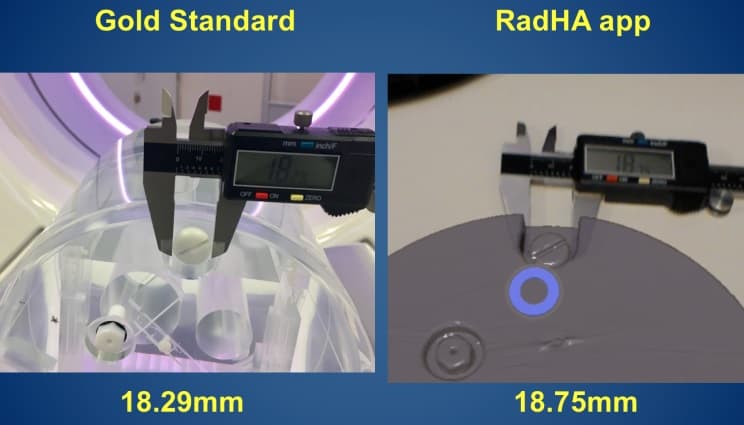
To determine the fidelity of their models to real-life measurements, they collected CT scans of five distinct quality control phantoms and converted these scans into 3D models through the RadHA software. They were then able to visualize holographic replicates of these models by wearing the HoloLens headset. With the headset on, they manually measured several preselected sections of each of the models in three planes (x, y and z) using calipers.

When they compared this information with manually collected standard measurements, they found there was no statistically significant difference between these gold standard numbers and those they took of the projected AR hologram models. The holography measurements were also nearly identical to the automated PACS measurements of corresponding CT scans.

These initial findings demonstrate that current AR technology is capable of producing reliable holograms from CT scans and could be used for educational, training, or research purposes, according to the investigators.

The results further highlight the potential of augmented reality as an “alternative to virtual reality – where users are digitally blindfolded – as well as 3D printing, which typically has a long turnaround time and a high cost,” Courtier said. “I can make these [holographic] models within 25 minutes and include new iterations in less than two hours, and even change the colours of the models on the fly.”

“I was impressed by how accurate measurements of the holograms were,” said presenter Jesus Uribe, a third-year medical student at UCSF. “To be able to participate in that [research] was really inspiring for me as a medical student and as someone interested in a career in radiology.”

‘Starting point’

What are some of the possible clinical applications of augmented reality holograms?

The researchers have already begun incorporating their AR technology into presurgical planning, especially to support communication during presurgical planning conferences.

“The augmented reality device is another tool for radiologists to use to relay information that we have in our minds – to take 3D reconstructions of 2D images and display them in a way that’s more natural to what the surgeon sees in the operating room,” Courtier said. “We’ve had a lot of positive feedback from surgeons. Being able to see things in a new way is exciting for them.”

Measurements of augmented reality holograms match up

Though only one person at a time can wear the headset, the holograms visible to the user can also be displayed simultaneously on a separate screen, allowing everyone to virtually walk through the case together, he said. This enables a seamless integration into the current workflow: The surgeons can look at the medical images alone first and then examine the holograms with radiologists and the rest of the team in a multidisciplinary conference.

With the holographic models now proving to have highly accurate measurements, physicians might even be able to rely on the measurements of tumours or vessels collected before surgery to help guide the operation, he noted.

“This study is a starting point showing that we have the ability to use [augmented reality holographic models] intraoperatively,” he said. “Our next plan is to obtain measurements of holograms based on MR images. We’ve already received a grant for this research.”

  • This article was originally published on AuntMinnie.com.
    © 2018 by AuntMinnie.com. Any copying, republication or redistribution of AuntMinnie.com content is expressly prohibited without the prior written consent of AuntMinnie.com.

Diamond quantum sensor breaks new record

Thanks to a new measurement scheme that makes use of quantum sensors in diamond, the spectral resolution of nuclear magnetic resonance (NMR) spectroscopy has been increased by 100-fold in microscopic volumes. The breakthrough allows researchers to perform NMR chemical analysis at the scale of single biological cells for the first time.

“This work reports the first experimental demonstration of NMR spectroscopy with full chemical specificity at the scale of a single biological cell, which has been a major scientific goal for the last 50 years,” says Ronald Walsworth of Harvard University, who led this research effort. “We use a new measurement scheme employing quantum sensors in diamond to realize a 100X improvement in NMR spectral resolution under ambient conditions for a sample volume comparable to that of a single cell – about 10 trillionths of a litre.”

The quantum sensors used by Walsworth and colleagues are nitrogen vacancy (NV) colour centres in diamond. These defects occur when two neighbouring carbon atoms in diamond are replaced by a nitrogen atom and an empty lattice site.

NV centres act like tiny quantum magnets that are isolated from their surroundings and can be manipulated using laser pulses. They are ideal as biological probes because they are non-toxic, photostable and can easily be inserted into or placed adjacent to living cells and tissues. NV centres are capable of detecting the very weak magnetic fields from a single cell, molecule, or organism, as the intensity of the light they emit changes with the local magnetic field. They can thus be used as highly sensitive magnetic probes that can monitor local spin changes in a material over microscopic distances.

Broad NMR spectral lines

“Over the last few years, we and other research groups have been able to apply NV sensors to NMR of nanometre and micrometre volumes,” explains Walsworth. “But until now the measurement techniques produced broad NMR spectral lines (typically greater than 100 Hz), due to both the short spin state lifetime of the NV centre (around 3 ms) and the fluctuating statistical spin polarization of the sample. This spectral resolution is too coarse to resolve molecular structure fingerprints important in chemistry, structural biology and materials research.”

Micro-NMR spectral resolution reaches 1Hz

Walworth’s team says that it has now overcome these problems by using an ensemble of NV centres combined with thermal spin polarization of the sample and a narrowband synchronized readout measurement that can sense NMR signals for as long as 103 seconds. The new technique produces an NMR spectral resolution of about 1Hz in the sample volume of a typical cell (about 10 trillionths of a litre), which allows observation of the key spectral features needed for chemical analysis.

According to the researchers, with further improvements in sensitivity, it might even allow for NMR spectroscopy of small molecules and proteins at the single-cell level.

Potential applications

Dirk Englund of the Massachusetts Institute of Technology, who was not involved in this work says that the new study is an “amazing advance” in the field of quantum sensing. “It takes magnetic field sensing to a new extreme that now allows for resolution of chemical shift spectra at the micron-scale, which matches the lengths of interest in cells. Just a few years ago, this still seemed far off and progress has been tremendous.”

Potential applications include NMR studies of single-cell metabolomics and NMR fingerprinting of protein expression in tumour cells, for example, say Walsworth and colleagues. “It may even help in the development of new drugs through the study of very small, hard-to-manufacture samples.”

The research is detailed in Nature doi:10.1038/nature25781.

Recognizing the value and values of material science

“We need to consider the cultural, social and environmental impact of new materials,” Lord Haskell told the MRE 2018 plenary attendees, a theme that recurred in talks and discussions with attendees and exhibitors throughout the conference. While the £100bn annual turnover, £50bn exports and 450,000 jobs the materials industry contributes to the UK economy were celebrated as you might expect, there was also clear interest in the values of materials science – beyond its obvious contributions to environmental challenges, such as renewable energy sourcing and storage.

Samuel Jarvis from the recently established Materials Science Institute at Lancaster University – a virtual organization that links several departments involved in materials science at the university – gave as an example one of the alloys used in mobile phones. From sourcing the alloy to its disposal, it is an embarrassing story. It is mined in impoverished, often war-torn regions of Africa that see little of the affluence the alloy bestows, and extracting it from waste is a process so toxic that it ends up back in Africa where regulations are less stringent. Yet while the ensuing “urban mining” of precious metals from waste in developing countries may be hazardous, it can also be a significant contribution to local economies. It may be that the benefits of not using such alloys outweigh economic deficits in the short-term, but as Jarvis added, “we have to start thinking of all the positive and negative outcomes when we come up with an alternative material”. The Institute has a new doctoral training programme to foster an approach to materials research that combines social science, humanities and design with materials science.

As well as launching a framework for “Responsible Research & Innovation”, EPSRC is also allocating resources into tackling diversity, which is particularly low in engineering. Taking gender as a case in point, Richard Gunn, Head of Advanced Materials and formerly Head of Equality, Diversity and Inclusion at EPSRC, pointed out that at just 10%, the UK is at the bottom in Europe when it comes to female representation among engineering professionals. While a discouraging statistic, initiatives such as innovate UK’s Women in Innovation  among others are intended to improve matters.

That said, materials science is clearly making a lot of positive contributions to society, the environment and the economy. As well as the impressive economic statistics, presentations highlighted some of the achievements that materials research and SMEs were helping to deliver. Examples include Realcar, a university–industry collaboration for aluminium that is helping Jaguar towards its goal of using 75% recycled aluminium. In her plenary, chief executive of Innovate UK Ruth McKernon also highlighted the work of CCm Research, which turns industrial CO2 into plastics and fertilizer, and Polysolar, which specializes in organic polymer photovoltaic materials for glazing and has recently produced a heated energy-harvesting bus stop.

But another point Gunn raised is the difficulty the materials community has in distinguishing itself when compared with other sectors, such as quantum technology. Media coverage extolling quantum cryptography clearly celebrates achievements of quantum research, but the praise due to materials science is not so apparent when describing, for example, advances in batteries to enable increased uptake of electric vehicles. Materials science is crucial in a lot of less obvious sectors. As Phil Williams from the Knowledge Transfer Network pointed out in the robotics session, “robotics is so advanced that what will help an amputee to walk now is advances in materials science”.  At the Materials Research Exchange at least both the value and values of materials science were clearly evident.

  • This article was edited 8th November 2018.

Tributes to Stephen Hawking pour in after physicist’s death aged 76

Tributes have been pouring in for the eminent cosmologist Stephen Hawking, who died earlier today at the age of 76. As well as enjoying a successful research career, Hawking also gained a place in popular culture for his bestselling book A Brief History of Time and his television appearances.

The UK’s Astronomer Royal Martin Rees, who was a colleague of Hawking at the University of Cambridge, led the way, saying that Hawking’s name will live on in the annals of science. “Millions have had their cosmic horizons widened by his best-selling books; and even more, around the world, have been inspired by a unique example of achievement against all the odds – a manifestation of amazing will-power and determination.”

Fabiola Gianotti, director general of the CERN particle-physics lab, paid her respects too. “Each time Stephen Hawking visited CERN, we were impressed by his great enthusiasm, vitality and passion for knowledge,” she said. “He was a brilliant example on how to face disease with courage. He was a warrior.”

Paul Hardaker, president of the Institute of Physics, which publishes Physics World, called Hawking “a quite remarkable physicist and certainly a remarkable person [who] made several fundamental and lasting contributions to cosmology but is probably best known by the public for his passion and enthusiasm in sharing his knowledge of how the universe works.”

Books and beyond

Many physicists have commented on the huge impact of Hawking’s book A Brief History of Time, which has reportedly sold 10 million copies. “Hawking, to everybody’s surprise, proved that the public has an interest in esoteric problems like what happens if you fall into a black hole, what happened at the Big Bang, or whether god had any choice when he created the laws of nature,” said theoretical physicist and author Sabine Hossenfelder. She called A Brief History of Time “a daring book about abstract ideas in a fringe area of theoretical physics”.

Many physicists have spoken of how Hawking inspired them to pursue a career in research. They include the astrophysicist Katie Mack who tweeted: “Reading about his work made me realize my dream was to become a cosmologist, and I did.” Physicist and comedian Jessamyn Fairfield tweeted: “I remember sitting in the library at 17 reading A Brief History of Time, fascinating and wonderful ideas that helped inspire me to study physics and math.”

Having been diagnosed with motor neurone disease in 1964 and given just a few years to live, there were also tributes to Hawking as an inspiration to people with disabilities. On BBC Radio 5 Live one visually impaired listener described Hawking as “like Elvis to the disabled world”. The Motor Neurone Disease Association, meanwhile, tweeted: “Throughout his inspirational life Professor Hawking played a vital role in raising awareness of motor neurone disease around the world.”

Hawking also enjoyed a degree of celebrity unknown to his fellow physicists and made guest appearances on television including The Big Bang Theory and The Simpsons. He also appears in  The Hitchhiker’s Guide to the Galaxy: Hexagonal Phase, which is currently airing on BBC Radio 4. Actor and author David Walliams, who appeared in a television skit with Hawking tweeted “Thank you for being – amongst everything else – a great laugh.”

Photonic technologies inspire X-ray innovation

History has seen many notable innovations in the field of medical X-ray imaging. From Wilhelm Conrad Röntgen’s discovery of X-rays in 1895 and Godfrey Hounsfield’s development of CT in 1967, both of which led to the award of Nobel prizes, through to the introduction of dual-energy X-ray absorptiometry in 1971.

But 1971 is a long time ago; perhaps we are overdue for the next disruptive innovation? According to Peter Seitz, from Hamamatsu Photonics Europe, inspiration for new X-ray imaging modalities may come from techniques currently being developed for photonics applications. “I will show five exciting new technologies that could lead to disruptive new medical imaging modalities,” he told the audience at the recent MediSens conference in London.

TOF range imaging

The first inspiration, said Seitz, is optical time-of-flight (TOF) range imaging. This is the technology employed in driverless cars to sense distances to nearby objects, and can also be found in many smartphones for proximity sensing.

TOF range sensing uses the travel time of reflected light to measure distances, and requires nanosecond pulse generation and detection. For optical systems, this is enabled by the use of vertical-cavity surface-emitting lasers (VCSELs) and single-photon avalanche diode (SPAD) photodetectors. But can this be achieved using X-rays?

X-rays are conventionally created using a radioactive element or an X-ray tube. The former requires a shutter to create pulses and cannot provide nanosecond switching. X-ray tubes, meanwhile, can only be switched at 100 ms speeds. Seitz suggested a third option: cold-catheter electron emitters. These miniaturized X-ray tubes are based on carbon nanotubes and can switch at rates of less than 10 ps, creating ultrashort X-ray pulses. He noted that fast detectors with 100 ps resolution also exist.

“TOF X-ray imaging may be around the corner; we have the sources and they are not expensive,” said Seitz. “Perhaps TOF imaging is not only for cars, but also for clinical applications.”

Direct photon detection

Next, Seitz discussed use of perovskite semiconductors for direct detection of visible photons. Perovskites, materials with the same crystal structure as the perovskite mineral CaTiO3, have recently been used to create quantum dots (QDs). Such perovskite QDs can be used to create high-quantum-efficiency light emitters and detectors with tailorable wavelengths.

Direct detection of X-rays remains challenging, however. Silicon detectors are not suitable for X-ray detection, while the more optimal detector – cadmium telluride – is very expensive. So can we use perovskites for direct X-ray photosensing? It appears so, said Seitz.

He explained that it is possible to grow high-quality X-ray detectors based on lead-halide perovskite crystals. Detector crystals with dimensions of 2–10 mm exhibit almost identical absorption properties to cadmium telluride, but at a cost of approximately one Euro per crystal.

“So are we there already? Not quite,” Seitz explained. “The problem is that everything works but it is not stable, something migrates in the perovskite. We need to fix this… then there will be sleepless nights for the cadmium telluride guys! Watch this space.”

Phase contrast imaging

Detecting cancer using X-ray absorption imaging is hindered by the fact that the tumour has the same absorption properties as surrounding tissue. The two tissues do, however, have different refractive indices. Inspired by dark-field optical imaging using phase contrast techniques, Seitz’s third suggestion was X-ray phase contrast imaging.

In optical phase contrast techniques, a small difference in refractive index causes light to be slightly deflected. By imaging this refracted light, it’s possible to distinguish structures of similar transparency and visualize far more detail. This same approach can be applied for X-ray imaging.

Phase-contrast X-ray imaging exploits refraction and interference effects to create images with significantly higher contrast than in conventional X-ray radiography, and can reveal boundaries between materials with differing refractive indices. Using a standard X-ray source, phase-contrast X-ray imaging allows simultaneous detection of a conventional absorption radiograph, a differential phase image and a scattering image.

“This is here – not yet in production, but it has been demonstrated, it’s possible, and it may come soon,” Seitz told the audience.

Content-sensitive spectroscopy

Another recent development in smartphone technology is the incorporation of optical spectroscopy. Phones with built-in spectrometers could be used to sense the environment, to test air quality, for example. “Spectroscopy is next big thing in smartphones,” said Seitz. “Can I have this for X-rays?”

X-rays used in medical applications interact with tissue via either the photoelectric effect or the Compton effect. Does this mean that it’s only possible to create two different images? Not if you can detect individual X-ray photons, Seitz explained. Then it should be possible to measure the energy of each photon and deduce the elemental composition of a target from its absorption spectrum.

“It is possible to do X-ray spectroscopy, provided you have detectors and stable sources and can reliably say for each photon when it arrived at the detector,” said Seitz. He described an experiment employing element-sensitive X-ray radiography to determine the relative content of two materials in a composite sample.

Triboluminescence

The last inspiration on Seitz’s list was triboluminescence – light generated when chemical bonds are broken in a material subjected to friction, impact or breakage. For example, flashes of blue light are produced when crushing a sugar cube, or unrolling adhesive tape.

It has also been shown that, in a vacuum, X-ray flashes with energies of up to 100 keV can be produced simply by unrolling Scotch tape. What’s more, researchers have already demonstrated that such triboluminescence can be used to create X-ray images of a finger, using a dental detector.

“The result is reminiscent of the first image taken by Röntgen,” noted Seitz.

Deaths from storm surges have dropped

Storm surges following windstorms or cyclones are responsible for an average of 8000 deaths every year. New research shows that storm surges have become less deadly over time but will this trend continue as rates of coastal urbanization increase, tropical cyclones intensify and sea level rises?

In 1970 a devastating tropical cyclone struck present day Bangladesh and India’s West Bengal. The storm, and its resulting storm surge, cost more than 300,000 people their lives, and made the Bhola cyclone the deadliest tropical cyclone ever recorded. Today the population living in that region is greater, so how many casualties should we expect if a storm equivalent to Bhola were to strike tomorrow?

To investigate the change in risk, Laurens Bouwer from independent Dutch research institute Deltares and Bas Jonkman from Delft University of Technology, also in The Netherlands, analysed the impact of coastal storm surge events occurring between 1900 and 2015, based on a compilation of events and data on loss of life.

For the 121 events that occurred during this time, Bouwer and Jonkman showed that the occurrence of very substantial loss of life – more than 10,000 people – from a single event has decreased over time. And although population in coastal areas has increased rapidly in most regions (world population has increased six-fold since 1900), there was a striking drop in total number of fatalities over time, suggesting that populations have become better prepared and protected.

“In 1900 coastal protection was still absent in many places, and little or no monitoring, forecasting and early warning of surge events was in place,” said Bouwer. “In many developed countries, since the 1950s, monitoring and early warning has become common practice. And in recent decades cyclones are being monitored and tracked in all large ocean basins using observations (satellite, airplanes), and forecasted using models.”

What’s more, many investments have been made in coastal protection, Bouwer added. “We take these developments to be explanations of better protection of lives around the world.”

However, South East Asia bucked this trend and showed no decrease in mortality. This was the only region of the world to continue having high mortality storm surges after 1992, with events such as Cyclone Nargis in 2008, which killed more than 138,000 people in Myanmar.

“The high mortality in Myanmar can be explained by the absence of sufficient protection, forecasting and early warning systems in this country,” write Bouwer and Jonkman in Environmental Research Letters (ERL) .

By contrast similarly large storm surges in Bangladesh – from Cyclone Sidr in 2007 – and the Philippines – from 2013’s Cyclone Haiyan – were very serious, but better early warning and evacuation procedures meant that they did not kill as high a proportion of the exposed population. As many as 10,000 people lost their lives from Cyclone Sidr, but as Bangladesh’s Bhola cyclone in 1970 demonstrated, it could have been far, far worse.

Looking ahead Bouwer and Jonkman expect the mortality rate from storm surges to fall further as warning and evacuation strategies are improved in developing countries. However, this gain in lives saved could be offset by the impacts of climate change. “Flood hazard may increase, because of sea-level rise, leading to lowered protection levels from coastal defences and potentially higher inundation levels,” said Bouwer. “Also, if cyclones become more intense, they can produce higher waves and surge levels.”

Locations where warning and evacuation procedures continue to be poor, such as Myanmar, will continue to be highly vulnerable to storm surge events, but in addition low-lying countries with few flood defences, such as the Philippines, Bangladesh and small Pacific Ocean islands, are likely to become more vulnerable as sea-level rises and cyclones intensify.

“Further investments must be made to sufficiently protect lives and assets,” said Bouwer. “Also plans need to be made to keep up with projected sea-level rise, in order to guarantee protection in the future.”

A synthetic detergent opens the door for protein research

Using a new detergent called glycol-diosgenin (GDN), Marta Wojnowska and her co-workers have managed to investigate a protein complex that secretes proteins. The team, from the University of Oxford, overcame limitations that other researchers had previously faced by solubilizing the protein complex TatBC in the synthetic detergent GDN, rather than the naturally occurring digitonin. Using GDN enabled the use of biophysical analysis methods such as quantitative lipidomics mass spectrometry, isothermal titration calorimetry and surface plasmon resonance (Biochemistry 57 1663).

Foxglove was not good enough
Until recently, the only way to isolate TatBC was by using a detergent called digitonin, which is derived from the flower foxglove. Similar to soap, it disrupts the membrane and solubilizes TatBC. Unfortunately, digitonin also makes biophysical analysis impossible due to “clouding”. Clouding occurs due to detergent instability in solutions over time, which leads to changing background signals during measurements and clogging of instruments.

The new detergent GDN, first synthesized in 2012, was found to be suitable to isolate the TatBC complex. It is a synthetic detergent, but is similar in structure to digitonin. TatBC, isolated using GDN, can bind its substrates with the same specificity as observed in a living cell. The researchers therefore used it to study the thermodynamics and kinetics of interactions between TatBC and the proteins it transports.

TatBC is part of the twin-arginine translocation pathway (Tat) that allows cells to export folded protein. This process presents a challenge, as the cell’s energy is stored in an ion gradient across the cytoplasmic membrane in bacteria, and across the thylakoid membrane in chloroplasts. Leakage of ions during transport depletes the cell’s energy. The proteins TatB and TatC interact to form a complex in the membrane that recognizes the folded substrate protein – ready to be transported -based on its twin-arginine secretion signal. While the structures of TatB and TatC by themselves are known, the TatBC complex could not be studied in isolation in digitonin.

Questions can now be answered
The researchers hoped to answer several questions. How many TatBCs are needed to bind a protein substrate? How tightly and quickly does it bind substrates? Can TatBC work in isolation or is it dependent on other components present in the cell?

Marta Wojnowska

Wojnowska, from the research group of Ben Berks, showed that isolated TatBC can bind substrates specifically, but that it does so more slowly than in an intact cell. Two to three TatBCs were present for each substrate protein, either indicating that some TatBCs are inactive or that multiple TatBCs are needed per substrate.

The team also found that the lipid mixture that co-purifies with TatBC is not representative of the overall lipid composition of the membrane TatBC in purified from. As it is known that TatBC is sensitive to different lipid composition, it might be that it is found in areas of the membrane with specific lipid composition or even that it recruits its favourite lipids. However, it might also be that the detergent selectively extracts lipids, which are not ideal for TatBC. This could explain the decreased activity.

A missing piece?
Another explanation for the slow binding could be that a component is missing from the system that is present in whole cells. The researchers now want to use the isolated TatBC complex to investigate whether addition of other cell components, like proteins or lipids, restores quick binding for the isolated protein.

Copyright © 2026 by IOP Publishing Ltd and individual contributors