The Cybathlon challenge

Thousands of competitors from around the world are gathering in South Korea this month to take part in the 2018 Winter Paralympics. The games – the 12th time they have been held – will include athletes with physical disabilities participating in everything from skiing and snowboarding to ice hockey and curling. Some of them will use physical aids, such as wheelchairs and “sit-skis”, to compete but .

Known as the Cybathlon, it took place in October 2016 at the SWISS Arena in Zurich. Organized by ETH Zurich – one of Switzerland’s top universities – the event was designed to showcase the latest ­technologies available for disabled people. But rather than concentrating on conventional sporting success, the Cybathlon instead centred on everyday activities that are not always easy for those with disabilities, such as climbing stairs, hanging up washing or setting the breakfast table.

Using equipment designed and built by 56 teams of scientists and engineers from 25 different nations, these state-of-the-art devices were piloted by 66 drivers with disabilities, who were pitted against each other in six different disciplines. Think Formula One racing for assistive devices – from prosthetics to brain-computer-interface technologies – with the drivers as the Lewis Hamiltons of the Cybathlon. They might not be living the glamorous lifestyle of a professional racer, but each driver’s expertise was vital to their team’s success: winning meant exploiting the technological innovations to the full.

The idea for the Cybathlon was the brainchild of Robert Riener, who heads the motor-systems lab in the Department of Health Sciences and Technology at ETH Zurich. He had been wondering how to bridge the gap between the capabilities of devices designed in labs such as his and what people with physical disabilities really need. “He wanted to shift new developments out of the lab and into the lives of people with disabilities,” says Roland Sigrist, who co-directed the event with Dario Wyss (both having done PhDs with Riener).

But Riener hadn’t envisaged something on the scale of the 2016 competition. “We didn’t know if it would be interesting for people and how they would react,” admits Sigrist. “Would they cheer or be quiet? Would they leave the stadium because it was so boring?” What Sigrist and Wyss eventually organized turned into an exciting and sometimes tense public sporting event. “For me it was overwhelming,” says Sigrist. “To see the whole audience and the pilots and the teams very enthusiastic [made] it a unique experience.”

It was exciting, it was stressful, it was amazing

Ana Matran-Fernandez, University of Essex, UK

With 4600 spectators watching on, the Cybathlon showed the public how assistive technology can improve the quality of life. “It was exciting, it was stressful, it was amazing,” says Ana Matran-Fernandez, an engineer from the University of Essex, who led one of four UK teams to take part in the Cybathlon. Dubbed the “BrainStormers”, her team won a bronze medal in the brain–computer interface event, in which an avatar is manoeuvred around a computer game through thought only.

Her enthusiasm was shared by other competitors, such as Aldo Faisal, a neurotechnologist at Imperial College London, who led Team Imperial. “Showing to the world what is possible, and making it into a sports contest was fantastic,” he says. But . “With a lot of these technologies, the engineering team designs without the end user involved and, at the end of the project, the user will say ‘that doesn’t work’,” Faisal explains.

Powered-arm prostheses

The devices on display at the Cybathlon covered a wealth of cutting-edge science and engineering – and developing many of them needed a careful understanding of the mechanics of human motion. Prosthetic legs, for example, have to support movement on a range of surfaces with varying forces. Assistive devices also increasingly deploy electronic signals to control and instruct movement, which involves finding methods to interface them efficiently with the user. As a result, the teams are becoming ever more interdisciplinary, with physicists, engineers and computer scientists all involved in the design.

Faisal’s Team Imperial entered several events, including the powered-arm prosthesis race. The races in this discipline required pilots who do not have arms to manipulate a series of objects, such as opening and closing clothes pegs to simulate someone hanging out their washing. As the latest bionic designs aim to transfer an intended motion from the user to the prosthesis automatically, the most natural solution would be to detect electronic activity in the remaining arm muscle of a user’s damaged limb.

Photo of Kevin Evison, the pilot representing Team Imperial in the powered-arm prosthesis race at the Cybathlon in 2016

Based on the work of many different student projects in physics, maths and engineering, Team Imperial’s arm prosthesis took a new approach. It avoided one of the biggest problems in powered-arm prosthetics, which is that the electrical contact between the user and the prosthetic can break down if, for example, the user starts to sweat. If that happens, the signal from the user does not then get received by the bionic arm. The team instead used a novel way of controlling a prosthetic arm designed at Imperial, which exploits the fact that when muscles tense up, they vibrate.

Instead of detecting electrical signals, their system detects mechanical signals from the user’s bicep muscles with an acoustic microphone, known as mechanomyography. These tiny vibrations are then converted back into electric responses at the microvoltage level and the signal is sent to the robotic hand, which moves in response. “Not only can we tune a better data-to-noise ratio, but it’s also about a hundred times cheaper than expensive high-gain amplifiers for each muscle,” Faisal claims.

Exploiting exoskeletons

The Cybathlon also included a race involving powered exoskeletons, which is a less established type of technology. These rigid, powered “gait-restoration” frames, which are worn or strapped on to the body, allow people with little or no mobility to walk upright, often using crutches for balance. While they may sound like science fiction, exoskeletons are already available in some spinal-chord-injury rehabilitation units. But current devices are slow – users typically go at barely a third of normal walking pace – and, like the Daleks in Doctor Who, they find stairs difficult.

In the exoskeleton race, pilots with complete paraplegia, who cannot control their legs, were required to climb stairs, sit down on a chair and manoeuvre across ramps. Researchers from ETH Zurich’s Rehabilitation Engineering Lab, who competed in the VariLeg team, approached the challenge by starting their exoskeleton design from scratch, seeking to replicate human movement as closely as possible. That’s harder than it sounds. If you’re an able-bodied person and, say, collide with an object, it doesn’t affect your gait: step on a stone, and your leg will become “compliant” and stiffen or bend as required. “We humans do that automatically and our research is now trying to imitate this natural human behaviour,” explains team member Volker Bartenbach.
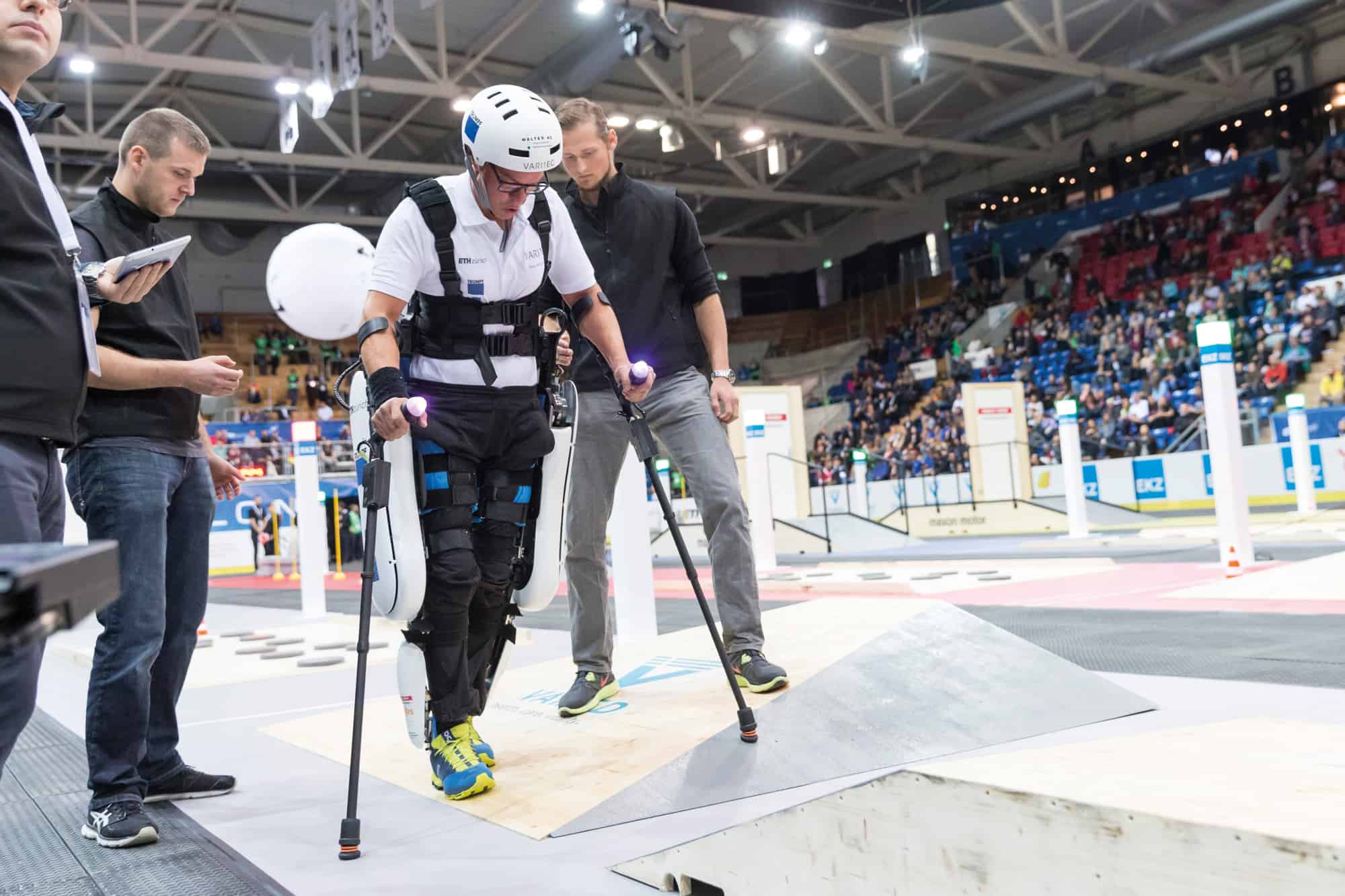
Photo of the VariLeg team from ETH Zurich in the powered exoskeleton race at the Cybathlon in 2016

In robotics, the term “compliance” means flexibility or suppleness. It’s the property that allows able-bodied humans to grasp an egg without crushing it. A non-compliant robot, in contrast, has predetermined positioning and will follow the same path despite any impediment. Compliance allows a variation of positioning and is what the VariLeg team tried to design into their exoskeleton – essentially allowing a user to deal with the ups and downs of uneven ground.

“Human muscle is very complex, but [we] have attempted to imitate it,” says Bartenbach, whose team has essentially integrated a spring into the leg joint so that it is compliant. The knee joint is driven by a variable stiffness actuator (VSA) that can change the stiffness of the knee so that it can adapt to different surfaces. This stiffness is controlled by modulating the tension of the spring, which is currently preset, though staff in Bartenbach’s lab are working on how an exoskeleton user could change the setting at will or even automatically.

VariLeg came fifth out of seven teams in the exoskeleton race, which was eventually won by ReWalk – a German firm that makes commercial exoskeleton systems for people to use at home and in rehabilitation clinics. Mirroring the Formula One analogy, the event not only required technical innovation, but also a skilful driver. “This is not easy to do, especially with the harder obstacles,” says Bartenbach. One of the obstacles in the race was a series of uneven stepping stones, which required a really high mobility, “We do not have [that] at the moment with our system, but maybe will in the future,” adds Bartenbach.

Brain waves

Another assistive technology that featured at the Cybathlon involved brain–computer interfaces (BCI). It’s a new area of research, which involves placing electrodes over the scalp to measure electrical activity in the brain. Known as electro­encephalography (EEG), the technique can turn characteristic signals associated with particular thoughts into commands that let people with para­lysis control a computer or device. In the Cybathlon race, the pilots controlling the BCI were required to move an avatar in a computer game through a series of obstacles using only their thoughts.

According to Matran-Fernandez from Essex’s BrainStormers team, a key part of any BCI design is to identify the distinct brain patterns that could constitute commands. It’s a bespoke effort, which in her case required asking the pilot to think different things many times over and then using a computer algorithm to find any signals that are different enough to be used in the game. “You are trying to find different thinking activities that produce a different pattern on the brain of the person who is going to wear the BCI,” Matran-Fernandez explains.

Photo of David Rose representing the University of Essex's Brainstormers team in the brain-computer interfaces event at the Cybathlon in 2016

The pilot in question was David Rose – a former rugby player who Matran-Fernandez found in an online forum and was keen to be part of the BrainStormers team. Once Rose had been tested, Matran-Fernandez and her colleagues came up with four usefully distinct thoughts from him: three to move the avatar in different ways and one for it to stay put. The thoughts they ended up using were: moving your right hand; moving your feet; thinking of a telephone ringing; and playing a word game in your mind. These all produced identifiable signals that could be differentiated by the BCI as they came from different parts of the brain.

The BrainStormers’ system was set up specifically to work with Rose’s brain and, unfortunately, would need to be reprogrammed if it were used by a different competitor as there are slight variations in everyone’s brain pattern. As Matran-Fernandez explains, when people with long-term paralysis think about moving their limbs, they are no longer used to using them. The brain area in which the signal is observed may therefore have shifted from the specific part of the motor cortex used by able-bodied people to somewhere new.

As with the exoskeleton race, the pilot has a huge role to play in the BCI events too. “If you start ­tensing the muscles in your neck the signal [this creates] is much bigger than what you get from the BCI and that will mess up the whole system,” says Matran-Fernandez. Luckily Rose was an experienced competitor and the BrainStormers bagged a bronze medal.

The future starts here

Key to the success of the Cybathlon was that it allowed different technologies to be directly compared and observed in a race. As Faisal points out, researchers working on assistive technology usually do things in isolation and rarely compare themselves against each other. “Everyone does their own thing and never benchmarks themselves against the competition,” he says. “Here we had a level playing field and could objectively see how good the different approaches are.”

Everyone does their own thing and never benchmarks themselves against the competition. Here we had a level playing field and could objectively see how good the different approaches are

Aldo Faisal, Imperial College London

The Cybathlon also allowed people to assess the maturity of each discipline – to see what is and is not possible – and revealed where people have misconceptions. “For example, BCIs just don’t work particularly well and give the impression you can read people’s minds,” Faisal says, “[but] we are very far away from that.”

Even for arm prostheses, which have been commercially available for more than 50 years, there are still challenges for what is a mature technology. The team that won the powered-arm prostheses race in Zurich, for example, used relatively old technology based on the movement of shoulder muscles to open and close a claw hand. “In real life, we know that 30% of bionic prosthetics are abandoned within six months of first use,” Faisal points out, with users finding that the devices either don’t work well, are uncomfortable or aren’t easy to use, meaning that the challenge is to find something that feels more intuitive. “It needs to be seen as part of your body and that requires thinking about the cognitive and psychological aspects of the design,” Faisal says.

As for exoskeleton technology, it is accelerating rapidly in terms of the number of scientific publications as well as companies, more than 50 of which were listed on the exoskeleton.com website in 2015. Researchers at ETH Zurich, for example, have set up a firm called MyoSwiss to develop wearable muscle supports to improve the mobility of people with weak muscles. Bartenbach, who is not part of the firm, says that while it’ll be at least a decade before paraplegics can throw away their wheelchairs, it’s likely they’ll find themselves using an exoskeleton in certain situations, such as getting out of a chair. “An exoskeleton won’t heal your injury, but it can help your body remain active. The task now is to make current devices faster, lighter and cheaper.”

An exoskeleton won’t heal your injury, but it can help your body remain active. The task now is to make current devices faster, lighter and cheaper

Volker Bartenbach, ETH Zurich

Matran-Fernandez, however, is not as optimistic about the future for BCI. Current communications technology allows the user to spell two or three words a minute, “which is really slow for a person who can type or speak” she says, and it is impossible to combine the technology with movement. “No system is going to be able to filter out the [electrical signal] noise that you create by moving,” she adds.

One area where BCIs are actively being pursued is for people suffering from “locked-in syndrome” – when they have awareness but are completely paralysed and sometimes cannot even move their eyes. In 2017 researchers from the University of Utrecht in the Netherlands implanted a BCI in a locked-in patient who was suffering from motor-neurone disease. The electrode was positioned over their brain’s motor cortex, connected to a transmitter implanted in the chest. When thinking about moving their hand, the patient was able to control a typing programme, at a speed of two letters a minute.

With so many promising research avenues, another Cybathlon in Zurich is already being planned for May 2020, with organizers envisioning a longer, two-day competition next time around. “We have space for 96 teams, which will be around 30 teams more than in 2016,” says Sigrist. And while the disciplines will stay the same, co-director Wyss promises extra challenges for teams in some disciplines. Smaller, satellite events in separate disciplines are also planned before the main event, hosted by universities across Europe, including one in Graz, Austria, next year.

Veterans of the 2016 Cybathlon are now planning their strategies for the 2020 rematch and eyeing up yet further innovations. Matran-Fernandez, for example, is trying to persuade her colleagues to create a new team to take part in Zurich and also to develop a practical BCI system. And that’s the key. If the Cybathlon can speed up the development of assistive technologies, it will have shown the value and rewards of research – and benefit people in everyday life.
Gamma-ray pulses could be created using laser-plasma accelerators

A new way of creating femtosecond, quasi-monoenergetic gamma-ray pulses has been proposed by Serge Kalmykov at the University of Nebraska-Lincoln and colleagues.  Their scheme involves using a stack of lasers to create pulses of electrons, which then produce gamma rays through Thomson scattering. Laser-driven gamma-ray sources could have a wide range of applications including nuclear forensics and radiation physics.

When a relativistic electron collides with a near-infrared photon, some of the electron’s kinetic energy can be imparted to the photon via Thomson scattering. For a 900 MeV electron colliding head-on with a 1.5 eV near-infrared photon, for example,  the photon is converted to a 19 MeV gamma ray.

Compact, low-cost solution

As a result, pulses of gamma rays can be created by firing electron pulses at pulses of near-infrared laser light. Gamma-ray pulses lasting just a few picoseconds have already been made using electrons from conventional accelerators. However, these accelerators are large and expensive and, because of their design, cannot create pulses of sub-picosecond duration

Writing in the New Journal of Physics Kalmykov and colleagues point out that laser-plasma accelerators (LPAs) can create sub-picosecond (femtosecond) pulses of electrons, and therefore offer a way of making ultrashort gamma-ray pulses. LPAs involve firing ultrashort, intense laser pulses at a plasma cavity, accelerating electrons to energies normally associated with conventional particle accelerators.

While LPAs offer a way forward, the physicists point out that there are challenges that must first be overcome.  In the Thomson scattering process, the electrons are much more energetic than the gamma-ray photons they produce. Therefore, the energy spectrum of the gamma rays is highly sensitive to the energy profile of the electron pulses. This is a problem because the electron pulses produced by LPAs tend to develop a broad range of energies as they travel through the plasma cavity. This results in gamma-ray pulses with broad energy distributions – something that is incompatible for practical applications. Another important challenge is that the lasers of today are simply not capable of delivering the power required to create a practical gamma-ray source.

Stack of lasers

Using simulations, Kalmykov and his colleagues have shown that these problems can be solved by using a stack of several different pulse lasers – each generating light at different wavelengths with modest energy outputs of about a joule per pulse. The research suggests that having tight control over the time delay, frequency difference, and energy ratio of each individual laser as it fires into the cavity, the system can produce focused gamma-ray pulses with a narrow spectrum of photon energies.

If such a system could be built, it would allow for applications including nuclear forensics, which require monoenergetic gamma radiation to investigate the atomic constituents of samples. It could also be useful for use in radiation physics, which is concerned with the interactions between radiation and matter.

PTW BEAMSCAN

BEAMSCAN™ is the world’s first all-in-one water phantom featuring wireless auto set-up and operation.

BEAMSCAN™ reduces manual interaction to the touch or click of a single button. Its innovative “Wireless Auto Setup”, which includes a unique patented three-point auto levelling function, uses advanced mathematical algorithms and computations rather than semi-automatic tools which require no screws, no tank shifts and no manual adjustments. An intuitive “Auto Setup Wizard”, which is easily accessed from a smart device or PC guides users step by step through the entire set-up process.

Hybrid gamma camera enhances intraoperative imaging

Use of a gamma camera to image sentinel lymph nodes during cancer surgery can help the surgeon assess the extent of cancer spread, and could help reduce mortality rates. Portable gamma camera systems for this application are already commercially available, but one key challenge of this approach is determining the exact spatial location of the recorded signal.

Speaking at the recent MediSens conference in London, John Lees from the University of Leicester described how combining gamma and optical imaging could solve this localization problem. “We can use hybrid gamma and optical imaging to improve diagnosis,” he explained. “The idea is to take a small camera into the operating theatre and help improve treatment outcomes for patients.”

Lees and colleagues have created a handheld hybrid gamma camera (HGC) based upon a high-resolution CCD chip coated with a columnar caesium iodide scintillator, located behind a pinhole collimator. The columns in the scintillator act as light pipes, channelling the light onto the CCD and maintaining a high spatial resolution. The device integrates an optical camera aligned to provide the same field-of-view.

The team tested the HGC using a hot-spot phantom filled with radioactive solution, and observed that the camera could resolve features as small as 1 mm. They also determined that the sensitivity was good enough: “We could detect down to 25 kBq in about one minute,” said Lees.

Lees described a contrast-to-noise ratio (CNR) analysis performed on a head-and-neck phantom, using cameras with 0.5 and 1 mm pinhole collimators. After imaging for just 10 s, the HGC could identify inserts with 0.1 and 0.2 MBq activity, at the parotic gland level, and 0.5 and 1.0 MBq signals at the submandibular level. In another example, imaging a thyroid phantom filled with 99mTc demonstrated that the HCG could visualize the thyroid after just 200 s, with greater detail appearing as scan time increased.

Clinical transition

The next step involves testing the HGC in the clinic. “Last year, we got ethical approval to undertake a clinical evaluation of the camera with patient volunteers,” Lees explained.

The team has already demonstrated that the HCG can perform combined optical/gamma imaging of the thyroid gland in patients. “We’ve got sensitivity, portability and spatial resolution,” said Lees.

He also presented a recent lymphoscintigraphy image in which the HGC clearly visualized the lymph nodes.

Lees also shared an image from a lacrimal drainage study. A couple of hours after administering 1 MBq of the radiopharmaceutical 99mTc DTPA, the hybrid image (using a 5 min acquisition at 7 cm from the patient) clearly showed the path of lacrimal drainage.

“We are also looking at preclinical imaging and pushing our camera to higher resolution,” said Lees. With this aim, the researchers have demonstrated that the HGC can image radiopharmaceutical in a mouse, with a 5-minute acquisition at a distance of 12.5 cm. He noted that the image quality was comparable to that recorded by the U-SPECT preclinical imaging system.

The next steps

Looking further ahead, one potential evolution of the hybrid camera could be to combine radionuclide imaging with near-infrared (NIR) fluorescence imaging, using an integrated gamma/NIR camera. “There is a lot of interest in taking a radiolabelled tracer and combining it with a fluorescent tracer,” said Lees. Such an approach could be employed in both preclinical or surgical applications.

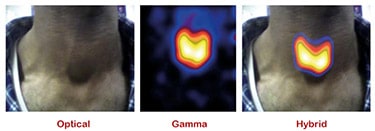
He presented images of a four-hole phantom recorded using optical, gamma, hybrid optical/gamma and NIR fluorescence. Combining all three modalities should provide exceptionally good spatial resolution. He also showed the first examples of in vivo radio-NIR fluorescent imaging in a mouse.

Finally, Lees described the use of two cameras to perform depth estimation. He presented an image of a breast phantom containing two radioactive 99mTc sources. The positions of the sources were apparent, but a single image could not provide information as to their depths. By using two cameras, and taking a sequence of optical and gamma images, it was possible to estimate the depth of the two sources. “We believe that we can also do this inside the body,” he noted.

Lees was asked by an audience member as to the possibility of adding another modality, such as ultrasound, to the camera. “Ideally, I would like to combine optical, gamma, NIR and ultrasound,” he responded. “But the technology needed to combine them is not straightforward.”

Marine sprawl could harm ecosystems

You’ve heard of “urban sprawl” but have you heard of “marine sprawl”? From oil platforms to ports, and offshore wind turbines to sea-walls, the world’s coastal environment is becoming cluttered with man-made infrastructure. New research suggests that marine sprawl may have serious ecological and economic consequences.

Globally, harbour space is growing at 3.7% per year, and offshore wind energy is expanding by nearly 30% per year. From an underwater perspective a plethora of new surfaces is appearing in shallow marine environments. For some species this represents a vast increase in comfortable new homes. For example, recent research has shown that the increase in gas platforms in the Adriatic Sea over the last 50 years has led to a massive rise in moon jellyfish numbers, whose larvae like to situate themselves on overhanging surfaces. But how is this marine sprawl affecting marine ecosystems as a whole?

Mariana Mayer-Pinto from the University of New South Wales, Australia, and her colleagues have assessed the wider impacts of marine sprawl by measuring aspects of ecosystem health such as productivity and filtration rates in one of the largest urbanised estuaries in the world: Sydney Harbour. At 9 different locations, including both natural and man-made habitats, the scientists photographed and collected all organisms within a 10 cm-quadrant. They also measured the filtration rate of oysters in 12 locations, and scraped clean a surface and returned six months later to see how quickly it was recolonised.

In total the team sampled a staggering 16,361 specimens from 112 taxa, discovering significant differences in the structure of intertidal ecosystems in natural and artificial habitats. Natural rocky shores were far more biodiverse, with 26 taxa – approximately one-third of the total found there – unique to the habitat. In particular, the researchers found that rocky shores have 40% more grazers than seawalls, and 70% more grazers than pilings.

Meanwhile, scavengers were around eight times more prolific on seawalls, compared to pilings or rocky habitats, and algae were more diverse on seawalls and rocky shores than on pilings. Oysters were more abundant on pilings than rocky shores, but they were also smaller, perhaps due to regular cleaning of the artificial structures preventing oysters from growing to full size. Surprisingly, filtration rates were similar for oysters in either habitat.

The decrease in diversity observed on manmade habitats supports previous findings, and confirms that manmade habitats alter the balance of ecosystems. “Because these structures tend to be readily colonised by a range of animals and algae, people believe they are surrogates of the natural habitats,” said Mayer-Pinto. “Previous work has shown that they can increase the number of invasive species, which in turn may have serious ecological and economic consequences.”

In addition, the infrastructure itself often displaces a valuable soft-sediment habitat. “These soft-sediment habitats, although often overlooked, provide important services such as nutrient cycling, clean water and carbon storage,” said Mayer-Pinto.

Much more work remains to be done to fully understand the impact of marine sprawl, but it’s clear that marine infrastructure is altering the balance of ecosystems, and that this may have negative consequences.

Mayer-Pinto and colleagues published their results in Environmental Research Letters (ERL) .


‘Nanowood’ makes a super thermal insulator

A new material dubbed nanowood made from aligned nanocellulose fibres could be used to thermally insulate buildings – both residential and commercial – to make them more energy efficient. The material, which is also lightweight and mechanically strong, is easy to fabricate using a simple chemical treatment. It contains naturally aligned cellulose nanofibrils, which makes it anisotropic – that is, it conducts heat more efficiently along the direction of the fibres, which reduces local heat build-up in the structure.

“Our wood-based material boasts a desirable mix of super thermal insulation, good mechanical strength, low mass density and cost-effectiveness,” explains team leader Liangbing Hu of the University of Maryland in the US. “Such a combination has never been realized before.”

The researchers made their nanowood using a chemical process to remove inter-lignin and hemicellulose to preserve only the cellulose component of their wood sample. The lignin removal step is compatible with processes used in the paper-making industry, stresses Hu, which means that it could easily be adapted to existing industry infrastructures.

Naturally anisotropic

Since it is derived from wood (which has a naturally anisotropic structure), the nanowood is anisotropic too. The nanocellulose fibrils in the material line up in one direction during the chemical treatment, allowing heat to travel more efficiently along the nanofibril direction. Indeed, Hu and colleagues measured a thermal conductivity of 0.03 W/mK in the transverse direction (perpendicular to the nanofibrils) and a roughly two times higher thermal conductivity of 0.06 W/mk in the axial direction. This prevents local overheating from accumulated thermal energy, something that is not possible in isotropic thermal insulators, say the researchers.

The mechanical strength of the nanowood is 50 times higher than cellulose foam and more than 30 times higher than the most commonly employed thermal insulation materials, such as silica and polymer aerogels, Styrofoam and wool. This high strength comes thanks to effective bonding between the aligned cellulose nanofibrils, which have a compressive strength of 13 MPa in the axial direction and 20 MPa in the transverse direction at 75% strain.

Towards commercialization

It is also very light, with an overall mass density as low as 0.13 g/cm3, says Hu, and is breathable, which means that it can be used indoors.

“Finally, the nanowood can effectively reject solar thermal energy (it reflects 95% of all solar spectrum wavelengths),” he tells nanotechweb.org.

As well as being used to thermally insulate buildings, it might also find use in a variety of other heat management contexts, such as in electrical, optical and space applications in which heat transfer and waste heat transfer needs to be tightly regulated, he adds.

The researchers, reporting their work in Science Advances DOI: 10.1126/sciadv.aar3724, say that a UMD spinoff company, Inventwood LLC, is now commercializing the technology.

How did complex carbon-based nanostructures form in space?

How did complex carbon-based compounds form in in the Universe, and in particular in our galaxy? New experiments that retrace the synthesis of polycyclic aromatic hydrocarbons (PAHs), such as pyrene, could help answer this question. The work could also help explain how more complex PAHs, and eventually 2D graphene-type structures formed from pyrene thanks to molecular mass growth.

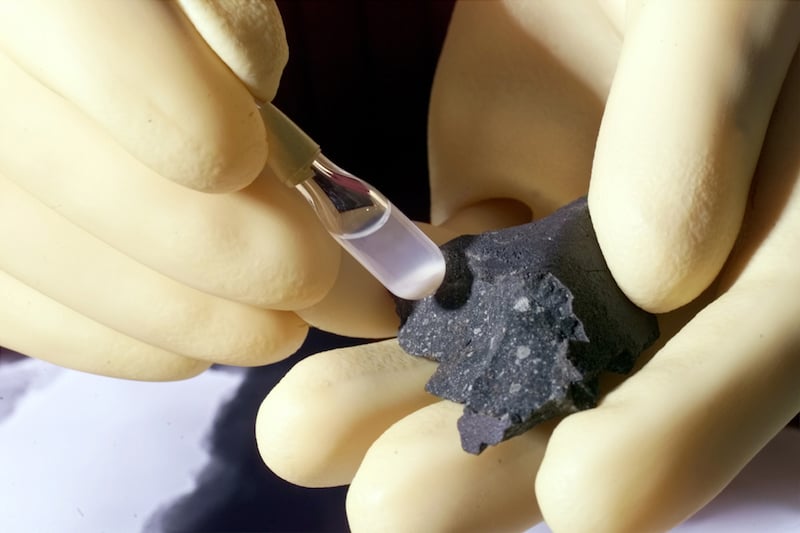
PAHs (which are organic molecules comprising fused benzene rings) along with alkylated (methyl, ethyl), ionized, (de)hydrogenated and protonated counterparts may make up 20% of all the carbon in our galaxy. PAHs have been detected in some carbonaceous meteorites such as Allende and Murchison, which suggests that they come from deep space. Thanks to carbon-13/carbon-12 and deuterium/hydrogen isotopic analyses, researchers believe that molecular mass growth processes allow higher molecular weight PAHs to form from lower-weight ones. The main astrochemical reactions at play here might be similar to those occurring in combustion processes in vehicle engines and in the formation of soot particles.

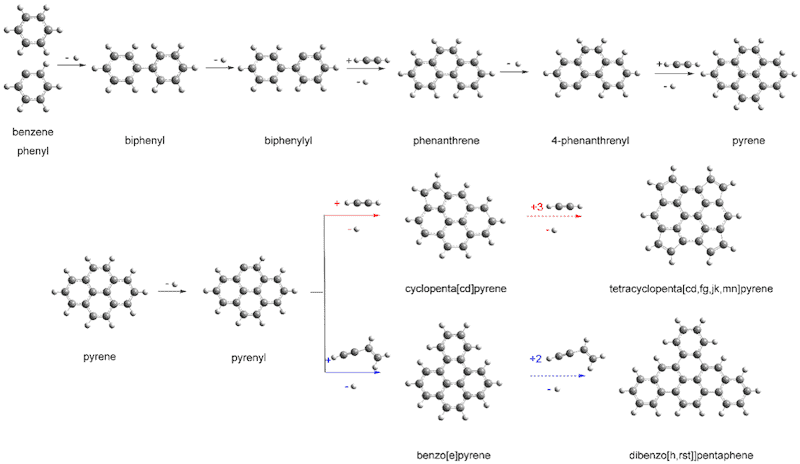
To find out how PAHs develop in space, researchers led by Alexander Mebel at Florida International University and Ralf Kaiser of the University of Hawaii, synthesized these molecules by building them up one ring at a time. They studied the chemical reactions that begin when a complex hydrocarbon, the 4-phenanthrenyl radical (which has a molecular structure that includes a sequence of three rings and contains 14 carbon atoms and nine hydrogen atoms) combines with acetylene (which has two carbon atoms and two hydrogen atoms).

Sample of the Murchison meteorite

Intermediate reaction steps

The researchers performed their experiments at the Advanced Light Source (ALS) at the Berkeley Laboratory. They injected the gas mixture into a microreactor and heated the sample to temperatures as high as those that exist around stars. They then focused a VUV light beam from the ALS synchrotron onto the heated gas mixture to ionize the molecules in the sample.

The team then proceeded to analyse the chemical reactions taking place using a detector that measures the different arrival time of particles created after ionization. These times reveal the signature of the parent molecules and, together with theory calculations, allow the researchers to determine the intermediate steps in the reactions.

Towards an understanding of the molecular carbon budget in our galaxy

The experiments indeed show that a four-ringed molecule (pyrene) can be produced from a three-ringed one (phenanthrene). “Large chains of ringed molecules and ultimately 2D graphene-type structures might form via the same processes,” says Kaiser.

How pyrene can form more complex hydrocarbons

This result brings us closer to an understanding of the molecular carbon budget in our galaxy and the fundamental molecular level processes of synthesizing PAHs, say the researchers, reporting their work in Nature Astronomy doi:10.1038/s41550-018-0399-y. “This is how we believe some of the first carbon-based structures evolved in the Universe,” adds Musahid Ahmed of the Berkeley Laboratory. “From 2D graphene you can then get graphite, and the evolution of more complex chemistry begins, he says.

Firm power parity metric

A paper from Imperial College proposes a new conceptual framework for understanding competition in electricity markets that includes variable input but marginal cost renewables. Noting that one of the primary drivers for consumers to switch from grid-supplied electricity to self-generated electricity (e.g. home rooftop PV with batteries) is cost savings, the researchers constructed a model that forecasts when going-it-alone “grid defection” by consumers may become widespread. In reality, few domestic consumers in the UK are likely to want to go entirely off grid. At least not for some time. Grid links are needed and useful for backup, e.g. for when there has not been enough sunshine for a while and consumers’ batteries are discharged, and also to sell any surplus power they can generate, beyond what they can store. However, the grid defection analysis is still a useful conceptual exercise, not least since it gives us some idea of the cost of balancing/backing up variable renewables. And, in time, some users may want to try the off grid option.

Based on detailed modelling of technology cost curves, the Imperial researchers estimate the year in which three types of consumers switch to on-site power generation that offers similar reliability and lower cost to grid-supplied electricity. But in so doing, instead of just using the normal concept of “grid parity”, the point of economic indifference between the cost of on-site renewable energy (e.g. roof top solar plus backup batteries) and the cost of conventional supply, they use a new concept, firm power parity. Building on the notion of cost equivalence, firm power parity is reached when “on-site renewables deliver the same service at the same cost as conventional electricity supplies”. Firm power is available when “the wind doesn’t blow, or the sun isn’t shining”.

Their results suggest that, “While it will become increasingly profitable for consumers to generate and store their own electricity, profitably disconnecting from the grid is more than a decade away in most markets. For consumers who already enjoy reliable transmission and distribution infrastructure, the cost of replicating grid reliability (even on a single-day basis) will remain significant.” But by 2030 the researchers say that may change so that these technologies will become disruptive to conventional sources, and it’s already the case in some off-grid areas, for example in developing countries, with local mini grids being an option.

There are some limits to the approach: the researchers note that “Our analysis does not yet account for the value obtained from a variable or time of use (TOU) tariff, which would likely act to accelerate the date of firm power parity. Furthermore, it does not incorporate the social costs of greenhouse gas emissions from grid-supplied electricity. To keep things simple, we fixed the price of electricity in each market, keeping it constant in 2017 real money terms throughout the forecast period.”

There are some parallels with the “equivalent firm power” concept proposed by Dieter Helm (see my earlier post), although that is part of a wider set of policy suggestions and it concerns the system level costs, as faced by supply companies and grid managers. For another, much more general, system choice metric, with some social and eco-costs also added, see “Co-production in distributed generation: renewable energy and creating space for fitting infrastructure within landscapes“.

There various new metrics are quite complex and to some extent an engineering approach to identifying the extra system cost is perhaps easier, e.g. the cost of grid balancing can be estimated directly and seems likely to be in the range of 10-15% extra on generation costs. So then you can judge if its worth it to make the change, e.g. at the system level. But that doesn’t give you an insight into the social and eco-costs and benefits. Neither does the approach that Trump tried to get adopted in the US –  it seemed mainly concerned with protecting the conventional energy market and supply system, and coal and nuclear plants particularly.

To that end, energy secretary Rick Perry proposed that the Federal Energy Regulatory Commission (FERC) develop and implement rules that accurately price generation resources necessary to maintain the reliability and resiliency of the US bulk power system. As proposed, the final market rules would allow for the recovery of costs for what the Department of Energy calls “fuel-secure” resources that provide “reliable capacity, resilient generation, frequency and voltage support and on-site fuel inventory”. Eligible units would be required to have a 90-day fuel supply on site in the event of supply disruption. The result would clearly benefit fossil and nuclear.

Energy security and grid balancing are obviously important, but this approach, with renewables seen as introducing extra risks and costs, might be seen as a bit negative, ignoring the climate-change issues and the role that renewables can play in avoiding them:

Fortunately, is was ruled out of order, at least for now. However, what seems a similar view had also emerged in Australia, where wind and solar farms may be forced to meet tougher standards to guarantee reliable energy. The idea emerged in a review of system reliability by chief scientist Alan Finkel, which, among other things, recommended that individual wind and solar farms be responsible for providing “dispatchable” generation via a “generator reliability obligation”, or contracting with other suppliers to meet this requirement.

The idea is being fought by green energy backers, with, according to Renew Economy, the industry “struggling to understand why each new plant would need to add battery storage or strike a deal for ‘firm capacity’ with a neighbouring gas plant”. They argue that “reliability isn’t a function of each individual power station but all of the system”. That’s clear: no one expects each gas, coal, nuclear plant to have its own backup. Grid balancing is best provided at the system level.

Nevertheless, it is reasonable that each generator should pay its share of the cost of this. Fossil plants can also have variable outputs, due to unplanned outages, as can nuclear plants, but the variations with solar and wind are larger. The proposed new Australian system would certainly make this visible, as would that proposed in the USA. In the UK, some of these extra cost are already covered by “use of system” charges and grid development/management costs charged by grid companies, who, typically, are responsible for balancing the system and keeping the lights on. But there are pressures to make renewable generators pay more and similar issues are emerging in the EU in relation to the priority dispatch provisions that renewables enjoy – their output is given priority (see Clean Energy News and Energy Transition.) Clearly, if we want low carbon green power, the priory dispatch approach promotes it, but rivals like nuclear don’t like it, and renewables do require balancing measures, which have to be paid for.

Political battles like this aside, in terms of methodology and easy assessment, by contrast to the defensive approaches being proposed in the USA and Australia, and even now the EU, stressing the costs and risks of renewables, and supporting their rivals, the firm power parity approach is more forward looking, focusing on the process of change, taking balancing costs into account, from the consumers point of view. And certainly, despite its limitations as currently configured, it can provide a rough view of when changes may occur: maybe quite soon. Charles Donovan, director of Imperial’s Centre for Climate Finance, says “The results of our research are exciting as they show we will soon be entering a period where reliable and profitable solar power production by residential energy consumers becomes a reality in relatively cloudy places like London.”

Meanwhile, in terms of the system level requirements, the capacity market provides balancing capacity, with the UK’s latest auctions (T1 for next year, T4 for four years ahead) contracting mostly gas-fired capacity, to be available to meet shortfalls. Coal plants and diesel plants mostly got shunned, but storage and demand management are beginning to make an impact, though it’s still small.

Oddly, however, nuclear plants were included in T4, despite not being able to load follow. They do offer some synchronous frequency support – an issue I explore in my next post.

Wrestling over the best subatomic particle, hitchhiker’s guide to Stephen Hawking, where are the women Brian?


Physicists are usually a staid bunch, but not so in this video from the US’s National High Magnetic Field Laboratory — in which some of the lab’s leading scientists fight their corner for their favourite subatomic particle. After watching the video, you can take part in the “Subatomic Smackdown” by casting your ballot for either the photon, electron, neutron or proton. You have until 30 March to make your vote count.

Yesterday, BBC Radio 4 broadcasted the first episode of The Hitchhiker’s Guide to the Galaxy: Hexagonal Phase, which it describes as the “sixth series of the cult science fiction comedy, based on Eoin Colfer‘s book And Another Thing… with additional unpublished material by Douglas Adams”. As well as having a subtitle that should make condensed-matter physicists laugh out loud, none other than Stephen Hawking plays The Guide Mark II in the radio drama. You can listen to a clip of Hawking’s performance or enjoy episode one (of six) in its entirety.

Finally, yesterday was International Women’s Day so you might have thought that celebrity physicist Brian Cox would have mentioned a few female scientists in his article in The Guardian today about science tourism. But incredibly, no women are mentioned. To add insult to injury, Cox is pictured in front of a radio telescope – and Jocelyn Bell Burnell used a radio telescope (ok, a different one) to observe the first pulsar.

Juno looks deep below Jupiter’s surface

Precise measurements of Jupiter’s gravitational field by NASA’s Juno spacecraft have allowed scientists to make an important connection between surface winds on the planet and motion deep below the surface. The data have also provided new insights into the composition of the core of the giant planet. A separate study by Juno scientists reveals that Jupiter’s north and south poles harbour persistent arrangements of cyclones, an unexpected observation that cannot be explained by current models of the Jovian atmosphere.

In addition to its famous red spot, the surface of Jupiter is covered by alternating light and dark bands that are created by powerful winds. Scientists believe that these bands are driven by energy welling up from the interior via convective cells. But despite calculations and simulations, scientists know very little about how this process occurs in the dense fluid of hydrogen and helium that makes up Jupiter’s interior.

Now in three papers published in Nature, Juno scientists have peered deep into the planet by analysing data derived from precise measurements of its gravitational field.

Doppler shift

In one paper, Luciano Iess and colleagues describe how they mapped Jupiter’s gravitational field by determining the acceleration of Juno as it orbited the planet. This was done by measuring the Doppler shift of the radio waves that the spacecraft sends back to Earth. These data revealed a surprising feature – that Jupiter’s gravitational field is not north-south symmetric about the planet’s equator. This is unexpected for a rapidly-rotating gas giant and is evidence of strong flows within the atmosphere and interior of Jupiter.

Another paper, written by Yohai Kaspi and colleagues, analyses the north-south asymmetry and shows that it is related to a north-south asymmetry of wind speed in the bands visible on the surface. This is strong evidence that the wind bands are not just a surface phenomenon and Kaspi and colleagues calculate that they persist to about 3000::km below the surface. This is about 5% of the distance to the centre of the planet, which means that about 1% of the mass of Jupiter is involved in these winds.

This interpretation of the gravity data is backed up by a third paper, which is by Tristan Guillot and colleagues. This group looked at the symmetrical component of the gravitational field and concluded that, below 3000 km, the Jovian interior rotates like a solid object – despite being a fluid. This supports the idea that the huge pressures inside Jupiter (about 100,000 atmospheres) ionizes hydrogen creating free protons and electrons. The presence of these charged particles is expected to create strong drag forces that suppress flow.

Image of Jupiter's polar cyclones

In a fourth paper in Nature, Alberto Adriani and colleagues used visible and infrared observations to show that the planet’s polar regions harbour regular patterns of cyclones that are remarkably persistent. The north pole is home to eight cyclones that circle a ninth cyclone that sits over the pole. The cyclones are all about 4000-4600 km in diameter and their positions and shapes remained more or less the same over hundreds of days of observation. In contrast, the south pole has five cyclones circling a central cyclone. These objects have larger diameters (5600-7000 km) and are also persistent. This is unlike the polar regions of Saturn, which contain one central cyclone.

The team says that fluid dynamics theory is unable to explain two important aspects of the polar patterns: that the cyclones and the patterns they make do not change appreciable over time, and that the cyclones do not appear to interact with each other.

Copyright © 2026 by IOP Publishing Ltd and individual contributors