Tales from a British physicist in Japan

“Dear Christoph and …” – my fingers paused on the keyboard. I was typing an e-mail to my graduate student and our German research collaborator. Despite this being a rather mundane, everyday task, it was causing me a headache. Like myself, Christoph was a member of his university’s faculty. Since academics typically use casual forms of address, I had called him by his first name for many years. My student’s name was Keitaro Jin, but I had never once called him “Keitaro”. Instead, I followed the Japanese norm of using his family name plus the suffix “-san”. Roughly speaking, “Jin-san” translates to “Mr Jin”. But addressing the e-mail to “Dear Christoph and Jin-san” would look equally bizarre in both cultures. It was a strange conundrum, but a rather typical one as a physicist working in Japan.

I had first visited Japan in 2009, spending four months at the National Astronomical Observatory of Japan (NAOJ) in Tokyo on a short-term postdoctoral fellowship funded by the Japan Society for the Promotion of Science (JSPS). I had loved my stay, and asked my adviser at the end of my visit about the possibility of returning. “You can come back to Japan,” I was told. “But only for a postdoctoral position, not for a faculty job.” The issue was that Japanese universities taught in the native language. Supporting a faculty member who could not speak fluent Japanese was therefore an impractical burden for most departments. However, at the start of 2011, I received an invitation from Hokkaido University to apply for a newly opened assistant professor position. It was a positive discrimination appointment, which favoured both female and foreign applicants. This change in protocol was due to a government initiative, and driven by necessity. In 2009 Nature published an article (460 151) declaring that Japan was at a “tipping point”. With a decreasing workforce and dropping science uptake at university, Japan had to either tap into its underused resource of female and international researchers, or tumble from the top ranks of nations involved in scientific research. This situation led to a spurt of government-supported programmes to recruit from these two pools, and offer more courses at university level taught in English. Despite these efforts, the same warning was repeated in the 2017 Nature Index, reflecting that Japan still has further to go.

In truth, nobody likes positive discrimination appointments. There is a concern (heightened by the ever-present imposter syndrome) that those who take such a position will be seen as weaker than their contemporaries, due to being selected from a reduced pool of applicants. However, one year after taking up my position at Hokkaido University, I was in no doubt about the importance of such schemes.

One of my first graduate students was initially so nervous about his English, he used an auto-translator to compose e-mails to me. Once he realized I cared nothing about broken grammar, and that a combination of charades and white-board Pictionary was an amazing way to communicate science, he relaxed. Two years later, he opted to present and write his Master’s thesis in English; a venture so successful he won the department award for best graduate presentation. Another of my students concluded his degree by engaging in a deep debate with me about the differences between American and British spelling (the point where I had to reach for a dictionary was when I decided my job was done). And a female graduate student in our group told me she would never have tried to become an astronomer if she had not met me. It was an emotional moment.

Of course, I could have supervised students anywhere in the world, and I hope I would have made a positive impact on their careers. But being in Japan gave my skillset a boost: I was able to offer expertise that was not shared by all my colleagues and, sometimes, I simply represent a choice that not all students had considered.

Not everything was smooth sailing. In addition to amusing conundrums regarding the culturally correct way to address someone via e-mail, I found that language and cultural misunderstandings occasionally resulted in more serious issues. The textbooks for my course were not ordered until a month after I started teaching. The required syllabus was never clearly described, nor the expected knowledge of the students. In the end, I started with a maths test of successively harder questions and waited for the students to turn green (to my first set of students, I can only apologise).

Cultural differences also meant that I was frequently teaching on Christmas Day, and I once had to rearrange accommodation options for an international meeting after I realized it was assumed invited senior researchers would be happy sharing rooms of four (shared sleeping can be common in Japanese hotels). There was also a more serious incident when a misunderstanding concerning a research grant resulted in me having to inform my two newly hired postdoctoral researchers that I could only fund them for 18 months, not three years. That was the closest I ever came to quitting.

However, support for international faculty has noticeably improved over the six years I have lived in Japan. Hokkaido University created a dedicated support office for its international science researchers, which solved all my serious problems. There is slightly newer but similar support at the Institute of Space and Astronautical Science at the Japan Aerospace Exploration Agency in Tokyo, where I moved last year.

That I have moved here and stayed is testimony to the fact I find the advantages of Japan far in excess of the troubles, although it notably helps to have a slightly devil-may-care outlook! While Japan may still be struggling to find its place on today’s global stage, the fact it belongs there is unequivocally reflected in the nine Japanese physicists who have been awarded a Nobel prize since 2000, not to mention the others in chemistry and medicine. To be part of this country’s future is undoubtedly an incredible opportunity.

Children in developing countries can benefit from proton therapy

Children with cancer are arguably set to benefit most from proton therapy as the number of clinics worldwide continues to grow. Steep dose gradients enable superior sparing of healthy tissue compared to photons, reducing the lifetime risk of radiation-induced cancer and increasing survival.

The majority of paediatric patients, however, do not have access proton therapy. Aside from a handful of centres in China and Russia, no low- to middle-income countries have operational proton clinics.

“Eighty per cent of children live in developing countries and they’re not receiving the most effective and safe radiotherapy possible,” says Phillip Taddei, a medical physicist at the University of Washington in Seattle. “We need to change that.”

An American-Lebanese collaboration led by Taddei has compared the projected lifetime risk of radiation-induced cancer at specific anatomical sites and mortality in paediatric medulloblastoma patients receiving proton or photon therapy. The researchers estimate that more than 1000 lives could be saved annually with global access to proton therapy (Biomed. Phys. Eng. Express 4 025029).

The in silico clinical trial is part of a larger effort by the collaboration to demonstrate measurable differences in outcomes for children receiving proton therapy instead of photon-based treatments. Supported by a Fogarty International Center award, Taddei worked on the study while based at the University of Texas MD Anderson Cancer Center in Houston and the American University of Beirut Medical Center.

Lower the risks

The collaboration compared the risks from proton and photon therapy in five girls and four boys aged two to 14, preparing proton and photon plans for each child. Each had already received proton therapy in Houston.

Craniospinal irradiation (CSI) proton plans using passive-scattering spread-out beams were prepared according to protocols at MD Anderson. Photon plans were prepared using conventional 3D conformal radiotherapy according to routine practise at the American University of Beirut.

Treatment planning systems at each centre calculated the mean equivalent dose received by each organ and tissue types at risk of radiogenic cancer, such as the lungs and breast tissue. Out-of-field dose contributions were calculated using separate models.

The researchers used the doses to estimate the lifetime attributable risk of secondary cancer for each anatomical site and the associated mortality. The site-specific risks of solid tumours were calculated with a linear no-threshold model. The total lifetime risk was calculated by summing the risks over all sites.

Rather than examine absolute risks, the collaboration calculated ratios of the risks due to proton therapy compared to photon therapy. As relative measures, the ratios are subject to significantly lower uncertainty.


Reducing risk with proton therapy

Absolute risks of radiogenic cancer incidence and death were revealed to be high for both treatment modalities, but substantial reductions were demonstrated using protons. The overall risk of secondary cancer was reduced by 44%, while mortality was reduced by 36%.

“In particular, we found for fatal site-specific secondary cancers, that proton therapy was most advantageous for reducing subsequent lung, colon and breast cancer,” said Taddei. Overall, the authors estimate that roughly 1010 deaths each year and 48,000 deaths over thirty years could be prevented if children in developing countries had access to proton therapy.

In a separate study still in progress, the collaboration is assessing the benefits of proton therapy in children with intra-cranial brain tumours. Further studies of other paediatric tumours routinely treated with radiotherapy are planned.

Centralized centres

Looking ahead, the authors identify regional, centralized proton clinics with large, international population catchments as the most promising way to reduce the risks for paediatric patients in low- to middle-income countries.

Obstacles such as up-front cost, infrastructure, training and international cooperation are significant, but surmountable, according to Taddei. Philanthropy, for example, is already being used to fund new facilities at the American University of Beirut.

“In the developing countries of the Middle East, centralized care is [also] already a reality,” Taddei told medicalphysicsweb. The Children’s Cancer Centre of Lebanon in Beirut, for instance, already treats children from Syria and Iraq with photon-based radiotherapy without charge to the families.

Japan’s SuperKEKB set for first particle collisions

First collisions at an upgrade to one of Japan’s premier particle-physics experiments are set to begin in April 2018. Following six years of work, the SuperKEKB accelerator will start smashing its first electrons and positrons together, heralding a new era of particle physics at the KEK particle-physics lab in Tsukuba.

SuperKEKB is a ¥29bn ($370m) upgrade of the 3 km circumference KEKB collider, which consists of two circular accelerators – one carrying electrons and the other positrons. KEKB was shut down in 2011 for construction to start on SuperKEKB, which involved upgrading the beampipes to allow SuperKEKB to produce electrons with an energy of 7 GeV, while the positron beam has an energy of 4 GeV.

The current of the electron ring has also been ramped up from 1.2 A to 2.6 A, with the positron ring boosted from 1.6 A to 3.6 A. This will increase the number of collision events by a factor of 40 over KEKB. The beam “spot” will be just 50 nm high at the collision point.

More B mesons

The upgraded accelerator is designed to pump out far more B mesons than ever before. It will also create other particles such as D mesons and tau leptons that could shed further light on why the universe contains more matter than antimatter.

The original KEKB facility included a detector called Belle that allowed physicists to study the remnants of the particle collisions. It has also been upgraded, and the renamed Belle-II can handle the huge increase in the collision rate and survive the radiation damage caused by the increased particle flux. Key to this design is the inner vertex detector, which has four layers of conventional silicon strips as well as two layers of pixel detectors made from a depleted P-channel field effect transistor (DEPFET). This material, it is hoped, should make the detector better at pinpointing where particles decay.

Unprecedented sensitivity

“Belle II is a unique universal spectrometer with full capabilities for detecting charged particles, photons and neutrinos with high efficiency,” Belle II’s Thomas Browder at the University of Hawaii told Physics World. “This will allow unprecedented sensitivity to the full range of new physics in the ‘flavour sector’”.

Collisions will run for six months to refine the accelerator and detector. The vertex detector will be installed in Belle II by January 2019, with the full physics programme starting a month after that.

Foetal movements crucial to skeletal development

For the first time, researchers have measured the mechanical stresses and strains brought about by foetal movements during the second half of gestation, using computational modelling based on MRI scans acquired in utero. This exciting work, performed in collaboration between Imperial College London, Kings College, UCL and Great Ormond Street Hospital, quantified foetal kick and muscle forces to show that stress and strain increased consistently until term (J. R. Soc. Interface doi: 10.1098/rsif.2017.0593). This is important, since changes in or lack of foetal movement late in pregnancy can be indicative of poor outcomes. This research fills in a gap of knowledge regarding the link between skeletal biomechanics and malformations.

Foetal movements such as kicking are thought to be important for healthy musculoskeletal development, with the stresses and strains (deformations) of the bones providing the relevant stimulation. The absence of movement, or little movement in the later stages of pregnancy has been linked to thin bones, and spinal and joint abnormalities, such as developmental dysplasia of the hip (DDH), for example. While previous studies have recognised the importance of foetal movement, tracking these changes and quantifying them within the uterus has never been performed before.

Imaging and modelling

Cine-MRI is typically used in cardiac motion studies to visualize the biomechanics and movement of fluid in the heart. Fast, dynamic movement can be measured by acquiring lots of images very quickly across time (such as a heart beating or, in this case, a foetus kicking). For this study, researchers chose four subsets of five MR scans at 20, 25, 30 and 35 weeks of gestation to track the movements of individual foetal joints.

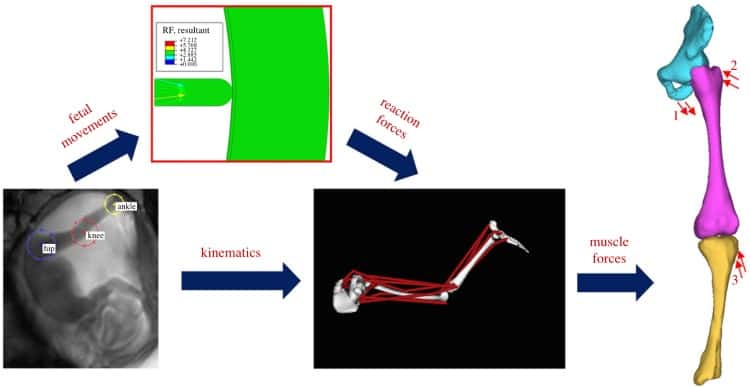
The researchers calculated foetal kick force by simulating a mechanical uterus environment and then inputting the observed kick displacements from the cine-MRI data. Next, they combined these predicted reaction forces with the cine-MRI tracking in order to predict forces for 19 muscles. Finally, they used post-mortem MRI scans (from a separate cohort) to create a stress/strain model. The forces calculated previously were used to quantify the amount of stress and strain in foetal lower limbs.

The computational pipeline developed for this study

Pumped up kicks

The researchers found that uterine wall displacement was unchanged between 20–30 weeks, but dropped at 35 weeks. However, this did not result in a reduced stress or strain, possibly because later in gestation higher muscle forces are expected (due to the larger foetus and cramped position when kicking). Foetal kick force steadily increased, showing a similar drop at 35 weeks.

Maximum stress was observed in the femur shaft and tibia, and at joint surfaces. Since the stresses occurred at the interface between mineralized and unmineralized regions, the researchers suggested that mechanical stress is linked to new bone tissue formation (ossification). Maximum levels of strain occurred near the joints, indicating a role for joint shaping (joint morphogenesis). Both stress and strain increased from 20 to 35 weeks in all regions.

Stresses in the foetal skeleton increased steadily throughout gestation, and hence the authors suggested that movement restrictions, even at the later stages of pregnancy, may have an impact on normal musculoskeletal development. This may result in different biomechanical stimulation, and possibly deleterious implications for severely pre-term babies.

This work provides a unique glimpse into the development of a foetus’ skeleton, combining imaging and modelling to provide grounded estimates of the mechanical forces produced in utero. Insights from this work will further research on foetal biomechanical development and skeletal malformations.

Wood-based ‘supermaterial’ is stronger and tougher than steel

It is stronger than steel, capable of deflecting bullets and lighter than metal alloys – yet this new “supermaterial” is made mostly from wood. The material was created by Liangbing Hu at the University of Maryland Energy Research Center and colleagues, who have developed a new way of treating and compressing wood.

When choosing materials, architects and engineers are often faced with a trade-off. Steel and metal alloys are exceptionally strong, but they are also heavy, and their manufacturing processes have negative environmental impacts. Alternatives include plastic-based substances, but these have complex manufacturing processes that currently make them expensive. For millennia, cheap and abundant wood was the material of choice, but its mechanical properties are no longer seen as appropriate for many modern uses. But now, Hu’s team has come up with a way of building on the unique properties of this common material.

Cellular collapse

In their natural form, wood cells are kept rigid due to polymers known as lignin and hemicellulose, interspersed with nanofibres of cellulose. Wood also contains systems of narrow tubes known as lumina, which run along its growth direction. To transform this structure into a more useful material, Hu’s team first treat samples of wood with a salt solution, which removes most of the lignin and hemicellulose, making the cell walls porous and less rigid. Afterwards, the researchers hot-press the wood at 100 °C, causing the cell walls and the lumina to collapse. This reduces the wood to just 20% of its original thickness.

The compressed substance contains densely-packed wood cells aligned along the growth direction, which results in a strongly-aligned system of cellulose nanofibres. These fibres have hydrogen and oxide groups in their molecular structures, giving rise to strong hydrogen-bond interactions between them. The density of the new material is about three times higher than that of untreated wood.

No trade-off

Once they had perfected the conversion process, Hu’s team set about testing the properties of their new substance. In most structural materials there is a trade-off between tensile strength (resistance to breaking while being stretched) and toughness (how much energy a material can absorb without shattering) – but the researchers saw improvements in both properties in their new material. Its tensile strength is 11.5 times higher than that of natural wood, making it much stronger than common plastics such as nylon and polystyrene. However, the toughness of the new material is also boosted – it is 8.3 times higher than natural wood, making it tougher than most metal alloys.

Overall, Hu’s team have created a material that offers a low-cost, high-performance, lightweight alternative to current construction materials. Their discovery could soon be used in a variety of fascinating applications.

The new material is described in Nature.

DNA nanobot ‘starves’ tumours

A DNA nanorobot programmed to transport blood-coagulating proteins specifically into tumours so that their blood supply is blocked could make for a promising new cancer therapeutic. The new system, which literally “starves” the tumour, only destroys cancer cells and not surrounding tissue. It has been shown to work on breast, lung, melanoma and ovarian tumours in mice and Bama miniature pigs.

“Our system is ‘intelligent’ and works using a ‘seek-and-destroy’ strategy,” explains team member Baoquan Ding of the National Center for Nanoscience and Technology in China.” “We demonstrate that the nanorobot can deliver biochemical moieties that do not work as therapeutics in the conventional sense but do so indirectly – in this case by blocking the blood supply of the tumour and so killing it.”

Ding and colleagues made their nanobot, which is hollow and tube-shaped, using the DNA origami technique, which is now widely used to fabricate various 3D nanostructure whose size and shape can be controlled. It only takes a few hours to make the bots through DNA-based molecular recognition and self-assembly, say the researchers. The devices are 90 nm long with a diameter of around 19 nm.

Molecular trigger to mechanically open the bot

“We functionalize the nanorobot on the outside with fastener strands containing a DNA aptamer that binds nucleolin, a protein specifically expressed in tumour-associated endothelial cells, and the blood-clotting enzyme thrombin in its inner cavity,” Ding tells nanotechweb.org. “The nucleolin serves a molecular trigger to mechanically open the bot, which releases the thrombin. This then activates blood coagulation at the tumour site, causing a clot and cutting off its blood supply.”

The researchers tested out their devices by injecting them into mice and miniature pigs bearing grafts of various human cancer cells. They found that they travel through the bloodstream “searching” for tumours thanks to the integrated DNA aptamers. The devices also proved safe and did not produce immunological reactions in these animals.

Unique strategy for cancer therapy

“We believe that our technique is a unique strategy for cancer therapy,” says team member Guangjun Nie. “What is more, the DNA nanobot we have developed could be further modified to load different cargoes and targeting groups to indeed treat other diseases since it is a customized and customizable system.”

The team, reporting its work in Nature Biotechnology doi:10.1038/nbt.4071, says that it would now like to test out its technique in larger animals and primates and hopes to finish these preclinical studies in one or two years.

Unfamiliar climates await poorest countries

Changing climate

The poorest countries are likely to experience the most unfamiliar and problematic climates in a world of unbridled climate change, researchers in the UK and New Zealand have warned.

The scientists have invented a new approach to assess how easily countries can adapt to climate change, based on how many months of the year will bring temperatures that those countries have not experienced in recent memory. In their assessment, under an RCP8.5 warming scenario after 2050, richer countries will experience up to 4 months per year of unfamiliar temperatures, while poorer countries will experience up to 10 months per year.

The disparity is primarily due to the mid-latitude location of richer countries, which gives them distinct seasons and a greater range of annual temperatures, and so more experience on which to prepare for the future.

“As global temperatures continue to rise in the future, our results show that low-income countries will experience unprecedented temperatures much more frequently than high-income countries,” said Luke Harrington of the University of Oxford, UK. “This disparity will still exist even if global temperatures are kept to relatively modest levels – 2 °C, for example – and therefore needs to be carefully considered by decision makers, especially as countries are already preparing their adaptation strategies for a warmer world.”

Looking at a region’s past climate is a common way of judging how well it will be able to adapt to a certain climate in the future. Typically, in this method, climates are compared on a same-month basis, so that if, for example, the month of March is warmer in Sydney or Singapore for the period 2051–2100 than it was at any point in the period 1951–2000 – which it would be in an unbridled RCP8.5 climate scenario – one could conclude that it will be hard for those particular regions to adapt.

But as Harrington and colleagues point out, a more helpful answer would be provided if, for example, March-like temperatures from any months in the two periods could be compared. This alternative methodology shows that in the past, Sydney experienced March-like temperatures in March, November and December, and in the future, under RCP8.5, it will experience them in April and October. Three months versus two: not a huge change, the researchers say, and one that Sydney might well be able to adapt to.

On the other hand, this new methodology shows that Singapore experienced March-like temperatures for eight months of the year in the past, but will experience them only infrequently in January and February in the future. This, say the researchers, is a much more problematic change.

In generating this sort of comparison as a map of the entire world, Harrington and colleagues have shown that, under RCP8.5, low-income countries will experience 2–10 months a year that are warmer than the hottest month experienced in recent memory, while high-income countries will witness 1–4 months a year that are hotter than any month previously experienced. “We were surprised at the significance of the disparities found,” said Harrington.

The researchers believe these disparities will compound the effects of climate change on low-income populations who, living generally at lower latitudes, have not experienced great ranges of temperatures and are therefore ill-equipped to adapt to different temperatures when they come.

Even so, Harrington says that the results are not a universal indicator of adaptability. “[Some] projected changes, such as to crop yields or ecosystem services, are impacted by climate change through a cascade of different, and often complex, processes,” he added. “In this context, emergent warming signals alone would not be a representative metric of such changes, and more targeted modelling studies would be necessary.”

The team published the study in Environmental Research Letters (ERL).

MRI technique differentiates benign breast lesions

A contrast-free MRI breast imaging technique combined with sophisticated data analysis could reliably differentiate malignant and benign breast lesions and reduce the number of unnecessary breast biopsies, according to a study from the German Cancer Research Center (Radiology 10.1148/radiol.2017170273).

Breast MRI is used to screen women at high risk of breast cancer and as an adjunct to mammography to clarify findings suspicious for cancer. The examination currently uses intravenously injected gadolinium-based contrast agents, which carry significant health risks for some patients.

Diffusion kurtosis imaging is an alternative approach that eliminates the need for contrast agents in some cases. The technique, which uses diffusion-weighted imaging (DWI) measurements derived from MRI, provides a picture of breast tissue on a microstructural level.

“Diffusion kurtosis imaging has been introduced in DWI to provide important information on tissue structures at a microscopic level,” said lead author Sebastian Bickelhaupt. “Since malignant lesions disrupt the tissue structures at this level, diffusion kurtosis might serve as a relevant marker of changes.”

Bickelhaupt, co-lead author Paul Jaeger and colleagues evaluated a retrospective analysis of data collected from 222 women at two independent study sites. The women had suspicious mammography findings that were classified as BI-RADS 4 (a suspicious abnormality) or BI-RADS 5 (highly suspicious of malignancy) lesions. All women underwent DWI, followed by biopsy.

The researchers developed a software algorithm for lesion characterization, and extracted imaging features using a kurtosis-based radiomics model. Radiomics analysis in an independent test set of 127 women reduced false-positive findings by 70%, while detecting 60 of 61 malignant lesions.

“The model might help to lower the number of BI-RADS 4 lesions suspected of being cancer on the basis of screening mammography while retaining a high sensitivity similar to the sensitivity reported for biopsies themselves,” Jaeger said.

Should the results hold in larger trials, the model has other potential clinical advantages. The algorithm makes the assessment reader-independent, ensuring that its accuracy is maintained across different imaging facilities. Bickelhaupt emphasized that the new approach is not intended to replace current contrast-enhanced breast MRI protocols in general, but to expand the spectrum of options available for answering specific clinical questions.

The secret content of extracellular vesicles revealed

Researchers in New York have investigated the mechanism of action of extracellular vesicles, also called exosomes, secreted by mesenchymal stem cells (MSC). Their research highlights that MSC-derived exosomes involved in cardiac regeneration act by: an increase in angiogenesis; an anti-apoptotic effect on cardiomyocytes; cell proliferation; and a decrease of collagen production by cardiac fibroblasts (Scientific Reports 8 1419).

Extracellular vesicles are released by almost all cell types and allow cells to communicate with each other through the delivery of genetic material (protein, microRNA (miRNA), complementary DNA and lipids). Cells modulate their behaviour depending upon the material that they receive from these exosomes.

Exosomes derived from MSCs have attracted great interest due to their reported regeneration properties. It is well accepted that MSCs’ role in regeneration is due to the exosomes that they secrete. Indeed, extracellular vesicles have shown healing behaviour in multiple conditions: inflammatory diseases, cardiac issues, neurological disorders and liver fibrosis. Because the exosome field is novel, however, the mechanisms by which they trigger those healing processes are not clearly identified yet.

Juliane Nguyen and her team at the University at Buffalo investigated the content of exosomes produced by MSCs to explain their therapeutic benefits. They modified the exosomes to highly express some miRNA and thus increase the target range of the exosomes.

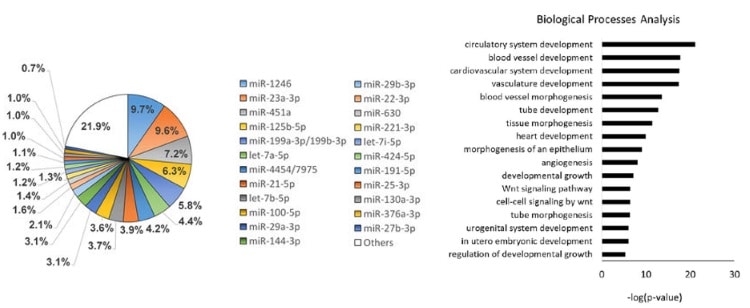
They found 23 miRNA that were expressed at a significant level. Those 23 miRNA are postulated to affect 5481 genes, which are involved mainly in cardiovascular development, pathways related to cell death and growth, angiogenesis and fibrosis.

miRNA found in MSC exosomes

Angiogenesis is the formation of new blood vessels. It is a requirement for tissue healing, since cells at the site of injury – like all cells in the body – require nutrients, oxygen and waste removal, functions all performed by blood vessels.

Fibrosis is the formation of excessive connective tissue, which results in scar tissue without properties appropriate to the tissue. By down-regulating pathways involved in fibrosis – specifically, molecules involved in the extracellular matrix layer that supports cells – these exosomes have been shown to reduce the rate of fibrosis.

Apoptosis is a mechanism that cells use to program their death (when they are too stressed, for example). The team observed in vitro that, although MSC exosomes were able to decrease cardiomyocyte apoptosis, they didn’t show any ability to increase their proliferation.

The researchers further enriched the exosomes by inserting miRNA into the cells that produce them. They chose the miRNAs to insert according to two criteria: bioinformatics analysis that predicted miRNA gene targets related to cellular proliferation and angiogenesis; the miRNAs had different target genes to those identified previously.

Exosomes were modified with miR199a, which has been proved, in silico and in vitro, to trigger 22 genes involved in cell cycle regulation, cell proliferation and cell death, increased cardiomyocyte proliferation and inhibited cardiomyocyte apoptosis. The researchers also used miR-130a-3p to enrich MSC exosomes. This miRNA targets a gene that, when down-regulated, induces angiogenesis, which was predicted by in silico results and confirmed in vitro.

In vitro tube formation

This research helps investigators understand how MSC exosomes function so they can more easily predict the outcomes of further studies. This work also shows that modification of exosome by incorporation of miRNA into the producing cell is feasible and allows the design of exosomes tailored to particular requirements.

Nuclear excitation by electron capture seen at long last

Physicists have been given the first glimpse of nuclear excitation by electron capture (NEEC), confirming theoretical predictions that were made more than 40 years ago. The global team – led by Jeff Carroll and Christopher Chiara of the US Army Research Laboratory in Adelphi, Maryland – excited an atomic nucleus by causing it to absorb an electron and confirmed its excited state by observing the subsequent pattern of nuclear decay. Their work could lead to the development of new energy-storage systems and could also explain the abundances of elements such as gold and platinum in the universe.

We often think of atomic electrons orbiting some distance away from the nucleus, but some inner-shell electrons have a finite probability of being inside the nucleus. Through a well known decay process known as “internal conversion”, for example, an atomic nucleus can decay by transferring energy to such an electron – causing it to be ejected from the atom.

No easy feat

NEEC is essentially the reverse of internal conversion, and some physicists have been advocating its existence for several decades. The process begins with the absorption of a free electron by a hole in a normally filled atomic shell. If the electron’s initial kinetic energy plus its atomic binding energy matches the energy difference between two nuclear states, then nuclear excitation can occur. While straightforward in theory, this energy-matching requirement makes NEEC no easy feat to pull off experimentally.

To make their observations, the team produced atoms of the radioactive isotope molybdenum-93 and had them absorb electrons of energy that they believed would cause NEEC. They predicted that if the nucleus did become excited, its sequence of decay products would be different to that of an unexcited nucleus. Determining the decay sequence involved analysing gamma-ray emissions from decay products with differing half-lives. As hoped, their measurements matched up with the theoretical predictions of the unique decay sequence of an excited molybdenum-93 nucleus.

One important consequence of the discovery is that it provides a possible explanation for the abundance of elements such as gold and platinum in the universe. If NEEC were a fairly common process in nature, then certain elements could transform into others after being created in stars. The team’s work could also lead to the development of new technologies that harness the energy of excited nuclei. This, according to Carroll, could lead to power sources with an energy density 100,000 times greater than that in chemical batteries.

The research is described in Nature.

Copyright © 2026 by IOP Publishing Ltd and individual contributors