Hawking completed his PhD – entitled “Properties of expanding universes” – in 1966 when he was 24 years old. To mark Open Access Week 2017, the 117-page tome was posted on the university’s Apollo open-access repository, which is already home to some 15,000 research articles and 2400 theses.
Yet within hours of Hawking’s opus being posted online, demand was so great that the site crashed. However, according to the university, it was still downloaded more than 60,000 times in the first 24 hours.
“By making my PhD thesis open access, I hope to inspire people around the world to look up at the stars and not down at their feet,” Hawking noted. “Anyone, anywhere in the world should have free, unhindered access to not just my research, but to research of every great and enquiring mind across the spectrum of human understanding.”
Still on famous physicists, how much would you pay for a short note written by Albert Einstein? How about $1.56m? Thought not, but that is how much a letter dubbed his “theory of happiness” fetched at auction in Jerusalem, Israel earlier this week.
Einstein wrote the letter during a lecture tour in Japan in 1922. A bellboy at the hotel he was staying – the Imperial Hotel in Tokyo – delivered a message to the physicist. When Einstein went to tip the boy, he realized he didn’t have any money so instead wrote a note to him on hotel letterhead that read (in German): “A calm and modest life brings more happiness than the pursuit of success combined with constant restlessness.”
The seller – who is unknown – put the letter up for sale at the Winner’s Auctions and Exhibition. While it was only estimated at $5000–8000, the price rocketed after intense bidding. Yet a second note that Einstein wrote at the time on a second sheet of paper with the words “Where there’s a will, there’s a way” sold at the same auction for only $250,000.
Finally, how old is zero? That question has opened up a row between an international group of researchers and the University of Oxford.
Last month the Bodleian Library in Oxford noted that an ancient Indian text, known as the Bakhshali manuscript, had been dated to between 300 and 900 CE.
The manuscript was discovered in 1881 in a field in Bakhshali, near Peshawar in present-day Pakistan, and was acquired by the library in 1902. The document includes arithmetic and was a manual for merchants trading across the Silk Road.
While the library noted that it contained the oldest known written zero but it could not be classed as a “true” zero, as it was only shown as a marker showing an empty decimal place and not as a fully fledged number.
Now a group of historians from Canada, France, Japan, New Zealand and the US, have voiced their disapproval of such a stance. They say that as the historical manuscript contains calculation like long multiplication, it would have been necessary to use zero as a number. They also claim that the document includes statements such as “having added one to zero”. The debate is sure to continue before, er, zeroing in on a solution.
A new kind of laser, in which light snakes around a cavity of any shape without scattering, has been developed by researchers in the US. They claim that their “toplogical laser”, which works at telecom wavelengths, could allow improved miniaturization of silicon photonics or even protect quantum information from scattering.
Topological insulators are materials that do not carry electrical currents in the bulk, but do conduct through edge states. Crucially, these states always travel in one direction, steering neatly around corners and imperfections in the surface without scattering or leaking out.
Such “topologically protected” electric currents can be induced in a thin sheet of any conductor by inducing an electric field across the sheet and a magnetic field perpendicular to it. In the bulk, the electrons simply travel in circles but at the edges they hop along in semicircles.
Although photons have no magnetic moment and so do not respond directly to a magnetic field, an analogous effect can be achieved using electrons excited by incident light. Such electrons respond differently to a magnetic field than if they had not been excited, and in turn influence the light differently.
“The interaction of the photons with the magnetic field is mediated by the material,” explains Boubacar Kanté, an applied physicist at the University of California, San Diego. That’s the theory – and it works well at low frequencies.
From theory to experiment
However, at the infrared wavelengths used in silicon photonics, materials respond so weakly to magnetic fields that many researchers had assumed it would not be possible to open up an optical band gap – a spectral region in which the bulk of a material cannot transmit electromagnetic waves.
Undaunted, Kanté and some of his students “started doing some calculations to really check whether some of these assumptions were correct”. They realised that while it would be possible to block bulk transmission in only a tiny wavelength band, this drawback would be useful in a laser, which is meant to have a narrow linewidth.
To find out, the researchers used two photonic crystals – periodic optical nanostructures – made from indium gallium arsenide phosphide. They placed one inside the other on top of a layer of the magnetic mineral yttrium iron garnet. The inner photonic crystal consisted of a series of star-shaped unit cells arranged in a square lattice, whereas the outer crystals had a triangular lattice of cylindrical holes. The interface between the two crystals is the laser cavity, in which laser amplifcation can take place.
Creating a band gap
The different patterns of the two photonic crystals gave rise to a one-way, robust photonic edge state, much like the electronic edge states in a topological insulator. The magnetic field opened an optical band gap just 42 picometres wide in the bulk photonic crystals, making them both perfectly reflective at about 1550 nm – the wavelength region most often used for fibre-optic transmission.
“If I take two mirrors that are topologically distinct,” explains Kanté, “then, because they are mirrors, light cannot penetrate the crystals; but, because they are topologically distinct, light can propagate in between them”.
Indium gallium arsenide phosphide spontaneously emits light when excited by a laser, with this light populating the edge state that exists between the topologically distinct materials. This edge state can then be used to make a scattering-proof laser cavity of any shape.
Extracting the beam
To extract a beam, the researchers removed a line of holes from the outer photonic crystal, creating a waveguide coupled to the cavity’s evanescent field – a type of non-propagating electromagnetic disturbance that occurs as a result of the waves in the cavity. They found that the light emerged from the waveguide with a strong preference for one direction, proving the light had come from the one-way edge mode.
This feature could be useful, say the researchers, because a laser beam reflecting back into the cavity can inject noise and even destroy high-power cavities. Devices designed to prevent this are usually bulky and energy intensive. “Now we have a device that can send light in a preferential direction with no way for it to come back to the source,” says Kanté.
The researchers also suggest that cavities of any shape could allow denser packing of integrated optoelectronic components, and consequently higher processing speeds. Finally, they note the use of scattering-free photonic paths could transport quantum states longer distances around quantum circuits. The researchers are now making an electricallly powered laser because – as Kanté puts it – “you don’t want to carry one big laser to feed another one.”
Quite remarkable
“I think it’s the first topological photonic material that is non-reciprocal because of magnetic bias in optics,” says Andrea Alù of the University of Texas at Austin. “That’s quite a remarkable result and I know many people were trying to do it.” Alù is, however, more sceptical about some of the potential applications, such as the miniaturization of lasers. “To define a photonic crystal, you need many unit cells,” he says. “Typically, the first band gap arises when the distance within the unit cells is a half-wavelength – so 750 nanometres. And you need a lot of them to create that interface. There are ways to make much smaller lasers than this.” One potentially interesting aspect not mentioned in the research, he suggests, is the possibility of creating a laser beam with angular momentum.
Far from being deserted, selectively logged forests provide important refuges for tropical species, sheltering them from severe climate warming. This new finding, reported in Global Change Biology, suggests that these areas could become a vital component of future conservation efforts in the tropics.
Rebecca Senior of the University of Sheffield, UK, together with collaborators from the UK and Malaysia, took detailed temperature measurements of both large and small microhabitats in different plots of forest in Malaysian Borneo. The measurements indicate how well an area shields, or buffers, small-scale habitats from general temperature increases. The team found that the buffering performance of forest selectively logged only 10 years ago was very similar to that of nearby untouched, or primary, forest.
These results highlight the importance of previously-logged forest in conserving the unrivalled biodiversity of the tropics, currently under threat from land-use change. The detrimental impact of wholescale deforestation on local wildlife is well known, but selective logging, where only certain trees are felled, is 20 times more widespread than wholesale conversion.
“Selective logging can be quite intensive, but it will still leave some forest behind,” Senior explains. Once the plant community recovers, and importantly once the canopy closes and shields the ground from the tropical sun, the forest returns to being a haven for animals.
In their study, the researchers conducted a comprehensive survey of each area, characterizing the surrounding vegetation and its community structure. They recorded the general air temperature, while a thermal camera and image analysis techniques were used to measure the temperature of surfaces in the area down to a millimetre scale, the habitat small animals actually experience. Finally, the temperatures of three discrete microhabitats – deadwood, tree holes and leaf litter – were logged for comparison against the overall macroclimate.
The number and accessibility of microclimate sites are also important to their conservation value. The areas in this study showed no difference in these parameters between logged and primary forest, suggesting that the logged forests can still support the small animals that rely on microclimates. Many of these animals, such as amphibians and invertebrates, are cold-blooded, which means that an ability to escape a wider temperature increase is even more important for their continued survival. These species often require quite a specific environment in which they can thrive, but they also struggle to track temperature zones owing to their own poor dispersal ability or artificial barriers like roads and farmland.
The ability of selectively logged tropical forests to preserve biodiversity adds an important new facet to the challenge conservationists face in maintaining the current richness of life in the tropical regions. Logged forest does show changes: the canopy is closer to the ground and the composition of the leaf litter may be different to primary forest. Yet, irrespective of this, the new work proves how invaluable even a heavily disturbed area can be in conserving the richness of life.
In the days following the Great Storm of October 1987, as people across southern England and northern France picked roof tiles and downed tree limbs out of their gardens, Juliet Davenport began thinking seriously about weather.
At the time of the storm, Davenport – now the chief executive of Good Energy, a UK-based supplier and generator of renewable energy – was a third-year physics student at the University of Oxford. She was fascinated to learn that meteorologists (including the BBC’s Michael Fish, who famously told viewers “not to worry” about an approaching hurricane) got their predictions wrong due, in part, to a simple error in the location of ship-based weather observations in the Bay of Biscay, which led them to predict that the storm would follow a more southerly track. “I realized then just how fundamentally sensitive our systems are to data fluctuations,” she told an audience at the University of the West of England (UWE) last night.
Thirty years later, Davenport is still fascinated by the science of weather and climate, but she has also become passionate about the economics of how business becomes an “engine for change” in the world. The role of business in decarbonizing the UK economy was a major theme of her talk. Often, she explained, people regard sustainability and climate change as “someone else’s problem”. That isn’t useful, she said, because “if you expect one part of a society to do all the work, it’s really hard”.
Of course, founding a renewable-energy company wasn’t exactly easy. Early in the company’s history, Davenport explained, she struggled to convince potential funders to back her. Indeed, when she approached the private equity firm 3i with a request for investment, a “spotty youth” (presumably a junior associate) turned her away, sneering “Why would I ever back anybody who’s trying to sell ‘green’?” Other challenges came from energy regulators, who asked Davenport for three years’ worth of audited accounts before they would grant Good Energy a licence to operate – a prudent requirement given the sensitive nature of the energy market, perhaps, but also one that was nigh-on impossible for a brand-new start-up to meet.
In absolute terms, Good Energy is still a minnow in the UK energy market, supplying renewable electricity to around 75,000 customers (disclosure: I’m one of them) and administering feed-in tariffs for 133,000 small-scale electricity generators. But it has grown steadily, and Davenport sounded optimistic about the future. The importance of dealing with climate change is now clear, at least from a scientific perspective, and green technology is making rapid progress on many fronts. Indeed, Davenport argued that some technologies have already reached a tipping point in public acceptance. “Once you’ve driven an electric vehicle, you don’t want to go back,” she explained, adding that she drives her own electric/petrol hybrid without heat, even in the winter, to extend the battery’s range because she finds the petrol motor so disappointing in comparison.
Progress on the policy front has been slower, though, and Davenport expressed some disappointment with the current UK government. “The way they’re acting, you’d think we never signed the Paris agreement on climate change,” she said, noting that the Brexit vote seems to have ushered in “a period of extreme short-termism” in Whitehall, with green targets scrapped and research on some technologies (such as carbon capture and storage and tidal lagoons) abandoned or put under review.
Mostly, though, Davenport stayed upbeat. At one point, she even stated that the UK has “plenty” of renewable energy. This surprised me, as I dimly remembered reading (in the late David J C Mackay’s book Sustainable Energy Without the Hot Air) that we’d need to cover most of Wales with wind turbines in order to meet 100% of the UK’s energy needs with renewables. After the talk, I asked Davenport whether Mackay had got his numbers wrong, or if something had changed since Sustainable Energy was published in 2008. Her answer was that the UK’s demand for energy has been dropping by around 3% each year for several years, partly because of increased efficiency, although she admitted that climate change has also helped, since it means we no longer use as much heating as we once did. (Davenport didn’t say this, but it struck me afterward that the 2008 financial crisis and the long-term decline of British heavy manufacturing might have contributed, too. Silver linings!) At any rate, Davenport argued that the decline in energy usage, coupled with advances in (especially) off-shore wind energy, has been a game-changer for renewables, surprising even optimists.
Davenport also dealt – rather neatly I thought – with the old question of how you run a country on renewables when the Sun isn’t shining and the wind isn’t blowing. Her answer, essentially, is an arbitrage system that enables suppliers to purchase energy from regions with a temporary excess (because of favourable local weather) and sell it to regions with a temporary shortage. Politically, that might be difficult, but in physics terms, it’s hard to see much wrong with the idea, especially if the country also maintained some limited degree of nuclear or gas power as back-up.
All in all, it was an impressive talk, and at the end, one audience member even asked Davenport if she fancied going into politics. “Not at all!” she laughed. Then she added a caveat: “Well, maybe when I’m really old and I don’t care anymore.”
“This chocolate chilli mango tiramisu is simply sublime!”
Fascinating, the contrast between the colloquial and technical meanings of terms. In everyday language, we apply the word “sublime” to things like clothes, music and food that are particularly awesome, deep or yummy. In physics and philosophy, however, the word has technical and precise meanings that stick closer to its etymology, which combines the Latin sub (close to or under) and limen (a threshold).
Physicists use sublime to indicate a phase transition from solid to gas that bypasses the liquid state and is triggered by an endothermic process just below the critical-point threshold. Philosophers, meanwhile, use the word to describe the agitation and disorientation you feel when confronted with something incomprehensible and overwhelming. Here, the threshold is between the limited human mind and the limitless, natural world.
For philosophers, then, the sublime is not synonymous with beautiful, and the two terms are in some ways opposites. While the beautiful is calming, integrates mind and nature, and is generated by the formal properties of the beautiful object, the sublime is arousing and formless.
So are there any instances in physics that can give rise to the philosophical experience of “sublime”? Last summer I attended a series of lectures given in Italy by Edward Casey – a colleague of mine at Stony Brook University – that convinced me that at least one experiment perfectly fits the bill.
Mind and nature
Philosophers have mulled over the sublime for centuries. In his 1756 treatise A Philosophical Enquiry into the Origin of Our Ideas of the Sublime and Beautiful, the Irish statesman and philosopher Edmund Burke wrote that terror is the “principle of the sublime”. Encountering overwhelming things such as hurricanes and volcanoes, for instance, disrupts our usual ways of coping with the world. But when such terror is placed at a safe distance – as in, say, a painting – we can feel its power without personal danger, producing a special kind of pleasure that makes us feel more vibrant and alive. It was this experience of fear-tinged pleasure that Burke dubbed “the sublime”.
In his Critique of Judgment (1790), the German philosopher Immanuel Kant analysed the concept somewhat differently, and described two kinds of sublime. One, the mathematical sublime, is inspired by experiences of things that are so vast and intricate (such as St Peter’s Basilica in Rome or the starry universe) that our imaginations cannot size them up by turning them into intuitions. Another, the dynamical sublime, consists of experiences of things of such stupifyingly overwhelming power (such as ocean storms) that we feel helpless to resist them.
Like Burke, Kant thought that when such disturbing encounters are put at a safe distance – as in art – they can generate a special kind of pleasure. Unlike Burke, Kant thought that the key to the sublime was the mental act of confronting something to which we realize our imaginations and power are utterly mismatched. Such an experience, Kant thought, reveals to us something liberating – the independence of our minds from nature – kindling in us a deep and humbling respect both for the implacable, law-governed natural world and for the freedom and transcendence that humans have with respect to it.
Casey’s lectures examined these two influential accounts of the sublime, as well as others, but gave the subject a twist. He is a philosophical “phenomenologist”, which means he is less interested in analysing concepts, such as the sublime, by taking for granted seemingly obvious analytic tools – especially those that come in neat pairs like mind/nature. The problem with these tools is that they often tempt us to squeeze an experience into conventional categories rather than to respect its nuances.
Instead, Casey began by trying to carefully describe the experience itself. That experience, he argues, reveals that the sublime is neither so much about a threatening object (as per Burke) nor about our special feelings in response (Kant). Instead, it is more like an aura that permeates an entire landscape, turning it into something we encounter differently from ordinary space and time. That encounter, he continues, can be inspired not only by terror, but also by other kinds of experiences of phenomena in which we perceive both nature and the way we perceive it as intimately knit together.
The critical point
Casey left me convinced that the double-slit experiment with electrons, which results in a visual pattern of spots indicating that these particles are spatially unpindownable, is an exemplary case of the sublime.
First, the experiment is (as per Burke) of a startling natural phenomenon; it reveals electrons behaving in extraordinary ways. Second, it shows (as per Kant) something that we cannot size up with our imagination and understanding even after almost a century of quantum mechanics. As Werner Heisenberg said, subatomic behaviour is unintuitable in ordinary space and time, while Niels Bohr remarked that those who are not shocked by quantum mechanics do not understand it. Finally, it is something (as per Casey) that we experience as not on one side or the other of the mind–nature threshold, but as the product of both. The double-slit experiment (and quantum mechanics, which provides its theoretical script), after all, is a human creation, even as it shows something shockingly indigestible to human imaginations and understanding.
There may be deeper illustrations of the non-classical character of quantum mechanics – the Stern–Gerlach experiment or demonstrations of the violation of Bell’s inequality – but the double-slit experiment is the most perceptually accessible and dramatic. As Richard Feynman remarked in his Lectures on Physics, it puts on clear display the mystery of quantum mechanics. Forget St Peter’s Basilica, hurricanes, volcanoes, hurricanes and tiramisu – if asked to name something truly sublime in the deep technical philosophical sense, I’d choose the double slit.
If you go on a scenic drive through the Danish countryside, you will see a lot of cows. That is not surprising: Denmark has around half a million dairy cows, spread over less than 43 000 km2 of land. What is, perhaps, surprising is that there is a link between these placid, productive creatures and a multibillion-euro research infrastructure for neutron and X-ray scattering. The connection exists thanks to researchers at the University of Copenhagen, who spotted an opportunity to use advanced research facilities to investigate the complex hierarchical structure of milk and milk-derived products.
The dairy studies date back to 2013, when the university, with support from the capital region of Denmark, began a pilot project to test the feasibility of employing X-ray and neutron scattering in industrial R&D settings. This project, known as NXUS (Neutron and X-ray User Support), established collaborations between industry and university scientists on many different topics, including the processes that take place when paint dries and techniques for enhancing the stability of protein-based drugs. However, dairy companies and their specific challenges were a major focus of the project, with companies such as Arla Food Ingredients, CO-RO A/S and DuPont Nutrition Biosciences ApS all interested in questions related to the processing and handling of milk products.
Dairy details
Milk is a complicated system with many constituent elements. However, some of its most important properties can be understood by considering it as a colloid of casein, or milk protein, arranged in globular agglomerates of thousands of individual casein molecules. These agglomerates are known as micelles, and their overall size is in the micron range. Closer examination, though, reveals that the substructure of these micelles is highly hierarchical, with features of various sizes. Examples include clusters of calcium phosphate that are only a few nanometres in size; groups of individual proteins that are some 15–20 nm across; and the overall structure of the micelle (hundreds of nanometres) and its surface. These substructures are very important for the properties of the milk, and in particular for the texture and “mouthfeel” of the finished product, whether it is yoghurt, cheese or anything else derived from milk.
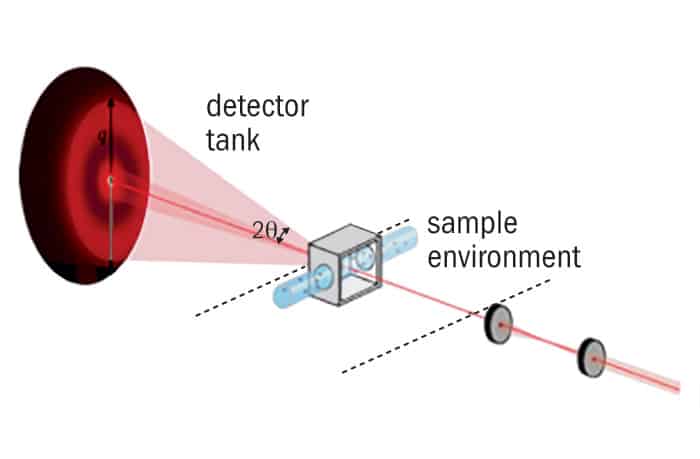
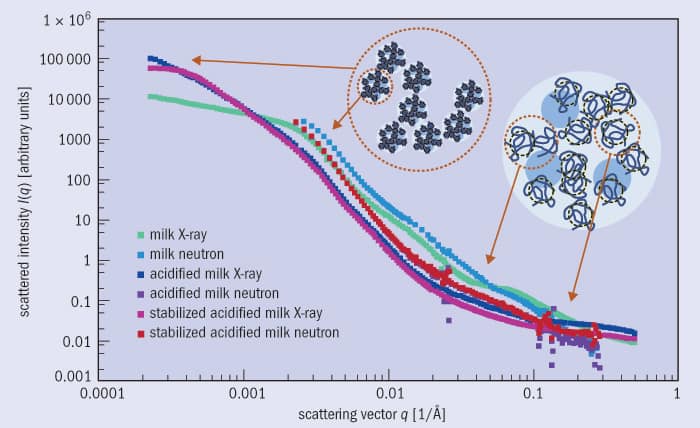
Small-angle neutron and X-ray scattering make it possible to study features with length scales from 1–1000 nm (see “Small-angle scattering” figure below), so they are perfect tools for studying casein micelles. One such study, performed in collaboration with DuPont Nutrition Biosciences, used a combination of SAXS and SANS to examine ways of stabilizing acidified milk in solution. Acidification of milk can lead to aggregation (or coagulation) of the casein micelles, and one needs to control this process in order to produce the desired dairy product – for example a certain type of cheese or yogurt – with the desired texture and stability. In this study, the structure of the casein micelles was studied before and after acidifying the milk, and before and after adding a stabilizing agent to the acidified milk. On a macroscopic level the samples differ in texture and the SAXS and SANS data reveal that at the nanoscale, too, there are clearly identifiable differences (see “Milking the data” figure below). The data also illustrates the benefit of using both X-rays and neutrons, since some features are only visible in one of the two corresponding data sets.
Small-angle scattering
Small-angle scattering The set-up of small-angle scattering experiments.
In small-angle scattering (SAS), a sample is placed in an X-ray or neutron beam (SAXS or SANS, respectively). Typical samples are protein solutions, emulsions or solutions of nanoparticles, detergents or polymers. The sample scatters the beam and the scattered intensity is measured as a function of the scattering angle, typically up to 5°. The detected scattering pattern is related to the Fourier transform of the sample structure, and thus makes it possible to determine the size and shape of scattering particles within the sample on length scales of between 1 and 100 nm (and sometimes even up to mm, depending on the experimental set-up).
While SAXS is widely available at small-scale lab facilities, SANS is more difficult to come by because it requires a neutron source in the form of a nuclear reactor or a spallation source. Nevertheless, SANS can offer great advantages over SAXS; in particular, the former technique can easily “see” the light elements that are so important for life. These light elements (hydrogen in particular) are either hard or impossible to see with SAXS and other X-ray based techniques, which are more sensitive to heavy elements. SAXS and SANS are often used in combination because they have a different scattering contrast with respect to the sample. Thus, employing both of these complementary techniques often makes it possible to learn about structural details that would not be possible to determine with either technique on its own.
Armed with some prior knowledge of the constituents of casein micelles, it is fairly easy to deduce, from visual inspection of the data, what is going on. The disappearance, after treatment, of the feature visible around a scattering vector q = 0.08 Å–1 in the scattering curves of the untreated milk samples indicates that calcium phosphate clusters in the micelles disappear upon acidification. Furthermore, the general suppression of features in the middle range of the data, around q = 0.01 Å–1, indicates a collapse of the micelle’s internal structure. Finally, acidification seems to make micelles cluster together in larger aggregates, but this clustering is reduced when the stabilizer is added. This can be deduced from the increase in scattering in the very low-q range of the data (the far left in the figure) on acidification, followed by a slight decrease and flattening when the stabilizer is added. A more detailed analysis of these data enabled DuPont Nutrition Biosciences to better understand the effects of their natural stabilizers on micelle mechanics at a molecular level. Projects involving Arla Food Ingredients and CO-RO A/S similarly provided the companies with specific knowledge that they would not otherwise have gained.
Assessing impact
With Denmark’s national milk production nearing 5 billion kg per year, and dairy exports worth €1.8bn to the economy annually, even a slight industry edge could have a large impact – not only for the individual dairy companies, but also for the country as a whole. But the effect is not necessarily limited to Denmark’s current industries. Richard B Larsen, a senior advisor at the Confederation of Danish Industry (CDI), argues that with the European Spallation Source (ESS) being built less than an hour’s drive from Copenhagen, and the neighbouring MAX-IV synchrotron facility already operating, international companies may choose to base their R&D departments in Denmark “due to the easy access and accompanying knowhow in applying neutrons and X-rays to investigate problems of industrial relevance.” With time, he adds, the expectation is that a robust industry research sector will generate highly specialized jobs that will, in turn, help realize the full potential of the area’s world-class research infrastructure.
Milking the data Small-angle scattering data from representative measurements, clearly showing the structural difference between raw milk, acidified milk and acidified milk with an added natural stabilizer. These differences occur at various length scales and correspond to changes in the sub-structures of casein micelles in milk. SAXS data comes from the ID-02 beamline at the European Synchrotron Radiation Facility (ESRF) in Grenoble, France and SANS data from the KWS-2 instrument at the Forschungsreaktor München-II in Germany.
Larsen’s enthusiasm is mirrored by Lise Arleth, a professor at the Niels Bohr Institute at the University of Copenhagen and founder of the NXUS project. The institute has a long tradition of exploiting neutrons and X-rays for basic science, she explains, so “having the NXUS project embedded in my research group has been a great opportunity to get experience in actually performing these industrial R&D projects on a larger scale.” Getting a new generation of scientists involved in industrial challenges has also been rewarding, Arleth says, since “they are the ones that ultimately will have to meet all the future expectations in this area.”
Those future expectations have already led to a new, larger partnership being founded with the aim of putting neutron and synchrotron science to work on industrial problems. The new LINX (Linking Industry to Neutrons and X-rays) consortium comprises three Danish universities and 15 industrial partners, with additional support from Innovation Fund Denmark, the CDI and two Danish regional governments. These organizations have committed to finding solutions to larger and more challenging questions relating to materials in general, including the food and biomedicine sectors. The LINX project is funded for five years, and a parallel LINX Association has also been established to give the project a sustainable long-term future as a platform and mediator for industrial use of neutron and X-ray methods after the public funding runs out.
Such long-term thinking is critical, in Arleth’s view. “Right now, we have many Danish companies that are highly interested in the opportunities provided by the upcoming ESS and MAX-IV, but they are just not sure how exactly they will benefit from the opportunities provided,” she says. “Presently, only a handful of Danish companies independently conduct experiments at the current large-scale facilities. The LINX project gives us an excellent opportunity to provide qualified answers to many of the ‘how’ and ‘what’ questions the companies have.” By the time the initial five years of funding runs out, she says, they hope to be able to demonstrate a significant increase in the number of Danish companies seeing benefits from applying neutron and X-ray technology to improve their products – plus several examples to inspire others to follow the dairy firms’ lead.
Roadside pillars on an origami-inspired folding base could block traffic noise without restricting a driver’s view. That’s the hope for a new kind of “sonic barrier” proposed by Manoj Thota and Kon-Well Wang at the University of Michigan, Ann Arbor. Their design can switch between configurations to selectively inhibit certain frequencies depending on traffic conditions.
Noise pollution from roads comes from many sources, including engines, exhausts and tyres, but the acoustic spectrum effectively depends on two main factors: the type and speed of the vehicles. Buses, heavy-goods vehicles and any slow-moving traffic produce spectra dominated by low frequencies, while cars and fast-moving vehicles tend to produce high-frequency noise.
A solid wall could block all these components equally well, but this is rarely necessary given that road traffic typically does not produce pure white noise. Optically transparent, periodic sonic barriers exist, but if they are fixed permanently in place, they can be effective only for certain frequencies. By allowing the periodicity to vary dynamically, Thota and Wang aim to produce a barrier that can be tuned to match the dominant frequency as required.
Fold to fit
Central to the idea is the use of a foldable substrate known as a Miura-origami sheet. Certain degrees of folding make the vertices of the sheet align in a square lattice, while a hexagonal lattice pattern results from other folding angles. By placing a vertical pillar at each vertex, the arrangement and spacing of the barrier components can be modified on demand.
The researchers modelled the system with analytical and numerical methods, and discovered two folding angles that maximized sound attenuation at 500 Hz and 1000 Hz, respectively. The results of the simulations were confirmed by a one-seventh-scale physical model using PVC pipes fixed to aluminium facets and polymer folding edges.
As the barrier requires just one-degree of actuation to switch between states, Thota and Wang think it could be a practical alternative to using solid walls or fixed-period structures to block traffic noise. As well as being permeable to wind – and therefore avoiding any of the wind-induced loading suffered by the foundations of walls – the proposed barriers are also better at diffusing sound waves reflected into the road, further reducing roadside noise levels.
The executive board of one of Switzerland’s leading universities – ETH Zürich – has launched an independent enquiry in response to allegations of misconduct at the institute’s former Institute for Astronomy (IfA). The IfA was closed in August after several students raised concerns about the management practices of senior staff at the institute. According to a statement from the ETH Zürich, the investigation will now take “a more detailed look” at the situation and that could lead to “additional measures” being taken.
The problems at ETH Zürich came into the open in February 2017 when allegations were made by “several doctoral students” against a female professor who worked at the IfA. While the professor has not been named by ETH Zürich, according to the allegations, she demonstrated “inept management conduct” towards her students. A month later – at their own request – the students, who have also not been named, were reassigned to a different supervisor. After the university’s executive board discussed the issues – which have not been made public by ETH Zürich – an agreement was reached that the female professor in question would be given support if she wanted to supervise doctoral students in the future.
According to its statement, ETH Zürich decided to close the IfA in August because the professor was married to a man who was also employed by the IfA – a set-up that ETH Zürich says was “not ideal”. While the two professors remain in the physics department at ETH Zürich, the rest of IfA staff have been integrated into a newly created Institute for Particle Physics and Astrophysics.
“Having identified the problematic circumstances, the priority was to reform the inappropriate personnel structure as quickly as possible so as to rectify the situation,” the statement says. “Nowadays such a pairing within the same institute would no longer be possible.”
While ETH Zürich’s board “commended the prompt and appropriate action” that was taken, it has now opened an independent enquiry that will focus on how “poor management” can be quickly escalated higher up within the organization. “The alleged conduct falls well short of the standards we expect of our professors, and so we took swift action,” says ETH Zürich president Lino Guzzella. “The official enquiry allows us to take an even closer look at the facts and decide whether further measures still need to be taken.”
However, some astronomers have voiced concerns about how ETH Zürich has dealt with the situation and how the institution blamed it on the couple being married. Writing on Twitter, astronomer Jessie Christiansen from NASA’s Exoplanet Science Institute at the California Institute of Technology says that ETH Zürich needs to “try harder”.
“As part of a married astronomer couple working at the same institute, I can assure you this [working alongside one’s spouse] is not the problem,” she says, adding that the issues rather emerge due to a “clear conflict of interest” such as a married couple supervising the same student or chairing the same committee. “I’d like to think we’re smart enough to put some protections in place that aren’t a blanket ban [on married couples],” she says.
Physicists at Harvard University in the US have built a silicon waveguide that exhibits a refractive index of, or close to, zero when operating at near-infrared telecom wavelengths. The waveguide can transmit energy more efficiently than previous designs, offering potential applications in computing and communications.
Most materials have a refractive index of more than one, which means that they reduce both the speed and wavelength of light passing through them compared to light’s passage in a vacuum. But a material with zero refractive index instead boosts the speed and wavelength of light to infinity, leaving it with a temporal but no spatial variation. (The effect does not contradict special relativity because it regards a wave’s phase, which carries no information.)
Orad Reshef, who is now at the University of Ottawa, says he was inspired to investigate materials with zero refractive index because “zero was such an abstract concept”. But, more practically, he says that zero-index materials might boost nonlinearity in light that is a long-standing and as-yet unfulfilled requirement for optical computers. This would mean one photon being able to dictate the behaviour of another, so enabling optical transistors and other types of switches.
Because the refractive index of a material is defined as the square root of its relative permittivity and relative permeability multiplied together, a zero index can in principle be achieved by setting the permittivity to zero. This, in fact, has been done using metals at radio and far-infrared frequencies but Reshef points out that this was achieved with a finite permeability. As such, he says, impedance – defined as the square root of permeability over permittivity – “blows up”, meaning it becomes almost impossible to transfer electromagnetic radiation between the material and the outside world.
Pillars of gold
Two years ago, the Harvard group reported having overcome this problem using a metamaterial – a light-manipulating array of tiny artificial structures. The metamaterial in this case consisted of a network of 400 nm-diameter silicon pillars embedded in a polymer material and coated with films of gold. The gold, by acting as a mirror, was needed to make the pillars in effect infinitely tall, which should reduce the permeability of any passing light waves to zero.
The researchers demonstrated zero-index refraction by directing light at a prism-shaped formation of the silicon pillars and measuring the angle at which the light emerged from the far side of the prism. This result represented an important step towards practical chip-based applications, says Reshef, because unlike previous zero-index metamaterials light could propagate parallel to the silicon substrate. However, he points out that a prism itself is “an entirely useless structure”, since it cannot be built smaller than a certain size and because light spills out of it.
Infinite waves
In the latest work, the group fashioned the metamaterial into a waveguide – the photonic equivalent of an electrical wire. The waveguide consists of a single row of the metamaterial, but rather than pillars of silicon sitting in air it is instead made up of semicircular air holes within a strip of silicon. The greater concentration of silicon means there is now no need for gold coatings, which reduces costs and keeps the silicon purer.
Because the waveguide does not have any angled faces, the group had to come up with an alternative way of proving zero-index refraction. Ingeniously, it fed light into both ends of the device to set up a standing wave. Normally, the peaks and troughs of such a wave would be too close together to be visible, but the very low refractive index inside the waveguide meant that they were stretched far enough apart to be seen with an optical microscope.
Just how far apart depended strongly on the input wavelength. The researchers observed that at around 1625 nm the peaks and troughs of the standing wave became so stretched out that only one was visible at any one time. Given the finite size of the waveguide, they could not definitively say that they had observed a zero refractive index but they got down to as low as 0.03. “No one has seen an infinitely long-standing wave before,” says Reshef. “So as physicists we all thought that was breathtaking.”
Masaya Notomi of the NTT Basic Research Laboratories in Japan applauds Reshef and colleagues for having simultaneously demonstrated zero refractive index and low impedance in a “surprisingly simple” one-dimensional waveguide. But he adds that further research is needed for practical applications, given a substantial radiation loss from the waveguide.
Few claims about metallic states of superdense hydrogen go unchallenged, and the latest is no exception. Two researchers at Harvard University in the US today report the observation of an electrically conducting liquid in the element compressed in the laboratory to extremely high pressures. They say their liquid metallic hydrogen might be like the stuff in the interiors of gas-giant planets such as Jupiter and Saturn, and fits with recent observations of Jupiter’s magnetic field. But other experts question these interpretations.
The idea that hydrogen might become metallic at high pressure goes back to a theoretical proposal in 1935. Such a high-pressure solid phase has been sought ever since, boosted by the suggestion in 1968 that this solid might be superconducting at room temperature. No one has convincingly seen such a state, although in disputed work published earlier this year, Isaac Silvera and Ranga Dias at Harvard claimed to have made it.
But liquid hydrogen should be metallic too at high pressure, and evidence for that was reported back in the mid-1990s. Now Mohamed Zaghoo, working with Silvera at Harvard, says that their observations of liquid hydrogen squeezed to up to 140–170 gigapascals (1.4 million atmospheres) in a high-pressure diamond anvil cell and laser-heated to temperatures of 1800–2700 K “reveal it to be much more conductive than previously thought.”
As the hydrogen sample became metallic, they noticed its reflectance increase sharply. “At a certain transition temperature, the reflectance abruptly rose to 50–55%, values typical of metallic behaviour,” says Zaghoo. The researchers calculated the conductivity from this reflectance, assuming that it is a simple metal with free electrons. They found it to be 5–7 times higher than a value measured for shock-compressed liquid hydrogen in 1996.
Confirmed by Juno?
The existence of such a metallic state inside Jupiter is, Zaghoo says, thought to be the reason the planet possesses a magnetic field. “The immediate implication [of the result] is that the magnetic field of Jupiter ought to be stronger than previously held,” he says. “And the field also should originate much closer to the surface than assumed.” Zaghoo comes to this conclusion because their experimental conditions are like those at a radius 84% of the full planetary radius, and the researchers estimate that the planetary dynamo layer may in fact extend out to at least around 91% of the radius.
Not everyone is convinced, however. Planetary scientist David Stevenson of the California Institute of Technology in Pasadena feels that the new result does not add significantly to this picture. “Their experiments are not for the conditions of relevance to the outer region of Jupiter,” he says. “What they did is extrapolate outwards to lower pressure, and this is debatable.”
Meanwhile, William Nellis, a high-pressure experimentalist who works at Harvard independently from Silvera’s group and reported the earlier, lower value of the liquid-phase conductivity, argues that the authors have found a different liquid conductive region from the one he saw, because the two regions were prepared by different techniques. They can’t be the same phase, he says, because they have different densities.
However, the earlier measurement is reliable, he says, because that conductivity was measured by direct electrical probing, whereas “to derive conductivity from a free-electron theory can introduce unknown systematic errors.” If two such phases exist in this region of the phase diagram, the question of which might be relevant to planetary conditions remains open.
For more on the claims surrounding liquid metallic hydrogen, check out our feature “Show us your metal”