Distant galaxy sheds light on the magnetic universe

The magnetic field of a galaxy five billion light-years from Earth has been detected by astronomers. This is the most distant galaxy known to have a coherent magnetic field and its measurement suggests that the magnetic fields of galaxies such as the Milky Way emerge early in their lifetimes.

Galaxies have magnetic fields that are typically a million times weaker than Earth’s magnetic field. While these fields are very difficult to measure, studying the magnetic properties of galaxies could provide important clues about how magnetism in the universe formed and evolved to its present state.

Very long time

A popular theory suggests that galactic magnetic fields begin as weak and tangled field lines with little coherent structure. Then, over a very long time scale, the magnetic fields organize themselves into coherent large-scale structures.

This latest measurement was made on a disc galaxy that is similar to the 13 billion-year-old Milky Way – but five billion years younger. The observation of microgauss-strength coherent magnetic fields similar to that of the Milky Way suggests that galactic magnetic fields emerge much earlier than previously thought.

Fossil record

“This means that magnetism is generated very early in a galaxy’s life by natural processes, and thus that almost every heavenly body is magnetic,” says Bryan Gaensler of the University of Toronto – who was involved in the study along with colleagues in Germany, the US and the UK. “Nobody knows where cosmic magnetism comes from or how it was generated,” he adds, “But now, we have obtained a major clue needed for solving this mystery, by extracting the fossil record of magnetism in a galaxy billions of years before the present day.”

The measurement was made on a strong lensing system called CLASS B1152+199. Light from a bright and very distant quasar is focused into two images by the nearer galaxy of interest. Radio waves from the quasar pass through the galaxy and undergo Faraday rotation – whereby the direction of polarization of the waves is altered by the galaxy’s magnetic field. Measuring the polarization – and therefore the galactic magnetic field – was done using the Karl G Jansky Very Large Array radio telescope in New Mexico.

The study is described in Nature Astronomy.

Science-themed comedy: are you having a laugh?

In his quest to find out what makes good science comedy, Glester meets performers at the Green Man festival in Wales and the Edinburgh Fringe festival in Scotland, both of which took place in August. Among them is the actor, comedian and radio presenter Samantha Baines whose interest in science was boosted through a fixation with the “dishy” physicist (her word) Brian Cox. Baines’ Fringe show 1 Woman, a High-Flyer and a Flat Bottom celebrated women astronauts and space scientists and played to sell-out audiences throughout the festival.

Other performers featured in the podcast include astrophysicist Catherine Heymans and the improv group Captain Train, whose show Lowpothesis involves them interacting with scientists on stage. For each of the performers, Glester finds out why the comedians chose science as their source material and what they hope to achieve with the routines, beyond hopefully making the audience laugh. He also explores how it can be liberating and challenging to take science to the comedy circuit, a world where subject matter is usually more directly linked with people’s everyday experiences.

Glester  reviewed several science-themed shows from this year’s Edinburgh Fringe for the October issue of Physics World. You can read his review here.

Carbon-nanotube yarn converts motion into electricity

Scientists have been trying for many years to develop new ways of converting mechanical energy from the environment into electrical energy. Now, researchers in the US and South Korea have found that, at very small scales, they can generate record levels of power by twisting yarns made from carbon nanotubes in contact with an electrolyte. They say that their “twistron” devices are well suited to powering remote sensors in industrial and other equipment, as well as potentially being able to tap energy from ocean waves and bodily movement.

Mechanical energy is usually converted into electrical energy using generators, devices that exploit the principle of electromagnetic induction to create a current by moving a conductor in a magnetic field. However, while able to approach 100% efficiency at large scales, generators become increasingly hard to build, and as such inefficient, when they are just a few millimetres or centimetres in size.

It is at this scale that the twistron is designed to operate. Developed by Ray Baughman of the University of Texas at Dallas and colleagues, the new device generates more energy per unit weight than previous energy harvesters operating between 1 Hz and a few tens of hertz. As the researchers point out, this frequency range encompasses many back-and-forth motions in nature, including human walking and breathing.

Capacitive effect

Each twistron is made by spinning several billion carbon nanotubes – hollow cylinders with carbon walls just one atom thick – into high-strength yarns a few tens or hundreds of microns in diameter and surrounding them with an electrolyte. The water in the electrolyte creates a very thin barrier between electrons on the surface of the yarn and ions in the electrolyte, thereby forming a capacitor that needs no external charging. Twisting the fibre then brings the charges on the yarn closer together, so reducing the device’s capacitance and increasing the voltage in an attached electrical circuit, causing a current to flow.

Baughman’s team has designed the twistron so that it twists when stretched, given that the energy from most external sources of motion can best be tapped through a stretching force. To do this, the researchers spin the yarns so much during their manufacture that they form a coil.

They found that twistrons can generate about 250 W of peak electrical power for each kilogram of yarn. So far they have limited themselves to very small amounts of yarn, but using a twistron weighing about 35 mg – about the mass of two houseflies – they were able to power an LED. They reckon that this output would also be enough to transmit a radio-frequency signal carrying 2 kB of information over 100 m about once every 10 s. This, they argue, makes their technology well suited to powering sensors in the wirelessly connected network of devices known as the Internet of Things.

Artificial muscle

In this case, they explain, twistrons would be coated with an electrolyte in the form of a gel, and could be hooked up to a polymer-based artificial muscle that contracts and expands in response to temperature fluctuations in the environment – so removing the need to install and replace batteries in remote sensors. Although they achieved peak powers using fluctuations of more than 100 °C, the researchers say that the muscles can respond to changes of just a few degrees if they are made long enough.

Tom Krupenkin of the University of Wisconsin–Madison, who was not involved with the research, agrees that providing power to mobile sensors is “one of the obvious possibilities” for twistrons. He also believes that the new devices could be incorporated into clothing, using the up-and-down motion of the chest to power a heart monitor, for example. But cautions that in this case the power available is likely to be very limited – “well below a watt”, he says.

One obvious application for twistrons is to generate electricity from ocean waves, since in this case the seawater would serve as the electrolyte and there would be no need to coat the yarns. Group member Shi Hyeong Kim of the University of Texas demonstrated this principle by installing a 10 cm-long, 1 mg twistron in the sea off the coast of South Korea, attaching the device’s lower end to a weight on the seabed and its upper end to a balloon on the water’s surface. He found that the up-and-down motion of the balloon stretched the twistron by up to a quarter, generating an average power of 1.8 μW in the process.

Major hurdles

Kim’s colleague Carter Haines, also at the University of Texas, acknowledges that the technology currently faces two major hurdles. One of these is efficiency – the twistrons typically converting only around 1% of mechanical energy into electricity. Rival “triboelectric” devices, in contrast, can turn about 10% of the energy used to rub two different materials together into electrical energy.

Potentially even more problematic, however, is the manufacturing process, which is very energy intensive and therefore extremely expensive. According to Matteo Pasquali, who works on yarn spinning at Rice University in the US, production costs would need to fall by “about three orders of magnitude below current R&D prices” – to a few hundred dollars per kilogram – if twistron wave power is to be viable at the megawatt scale.

As such, says Haines, twistrons might be best suited to niche markets. For example, he says that they could provide maintenance-free power for buoys that monitor the climate or track the movement of fish. Nevertheless, he and his colleagues are trying to raise efficiencies and reduce costs. “Our goal right now is to use the same approach with lower cost materials,” he says.

The research is described in Science.

Gravitational waves could soon reveal how black holes pair up

All the gravitational waves so far detected by LIGO have come from mergers of binary black holes, but how such black holes form and pair up is uncertain. Now, researchers in the US and UK have shown that the waves produced when black holes merge can provide significant information about how the pairs formed. The researchers suggest we should have a definitive answer about the origins of black-hole binaries within a few years.

Several theoretical models predict how black-hole binary systems could form. In one, both stars in an isolated binary system collapse to form black holes, which are then drawn into a tighter binary black-hole orbit. Binary black holes formed this way would most likely have their intrinsic angular momenta (or spins) aligned along the axis of the binary orbit.

“To grow up together and then to shrink their orbits, the stars’ atmospheres and cores have to interact tidally,” explains astrophysicist Will Farr of the University of Birmingham. “Tides act to bring their spins into alignment.”

Random orientation

In a second model, two existing black holes are pushed together into an orbit by gravitational interactions with other objects. In this case, the relative orientation of spins of the two black holes would probably be random.

Farr says it is “almost certain” binary black holes form through both methods. “The interesting question is the relative frequency of one type of formation versus the other.” Estimates of the rates of both vary over three orders of magnitude, so the researchers concluded it was unlikely the two rates would be similar enough for the four mergers so far seen from gravitational-wave observations to include binaries formed through different methods. They looked at the “effective spin” of each binary: the vector sum of the spin components of the two black holes, weighted by their masses, along the direction of the binary orbit.

Two black holes with large spin components in the same direction can enter a much closer orbit before finally collapsing together and merging: “As the black holes go around, the stretching and squeezing of space–time oscillates,” explains Farr, “And in those oscillations, you can see the pattern of them approaching each other and plunging as if they were non-spinning or approaching much closer and plunging as if they were spinning.”

Large errors

The researchers studied the distribution of possible effective spins from each event. Although there was a large error on the measurements, all four events had small effective spins. This could result from either intrinsically small spins or spins misaligned with the orbital angular momentum. However, in some events, the effective spin appeared most likely negative: “If [the spins] all point in the same direction, there’s no way to get a negative value,” says Farr. The researchers conclude, therefore, that their results are more consistent with randomly oriented spins, favouring a binary formation model such as the second.

With only four data points from LIGO – three confirmed detections and one possible sighting – they cannot draw firm conclusions. Nevertheless, the researchers suggest that, if future observations have similar uncertainties to those already seen, an additional 10 observations – which may be available within three years – should allow researchers to determine how most black-hole binaries form. “This is, on some level, the first example of what you can do with a population [of gravitational-wave observations],” concludes Farr. “In a decade, we’re going to look back at when we had four events in the can and people were trying to analyse them and think ‘they were the early days: now we’ve got hundreds of them, we do all these sophisticated things and we really understand what’s going on.'”

Squeezing data

Steinn Sigurðsson of Penn State University is impressed by the statistical analysis of gravitational-wave signals: “People used to think we’d need thousands of data points to get the statistics,” he says, “But we’ve got really good at squeezing data and extracting everything we can out of it…The paper’s basically saying ‘We can do a lot with just a few data points’…In some sense it’s what the particle-physics people were doing 20 years ago when they had data and we didn’t.” He cautions, however, that the events may not be representative of all binary black-hole mergers: “With our limited detectors right now we see the biggest bangs,” he says.

Vicky Kalogera of Northwestern University says that “the authors do a very good job of showing that effective spin will be a tell-tale quantity that gravitational-wave measurements will eventually use to reveal what is going on with these binary black holes.”

The research is described in Nature.

Spacesuit of the future, another ancient Pythagoras, Disney’s football analysis

By Sarah Tesh and Michael Banks

new SpaceX suit

Astronauts on board the SpaceX Dragon Capsule will look like they’ve stepped out of a sci-fi film. This week, Elon Musk revealed his company’s futuristic space attire on Instagram. The suits are aesthetically very different to the bulky gear NASA astronauts currently wear, the Extravehicular Mobility Unit (EMU). They are even sleeker than NASA’s next generation Z-2 suit, which was previewed in 2015. The SpaceX garb are apparently also easier to walk in and more practical for everyday use. While not quite at the tech standard of fiction, the SpaceX suits definitely look the part.

From the future, to the past – turns out that Pythagoras was not the first to work out his eponymous theorem. At least 1000 years before (so about 3500 years ago), an unknown Babylonian genius not only marked out the same theorem but also a series of complex trigonometry tables that scientists say are more accurate than any available today.

The mathematical inscriptions are written in a clay tablet (dubbed Plimpton 322) and researchers have been arguing for nearly a century about their meaning. Now, a team from the University of New South Wales in Australia believe they’ve cracked the four columns and 15 rows of markings. “Our research reveals that Plimpton 322 describes the shapes of right-angle triangles using a novel kind of trigonometry based on ratios, not angles and circles,” says Daniel Mansfield. “Babylonian mathematics may have been out of fashion for more than 3,000 years, but [the Plimpton 322 table] has possible practical applications in surveying, computer graphics and education. This is a rare example of the ancient world teaching us something new.”

Sport is all about “big data” these days and football is no different. During a game, a myriad of stats are amassed for each player from the distance they run to how many successful passes they make. Researchers at Walt Disney – yes, you read that right – have used player-position data during 45 European matches to develop an algorithm that can automatically recognize when teams are changing formation. The tool can be used to identify when defending players are out of position and put defending players in the best place based on what the attacking team is doing. So why is Disney carrying out this research? “This new capability has applications well beyond sports,” says Markus Gross, vice president at Disney Research. “These include robot movement, autonomous vehicle planning and modelling of collective animal behaviour.”

LIGO–Virgo comments on neutron star rumours, sort of

By Hamish Johnston

Have gravitational waves from merging neutron stars been detected for the first time?

Physicists working on the LIGO and Virgo gravitational-wave detectors have issued a statement that appears to be a response to rumours that both gravitational waves and electromagnetic radiation from an astronomical event have been detected.

LIGO has already detected gravitational waves from three different binary black-hole mergers. But none of these events appeared to emit electromagnetic radiation that could be detected by astronomers using telescopes on Earth or in space.

A neutron star merger, however, is expected to give off significant amounts of light and some people not involved with LIGO–Virgo have said that both light and gravitational waves from such an event have been detected. If so, this would be the first “multi-messenger” observation involving gravitational waves.

The LIGO–Virgo statement neither confirms nor denies the rumour, but does hint at a multi-messenger discovery: “Some promising gravitational-wave candidates have been identified in data from both LIGO and Virgo during our preliminary analysis, and we have shared what we currently know with astronomical observing partners.” The collaboration adds: “We are working hard to assure that the candidates are valid gravitational-wave events, and it will require time to establish the level of confidence needed to bring any results to the scientific community and the greater public.”

A guide to the unknown universe

Particle physicist Daniel Whiteson has teamed up with PHD Comics creator Jorge Cham to produce an intriguing new book. We Have No Idea: a Guide to the Unknown Universe uses humour and cartoons to introduce some of the deepest unknown questions of physics. The book combine’s Cham’s signature sketches with explanations of the big scientific questions that have left leading physicists scratching their heads for decades. In the August 2017 issue of Physics World, Whiteson writes about his experiences producing the book and what he hopes it can achieve. You can read that article here: “When goofing off is good“.

Qubits can swim through seawater

Photon-based qubits and entangled states have been transmitted up to 3 m in sea water by Xian-Min Jin and colleagues at Shanghai Jiao Tong University and the University of Science and Technology of China. While this distance pales in comparison with the 1400 km satellite-to-ground transmission achieved earlier this year by another team in China, the ability to send quantum information through seawater is a significant challenge because the liquid medium is much more absorptive of light than air.

Photons make very good qubits (quantum bits of information) because they can travel long distances without interacting with transmission media such as an optical fibre or air. These interactions destroy quantum information and therefore at first glance water should be a poor medium for qubits because it is much more absorptive of light than optical fibres or air.

Window of opportunity

The team managed to get around this problem by using photons with wavelengths of 405 nm, which falls within the “blue-green” window in which light absorption in water is relatively low. They also worked out that encoding quantum information in the polarization states of a photon gives the qubit its best chance of surviving its watery journey. This is because seawater is isotropic and therefore there should be no strong de-polarization effects. Indeed, the team’s calculations suggest that the polarization of a photon can survive multiple collisions with molecules in seawater – and any depolarization that does occur can be dealt with by filtering out the affected photons.

Jin and colleagues showed that quantum information encoded in single 405 nm photons can be transmitted 3 m with a fidelity of greater than 98%. The team also did a separate experiment involving entangled pairs of 810 nm photons. Although these photons experience about 300 times more absorption than their 405 nm counterparts, they found that quantum entanglement is preserved to a very high degree after one of the photon pair is transmitted 3 m through seawater.

Secure submarines

The transmission of qubits and quantum entanglement play roles in quantum key distribution (QKD), which uses the laws of quantum mechanics to ensure that messages can be sent securely between two parties. It could be possible, therefore, to use QKD on a submerged submarine, for example. The problem, however, is that seawater is highly absorptive of light even at 405 nm, so communicating over distances of a kilometre or more would require huge numbers of photons.

The research is described in Optics Express.

America’s night in a day

By Sarah Tesh

On Monday 21 August, the US witnessed some unusual events. Day turned to night, temperatures dropped as much as 6 °C, animals behaved weirdly and street lights came on in the middle of the day – all because a vast, 115 km-wide shadow swept across the land.

This was, of course, a solar eclipse – where the Moon passed in front of the Sun casting a shadow on Earth. Millions watched with special glasses, home-made pin-hole cameras, digital cameras, and – in the case of scientists – satellites and telescopes.

Among the spectators was my colleague Tami Freeman, editor of Medicalphysicsweb, who watched the event at the side of a road in Wyoming. At about 10:25 local time, the spectacle began and over the next hour and a half, Tami and her family watched the Moon move across the Sun’s face.

“The Sun transformed into a tiny crescent shining a dim silvery light onto the ground,” describes Tami. “And then – the diamond ring – the last beautiful flash of bright light as the Moon fully covered the Sun’s face. The sight of the Sun’s corona was breathtaking; the stars and planets became clearly visible in the sky, and all around a 360° sunset lit up the horizon in reds and oranges. Then just as quickly, the diamond ring reappeared for a brief moment, and the light began to return. Truly a privilege to witness such a spectacle.”

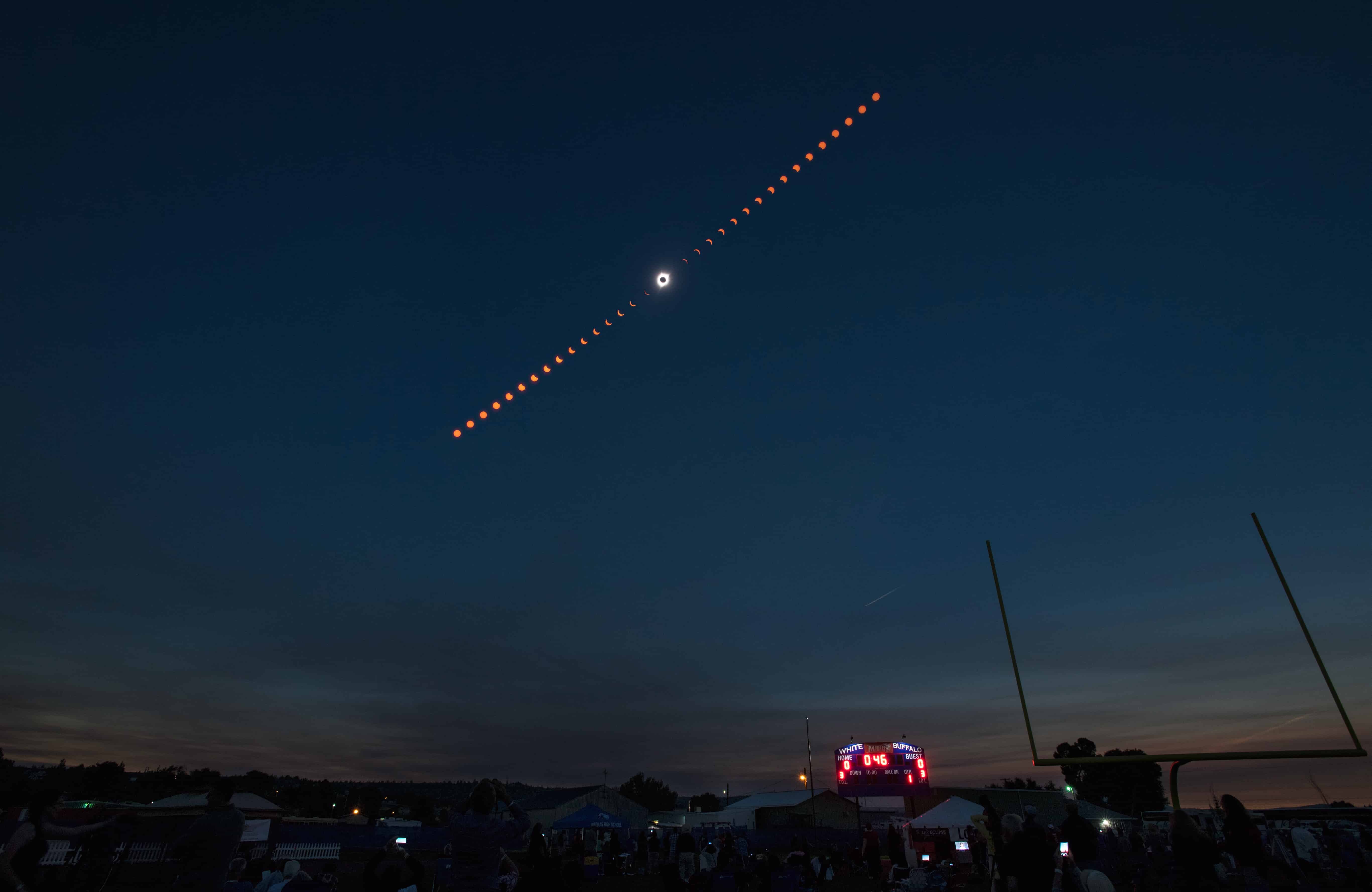
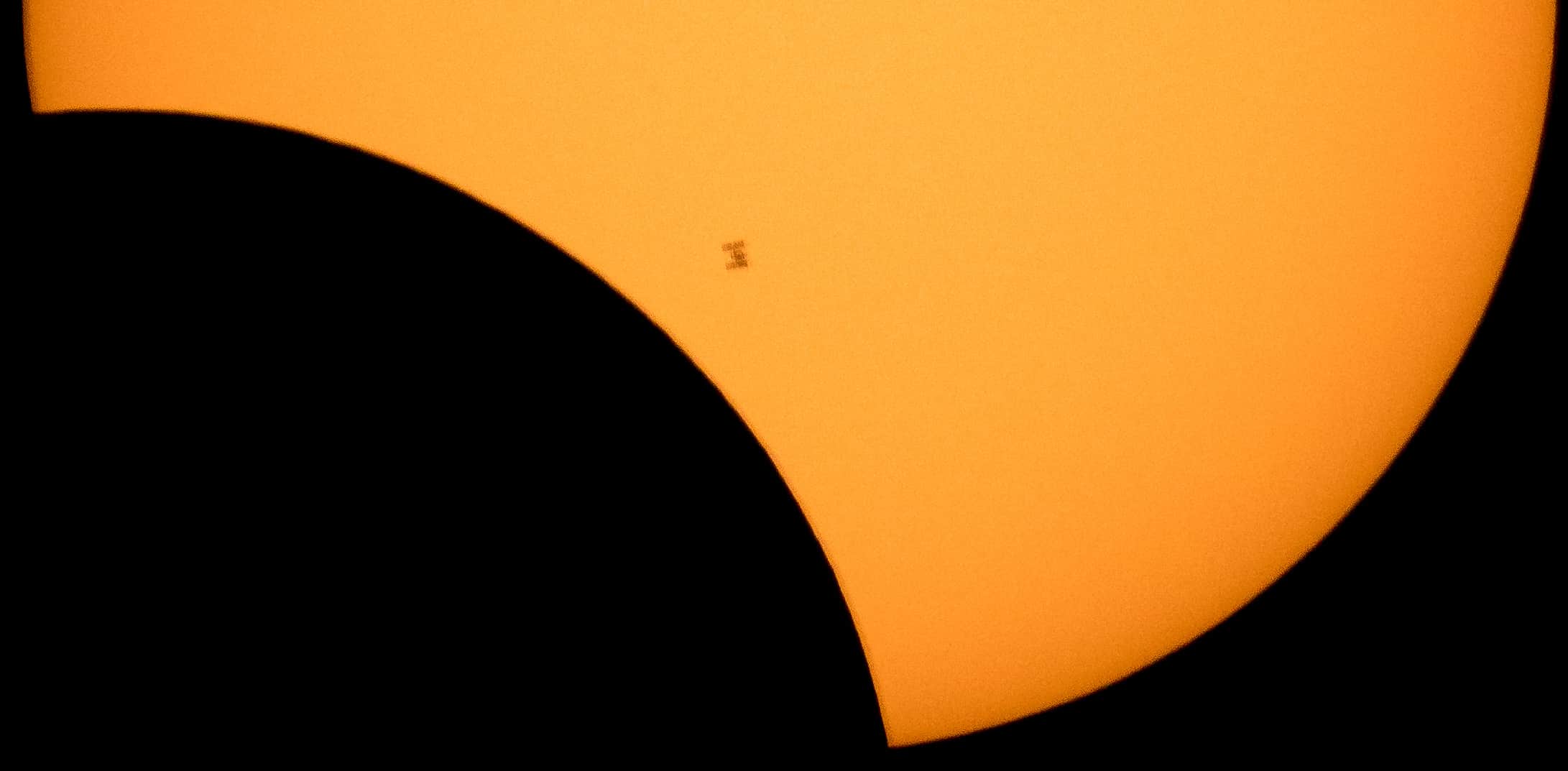
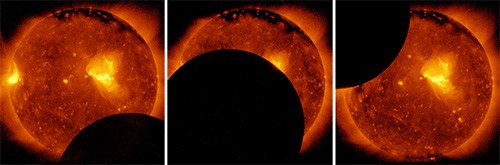
Tami captured some truly magnificent pictures of the eclipse from her spot on the path of totality (see above and the first below). Of course, there are countless other eclipse pictures on the Internet, but here are some of my favourites showing the phenomenon from a range of different perspectives.

Looking up

Total solar eclipse

a composite image showing the progression of the total solar eclipse over Madras, Oregon

Zooming in

the International Space Station silhouetted against the Sun during the partial solar eclipse
the Hinode solar observation satellite view of the eclipse

Looking the other way

View from the International Space Station
NASA's Earth Polychromatic Imaging Camera (EPIC) captured the Moon's shadow from a height of a millions miles away

Back down to Earth

Pin-holes - natural and otherwise - created tiny crescent representations of the partially covered Sun

Stay tuned for one more blog on the eclipse from David Appell in Oregon – where the Moon’s shadow first touched ground. And if you want to know where the next total solar eclipse is (and the 14 after that), check out the fun tool on Science News.

Oh, America!

The greatest threat to America’s science planning is active ignorance.

Let me illustrate with an episode that happened 14 years ago, but might as well have been yesterday. In 2003 the US Department of Energy (DOE) released a report entitled Facilities for the Future of Science: a Twenty-Year Outlook, which prioritized 28 proposed projects costing $50m or more.

Written by the DOE’s Office of Science, the report highlighted exciting new facilities such as the Linac Coherent Light Source at the SLAC National Accelerator Laboratory. It also picked out upgrades to several existing light sources: the Advanced Light Source at Lawrence Berkeley National Laboratory, the Advanced Photon Source at Argonne National Laboratory and the National Synchrotron Light Source (eventually NSLS II) at Brookhaven National Laboratory.

Spencer Abraham, who was DOE secretary at the time, released the report with great fanfare, and it was widely reported in the science press. Facilities for the Future of Science was also posted online by a reader of Slashdot – the tech-savvy website that bills itself as “News for nerds. Stuff that matters”. Slashdot’s readers posted a few critical comments about the report, but one made my jaw drop.

“I’m all for research,” wrote a reader named Salamander, “but most of the stuff on this list is ‘big science’ only in terms of the money that will be spent, not the knowledge that will be gained. There’s tons of biotech, materials science, computing, optics, and other research that would be more rewarding. The most appalling omission is that the DOE doesn’t seem to think that battery technology – the thing holding back deployment of many other technologies – deserves even one project. Nothing on portable fuel cells, microturbines, biodiesel, wave power, or other energy-related technologies either, except fusion. What is the DOE thinking?”

Oh, America! I say those words with a mixture of sorrow and rage. Sorrow, because the government agency investing in these facilities does a pathetic job of justifying them to voters. Rage, because Slashdot readers, who pride themselves on their knowledge, should have known better.

Slashdot is “a built-in assembly of the DOE’s natural constituency”, says Bruce Ravel, a physicist at the National Institute of Standards and Technology who recently drew my attention to the post. “That the DOE couldn’t even convince a bunch of Slashdot-ers that its facility funding list was a good idea is pretty damning.”

Anyone with the slightest knowledge of these facilities knows exactly what the DOE was thinking. Research into battery technology is among the most exciting projects conducted at synchrotron sources. Other key energy-related projects involve fuel cells and biofuels, and developing the microfabrication procedures on which other energy-related technologies will depend, such as microturbines. In fact, it would be impossible to pursue such energy projects intelligently without facilities of the kind the DOE was prioritizing.

What’s more, the scientific infrastructure that the DOE was evaluating supports many other projects too – and does so to this day. These range from analysing the composition of comets and enabling the creation of HIV drugs to developing the ability to locate trace explosives in anti-terrorism programmes and even studying imperilled fish. That’s what the DOE was thinking. But in a fully self-aware democracy, the connections between the scientific infrastructure and such projects should be obvious to both politicians and the public.

Two types of ignorance

Salamander is just one Slashdot reader, and let’s hope an anomalous one. In truth, most Slashdot readers seem to express deeper insight into science. Still, I think the remark illustrates an urgent American problem – namely, the conviction that the country can and should address specific scientific, technological and health issues directly, without supporting the research infrastructure required to tackle them, or even knowing much about that infrastructure.

It is the conviction, for instance, that you can fight cancer without supporting basic research into how cells behave – or that you can promote battery technology without supporting facilities that allow investigating the behaviour of matter at the nanoscale. This conviction becomes a threat to America’s science programme when it is shared by the politicians who fund that programme.

This problem is a version of what philo­sophers call “active ignorance”. Basic ignorance means lacking knowledge of something, or having erroneous beliefs about it. I may, for example, not know about synchrotron sources and what they do, or about the origin of cancer, or may have only vague ideas about them. Basic ignorance nevertheless implies a good – or at least a neutral – will; that if and when the person who has basic ignorance is taught or corrected, that person will change their views.

Active ignorance, in contrast, involves what the Northwestern University philo­sopher José Medina, in his 2013 book The Epistemology of Resistance, calls “the active participation of the subject”. It indicates that a variety of attitudes and habits are in play that allow a person “to create and maintain bodies of ignorance” in areas of social and political concern. In short, people who are actively ignorant strive to remain ignorant.

The critical point

Medina’s book is about racial and sexual oppression and does not discuss science. But I find his discussion illustrative of the attitude that many Americans have towards science funding. If it is my duty to vote for politicians who formulate policies on issues like improving battery technology or curing cancer, it is also my duty to equip myself with the appropriate knowledge of how this happens; it is a moral failing if I do not.

As Medina notes, active ignorance is difficult to undo, for it is supported by “a battery of” defence mechanisms, which are also present in the context of US science policy. But naming and describing it is the first step.

Oh, America!

Copyright © 2026 by IOP Publishing Ltd and individual contributors