The dark lenses of sunglasses have been replaced with organic solar cells by scientists in Germany. The cells are able to power a small mircocontroller that sends information on ambient conditions to a couple of displays in the spectacle arms, and in future might provide power for personal devices such as hearing aids.
Organic solar cells are less efficient than conventional silicon devices and not as resistant to continuous strong sunlight, making them less suited to providing power from rooftops. But, according to team member Daniel Bahro of the Karlsruhe Institute of Technology (KIT), the fact that they are light, flexible and transparent opens up a number of new, previously impractical applications.
Bahro and colleagues designed the new “lenses” to have a similar weight and transmission spectrum to those in normal sunglasses. The lenses are made from a polymer and two types of fullerene molecules sandwiched between electrodes and layers of glass. They are then inserted into a commercially available plastic frame. Once connected to a printed circuit board and liquid crystal display in each spectacle arm, they provide information on the ambient light intensity and temperature.
Can’t handle the light
The team found that in outdoor light with an intensity of 1 “sun” the device converted just 0.06% of incoming power to electricity and yielded under a milliwatt of power. Bahro says that this was in part due to the use of a single piece of solar cell for each lens. He and his colleagues could instead have joined lots of narrow cells together in order to limit the “Ohmic losses” that result when charge carriers travel through a cell’s electrodes. However, he explains, doing so would have impaired vision.
The fact that Ohmic losses are proportional to the square of the current, which rises with light intensity, meant that the glasses performed proportionally much better at lower intensities. At 0.01 suns the efficiency of each cell reached 2.4%, which yielded an output of 400 μW. As such, the researchers tailored their electronics to duller conditions such as those typical to offices and other indoor environments.
At about 0.002 suns, which is typical of indoor lighting, each lens had an efficiency of 6.7% and produced around 200 μW. That is too low for mobile phones, common light-emitting diodes or portable music players, but, says Bahro, would be enough for hearing aids, remote controls and some wrist watches. He also believes the technology could reduce the size of the battery or limit the frequency of recharging in power-hungry “smart glasses”, such as the Google Glass headset.
Showing off
Bahro acknowledges that the technology is not yet practical for many applications, given the need for cables to join the glasses to wherever the power is required (as well as the fact that the device works best in conditions that make sunglasses largely redundant). But he says that he and his colleagues were not aiming to commercialise the technology; rather they intended it as a way of showing off the benefits of organic solar cells.
Indeed, Bahro adds that many visitors to the Hannover Messe trade fair in Germany this April, where the device was on display, couldn’t tell the difference between the solar glasses and normal sunglasses. “People usually think of solar cells as bluish-coloured modules,” he says. “They don’t expect them to be transparent, or coming in different shapes and colours.”
The approaching total solar eclipse on 21 August is the subject of much interest and excitement — but the Earth has of course been in and out of the Moon’s shadow since it formed. While we have the technology to take spectacular photos of the corona framing the Moon, our ancestors were limited to much cruder means of recording such events. For example, the ancient petroglyph (a carving in rock) shown above may represent a total eclipse that occurred in 1097. The carving is on a free standing rock known Piedra del Sol in New Mexico’s Chaco Canyon. “I think it is quite possible that the Chacoan people may have congregated around Piedra del Sol at certain times of the year and were watching the sun move away from the summer solstice when the eclipse occurred,” says solar physicist J. McKim Malville from the University of Colorado, Boulder in the US, who focuses on archaeoastronomy. Other nearby carvings may be related to the 1054 supernova and the passing of Halley’s Comet in 1066. “The appearance of the spectacular supernova and comet may have alerted the residents of the canyon to pay attention to powerful and meaningful events in the sky,” says Malville. Hopefully our records of astronomical events will be as long lasting as those of the Chacoan people.
They say asteroids crashing into the Earth is one scientific topic you can guarantee will always make it into the mainstream media. And so it proved this week, with plenty of coverage of asteroid 2012 TC4, which will pass close to Earth on 12 October this year. Quite why this story made it onto various news outlets, from the Guardian and the Daily Mail to MSN News and the Telegraph isn’t quite clear. That’s because the asteroid, which is about 15-30 metres long, will “zoom harmlessly” at a distance of about 44,000km past the Earth, according to a press release from Agence France-Presse (AFP). As Detlef Koschny from the European Space Agency’s near-Earth bojects team told AFP: “There is no possibility for this object to hit the Earth”. The asteroid’s trajectory is a close miss for sure – the farthest satellites are 36,000 km from our planet – but we’re scratching our heads why this rocky body’s trajectory is has made it into the news two months before it flies by. I guess people just love click-bait scare stories. Look at us, even we’ve been snared. And so, now, have you.
“It’s absolutely shameful for them to use my name in their marketing campaign without my permission,” proclaimed the Nobel laureate Andre Geim from the University of Manchester. For the past two years Geim, who recently said that he could leave the UK because of Brexit, has been the face of a Chinese underwear company that claims to have incorporated graphene into its products. The firm, Shenquan, says that by putting graphene into its garments it can help them retain heat, eliminate odours, kill bacteria and even improve sexual performance. “I was told that because the material is ‘very black’ it retains heat better. I pointed out that this contradicted basic science because dark surfaces emit heat better, not retain it,” Geim told theSouth China Morning Post. “After this remark, the company gave me boxers and a pair of socks to try for myself to see how it works … I never put them on because their textile felt low quality and uncomfortable, at least in 2015.” Ouch.
The Sun’s core rotates four times faster than its outer layers – and the elemental composition of its corona is linked to the 11 year cycle of solar magnetic activity. These two findings have been made by astronomers using a pair of orbiting solar telescopes – NASA’s Solar Dynamics Observatory (SDO) and the joint NASA–ESA Solar and Heliospheric Observatory (SOHO). The researchers believe their conclusions could revolutionize our understanding of the Sun’s structure.
Onboard SOHO is an instrument named GOLF (Global Oscillations at Low Frequencies) – designed to search for millimetre-sized gravity, or g-mode, oscillations on the Sun’s surface (the photosphere). Evidence for these g-modes has, however, proven elusive – convection of energy within the Sun disrupts the oscillations, and the Sun’s convective layer exists in its outer third. If solar g-modes exist then they do so deep within the Sun’s radiative core.
A team led by Eric Fossat of the Université Côte d’Azur in France has therefore taken a different tack. The researchers realized that acoustic pressure, or p-mode, oscillations that penetrate all the way through to the core – which Fossat dubs “solar music” – could be used as a probe for g-mode oscillations. Assessing over 16 years’ worth of observations by GOLF, Fossat’s team has found that p-modes passing through the solar core are modulated by the g-modes that reverberate there, slightly altering the spacing between the p-modes.
Fossat describes this discovery as “a fantastic result”, in terms of what g-modes can tell us about the solar interior. The properties of the g-mode oscillations depend strongly on the structure and conditions within the Sun’s core, including the ratio of hydrogen to helium, and the period of the g-modes indicate that the Sun’s core rotates approximately once per week. This is around four times faster than the Sun’s outer layers, which rotate once every 25 days at the equator and once every 35 days at the poles.
Diving into noise
Not everyone is convinced by the results. Jeff Kuhn of the University of Hawaii describes the findings as “interesting”, but warns that independent verification is required.
“Over the last 30 years there have been several claims for detecting g-modes, but none have been confirmed,” Kuhn told physicsworld.com. “In their defence, [Fossat’s researchers] have tried several different tests of the GOLF data that give them confidence, but they are diving far into the noise to extract this signal.” He thinks that long-term ground-based measurements of some p-mode frequencies should also contain the signal and confirm Fossat’s findings further.
If the results presented in Astronomy & Astrophysics can be verified, then Kuhn is excited about what a faster spinning core could mean for the Sun. “It could pose some trouble for our basic understanding of the solar interior,” he says. When stars are born, they are spinning fast but over time their stellar winds rob their outer layers of angular momentum, slowing them down. But Fossat suggests that conceivably their cores could somehow retain their original spin rate.
Solar links under scrutiny
Turning attention from the Sun’s core to its outer layers reveals another mystery. The energy generated by nuclear reactions in the Sun’s core ultimately powers the activity in the Sun’s outer layers, including the corona. But the corona is more than a million degrees hotter than the layers of the chromosphere and photosphere below it. The source of this coronal heating is unknown, but a new paper published in Nature Communications has found a link between the elemental composition of the corona, which features a broad spectrum of atomic nuclei including iron and neon, and the Sun’s 11 year cycle of magnetic activity.
Observations made by SDO between 2010 (when the Sun was near solar minimum) and 2014 (when its activity peaked) revealed that when at minimum, the corona’s composition is dominated by processes of the quiet Sun. However, when at maximum the corona’s composition is instead controlled by some unidentified process that takes place around the active regions of sunspots.
That the composition of the corona is not linked to a fixed property of the Sun (such as its rotation) but is instead connected to a variable property, could “prompt a new way of thinking about the coronal heating problem,” says David Brooks of George Mason University, USA, who is lead author on the paper. This is because the way in which elements are transported into the corona is thought to be closely related to how the corona is being heated.
Quest for consensus
Many explanations for the corona’s high temperature have been proposed, ranging from magnetic reconnection to fountain-like spicules, and magnetic Alfvén waves to nanoflares, but none have yet managed to win over a consensus of solar physicists.
“If there’s a model that explains everything – the origins of the solar wind, coronal heating and the observed preferential transport – then that would be a very strong candidate,” says Brooks. The discovery that the elemental abundances vary with the magnetic cycle is therefore a new diagnostic against which to test models of coronal heating.
The internal structures of live cow embryos have been imaged in 3D by researchers at the University of Illinois at Urbana-Champaign in the US. The method developed by Gabriel Popescu and colleagues could allow scientists to determine the health of embryos before in vitro fertilization in humans.
Biomedical microscopy methods typically involve shining light through thin slices of tissue, or using chemical or physical markers that identify a specific object in a thick sample but can be toxic to living tissues. “When looking at thick samples with other methods, your image becomes washed out due to the light bouncing off of all surfaces in the sample,” says team member Mikhail Kandel.
Imaging the depths
Popescu and colleagues therefore developed a technique called gradient light interference microscopy (GLIM). The method uses two interfering light fields that are identical except for a small transverse spatial shift. By controlling the phase shift between the two waves, the researchers generate intensity images from multiple depths that can be put together to form a 3D representation of the sample.
GLIM – which can be added onto an inverted optical microscope – can probe both thin and thick specimens and the researchers used the technique to look at live embryos from cows. “This method lets us see the whole picture, like a 3D model of the entire embryo at one time,” says team member Tan Nguyen.
Educated guesses
At the moment, there is no universal, non-invasive technique for determining embryo viability for in vitro fertilization. An embryo is chosen based on “educated guesses” made by examining factors such as the colour of fluids in cells and development time. “One of the holy grails of embryology is finding a way to determine which embryos are most viable,” explains team member Matthew Wheeler.
But the researchers will have to wait to see if their technique has successfully analysed embryo health. “The ultimate test will be to prove that we have picked a healthy embryo and that it has gone on to develop a live calf,” explains Marcello Rubessa. The team hopes its research, published in Nature Communications, could help human fertility treatments in the future.
Nanoparticle drug delivery systems that can penetrate multiple biological barriers have great clinical and therapeutic potential.
Now, a team of researchers from the US and China has designed a new drug delivery system that exploits self-assembled nanocages made from ferritin (FTn), a naturally occurring protein that is used in humans to transport iron (PNAS 114 32 E6595-E6602). In this case, the FTn nanoparticles differ in structure from the natural protein and are engineered to have a hollow interior that can be loaded with, for example, a high concentration of cancer drugs.
The research team, led by Justin Hanes and Jung Soo Suk from Johns Hopkins University in Baltimore, were interested in controlling the delivery of cancer drugs to lung airways. Such targeted drug delivery minimizes unwanted side effects while enhancing therapeutic outcomes, potentially yielding a more localized treatment for lung airway cancers.
Breaking through the barriers
To reach tumour tissue in the lung airways, the FTn nanocages must be able to penetrate the dense and highly adhesive protective mucus gel layer covering the airway epithelium. The researchers devised a way to coat the FTn nanoparticles with a dense layer of non-adhesive polyethylene glycol (PEG) polymers, using a unique strategy of fine-tuning the location and surface density of PEG. In tests, the lung airways of mice that had inhaled the PEGylated FTn showed uniform distribution of the nanoparticles, while the uncoated particles were found to aggregate in the mucus gel layer.
FTn is a very attractive candidate for a cancer drug delivery platform, since transferrin receptor 1 (TfR 1) is highly expressed on tumours and has an intrinsic affinity for ferritin. Looking at in vivo and in vitro cancer tumour tissues that perform TfR 1-dependent ferritin uptake, the authors investigated the effect of varying the molecular weight of the PEG. They found that FTn coated with PEG of low molecular weight offered the optimal formulation for penetrating both the airway mucus and tumour tissue barriers. Importantly, coating the nanoparticles with low molecular-weight PEG did not interfere with the intrinsic tumour-targeting capability of FTn.
Targeted drug delivery
The researchers also tested whether the coated nanocages could effectively deliver doxorubicin (DOX), a chemotherapy drug that is often used to treat airway-related lung cancers, to dense tumour tissues. They chemically conjugated DOX to PEGylated FTn via an acid-sensitive linker, which should cause the DOX to be preferentially released in intracellular acidic vesicles once the FTn nanoparticles had been taken up by the tumour cells.
The results confirmed that the tumour-penetrating property of PEGylated FTn markedly improves the distribution of DOX within dense tumour tissue. When studying survival rates in an aggressive mouse lung cancer model, mice that had inhaled DOX conjugated to PEGylated FTn achieved a 60% survival rate at day 60. This represents a huge improvement compared to the median survival of 18 days in untreated mice and for mice treated with DOX in solution. The findings of the study are an important proof-of-principle for a new nanoparticle drug-delivery system that could one day find its way into the clinic.
To avoid the worst effects of global warming demands an effective and economically feasible way to decrease the concentration of atmospheric CO2. Researchers in the US have developed a way to remove this greenhouse gas from the atmosphere while simultaneously producing industrial quantities of carbon nanotubes (CNTs). The low-energy, facile process, termed “C2CNT”, uses molten electrolysis to yield CNT “wools” that can be used for weaving into composites and textiles.
Led by Stuart Licht, researchers at George Washington University synthesized CNTs using a system comprising a molten lithium carbonate (Li2CO3) electrolyte, a Nichrome anode, a Monel (nickel–copper alloy) cathode, and CO2 as the only reactant. The electrolysis was performed at 770 °C under a constant current, and resulted in CNTs more than 1 µm thick and 1 mm long. This represents a 100-fold length increase compared to CNTs achieved until now.
The researchers observed by SEM that the new C2CNT method first involves the formation of a fine carbon film on the Monel cathode surface. CNTs then grow out from this graphene layer in the presence of metallic (Fe, Ni, Cr) catalysts which act as nucleation sites for dissolved CO2. The metallic particles are derived from dissolution of the Nichrome anode during electrolyte equilibrium, and results suggest that they cause CNTs to form between them and the graphene coating. This growth pattern boosts contact with the bulk electrolyte and means that CNT formation is not constrained by carbon diffusion.
As the availability of co-nucleation metallic sites is key in the production of uniform, long CNTs, the composition of the electrodes is an important factor to consider. The group’s previous approach, which yielded shorter, thicker and more convoluted CNTs, involved a zinc-coated steel cathode and a pure nickel anode, suggesting that electrode composition can tune CNT morphology.
Scalability and industrial viability
Given that the sole feedstock in the C2CNT process – CO2 – can be obtained easily from atmospheric or industrial sources, the cost is limited largely by the price of electricity. Licht and colleagues calculated the cost per ton of CNTs at $660, but this could be made even lower if solar energy is used to drive the process. Due to the electrochemical nature of the approach, its scalability is highly feasible, depending only on the size of the electrolysis chamber.
Three for one: why not include water purification, too?
First stages of the C2CNT scaling process would include transformation of concentrated, hot sources of CO2 from cement works and power plants. This gives the further advantage of feeding co-product O2 back into the plant. Potential applications of the novel CNT wool produced include textiles, composites, and a lighter, stronger replacement for steel and aluminum. Typical sulfur and nitrogen emissions of these industrial smoke stacks could be used to produce heteroatom-doped CNT with useful properties like high electrical conductivity.
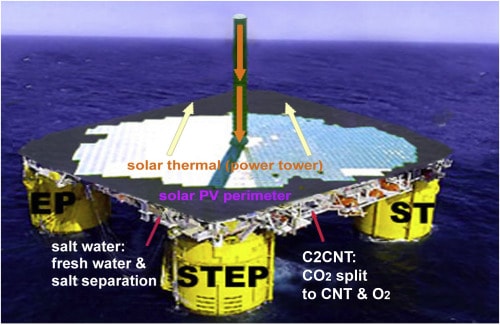
A more ambitious use of the C2CNT method would see CO2eliminated directly from the atmosphere using a combination of solar cells and focused solar thermal energy. Licht and his team estimate that dedicating less than 10% of the area of the Sahara Desert to such a project would be enough to remove all excess anthropogenic CO2 in 10 years. Alternatively, siting such facilities in open ocean areas would allow the inclusion of a water purification system as well. This approach would not only mitigate climate change and minimize the cost of CNT production, but also produce fresh water.
The work developed by Licht and his collaborators is remarkable in terms of targeting a significant societal problem with a scalable, marketable approach. Using electrochemistry, the researchers have attained conversion of a waste gas, CO2, into a valuable commodity, proving that solutions to climate change can be found in what chemistry is all about: the transformation of matter.
Scientists in the Republic of Ireland, the US and the UK have discovered that nanocrystalline copper films are not as flat as they may seem. Using scanning tunnelling microscopy (STM) to map the surfaces of copper films with atomic detail, the researchers revealed that the grains in copper rotate and misalign in an effort to reduce grain boundary energy, resulting in a surface topography marred by valleys and ridges. The roughness of this surface is predicted to have a pronounced effect on the role of nanocrystalline metals in integrated circuits.
Nanocrystalline metals comprise nanoscale grains containing upward of a million atoms arranged in a well ordered crystalline structure. Microchip technology relies on the use of nanocrystalline metals and patterned films as electrical contacts and interconnect components in integrated circuitry. The utility of these materials depends largely on their thermal and electrical conductivities, properties which are greatly affected by how the grains fit together. Structural defects, misalignments and dislocations lead to surface roughening of nanocrystalline metal films, inducing processes that affect electronic transport and hamper their performance.
For copper, in which grains tend to grow with one specific surface orientation, it would be expected that the grains and grain boundaries form a continuous, flat surface. However, this does not seem to be the case. Xiaopu Zhang and John Boland, at Trinity College Dublin, and co-workers at University of Pennsylvania, Intel Corporation, and Imperial College London, used STM to generate a topographic map of the surface of a thin copper film. The researchers discovered valleys and ridges a few nanometres in depth and height where grain boundaries emerge at the surface.
Zhang and colleagues corroborated their analysis of the topographical data with simulations to show that these valley and ridge features arise from low-angle rotation of the grains. Grain boundary energy is minimized in a complex way by maximizing the distance between structural defects. Furthermore, valleys and ridges can be treated as complementary features, as simulations reveal that a grain boundary which forms a valley at the top surface of a copper film also forms a ridge at the bottom surface, and vice versa.
These findings suggest that perfectly flat surfaces are impossible, not only for copper but also for other structurally similar metals such as gold and silver, whose utility is hugely dependent on surface smoothness. The results allow a new perspective on the engineering of such materials for technical applications that is vital for the advancement of high-performing electronics. With this knowledge, the researchers suggest it may be possible to tailor the processing conditions of nanocrystalline metals – by techniques such as grain boundary doping, and controlling the interface between the film and substrate – in order to finely tune their properties for precise functionality.
Thousands of scientists and students across 25 Indian cities have taken to the streets to protest over the government’s lack of support for science. The march was organized by the Breakthrough Science Society – a non-profit advocacy group based in Kolkata.
Many of the protestors held banners with messages such as “Defend science, don’t defund science”. They are calling on the government to increase science spending to 3% of GDP, much higher than the current 0.9% and the government’s target of 2%. The organizers also call on the Indian government to spend 10% of GDP on education as well as to end its promotion of “unscientific ideas”.
The demonstrations in India follow the March for Science on 22 April, which saw thousands gather in around 600 cities to support scientific research. That march was endorsed by more than 200 scientific organizations and sought to promote the value of science – and scientists – to society.
Sometimes your best ideas come when you are goofing off.
It was just this kind of procrastination that led to my collaboration with cartoonist Jorge Cham and culminated recently in the publication of our new popular-science book, We Have No Idea: a Guide to the Unknown Universe, which uses humour and cartoons to describe some of the deepest unknown questions of physics.
Jorge is the artist behind the popular webcomic PHD Comics, which captures the struggle of life in academia and the frustrating experience of research. But Jorge didn’t start his life planning to be a cartoonist. He first went to graduate school in mechanical engineering at Stanford University in the late 1990s designing robots that could walk in a way that mimics the locomotion of cockroaches, and his original intention was to follow an academic path. But when Jorge needed a mental break from the daily struggles of getting his robot critters to perform, he picked up his pen and starting doodling.
Just a few weeks after starting his graduate studies, he was crafting comic situations that poked fun at the real-life research situations he often found himself in. One was the Professor Negation Zone: a hypothetical region that surrounded his PhD adviser and ensured that any functioning robot would suddenly and inexplicably cease to work when it was time to demonstrate it to his boss. Jorge published these comics three times a week in the campus student newspaper, the Stanford Daily, working on it in his free time and treating it as a fun goof-off rather than the foundations of a future career.
But his comics were wildly popular with the Stanford student population, and soon Jorge took his procrastination to the next level, putting the comics online. They spread around the world, revealing that Jorge had discovered a vein of academic frustration that spanned the globe. He finished his degree in robotics, and took up a teaching position at the California Institute of Technology, but found that academia’s appetite for his comics had outstripped its interest in his robotics research. So in the mid-2000s, he left academia and became a full-time cartoonist. Now, Jorge’s goofing off was his new job.
Freed from the confines of the research lab, Jorge went on the road, visiting universities and research labs around the US, Europe and even Australia. He talked to his hosts about their research, learning about the mysteries they were trying to unravel and hearing about their personal stories. He wrote comics about these experiences, showing the personal side of the scientists and explaining their research in a clever and compelling visual style. This science-communication project expanded the portfolio of PHD Comics from making fun of academic life to explaining its significance.
Goofing off at CERN
Meanwhile, in a research lab across the world, I was doing my own goofing off. I’m a particle physicist by training, trying to understand the fundamental nature of matter by smashing particles together to reveal the universe’s smallest building blocks or to create new, exotic forms of matter. I did my PhD at the University of California, Berkeley, but spent most of my time at the Tevatron particle accelerator at Fermilab, just outside Chicago. Later, I joined the ATLAS experiment at the Large Hadron Collider (LHC) at CERN, which was then searching for the Higgs boson and other new hypothetical particles.
Credit: Jorge Cham
It was 2009 and while my job was often exciting and fun, it could also be frustrating. On a good day, I was writing programs to sift through the vast number of collisions to hunt for the few that might reveal evidence of a new particle, or brainstorming with my students how to design a new particle-physics experiment to hunt for dark matter. But for a practising particle physicist, the days of dramatic discovery are rare; more common are early-morning meetings, avalanches of e-mails about trivial or bureaucratic issues, and a long parade of null results.
So I too felt a desire to branch out from the traditional activities of a particle physicist and develop a side project that tapped into a different kind of creativity. The search for the Higgs boson was heating up and receiving a lot of public attention in the popular press. Some of this was high-quality science communication, but I felt that most of it lacked something that captured the essential ideas and the experience of searching for this elusive particle.
For example, while the discovery of the Higgs boson was a validation of a decades-old theoretical prediction and the last missing piece of the Standard Model of particle physics, it did not put to rest all of our simple but deep questions about the nature of particle mass. The Higgs boson and its associated field are the mechanism that allows the matter particles to have mass, but provides no explanation for the puzzling mystery of their peculiar range of masses. The top quark is extraordinarily massive, while its close cousin the up quark is nearly massless in comparison. Why, then, does the Higgs field give so much mass to one and so little to the other? We have no idea and the Higgs theory provides no answer. Unfortunately, most media coverage about the Higgs boson implied that its discovery would complete the physics effort at the LHC, with all details in place and all questions put to rest.
Like most researchers, I was a long-time fan of Jorge’s comics, and enjoyed his forays into explaining science, ranging from paleontology to neuroscience. Something about his combination of text and informal jaunty visuals brought the ideas through in a way that traditional text-plus-figures had not. I was hoping to work together with Jorge to develop a comic that described our research on the Higgs boson and on the search for dark matter. But partnering with him seemed more like a daydream than a possible reality. After all, Jorge is a celebrity among academics; nearly every research lab I have visited has at least one of his cartoons pasted to the door.
When my wife suggested I e-mail him proposing this collaboration, I scoffed at her naivety. It seemed to me as likely to succeed as e-mailing Brad Pitt and asking him to star in a movie about my life. But e-mails cost nothing, so I fired off a brief message, fully expecting never to hear back.
Credit: Jorge Cham
To my surprise and delight, Jorge responded fairly quickly. Maybe he liked the idea of doing a comic explaining the research at CERN, or perhaps it was that I was offering to pay for his skills. Probably a bit of both. We arranged to meet, and he came down from Pasadena to Irvine and spent a day with me. Particle physics was far out of his realm of expertise, but Jorge has a technical mind and lots of experience asking people questions on a dizzying range of topics. I was impressed with how much of the core concepts he was able to grasp and distil. Our initial plan was to produce a traditional static comic, with diagrams explaining what we were doing at CERN and pointing out why it was interesting and important. Jorge recorded our conversation so he could refer back to it later if he had questions.
But when he sat down to pull the ideas together into a comic, Jorge had a different idea: rather than creating a set of fixed images, he was inspired by a few online science videos to make an animated science cartoon. He edited down his recording of our day-long conversation to a few minutes to make me sound smart and on-point, and added animated drawings to accompany my explanations. When I first saw what he had produced, I was amazed and impressed. It was like a lecturer’s dream. Imagine standing in front of a chalkboard and speaking, while someone with much greater artistic skill draws clever and witty diagrams to illustrate your points.
Our video about the Higgs boson was posted online a few months before its actual discovery was announced in July 2012. At the time, the world’s attention was focused on this mysterious boson – at least for a few days – and many science writers and citizens found our video. It soon went viral, receiving millions of views around the world, and many commented that it was one of the clearest explanations of the Higgs boson they’d come across.
Later, when François Englert and Peter Higgs won the 2013 Nobel Prize for Physics, I was delighted to find that the Nobel Committee for Physics included a link to our video in their list of “further reading”. I suspect it may be the only time my work is mentioned by the Nobel committee, even if it was not the main thrust of my intellectual life, but something I did when goofing off. Jorge and I later collaborated on a video about gravitational waves, which also saw millions of views when the discovery of these subtle ripples in space–time was announced in March 2016.
Unknown unknowns
Sometime in 2015 Jorge and I decided to try something different. Most popular-science communication, we realized, focuses on the answers – explaining what we do know. But I felt there’s so much about the world we still don’t know. So rather than developing comics that explain existing scientific discoveries, we thought it would be fun to write a book discussing some of the biggest unsolved questions in the universe. After all, what bigger thrill is there for a scientist than to make a revolutionary discovery that peels back a layer of reality and reveals that the universe is not as we thought it was?
Credit: Jorge Cham
The mystery at the centre of my professional life – “What is the universe made of?” – has seen a lot of progress, as everything around us can be explained in terms of just three basic building blocks: the up quark, the down quark and the electron. Physicists have discovered nine other particles, but why are there 12 in total? Are there more? What explains the strange patterns of their masses and interactions? Are they all built out of one smaller particle?
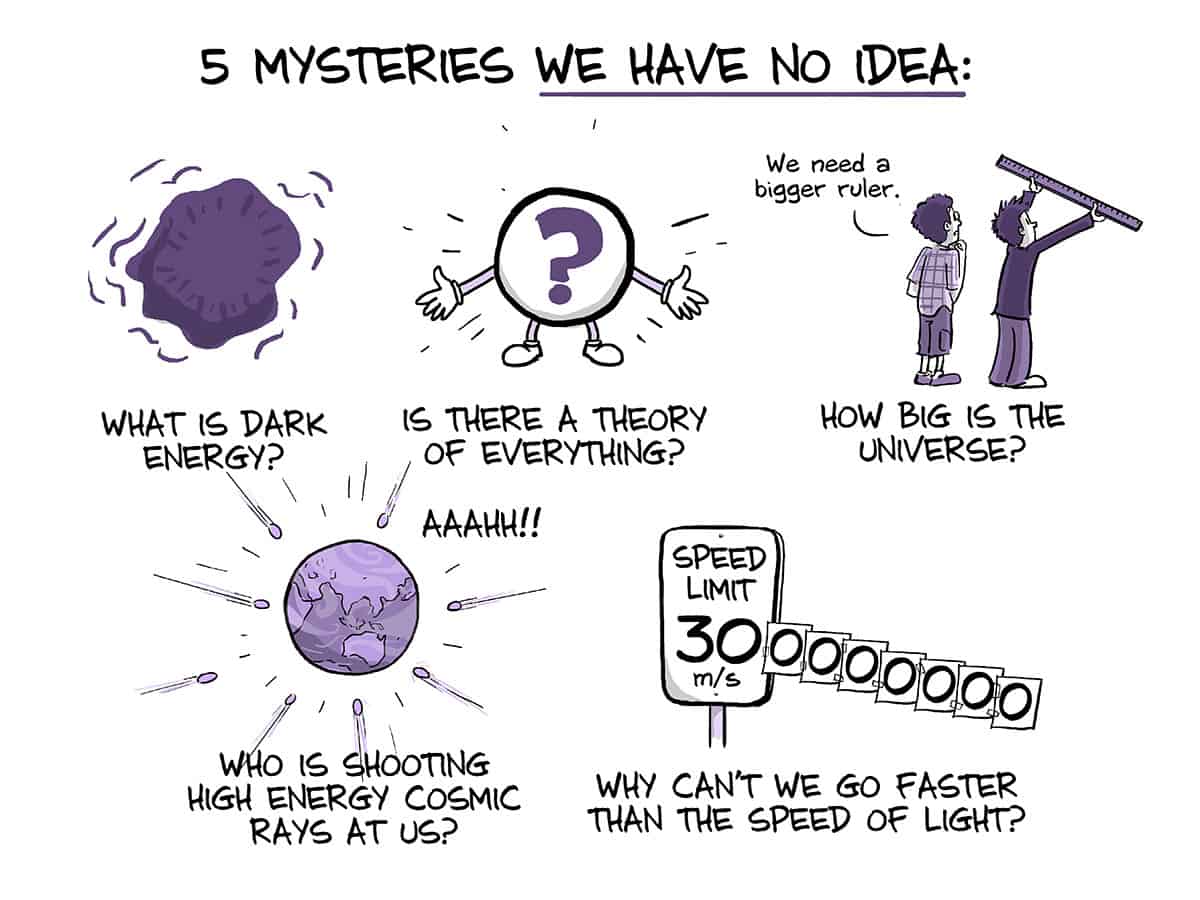
Even more dramatically, this understanding of matter only applies to 5% of the stuff in the universe. About 27% of the universe is invisible “dark matter” and the other 68% is enigmatic “dark energy”, which is science code for “we haven’t a clue”. And the large questions don’t stop there. The nature of basic elements of our universe, such as space, time and mass continue to elude us. We don’t know either how big the universe is, or if we are alone in it.
Writing the book turned out to be quite different from writing a scientific article. First, Jorge and I discussed which questions to cover, picking those that were interesting at face value and did not need a long explanation or scientific training. That ruled out some fascinating puzzles, such as neutrino oscillation. In some cases, such as dark matter, the material was second nature to me, but in others, such as early-universe cosmology, I talked to colleagues who have deeper expertise and did background research.
For each topic, I wrote a first draft, detailing the importance of the question and then exploring the current ideas. Jorge and I then passed it back and forth until we felt it was as clear as possible – often totally reorganizing the material to reflect his skill in making cutting-edge science accessible. The chapter on gravity, for example, split into two: one on the nature of space itself and a second on the mystery of gravity’s weakness. Once the text was finalized, Jorge would draw cartoons to illustrate the points or make jokes to keep the tone light.
We titled our book We Have No Idea to convey our excitement for the future revelations that physics holds, not to criticize modern physics for failing to unravel them. In speaking to the public about our book, I have been amazed at the passionate curiosity that non-scientists display for these frontier questions, which seem to touch a nerve of human curiosity. Be it string theory, aliens or the early universe, everyone from young children to senior citizens has penetrating questions they want answered.
And though our collaboration grew out of independent efforts at procrastination and distraction, it might just be the best thing we have ever done.
By shining laser light at carbon nanotubes containing special defects, scientists in the US and Japan have taken a step forward in the quest to deliver single photons at room temperature and at wavelengths suited to the telecommunications industry. The technique, which would be a boon for developers of quantum technology, allows the researchers to tune the light emitted by the nanotubes across a range of infrared wavelengths, at some of which they showed room-temperature, single-photon emission.
Single-photon emission is a key component of several quantum-information technologies, in particular quantum communication. If a bit of information is encoded in a laser pulse containing many photons, as is the case conventionally, eavesdroppers can steal information by tapping some of those photons. Attenuating such pulses to the single-photon level might seem a good idea, but it does not completely solve the problem because the laser might emit two photons at the same time.
Other applications to exploit sources of single photons could include quantum computing, where photons would play the role of quantum bits. Quantum metrology, meanwhile, would benefit from a true single-photon source because its signal-to-noise ratio would not be restricted by lasers’ “shot-noise” limit (which is equal to the square root of the laser intensity).
From dots to tubes
The ideal source of single photons is an individual atom. Being a two-level quantum-mechanical system, it emits a single photon when a laser pulse excites a single electron and that electron relaxes down to the ground state. Among the technologies developed to imitate this process is the quantum dot, a tiny piece of semiconductor that can emit single photons by virtue of its atom-like structure of discrete electronic states.
Around 15 years ago, physicists showed that quantum dots made from indium arsenide could emit single photons at telecom wavelengths (1.3 to 1.5 µm). Unfortunately, these devices need to operate at cryogenic temperatures (4 K), making them too expensive for practical use. Nitrogen-vacancy defects in diamond can also generate single photons at room temperature, but unfortunately only at visible wavelengths.
The disadvantage of using carbon nanotubes is that these rolled-up sheets of carbon atoms are one-dimensional and so do not naturally have the energy-level structure of a (zero-dimensional) atom. In the latest work, Stephen Doorn at the Los Alamos National Laboratory in New Mexico and colleagues generate electron–hole pairs known as excitons on the surface of a nanotube using a laser beam, and then trap a single exciton within a defect on the nanotube surface such that the electron drops back to its ground state and emits a single photon.
Dips and wells
Such a scheme was first reported by Atac Imamoǧlu of ETH Zürich and colleagues in 2008. That work exploited very slight dips in electric potential on the surface of carbon nanotubes caused by variations in the nanotubes’ environment when they are stored in a liquid suspension and then dispersed on a substrate. Unfortunately, the dips are just a few milli-electronvolts (meV) deep, which is far less than the thermal energy of an exciton at room temperature. As such, the scheme relied on cooling the nanotubes down to 4 K.
To operate at room temperature, Doorn and co-workers add defects that create much deeper potential wells. They did so first two years ago when they introduced oxygen defects with depths of up to 300 meV. But although they managed to generate single photons at room temperature, they found that the emission was unstable – blinking on and off rather than remaining constant – and were unable to tune the emission to telecom wavelengths.
Benzene and ring
Now the researchers have turned to molecules similar to benzene, a ring of six carbon-hydrogen pairs that form a 130–300 meV-deep pit when attached covalently to a nanotube. By varying a nanotube’s diameter, the nanotube plus ring can be made to emit from 1.15 to 1.6 μm at three wavelengths within the telecom band. They have also shown that the modified nanotubes can generate single photons stably at room temperature at wavelengths less than 1.5 μm. Unfortunately, however, at the wavelength most useful for telecoms applications – 1.55 μm – the tubes had to be held at 220 K.
The researchers needed this lower temperature to compensate for detection inefficiencies at longer wavelengths. High efficiencies are important because the process used to demonstrate single-photon emission – spreading out the incident laser pulses in time and then measuring the time delay between successive emitted photons – is very drawn out. But group member Han Htoon] of Los Alamos maintains this problem should not hold them back for long, given the existence of more efficient detectors on the market. “There is no fundamental reason why we couldn’t operate at room temperature,” he says.
Indeed, Milos Toth of the University of Technology Sydney in Australia reckons the latest work “looks like a promising path to practical devices”. But he adds that other technologies, including novel 2D materials and more conventional semiconductors being studied by his group, are also in the running. “It’s not yet clear which material system will prevail,” he says.
Beyond raising efficiencies, Doorn and colleagues will have to show that they can drive the nanotube emitters electrically so as to make chip-mountable devices, with their existing laboratory experiment being driven by a laser that occupies half of an optical bench. “We expect that we can demonstrate an electrically driven photon source within a year or two,” says Htoon. “But integration into a photonic network will take a bit longer.”