The transformation of water freezing into an exotic type of ice has been directly observed for the first time by researchers in the US.
Most of the ice on Earth has a hexagonal crystal structure, but water can transform into more than 15 types of ice, each with a different molecular arrangement. These rare frozen phases require non-atmospheric pressures and controlled temperature environments to form, so can only be produced on Earth in laboratory experiments.
One exotic type is ice VII – a cubic crystal phase that can form at high pressure and high temperature. It is thought that this “hot ice” could be found on the ocean floor of Saturn’s moon Titan and other watery exoplanets. Back on Earth, however, it is difficult to create and maintain ice VII in a lab. Previous studies have attempted to “shock freeze” water using lasers to create pressure changes, but they have not been able to measure its rapid formation or characterize its structure.
Popular topic
“There have been a tremendous number of studies on ice because everyone wants to understand its behaviour,” says team member Wendy Mao from Stanford University. “What our new study demonstrates, and which hasn’t been done before, is the ability to see the ice structure form in real time.”
To create ice VII, the team fire an intense laser at a sample of water sandwiched between a diamond platelet coated with gold and a quartz platelet. The laser light vapourizes the diamond, generating a huge pressure shock 50,000 imes greater than that of Earth’s atmosphere at sea level. The force triggers the phase change to ice VII, with the transformation happening in only 6 ns.
Mao and colleagues recorded the fast phase change with femtosecond-long X-ray pulses generated by the X-ray Free Electron Laser at SLAC’s Linac Coherent Light Source. The X-rays are diffracted by the transforming water, allowing the researchers to characterize the changing molecular structure.
Disorder to order
“These experiments with water are the first of their kind, allowing us to witness a fundamental disorder-to-order transition in one of the most abundant molecules in the universe,” says team member Arianna Gleason. “Learning about the icy interiors [of icy satellites and planets] will help us understand how the worlds in our solar system formed and how at least one of them, so far as we know, came to have all the necessary characteristics for life.”
A significant number of known exoplanets could have larger diameters than previously thought, according to two astronomers in the US. These exoplanets orbit stars that are in a binary system with another star – and it is light from this companion star that has thrown off previous measurements. The work suggests that some known exoplanets are less dense than previously thought, which means that they resemble Jupiter, rather than Earth.
Many of the exoplanets discovered by the Kepler space telescope and other instruments orbit stars in binary systems. It can be difficult to differentiate between the two stars in such systems – which can appear as a single point of light. This is a problem if the exoplanet is studied using the transit method whereby the diameter of the planet relative to that of its star is determined from how much starlight it blocks when it passes between Earth and the star. Astronomers can inadvertently be measuring extra light from the companion star, which means that the measurement yields a smaller diameter for the exoplanet than its actual value.
Large errors
If the exoplanet orbits the brighter of the two stars in a binary system, then the measurement error is small. If the binary stars are the same brightness, the error is about 40% – and can be even larger if the exoplanet orbits the dimmer of the two stars.
The diameter is then used to calculate the density of the exoplanet, which determines whether it is a dense, rocky body like Earth or a gaseous planet like Jupiter. The diameter of the planet is also used to work out how closely the exoplanet orbits its star, which determines whether it lies within the habitable zone where liquid water and life could exist.
Elise Furlan of Caltech and Steve Howell of NASA Ames Research Centre looked into the extent of this problem by looking at Kepler data from 50 exoplanets that had already had their masses and diameters calculated. All of the exoplanets’ stars are in binary systems, but this had only been previously accounted for in seven cases.
Unknown orbit
Furlan and Howell worked out that 35 of the exoplanets orbited the larger star in their binary systems – which meant that their calculated sizes did not change significantly. For the other 15, they were unable to determine which star the exoplanet orbited. Five of these are in systems with stars of similar brightness, suggesting the exoplanets are 40% bigger than previously thought.
“Our understanding of how many planets are small like Earth, and how many are big like Jupiter, may change as we gain more information about the stars they orbit,” says Furlan. “You really have to know the star well to get a good handle on the properties of its planets.”
Howell adds: “In further studies, we want to make sure we are observing the type and size of planet we believe we are.” He adds: “In the big picture, knowing which planets are small and rocky will help us understand how likely we are to find planets the size of our own elsewhere in the galaxy.”
The research will be described in the Astronomical Journal and a preprint is available on arXiv.
The first experimental evidence of a quasiparticle known as a type-II Dirac fermion has been found by three independent research groups – one based in South Korea and two in China. Two of the groups found signs of the quasiparticle in the crystalline material palladium ditelluride. This could mean that the material is a topological superconductor – a hypothetical material with unique properties that could be useful as components in the proposed technology known as a topological quantum computer. The third group found evidence for type-II Dirac fermions in a similar material called platinum ditelluride.
Dirac fermions are subatomic particles with half-integer spin that are not their own antiparticles. Electrons in solids can also exhibit particle-like collective behaviour that can be described in terms of Dirac-fermion quasiparticles, which obey the same physics as their subatomic counterparts. These quasiparticles can exist as a so-called topological phase of matter with unique properties that condensed-matter physicists think could eventually be useful in quantum computing.
A type-II Dirac fermion is a special type of Dirac fermion that has a specific electronic band structure resembling a tilted cone. Prior theoretical calculations suggested that they could be lurking in palladium ditelluride, says Han-Jin Noh of Chonnam National University, who is a member of the South Korean group. To confirm this, his team used a technique called angle-resolved photoemission spectroscopy (ARPES), in which high-energy photons strike the material from different directions, causing the material to emit electrons. The researchers measure the energy and momenta of the emitted electrons and use that data to map out the material’s electronic band structure.
Telltale sign
ARPES measurements were also carried out on platinum ditelluride by Mingzhe Yan from Tsinghua University. Both teams found that the conduction and valence bands meet at a single point called a Dirac or Weyl point. This point is the telltale sign that the materials could harbour Dirac fermions – and in this case, type-II Dirac fermions, because of the specific geometries of the materials’ band structures.
Meanwhile, a group that included Xiangang Wan of Nanjing University in China performed a different type of measurement on palladium ditelluride. The researchers placed the material in a magnetic field and measured its resistivity, which oscillated back and forth. These Shubnikov–de Haas oscillations are also a consequence of the Dirac-point geometry in the material’s electronic band structure, Wan says.
Noh says that the evidence for Dirac fermions in palladium ditelluride is exciting, particularly because the material is also a superconductor below 1.7 K. Since it is a superconductor and can host topological states, it could be an exotic new material known as a topological superconductor. “We still don’t know whether it is a topological superconductor, but we expect it might be,” Wan says.
Anyone for anyons?
Topological superconductors have different properties compared with regular superconductors, says Alexey Soluyanov of ETH Zürich in Switzerland, who was not involved in the research. They could host another sought-after quasiparticle known as an anyon. Anyons could be used in topological quantum computers, a proposed type of quantum computer that relies on topological states of matter that should be more stable than the quantum computers currently being built.
But these technologies are all speculative, and now the teams need to show that the palladium ditelluride actually is a topological superconductor. The groups are also focused on understanding the basic science of these quasiparticles and exotic states of matter. Noh’s group plans to introduce impurities into the material to make its exotic properties easier to access in experiments. “Academically, they are really interesting things,” Noh says. “They’re really something new in the condensed-matter physics world.”
Chinese researchers were paid an average of $43,000 in 2016 for each paper published in Nature and Science, according to a study by information specialists in China and Canada.
Wei Quan from Wuhan University, Bikun Chen at Nanjing University of Science and Technology and Fei Shu at McGill University analysed 168 “cash-per-publication” policies at 100 Chinese universities from 1999 to 2016. The researchers found that Chinese universities offer cash rewards ranging from $30 to $165,000 for papers that are published in journals indexed by Web of Science, with the average amount increasing over the past decade. The largest payouts were for Nature and Science papers, with the average award increasing 67% from $26,212 in 2008 to $43,783 in 2016.
Negotiable awards
They also note that in some cases the amount of cash available for such papers was “negotiable”. Payments for publication in other journals were significantly lower, with the average cash award for a paper published in the Proceedings of National Academy of Sciences $3513 in 2016, increasing slightly from $3156 in 2008.
The pace of change in China can be bewildering – and science is no exception. With every year that goes by, the country publishes more papers, spends more cash on research and opens up yet more world-class facilities.
This is the third Physics World special report on physics in China – following publications last year and in 2011.
Most of this year’s report was based on an action-packed schedule of visits and interviews earlier this year at institutes and labs in Shanghai and Beijing.
Speaking to researchers during my travels, it became clear that China is reaping particular benefits from its 1000 Talents programme, which seeks to persuade top Chinese researchers who have spent time abroad to return home. Such scientists are bringing huge experience back and using it to put China at the forefront of many fields of research.
China is also showing a growing appetite to attract foreign scientists who have not worked there before. Getting overseas researchers to move to China is not always easy, so one solution has been for China to encourage Western institutions to branch out into the country. The Kavli Foundation, for example, has just opened a new Kavli Institute for Theoretical Sciences in Beijing, which aims to have about a third of its faculty from outside China.
Spiders don’t spin when hanging from their webs because their silk dissipates energy by partially deforming when twisted. This is the conclusion of Dabiao Liu from Queen Mary University of London in the UK and colleagues, who have investigated the unusual ability with the hope it can be mimicked in synthetic fibres.
Spiders produce various types of silk, each with different properties for specific purposes. For the outer rim and spokes of their webs, they use dragline silk, which has incredible strength comparable to high-grade steel. Spiders also use this silk to lower themselves from heights. But, rather unusually, spiders do not spin uncontrollably on their threads as they descend. “Spider silk is very different from other, more conventional materials,” says Liu. “We find that the dragline from the web hardly twists, so we want to know why.”
The team tested the silk of two species of golden silk orb weavers using a torsion pendulum experiment. They suspended washers from dragline silk in an isolated environment, thereby removing any external disturbances. Using a turntable, they twisted the silk and recorded the behaviour with a high-speed camera.
Liu and colleagues discovered the silk deforms slightly when twisted, while carbon-fibre and metal wires do not, and therefore causes the washers to spin. This process dissipates more than 75% of the potential energy, rapidly slowing oscillations. When twisting stops, the silk partially snaps back.
The researchers suggest the unusual property is due to the silk’s structure – a core of multiple fibrils surrounded by a “skin”. The fibrils are made of amino acids, some of which are organized in sheets and others in unstructured looping chains. Liu and team believe twisting causes the sheets to stretch, and warps the hydrogen bonds linking the chains. While the sheets return to their original shape when twisting stops, the chains remain partially deformed.
This unique ability to glide gracefully from heights helps spiders avoid startling prey or attracting predators. If scientists can harness the property in synthetic fibres, they could have many applications, such as violin strings, helicopter rescue ladders and parachute cords. Liu and team’s study is presented in Applied Physical Letters.
A theoretical study of nickel at high temperatures and high pressures suggests that the metal could play a crucial role in generating the Earth’s magnetic field. That’s the conclusion of Giorgio Sangiovanni of the University of Würzburg and an international team, which has done calculations suggesting that the thermal conductivity of nickel is much lower than that of iron under these extreme conditions.
The geodynamo model says that the Earth’s magnetic field is created by the flow of liquid iron in the outer core of the Earth. This flow is driven by the convection of heat from the inner core to the mantle. A problem with this model is that the thermal conductivity of iron is predicted to be very high at the relevant pressures and temperatures – and this means that convection should not occur.
Crystal structure
Compared to some other metals, iron and nickel are relatively poor thermal conductors under ambient conditions. At high pressures and temperatures, however, the crystal structure of iron is expected to change – resulting in a large increase in its thermal conductivity. By performing calculations at Germany’s Leibniz Supercomputing Centre, Sangiovanni and colleagues have shown that nickel is likely to retain its crystal structure – and poor thermal conductivity – at high pressures and temperatures.
Writing in Nature Communications, the team suggests that further research is needed into the possible contributions of nickel and iron/nickel alloys to the convection that is believed to be driving the Earth’s magnetic field.
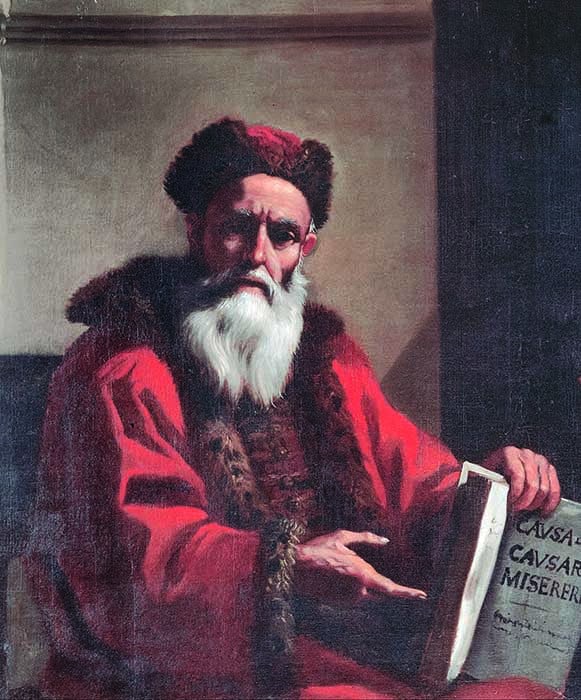
Get me out of here: Plato’s book The Republic tells of Socrates likening the process of education to an escape from a cave. (Painted by Mattia Preti 1649)
I never fully realized the perilous state of the humanities until I read recent remarks by physicists about “Plato’s cave”, one of the oldest and most influential allegories in Western literature. It appears in Plato’s book The Republic, which was written in about 380 BC. In the book, Plato recounts an extended conversation between his teacher, Socrates, and a group of Athenian youths on the nature of justice. Socrates regards education as vital to justice, and at the thematic core of The Republic likens the process of education to an escape from a cave.
Several physicists have recently given their own take on the meaning of this allegory. The Italian physicist Carlo Rovelli mentions it at the beginning of Reality Is Not What It Seems (Penguin 2016), describing scientific thinking – or the fashioning of “novel and more effective images of the world” – as the right way to escape the cave. Meanwhile, in The Greatest Story Ever Told – So Far: Why Are We Here? (Simon and Schuster 2017), US cosmologist Lawrence Krauss says that “Plato’s vision of ‘pure thought’ has been replaced by the scientific method”, which uncovers “the underlying realities of the world”.
So what’s the harm in stretching one’s interpretation of a book written almost 2500 years ago? A lot.
Not what it seems
The allegory – as told originally in The Republic – unfolds as follows. Imagine a cave, Socrates asks his companions, in which a community of people are chained in place so they face a wall, and are captivated by the images they see on it. The process of education unfolds in three steps.
In step one, individuals break free of the bonds and are able to turn around and see that the images are just shadows cast by other objects that a cohort of people are moving back and forth in front of a fire. Today’s teachers often compare that situation to a cinema, in which members of the audience, who have spent their lives thinking that cinema is reality, finally stand up and discover that movies are actually made by filmmakers who selectively display things for the entertainment and control of the masses.
In step two, an individual is dragged up a “rough, steep” path out of the cave and into the light. There, after acclimatization, that individual can see the eternal and unchanging ideas or forms that govern life in that cave. In this second step, the central idea (and hardest to grasp) is the Good, which Socrates compares to the Sun insofar as the Good illuminates and nurtures everything else. Later in The Republic, Socrates illustrates the relation between the ideas seen in the second step and particular examples by pointing out that while there are many beds there is a single concept “bed”, and knowledge involves grasping the concept in the examples.
But the bed example is just a teaching analogy. The ideas that occupy Socrates all have to do with human life, such as justice, truth, knowledge, love and courage. These ideas cannot be disproven or altered but are always at work, however dimly and inadequately, in cave activity. Understanding them is not becoming knowledgeable about, say, cosmology but becoming wise through a process of self-transformation in which one becomes able to be governed by the Good.
Remember it’s only an allegory: Socrates is playing a teacher’s role in trying to motivate Athenian youths, and the story aims to entice them to make the difficult journey up that rugged path. No deep reading is required to see that, in practice, education is a lifelong and never complete process. Thanks to our bodies and our mortality, humans never make it entirely out of the cave, which is their permanent home. Furthermore, there’s a third step in which the educated person, who is aware of the ideas, does not remain contemplating them, but attempts to use the acquired wisdom to interact with the other cave dwellers by returning into the cave.
And there’s another thing too: while the allegory is about education, Plato clearly means it to highlight the obstacles to education as well. One comes from an obsession with spectacle (think of the Internet and social media), which blocks the search for deeper truth. Another comes from powerful individuals who feel threatened by education and expertise, and try to quash them.
My problem with Rovelli and Krauss is their claim that science is the only mechanism to escape the cave and fulfill the educational process described by Socrates. This promotes a distorted and dangerous view of education. It bleaches from the realm of underlying reality anything that has to do with human existence. Socrates was interested in answering the question, “How should we human beings live?” and such an interpretation erases everything he cared about.
The critical point
In the cave, human beings have many different ways of living in which they seek love, prestige, pleasure, friendship, happiness and other kinds of “good” things, and the humanities seek to foster the wisdom that enables living well. Explaining the physical world – producing “effective images” of it – is only one of these ways. While the resulting images may help with other ways of living, they do not supplant them. To suggest that the scientific method replaces other ways of thinking and is the sole way to uncover underlying realities of the world not only fails to understand the cave allegory but also belittles the values and practices of the humanities.
These values include not only understanding ideas like justice but also things like Plato’s cave allegory. Calling science the way to escape Plato’s cave is an invalid interpretation – a dangerous one that attacks the humanities and wisdom they seek to foster. That, to me, is the most extreme hazard.
Volcanoes are intractable, majestic and enigmatic and there is something both primal and terrifying about watching them erupt, even at a safe distance. The juxtaposition of beauty and danger is a heady mix and many people, tourists and scientists alike, are drawn, inexorably, towards them. With that powerful attraction, however, comes risk.
Take the Volcán de Fuego in Guatemala, which rises sharply out of a gently sloping terrain of rich, lush volcanic soil covered in sugar-cane fields. It is an active volcano that has erupted violently more than 30 times in the last two years, and from the observatory where I’m staying, new sunlight bathes its peak, while the steaming plume emanating from the summit appears to glow.
Insects buzz, and students rustle in their sleeping bags as the first light catches their tents. The smell of coffee, good coffee, pervades the air. As a tractor, laden with cane farmers, chugs slowly past, it is impossible not to feel inspired by the backdrop. I know their day will be tougher than mine, but I retreat in solace to thinking about how our research should make them safer.
Deadly location
I am in Guatemala with a group of other volcanologists and engineers from the UK, and we are here to work with local scientists to investigate the volcano’s current activity and to examine how emissions from it affect the local population. It’s vital work because if Fuego erupted as strongly as it did in October 1974, the blast would devastate Guatemala and its people, more than 100,000 of whom now live within 10 km of the summit.
Among the dangers are the deadly avalanches of hot gas and rock that occur with alarming regularity. Indeed, these “pyroclastic density currents” (PDCs) are the biggest killers from volcanoes. Then there are the large mudslides that cascade down Fuego’s flanks every rainy season. Finally, there is the fine ash, which is produced whenever the volcano erupts and carpets the entire area, including local villages. Although it’s responsible for the wonderfully fertile local soil, the ash risks the health of those who breathe it in.
There is a lot we still need to know about the volcano’s activity and its hazards. In particular, we want to learn how to predict when the next eruption will occur and which valley any lava and PDCs will flow down. Our aim in regularly monitoring Fuego is therefore to get a better understanding of the volcano so that local people can take the best possible decisions next time it erupts. Unfortunately though, our task is not as simple as it sounds.
The summit of the Fuego volcano is inaccessible; it’s just too dangerous to get to the very top. You can’t get closer than 1 km from the peak and the nearest villages lie about 6 km away. This year we’ve therefore come armed with three different types of drone – or unmanned aerial vehicle (UAV), to use the jargon. It’s not the first time people have flown drones over volcanoes, but ours are geared more for research. So far we’ve used off-the-shelf cameras that can collect live data but we’re also developing different types of more specialized cameras to capture information.
During our first drone mission, we get a good view of the summit crater. Gustavo Chigna, Guatemala’s leading volcanologist and my collaborator for nearly 20 years, smiles broadly. He tells us it’s the first time he’s seen the summit in five years, the previous occasion being with a fixed-wing plane. The beauty of drones is that they give volcanologists a new, low-risk way of accessing volcanoes. Indeed, we’re moving beyond simply observing volcanoes with drones and starting to carry out proper, scientific measurements.
Fuego is an incredibly dynamic volcanic system. Its topography changes on timescales so rapid they feel alien to the two geologists on our team. Outcrops – exposed deposits from previous eruptions – are transient, sometimes vanishing in a single rainy season. As for the seven or eight valleys carved into Fuego’s side, they are constantly being filled by PDCs and eroded by mudslides. If a valley is full of material, the next flow might instead pour down the mountainside, which means that the valley and the local gradient of Fuego dictate the exact nature of any hazardous flows .
One project we’ve been working on is to create a detailed 3D topographical map of Fuego, which we would use to calculate how material flows down the sides of the mountain when it erupts. Unfortunately, an individual 2D image taken by a drone is not enough on its own. Using it to work out how lava flows down the mountain would be like pouring a cup of coffee on a flat photograph rather than over a papier-mâché model of the volcano. We therefore take many images of Fuego from about 60 different viewpoints and combine them using an off-the-shelf software package, such as Agisoft, in a process called structure from motion (SfM).
To do this, we need to know the precise location of the drone each time it captures an image, which we obtain using GPS trackers attached to the drone. The resulting map, or topographic digital elevation model (DEM), can be created in a few hours while we’re out in the field and consists of an array of numbers each of which corresponds to an elevation at a particular point on the volcano. Thanks to close-up pictures of the volcano taken by the drone (figure 1), each map has a resolution of a few centimetres, which is far better than the 30 m value from commercial DEM packages.
1 Close-up view A small ash explosion from the Fuego volcano, captured by a Phantom 3 drone. (Courtesy: University of Bristol, Cambridge & INSIVUMEH)
In practice, it is not easy to map those parts of the volcano where the drone images have low contrast (such as older lava flows), contain transparent bits (such as the plume), or have few features present. However, we can calculate the topography of valleys quickly and easily as they have good contrast and we’re mapping something solid, rather than a fluid-like plume. This work raises the tantalizing possibility of one day being able to map valleys in real time and so produce much more accurate predictions of where and how far material will flow. Our work is revolutionizing hazard prediction from volcanogenic flows.
Analysing the ash
Volcanologists don’t just rely on optical measurements, however. Ground-based cameras and satellite sensors can yield information about volcanoes at ultraviolet and infrared wavelengths too. So by using drones, we now have another way of studying volcanoes using these radiation bands.
Infrared light is particularly valuable as we can use it to calculate the heat flux from a volcano, to map and model the flow of lava, and to determine the composition of the lava from the precise frequencies the volcano emits. We can also use this infrared light to measure the amount of ash, carbon dioxide, sulphur dioxide and other gases, by working out how strongly they scatter and absorb thermal infrared light. Indeed, the beauty of using drones is that they give us a way of verifying satellite measurements of the amount of ash emitted by volcanoes. Whether the drones match the satellite data or tell a different story, however, is something we can’t yet tell.
The other important aspect of observations of volcanic emissions is that they are a proxy for what’s happening out of view. For example, in a volcano with an open vent that is producing sulphur dioxide, any jump in the rate of emission tends to signify that the volcano is about to erupt. Conversely, if the vent closes up, any drop in emissions could mean pressure is building up and the volcano is about to explode.
We shouldn’t forget either that volcanic emissions are dangerous. Gases such as sulphur dioxide are toxic to humans, plants and animals, while the ash particles, if small enough, can cause cancer. And if the ash ends up in the engine of an aeroplane that happens to be flying by, it can damage the turbine and, in extreme cases, cause it to cut out entirely. Rain can also turn ash into catastrophic mudslides, potentially sending it tens of kilometres further afield, creating a secondary hazard to people living relatively far from the volcano. Estimates suggest there’s enough ash on the flanks of Fuego to generate mudslides for the next 20 years, even if the volcano never erupts during that time.
Unfortunately, there are big uncertainties when using infrared observations to determine the size distribution of volcanic ash particles as we have only a handful of wavelength bands at our disposal. These particle-size distributions are important as they are largely responsible for dictating the fate of an ash cloud and are an important parameter in models that predict where ash goes in the atmosphere after an eruption. In fact, until recently, volcanologists relied on a particle-size distribution in the range 1–100 µm that had been measured in 1989 by Peter Hobbs, an atmospheric scientist from the University of Washington in the US, which was used to manage large swathes of global airspace. The problem is that this single distribution is unlikely to be characteristic of all ejected volcanic ash, which depends a lot on the amount and crystalline structure of silica in a volcano, as well as on how it erupts.
Another key aim of our project at Fuego has therefore been to capture and examine volcanic ash in situ using drones. It’s been done before using balloons flying over a number of volcanoes in places such as Costa Rica and Indonesia, but those missions have only been at high altitude – typically about 10 km up. That makes it tricky to control a balloon so that it flies where you want it to go; although it will fly rapidly through a plume in a horizontal direction, if you happen to miss the plume, you can’t redirect the balloon.
During our last trip the engineers on our team managed to get a drone known as a “quadcopter” close enough to make observations of Fuego’s vent and of the plume of gas from a second volcano, Pacaya. We also flew a fixed-wing aircraft through Fuego’s ash clouds for the first time.
The future’s up in the air
Drones are giving volcanologists unprecedented access to – and high-quality data for – areas that were unthinkable even a decade ago. My prediction is that it will become routine to use drones to monitor volcanoes over the next few decades – all we need is for physicists, engineers and geologists to continue working together. In the short term, my colleagues and I are all heading back to Guatemala later this autumn to continue our effort. We’re all excited by the prospect, and can’t wait to get back into the air.
How to study volcanoes with drones
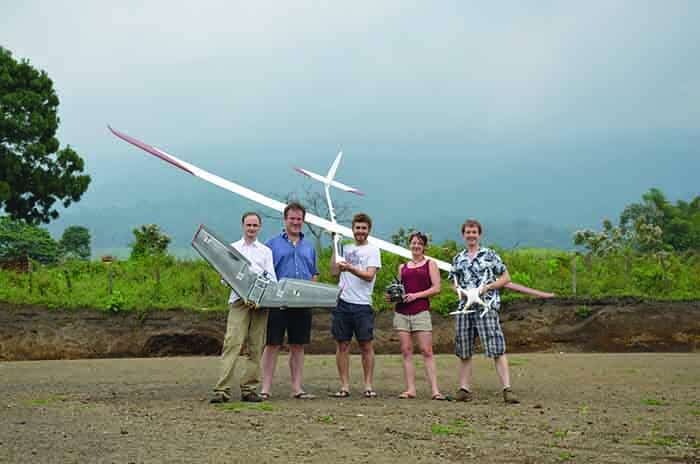
Inside information: the author and colleagues are mapping and monitoring Volcán de Fuego using unmanned aircraft. (Courtesy: Matthew Watson)
The engineers on the UK team studying the Volcán de Fuego in Guatemala have trialled three systems for flying over this dangerous volcano, all of which are powered by electric engines. The first is an off-the-shelf DJI Phantom 3 Pro quadcopter with a standard 4K camera (bottom right in photo). This drone has let us create 3D maps, known as digital elevation models, of both the summit crater and the valleys down which hazardous material travels. These models have, in turn, helped us make predictions about the timing and direction of the next eruption and what materials it might contain. To this system we’ve also added an infrared camera from the US firm Therm-App, which we’ve used to survey lava flows. Unfortunately, we can’t add any more kit as the quadcopter’s maximum payload is only 300 g.
The second system we’ve used is a Ritewing Zephyr 2 delta-wing aircraft (bottom left in photo), which has a wingspan of 1.5 m and can carry a payload of 800 g. We have used it to collect ash samples from the volcano by sticking adhesive tape on its leading edges and installing a filter pack with pump on the front. The craft also has a series of lightweight sensors that monitor air pressure, temperature and relative humidity. The beauty of this system is that because the ash sensors are on the front but the craft is powered by a rear-mounted propeller, we reduce the number of fine particles lost from air disturbance.
Our final system for studying the Volcán de Fuego is a small glider known as a Thermik XXXL (rear of photo). Launched using a catapult, it has a 5 m wingspan and can carry a 1.1 kg scientific payload. Although this craft has a front-mounted propeller, it can be folded backwards in flight so the aircraft glides through the plume. We’ve already trialled the glider and our plan now is to fit it with both gas and ash sensors, along with a pointable infrared camera.
Despite more than 30 years of campaigning by learned societies and community interest groups, the statistics for women in science are grim. In the UK, girls make up one-fifth of A-level physics classes and only 9% of professional engineers. Although it has become trendy to talk about diversity, to offer “women in science” scholarships and to decorate laboratory walls with photographs of women in lab coats, there are still external forces at play that prevent women from being as successful in science as their male counterparts. In Inferior: How Science Got Women Wrong and the New Research That’s Rewriting the Story, author Angela Saini puts forward the idea that bad science has been used to endorse the cultural prejudice that women are both biologically and psychologically second rate to men.
The book contains an impressive collection of studies spanning psychology, biology and neuroscience, which highlight misconceptions – such as claims that women are “better at multi-tasking” or “don’t like playing chess” – that have become ingrained into our society, but have no scientific basis. An engineer by training, Saini makes complicated studies accessible for non-specialists: studying humans is a completely different discipline from most physics research. The language is clear and non-judgemental and Saini makes her case with meticulous detail, taking care to remain non-biased throughout. Inferior is not a collection of complaints about the lack of women in science. Instead, it is an objective critical analysis into what research has overlooked.
This is an admirable mission. Throughout the book Saini travels long distances only to interview people who seem to have made it their life’s work to prove women are weaker than men. For example, Saini was at an event promoting her previous book Geek Nation when she was approached by an audience member who made derogatory comments about women’s academic achievement. This is one of very few personal anecdotes in the book and serves to remind the reader of the need for this kind of work.
It was only in 1993 that it became a requirement to involve women as subjects in medical trials. It is well documented that women live longer and are more resilient to certain diseases, but there has been little biological investigation as to why. We are introduced to the gender studies of Simon Baron-Cohen – a professor of developmental psychopathy at the University of Cambridge, who has spent years trying to find differences between the brains of men and women – that are now open to serious questioning. Saini’s wit makes even the most depressing studies light and easy to read. In his own book The Essential Difference, Baron-Cohen’s description of the hobbies of those with a “male brain” (DIY, programming, tweaking sound systems) are lazy and dated, and Saini points out they are also painfully middle class and English.
Saini describes that something as simple as a misworded press release with a flashy headline can be reproduced in national newspapers, and our interpretation of such information is usually shaped by any prejudices we already have. Inferior transitions seamlessly from the human to the animal kingdom, where we have chosen to extend our human stereotypes. She visits zoos, observes animals and talks to experts. The public are likely to be familiar with the well-documented studies of controlling male baboons and hierarchical male chimpanzees; whereas we rarely read of the aggressive female bonobos or promiscuous bluebirds. She points out that if brain size is linked to intelligence, we’d expect blue whales to outwit us all.
There are an estimated 100 trillion synapses in the human brain – 1000 times more than the number of stars in the galaxy. The invention of functional magnetic resonance imaging (f-MRI), which maps brain activity, allows us to identify parts of the brain associated with specific tasks. Simple and seductive, neuroscience offered the promise of understanding everything from emotions to addiction. f-MRI became the 1990s go-to technique for characterizing gender differences. But the statistics were sloppy, and bold claims made using small sample sizes, combined with questionable peer review, led to results that could not be reproduced. In 2009 in a lab at Dartmouth College in the US, neuroscientist Craig Bennett famously recorded brain activity in a dead Atlantic salmon. His study demonstrated the dangers of statistical errors in f-MRI.
The book began as an investigation into the science behind menopause. Until the late 1930s it was regarded as a disease – one that drove women mad. Treatments were, at worst, lethal and varied from being sent to an insane asylum to poison. Once endocrinology had revealed the hormonal changes behind menopause, scientists tried to fix it. By the 1960s American drug companies were selling hormone-replacement therapy as an anti-ageing elixir. The “youth-restoring blend of oestrogen” promised to keep women attractive and interesting. In the 1990s dangerous links between oestrogen-replacement therapy and cancer were found, not to mention an increased risk of heart attack and stroke. Today, hormone-replacement therapies are much more regulated and prescribed only for short periods of time – and the medical jury is still out on just how safe and effective they are. Male academics still claim that menopause is nature’s way of saying older women aren’t sexually attractive. Through discussion with acclaimed primatologist Sarah Hrdy at the University of California at Davis in the US, Saini demonstrates that menopausal women are far from useless. The “grandmother hypothesis” describes how older women who look after the second generation enhance social networks and ensure genetic survival.
Inferior is an engaging and harrowing study that easily moves between eras, continents and disciplines. Saini is a meticulous researcher whose attention to detail is evident in her interviews with scientists behind some of the biggest results in neuroscience and psychology. Instead of writing around the issue of representation of women in science, Saini identifies what science has got wrong about women. Her research demonstrates it is the scientists themselves who are partly to blame, peppered with in-built prejudice from centuries of cultural conditioning. It is my hope that this important book encourages scientists and educationists of the need for more evidence-based approaches to ensure equality and diversity in science.


 This is the third Physics World special report on physics in China – following publications