

Nathan Myhrvold – the polymath physicist whose passions range from cosmology to cooking – is publishing a massive, five-volume book about the science of bread and bread-making. To find out what happened when Physics World columnist Robert P Crease caught up with this intellectual livewire at his Cooking Lab headquarters in Seattle, see this free-to-read article from the October 2017 issue of Physics World.
Atoms and Josephson junctions simulate 1D quantum liquid
A theory that describes how quantum particles interact with each other in 1D has been put to the test by two independent teams of physicists. In one experiment, aspects of the Tomonaga–Luttinger theory were verified using laser-trapped ultracold atoms. The other study made use of superconducting devices. Confirmation of the theory could lead to the development of new technologies based on nanowires and other 1D systems. Applications include electronics, sensing, energy harvesting and quantum information.
Tomonaga–Luttinger theory describes a 1D ensemble of interacting quantum particles in terms of a Tomonaga–Luttinger liquid (TLL). It predicts properties of 1D quantum systems such as how electrons behave in a nanowire. Testing these predictions in a systematic way has not been possible, however, because it is very difficult to control how particles interact in 1D systems such as nanowires.
Quantum simulator
One way forward is to create an analogous quantum system such as an ensemble of trapped ultracold atoms, in which parameters such as particle interactions can be controlled. While there has been some progress in studying TLLs using quantum simulators, challenges remain. One problem is that a TLL has a homogenous distribution of particles whereas most quantum simulators have spatial order. Ultracold atoms, for example, are held in a 1D lattice with regular spacing.
Now, Bin Yang, Yang-Yang Chen and colleagues at the University of Science and Technology of China have overcome this inhomogeneity problem in an ultracold-atom simulator. Their experiment begins with a regular 1D array of rubidium-87 atoms trapped in an optical lattice of laser light. A laser pulse is then used to eject atoms from the central region of the trap, which sets off a density wave that moves outwards from the centre of the trap. The atomic density in the central region of the trap becomes nearly uniform, thus providing a homogeneous analogue to a TLL.
TLL parameter
By measuring the density and speed of sound in the central region, the team could work out the “TLL parameter” – which measures the level of quantum fluctuations in the system. Yang, Chen and colleagues then measured the momentum distribution in the system and confirmed that it was as predicted by the TTL model.
Meanwhile at the University of New South Wales, Timothy Duty and colleagues took a very different approach. They made their quantum simulators using lines of superconducting material that are interrupted by Josephson junctions at intervals of about 1 μm. In this case, the quantum particles are the Cooper pairs of electrons that are responsible for superconductivity.
Disorder versus interactions
Josephson junctions are non-superconducting regions through which the Cooper pairs can tunnel. There is inherent disorder in the materials used to make simulators and this results in slight differences in the number of Cooper pairs at each junction. By studying simulators with different sized junctions – and therefore different levels of disorder – Duty and colleagues were able to look at how disorder and particle interactions compete against each other to determine the properties of the TLL. When interactions dominate, for example, the system behaved as a superfluid. But when disorder prevails, the system became glass-like with no flow.
Both studies are described in Physical Review Letters.
What happened to the GW170817 neutron stars after the merger?
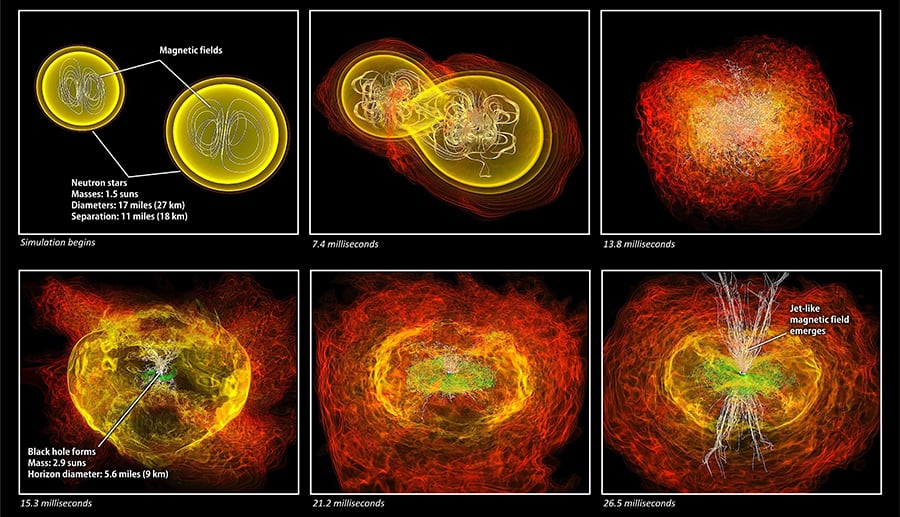
One of the many open questions raised by the first-ever gravitational-wave observation of a neutron-star merger is what happened to the two neutron stars in the aftermath – did they form a black hole or a neutron star, or both?
The gravitational-wave signal from the LIGO–Virgo detectors provides clear evidence that the merger involved two neutron stars with a combined mass of a small black hole. However, exactly how the two bodies joined together could not be observed because the frequency of the gravitational waves given off just before and during the merger were too high frequency to be seen in the detectors. Furthermore, there was no post-merger signal observed from the object created in the collision.
Four possible outcomes
There are four possible outcomes of the merger, according to Jim Hough of the University of Glasgow. One involves the two neutron stars merging to form another neutron star. Or a “hypermassive neutron star” could be formed, which would decay in less than a second into a black hole. The third option is the creation of a “supermassive neutron star” that decays into a black hole within a few hours. The final possibility is the direct formation of a black hole.
The merger produced a gamma-ray burst that is associated with the formation of a powerful jet of material being ejected from the merged object. Unfortunately, this does not narrow the options, according to Francesco Pannarale of Cardiff University, because such a jet could be formed by either a black hole or a rapidly spinning neutron star. “It’s not clear cut which one we have seen,” says Pannarale.
Missing X-rays
However, Phil Evans of the University of Leicester points out that if the merger had formed a neutron star that lasted for more than a few hours, then a characteristic X-ray signal should have been observed. “We have comprehensively ruled that out,” he says, “So if there was a neutron star, it did not last very long”.
Indeed, there is some evidence in favour of short-lived intermediary neutron star in the ultraviolet radiation that was detected shortly after the merger. “This would involve a source of neutrinos, which could come from the surface of a hypermassive neutron star,” explains Evans. “So it’s possible that a neutron star was formed at least for a very short time – but we can’t be certain.”
- There is much more about neutron-star mergers and other cosmic events that can be studied by LIGO–Virgo in the Physics World Discovery book Multimessenger Astronomy
The physics of sperm: the movie
By James Dacey
Luke Skywalker et al. re-entered the public imagination recently with the release of the trailer for Star Wars: the Last Jedi. But where that movie takes you on a galactic adventure, a new short web film by the Wyss Institute in the US takes you on a swashbuckling tour of the microscopic – tracking animated sperm on a mission to fertilize an egg.
The Beginning is based on collaborative work between a pair of researchers at the Wyss Institute for Biologically Inspired Engineering at Harvard University. Founding director Don Ingber teamed up with the biophysicist/professional animator Charles Reilly to seek an atomic-level understanding of sperm movement. Combining molecular dynamics simulations with film animation software, they have visualized how a sperm tail moves based on scientific data.
“Applying an artistic process to science frees you from the typically reductionist approach of analysing one particular hypothesis and teaches you a different way of observing things,” says Reilly. Now a staff scientist at the Wyss, Reilly previously worked at Hollywood film director Peter Jackson’s Park Road post-production facility in New Zealand. The goal for this latest project was to create a film that captures the public imagination but also depicts valid scientific models.
In the classic Star Wars trope, tilted text drifting off into space informs viewers: “Countless agents have been deployed, and are on their way, each willing to sacrifice its life to complete the mission.” The agents in this adventure are individual sperm cells, propelling themselves through the darkness with their whip-like tails towards an egg. Tension-filled classical music heightens the drama, as the film realistically depicts the mechanics of how sperm move, [spoiler alert] culminating with one Jedi sperm penetrating the egg membrane to trigger the creation of new life.
At one point, the film zooms in on the tail – known as the “axoneme” – revealing it at a range of scales. We see a tube comprising pairs of microtubules arranged in a column around a central pair. Zooming in further, we see rows of motor proteins called “dyneins” attached to the microtubules, which exert the required force for the system to bend and thrust forwards. According to the researchers, the unique features of their simulation is its consistency across the range of scales. They say it even sheds new light on the specific biomolecular process that ultimately enables sperm to travel in the required direction. By their own omission, it was tricky to find a journal willing to publish the work (probably due to its novel approach), but the findings have now been published in ACS Nano.
“Science is the pursuit of the unknown,” says Ingber. “We have a responsibility to reach out to the public and convey that excitement of exploration and discovery, and fortunately, the film industry is already great at doing that.
Ingber is no stranger to interdisciplinary research, in fact the entire Wyss philosophy is based on teaming people with varied backgrounds, as he explained in this interview for the recent Physics World special report on the US. Ingber also features in this recent Physics World film (below) about a Wyss project to recreate human organs on chips. The goal of that project to develop an alternative to drug-testing on animals and pave the way to personalized treatments.
What gravitational waves did (and didn’t) tell us about GW170817
By Hamish Johnston
The GW170817 neutron-star merger was by no means an instantaneous event. Physicists working on the LIGO-Virgo gravitational-wave detectors were able to watch the two stars spiral towards each other for about 100 s before they merged. Valuable information about the neutron stars has been gleaned from the observation, but the detectors were unable to see the merger itself and its aftermath.
In “The gravitational-wave story of a neutron-star merger”, Jocelyn Read of California State University Fullerton takes up the story at 17 min before the merger. Then, the neutron stars would have been be separated by about 700 km and have an orbital frequency of about 10 Hz.
Read goes on to explain how the system slowly came into view as its frequency increased to about 30 Hz at about 100 s before the merger. As more data were accumulated and the frequency increased, she explains how key parameters such as the masses of the neutron stars were worked out.
In the final 2 s before the merger, the neutron stars were close enough for tidal forces to cause significant distortions of their shapes. This would affect the rotation of the system and should become apparent in the signal as its frequency reached hundreds and then thousands of hertz. Analysis of the high-frequency signal has not revealed any evidence for such distortions – which puts important limits on the radii of the neutron stars and the nature of the matter they contained.
Above 2000 Hz, noise overwhelmed the signal, so scientists could not follow the last moment before the neutron stars coalesced. Also, there was no high-frequency post-merger signal detected so the ultimate fate of the system is not known. There is good evidence, however, from electromagnetic observations that a black hole was in existence shortly after the merger.
Read’s piece appears on CQG+ blog, which is brought to you by the journal Classical and Quantum Gravity. The blog will no doubt be a source of many more nuggets of knowledge about GW170817.
Optical trap reveals molecular tension
Cells must sense, respond to, and exert mechanical signals to navigate their physical surroundings. Recent advances in single-molecule manipulation techniques are now allowing researchers to study how mechanical signals interact with individual biomolecules. And an interdisciplinary team at Stanford University in the US has now exploited these techniques to reveal how one key biomolecule strengthens under mechanical tension in an orientation-dependent manner. Their findings, reported in Science, have important implications for our understanding of cell movement (Sciencedoi: 10.1126/science.aan2556).
According to William Weis, a professor in structural biology at Stanford, the importance of these mechanical phenomena cannot be understated. “Mechanical signals are key in countless critical biological processes, including embryonic development, immunity and cancer metastasis,” he explains.
Two components of the cell have received significant attention in this field: the cytoskeleton and adhesion complexes. “The cytoskeleton gives the cell its structure and generates the mechanical force needed for movement, while adhesion complexes are found on the cell’s exterior surface and anchor cells to surrounding tissues,” continues Weis. These complexes also contain mechanosensors – biomolecular machines that measure the mechanical properties of nearby objects.
You can compare a cell crawling across a surface to an ice-climber using axes to climb up a wall of ice. The climber’s back and arm muscles are like the cytoskeleton, generating the force needed to pull her up. As the climber ascends, she uses her axe both to check the strength of the ice and to pull herself up, analogous to the way a cell uses an adhesion complex for mechanosensing and adhesion.
However, a critical factor in this process is the climber’s hand, which links her force-generating muscles to the axe. Similarly, the cell has special biomolecular machinery that links the force-generating cytoskeleton to the adhesion complex.
Vinculin is a protein that does just that. While there are several different types of adhesion complexes containing vastly different biomolecular machinery, vinculin is one of the few known biomolecules that plays a role in all of them. Recent studies have shown that vinculin’s role as a one-size-fits all connector is critical for several cellular tasks such as unidirectional movement.
The team sought to study the effect of mechanical force on individual vinculin molecules. “Using a single-molecule technique called the optical trap, we attached single cytoskeleton fibres to single vinculin molecules and then pulled the two apart at a constant force,” explains Alex Dunn, a professor in chemical engineering. “Importantly, the high precision of the optical trap enabled us to tug with forces between 1 and 30 piconewtons, which is comparable to forces exerted by single biomolecules in live cells.”
The interdisciplinary team then measured the length of time that the vinculin molecule stayed attached to the fibre. Surprisingly, the team found that the vinculin could hold on for longer as they tugged with stronger forces. That result is counterintuitive; if our ice climber concentrates all her weight on one of her hands, then her forearm will tire out and she’ll be able to hang on for less time.
The team revealed that vinculin forms what’s known as a “catch bond” with the cytoskeleton fibre. It turns out that many biomolecules form catch bonds, and we now know that catch bonds are a critical factor in explaining how cells respond to mechanical signals.
As the team analysed the data, they started noticing that the catch-bond behaviour depended heavily on the orientation of the cytoskeleton fibre. This finding suggested that vinculin interacts differently with the cytoskeleton, depending on whether the fibre is pushing out to the cell’s edge or pulling in to the cell’s centre.
To illustrate how this finding could help explain cell behaviour, the team ran simulations of cytoskeleton fibres stochastically drifting over stationary vinculin molecules. The team found that the simulated fibres met much higher resistance due to vinculin binding when drifting backwards, which would result in a faster net motion of the polymerizing cytoskeleton out towards the cell’s outer edge. These findings could help explain how cells are able to crawl unidirectionally across a surface.
“This paper really points out that it’s important to think about how the cytoskeleton is organized. You have an adhesion molecule, vinculin, that not only senses force, but also senses its local cytoskeletal architecture,” says co-author and biophysics graduate student Derek Huang. The team is currently digging deeper into their findings to understand the biomolecular machinery that enables directionally-dependent catch-bond behaviour. They are also searching for this behaviour in other important adhesion molecules.
Neutron star merger as it happened
By Hamish Johnston
At 12:41:20 UTC on 17 August, the Fermi Gamma-ray Space Telescope sent a notice to the astronomy community saying that it had detected a gamma-ray burst. Normally such an event wouldn’t raise much fuss – but this time things would be very different.
Back on Earth, scientists working on the LIGO-Virgo gravitational wave detectors were busy analysing a signal that had arrived about 2 s before the gamma-ray burst and looked very much like the merger of two neutron stars. Such a cataclysmic event is expected to give off copious amounts of electromagnetic radiation including an initial burst of gamma rays.
LIGO-Virgo sent its first notice at 13:21:42 saying that it had spotted a neutron-star merger and by midnight the team was already telling other astronomers where to point their telescopes to capture light from the event.
At 01:05:23 on 18 August, the Swope Telescope at Cerro Las Campanas in Chile was the first to report seeing an optical signal. As well as detecting the first visible light from a neutron-star merger, Swope also had the first-ever view of a “kilonova”. Hitherto hypothetical, this is a huge explosion that astrophysicists now know produces heavy elements including most of the gold in the universe.
The floodgates then opened and sightings came fast and furious from dozens of other optical, infrared, radio and X-ray telescopes. The era of multimessenger astronomy was well underway less than 24 h after the first observations by LIGO-Virgo and Fermi.
You can read a minute-by-minute, telescope-by-telescope account of this amazing observation in “Multi-messenger observations of a binary neutron star merger”, which is free to read in The Astrophysical Journal Letters.
Spectacular collision of two neutron stars observed for first time
Astronomers have made one of the biggest breakthroughs of the decade after detecting both gravitational waves and gamma rays from the merger of two neutron stars. Announced today at a co-ordinated set of media briefings in Washington DC, London, and elsewhere, the detection was made on 17 August, with the gravitational waves spotted by the LIGO–Virgo collaboration and the gamma rays picked up by the Fermi Gamma-ray Space Telescope. The observations prompted astronomers to point dozens of different telescopes and detectors around the world, and in space, at the origin of the signals in a distant galaxy. Together, these facilities captured radiation from the aftermath of the merger across the electromagnetic spectrum from gamma rays to radio waves.
As well as being the first-ever example of “multimessenger astronomy” involving gravitational waves, the observations have yielded important clues about how heavy elements, such as gold, are produced in the universe. The ability to measure both gravitational waves and visible light from neutron-star mergers has also given a new and independent way of measuring the expansion rate of the universe. In addition, the observation settles a long-standing debate about the origin of short, high-energy gamma-ray bursts.
Given the far-reaching impact of the new measurements, rumours were circulating for weeks in advance of today’s announcement. Sheila Rowan, director of the Institute for Gravitational Research of the University of Glasgow in the UK and a LIGO team member, is thrilled at “the sheer versatility” of the observations, saying that “exciting science has already been done with many firsts being reported”.
Up all night
The gravitational-wave observation, dubbed GW170817, is the loudest ever seen in both US-based LIGO gravitational-wave detectors, which are in Hanford, Washington, and Livingston, Louisiana. A somewhat weaker signal was seen by the Virgo gravitational-wave detector near Pisa, Italy. Virgo had on 14 August detected its first gravitational wave from a black-hole merger, which not only told scientists that the detector was working properly but also suggested that the GW170817 signal came from a direction that Virgo is least sensitive to.
The merged neutron stars seen in the GW170817 event likely formed a black hole with a powerful jet, which produced the gamma rays that were also observed. Information from the three detectors enabled the LIGO–Virgo team to limit the location of the merged neutron stars to about 28 square degrees of sky. A battery of telescopes and other instruments was then able to pinpoint the source to galaxy NGC 4993, which lies about 130 million light-years from Earth.
Among those involved in the search was Nial Tanvir from the University of Leicester in the UK, who says that astronomers immediately triggered observations on several telescopes in Chile to search for the explosion that they expected the merger to produce. “In the end we stayed up all night analysing the images as they came in, and it was remarkable how well the observations matched the theoretical predictions that had been made,” he says.
The gravitational-wave signals were measured for about 100 s, whereas those from previous black-hole mergers lasted less than about 1.5 s. This longer measurement time reduced the uncertainty in the location of the merger, while the shape of the signal allowed astronomers to estimate the masses of the neutron stars to each be about 1.1 to 1.6 solar masses. The amplitude of the signal gives the distance to the source to within a 30% margin of error.
High-energy gamma rays from GW170817 were detected in the form of a short burst, some 2 s after the gravitational waves. Astronomers had suspected that such bursts are caused by neutron-star mergers, but had little understanding of how it happens. “We confirmed that colliding neutron stars power short gamma-ray bursts, solving one of the greatest mysteries in present-day high-energy astrophysics,” says Francesco Pannarale of the University of Cardiff in the UK.
The prompt arrival of the gamma-ray signal also confirms that gravitational waves travel at the speed of light, while the ability to observe light and gravitational waves arriving from distant objects will allow physicists to perform more stringent tests of Einstein’s general theory of relativity.
Neutron matters
The gravitational waves produced in GW170817 were given off by the two neutron stars as they spiralled inwards. As stars approached each other, their shapes can be distorted by tidal forces. The amount of distortion depends on the state of matter in the star and how the matter is distributed. Such distortions would affect the gravitational-wave signal, but were not seen in GW170817. Mark Hannam, who is also at Cardiff, says that this has allowed astrophysicists to already rule out certain models of what that matter could be like.
Unfortunately, the LIGO–Virgo collaboration was unable to detect gravitational waves from the precise moment the neutron stars merged, as the frequency of those waves was too high to be seen by the detectors, meaning that the gravitational-wave astronomers were unsure if the pair formed a neutron star or a black hole. According to Jim Hough of the University of Glasgow, there are four likely scenarios. One involves the two neutron stars merging to form another neutron star. Another is that a “hypermassive neutron star” could be formed, which would decay in less than a second into a black hole. The third option is the creation of a “supermassive neutron star” that decays into a black hole within a few hours. The final possibility is the direct formation of a black hole.
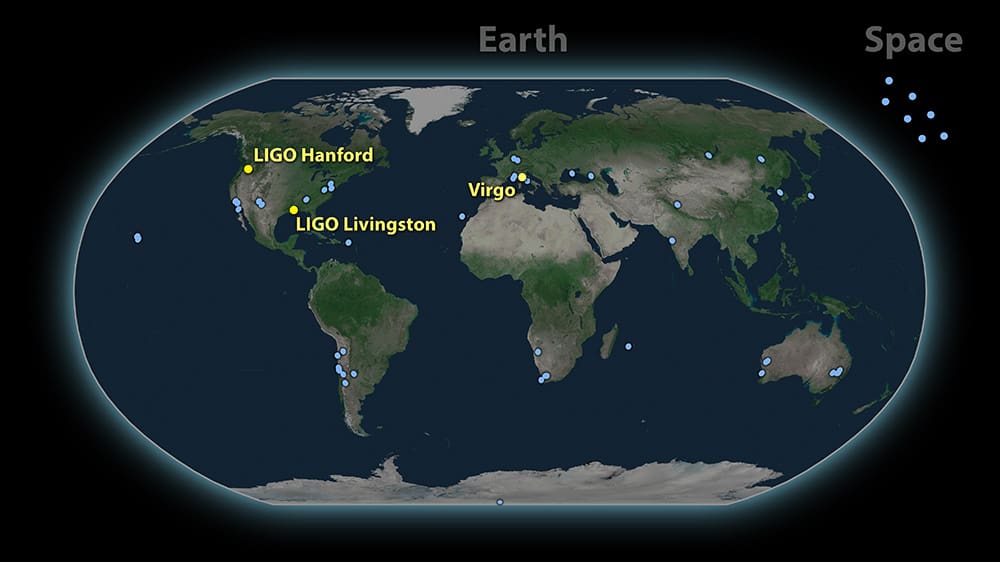
Subsequent observations by as many as 70 other telescopes, however, suggest that the ultimate result of the merger was a black hole surrounded by an accretion disc of material. As this material was sucked into the black hole, a fast-moving jet of material blasted outward along the black hole’s axis of rotation. When this jet collided with gas in the galaxy, it started slowing down and the lost kinetic energy was broadcast as gamma rays. Because Earth is roughly in the same direction as the GW170817 jet, astronomers were able to detect those rays.
As it moved outward from the black hole, the jet slowed down and the energy of the emitted radiation dropped too. This explains why emissions of lower-energy X-rays, visible light, infrared and radio waves were also all detected in the weeks after 17 August. Indeed, astronomers are still observing signals from GW170817 two months on.
Forging heavy elements
One important early result of seeing GW170817 – according to Imre Bartos of the University of Florida in the US – is evidence for the creation of elements heavier than iron in the neutron-star merger. Such elements are believed to be created within neutron-rich heavy nuclei ejected during the merger. These nuclei then radioactively decay to stable heavy nuclei, and the radiation given off causes the surrounding ejecta to glow. This glow was first detected in GW170817 by the relatively small Swope Telescope in Chile. “Then after some initial observations the big guns came in and took very detailed measurements that gave us a lot of information,” says Bartos. “These include the US Gemini Observatory, the European Very Large Telescope and NASA’s Hubble Space Telescope.”
Kate Maguire of Queen’s University Belfast in Northern Ireland says that astronomers have discovered that this neutron-star merger scattered heavy chemical elements, such as gold and platinum, out into space at high speeds. “These new results have significantly contributed to solving the long-debated mystery of the origin of elements heavier than iron in the periodic table,” she says.
Look back in time
These spectacular observations have also given astronomers a new way of measuring the Hubble constant, which is the rate of expansion of the universe as a function of distance from Earth. Indeed, Hough points out that obtaining such a technique was one of the initial reasons why LIGO and its European precursor GEO were built. The measurement is made possible because knowing the amplitude and polarization of a gravitational wave lets astronomers determine the distance to its source. And being able to see the galaxy of origin, they can determine the redshift of its light, and hence the velocity it is moving away from Earth. Based on these distance and velocity measurements, the resulting Hubble constant calculated from GW170817 agrees with independent observations.
“As gravitational-wave detectors improve,” says Hough, “we will be able to look further into the past to measure the Hubble constant.”
After just two months of observation, GW 170817 is already one of the most studied object outside of the solar system, Bartos told Physics World. “We are still learning a lot and data will be analysed for years to come.” Perhaps more importantly, Bartos does not see this as a singular or rare observation. “We will,” he says, “see many more of these events in the future.”
The observations are described in a number of papers published in The Astrophysical Journal Letters, Physical Review Letters, Nature and Science.

- There is much more about neutron-star mergers and other cosmic events that can be studied by LIGO–Virgo in the Physics World Discovery ebook Multimessenger Astronomy
The great detector: a visit to LIGO Livingston
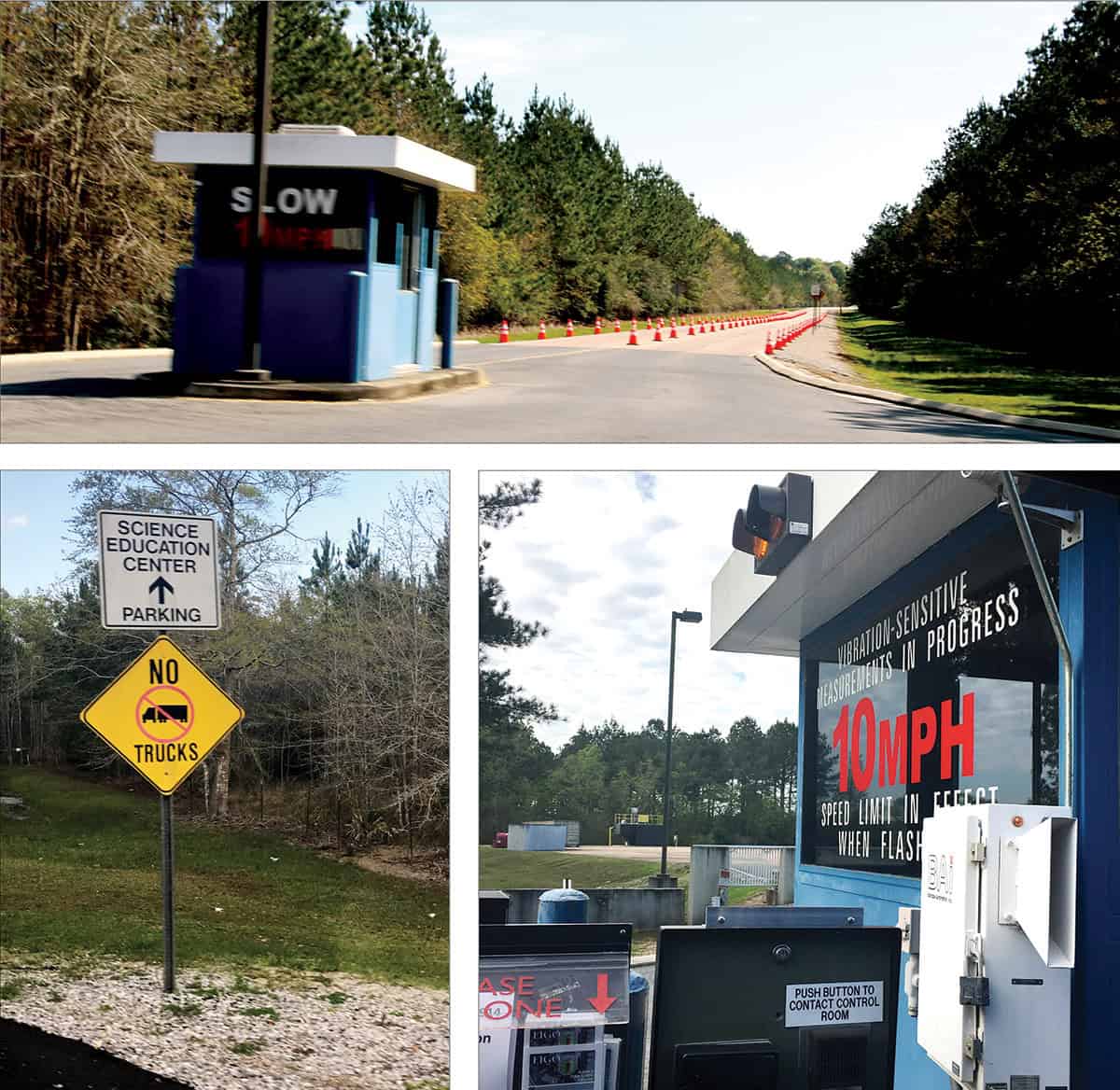
The road to LIGO Livingston is paved with orange traffic cones.
I’m in a taxi with my Physics World colleague Sarah Tesh, having driven up from New Orleans, where we’d been attending this year’s March meeting of the American Physical Society. We’ve turned off the main highway that links the city of Baton Rouge to the sleepy town of Livingston, and are heading along a secluded road through dense pine forest. Our destination is the sprawling Laser Interferometer Gravitational-wave Observatory (LIGO) complex, but there’s no indication that a world-class laboratory lies just around the corner.
After about eight miles, we turn off into the aptly named LIGO Lane and finally see a sign adorned with the blue-and-white LIGO Livingston logo. We’ve almost reached the site of this giant interferometer, which – along with its counterpart in Hanford, Washington – has for 15 years been silently collecting data in the search for gravitational waves, those “ripples in space–time” that Einstein first predicted. Sarah and I know we’ve finally arrived by the presence of a long row of flashing lights and traffic cones, not to mention a bold, red “10 MPH” sign and another stating: “Vibration-sensitive measurements in progress”.
The LIGO Scientific Collaboration (LSC) became front-page news last year when its members announced in February that they had finally made the first ever direct observations of gravitational waves. These were created when two black holes, of 36 and 29 solar masses, respectively, merged to form a spinning, 62-solar-mass black hole, some 1.3 billion light-years away in an event dubbed GW150914. Since then, the collaboration has detected gravitational waves from two further black-hole mergers and also bagged the 2016 Physics World Breakthrough of the Year award.
History makers
Our host for the day is Amber Stuver, a LIGO scientist and lecturer at Louisiana State University, who is now at Villanova University as an assistant professor. She greets us as we pull into the parking lot at snail’s pace, past the “no trucks” sign, and wander into the main building of one of the most amazing experiments ever built. After showing us around their children’s exhibit space – built in partnership with the Exploratorium museum in San Francisco – our first stop is the main control room for the whole Livingston site.
Every bit of desk and wall space is adorned with dozens of monitors and screens. It’s a confusing and colourful view, as half the screens are covered in data and graphs, while others stream live-feeds from different parts of the site. Stuver tells us that the detectors are gathering data as part of the second observational run, which began in November 2016, and she introduces us to the crew at hand. We meet Michael Fyffe, who is one of the lead operators, as well as LIGO staff scientist Joseph Betzwieser from the California Institute of Technology and LSC fellow Andrew Matas from the University of Minnesota.
The LSC Fellows programme includes people from all over the US, and indeed the world, who visit the site for short periods and take part in an instrumental project with a staff scientist. In addition to staff on site, LIGO also has a slew of instrumental scientists all over the world who study the machine when it is online, making notes of what can be changed or fixed during the next “commissioning phase” once the current run is over.

As we know now, the LIGO detectors were at the end of one such phase when they made their legendary first detections on 14 September 2015 – a discovery widely tipped to win a Nobel prize. Indeed, as I chat to Betzwieser – who works on the calibration of the interferometer – he tells us he was there the night before “doing some calibration measurements”, along with other colleagues who were performing “physical environmental monitoring injections”, which basically involve “taking giant speakers and blasting sound into the instrument” to see how it appears in the actual detector.
“We eventually knocked off around 4 a.m. that night and a few hours later the gravitational wave came in,” Betzwieser recalls. “So the next morning was quite interesting! But if any of us had decided to keep working past 4 a.m., we would have actually prevented the interferometer from detecting that very first event.” On such small moments, history can turn. “I was very happy that I went to sleep early that night!” Betzwieser laughs.
During a run, there is always at least one operator in the control room to fix the detector if anything goes wrong – day or night. “Many of these systems are almost completely automated, but in the end you still need a human,” says Stuver. Matas, for example, studies the LIGO site and its detectors on a daily basis, keeping remote workers abreast of the situation on the ground. He even monitors the impact of aircraft on the detectors, which are so sensitive that they can pick up the sound of a plane flying overhead, which shows up as noise in the data. The LIGO team therefore uses an array of microphones set up across the site, which record information about passing planes.
Pickin’ up bad vibrations
As we look around the room, Stuver points to an important screen that shows a live feed of the “nice Gaussian laser beam, round and bright in the middle”, which is currently bouncing around in the arms’ “resonant cavities”. She explains that the detectors’ arms are aligned such that one is half a wavelength shorter than the other, so that destructive interference occurs at the output (meaning that it is dark when there is no detection). In case of an actual observation, there are “extra photons that become statistically significant,” Stuver adds.
Suddenly, the monitors’ flag up an earthquake somewhere off the coast of Colombia. There are seismometers scattered around the entire site, as well as along the detector’s arms, making LIGO – strange though it may seem – one of the best earthquake detectors on the planet. As we pore over Fyffe’s monitor, he pulls up the latest data from the US Geological Survey (USGS) and we learn that it’s a magnitude-5.2 quake. That’s “not big enough to break lock”, but it does throw up some noticeable spikes on the wall monitor labelled “earthquakes”.
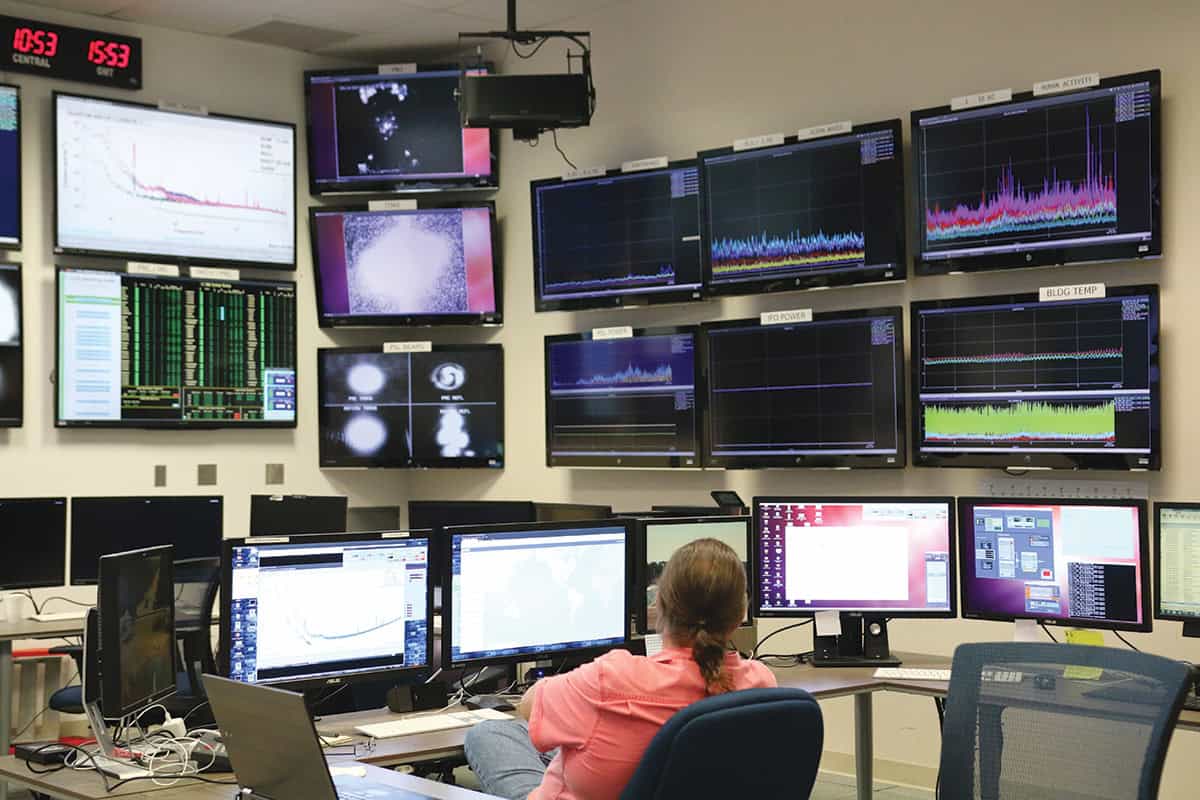
The neighbouring monitor picks up “ocean waves”, which Fyffe tells me are more of a continuous background rumble of noise – their machine is sensitive enough to constantly pick up waves in the Gulf of Mexico. Indeed, Fyffe adds that a magnitude-6 earthquake anywhere on the global sea makes “the whole earth vibrate like a bell, and we see dozens of these a week”. He recalls their detectors going “off the charts” during the devastating magnitude-7 earthquake and its many aftershocks in Haiti in 2010.
A third screen, which monitors all of the noise produced by “human activity”, is probably the busiest and also the most local. Pointing to a specific large spike on the monitor, Fyffe tells us those are the ground vibrations from our taxi pulling into the parking lot; while a much larger and longer subsequent spike was most likely thanks to a large freight train that trundled over the nearby tracks a while ago. Despite all of these seemingly unending sources of noise and disturbance, the detector is “about as best as we can get it,” says Fyffe, adding that their new suspension is good enough that it can ride out even a big earthquake.
“The system is getting so good that even if the lock does break, we are up and running again in no time,” Stuver interjects. When LIGO staff talk about the detector being on “lock”, they mean the machine being perfectly set up to take data. “All the [Fabry–Pérot] cavities are locked in alignment and the sensors are active,” explains Stuver. On a good day, it takes the team about 20 minutes to go from lock to “science mode” where they begin making observations and taking data. Most of this set-up is automated, but Fyffe adds that any odd kink in the system requires him to intervene.
Off kilter
As we chat, a small hoard of school girls from a nearby academy, who are also visiting the site, troop into the control room. They seem fascinated by the many monitors and promptly start firing questions at their teacher, who encourages them to speak to the scientists at hand instead. Soon though, there is a sudden commotion in the control room – the machine’s alignment has gone off kilter and they have lost the “lock”. The girls are ushered out as Fyffe and the others begin to assess the situation. It’s bad news for LIGO staff, but great for Sarah and me as the intervening downtime lets us walk along one of the interferometer’s two arms, which would be forbidden if the detector were running.
While a stray bullet would not badly damage the detector pipes, it would affect data-taking
Stuver ushers us into her car and we begin another slow crawl, along one of the 4 km-long arms, that are dubbed X and Y. As we drive through the pine forest, Stuver tells us that hunting is common in these parts. Indeed, one unforeseen problem in LIGO’s early days was that bullets would occasionally hit the arms as hunters chased deer and fowl through the trees. While a stray bullet would not badly damage the detector pipes, it would affect data-taking. The surrounding forest therefore has a series of elevated wooden hunting-hides that point away from the detector, thereby getting around this particular issue and allowing the locals to continue hunting.
Stuver informs us that LIGO’s civil engineers also had to take Louisiana’s 500-year floodline into consideration while creating the Livingston detector. They had to build above it, as burying the entire detector underground would have been expensive and difficult due to the high water-table. More importantly, engineers also had to correct for the curvature of the Earth, which amounts to more than one vertical metre over the 4 km length of each arm. To make sure that each arm was perfectly level along its entire length, the engineers built GPS-assisted, earth-moving, reinforced concrete floors that are up to 75 cm thick, which minimize seismic vibrations too.
X marks the spot
As we finally reach the far end of the X arm, I can’t resist stepping gingerly out of the car as even hopping on the spot – Stuver warns – would be picked up by the detector because we are so close to it. She adds that LIGO’s ultrahigh vacuum – which comprises a staggering 353,000 cubic feet (≈ 9996 cubic metres) of vacuum at 10–9 torr (1.33 × 10⁻⁷ Pa) – has never been released since it was first established in 1999, a task that took 40 days of constant pumping. During upgrades, the arms are sealed off as most of the equipment is held at either end.
LIGO staff constantly monitor the vacuum using ion pumps to extract stray gas molecules, though it’s impossible to set up a good vacuum in the end sections and the corners where most of the work is done. “So we bathe those sections holding the instruments in liquid nitrogen once we finish working there and basically freeze the arms and thereby freeze any gas molecules there,” explains Stuver, pointing to a giant, two-storey-high tank sitting just outside the building that houses the X arm’s far mirror.
Fyffe and the others in the control room have now got the detector back up and running, but they don’t know what went wrong in the first place. “These things just happen sometimes,” he shrugs, and so we head back to the main buildings where the two arms meet. This is the corner-station where the laser originates and is sent through a beamsplitter, down the two arms (see box above).
We’re just in time to meet with Brian O’Reilly, who is LIGO Livingston’s main run co-ordinator. It’s his job to ensure the detector is running smoothly, as well as co-ordinate with the sister site at Hanford. O’Reilly catches up with the operators at the end of every shift, several times a day, as well as the detector engineers. “If we get an event alert, which often happens in the middle of the night, then my phone goes off and I have to log in and join a discussion where we decide whether to share the event with electromagnetic observers,” he explains, referring to the observatories and telescopes around the world that LIGO alerts in case of an event.
How aLIGO detects gravitational waves
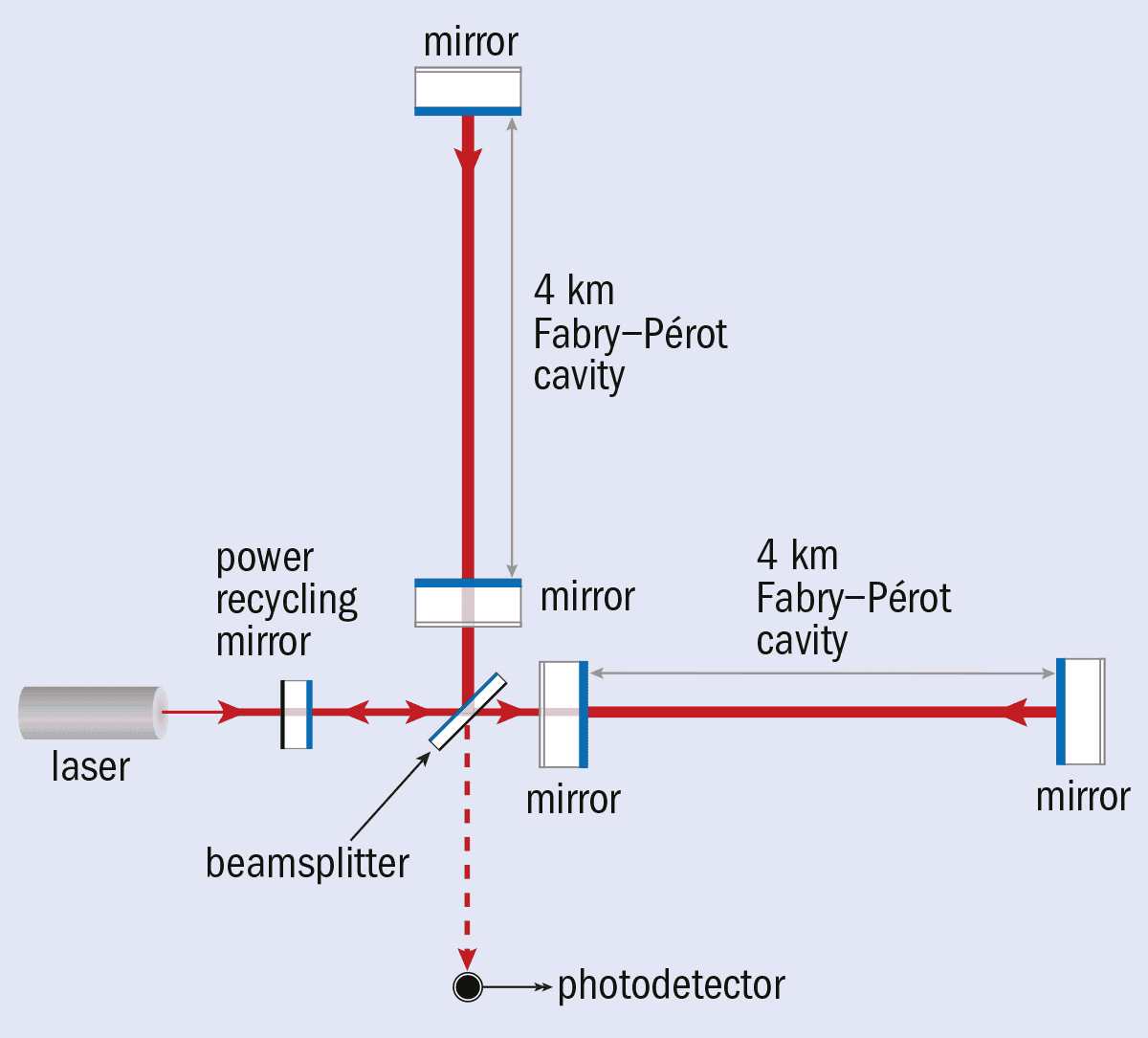
Following the completion of a $200m upgrade in 2015, Advanced LIGO (aLIGO) was ready to detect gravitational waves. The two observatories are essentially Fabry–Pérot interferometers consisting of two 4 km-long arms at right angles to each other, with “test masses” in the form of pure silicon primary mirrors – each weighing 40 kg and suspended as a pendulum – at both ends of the arms. Both interferometer arms are housed in an ultrahigh vacuum. The interferometers also have a “power-recycling mirror”, which can boost the laser power from 200 W to 750 kW. Despite these upgrades, even a strong gravitational-wave signal displaces a mirror by barely 10–19 m.
During a run, laser light with a wavelength of 1064 nm and a power of 20 W is sent to a beamsplitter, which transmits one half of the light into one of the arms and reflects the rest down the other arm. As each arm itself is a Fabry–Pérot cavity, the light is allowed to bounce back and forth some 400 times in each arm, effectively increasing the arm length to nearly 1600 km and thereby boosting aLIGO’s sensitivity.
After the bounces, light from each arm returns to the beamsplitter, where the two beams combine. Some of this light is again transmitted through the beamsplitter and is detected at the photodetector. If the light travels exactly the same distance down both arms, the two combining light waves interfere destructively, cancelling each other so that no light is observed at the photodetector. But if a gravitational wave slightly stretches one arm and compresses the other, the two beams would no longer completely subtract each other, producing an interference pattern at the detector. This pattern contains information about how much the two arms have lengthened or shortened, which in turn tells us about what produced the gravitational waves.
However, aLIGO does not actually measure the change in path length, which is itself affected by a passing wave. Instead, it measures tiny shifts in the period of the two beams – if the crests or troughs of the wave arrive out of synch, they produce an interference pattern, meaning that the laser actually acts as a clock and not a ruler.
On the edge
From this current run, which ended on 25 August, O’Reilly is really hoping that they pick up a neutron star event. “[That could be] either a neutron-star binary inspiral event, or a neutron star and a black hole…but I think our sensitivity is maybe at the edge of seeing something like that, so we would require a little bit of fortune,” he says. As Physics World went to press, rumours were circling that LIGO has indeed picked up one such event, but there has been no official conformation.
I ask O’Reilly about what a regular day at LIGO looks like for him, working in a wild and beautiful location, on such a big experiment. “I have young babies and they wake me up in the early hours of the morning… so I’ll typically call the operator and see how the night went. I can look online at our performance and see at a glance how things went, but I’ll call if there has been a problem and we will discuss it and see if some intervention is required.”
From all the people I’ve spoken to through the day, the highly collective nature of the entire collaboration is obvious and to me is a clear feature of their success. “I think it’s an exciting time for gravitational-wave astronomy,” says O’Reilly. “Over the next four or five years we will probably make – hopefully make – no, we will make more exciting discoveries and really set the stage for the next generation of detectors, guiding where we will look and what type of things we will see.”
As we slowly drive back up LIGO Lane, I wonder if the team members have already made any more detections, but are keeping quiet while they confirm their findings. As it happens, I was right – LIGO announced its third detection this June, having picked up the waves on 4 January. Those ripples that LIGO has been chasing after may be tiny, but the impact they are having on modern astronomy is, I am sure, going to be huge.
Nanosheet actuators lift 150 times their own weight
Transforming electricity into movement is a challenge at the root of technologies from robotics to drug delivery, and is performed by a device called an actuator. Researchers in the US have presented an electrochemical actuator made from nanosheets of molybdenum disulphide (MoS2) capable of lifting 150 times its weight consistently over hundreds of cycles. The device can be cycled at up to 1 Hz, which is much faster than the rate achieved until now by similar devices.
MoS2 has a structure similar to that of graphite, with layers of strongly bonded atoms, but weak bonds between the layers. This means it can be exfoliated to form nanosheets, which are then restacked to form thin films with high surface-to-volume ratios. Large amounts of electrochemical charge can be stored in the material as ions by a process known as ion intercalation, which is the same mechanism used in the electrodes of rechargeable batteries. Writing in Nature, Manish Chhowalla and colleagues at Rutgers University describe how the material can harness the movement of these ions to drive an actuator over useful length scales.
Ion intercalation makes movement
The principle underlying the researchers’ device is the mechanical strain exerted from ion intercalation. Positive ions intercalate into MoS2 when it is placed into an appropriate ionic solution. The ions act to pull the negatively charged nanosheets closer together, which makes the material contract in the out-of-plane direction. This results in expansion in a perpendicular plane, causing the structure to become longer and thinner.
The extent of the size change depends on the concentration of intercalated ions, which Chhowalla and his team varied by applying a voltage between the MoS2 film and a reference electrode also in the solution. When the voltage of the film is negative with respect to the solution, more positive ions are intercalated within the material and it lengthens. A positive voltage repels the cations and shortens the film.
To translate this effect into motion, the researchers used a flexible Kapton beam as a substrate for the MoS2 film. By applying a voltage across the system, the change in length induced a strain in the substrate, causing it to bend and serve as an actuator.
So many materials
Read more

Actuator performance
Chhowalla and his team found that a voltage that alternated between -0.3 V and 0.3 V was enough to force a useful degree of movement from the plastic beam. The cycle frequency of the driving voltage was varied, and achieved a maximum beam oscillation of around 1 Hz. Although the magnitude of induced curvature begins to reduce at speeds faster than about 0.8 Hz, this is still a much greater rate than that demonstrated by similar devices, which typically operate at only 0.00025 Hz.
The researchers measured the curvature over more than 8000 cycles at 0.2 Hz, and found no signs of degradation. This is a promising indication that the device is robust to both electrochemical and mechanical fatigue. The team also demonstrated that a lifting device using the coated strips was able to lift 150 times its own weight.
The technique that the research team at Rutgers University has presented is clearly an impressive proof of concept. What remains to be seen is how an actuator within an ionic solution can be developed into a useful device, and whether it can be scaled up.
Copyright © 2026 by IOP Publishing Ltd and individual contributors