An artificial buffer composed of a photoionizing material released into space at the edge of Earth’s magnetic field could hold off powerful solar storms that potentially pose a risk to modern civilization.
The plan to put a buffer in place is called StormWall, proposed by space plasma dynamicist Brian Walsh of Boston University, and Dan Welling and Zhenguang Huang of the University of Michigan.
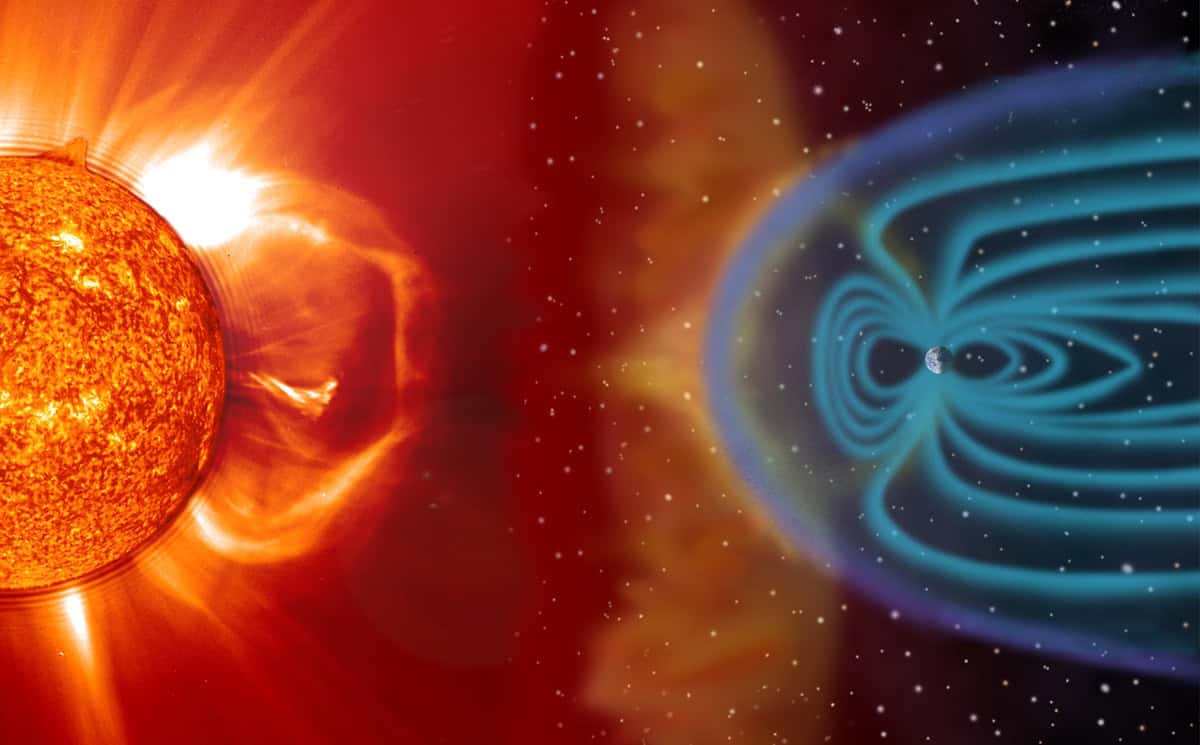
Solar storms are triggered when a coronal mass ejection (CME) on the Sun launches a vast cloud of charged particles towards us. If this cloud hits us, the charged particles can overwhelm Earth’s magnetic field. Magnetic reconnection, the process of magnetic-field lines snapping under pressure from the solar storm and joining back together, inputs much of the CME’s energy into Earth’s magnetosphere, where it can make its way down to the surface via charged particles stored in Earth’s radiation belts.
“Magnetic reconnection is the gateway by which energy comes from the Sun into Earth’s space environment,” Walsh tells Physics World.
The efficiency with which magnetic reconnection accomplishes this is governed by the magnetic field’s strength and direction, plus the density of plasma – ionized atoms and molecules – in Earth’s magnetosphere. The stronger the field strength and the lower the plasma density, the more energy reconnection deposits on the Earth.
Bolstering our defences
Although we cannot change the magnetic-field strength, “we can increase the plasma density by depositing material into space that can be photoionized,” says Walsh.
Nature already does this to a modest extent. Atoms and molecules leak from the upper atmosphere and are photoionized by solar ultraviolet light. This involves knocking an electron off an atom or molecule, thereby giving it an electric charge that allows it to interact with the magnetic field. The ionized materials follow natural “drift paths” along magnetic-field lines to the edge of the magnetosphere.
StormWall intends to bolster these natural defences by adding large quantities of material. In their work, Walsh, Welling and Huang suggest that a group of six spacecraft placed in geosynchronous orbit and each carrying the equivalent of a dozen fuel tankers’ worth of material would provide enough of a shield to ward off a solar storm. However, Walsh says that ultimately a greater number of smaller spacecraft might be more efficient.
“There is an economy of scale and the potential for international collaboration when the number of spacecraft becomes bigger,” he says. “The beautiful thing is that there’s not a lot of complicated technology in it.”
The key component is the material, and Walsh and his team have looked at a range of materials, particularly alkalines such as lithium and sodium.
“The most important thing is that it has to photoionize relatively quickly, and alkaline materials are great for that,” says Walsh, who highlights salt water, which is rich in sodium, as one possibility.
Simulations indicate that such a plasma buffer could cut the intensity of a solar storm by half as the bulk of the solar plasma is diverted around us, in the same way that stream-water flows around a stone.
Expensive problems
StormWall would not be a perfect solution. For one thing, it would be mightily expensive to launch – Walsh’s estimate is in the same region as the $4 billion Artemis II mission, maybe a little less. Furthermore, StormWall is a one-shot deal. After the photoionizing material is released, the space tankers will be left dry and more spacecraft will have to be launched to replace them.
StormWall would also require perfect timing. The photoionizing material would only remain in Earth’s magnetosphere for about six hours before dissipating into space. Releasing it at the right time to coincide with the arrival of the CME is paramount. This would require consistent accuracy in predicting space weather, which would be dependent on better modelling and more spacecraft observing the Sun in stereo so that CMEs can be tracked.
Walsh’s team is currently exploring ways to bring the cost down and make the process more efficient, such as a staged release of material that lasts longer in the magnetosphere, or a more suitable orbit that enables a more targeted release of material.
The Carrington Event revisited
In 1859, a solar storm of such ferocity hit Earth that it prompted telegraph wires to catch fire from the energy that it dumped into electrical systems. This storm is known as the Carrington Event and, if it took place today, the total damage could exceed $2.4 trillion. Our entire modern way of life, revolving around electrical grids, data centres, banking systems, the Internet, satellite GPS and communications, would be affected. Following the powerful solar storms of May 2024, which saw the Northern Lights visible for several nights as far south as the Bahamas and the Canary Islands, the cost to farmers in the US alone who lost GPS signal for their precision tractor farming was at least $500 million. So while several billion dollars to launch StormWall is expensive, the cost of not launching could be far higher, argues Walsh.
Unfortunately, Walsh does not see a great deal of movement from governments or businesses to try and protect ourselves.
“There is a very small United Nations group that thinks about this, but there’s little action,” says Walsh. “In 2018 the US’s Department of Homeland Security reported on the most likely threats that we are not paying attention to. Number one was a pandemic, and number two was a solar storm.”
Solar storms could be forecast by monitoring cosmic rays
With private companies now owning more assets in space than governments, the onus is increasingly on both billionaires and politicians to take pre-emptive action to mitigate the effects of a catastrophic solar storm.
“We are vulnerable, but StormWall would be in a good position to do something about it,” says Walsh.
Walsh, Welling and Huang report their proposal in Space Weather.