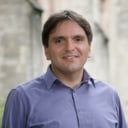
Mary Bishai is an experimental neutrino physicist at Brookhaven National Laboratory in the US
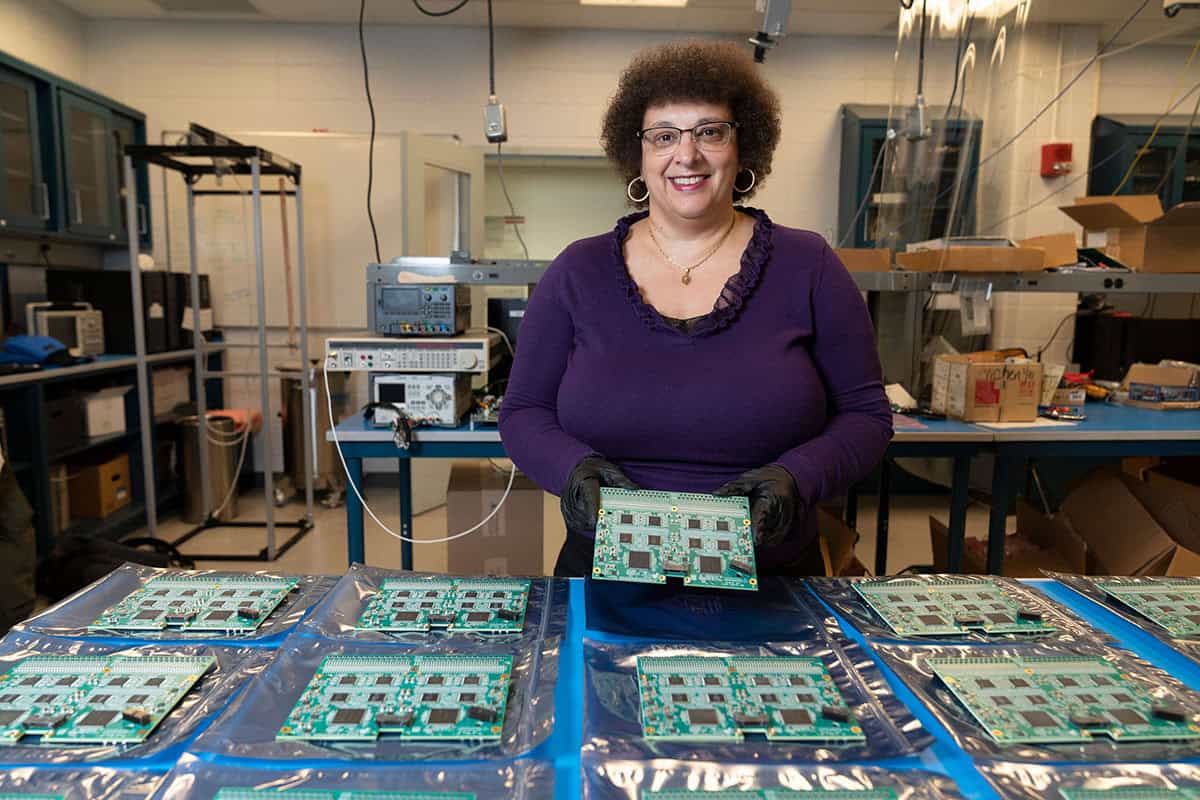
Born and raised in Egypt, Mary Bishai studied physics at the University of Colorado, Boulder, US, before doing a master’s and PhD, also in physics, at Purdue University. After a post-doc at Fermilab, she joined Brookhaven National Laboratory in 2004, where she is now a distinguished scientist. Bishai served as co-spokesperson for the Deep Underground Neutrino Experiment (DUNE) from 2023 to 2025 and, over the years, has collaborated on many other leading particle-physics projects, including MicroBooNE, the Daya Bay neutrino experiment, the Main Injector Neutrino Oscillation Search, the CDF experiment at Fermiab, and the CLEO experiment at Cornell University. In 2026 she was elected fellow of the American Association for the Advancement of Science.
What skills do you use every day in your job?
I enjoy brainstorming. If I am having a mental block or get stuck in a technical or personal interaction issue, I walk down the hall to chat with a colleague about their work – even if it isn’t related to my own problem. This serves two purposes. First, it helps ameliorate the feelings of loneliness and frustration to discuss your challenges with others. Second, a surefire cure for any mental block is to divert your attention to a different topic. Another essential skill is to try to play devil’s advocate with myself and colleagues. My team finds this infuriating sometimes, but it’s vital – you need to be your toughest critic.
What do you like best and least about your job?
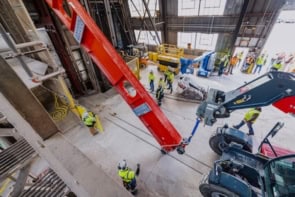
For a self-professed nerd like me, doing big science is heaven. I get to geek out on a broad set of technical and scientific challenges and work with lots of really cool experts from a variety of disciplines. Recently, for example, as part of DUNE, I’ve been looking at designs for the infrastructure that houses the Long Baseline Neutrino Facility. Located at Fermilab near Chicago, it will send the world’s most powerful beam of neutrinos to a detector in an underground lab 1300 km away in South Dakota.
In any given week, I might find myself discussing the mechanical engineering of detectors or learning about the civil engineering required for large-scale facilities. I might be discovering fascinating details about the hydrogeology of the Fermilab site, exploring the design of focusing magnets, or studying the results of simulations of high-energy particle interactions in materials.
I could also find myself in a meeting of the artificial intelligence (AI) expert team, learning new AI approaches, such as improving the search for neutrinos from supernovae using our detectors. Wandering the hallways, I might bump into a colleague from Brookhaven’s chemistry division and get chatting about new detector materials. I also work with theorists on new ideas for physics at DUNE.
I’m happiest trying to connect the dots between physics goals and technical and engineering disciplines, coming up with multidisciplinary design solutions to realize these massive science projects
I trained as an experimental particle physicist, but I’m happiest trying to connect the dots between physics goals and technical and engineering disciplines, coming up with multidisciplinary design solutions to realize these massive science projects. Best of all is when I ask a question in an area I’m not an expert in – say civil engineering – and someone replies: “Hmm, we hadn’t thought about that.”
My least favourite part of the job is that it can be very challenging to deal with large international collaborations of scientists and engineers over the very long time scales of large-scale projects. You need a lot of emotional resilience, stamina and patience to keep going for the decades it takes to get these large-scale projects to fruition. Burn out and despondency are downsides; keeping yourself and your team going is very difficult.
What do you know today that you wish you knew when you were starting out in your career?
Always be honest to the science. If it looks like something you put a lot of effort into is a dead end, drop it; don’t wait until someone tells you to stop. There will be a lot of dead ends before you find the right direction. When an approach fails, it means you have a new intellectual challenge – and that’s the fun part. Don’t be afraid to challenge established dogma and groupthink, even if it means difficult discussions with your colleagues no matter how senior. And most importantly, don’t keep pushing when you are burning out. It’s okay to step back and slow down for a while.