By including weights associated with particles, researchers in the US, South Korea and Germany have generalized significantly the concept of hyperuniformity of multi-particle systems.
Hyperuniformity refers to a structural property in which at large enough length scales there is hidden order. Hyperuniform systems behave like they have no order at small length scales, similar to liquids, but at larger length scales they behave like crystals. This dual character leads to important applications for such materials, and the addition of weights allows for this characterization to extend to cases where additional properties of particles are included – such as a particle’s charge or mass.
The simplest example of a hyperuniform material is a crystal in which atoms or molecules are arranged in a uniform lattice that repeats in all directions. In addition to crystals, there are two classes of hyperuniform structures that are of great interest to physicists: quasicrystals and exotic disordered systems. Quasicrystals have highly ordered structures, but their patterns never repeat – so they are not true crystals.
Exotic disordered systems are of great interest to Salvatore Torquato of Princeton University, who was involved in this latest research on hyperuniformity. He tells Physics World that these systems are especially interesting because “they can behave like perfect crystals in the way they suppress large-scale density fluctuations and yet have characteristics of liquids or glasses at small length scales”.
Omnidirectional mirrors
From an engineering point of view, being both liquid-like and crystal-like is very useful. For example, crystalline materials will transmit light at specific wavelengths and incident angles and reflect light at others. In 2022, Torquato and colleagues showed that these optical “band gaps” should also exist in some exotic disordered systems, but without the restriction on incident angles. They suggest that this property could be used to create omnidirectional mirrors that operate only for light at certain wavelengths — unlike everyday mirrors, which reflect light at all wavelengths.
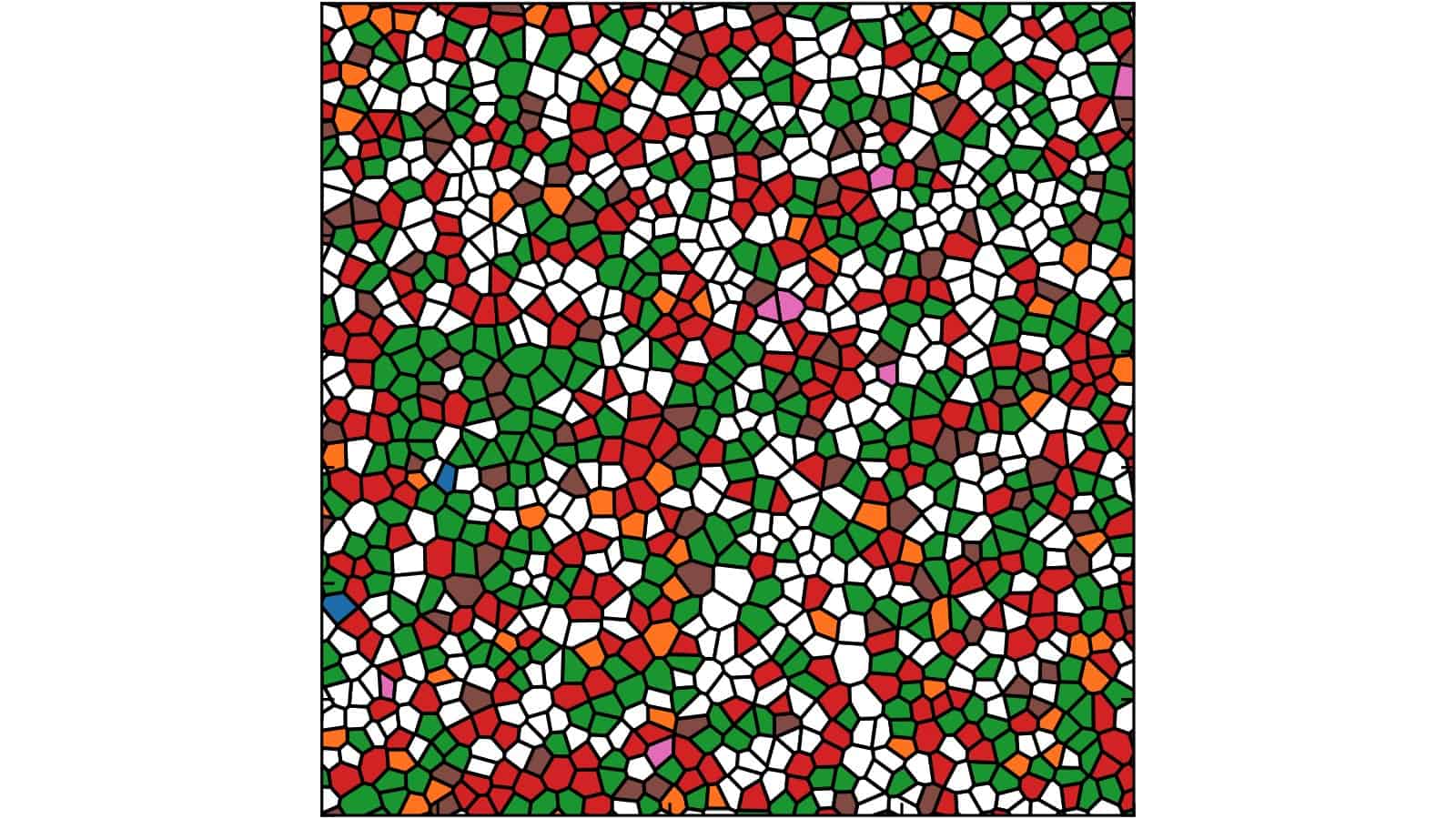
In their latest work, Torquato and colleagues have extended the theoretical description of hyperuniform systems by assigning “weights” to a material’s particle constituents. These weights can be scalar or vector properties. Examples of scalar properties include the charge or mass of a particle; whereas vector properties include the dipole moment or velocity of a particle.
Toraquato and colleagues discovered that under this more general framework of hyperuniformity, including weights can take a particle system which, without weights, is hyperuniform to one which is not (and vice versa).
Different atomic species
For example, one could begin with a standard hyperuniform system comprising identical particles and then imagine that the particles can have one of several different masses. In the real world this would describe a material made of several different atomic species.
Hyperdisorder appears in pigment patterns on squid skin

The team’s work is important because it represents a significant expansion in the number and richness of systems that can be studied and potentially classed as hyperuniform. Furthermore, weighting provides engineers with additional degrees of freedom that could be used to fine tune hyperuniformity to create new and useful materials.
Torquato is hugely excited about future directions of this work: “Our generalization of hyperuniformity to weighted many-particle configurations opens up an immense set of problems. Our next steps will be driven by what we find to be the most exciting prospects”.
The research is described in Physical Review X.