Newton’s and Einstein’s theories of gravity apply across distances of hundreds of millions of light-years. That is the conclusion of an international team of scientists, whose measurements of the gravitational acceleration of galaxy clusters have been made over the largest distances ever studied.
The study supports the Standard Model of cosmology, which invokes the gravitational effect of dark matter to explain the large-scale structure of the universe. As a result the team claims that its observation is at odds with alternative theories of gravity such as modified Newtonian dynamics (MOND).
“We’re seeing a clear pattern: these alternative models of gravity are running out of room to manoeuvre,” the study lead, cosmologist Patricio Gallardo of the University of Pennsylvania in the US tells Physics World.
However, an astronomer who studies MOND argues that the result – and the conclusion – is not clear cut. “I’m not convinced that they’re testing MOND,” says Stacy McGaugh, a professor of astronomy at Case Western Reserve University in the US.
Vast distances
The debate revolves around dark matter, which is a hypothetical substance that the majority of astronomers believe is responsible for the “extra gravity” observed in the universe that cannot be explained by the presence of visible matter alone. But the evidence for dark matter is circumstantial and this leaves room for theories such as MOND – which suggests that a small modification to gravity at low gravitational accelerations precludes the need for dark matter.
To probe the nature of gravity over large distance scales, Gallardo’s 40-strong team measured the gravitational acceleration between pairs of galaxy clusters (pairwise clusters) separated by distances ranging from about 100 million to 750 million light-years.
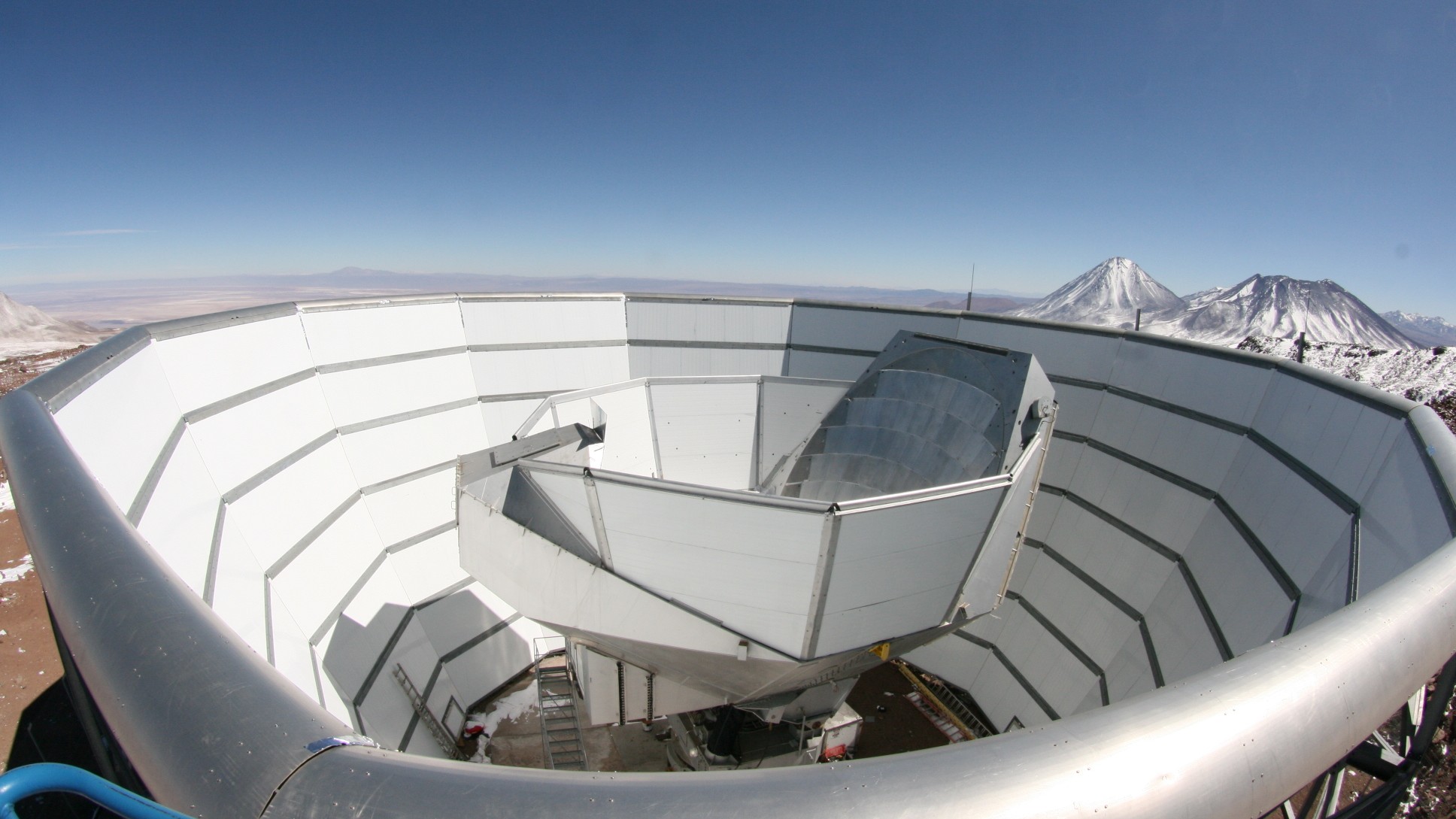
They used the kinematic Sunyaev–Zel’dovich (kSZ) effect to provide information on the motions of the clusters. This involves the cosmic microwave background (CMB) radiation, which comprises photons left over from the Big Bang. As these microwave photons pass through a galaxy cluster, they scatter off free electrons and receive an energy boost that the team detected using the Atacama Cosmology Telescope in Chile.
Gravity tends to pull these clusters together and this Doppler shifts the kSZ energy boost. This subtle effect was detected for the first time in 2012.
A statistical method called the pairwise kSZ estimator determined the average infall velocity of cluster pairs.
Clean comparison
“This estimator gives us a clean way of comparing the theoretical predictions made by cosmologists of the pairwise accelerations under the influence of gravity,” says Gallardo.
Gravitational acceleration on the length scale of interest was then determined by combining the infall velocity observations with the distribution of galaxies as mapped by various surveys. They found that gravity follows an inverse-square law with regards to distance, just as predicted by the gravitational models of Newton and Einstein.
Gallardo argues that if MOND is correct, then the observed fall in gravitational acceleration would not be as steep as the inverse square.
“Even if an alternative theory of gravity predicts the distributions of galaxies, it will still fail to predict the pairwise velocities without introducing a component of invisible dark matter,” says Gallardo.
However, not all astronomers agree with this conclusion.
“It appears that they’ve worked out what they expect conventionally, then projected this onto what they imagine MOND would do, [but] it isn’t actually a MOND calculation,” says McGaugh.
Galaxy distributions
McGaugh questions how well the pairwise velocities can be isolated from the gravitational tugs of all the other galaxy clusters around them.
Gallardo counters, “It is right that everything pulls on everything, but that is precisely the beauty of this technique”. At its basis is the correlation function of galaxies, which describes the probability that two galaxies will be within a given distance of each other. At its the heart is the distribution of matter in the universe, as laid out in the Big Bang and described by the Standard Model of cosmology.
“If clusters are too close to each other, then the details of how they are placed will matter, but as distances grow and the universe looks more and more isotropic, the averages tend to smooth out and the equations governing the evolution of the distribution of matter take over,” says Gallardo.
McGaugh argues that something else, called the external field effect, happens at large distances. This is a concept in MOND where the gravitational acceleration produced by all the other objects in the universe is non-negligible and can affect smaller systems, such as a pair of galaxy clusters.
Background acceleration
“Once one gets far enough out, this takes over when the background acceleration of everything else is greater than that between any two objects,” McGaugh says.
McGaugh cites a paper in The Astrophysical Journal on which he was co-author. It describes how the gravitational acceleration field in the local universe can be calculated from the known distribution of galaxies. He describes that field as “a mess” and that the approach of Gallardo’s team averages over the subtleties.
Cosmic combat: delving into the battle between dark matter and modified gravity
Nevertheless, Gallardo remains bullish. “When we look at different scales and tracers of the gravitational potential such as anisotropies of the CMB, the polarization of the CMB, the baryon acoustic oscillations, the lensing of the CMB and galaxy lensing, they all seem to favour the existence of dark matter and disfavour modifications of gravity,” he says.
However, MOND has its own accomplishments, such as being able to predict the gravitational acceleration curves of galaxies, explain the plane of dwarf galaxies found around the Milky Way and Andromeda galaxies, and even the orbits of wide binary stars. But while Gallardo acknowledges that MOND “has partial successes in some regimes,” it “fails to provide a unified and consistent view of how gravity influences the history of the universe”.
In response McGaugh feels that crucial elements of MOND are being papered over and ignored.
“They’re basically reinventing the wheel without knowing a better wheel was already in the literature,” he says.
Gallardo and colleagues report their results in Physical Review Letters.
- Keith Cooper has written a series of articles about dark matter and alternative theories of gravity.