There is a shape in physics that is remarkably hard to destroy. You can shake it, heat it, push it and disturb it in every way imaginable, but unless you physically tear the fabric it resides in, it will survive perfectly intact. This is not wishful thinking. It is a mathematical certainty. That shape is called a skyrmion.
The easiest way to picture a skyrmion is to imagine a dartboard covered in tiny arrows. At the very centre, every arrow points straight down into the board. At the outer edge, every arrow points straight up. In between, they rotate smoothly through every possible direction, completing a full rotation and closing back on themselves. This pattern has a score called the skyrmion number, and that score is locked at exactly ±1 (the sign simply defines which way the twist runs). Noise cannot nudge it. Heat cannot drift it. A stray disturbance cannot flip it. The only way to change it is to violently rip the whole pattern apart.
Scientists first found skyrmions hiding inside certain magnetic materials and immediately recognized them as dream candidates for carrying information (a skyrmion present means 1, a skyrmion absent means 0, and nothing in the environment can accidentally corrupt it). But magnetic materials are slow and confined to a chip. The next natural question was bold: what if you could take this indestructible shape and put it inside light itself, travelling freely through open space?
A team of researchers from Tianjin University in China, together with collaborators at Nanyang Technological University in Singapore and Oklahoma State University in the US, has now done exactly that – and gone one step further. As described in Optica, the researchers created not just one skyrmion in light, but two completely different kinds, and found a way to switch between them at will using nothing more than the rotation of a single thin optical half-wave plate.
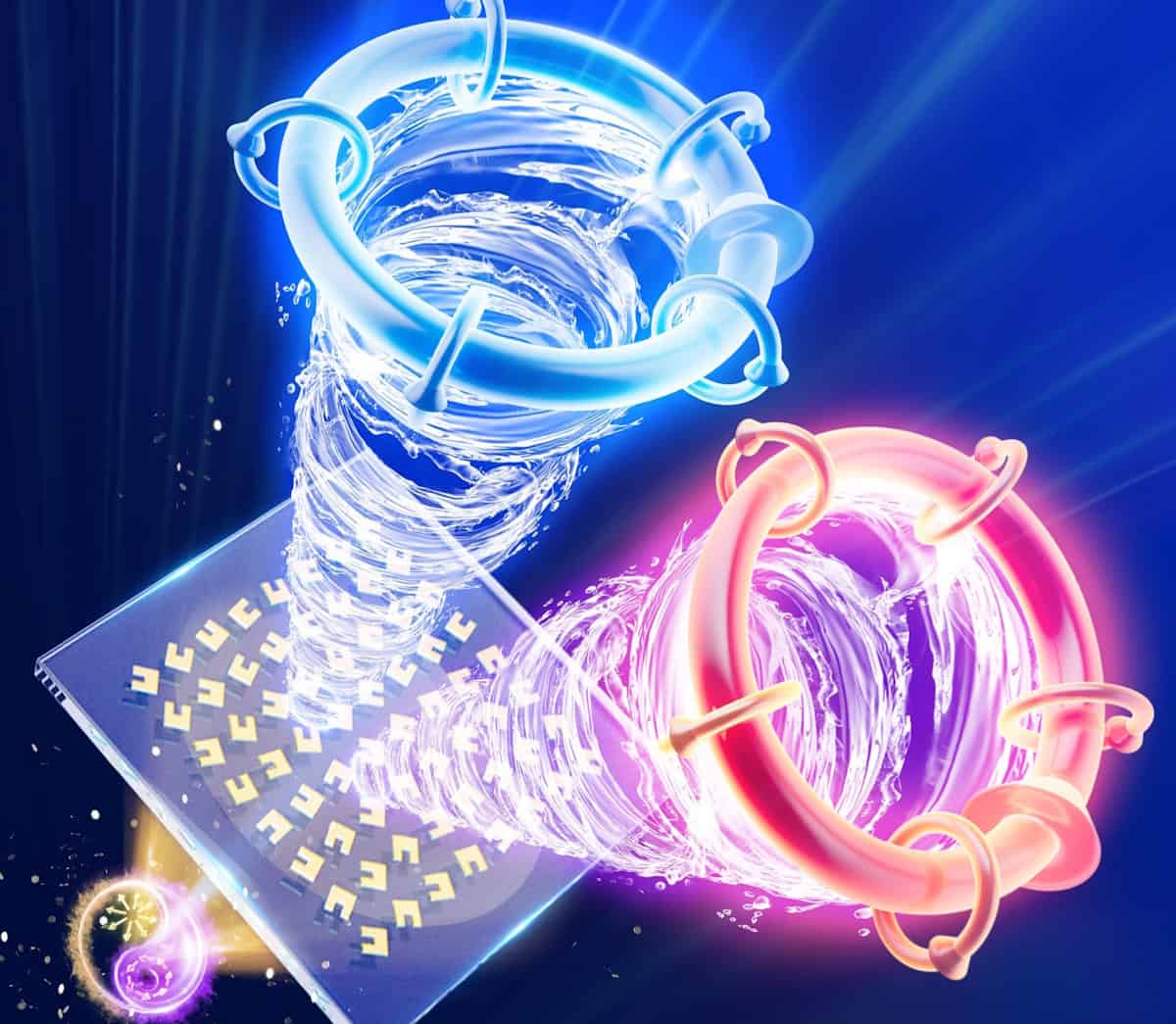
The two types are an electric skyrmion, where the topological twist lives in the electric field of the light wave, and a magnetic skyrmion, where the same twist lives in the magnetic field. And they are as distinct from each other as a left-handed knot is from a right-handed one.
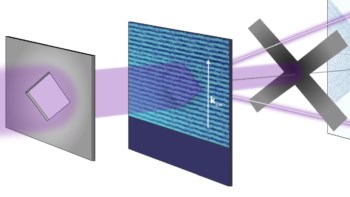
To generate these skyrmions, project leader Jiaguang Han and colleagues built a flat chip roughly the size of a small stamp, its surface packed with thousands of tiny C-shaped gold antennas, each one far smaller than a bacterium. When a structured laser beam hits this chip, the antennas absorb the incoming near-infrared light and re-radiate it as terahertz waves.
The key is how the antennas are arranged on the chip: one set is laid out in concentric rings pointing outward, while another set spirals around the centre like the spokes of a wheel. Each arrangement, when activated by the right kind of laser beam, generates a different skyrmion-carrying light pulse. Switching the laser from one beam shape to the other is done by rotating a single optical plate by just 45°, which flips the chip from producing one skyrmion type to the other, instantly and cleanly.
“The core innovation lies in the nonlinear metasurface that converts shaped near-infrared femtosecond laser pulses into tailored terahertz toroidal light pulses,” explains first author Li Niu in a press statement.
The team confirmed this process by mapping the full three-dimensional structure of each light pulse at multiple positions in space and time. The skyrmion numbers they measured came out at –0.990 and +0.992 for electric skyrmions, and –0.991 and +0.994 for magnetic skyrmions, within 1% of the mathematically perfect value of ±1. The tiny deviation from a perfect score of ±1 is simply down to the limits of any real measurement – sampling a fleeting pulse of light in three dimensions will always leave a small rounding error. However, the topology itself remains exactly intact.
The importance of this result reaches far beyond the elegance of the experiment. The next wave of wireless communication technology – already being designed to operate at terahertz frequencies, which can carry vastly more data than current mobile networks – has a serious enemy: the real world. Humidity, atmospheric turbulence, buildings and even rain can scramble a terahertz signal in ways that are very hard to protect against.
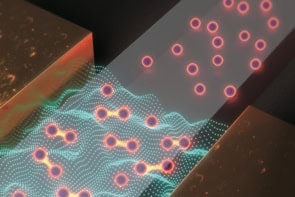
Tailored material makes speedier skyrmions

Conventional optical signals encode information in the brightness or precise timing of a wave, but both of those are fragile; noise corrupts them the same way that a smudge ruins ink on paper. A skyrmion signal is fundamentally different. The information is encoded in the topological shape of the light pulse, and that shape cannot be accidentally altered by the environment. It is protected not by better engineering or thicker shielding, but by mathematics itself.
On top of that, having two switchable skyrmion states, electric and magnetic, effectively enables two distinct channels of information to travel along the same beam, doubling the capacity without using any extra bandwidth.
What this team has built is a proof of concept for a new kind of communication: one where the message is written in a shape that the universe, by its own rules, refuses to erase.