There are craters on the Moon where the Sun never shines – and researchers in the US and Germany have shown that these shady locations would be ideal for housing lasers that are more stable than similar devices operated on Earth.
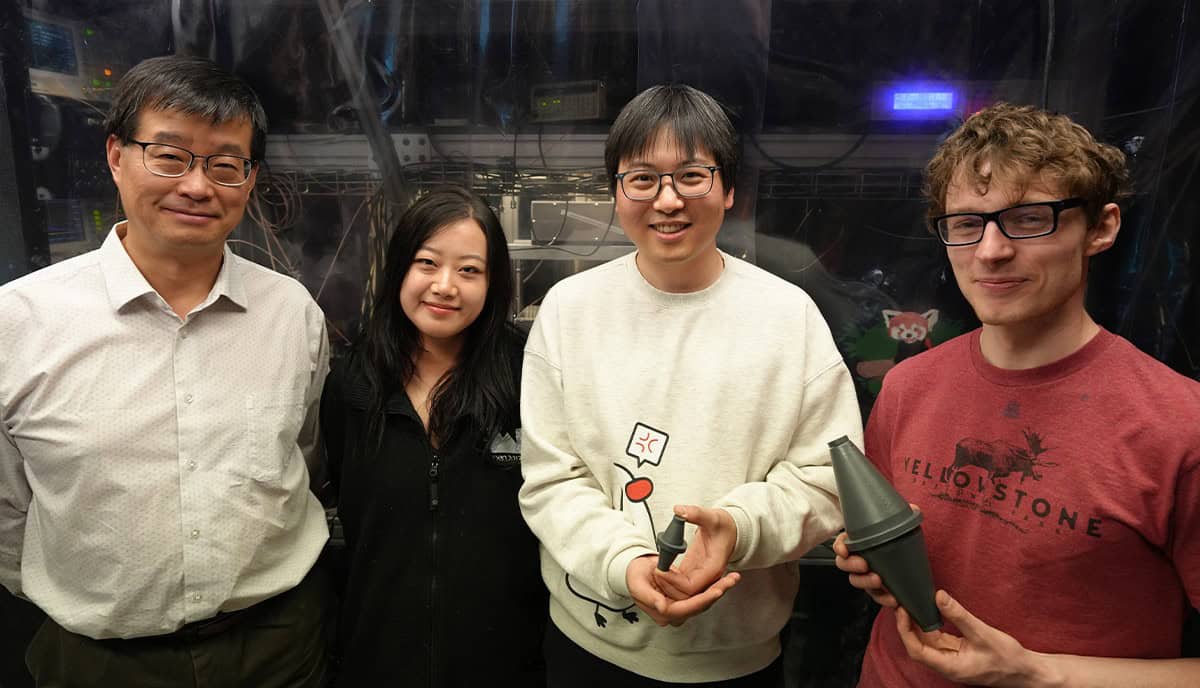
Writing in the Proceedings of the National Academy of Science, Jun Ye at NIST and the University of Colorado and colleagues explain the benefits of installing a silicon optical cavity in a permanently shaded crater. Such a cavity is a block of silicon with internally facing mirrors at opposing ends. Light from a commercial laser is shone into the cavity where it bounces back and forth, growing in intensity and coherence. The length of the cavity defines the frequency of the trapped light. So if the cavity is machined to a very high precision, then the cavity light has a very narrow frequency range.
Some of this light is extracted from the cavity, creating a source of high-quality laser light. To ensure the stability of the laser, the cavity can be cooled to cryogenic temperatures to minimize thermal fluctuations. Now, Ye and colleagues have shown that this stability can be improved significantly if a cavity is operated in a shady nook on the Moon.
Cold vacuum
There are more than 300 regions of the Moon that are in permanent shadow. As well as being enveloped in darkness, these regions tend to maintain a steady temperature of about 50 K. While the Moon has no real atmosphere, it is not surrounded by a perfect vacuum. Radioactive decay and bombardment by meteorites, the solar wind and sunlight liberates molecules from the surface and these will linger briefly before escaping into space. Because dark craters are not subject to bombardment, there should be fewer gas molecules in these regions – and therefore a better vacuum than on the surface. Indeed, the team calculates that pressures of less than 10−10 Pa should exist in these craters, which is well within the ultrahigh vacuum regime.
As a result, dark craters should be a perfect environment for operating a silicon optical cavity. There it would experience a small number of collisions with gas molecules, boosting its stability. What is more, by radiating heat out of the crater and into space, Ye and colleagues reckon that an optical cavity could be further cooled to a chilly 16 K. At this temperature, silicon will neither expand nor contract in response to tiny temperature fluctuations – further stabilizing the output of the cavity.
According to the researchers’ modelling, such a cavity would have a very low thermal noise-limited stability of 10−18 and a coherence time exceeding 1 min. This performance, they say, is ten times better than that achieved by the best cavities operated on Earth.
Testing Einstein
The team proposes several different uses for light emitted by the cavity. Because it would have a very stable frequency, it could be used as a very precise lunar time signal. This would be very useful for the navigation on, or near to, the Moon as well as for scientific experiments – including those that test Einstein’s general theory of relatively.
Ultrastable lasers would also allow scientists to create long-baseline interferometers for astronomical observations, including the detection of gravitational waves. Furthermore, the cavities themselves could also be used as detectors. Gravitational waves at certain frequencies would affect the output of a cavity – as could hypothetical interactions between silicon atoms and dark matter.
‘Einstein’s flying mirror’ technique opens a path towards extreme light intensities
Using a high-powered relay laser, the cavity signal could be transmitted to lunar satellites that contain atomic clocks – creating a timing network similar to Earth’s global navigation satellite systems such as GPS. Furthermore, light from the cavity could be used to create a quantum network that stretches from the Moon to the Earth.
Team member Yiqi Ni works for the US-based company Lunetronic, which is developing technologies for use in permanently shadowed craters. Ni says that a silicon optical cavity could be operated in low-Earth orbit within two years – and be installed on the Moon within three to five years.
The team also includes researchers from the US National Institute for Standards and Technology (NIST) and PTB, which is Germany’s national metrology and standards institute.