Tests of fundamental physics that were previously impossible could become a reality thanks to a new way of producing extremely intense beams of light. Using a state-of-the-art high-power laser, researchers at the University of Oxford, UK demonstrated that they could dramatically increase the efficiency of a nonlinear optical technique called relativistic harmonic generation. According to the team, this increase could herald a paradigm shift, making it possible to achieve hitherto unheard-of electromagnetic field intensities in the laboratory.
The theory of quantum electrodynamics (QED) predicts that at very high intensities, light can interact with the vacuum, converting light energy directly into matter. “If we can achieve such intensities, we could test theories about the fundamental nature of the universe,” says Robin Timmis, who led the new study. “However, doing so requires a laser system a million times more intense than those currently available.”
Relativistic harmonic generation
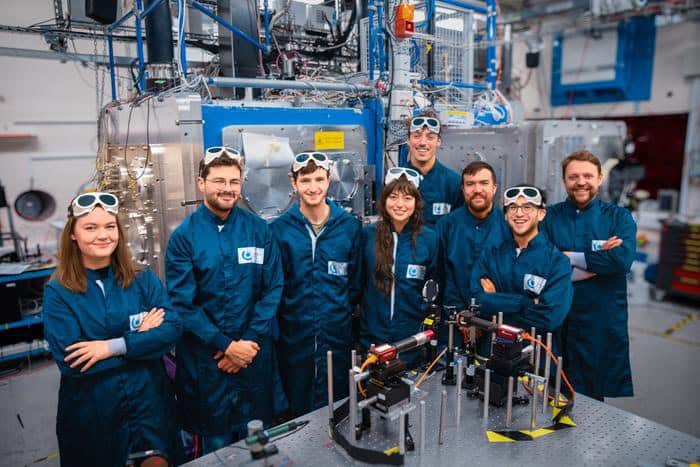
In the new work, Timmis and her colleagues in Peter Norreys’ group at Oxford used the Gemini laser at the UK Science and Technology Facilities Council’s Central Laser Facility (CLF) to generate coherent extreme ultraviolet (XUV) and X-ray photons via relativistic harmonic generation. They began by firing high-frequency, ultrashort, sub-picosecond (10-12 s) laser pulses onto a solid glass target. This creates a plasma that acts like an oscillating mirror, and Timmis likens the next step to shining a flashlight at this mirror while it is rushing towards you at near-light speed – a concept known as “Einstein’s flying mirror”. The result is that the light reflected from the plasma becomes compressed, and gains intensity.
Working with researchers from Brendan Dromey‘s group at Queen’s University Belfast in Northern Ireland, the team used a process called coherent harmonic focus to concentrate this light into a region as small as a few nanometres across. This step may have boosted the light beam’s intensities as high as 1023 W cm−2, although Timmis acknowledges that this is an estimate based on previous theoretical simulations, as the team was unable to measure it directly.
“If confirmed with further experiments at Gemini, or indeed even larger facilities, we may have made the most intense source of coherent light ever,” says Timmis, who received this year’s Institute of Physics Culham Thesis Prize in part thanks to this work, which is described in Nature. “The energy in our XUV beam was over three orders of magnitude brighter than previous measurements,” she adds. “By resolving a long-standing gap between theoretical expectations and experimental results, we confirmed the required energies to support a coherent harmonic focus and therefore offer a substantial boost in intensity above that of the original laser pulse.”
Towards the next generation of extreme electromagnetic field studies
According to the researchers, these results demonstrate that there is a realistic experimental pathway to next-generation laboratory studies of extreme electromagnetic fields. In particular, they say that the quantum critical field for QED tests, which is known as the Schwinger limit and has a value of >1016 V cm−1 or >1029 W cm−2, is now open, paving the way towards all-optical studies of the quantum vacuum. As well as fundamental physics, Timmis says that more efficient harmonic generation could also have applications in ultrafast imaging of physical and biological systems, photolithography and fusion science.
Atomically thin lasers shine for the first time at room temperature
The Oxford team is now analysing data from a follow-on experiment at the CLF that will guide their next steps. “We will be shortly publishing results about a new harmonic beam that we have discovered on that run,” reveals Timmis, “and future studies will focus on actively controlling the coherent harmonic focus and directly measuring its intensity.”