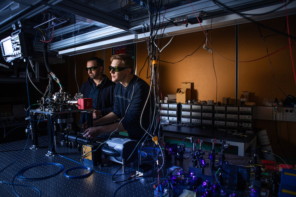
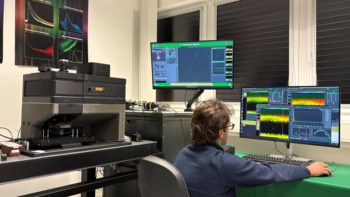
SmarAct, a German specialist in high-precision positioning, automation and metrology systems, is developing enabling technologies to translate the theoretical potential of all-optical computing into scalable real-world applications
German technology start-up Akhetonics is reimagining the future of high-performance computing (HPC), deploying its proprietary know-how in photonic-design automation and photonic integrated circuits (PICs) to realize the first all-optical digital computation devices. The end-game: an all-optical digital processor – what Akhetonics calls its reasoning processing unit (RPU) – that will fundamentally transform the way that data is processed, transmitted and stored at every level of the HPC stack.
While the anticipated upsides of photonic computing are compelling – think bandwidth scaling, energy-efficiency and reduced latency – the translation of Akhetonics’ R&D effort and early-stage PIC designs into at-scale implementation is still in its infancy. What’s evident even now, though, is that the start-up’s progress is being accelerated by collaboration, interdisciplinary expertise and innovation spanning photonic system design and precision-motion and control technologies.
Collaboration, co-development, customization
A case study in this regard is Akhetonics’ partnership with SmarAct, a German manufacturer and developer of specialist products for nano- and picometre-precise positioning, metrology and automated assembly. Both companies are shaping the future of photonics, albeit along complementary tracks: Akhetonics with its vision of a full-stack photonic computing architecture; SmarAct with a portfolio of enabling technologies that’s helping to make next-generation optical computing a practical proposition.
The two vendors began working together after an initial meeting four years ago at the European Conference on Optical Communication (ECOC 22) in Basel, Switzerland. Top of the Akhetonics shopping list: a versatile optical test system to characterize its advanced PICs.

“There are off-the-shelf PIC characterization systems on the market, but they all impose constraints on our design options,” explains Leonardo Del Bino, co-founder and chief technology officer (CTO) at Akhetonics. “Instead, we teamed up with SmarAct to co-develop a compact and modular test architecture built to our exacting specifications. The resulting set-up gives us the flexibility to evaluate and optimize all sorts of innovative PIC designs.”
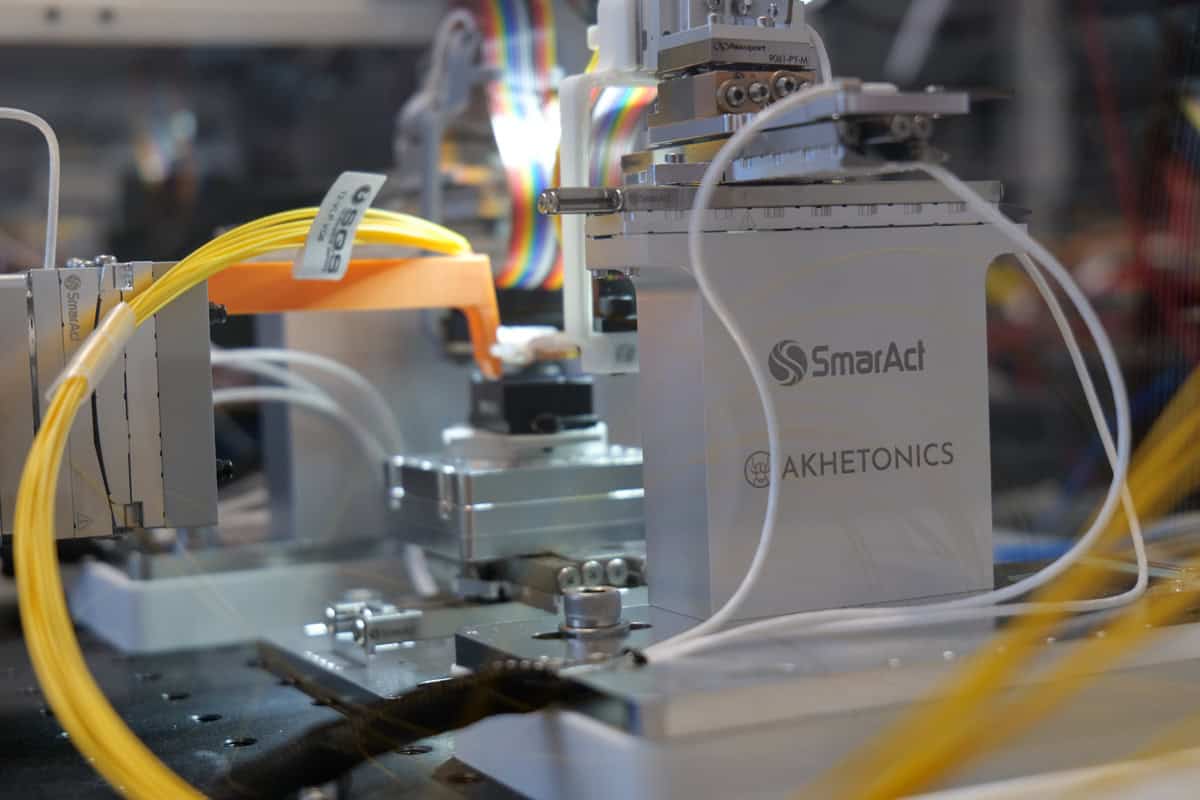
At the heart of the Akhetonics optical testing workstation sit two discrete nanopositioning subsystems: an XY-Rz chip platform (itself comprising three nanopositioning stages offering horizontal translation along the X and Y axes and rotation limited to the Z axis) and a Z-Rx-Ry “pivot” for an optical probe (where translation occurs only along the Z axis, with simultaneous angular rotation around the X and Y axes). The test set-up (which also incorporates a digital microscope for PIC inspection and alignment) can be used without restriction in every degree of freedom, with the two subsystems working in tandem to ensure precise multi-axis positioning for optical coupling and electro-optic characterization tasks.
On a more granular level, each nanopositioning subsystem is based on SmarAct positioners equipped with integrated optical encoders (SmarAct’s METIRIO® sensors with a resolution of 1 nm) along all six axes of motion. The first subsystem provides three degrees of freedom for lateral alignment (with 49 mm travel in both X and Y, 360° rotation around Rz and a unidirectional positional repeatability of ±40 nm per linear axis). The second subsystem provides vertical and angular alignment (with 31 mm travel in Z, ±5° tilt around Ry, ±45° rotation around Rz and a unidirectional positional repeatability of ±40 nm for the linear Z axis).
To evaluate new PIC designs, Akhetonics’ optical test routines focus primarily on measuring and minimizing insertion losses between input/output fibres and on-chip planar waveguides. Typical measurements include wavelength- and polarization-dependent coupling losses (for example, when a fibre array couples laser light into a series of on-chip grating couplers or when light is coupled from a planar waveguide back into an optical fibre). The subsequent integration of electrical probes into the test system (using two separate XYZ probe towers) supports electro-optic characterization of key on-chip building blocks like optical modulators and photodetectors.
“The requirements for the electro-optical testing are nothing crazy,” says Del Bino. On-chip electrical contacts are in the ballpark of 100 μm x 100 μm, so Akhetonics engineers need positional and alignment precision an order-of-magnitude better than that for their electrical probes. “On-chip optical testing is a different story,” he adds. “A fibre-waveguide mismatch of 1 μm means significant coupling losses, so we need positional accuracy and repeatability of tens of nm or less.”
The rewards of reciprocity
Operationally, the custom test system is the result of ongoing collaboration between the engineering team at Akhetonics and the product development team at SmarAct. After firming up performance requirements, the two vendors iterated back-and-forth with 3D CAD drawings before converging on a final agreed system design.

“We supplied the nanopositioning stages that form the precision-motion core of the workstation,” explains Max Trippel, SmarAct’s business development manager for photonic applications. Akhetonics then integrated these modules into its own test environment, including the fibre and fibre-array-unit holders; the required optical and electrical measurement equipment; and the software routines for photonic characterization. “This approach gives Akhetonics the flexibility to build exactly the test workflow it needs, while relying on a stable and repeatable positioning platform,” Trippel adds.
Crucially, the SmarAct software “ecosystem” and Python interface make it easy to integrate the nanopositioning stages within Akhetonics’ PIC test routines. That software application platform, known as the SmarAct Control and Process Environment (SCoPE), also creates opportunities for continuous process improvement and product innovation (for example, the ability to develop custom routines for fast calibration and alignment on all axes).
In this way, SCoPE will be a natural fit as Akhetonics transitions its PIC testing programme from an R&D setting through small-batch production runs and, ultimately, to volume manufacturing capability (see “SCoPE in brief”, below). “Our goal with SCoPE is to provide customers with easy access for system development, whether that’s for the testing or assembly of photonic components,” says Trippel. “SCoPE is a living platform and we’re constantly integrating novel functionalities and application-specific plug-ins as well as features to facilitate control of third-party devices.”
Strategically, the SmarAct-Akhetonics partnership is shaping up as a win-win for the long term, with the latter’s growth trajectory and evolving platform technologies feeding into SmarAct’s product development roadmap. “Our customers’ success is our success,” Trippel concludes. “Working in this way with Akhetonics and its peers means we have line-of-sight on ‘what’s next’ in photonic computing. Watch this space: the last word has not been spoken.”
SCoPE in brief
The SmarAct Control and Process Environment (SCoPE) is a modular and extensible software application platform that combines visual process modelling, Python scripting and hardware integration. SCoPE enables customers to develop, control and run automated processes in a unified environment that offers…
- Process modelling and automation: visual drag-and-drop process editor enables intuitive creation, control and execution of automation workflows. Live process display gives users direct feedback during execution.
- Python scripting backend: integrated Python scripting allows developers to extend workflows with custom logic, algorithms and third-party devices to create advanced automation scenarios. Package and dependency management are built-in.
- Device control and hardware integration: native support for SmarAct hardware such as positioning systems, controllers, grippers and interferometers through specialized plug-ins.
- Custom user interfaces: flexible Qt widget integration makes it possible to build tailored graphical user interfaces for specific applications.
- Data visualization and imaging: configurable plotting widgets, real-time data visualization, process messaging and an integrated image processing pipeline support instant process feedback and image-based automation tasks.
- Plug-in architecture: the modular plug-in system enables SmarAct and third parties to extend SCoPE with additional functions, algorithms, hardware integrations or communication interfaces.