Engineers are constantly striving to improve the safety and performance of electric vehicle (EV) batteries. Much effort has been put into developing new electrode materials over the years, but future improvements may not follow the same path and may just be as simple as utilizing physical pressure.
A recent study, led by researchers at the University of Cambridge, suggests that EV batteries could be made to last up to twice as long, by applying the right amount of pressure to the electrodes. It is, however, a fine balancing act, as too high or too low a pressure can cause the battery to fail. To employ this approach in real world systems, engineers will need to make sure that the process is easily repeatable without significant pressure error, but it’s an interesting avenue of battery engineering that has come to fruition.
“We carried this work out to improve the sustainability of batteries,” says Michael de Volder, one of the lead researchers on the study. “Given that we are not very good at recycling batteries, extending the lifetime of batteries reduces the need for mining critical minerals for making new batteries and therefore improves their sustainability.”
For their study, reported in Nature Energy, the researchers developed a dilatometer with pneumatic bellows to apply pressure to the electrodes. The bellows act like a clamp to maintain a uniform and constant pressure on the electrode, while a sensor detects small volume changes that occur as the battery charges and discharges.
The researchers tested their electrode pressurization approach on commercial nickel manganese cobalt (NMC) lithium-ion pouch batteries (which have a flexible packaging), without changing their electrolyte or electrode composition. By using commercial batteries with a standard setup, they could test them fairly under different pressures.
“In this work we optimized how hard battery anodes and cathodes should be pushed together to maximize the lifetime of batteries,” de Volder tells Physics World. “Importantly, we also unravel which degradation mechanisms kick in if you press too hard, or not hard enough.”
Doubling battery lifetime
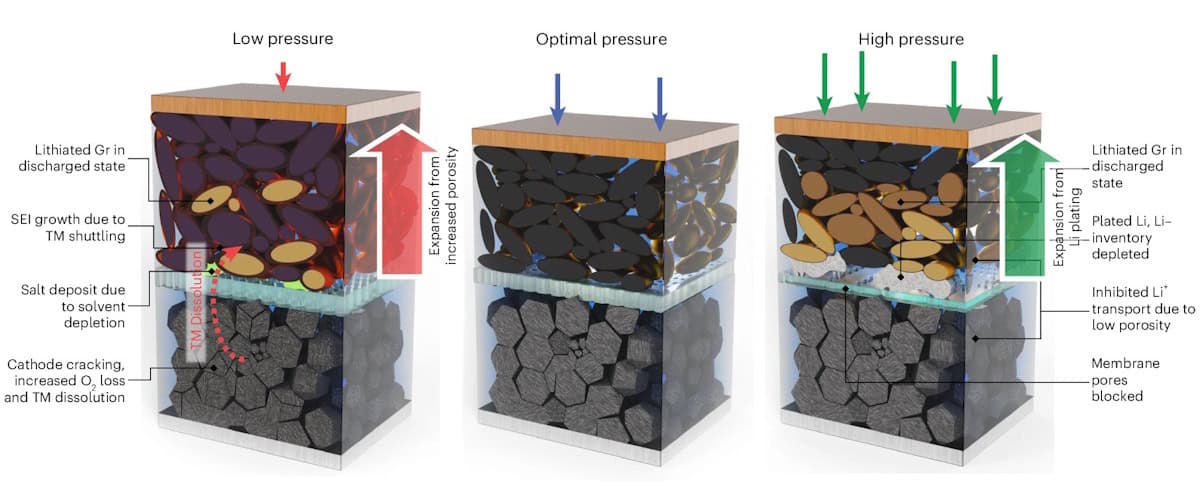
The researchers found that increasing the stack pressure fourfold over typical initial values used in conventional coin cells – to an optimal pressure of 12.5 bar – doubled the lifetime of the NMC811 cells. They compared the results with NMC cells tested at an extra-low pressure of 1.5 bar, a low pressure of 3 bar, a medium pressure of 6.5 bar and a high pressure of 37.5 bar.
Different degradation mechanisms emerged at high and low pressures outside of the optimal pressure zone. Low stack pressure accelerated cathode cracking, causing an increase in transition metal dissolution and excessive formation of the solid electrolyte interphase (SEI) layer. The cracking is likely due to a small number of particles bearing most of the mechanical load, leading to localized high-stress concentrations that initiate crack propagation.
Higher stack pressures, meanwhile, caused increased lithium plating on the anode. The team observed that the electrode thickness reduced during initial cycling but then underwent rapid thickness growth. When the electrodes are at their thinnest, they have a lower porosity that limits lithium transport, leading to higher overpotentials and higher lithium plating. This increases the amount of “dead” lithium and reduces the usable lithium inventory in the battery, causing it to degrade faster.
“We found that when the pressure applied to battery cells is sub-optimal, certain dangerous degradation processes can be accelerated. So, in a way, pressure optimization might improve the safety of batteries. However, more research is needed before we can draw reliable conclusions on this front,” says de Volder.
Sandwich strategy makes solid-state lithium battery last longer

The pressurization results in this study are still in the early stages, but if shown to be viable at scale in commercial systems, could help EV batteries to last longer. In theory, this could give second-hand EVs a higher market value as the vehicle will have a longer battery life when sold. Additionally, if EV batteries can last longer, it will reduce the pressure on lithium mining operations and reduce the amount of raw material required for battery manufacturing (assuming the same demand) – something that is becoming an issue due to the skyrocketing price of lithium.
Cambridge Enterprise, the university’s innovation arm, has filed a patent, so the research team and university obviously see commercial viability in the process. When asked about the team’s future plans, de Volder tells Physics World that “we studied pressure optimization for one specific battery chemistry, but we anticipate that gains can be made in the lifetime of other battery chemistries too”.