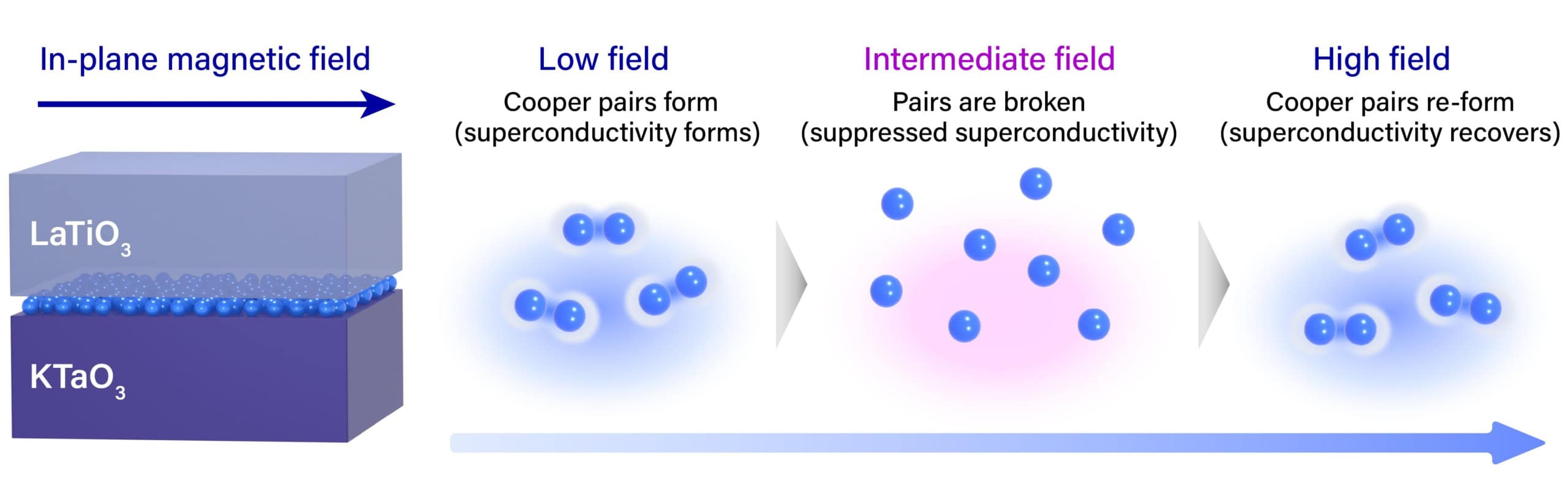
Unconventional superconductors are poorly understood materials with exceptionally useful properties. One example is their response to magnetic fields. In conventional superconductors, applied magnetic fields suppress superconductivity by either breaking up the paired electrons that facilitate it (Cooper pairs) or introducing magnetic flux which introduce resistance when it moves through the material. However, in a few unconventional materials, competition between ferromagnetic ordering, where the magnetic moments align to point in the same direction, and superconducting ordering, where paired electron moments point in opposite directions, can lead to a phenomenon known as re-entrant superconductivity (RSC). This is where, in an applied field, the magnetic ordering will at first destroy superconductivity, but when the field increases further, the superconductivity reappears.
An international team of physicists led by Denis Maryenko of Japan’s RIKEN Center for Emergent Matter Science has now observed this phenomenon for the first time in a two-dimensional (2D) unconventional superconductor. “We did not look for the RSC, and it was extremely surprising that we saw that,” Maryenko tells Physics World.
2D or not 2D
RSC has previously been observed in three-dimensional ferromagnetic materials such as CeRh2As2, organic superconductors and possibly in so-called heavy fermion compounds such as UTe2. However, 2D materials have several advantages over 3D ones when it comes to superconductivity. For example, in the conductor MoS2, the material’s electronic band structure and spin-orbit coupling (SOC) combine to keep the electron spins pointing in a direction perpendicular to the sample’s surface. This locking greatly increases the value of the upper critical field, which is the maximum magnetic field at which superconductivity can persist.
Since 2D superconductivity had previously been observed at interfaces between KTaO3 and other materials, the RIKEN team took this as a starting point. “Our approach was to grow LaTiO3, [since] that has good lattice matching [to KTaO3], which is beneficial for epitaxial growth,” Maryenko explains.
Writing in Science Advances, the physicists describe how they performed magnetotransport measurements on their LaTiO3/KTaO3 heterostructures to understand how these samples behaved in the presence of increasingly large applied magnetic fields. “We just wanted to see how the critical magnetic field behaves as a function of temperature, but suddenly we started seeing something else emerging at a rather low field: a resistive peak that seemed to separate two superconducting regions,” Maryenko says.
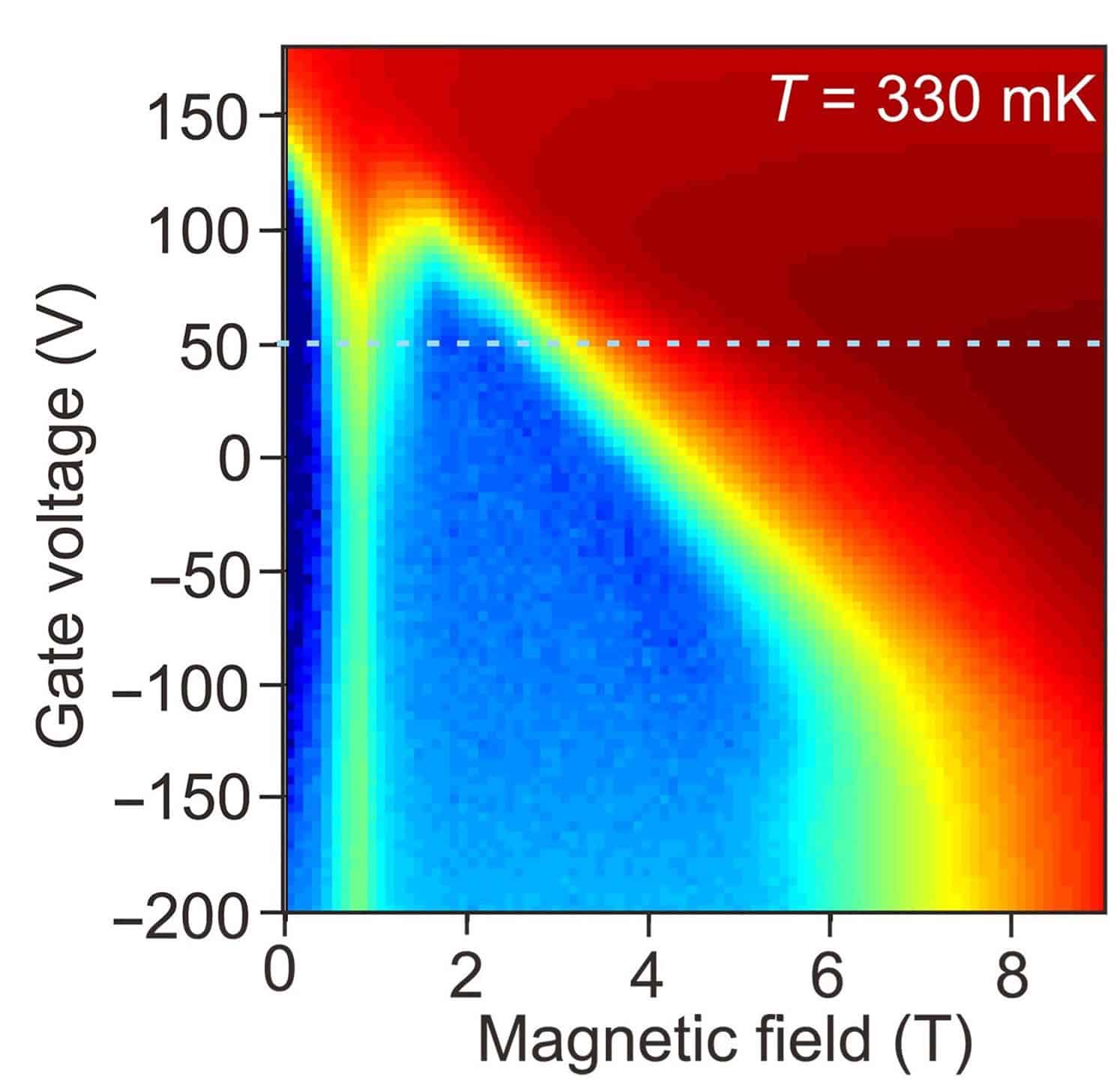
This cusp, he explains, appears at a magnetic field B∗ of 0.9 T with zero resistance measured at both lower and higher applied fields. In this experiment, B∗ is independent of temperature and the concentration of charge carriers, which Maryenko and colleagues controlled experimentally by tuning a gate voltage across the interface.
Explaining re-entrant superconductivity
The researchers considered several possible explanations for the RSC, including Zeeman splitting, orbital effects and something called the Jaccarino-Peter effect, where internal and external magnetic fields compensate for each other and cancel out.
To identify the correct explanation, Igor Maznichenko and Sergey Ostanin from Martin Luther University in Germany and Arthur Ernst from Johannes Kepler University in Austria performed ab initio calculations to determine the electron band structure for the interface. These calculations identified the presence of a so-called Van Hove singularity, where for certain momenta, the electrons will have very high density of states.
Then, Vitalii Dugaev from Rzeszów University of Technology in Poland and Evgeny Ya Sherman at the University of the Basque Country in Spain developed a SOC-based model, taking inspiration from symmetry arguments and the ab initio band structure calculations. In the absence of an applied field, they found that there is a p ↔−p symmetry in the bands. This means that electrons with opposite momenta will have the same energy, so two electrons that form a Cooper pair, and have the same energy, have a total momentum equal to zero. In other words, the system favours spin-singlet Cooper pairs which form easily.
Applying a field breaks this symmetry, thereby reducing the Cooper pairing efficiency and decreasing the critical temperature Tc for the onset of superconductivity. On the other hand, the applied field also shifts the electrons closer towards the Van Hove singularity, increases the density of states and increases Tc. The combination of these opposing effects results in a minima appearing in Tc(B), hence RSC. The discovery of RSC in these materials establishes the system as a robust platform for studying unconventional superconductivity in 2D systems.