Could a mirror world – in which every type of elementary particle has a corresponding mirror particle – exist in parallel to our ordinary world? For now, the answer is probably no, but in exploring this question, physicists at the Ultracold Neutron (UCN) Physics Group at the Paul Scherrer Institute (PSI) in Switzerland, say they have refuted this hypothesis with the best precision yet. Their work, which involved looking for so-called neutron-to-mirror-neutron transitions, also excludes mirror neutrons as potential components of dark matter, the mysterious substance thought to make up over 25% of the universe’s mass. Dark matter has never been detected directly, but its existence is inferred through observed gravitational interactions.
Theoretical physicists put forward the idea of a mirror world as long ago as the 1950s to address problems related to parity symmetry conservation in particle physics. Here, a set of mirror particles would exist as exact duplicates of their ordinary particle counterparts except that their so-called handedness would be reversed. In this picture, particles like the electron e, proton p and neutron n have mirror partners denoted by e′, p′ and n′. These mirror particles would have almost the same mass as the ordinary particles.
Not easy to detect
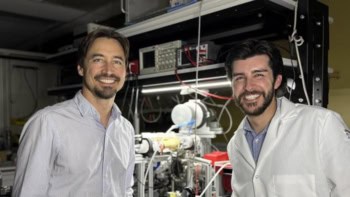
Finding proof for the existence of this mirror matter is important as it could account for dark matter – provided that during the evolution of the universe mirror matter was cooler than ordinary matter. Mirror matter is not easy to detect, however, because mirror particles are predicted to interact with ordinary matter in only two ways. The first is via the force of gravity and the second is through the rare oscillation of neutral particles such as neutrons that “mix” with their mass-degenerate mirror partners. This, explains Bernhard Lauss, one of the physicists at the PSI’s Center for Neutron and Muon Sciences who led this new study, means that ordinary neutrons might, on very rare occasions, turn into their mirror particles and simply “vanish” from our world. The time period up to this event is known as the n−n′ oscillation time, and afterwards a neutron could even reappear as if out of nowhere.
Neutron-to-mirror-neutron mixing has been predicted to have an n−n′ oscillation time as small as few tens of seconds, but it is not easily detectable because it is suppressed by environmental factors such as the presence of ordinary and/or mirror matter or of ordinary and/or mirror magnetic fields.
In recent years, researchers have been trying to reduce these environmental effects by studying neutrons cooled to extremely low temperatures. There are only a few laboratories around the world that can produce such ultracold neutrons at high regular flux. One is the Institut Laue–Langevin (ILL) in Grenoble, France, and another is the PSI.
Unexplored regions
The results from a series of experiments at the ILL in the past 20 years conducted at various magnetic fields were interpreted as being anomalous signals in the range of magnetic fields at which n−n′ oscillations could take place, thereby rekindling interest in the existence of mirror neutrons. More recently, the nEDM collaboration at PSI excluded a big part of this magnetic field range, but some magnetic field regions remain unexplored.
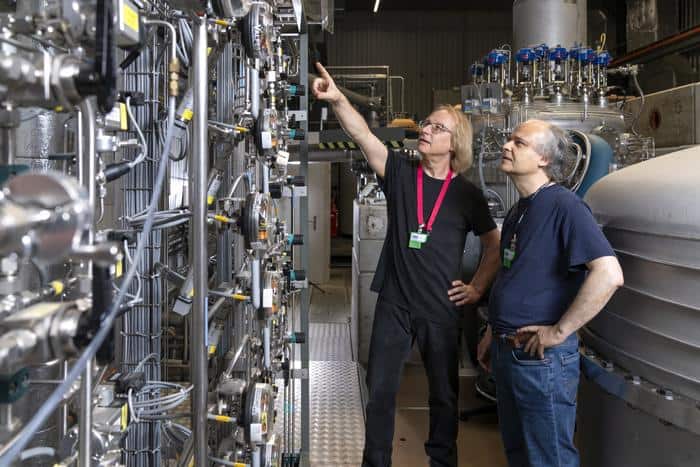
In the latest work, Lauss together with his colleague Géza Zsigmond and co-workers from PSI, the ETH Zurich and the Jagiellonian University in Krakow used ultracold neutrons from the PSI UCN source produced via a technique called superthermal moderation in a deuterium crystal cooled down to a temperature of 5 K. The researchers trapped these neutrons in a non-magnetic vessel made of stainless steel under vacuum. They were able to trap an unprecedented number of neutrons – on the order of 25 billion in all – something that allowed them to significantly improve the sensitivity of such experiments. A set of eight rectangular coils surrounding the storage vessel was used to generate a magnetic field that could be precisely controlled and scanned over two orders of magnitude, from 5–109 µT.
The team released around 1.5 million neutrons from the storage vessel into a gas-electron-multiplier based UCN-detector every six minutes to count how many neutrons remained in the tank after being stored there for 200 s. The researchers repeated the process over a period of several months, gradually varying the strength and flipping the direction of the magnetic field to scan all the relevant fields over which oscillations between neutrons and mirror neutrons are expected to occur. Finally, they performed complex computational simulations on the EULER cluster at the ETH Zurich to predict theoretical probabilities of n-n’ transitions that they then compared with the neutron losses they measured.
New limits set
The result? The researchers say they saw no evidence for such oscillations under the tested conditions. This finding, explains Lauss, means that there is a “very high probability” that previous speculations about the transformation of neutron particles into their mirror counterparts can be ruled out and that new limits for the n−n′ oscillation time constant have now been set. “Indeed, we have excluded the parameter space previously claimed for potential signals to 99.98 %,” he explains.
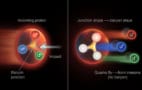
Protons and neutrons are more than just groups of three quarks
“The result therefore also excludes mirror neutrons as relevant dark matter particles,” Lauss tells Physics World.
Despite the existing limits already being very tight, Lauss, Zsigmond and their colleagues say they now plan to study the n−n′ transitions theoretically expected at zero mirror-magnetic fields to establish even more stringent limits. “Improving sensitivity further will be very challenging though, and perhaps even impossible,” admits Zsigmond. “A twofold increase, for example, will require 16 times more neutrons because the sensitivity of the experiment scales with the fourth root of the neutron counts.”