Scientists have measured antineutrino emissions from spent nuclear fuel for the first time, demonstrating that monitoring efforts need not stop when the reactors do. This is important because although independent nuclear safeguarding agencies have long used antineutrino emissions to glean information on reactor operations, previous detection schemes only worked when the reactors were running. Now, however, members of the Double Chooz collaboration have shown that it is possible to detect residual antineutrino emissions during a complete reactor shutdown – including from spent fuel stored in cooling pools.
Like neutrinos, antineutrinos are tiny, nearly massless fundamental particles that come in three flavours: electron, muon and tau. The largest human-made sources of electron antineutrinos are the reactor cores of nuclear power plants, which produce them via beta decay of neutron-rich fragments that are primarily generated during the fission of heavy elements such as uranium and plutonium.
Because antineutrinos interact so rarely with other particles, their emissions cannot be shielded and their signatures cannot be altered. They can also be detected some distance from the power plant itself. All these features make them valuable for nonintrusive nuclear reactor monitoring. Indeed, the idea of using antineutrinos to provide real-time information about the fissile content of a reactor core – and thereby detect illicit production of material that could be used in nuclear weapons manufacturing – dates back to the 1970s.
When a reactor is shut down, long-lived fission products (found in burnt fuel assemblies that remain in the reactor core, as well as assemblies that were previously removed and stored in nearby cooling pools) continue to decay, producing a residual neutrino flux. However, this residual signal is only around 1% as strong as the signal from an operating reactor. It also lies in a region of the energy spectrum that is strongly affected by background activities.
Measuring the residual neutrino flux and its energy spectrum
In the new work, which is detailed in Physical Review Letters, a team led by Thierry Lasserre and Anthony Onillon from the Max-Planck-Institut für Kernphysik (MPIK) in Heidelberg, Germany, succeeded in measuring the residual neutrino flux and its energy spectrum despite these difficulties. They obtained their data from the Double Chooz neutrino detection experiment, which is located near the two 4.25 GWth cores of the Chooz B nuclear power plant in the French Ardennes. This experiment uses a pair of detectors – labelled “near” and “far” and located around 400 m and 1.05 km from the cores – to study a fundamental parameter called the 𝜃13 neutrino mixing angle that describes how neutrinos transform between different types as they travel.
The Chooz plant uses a pair of pressurized water reactors, each of which contains 205 fuel assemblies consisting of roughly 600 kg of enriched uranium dioxide (mainly 238U with a few percent of 235U). During operation, these reactors also produce additional fissile isotopes, 239Pu and 241Pu, through neutron capture and subsequent decay processes involving 238U. In a typical cycle, they operate at full power for over a year and are then shut down for six to eight weeks for refuelling. During this time, some of the spent fuel assemblies are removed and transferred to storage pools in a nearby building.
The Double Chooz neutrino detector consists of more than 30 m3 of liquid scintillator, which is a material that emits short, double flashes of light when an antineutrino hits it. The outer part of the detector is shielded from the background radiation of the surrounding mountain rocks by 15 cm of demagnetized steel for the far detector and 1 m of water for the near detector. The inner part of the detector is shielded by a thick layer of mineral oil. Finally, an outer “muon veto” consisting of segmented scintillator modules positioned above the detector eliminates contributions from cosmic muons that can mask the signal from the antineutrinos.
Over 100 events observed
The researchers collected their data in 2017 when both of Chooz’s reactors were simultaneously shut down for 24.4 days for refuelling and maintenance. This unusual double shutdown was long enough for the team to obtain the statistics and low background signals needed to extract, for the first time, a quantitative residual reactor antineutrino spectrum.
After accounting for muon veto-induced dead time, the researchers clocked up 17.2 days of measurements for the near detector and 22.2 days for the far detector. While they analysed data from both, they mainly focused on the near detector because it is closer to the reactor cores and spent fuel pools and is therefore more sensitive to the residual antineutrino flux.
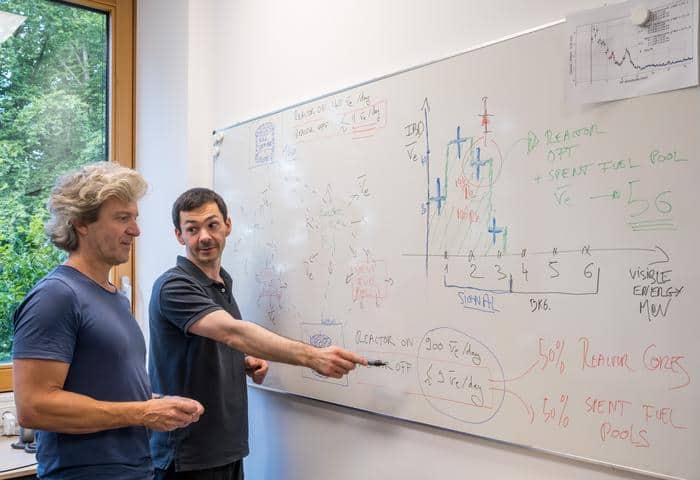
In the 1–3 MeV range, where the residual neutrino signal is strongest, the researchers observed 106 ±18 events, which represents a 5.9 σ excess over the background. This value, they say, is in very good agreement with the 88 ±7 events predicted by detailed simulations of the remaining nuclear fuel inventory and the decay of long-lived fission products.
Antineutrino detectors could spot signs that a fusion reactor is producing weapons-grade plutonium

According to the researchers, this result had a long gestation period: “In 2003, the IAEA safeguards met with the neutrino community and raised a question: could antineutrinos also provide information on spent nuclear fuel?
“The main difficulty has been detecting the faint residual antineutrino signal. This meant obtaining data during periods when both Chooz reactors were simultaneously off, very low and well-controlled detector backgrounds, and a detailed simulation of the irradiation and cooling history of relevant fuel assemblies.”
The researchers hope that their result will become a robust benchmark for agencies and experimenters designing detectors for specific spent-fuel monitoring applications. “Such monitoring is feasible and could provide an independent, non-intrusive complement to reactor-status and spent fuel inventory,” they tell Physics World, though they add that “it will not necessarily be easy, compact or inexpensive to implement.”