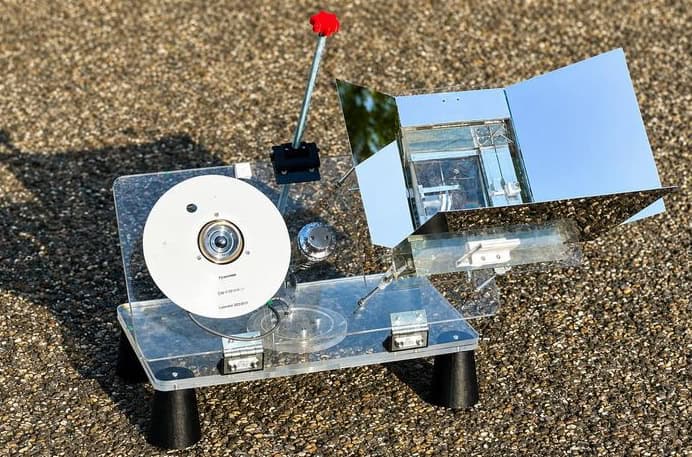
Researchers at the Karlsruhe Institute of Technology (KIT) in Germany and Stanford University in the US have developed an energy-collecting device that can simultaneously cool, produce electricity and generate heat. In their prototype, a radiative cooling layer reached 6.5 °C below ambient temperature while a solar collector generated electricity and reached nearly 111 °C.
“The new system could be installed on the roofs and facades of buildings to provide these three energy services at once,” says Gan Huang, who is head of the Hybrid Solar Technologies lab at KIT. “It could also be attractive for AI data centres that need both intensive power and cooling at the same time.”
As many of us have experienced, summer in the northern hemisphere has been particularly hot this year – a situation that is only likely to worsen in the future as the effects of climate change take hold. With this warming will come the increased need for air conditioning to cool down buildings. The problem is that current compression-based systems consume a lot of electricity and produce large amounts of CO2.
Passive daytime radiative cooling
A potential alternative is passive daytime radiative cooling (PDRC), in which heat is continuously exchanged between objects at different temperatures by absorbing and emitting thermal radiation. When the heat absorbed by the material is less than the energy radiated to outer space, it can cool down during the day – even without electricity.
Our planet naturally experiences this effect by radiating heat out to space. This allows it to cool down at night because its temperature (of around 300 K) is much higher than that of outer space (around 3 K) and there is no incident solar irradiation from the Sun at night.
A good PDRC material needs to satisfy several criteria. For one, it must reflect sunlight strongly at solar spectrum wavelengths (of 0.3 to 2.5 µm) to avoid it heating up. It also needs to emit heat strongly in the long-wave infrared (LWIR) wavelengths (of 8–13 µm) where the atmosphere is more transparent to infrared radiation, so that it can lose energy to the cold sky. Over the past decade, researchers have succeeded in developing a wide range of PDRC materials, including multilayer nanophotonic emitters, single-layer polymers on reflectors and porous ceramics. However, conventional PDRC systems cannot harvest the coldness of outer space and solar energy from the same surface at the same time.
A hybrid PDRC and photovoltaic-thermal collector
In the new work, which is detailed in Cell Reports Physical Science, the KIT researchers made a hybrid PDRC and photovoltaic-thermal collector. The emitting layer in the device, which is transparent, consists of a silica substrate coated with the silicone polymer polydimethylsiloxane. This layer allows sunlight to pass through while simultaneously emitting heat as LWIR radiation through the atmospheric window. Beneath the transparent emitter, a Fresnel lens concentrates the transmitted sunlight onto the (gallium arsenide-based) photovoltaic-thermal collector mounted on a two-axis solar tracker. This is where electricity is generated.
In outdoor experiments performed during the day, the prototype simultaneously achieved cooling of up to 6.5 °C below ambient temperature, an electrical power density of 60.6 W/m² and heating up to 110.8 °C. “This is exciting,” says Huang, “because it shows that the hot Sun and the cold universe can be harvested together, rather than treated as separate resources as has been the case until now.”
Giant barocaloric cooling effect offers a new route to refrigeration

The main challenge was ensuring that the solar collector became hot while the radiative cooler stayed cool, he explains. “We achieved this by concentrating the transmitted sunlight onto a much smaller solar collector underneath the transparent cooling layer, so reducing thermal interference between the hot and cold parts in the device.”
The team is now busy improving the efficiency and practical design of its system. “We are already working on a better optical design, improved thermal management and more efficient solar cells,” reveals Huang.
“The Sun is not the only renewable energy resource in the sky, the coldness of outer space is another,” he says. “We believe there are many exciting possibilities for a new generation of energy systems if we learn how to manage both these together.”