While Earth’s atmosphere is constantly changing, many spectacular storms and atmospheric waves on Saturn remain stable for decades or even centuries.
Images from NASA’s Voyager craft as it flew-by the planet in the early 1980s revealed a large and long-lived hexagonal atmospheric wave around Saturn’s north pole.
Yet despite decades of observations from other craft such as the Cassini mission, no similar wave has been reported in the southern hemisphere or elsewhere.
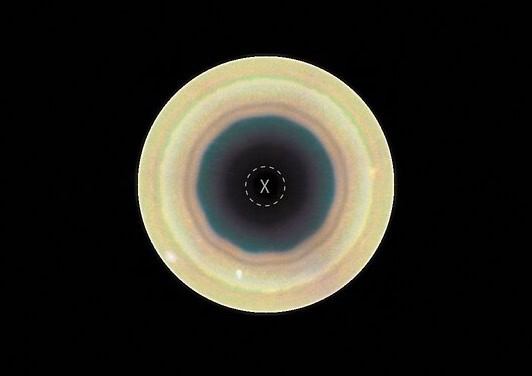
Now, Agustín Sánchez-Lavega from the University of the Basque Country in Bilbao and colleagues have spotted a growing decagon-shaped wave around the planet’s south pole.
The researchers discover the phenomenon thanks to images from NASA’s Hubble Space Telescope as well as ground-based telescopes as the planet’s south pole came back into view from Earth due to Saturn’s axial tilt.
It seems that the 10-sided wave developed between 2023 and 2025 and may still be evolving, in contrast to the 40-plus years of steadiness shown by the hexagon.
The longitudes of the decagon’s vertices oscillate over a period of 32 days, and its movements suggest it may be trapped by the curvature of an atmospheric jet.
The researchers suggest the wave could have been created by a spatially periodic disturbance in the jet peak or driven by an “anticyclonic vortex” to its north.
However, further study is required to better understand how it formed and how it compares to the hexagon structure in the north.
“The most intriguing part to me is that this seems to have just formed recently,” notes study co-author Amy Simon from NASA’s Goddard Space Flight Center in Maryland. “The question is, why did it suddenly form now when we haven’t seen one before?”