Integrating all dosimetry and positioning verification into a single device, Daily QA 4 Pro enables comprehensive machine QA in a single setup and session
For radiotherapy centres, daily quality assurance (QA) provides the final safety check before each day of patient treatments – ensuring that all linear accelerators (linacs) deliver radiation safely, accurately and as expected.
But as radiotherapy technologies evolve, the required QA procedures become increasingly complex, with verification tests often performed in isolation using multiple phantom set-ups. New treatment techniques – such as surface-guided radiotherapy (SGRT), which is more widely used now than ever – also introduce new QA requirements. And the ongoing adoption of adaptive radiotherapy, where measurement-based pre-treatment QA is not possible, increases the emphasis on machine QA, in which daily QA plays a key role.
What’s needed is a comprehensive QA approach that incorporates the dosimetry, imaging and positioning checks required for all radiotherapy modalities. Addressing this challenge, US manufacturer Sun Nuclear has launched Daily QA 4 Pro, a new device that simplifies daily machine QA by combining dosimetry and positioning verification via imaging into a single indexed, imageable platform.
“The main motivation for launching the Daily QA 4 Pro was to create a product that not only met the current needs of clinicians, but also future needs, based on our vision of the radiotherapy QA field,” explains Rajiv Lotey, technical product manager for the Daily QA 4 Pro.
The next-generation platform builds on the company’s Daily QA 3 beam quality analysis product, which was introduced more than a decade ago and is now standard in many radiotherapy departments. “The biggest difference between the Daily QA 4 Pro over the Daily QA 3 is the end-to-end QA functionality – representing the patient workflow – achieved by integrating a 3D high-resolution array, fiducials, an SGRT-compatible surface, an imageable architecture, and the ability to correlate all imaging and mechanical isocentres together onto one device,” says Lotey.
Enabling new modalities, expanding clinical applications
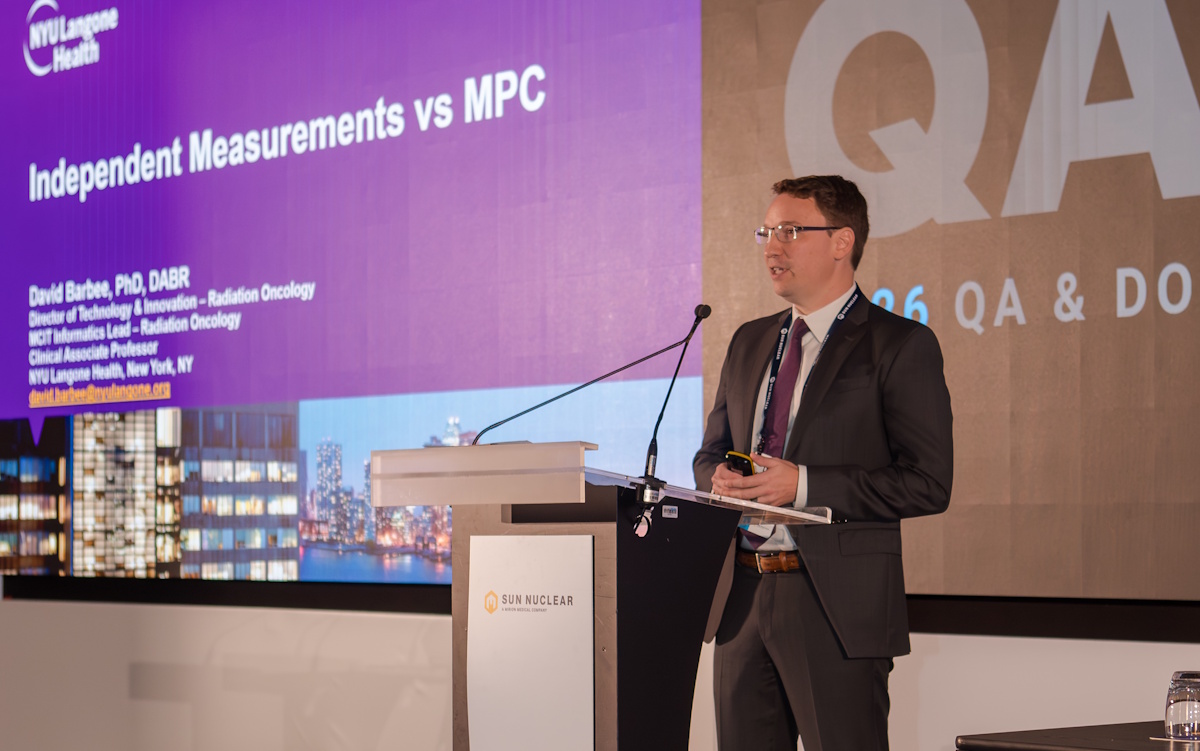
David Barbee, Director of Technology and Innovation in Radiation Oncology at NYU Langone Health, was one of the first to adopt this technology. Speaking at the recent QA & Dosimetry Symposium (QADS) hosted by Sun Nuclear, he described his early experiences of using the next-generation Daily QA 4 Pro.
“The first thing I wanted to do was evaluate surface-guided radiation therapy, because we don’t currently do this during daily QA,” Barbee explained.
To perform this test, the team defined a region-of-interest in the hospital’s VisionRT SGRT system that covered the entire surface and edges of the Daily QA 4 Pro and tested it over the full range of couch motion. The maximum translation range that it could detect was about ±4.5 cm in the lateral (side to side) and longitudinal (along the couch length) directions, and +13 to –17 cm vertically.
“For pitch and roll, we tested the 3°/3 mm limits and 90° couch rotations, and it observed them perfectly,” he added. “This is the first time we’ve ever run this test and compared our SGRT system to our image guidance system,” he noted. “This is very, very helpful.”
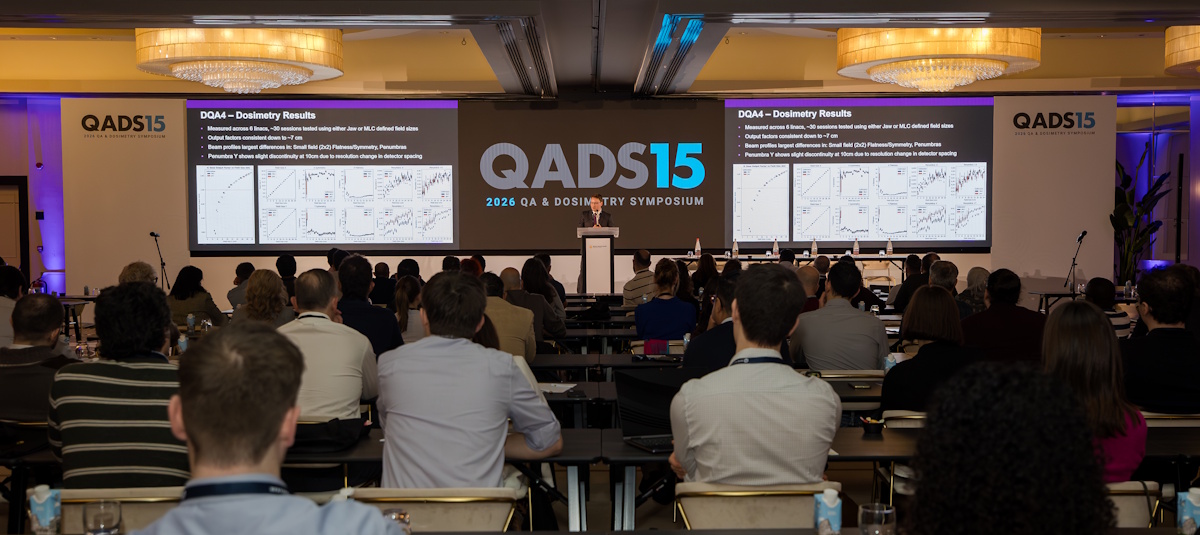
For dosimetry, Barbee noted that many parameters are carried over from the Daily QA 3 – including the output profile constancy, the field size and shift, and the flatness and symmetry – but added that the Daily QA 4 Pro can measure at a much wider range, anywhere from 2 to 20 cm square fields. “There are also new metrics, such as the penumbra, beam shape constancy for FFF [flattening filter-free] fields, the beam centre and the dose-per-pulse,” he explained. “And there’s a new dose output correction factor for when you need to move this device to a different unit.”
Barbee and colleagues performed a range of dosimetry assessments using the Daily QA 4 Pro, measuring 30 sessions on six linacs using both jaw- and multi-leaf collimator (MLC)-defined field sizes. They found that the output factors were consistent down to about 7 mm, after which the MLC gave slightly higher output factors, while the largest beam profile differences were seen in flatness and symmetry for very small fields.
Integrating Winston–Lutz
The Daily QA 4 Pro incorporates active measurement Winston-Lutz tests – a standard procedure for evaluating isocentre accuracy – using the system’s onboard 3D detector array to directly measure the radiation isocentre. The NYU Langone team used the Daily QA 4 Pro to quantitatively assess the mechanical isocentres and their response to gantry, collimator and couch motion for six linacs, again using both jaw- and MLC-defined fields.
Barbee noted that the system runs the gantry and collimator checks automatically. “You can basically hit play on SunCHECK and then you don’t touch anything again until you get to the couch, which you have to move from the console,” he explained.
To test the accuracy of the results, Barbee compared them with two years’ worth of Machine Performance Check (MPC) and traditional Winston-Lutz measurements of all of the centre’s linacs. Daily QA 4 Pro measurements agreed well with previous isocentre results across all machines tested. “It’s a little bit early to say, but it looks commensurate, there are no concerns,” he noted.
A look inside the device
The Daily QA 4 Pro measures 30 x 50 x 6 cm, weighs 6.2 kg and sits on a 4.1 kg six degrees-of-freedom base. It incorporates four ion chambers that measure field sizes down to 5 x 5 cm, as well as 249 diodes spaced at high resolution in the x– and y-directions, the diagonals and along both sides. There are also eight 3 mm tungsten carbide BBs positioned off-axis, factory-calibrated to enable micron-level corrections.
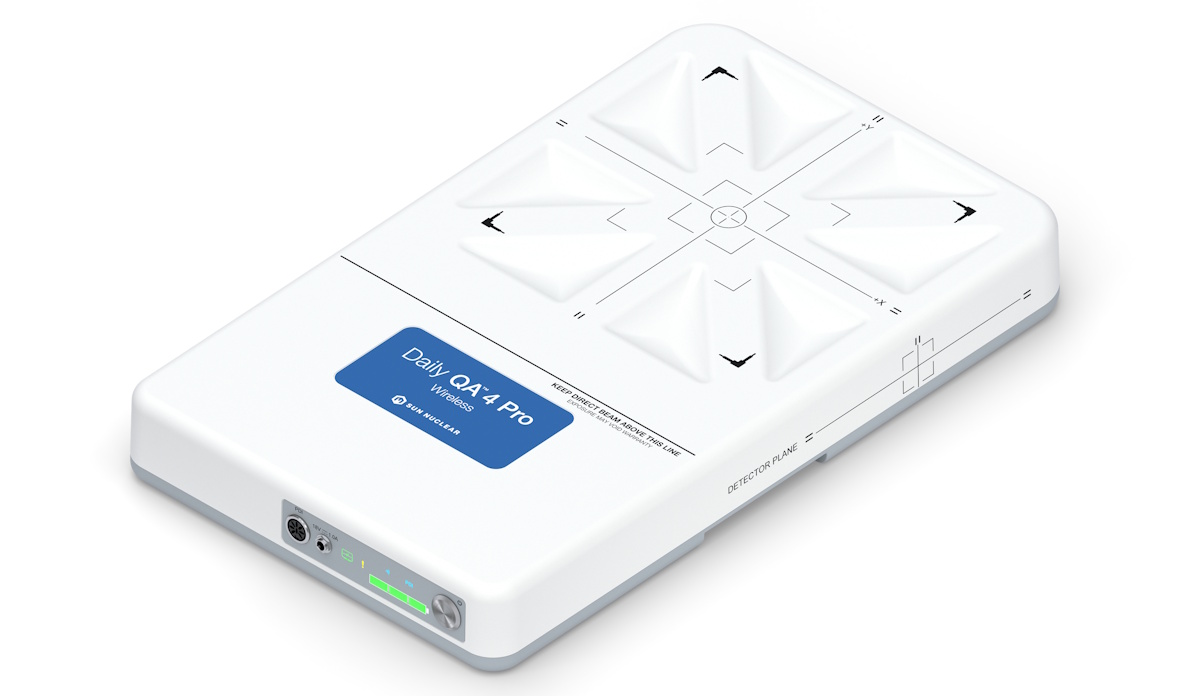
Externally, the device incorporates scribed laser alignment marks with 2 mm tolerance on its sides and surfaces, plus a crosshair for collimator alignment. There are also field size markings for 5 x 5, 10 x 10 and 20 x 20 cm fields, as well as eight symmetric reliefs designed specifically for SGRT.
The Daily QA 4 software is designed to integrate into the SunCHECK environment and can be controlled using either SunCHECK Local via a standalone laptop or (starting in version 6.0) the SunCHECK Server.
The team also ran active imaging Winston-Lutz tests, which evaluate system geometry by analysing the position of a known target in images acquired using the linac’s imaging panels. The Daily QA 4 Pro device detects the image fiducials (tungsten carbide BBs) and compares their positions to expected values for each gantry angle. These tests allow users to assess factors such as device positioning, gantry angle accuracy and overall alignment.
“This is all summarized into a report showing the maximum error in any one of those parameters across all gantry angles,” explained Barbee. “It will tell you which gantry angle was the worst and what the value there was.”
Used together, the two Winston-Lutz methods combine direct radiation measurement with imaging-based verification to provide a more complete understanding of system health and to help identify, quantify and correct any errors.
Efficiency analysis
Barbee notes that while the Daily QA 4 Pro generates a comprehensive set of dosimetry and positioning verification data, at first glance, it looks like a lot more work. An efficiency analysis, however, proved the opposite – demonstrating significant gains in workflow efficiency.
Currently, Daily QA 3 and IGRT tasks take about 16 min to perform. “Daily QA 4 Pro cuts about five minutes off that time, because you’re not going in and out of the room and doing multiple setups,” he explained. “Adding Winston-Lutz currently doubles the time to over half an hour. But with Daily QA 4 Pro, you only add five minutes. And it’s a simple setup that your therapist can run as part of their morning QA.”
“The Daily QA 4 Pro integrates image-guided radiotherapy, SGRT, beam dosimetry and Winston-Lutz verification into a single device, enabling comprehensive daily QA in a single setup and session,” Barbee concluded. “This provides an independent, interpretable alternative to vendor black-box QA systems, with comparable isocentre and imager tests, and superior beam quality constancy tests. It really can consolidate a lot of phantoms that you might not need anymore.”