The most precise calculation of the muon’s anomalous magnetic moment to date has put to rest the possibility of that property revealing new physics beyond the Standard Model – at least for now. The new result, from an international team of physicists, was obtained using a new method to calculate this anomaly that is based on lattice quantum chromodynamics (QCD).
In the Standard Model (SM) of particle physics, which is currently our best theory of the fundamental forces of nature (barring gravity), the muon is an elementary particle. It belongs to the same family (of quarks and leptons) as the electron, but is more than 200 times heavier. The muon interacts with other SM particles via two of the fundamental forces – electromagnetism and the weak force.
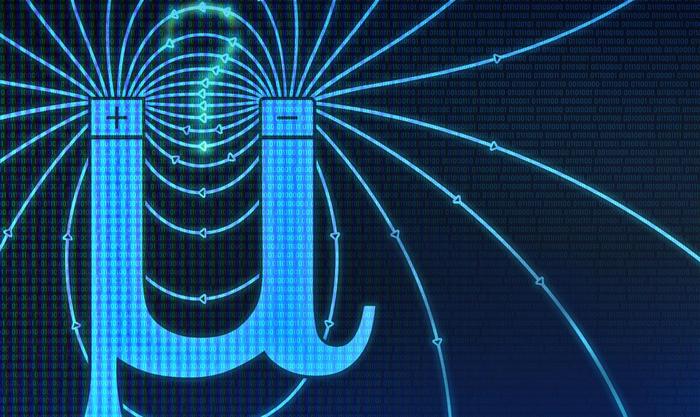
Quarks and leptons all possess a magnetic moment that comes from their intrinsic angular momentum, or spin, and quantum theory posits that this magnetic moment is related to the spin by the “g-factor”. This quantity was originally calculated to be equal to exactly two for both the electron and muon.
Experiments over the last 50 years have detected minute deviations from this number, however. This difference, of roughly 0.1 %, is known as the “anomalous g-factor”, aµ = (g – 2)/2, and it comes from so-called radiative corrections – the continuous emission and re-absorption of short-lived “virtual particles” by electrons and muons.
Measuring such discrepancies is very important for physicists because the g-factor could point to the existence of other particles – both known and as-yet undiscovered – so hinting at physics beyond the SM. They can do this thanks to the muon. Since this particle is so heavy compared to the electron, the impact of virtual particles acting on it is significantly greater. This enhanced sensitivity means that measuring the muon g−2 is better for searching for new physics than the electron g−2.
Difficult measurements and calculations
The problem is that such calculations are not easy – all the more so because the muon’s magnetic moment also receives contributions from the strong force as well as the electromagnetic and weak interactions (even though the muon does not itself partake in strong interactions). These strong contributions come from the muon interacting with the photon, which in turn interacts with quarks that then themselves interact via the gluon — the mediator of the strong-force.
The strong force (which is responsible for binding quarks into protons, neutrons and other hadrons) is notoriously difficult to integrate into theoretical calculations, however, because it is so strong.
In the new work, the researchers overcame this problem using lattice QCD of the most uncertain theoretical contribution to the muon g−2 – the “leading-order hadronic vacuum polarization” (LO-HVP), which has been traditionally determined using experimental data. Lattice QCD, they explain, is a computational technique that simulates the strong force on supercomputers by dividing space-time into a fine grid or lattice of small cells. The equations of the strong interaction are then solved on this lattice.
To reach the level of precision required to calculate the muon g−2, the researchers improved on their previous lattice calculation using finer grids and also combined it with experimental data in the very long-distance interaction region. This hybrid approach dramatically reduced errors, so allowing for the most precise value of the muon magnetic moment ever.
“Our result together with the other contributions yields a prediction that combines three interactions (the electromagnetic, weak and strong forces), each of which require vastly different theoretical tools, into a single calculation that differs from the recent experimental measurement of aμ by only 0.5 standard deviations,” says Kalman Szabo of Penn State University in the US, who is a lead researcher on the team. “This provides a notable validation of the Standard Model to 11 digits.”
The original goal in their latest work, he explains, was to have an unambiguous and ab initio pure theoretical work to calculate the magnetic moment of the muon. “When we started, there were very strong signs that there was a tension between experiment and theory in this quantity, which would mean the presence of a new interaction.”
No tension and no new interaction
“Confirming this tension would have been – with some bias from our side – the ‘fundamental discovery of the century’”, he says. “In the end, however, our study shows that there is no tension. Thus, we did not find the new interaction but proved that quantum theory holds with an unprecedented accuracy.”
The muon’s magnetic moment exposes a huge hole in the Standard Model – unless it doesn’t

The result does not mean that new physics has been ruled out, however, he adds. Future experiments and calculations will help clarify the picture, but for now, the Standard Model holds strong.
“We now have a beautiful proof of quantum field theory and this gives credibility to any further work based on this theory,” he tells Physics World. “The accuracy is astonishing, which gives hope to answer other questions related to the strong interaction with similar or even better accuracies.
“Indeed, other groups are now racing to try to validate (or refute) our result, something that can only beneficial for the advance of our field in general.”
The research is described in Nature.