A new quantum test of the weak equivalence principle performed on the China Space Station using cold atom interferometry is the most precise to date, yielding an uncertainty of 2.8 x 10⁻⁸ and a test result of around –2.7 x 10⁻⁷. Meanwhile, a separate team in Israel, Germany and the UK has measured an object’s quantum phase in freefall in the laboratory and confirmed that Einstein’s equivalence principle holds here too.
The weak equivalence principle (WEP), or the “universality of freefall”, is an important pillar of Albert Einstein’s general theory of relativity, in which mass and gravity are intimately linked to the curvature of space–time. The WEP states that, in the absence of other forces, all objects fall with the same acceleration under the influence of gravity regardless of their mass or composition. In other words, gravitational mass (the m in F = GMm/r2, where F is the gravitational attraction between two masses placed a distance r apart and G is the gravitational constant) and inertial mass (the m in F = ma, where a is the acceleration produced by the force F) are the same.
Precisely measuring this principle is crucial since any detected violation could point to new physics. It is also important for continuing to corroborate the theory of general relativity, which may be incomplete because it appears to be fundamentally incompatible with another well-tested theory: quantum mechanics. Today, tests of the WEP using macroscopic bodies have reached extraordinary precision – at the 10−13 level on Earth and 10−15 in space. These latest studies investigate the principle in the quantum realm.
Cold atomic interferometry
Conventional interferometry works by splitting a coherent beam of light and then recombining the different components at a detector. If the two components are in phase when they recombine, the interference is constructive and the two components reinforce each other. However, if the two components are out of phase, they cancel each other out, leading to a characteristic pattern of bright and dark fringes. Atomic interferometry is similar but relies on beams of atoms rather than beams of light.
Cold atom interferometry (CAI), which is atomic interferometry at ultracold temperatures of just above absolute zero, has found applications in inertial sensing and fundamental physics research. It also turns out to be a powerful technique for testing the WEP.
There is a problem with using CAI on Earth, however, because our planet’s gravity limits the interference time of the atom beams to just a few seconds. Experiments in microgravity allow this time to be extended to minutes, but because the resolution of a WEP test scales inversely with the square of the interference time, even longer interference times are needed to achieve the required precision (10−17 or more). This necessitates a permanent microgravity environment, something that is only possible in space.
Clouds of billions of 85Rb and 87Rb atoms
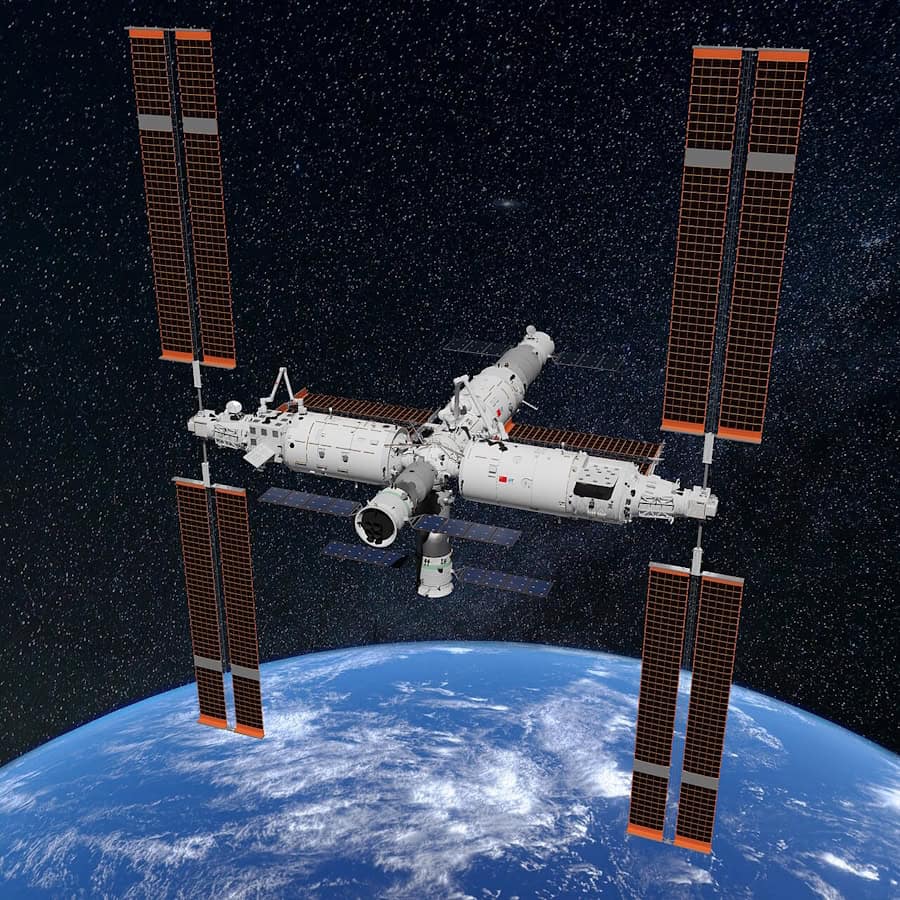
In the new work, detailed in Science Advances, a team of physicists led by Mingsheng Zhan from the Chinese Academy of Sciences, Hefei National Laboratory and Wuhan Institute of Quantum Technology sent their experiments to be performed onboard the China Space Station, using the cold atom interferometer installed on its High Microgravity Level Research Rack. This instrument contains clouds of billions of 85Rb and 87Rb atoms that interfere when probed with counterpropagating Raman lasers reflected by a piezo tilt mirror.
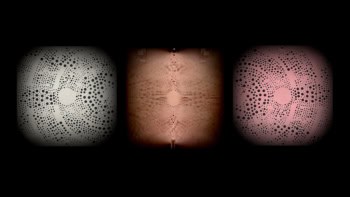
By exciting and detecting the fluorescence of the isotopes sequentially at slightly different times, the researchers obtained two sets of symmetric interference images, one from the 85Rb atoms and one from the 87Rb atoms. Measuring the differential phase of these images – after suppressing the residual acceleration of the space station and effects from vibrations – allowed them to calculate the difference in the acceleration between the two isotopes in the vertical, freefalling direction.
After running their experiment for 280 days, during which time the researchers acquired more than 9700 pairs of interference fringes, they obtained a test result of around –2.7 x 10⁻⁷, after correcting for errors.
“We believe that our technique will have a significant impact,” says Zhan. “First, it demonstrates that an integrated interferometer meeting the requirements of in-orbit operation is possible, giving the community confidence to continue with even more technically demanding space-based interferometry experiments that aim for ever increasing precision. The technology developed in this project will also itself help advance atom-interferometry-based instruments, such asinertial navigation systems.”
Measuring an object’s quantum phase in freefall
Meanwhile, physicists at the Ben-Gurion University of the Negev, the University of Ulm and the University of Oxford have also used CAI, this time to measure an object’s quantum phase in freefall. They confirm that the effect is the same as predicted by Einstein’s equivalence principle (EP), which states that for an observer in freefall, gravity should locally disappear.
In their work, also detailed in Science Advances, the researchers used a completely novel version of the CAI technique that they call the Quantum Galileo Interferometer (QGI) – in honour of Galileo Galilei’s discoveries regarding the laws of freefall. The experiment, which was carried out at Ben-Gurion University, again makes use of clouds of 87Rb atoms cooled to just above absolute zero.
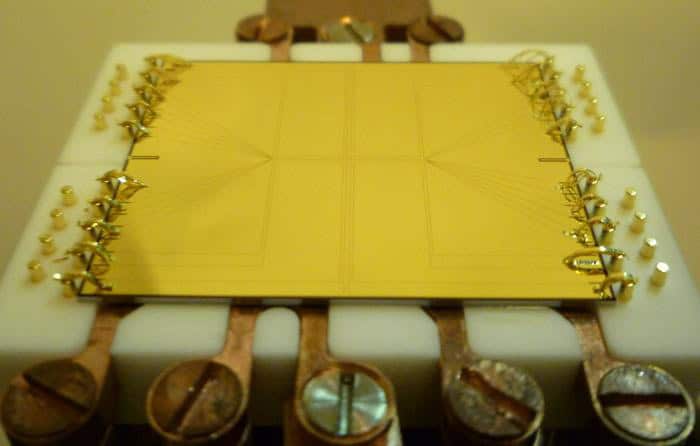
The researchers began by applying microwave pulses to put the ultracold atoms – which were placed 113 µm below the surface of an atom chip containing current-carrying wires that produce magnetic field gradients – into a quantum superposition. This meant that each atom effectively travels along two different paths at once. One part of the atomic wave responded to the magnetic fields such that an applied upward force exactly counteracted the downward pull of gravity and the wave was held stationary in the apparatus – that is, static relative to Earth. This part of the wave is referred to as the reference atomic wave (or wavepacket). The second part of the wave was sent upwards in a ballistic trajectory.
A magnetic cannon and parachute
Realising this ballistic trajectory, affected only by gravity, required a “magnetic cannon” and a “magnetic parachute”, explains Ron Folman, who is one of the leaders of this study. “After the short-duration magnetic cannon, we switched this part of the wave into a state that is almost unaffected by the magnetic field so that it could fall freely under gravity. And at the end of the fall, we used another precisely controlled magnetic pulse to stop the relative motion between the two waves and reunite the two parts so that they interfered with each other.”
That interference allowed the researchers to measure the tiny difference in quantum phase accumulated while one was falling and the other was held still — two frames that may be referred to as the Einsteinian and the Newtonian frames, respectively. This means that when both parts of the wave have the same velocity, the transformation between the wavefunction in a Newtonian (laboratory) frame of reference and the wavefunction of the same object in an Einsteinian frame that freefalls with the same acceleration, involves a transformation phase known as a gauge phase.
Space-borne atoms herald new tests of Einstein’s equivalence principle

According to their experiments, the gauge phase measured by the researchers is the same as the one predicted when Einstein’s EP is applied to such a quantum wave, so confirming the principle for these quantum objects and at these low masses and energies.
“Some members of our team,” notes Folman, “including Nobel laureate Sir Roger Penrose, expect this co-existence between general relativity and quantum mechanics to break for objects with higher masses. Indeed, the Ben-Gurion University group is now repeating the same experiment with nanodiamond particles to test this hypothesis,” he tells Physics World.
The observation, says study co-leader Vlatko Vedral at Oxford University’s department of physics, constitutes a fundamental test of the interface between quantum theory and gravity. “The connection between these two pillars of modern physics remains one of the most important open questions in physics, and it is thus of paramount importance to understand the phenomenon of freefall and the EP in the quantum domain.”