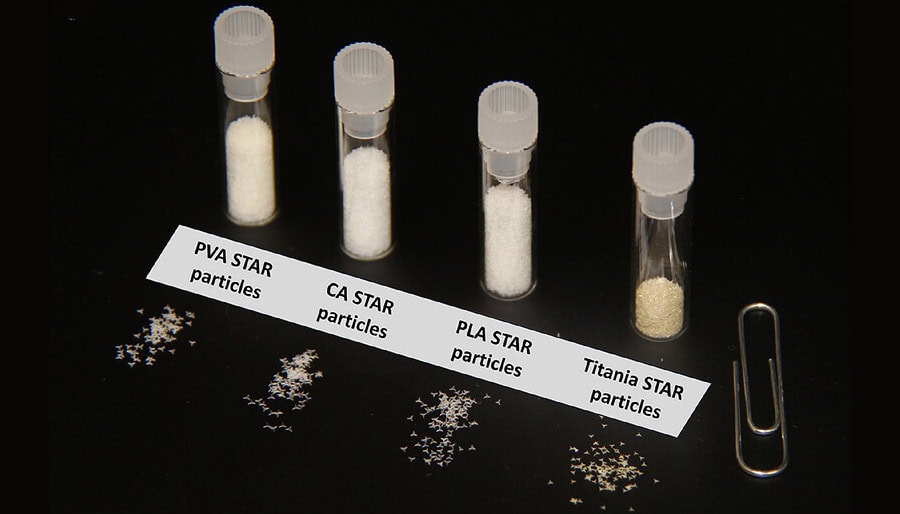
Delivering drugs directly to the skin provides a targeted means of treating dermatological conditions while minimizing side effects. The approach is limited, however, by the stratum corneum – the skin’s outer layer – which acts as a barrier that can restrict the effectiveness of most topically applied drugs. To overcome this, a team at Georgia Tech has developed biodegradable “STAR particles” that use microscopic needles to painlessly puncture the skin and increase its absorption of medication.
“Very few drugs can be absorbed effectively into the skin, which means that many drugs in dermatology are given by mouth or injection,” explains team leader Mark Prausnitz. “This exposes the whole body to the drug, often causing side effects and reducing drug efficacy. STAR particles painlessly make micropores in the skin that allow drug that is rubbed on the skin to be absorbed. This targets drug delivery exactly to the site where it is needed.”
Previously, the researchers fabricated the STAR particles from a ceramic material (titania), which is safe to use on the skin, but not biodegradable, raising possible environmental concerns. In their latest work, reported in Advanced Healthcare Materials, they designed polymer STAR particles that dissolve or biodegrade after use, reducing their potential environmental impact.
STARs effectively create micropores
Prausnitz and colleagues created STAR particles from three polymers: water-soluble poly(vinyl alcohol) (PVA), enzyme-degradable cellulose acetate (CA) and hydrolysable polylactic acid (PLA). All three materials have previously been used to create microneedle patches, which enhance drug delivery but can generally only be used on small areas of skin.
“For dermatological conditions like eczema and psoriasis, patients need to treat skin with variable and sometimes large areas,” says Prausnitz. “STAR particles provide the power of a microneedle patch to increase skin permeability with the flexibility to apply them over large and variable areas by simply rubbing a gel or cream containing STAR particles on the skin.”
The researchers fabricated the polymer STAR particles using femtosecond laser micromachining to create star-shaped structures with sharp, well-defined microneedle tips and a tapered profile. They tested the ability of the various particles to puncture pig skin samples.
While PVA STAR particles cannot be applied using water-based vehicles, when suspended in non-aqueous formulations such as isopropyl palmitate (a non-toxic ingredient widely used in dermatology), they successfully punctured the skin. The STAR particles remained intact after use and the formulations worked equally well after storage for one week.
Similarly, CA and PLA STAR particles in water formulations demonstrated consistent skin-puncturing ability, even after a week’s storage, with no visible damage to the particles after application. The researchers note that titania STAR particles in water (examined as a control) generated more pores than the polymer particles, due to their higher hardness.
Drug delivery demonstration
The team next investigated how the STAR particles could enhance the delivery of three drugs – tacrolimus, methotrexate and copper tripeptide-1 – into pig skin samples.
Tacrolimus is used to treat inflammatory skin conditions and is soluble in non-aqueous solvents. After topical drug delivery, rubbing the skin with PVA STAR particles in isopropyl palmitate for 10 s or 30 s increased drug levels within the skin 1.7- or 3.2-fold, respectively, compared with control samples.
For CA STAR particles, the researchers examined methotrexate, which is commonly used for psoriasis treatment but cannot be delivered topically due to its very low skin permeability. Treatment with CA STAR particles for 10 or 30 s increased intradermal delivery of methotrexate 5.4- or 25.2-fold, respectively.
Finally, they used PLA STAR particles to deliver copper tripeptide-1, a skincare ingredient employed for anti-aging, wound healing and skin regeneration applications. The particles enhanced intradermal drug delivery 12.1- or 37-fold, after 10 or 30 s application, respectively.
Safety considerations
As the STAR particles are designed to create micropores in skin, it’s possible that they could unintentionally end up in other parts of the body, where the microneedles could cause damage. While this risk is likely small (as the STAR particles require forceful application to be effective), the water-soluble PVA STAR particles eliminate any potential risk as they rapidly dissolve upon contact with wet tissues.
The CA and PLA STAR particles will likely retain their structure immediately after use, but will eventually become blunt and weak upon enzymatic degradation or hydrolysis. Likewise, any potential environmental consequences of non-degradable STAR particles are reduced or eliminated with the water-soluble and biodegradable materials.
Living bioelectronics capture physiological signals and deliver targeted therapy

The team concludes that the biodegradable STAR particles address environmental and safety concerns while enhancing drug delivery to the skin. The approach paves the way for improved patient outcomes and broader applications, enabling delivery of hydrophilic drugs and larger molecules that are usually blocked by the stratum corneum barrier. Prausnitz tells Physics World that the research is primarily targeted at treatment of dermatological diseases that can spread over large areas of skin – such as psoriasis, eczema, vitiligo and allergic rashes – as well as cosmetic applications.
“We have licensed the STAR particle technology to a company that is preparing for a clinical trial next year using STAR particles to deliver siRNA as a novel eczema treatment,” he says. “At Georgia Tech, we are focused on advanced materials, manufacturing and formulations for the next generation of STAR particles.”